12 Best Sight Word Games for Kindergarten: Apps, Cards and Classroom Picks

 Discover a Free Education Video App for Kids
Pastory uses AI to personalize educational video content based on your child’s interests and personality. Safe, engaging, and built for curious young minds. Sign up now to stay updated and enjoy early access with a free trial
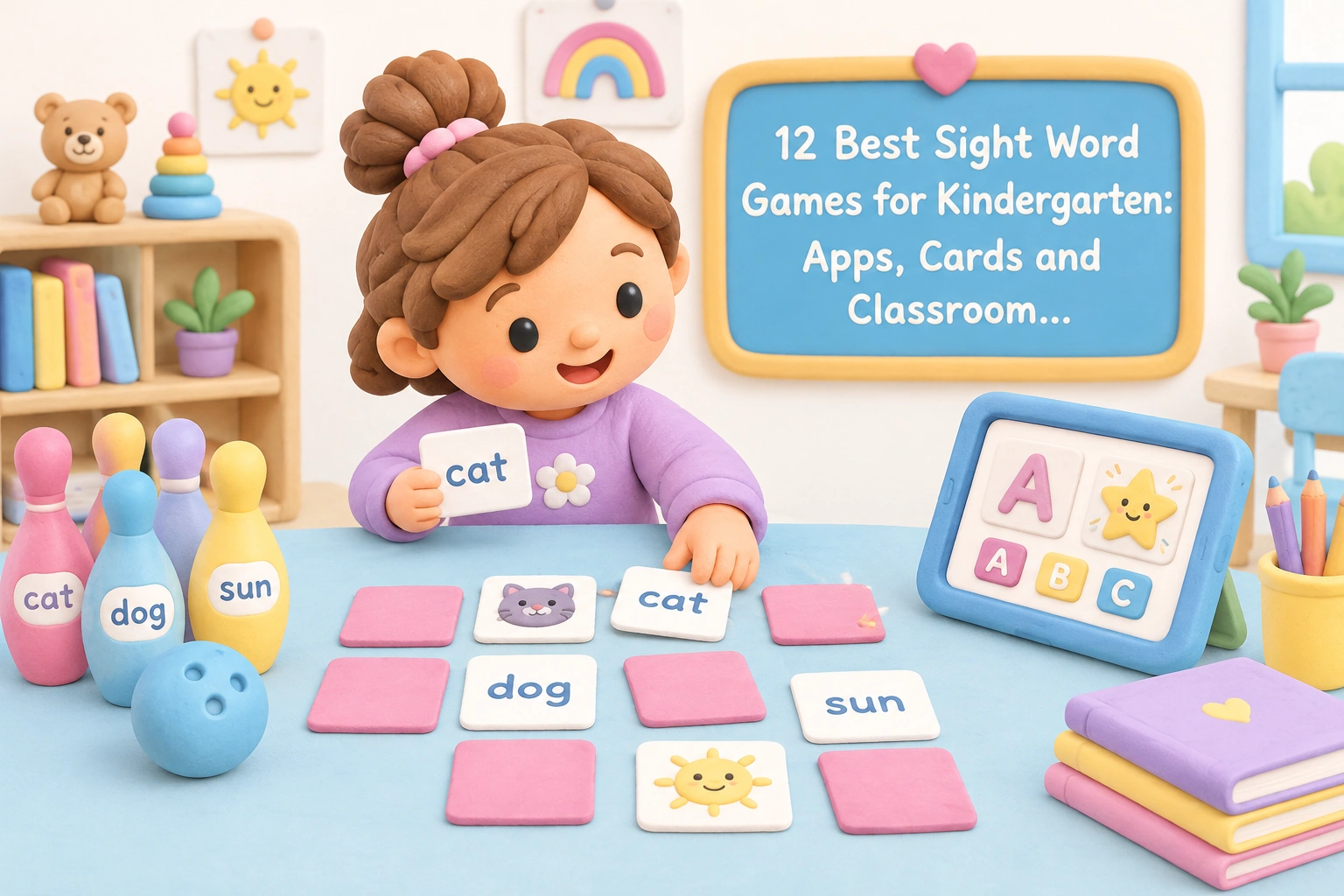
Learning to read depends heavily on a child’s ability to recognize high-frequency words instantly, without sounding them out letter by letter. Sight word games for kindergarten make that practice feel like play rather than drill, which matters enormously for five- and six-year-olds whose attention spans are short and whose motivation is closely tied to enjoyment. This guide covers 12 of the best options across three categories — apps, card games, and classroom or home activities — along with practical guidance on choosing the right format for your child and what the research actually says about how these games support early literacy.
Key Takeaways
- Sight word games work best when they complement systematic phonics instruction rather than replace it, in line with Science of Reading principles.
- Most kindergarteners are expected to recognize between 50 and 100 high-frequency words by the end of the school year, though individual progress varies widely.
- Multi-sensory, hands-on games tend to support stronger retention than flashcard drilling alone, because they engage more cognitive pathways during learning.
- Apps can provide useful independent practice, but caregiver involvement and screen time limits remain important considerations for this age group.
- Choosing between the Dolch word list and the Fry word list matters less than consistent, enjoyable practice — both lists cover the most common words in early reading texts.
Why Sight Words Matter for Kindergarten Reading
Sight words — also called high-frequency words — are the words that appear most often in printed text. Words like the, said, was, and they make up a large proportion of the words children encounter in early readers, yet many of them cannot be decoded reliably using standard phonics rules. Automatic word recognition of these words frees up a child’s working memory so they can focus on meaning and comprehension rather than decoding every syllable. Research in cognitive reading science describes this process as orthographic mapping — the brain stores a word’s spelling, pronunciation, and meaning as a single connected unit, allowing instant retrieval.
It is worth noting that the Science of Reading movement has prompted useful debate about how sight words should be taught. Rather than asking children to memorize words as whole visual shapes, many literacy specialists now recommend briefly analyzing the phonics patterns within each word — even irregular ones — before practicing recognition. Words that are truly irregular (sometimes called heart words) benefit from this approach because children understand which part of the word is unusual. Games that involve saying, spelling, and writing a word together tend to support this kind of deeper processing better than pure visual repetition.
Dolch vs. Fry: Which Word List Should You Use?
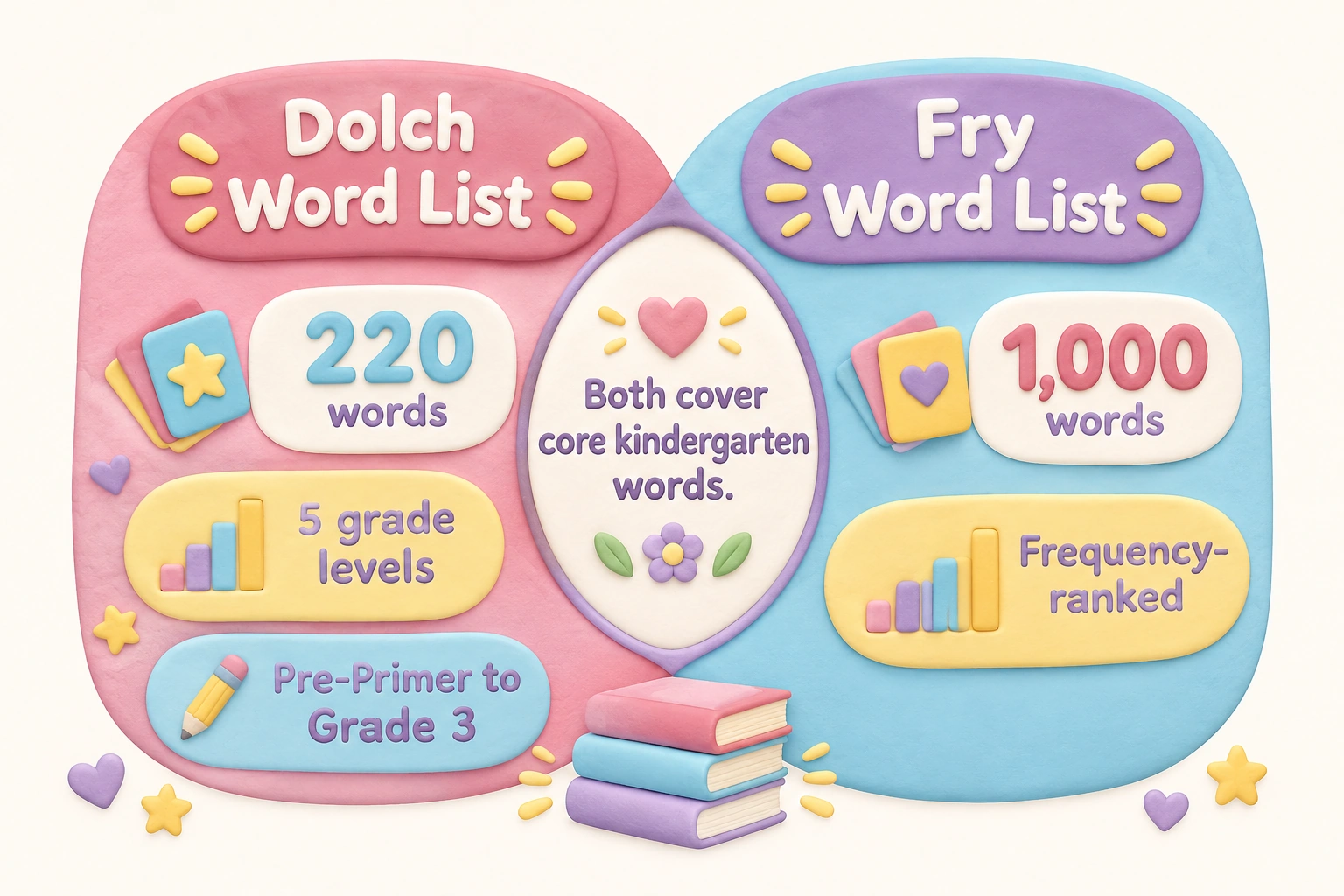
The two most widely used word lists in early literacy are the Dolch word list and the Fry word list. The Dolch list contains 220 service words organized into five grade levels — pre-primer, primer, Grade 1, Grade 2, and Grade 3 — plus a separate noun list. The Fry word list ranks 1,000 words by frequency of appearance in printed text, making it easy to prioritize the most commonly encountered words first. For kindergarten specifically, the Dolch pre-primer (40 words) and primer (52 words) levels are the most relevant starting points.
In practice, both lists overlap significantly at the kindergarten level, and most commercially available games and apps cover one or both. If your child’s school uses a specific list, matching your home practice to that list is more useful than debating which list is theoretically superior. What matters most is that the words your child is practicing appear regularly in the books they are actually reading.
Best Sight Word Apps for Kindergarten
Apps can provide engaging, low-prep independent practice that adapts to a child’s pace. The table below summarizes key features of widely used kindergarten sight word apps to help parents and teachers compare options quickly.
| App | Free or Paid | Platform | Word List | Number of Games | Progress Tracking | Best For |
|---|---|---|---|---|---|---|
| Sight Words by 22learn | Free (in-app purchases) | iOS, Android | Dolch | 8+ | Yes | Independent home practice |
| SpellingJoy | Free | iOS, Android | Dolch + Fry | Multiple | Yes | Progress-focused home use |
| Khan Academy Kids | Free | iOS, Android | Common Core aligned | Integrated curriculum | Yes | All-round early literacy |
| Starfall | Free (basic) / Paid | Browser, iOS, Android | Phonics + sight words | Many | Limited | Phonics + sight word combo |
| Teach Your Monster to Read | Paid (low cost) | iOS, Android, PC | UK phonics aligned | Gamified levels | Yes | Gamification-motivated learners |
| Reading Eggs | Paid (subscription) | iOS, Android, Browser | Dolch + Fry | Many | Yes | Structured curriculum at home |
| Room Recess (browser) | Free | Browser | Dolch | 2+ (Sight Word Safari, Smash) | No | Quick classroom warm-ups |
When evaluating any kindergarten sight words app, look for built-in progress tracking so you can see which words a child has mastered and which still need practice. Apps that include multiple game formats within a single word list tend to maintain engagement better than those with a single repetitive mechanic. Also consider whether the app is ad-free, especially for independent use by five- and six-year-olds. The American Academy of Pediatrics recommends that screen time for children aged five and older be purposeful and supervised where possible, so co-playing an app alongside your child — at least initially — can improve both learning outcomes and screen time quality.
App Pick 1: Sight Words by 22learn
This app covers the full Dolch list across eight different game formats, including matching, spelling, and sentence-building activities. The variety of game types within a single app helps prevent the repetition fatigue that can occur when a child practices the same words through the same mechanic every day. Built-in progress tracking allows parents and teachers to monitor mastery by Dolch level, which is useful for aligning home practice with classroom instruction.
App Pick 2: SpellingJoy
SpellingJoy is a free app covering both the Dolch and Fry word lists with clear progress tracking and no advertisements. Its straightforward interface suits early readers who are easily distracted by complex menus or animated rewards. Because it covers both major word lists, it works well whether a child’s school follows Dolch or Fry sequencing.
App Pick 3: Khan Academy Kids
Khan Academy Kids is a free, comprehensive early learning app that integrates sight word practice within a broader literacy and numeracy curriculum. Rather than isolating sight words as a separate drill, the app embeds word recognition into stories, games, and activities — an approach that may support more natural reading development. Its adaptive design adjusts difficulty based on a child’s responses, making it suitable for a range of ability levels within the kindergarten age group.
Best Sight Word Card Games for Kindergarten
Physical card games offer a screen-free alternative that also develops turn-taking, fine motor skills, and social interaction alongside word recognition. They are particularly well suited to family game time, small group instruction, and literacy centers where a teacher needs low-prep, reusable materials.
Card Game Pick 4: Sight Word BINGO
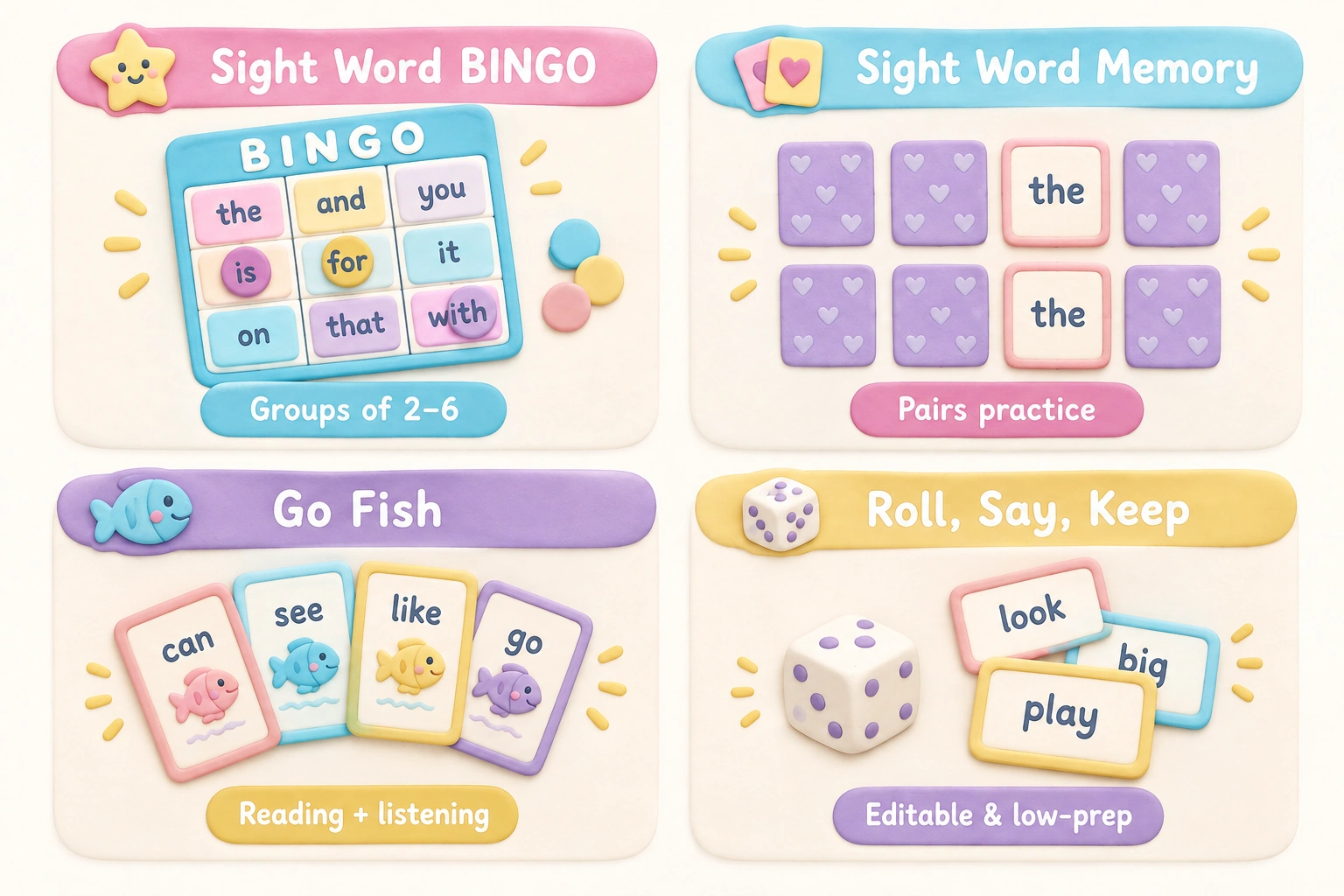
Sight Word BINGO is one of the most versatile and widely used card games for kindergarten literacy practice. Players mark words on their cards as a caller reads them aloud, which means every child hears each word spoken clearly before locating it visually. Printable versions are freely available online and can be customized to match the specific Dolch pre-primer or primer words a class is currently learning. Commercial versions with durable laminated cards are also available for classrooms that need a ready-made set. BINGO works well for groups of two to six players and requires minimal teacher facilitation once children understand the rules.
Card Game Pick 5: Sight Word Memory (Concentration)
In Sight Word Memory, pairs of matching word cards are placed face down and players take turns flipping two cards at a time, reading each word aloud before checking for a match. The game reinforces word recognition through repeated exposure in a low-pressure context, and the memory challenge adds an engaging cognitive layer beyond simple reading. Sets can be purchased pre-made or created inexpensively using index cards, making this one of the most accessible options for home use. For struggling readers, starting with a smaller set of eight to ten pairs reduces frustration while still providing meaningful practice.
Card Game Pick 6: Roll, Say, Keep
Roll, Say, Keep is a simple editable card game format that has become popular in kindergarten classrooms because it requires almost no preparation and can be adapted to any word list. A child rolls a die, reads the corresponding number of sight word cards aloud, and keeps the cards they read correctly. The competitive element — collecting the most cards — motivates repeated reading without the pressure of a timed test. Because the game format is editable, teachers can swap in the exact words their class is currently working on, making it a flexible tool for differentiated small group instruction.
Card Game Pick 7: Sight Word Go Fish
Adapting the classic Go Fish card game to sight words is straightforward and requires only a set of word cards with duplicate pairs. Players ask each other for specific words by reading them aloud — “Do you have where?” — which means every turn involves both reading and listening practice. This social element makes Go Fish particularly useful for developing oral language alongside word recognition, and the familiar game structure reduces the learning curve for children who already know how to play the original version.
Best Classroom and Home Sight Word Games
Hands-on, movement-based games are especially effective for kindergarteners because they combine physical activity with cognitive engagement. Multi-sensory learning — using sight, sound, touch, and movement together — may support stronger memory formation than visual-only practice, according to general principles of cognitive learning theory. The following games require minimal materials and can be adapted for home or classroom use.
Classroom Pick 8: Fly Swatter Sight Word Game
In this whole-class or small group game, sight words are written on cards or a whiteboard and two children compete to swat the correct word first when the teacher calls it out. The physical action of swatting adds a kinesthetic dimension that many kindergarteners find highly motivating. The fly swatter game works well as a warm-up activity at the start of a literacy block and can be adapted for word work stations by having children take turns calling words for each other. It is a genuinely low-prep option — the only materials needed are two fly swatters and a set of word cards.
Classroom Pick 9: Sight Word Hopscotch
Writing sight words inside hopscotch squares — either on paper indoors or with chalk outdoors — turns gross motor play into reading practice. Children must read each word aloud as they land on it, combining physical movement with word recognition in a way that is naturally engaging for active learners. Sight Word Hopscotch is particularly effective for children who struggle to sit still during traditional literacy activities, and it can be set up in minutes using chalk or masking tape.
Classroom Pick 10: Sight Word Sensory Bin
A sensory bin filled with sand, rice, or kinetic sand and buried sight word cards or letter tiles offers a tactile, exploratory approach to word work. Children dig out cards, read the words, and then trace or write them in the sensory material. This multi-sensory format engages touch and movement alongside visual recognition, which may support orthographic mapping by creating multiple memory pathways for each word. Sensory bins work well as independent word work stations during literacy center rotations, requiring minimal teacher supervision once children understand the routine.
Classroom Pick 11: Sight Word Bowling
Sight Word Bowling uses plastic bottles or cardboard tubes labeled with sight words as pins. A child rolls a ball, then reads aloud every word on the pins they knock down. The game combines physical play with reading practice and works well in small group instruction settings or as a literacy center activity. It is easy to differentiate by assigning different word sets to different groups — pre-primer words for children who are just beginning and primer words for those who are ready for a greater challenge.
Classroom Pick 12: Playdough Sight Words
Building sight words with playdough — rolling letter shapes and assembling them into words — is a hands-on practice format that engages fine motor skills alongside letter recognition and spelling. The tactile nature of playdough makes it particularly appealing to children who are not yet motivated by paper-based activities. Playdough Sight Words can be used as an independent word work station or as a paired activity, and it aligns well with the Science of Reading recommendation to analyze the letter-sound structure of words rather than memorizing them as whole visual units.
How to Choose the Right Sight Word Game for Your Child
The most effective sight word game for any individual child depends on several factors beyond the word list it covers. Consider the following when making a choice.
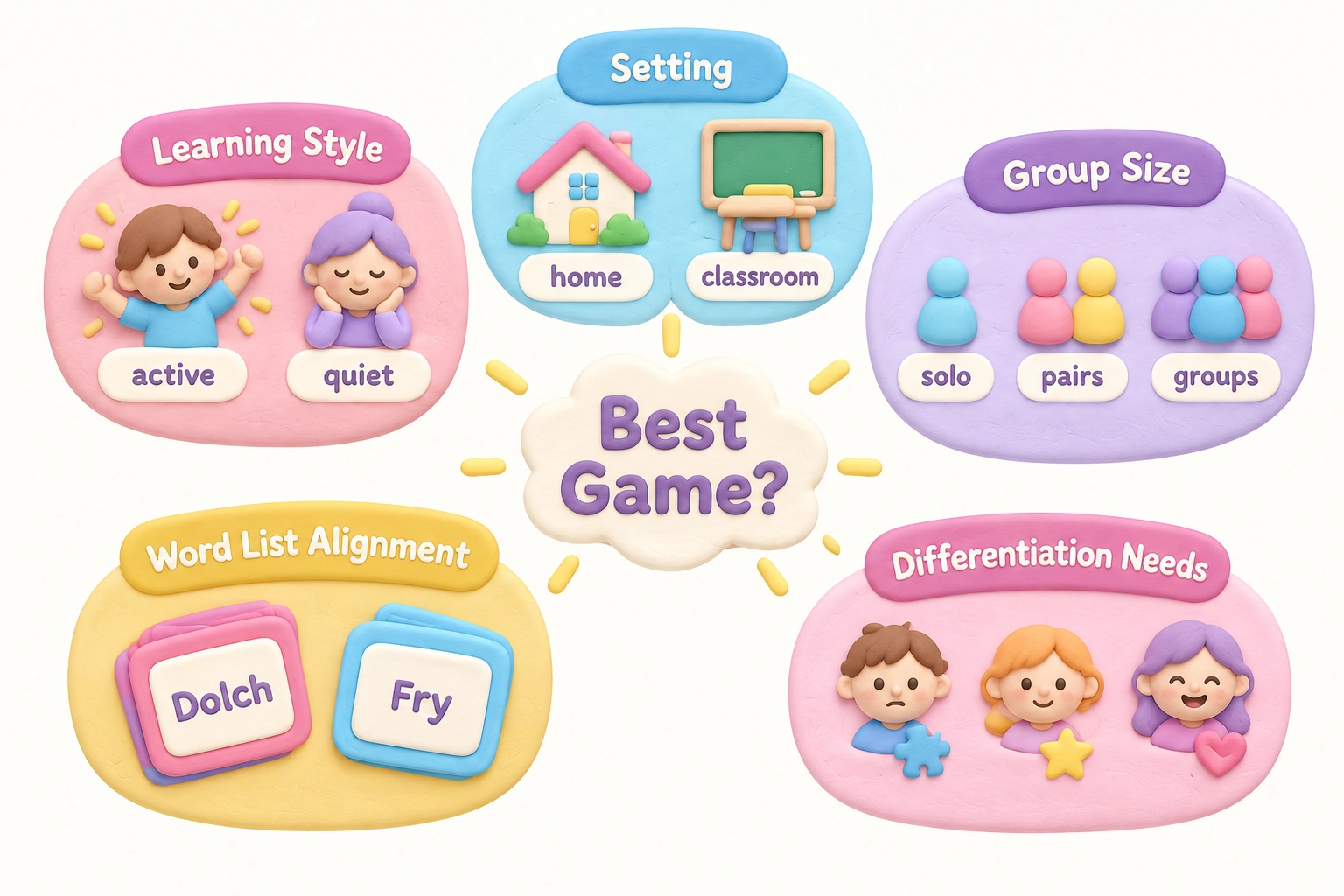
- Learning style and temperament: Active, movement-oriented children often engage better with physical games like hopscotch or bowling. Children who prefer quiet, focused activities may respond better to memory card games or app-based practice.
- Setting: Some games — like fly swatter or bowling — need space and are better suited to classrooms. Others, like Go Fish or a sight word app, work well at a kitchen table.
- Group size: BINGO and fly swatter work well for larger groups. Memory and Go Fish are better for two to four players. Apps are designed for individual use.
- Word list alignment: Check whether the game uses the Dolch word list, the Fry word list, or a custom list, and match it to what your child’s school is teaching.
- Differentiation needs: For children who are struggling, choose games with smaller word sets and clear visual support. For advanced kindergarteners, editable sight word games allow you to introduce primer or Grade 1 words ahead of schedule. For ELL students, games that pair words with pictures or spoken audio provide additional context.
- Prep time: Teachers managing literacy centers benefit from genuinely low-prep formats. Roll, Say, Keep and sensory bins can be set up in under five minutes once the initial materials are prepared.
Adapting Games for Struggling Readers and ELL Students
Children who are finding sight word acquisition difficult may benefit from a slower pace, smaller word sets, and more explicit phonics instruction alongside game-based practice. Rather than introducing all 40 Dolch pre-primer words at once, starting with five to eight words and achieving genuine mastery before adding more tends to produce better outcomes than rushing through a full list. Games that involve saying, clapping, and writing a word — not just reading it — provide the multi-sensory reinforcement that early readers often need.
For ELL and ESL students, sight word games that include picture support or spoken audio are particularly helpful because they connect the printed word to meaning, not just to pronunciation. Apps like Khan Academy Kids that embed words in meaningful story contexts may be more effective for this group than isolated flashcard-style games. Caregiver involvement — playing alongside the child and discussing word meanings — adds a language-rich layer that no app or card game can fully replicate.
Frequently Asked Questions
How many sight words should a kindergartener know by the end of the year?
Most kindergarten curricula target between 50 and 100 high-frequency words by the end of the school year, typically covering the Dolch pre-primer and primer lists. However, individual progress varies considerably depending on a child’s prior literacy exposure, phonics instruction quality, and home reading environment. If you are concerned about your child’s progress, speaking with their classroom teacher is the most reliable way to get an accurate picture.
Are sight word games a substitute for phonics instruction?
No. Sight word games work best as a complement to systematic phonics instruction, not a replacement for it. The Science of Reading emphasizes that even irregular high-frequency words benefit from some phonics analysis — understanding which letters are regular and which are unusual helps children store words more reliably in memory. Games that involve spelling and writing words alongside reading them support this approach better than pure visual recognition drills.
How much time should a kindergartener spend on sight word practice each day?
Short, frequent sessions of five to ten minutes tend to be more effective for kindergarteners than longer, less frequent practice. Daily exposure — even briefly during a car journey using flashcards or a quick app session — supports the spaced repetition that helps move words into long-term memory. Avoid sessions that feel like a test; the goal is relaxed, repeated exposure.
What is the difference between Dolch and Fry sight words?
The Dolch word list contains 220 words organized by grade level from pre-primer through Grade 3, plus a noun list. The Fry word list ranks 1,000 words by how frequently they appear in printed text. Both lists overlap significantly at the kindergarten level. The Dolch list is more commonly used in US kindergarten classrooms, while the Fry list is often preferred by teachers who want a frequency-based progression. Either list provides a solid foundation for early reading fluency.
Can sight word apps replace physical card games?
Apps and physical card games serve different purposes and work well together. Apps provide independent, self-paced practice with immediate feedback and built-in progress tracking. Physical card games develop social skills, turn-taking, and fine motor abilities alongside word recognition, and they do not contribute to daily screen time totals. A balanced approach — using apps for independent practice and card or movement games for shared family or classroom time — tends to be more engaging and developmentally well-rounded than relying on either format alone.
Are free sight word games as effective as paid ones?
Many free options — including printable BINGO cards, browser-based games like Room Recess, and apps like Khan Academy Kids and SpellingJoy — are genuinely high quality and cover the core Dolch and Fry word lists effectively. Paid products sometimes offer greater durability (laminated cards), more game variety, or more detailed progress tracking. The quality of the interaction around the game — whether a caregiver is engaged and enthusiastic — tends to matter more for learning outcomes than the price of the materials.
Choosing Sight Word Games That Will Actually Get Used
The best sight word game for kindergarten is ultimately the one that a child will return to willingly. A beautifully designed app that a child finds boring after two sessions is less valuable than a simple set of homemade BINGO cards played enthusiastically every evening. When selecting games, prioritize genuine engagement alongside word list alignment and developmental appropriateness.
For parents, a practical starting point is one app for independent practice — Khan Academy Kids or SpellingJoy are strong free choices — combined with one physical card game for shared family time, such as Sight Word Memory or Go Fish. For teachers building literacy centers, a rotation of three or four low-prep hands-on games — sensory bin, Roll, Say, Keep, fly swatter, and playdough words — provides enough variety to sustain engagement across a school week without excessive preparation time.
If your child is struggling with word recognition despite regular practice, it is worth discussing the issue with their teacher or a reading specialist. Difficulty with automatic word recognition can sometimes signal a need for more intensive phonics instruction or, in some cases, an assessment for reading difficulties such as dyslexia. Games are a valuable support tool, but they work best within a broader, well-structured early literacy program that includes systematic phonics instruction, shared reading, and plenty of opportunities to apply new words in real books.

Take a short quiz to find out what your everyday choices say about your parenting style
When your child is curious about something new, what’s your instinct?
Take a short quiz to find out what your everyday choices say about your parenting style
“Can I download this app?” What happens next?
Take a short quiz to find out what your everyday choices say about your parenting style
When it comes to rules at home, which sounds most like you?
Take a short quiz to find out what your everyday choices say about your parenting style
If you could give your child one life skill today, what would you pick?
Take a short quiz to find out what your everyday choices say about your parenting style
Your child gets to choose what to watch. What would your ideal setup look like?
Take a short quiz to find out what your everyday choices say about your parenting style
Pick your parenting superpower ✨