Best Online Phonics Games for Kindergarteners

 Discover a Free Education Video App for Kids
Pastory uses AI to personalize educational video content based on your child’s interests and personality. Safe, engaging, and built for curious young minds. Sign up now to stay updated and enjoy early access with a free trial
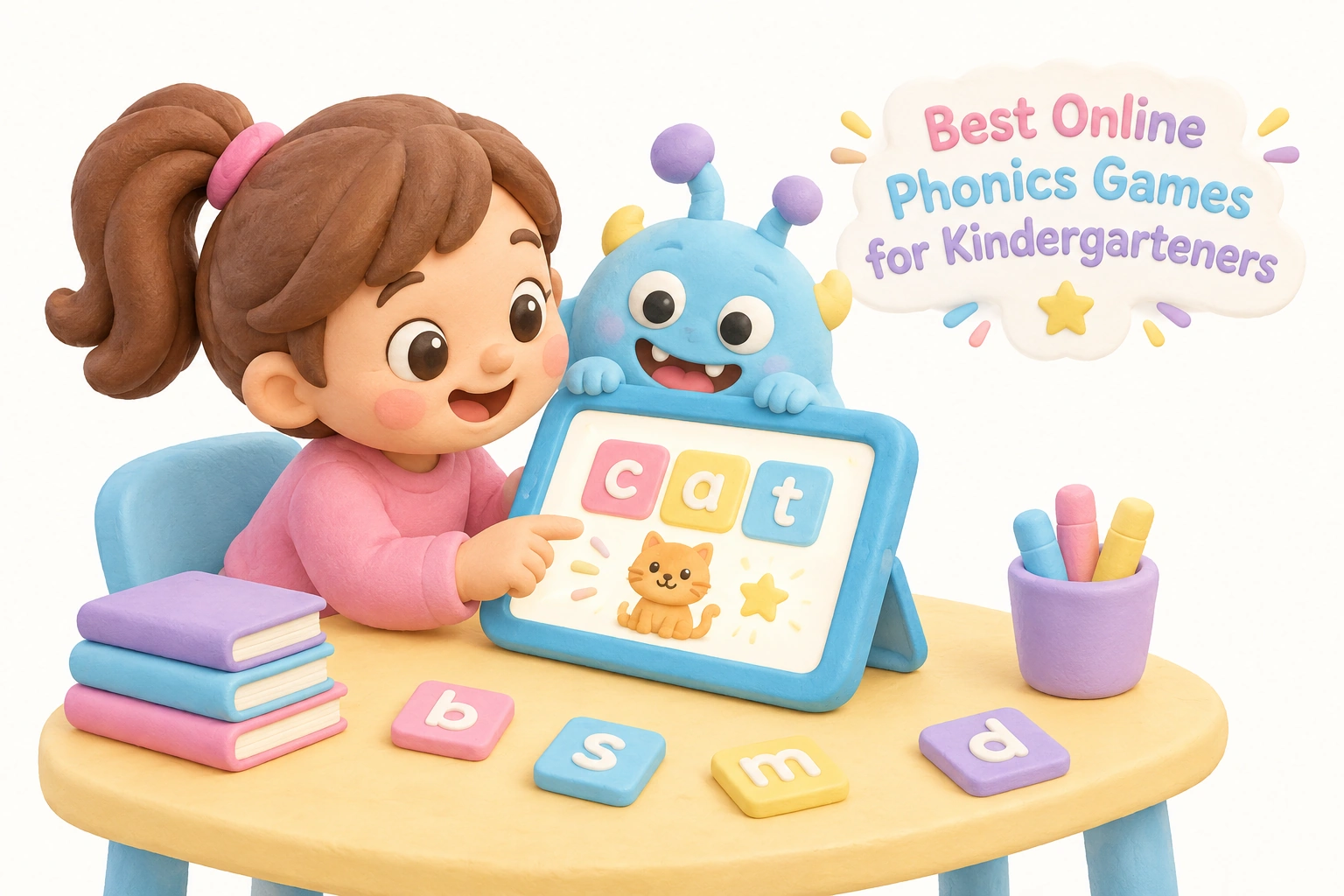
Finding the right phonics games online for a kindergartener can feel overwhelming when dozens of platforms compete for attention. This guide cuts through the noise by focusing on what actually supports early reading development: the specific phonics skills kindergarteners need, which platforms address those skills systematically, what to watch out for in games that look educational but may not be, and how to use screen time wisely so digital practice complements rather than replaces real instruction.
Key Takeaways
- The most effective kindergarten phonics games build skills in a clear sequence — from letter-sound correspondence and beginning sounds through CVC words, short vowel sounds, word families, and eventually consonant digraphs and blends.
- Free platforms such as Starfall, Teach Your Monster to Read, and Khan Academy Kids offer genuine phonics practice without a subscription, though some features are limited on free tiers.
- Science of Reading alignment matters: look for games that teach systematic phonics and decoding skills rather than relying on picture-guessing or random clicking.
- Short, focused sessions of 10–15 minutes tend to work better for kindergarteners than extended screen time, and caregiver involvement significantly improves outcomes.
- Digital phonics games work best as a supplement to structured literacy instruction, not as a standalone reading program.
What Phonics Skills Do Kindergarteners Actually Need?
Kindergarten phonics follows a developmental progression that moves from simpler to more complex skills. Understanding this sequence helps parents choose games that match where their child currently is, rather than jumping ahead or staying too long on skills already mastered.
The typical kindergarten phonics progression begins with letter recognition and letter-sound correspondence — understanding that each letter or letter combination represents a specific sound. From there, children move to identifying beginning sounds (also called initial sounds) in spoken words, then to recognizing ending sounds and middle vowel sounds. Once those foundations are in place, kindergarteners begin reading and spelling simple CVC words (consonant-vowel-consonant words like cat, hop, and big), which requires blending sounds together — a core decoding skill.
Later in the kindergarten year, many children begin working with word families (groups like -at, -an, -ip, -og), short vowel sounds across all five vowels, and introductory consonant digraphs such as sh, ch, th, and wh. Phonemic awareness — the ability to hear, identify, and manipulate individual sounds in spoken words — underpins all of this and is distinct from phonics itself, which involves connecting those sounds to written letters.
A game that only drills letter names without connecting them to sounds, or one that asks children to match pictures without reading any text, is practicing a different skill set. When choosing interactive phonics games, look for activities that explicitly link letters to sounds and require the child to decode written words, not just recognize images.
What the Science of Reading Means for Game Selection
The Science of Reading is a body of research — drawn from cognitive science, linguistics, and educational psychology — that identifies how children most reliably learn to read. Its central finding is that most children need explicit, systematic phonics instruction that teaches letter-sound relationships in a deliberate sequence, rather than learning to read through memorization, context guessing, or whole-language exposure alone. This approach is sometimes called structured literacy.
For parents choosing phonics games online, Science of Reading alignment means looking for platforms that teach phonics skills in a logical order, provide clear audio models of sounds, require children to decode words rather than guess from pictures, and build from simpler to more complex patterns. A game that rewards a child for clicking on a picture of a cat when they hear the word “cat” is not the same as one that asks them to blend the sounds /k/ /æ/ /t/ to read the written word. The second activity builds genuine decoding skills; the first may build vocabulary but does not teach phonics.
Not every free online game is Science of Reading aligned, and some popular platforms mix systematic phonics activities with less structured games. This does not make them useless, but it does mean parents should look at individual game types within a platform rather than assuming the whole platform is equally effective.
Best Free Online Phonics Games for Kindergarteners
Several high-quality platforms offer genuinely useful free phonics practice for kindergarteners without requiring a subscription or even a sign-up account.
Starfall
Starfall is one of the most established browser-based phonics platforms available. Its free tier covers foundational phonics including letter sounds, CVC words, and short vowel reading through animated, interactive stories and activities. The platform follows a systematic phonics sequence and provides audio support throughout, making it accessible for early readers who cannot yet read instructions independently. A paid subscription (approximately $35 per year) unlocks additional content including math and more advanced reading activities, but the free phonics content alone is substantial for kindergarten use.
Teach Your Monster to Read
Developed by the Usborne Foundation and a BAFTA-winning game, Teach Your Monster to Read is free to use on desktop browsers and covers phonics skills from letter sounds through blending and early sentence reading. The game-based format — in which children build and guide a monster character — provides strong motivation for kindergarteners. It is worth noting that the free version is available on desktop only; the mobile app version requires a one-time purchase. The platform aligns well with systematic phonics principles and covers the phonemic awareness and decoding skills typical of the kindergarten year.
Khan Academy Kids
Khan Academy Kids is a free, ad-free app and browser platform covering early literacy alongside math and social-emotional learning. Its phonics content includes letter sounds, beginning sounds, and early blending activities. While it is not exclusively a phonics platform, the literacy section is well-structured and appropriate for kindergarteners. The platform does not require a sign-up for basic use and is considered safe for young children.
KizPhonics
KizPhonics is specifically designed with Science of Reading principles in mind and offers leveled phonics games organized by skill stage, including Pre-K, Kindergarten Level 1, and Kindergarten Level 2. Games cover beginning sounds, CVC words, short vowel sounds, and word families. The platform is browser-based and largely free, making it a practical choice for parents who want skill-sequenced practice without a subscription.
SplashLearn
SplashLearn offers a free-to-start model with phonics games covering vowel sounds, blending, and consonant digraphs. The platform includes adaptive difficulty features and progress tracking, which can help parents understand which skills their child is consolidating. Some advanced content requires a paid subscription, but the free tier provides meaningful kindergarten-level phonics practice.
Paid Platforms Worth Considering
Several subscription platforms offer more comprehensive phonics curricula with features such as adaptive difficulty, detailed progress reports, and broader skill coverage. Whether the cost is justified depends on how much structured phonics practice a child needs beyond what free resources provide.
Reading Eggs and Fast Phonics
Reading Eggs is a comprehensive literacy platform covering ages 2–13, with a phonics-focused component called Fast Phonics that is explicitly aligned with systematic phonics instruction. The platform includes decodable readers, blending activities, and structured progression through short vowels, long vowels, consonant blends, and digraphs. Pricing is approximately $70–100 per year. Reading Eggs provides detailed progress tracking for parents and teachers, which makes it useful for monitoring skill development over time. A free trial is typically available.
HOMER
HOMER is a personalized early literacy platform that adapts content to a child’s current skill level and interests. It covers phonemic awareness, letter-sound correspondence, CVC words, and early reading comprehension. Pricing is approximately $80 per year. HOMER’s personalization approach means the platform adjusts the difficulty and content type based on how a child performs, which may suit children who need a more individualized pace. As with all personalized platforms, the quality of adaptation depends on how accurately the system assesses the child’s current level.
ABCmouse
ABCmouse is a broad early learning platform covering phonics alongside math, art, and science. Its phonics games include matching activities, puzzle formats, and farm-themed letter-sound games. The platform is engaging for young children, though its phonics content is less systematically sequenced than dedicated phonics platforms. ABCmouse may work well as a motivating supplement for children who enjoy variety, but parents looking for rigorous, structured phonics progression may find more focused platforms more effective for that specific goal.
Platform Comparison: Free vs. Paid at a Glance
| Platform | Cost | No Sign-Up Required | Key Phonics Skills | Science of Reading Aligned | Progress Tracking |
|---|---|---|---|---|---|
| Starfall | Free tier / ~$35/yr | Yes (free tier) | Letter sounds, CVC, short vowels | Mostly yes | Limited |
| Teach Your Monster to Read | Free (desktop) | Yes | Letter sounds, blending, early sentences | Yes | Basic |
| Khan Academy Kids | Free | Yes | Letter sounds, beginning sounds, blending | Partially | Basic |
| KizPhonics | Free | Yes | CVC, short vowels, word families | Yes | No |
| SplashLearn | Free to start / paid | No | Vowels, blending, digraphs | Partially | Yes |
| Reading Eggs / Fast Phonics | ~$70–100/yr | No | Full K–2 phonics sequence | Yes | Detailed |
| HOMER | ~$80/yr | No | Phonemic awareness, CVC, early reading | Partially | Yes |
| ABCmouse | Subscription | No | Letter sounds, matching, puzzles | Partially | Yes |
Matching Games to the Kindergarten Phonics Progression
Rather than choosing a single platform and using it for everything, parents and teachers often get better results by matching specific games to the skill a child is currently working on. The following sequence reflects the typical kindergarten phonics progression and suggests where different game types fit best.
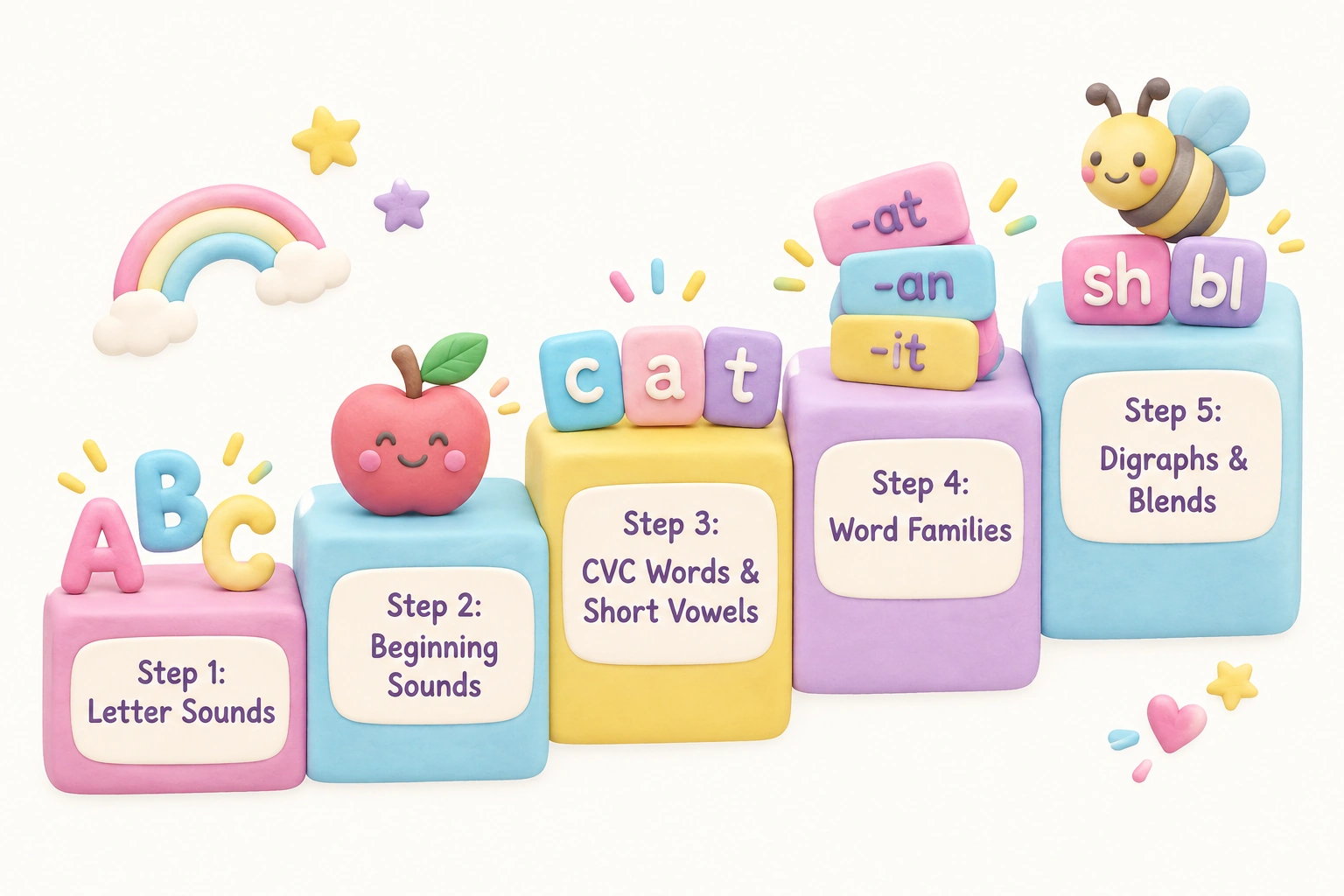
- Letter recognition and letter-sound correspondence: Start with games that pair letter shapes with their sounds and provide clear audio models. Starfall’s letter activities and Khan Academy Kids’ alphabet section work well here.
- Beginning sounds and phonemic awareness: Games that ask children to identify which word starts with a given sound, or to sort pictures by initial sound, build the phonological awareness foundation. KizPhonics Level 1 and Teach Your Monster to Read both cover this stage.
- CVC words and short vowel sounds: Once beginning and ending sounds are secure, blending three-phoneme words is the next step. SplashLearn’s vowel games and KizPhonics Level 2 target this directly. Starfall’s “Learn to Read” section also covers CVC blending.
- Word families: Grouping words by shared endings (-at, -an, -ip) helps children recognize patterns and read new words more quickly. Reading Eggs and several Turtle Diary games address word family patterns.
- Consonant digraphs and blends: These are typically introduced toward the end of kindergarten or in early first grade. Fast Phonics (Reading Eggs) and SplashLearn’s digraph games cover sh, ch, th, and wh, as well as s-blends and r-blends.
For Teachers: Classroom-Friendly Phonics Games
Teachers using phonics games online in a classroom or small-group setting have different needs from parents using them at home. The most useful classroom platforms share a few key features: they work without individual student logins, they display clearly on a projector or interactive whiteboard, and they can be used for whole-class or small-group instruction without requiring each child to have a device.
Starfall works well in this context because it is browser-based, requires no sign-up, and its animated phonics activities are visually clear on a large screen. BBC Bitesize phonics games are similarly classroom-friendly and designed with group use in mind. ICT Games offers short, focused phonics activities — including games targeting specific sounds — that teachers can use as warm-up activities or targeted practice for small groups. For individual device use in a classroom, KizPhonics and SplashLearn both offer teacher account options with class management features.
Red Flags: What to Avoid in Phonics Games
Not every game labeled “phonics” actually teaches phonics effectively. Some common patterns in less effective games are worth knowing before choosing a platform.
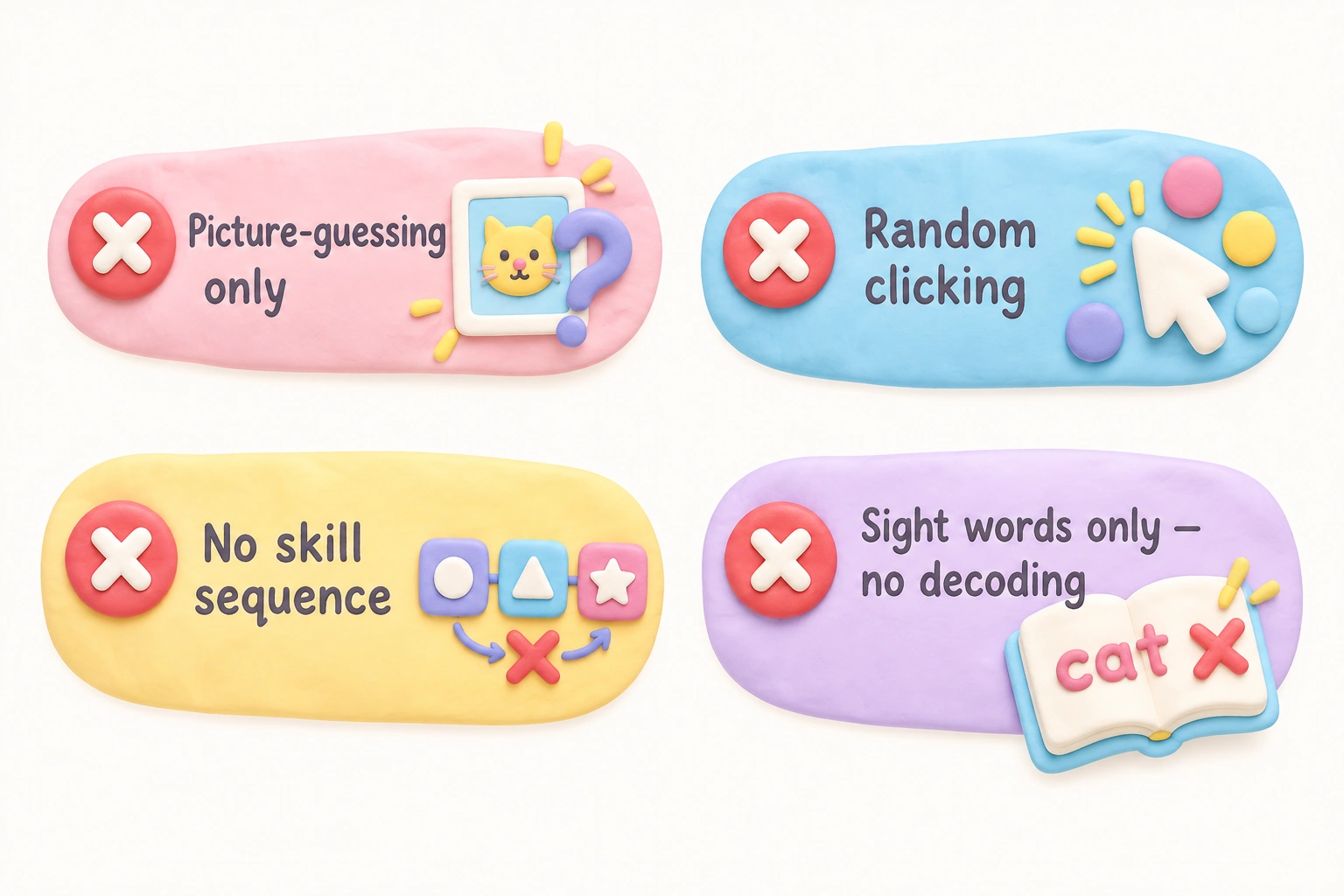
- Picture-guessing without decoding: If a child can answer correctly by looking at pictures rather than reading letters, the game is not building decoding skills. Effective phonics games require children to process the written form of words.
- Random clicking or trial-and-error: Games that allow children to click through options until they find the right answer by elimination are not teaching phonics — they are teaching persistence in guessing. Look for games that require a deliberate response based on sound-letter knowledge.
- No systematic progression: A collection of unrelated letter games without a clear skill sequence may be entertaining but is unlikely to build reading skills as efficiently as a structured program. This is especially relevant for children who are just beginning to learn letter-sound correspondence.
- Heavy reliance on sight word memorization alone: While high-frequency words are a useful part of early literacy, a game that focuses exclusively on memorizing whole words without teaching the underlying phonics patterns does not build the decoding skills children need for reading unfamiliar words.
- Flash-dependent or outdated technology: Some older phonics game sites relied on Adobe Flash, which is no longer supported in modern browsers. Check that a platform works on your current device and browser before committing to it.
Screen Time Guidance for Kindergarten Phonics Practice
The American Academy of Pediatrics (AAP) recommends that screen time for children aged 2–5 be limited to one hour per day of high-quality programming, with caregiver co-viewing where possible. For children aged 6 and older, the guidance shifts to ensuring screen time does not displace sleep, physical activity, and face-to-face interaction rather than setting a strict daily limit. Kindergarteners typically fall at the older end of the 2–5 range or just above it, so these guidelines are directly relevant.
For phonics practice specifically, short and focused sessions tend to be more effective than extended play. Sessions of 10–15 minutes on a specific phonics skill — followed by an offline activity that reinforces the same skill, such as reading a decodable book or playing a card game with letter tiles — are likely to produce better learning outcomes than 45-minute uninterrupted game sessions. Fatigue and distraction increase quickly in five- and six-year-olds, and the motivational novelty of a game diminishes with extended use.
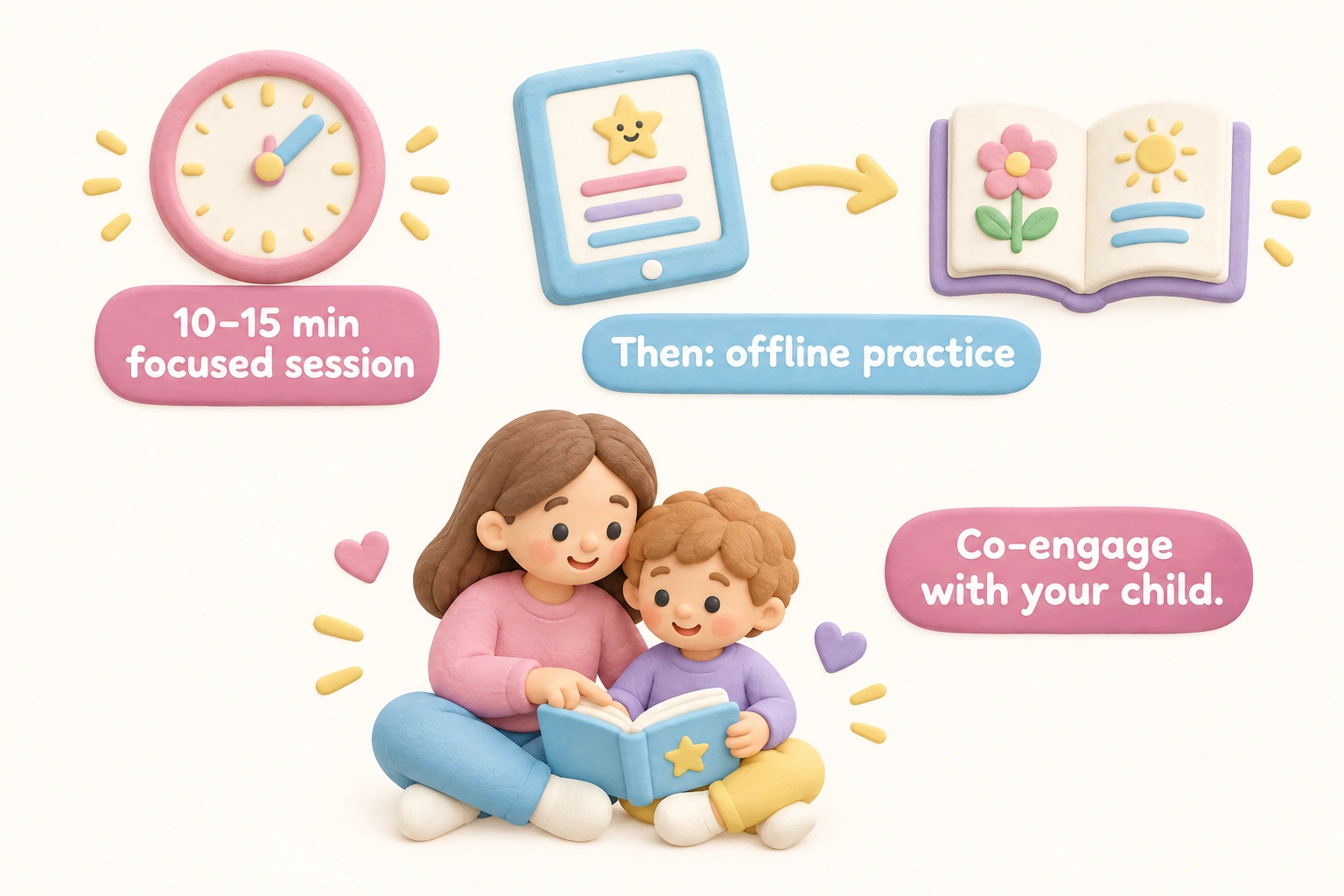
Caregiver involvement during phonics game sessions adds meaningful value. Sitting alongside a child, asking them to explain what sound a letter makes, or pointing out a word from the game in a physical book afterward helps transfer learning from the screen to real reading contexts. This kind of active co-engagement is consistently associated with better early literacy outcomes than independent screen use.
What to Do After the Game: Transferring Skills Off-Screen
One of the most underappreciated aspects of using phonics games online is what happens after the screen is turned off. A child who can correctly blend CVC words in a game environment has not necessarily consolidated that skill for real reading. The Science of Reading emphasizes that decoding skills need to transfer to actual text — decodable books, environmental print, and eventually any written material the child encounters.
After a phonics game session, a simple check is to write two or three words from the skill the game covered on a piece of paper and ask the child to read them without any pictures or audio prompts. If they can do this, the skill is beginning to transfer. If they struggle, more practice — both digital and offline — may be needed before moving to the next skill level. Decodable readers, which are short books written specifically to use the phonics patterns a child has learned, are one of the most effective offline complements to digital phonics practice.
A Note for ESL and EFL Kindergarteners
Children learning English as a second or additional language have specific needs when it comes to phonics instruction. English phonics games online can be genuinely useful for ESL kindergarteners because the audio support and visual context in well-designed games help connect sounds to letters in a language the child is still acquiring. However, games that assume prior vocabulary knowledge — for example, asking a child to identify the beginning sound of a pictured object they may not recognize — can be frustrating rather than helpful.
KizPhonics is one platform that has been developed with ESL and EFL learners in mind, offering clear audio models and leveled content that does not assume extensive English vocabulary. For ESL kindergarteners, pairing phonics games with simple decodable texts and plenty of spoken English exposure is particularly important, as phonics instruction works best when children can connect the sounds they are learning to words they actually use and understand.
Frequently Asked Questions
Are free online phonics games as effective as paid ones?
Free platforms such as Starfall, Teach Your Monster to Read, and KizPhonics offer genuinely systematic phonics practice that can be highly effective for kindergarteners. Paid platforms typically offer more comprehensive curricula, adaptive difficulty, and detailed progress tracking, which may be worth the cost for families who want a more complete digital literacy program. For targeted phonics skill practice, free options are often sufficient.
How often should a kindergartener play phonics games?
Short daily sessions of 10–15 minutes tend to be more effective than longer, less frequent sessions. Consistency matters more than duration. Pairing digital practice with offline reading activities — such as decodable books or letter-sound card games — helps reinforce skills more durably than screen time alone.
Can phonics games replace phonics instruction?
Phonics games online work best as a supplement to, not a replacement for, direct phonics instruction from a teacher or caregiver. Structured literacy instruction involves explicit teaching, immediate corrective feedback, and the ability to respond to a child’s specific errors in ways that automated games cannot fully replicate. Games are valuable for motivated practice and skill reinforcement, but they are most effective when used alongside real instruction.
Are online phonics games safe for kindergarteners?
Most of the platforms listed in this article are designed specifically for young children and are ad-free or have child-safe advertising policies. Browser-based platforms that require no sign-up — such as Starfall and KizPhonics — carry minimal data privacy concerns. For subscription platforms, review the privacy policy to understand how child data is handled. Supervising young children during screen time and using platforms on a shared family device rather than a personal one adds an additional layer of safety.
What if my child finds phonics games too easy or too hard?
Most platforms offer some form of level selection or adaptive difficulty. If a game is consistently too easy, move to the next skill level in the phonics progression — for example, from beginning sounds to CVC blending. If a game is too hard, step back to the previous skill and ensure it is secure before moving forward. Platforms like KizPhonics make this straightforward by organizing games explicitly by kindergarten skill level.
Do phonics games work on tablets and mobile devices?
Most modern phonics platforms are compatible with tablets and mobile devices, but there are exceptions worth checking. Teach Your Monster to Read is free on desktop browsers but requires a paid app for mobile use. Some older game sites may have compatibility issues on certain devices. Before committing to a platform, test it on the device your child will actually use.
Choosing the Right Phonics Games for Your Kindergartener
The best phonics games online for a kindergartener are the ones that match the specific phonics skills the child is currently working on, follow a systematic progression, and require genuine decoding rather than picture-guessing. For most families, a combination of one or two free platforms — such as Starfall or Teach Your Monster to Read for regular practice, and KizPhonics for skill-targeted games — provides a solid foundation without any cost. Paid platforms like Reading Eggs or HOMER may be worth exploring if a child needs a more structured, comprehensive digital curriculum or if detailed progress tracking is important to you.
Whatever platform you choose, the most important factor is how the digital practice connects to real reading. Keeping sessions short, staying involved as a caregiver, and regularly checking whether skills transfer to actual books and written words will make phonics games a genuinely useful part of your child’s early literacy development rather than just an entertaining screen activity. If you have concerns about your child’s reading progress, a classroom teacher, reading specialist, or speech-language pathologist can provide guidance tailored to your child’s individual needs.

Take a short quiz to find out what your everyday choices say about your parenting style
When your child is curious about something new, what’s your instinct?
Take a short quiz to find out what your everyday choices say about your parenting style
“Can I download this app?” What happens next?
Take a short quiz to find out what your everyday choices say about your parenting style
When it comes to rules at home, which sounds most like you?
Take a short quiz to find out what your everyday choices say about your parenting style
If you could give your child one life skill today, what would you pick?
Take a short quiz to find out what your everyday choices say about your parenting style
Your child gets to choose what to watch. What would your ideal setup look like?
Take a short quiz to find out what your everyday choices say about your parenting style
Pick your parenting superpower ✨