Best Video Games for 5-Year-Olds: Beginner-Friendly Picks

 Discover a Free Education Video App for Kids
Pastory uses AI to personalize educational video content based on your child’s interests and personality. Safe, engaging, and built for curious young minds. Sign up now to stay updated and enjoy early access with a free trial
Choosing the right first video game for a five-year-old is genuinely tricky. The market is enormous, ESRB ratings only tell part of the story, and what works brilliantly for a seven-year-old can frustrate a younger child to tears within minutes. This guide cuts through the noise with parent-approved picks chosen specifically for beginner-friendly controls, forgiving gameplay, and age-appropriate content — plus honest guidance on screen time, parental controls, and what to avoid.
Key Takeaways
- The best video games for 5-year-olds share a few core traits: simple mechanics, no fail state or instant respawn, bright visuals, and no reading requirement.
- The Nintendo Switch is the most widely recommended platform for this age group, though strong options exist on PlayStation, Xbox, and PC.
- The American Academy of Pediatrics (AAP) recommends no more than one hour of quality screen time per day for children ages 2–5, making game selection and session length equally important.
- Co-op games that parents and children play together offer developmental benefits beyond solo play, including language development, turn-taking, and shared problem-solving.
- A small number of popular titles — including fast-paced online shooters — are genuinely unsuitable for this age group regardless of a child’s enthusiasm for them.
What Makes a Video Game Right for a 5-Year-Old?
Five-year-olds are at a fascinating developmental crossroads. Fine motor skills are still maturing, meaning precise button combinations or rapid joystick movements can be genuinely difficult rather than simply unfamiliar. Attention spans are growing but remain shorter than those of school-age children, and frustration tolerance is still developing. A game that punishes mistakes harshly — sending a child back to the very beginning after a single error — can quickly turn an exciting new experience into a tearful one.
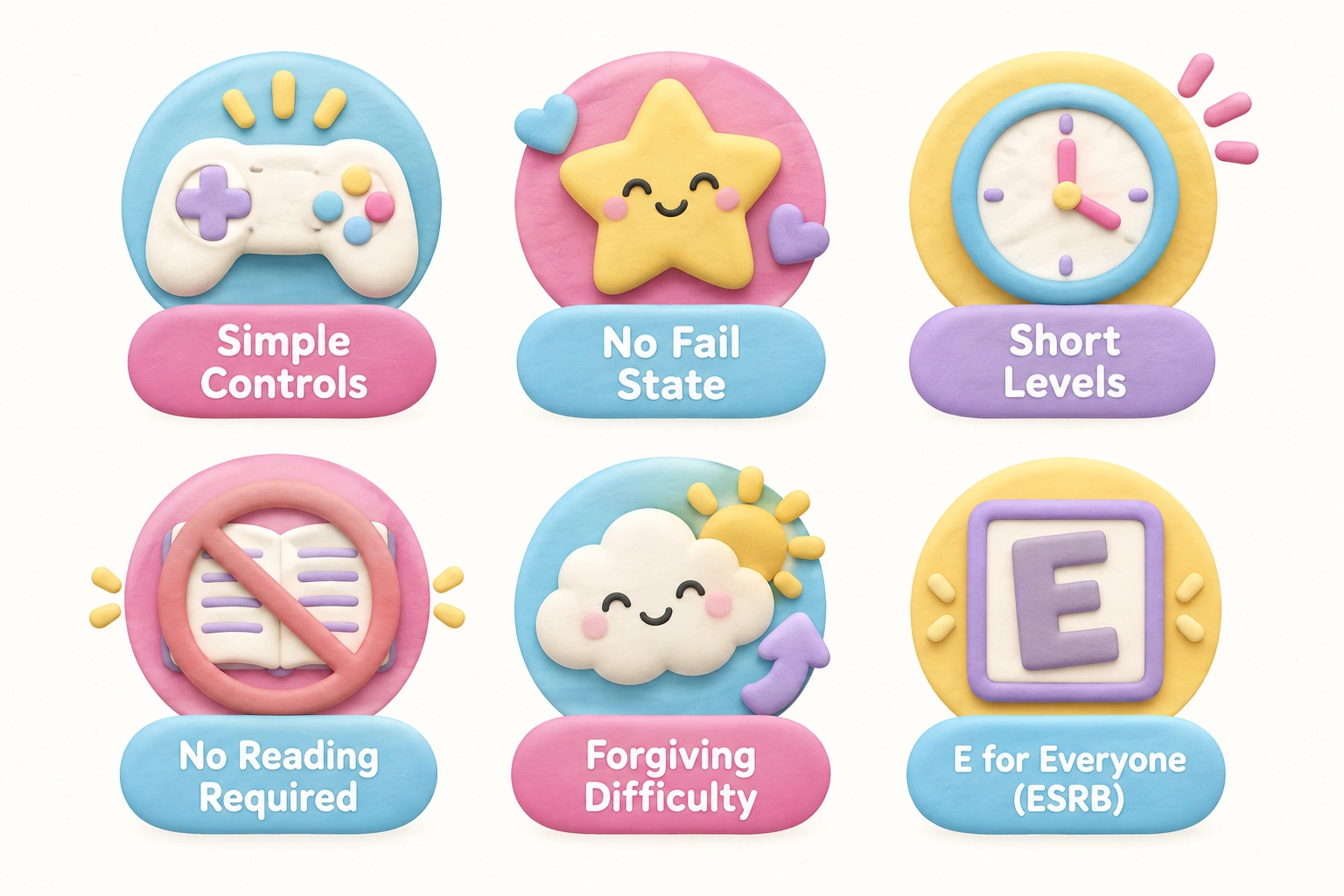
When evaluating age-appropriate video games for this age group, look for the following characteristics:
- Simple controls: Games that rely on one or two buttons, or that use motion controls intuitively, are far more accessible than those requiring complex button combinations.
- No fail state or instant respawn: Games where a child cannot permanently lose, or where they reappear immediately after a mistake, remove the sting of failure and keep engagement high.
- Short levels or natural pause points: Sessions that can end cleanly without losing progress respect both the child’s attention span and the parent’s screen time limits.
- No reading requirement: At five, many children are still developing early literacy. Games that communicate through visuals, sound, and simple icons rather than text walls are far more inclusive.
- Bright, cheerful visuals and forgiving difficulty: Gentle pacing, clear visual feedback, and a non-threatening aesthetic all support a positive first experience with gaming.
- E for Everyone (ESRB) rating: The ESRB’s E rating indicates content suitable for all ages, with minimal or no violence, no suggestive themes, and no strong language. This is the baseline to look for, not a guarantee of age-appropriateness on its own.
Common Sense Media is another useful resource alongside ESRB ratings. It provides parent and child reviews that often flag specific concerns — such as mild cartoon violence or in-game purchase prompts — that a rating alone may not capture.
Best Video Games for 5-Year-Olds: Curated Picks by Category
The following recommendations are grouped by genre to help parents match a game to their child’s interests and temperament. All titles carry an E for Everyone (ESRB) rating unless otherwise noted, and all have been selected for beginner-friendly controls and forgiving gameplay.
Platformers: Jump, Explore, and Discover
Kirby and the Forgotten Land (Nintendo Switch) is one of the most consistently recommended first video games for young children, and for good reason. Kirby’s ability to inhale enemies and copy their powers means there is always a way forward even when a child is struggling. The game features an optional co-op mode where a second player controls a helper character, making it an ideal parent-and-child experience. Difficulty is gentle throughout, and the colorful post-apocalyptic world is visually delightful without being frightening.
Yoshi’s Crafted World (Nintendo Switch) takes the forgiving gameplay concept even further. The entire game is designed around a craft-paper aesthetic, and Yoshi can take multiple hits before losing a life. A “Mellow Mode” option gives Yoshi wings, making the platforming sections almost entirely stress-free. This is an excellent choice for a child who is encountering a controller for the very first time.
Sackboy: A Big Adventure (PlayStation 4/5) offers a similarly gentle platforming experience on Sony hardware. The game supports local co-op for up to four players, and its tactile, fabric-based visual world is genuinely charming. Sackboy is a strong pick for families with a PlayStation console who want a beginner-friendly platformer with cooperative play built in.
Racing Games: Simple Speed and Shared Fun
Mario Kart 8 Deluxe (Nintendo Switch) remains one of the best entry points into gaming for young children. The Smart Steering and Auto-Accelerate assist features effectively remove the need for precise control, allowing a five-year-old to participate meaningfully in races without constant frustration. Split-screen local multiplayer means the whole family can race together, and the colorful tracks and familiar characters make it immediately appealing. Mario Kart 8 Deluxe is also fully compatible with the Nintendo Switch 2, which launched in mid-2025 with backward compatibility for most Switch titles — a useful note for families upgrading their hardware.
PAW Patrol: Grand Prix is worth considering for children who are devoted fans of the television series. The racing mechanics are simpler than Mario Kart, the characters are immediately recognizable, and the stakes feel appropriately low. Licensed games like this one trade depth for accessibility, which is often exactly what a five-year-old needs from their first gaming experience.
Creative and Sandbox Games: Open-Ended Exploration
Minecraft in Creative Mode (Nintendo Switch, PlayStation, Xbox, PC) deserves special mention as one of the most developmentally rich options available. In Creative Mode, children have unlimited resources, cannot be harmed by enemies, and are free to build whatever they can imagine. There is no objective to complete and no way to fail. Research suggests that open-ended sandbox play of this kind may support spatial reasoning, creativity, and problem-solving skills — though outcomes vary considerably by child and by how the game is used. Parents should be aware that Minecraft’s Survival Mode introduces enemies and resource scarcity that may be too stressful for some five-year-olds, and that online multiplayer servers require careful parental controls setup.
Animal Crossing: New Horizons (Nintendo Switch) is a gentle life simulation game in which players develop a deserted island at their own pace. There is no combat, no fail state, and no time pressure. The game’s real-time clock means it rewards short daily sessions rather than long uninterrupted play, which aligns naturally with recommended screen time limits for this age group. Animal Crossing is particularly well-suited to children who prefer calm, creative play over action and competition.
LEGO Games: Co-Op Built for Families
The LEGO video game series — including LEGO Star Wars: The Skywalker Saga and LEGO Marvel Superheroes — is specifically designed for cooperative play, and the drop-in drop-out co-op mechanic means a parent can join or leave a session without disrupting the child’s experience. When a character falls off a ledge or is defeated, they respawn instantly as a pile of LEGO studs with no meaningful penalty. This no fail state design philosophy makes LEGO games among the most forgiving on the market. The humor is gentle and visual, reducing the reading burden, and the familiar licensed characters — from Star Wars to Marvel to Harry Potter — give children an immediate connection to the world they are exploring.
True Beginner Picks: For Children Who Have Never Held a Controller
Some children encounter a game controller for the very first time at age five, and the standard beginner-friendly recommendations can still feel overwhelming. For these children, a smaller set of titles stands out as genuinely introductory.
Sesame Street: Friends & Fun was developed specifically to be the first console video game a young child tries. Controls are minimal, the characters are universally familiar, and the activities are structured around early learning concepts. It is not a technically sophisticated game, but that is precisely the point.
Astro’s Playroom (PlayStation 5) comes pre-installed on every PS5 console at no additional cost, making it an accessible starting point for families with Sony hardware. The game uses the DualSense controller’s haptic feedback and motion controls in intuitive ways, and its difficulty is gentle enough for young beginners while remaining engaging for adults playing alongside them.
Bluey: The Videogame (Nintendo Switch, PlayStation, Xbox) translates the beloved Australian animated series into a simple, exploration-based game. The mechanics are minimal, the world is familiar to fans of the show, and the cooperative play option means a parent can guide the experience naturally.
Nintendo Switch Sports and Party Games
Nintendo Switch Sports uses motion controls to simulate sports including tennis, bowling, football, and volleyball. The physical, intuitive nature of motion controls makes this one of the most accessible gaming experiences for children who have never used a traditional controller. Bowling in particular requires almost no prior gaming experience and delivers immediate, satisfying feedback. Party games of this type also support physical activity alongside screen time, which is a meaningful consideration for parents managing overall daily movement.
Games to Approach With Caution or Avoid
Knowing what not to buy is as useful as knowing what to recommend. Several popular titles that children of this age frequently request are genuinely unsuitable for five-year-olds, and understanding why helps parents navigate these conversations confidently.
- Fortnite: The shooting mechanics, fast-paced online multiplayer, and real-time communication with strangers make Fortnite inappropriate for five-year-olds. The game’s free-to-play model also includes aggressive in-game purchase prompts that are difficult to manage without robust parental controls.
- Traditional Super Mario platformers (Super Mario Odyssey, Super Mario Bros. Wonder): These are excellent games, but they require precise timing and spatial awareness that many five-year-olds find genuinely frustrating. Super Mario Odyssey in particular has sections that demand controller precision beyond what most children this age can reliably achieve. These titles may be better introduced at age six or seven.
- Any game rated T (Teen) or M (Mature) by the ESRB: These ratings exist for meaningful reasons. Content that includes realistic violence, horror elements, or mature themes is developmentally inappropriate for five-year-olds regardless of a child’s apparent maturity.
- Unmoderated online multiplayer games: Even games with appropriate content ratings can expose young children to inappropriate language or behavior from other players in online environments. If a game includes online play, parental controls should restrict this feature entirely for children of this age.
Developmental Benefits of Age-Appropriate Gaming
When chosen carefully and used within reasonable time limits, video games for 5-year-olds can offer genuine developmental value. Hand-eye coordination and fine motor skills may be supported by games that require precise timing and spatial navigation. Problem-solving skills and pattern recognition are engaged by puzzle elements and level design that requires trial and error. A 2022 study published in JAMA found associations between video gaming and enhanced cognitive performance in children, including improvements in response inhibition and working memory — though the researchers noted that the direction of causation and the role of game type require further investigation.
Cooperative games offer an additional layer of social and emotional development. When a parent and child play a LEGO game together, they are practicing turn-taking, communication, shared goal-setting, and collaborative problem-solving in a low-stakes environment. This co-play framing — where the game is a shared activity rather than a solo screen experience — is consistently associated with more positive outcomes than independent, unsupervised gaming.
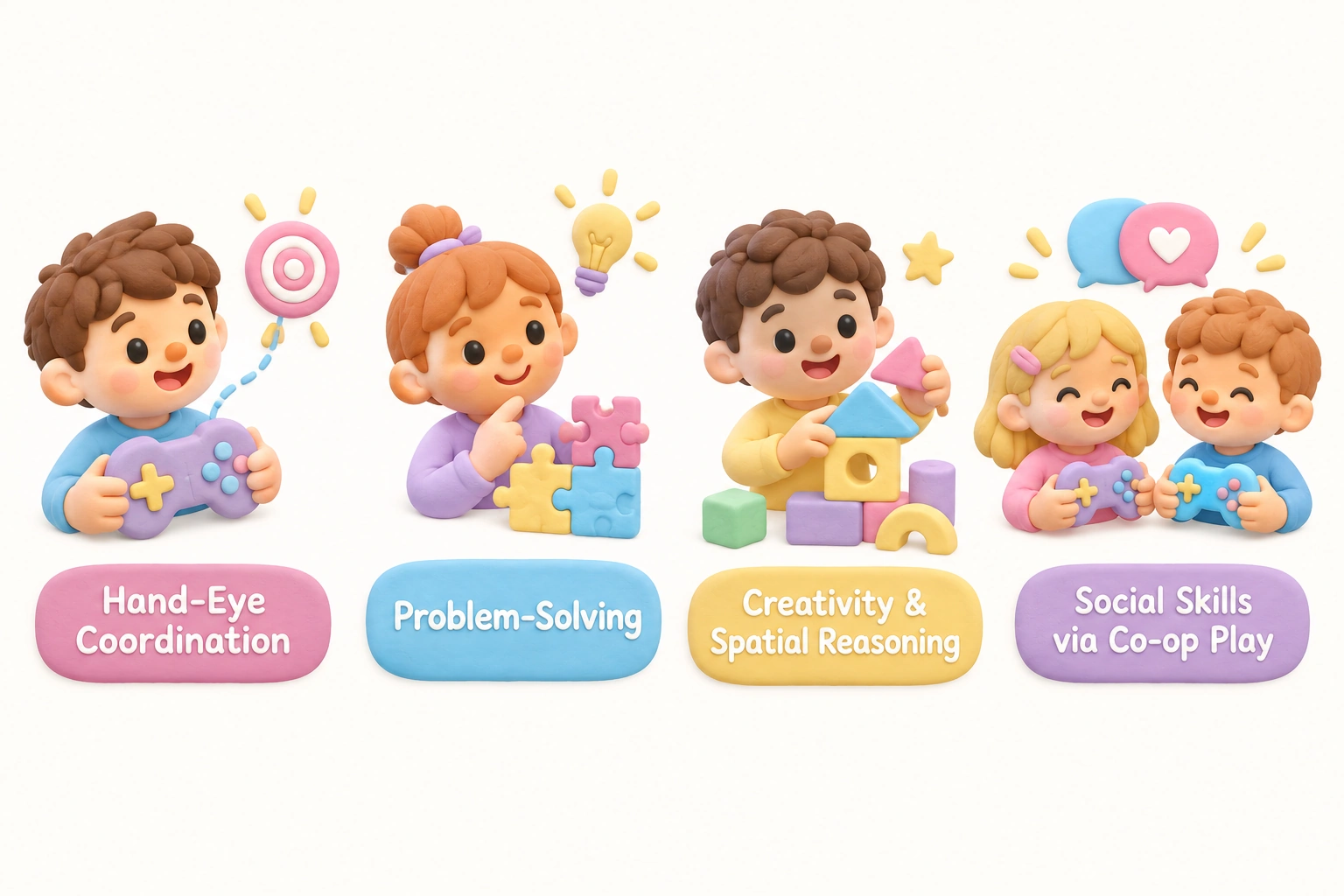
Creative sandbox games like Minecraft in Creative Mode may support spatial reasoning and imaginative play in ways that parallel traditional block-building toys. Open-ended digital environments that allow children to construct, experiment, and revise their creations engage similar cognitive processes to unstructured physical play, though the evidence base for specific developmental outcomes remains developing.
Screen Time, Parental Controls, and Practical Setup
The American Academy of Pediatrics recommends no more than one hour of quality screen time per day for children ages 2–5. For children aged six and older, the AAP recommends that parents place consistent limits on screen time and ensure it does not displace sleep, physical activity, or face-to-face interaction. Video game time counts toward this total alongside television, tablets, and other screens.
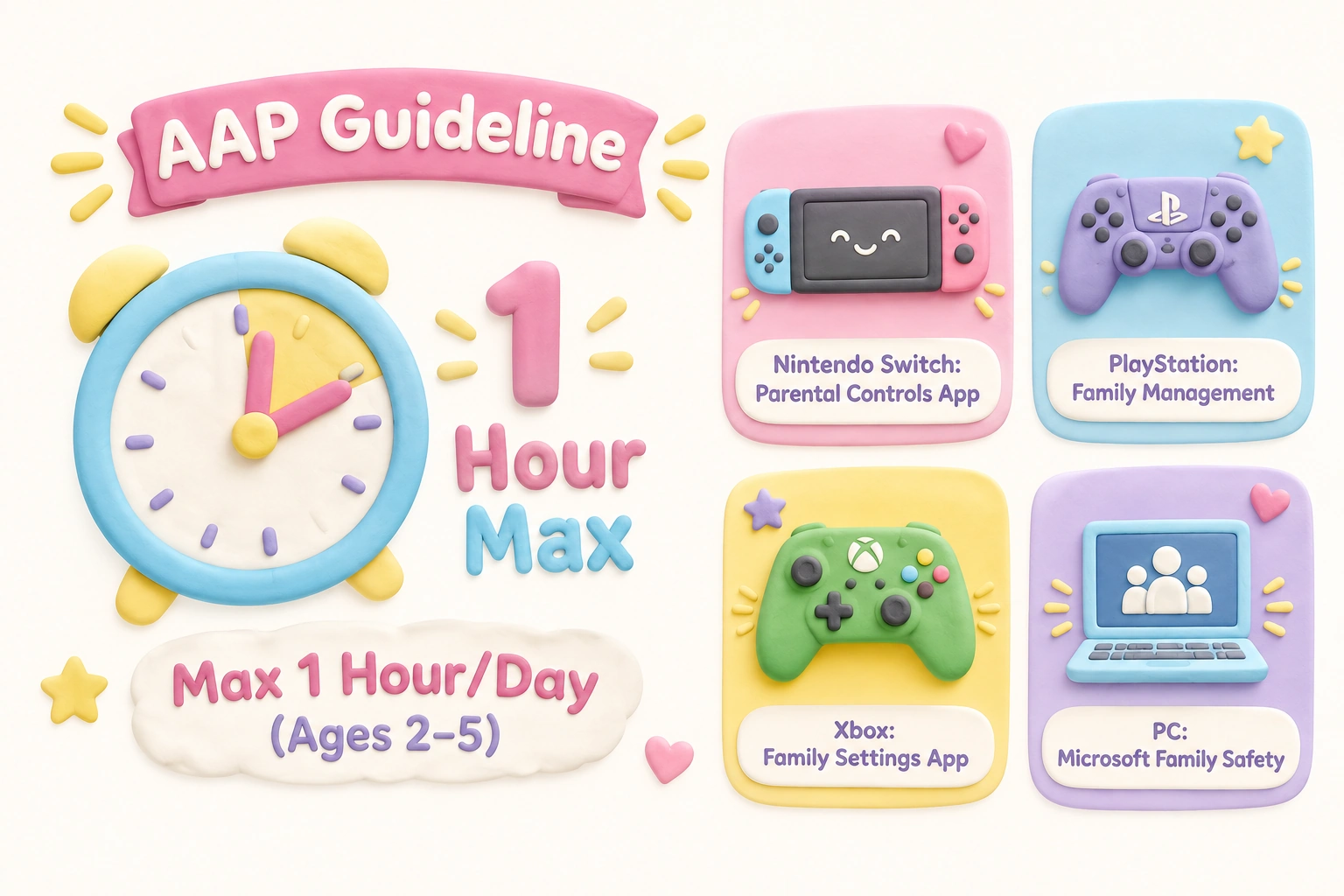
Setting up parental controls before a child’s first gaming session is strongly recommended. Each major platform offers dedicated tools:
| Platform | Parental Control Tool | Key Features |
|---|---|---|
| Nintendo Switch | Nintendo Switch Parental Controls app (free, iOS/Android) | Screen time limits, bedtime alarms, content restrictions by age, online play restrictions, purchase controls |
| PlayStation 4/5 | PlayStation Family Management (web and app) | Spending limits, playtime management, content age restrictions, communication controls |
| Xbox Series X/S | Xbox Family Settings app (free, iOS/Android) | Screen time scheduling, content filters, spending limits, friend request controls |
| PC (Windows) | Microsoft Family Safety app | Screen time limits, content filters, spending controls, activity reporting |
The Nintendo Switch Parental Controls app is particularly well-regarded for its simplicity and the granularity of its controls, making it a strong choice for families new to managing children’s gaming. The Federal Trade Commission (FTC) also provides a useful overview of parental control options across platforms for families who want an independent reference point.
Beyond technical controls, co-viewing and co-playing remain the most effective forms of media supervision for young children. Sitting with a child during gaming sessions — even briefly — allows parents to observe content, model positive responses to frustration, and turn gaming into a shared rather than isolating experience.
Quick Reference: Game Comparison by Difficulty and Genre
| Game Title | Platform | Genre | Difficulty for Age 5 | Local Co-op? | No Fail State? |
|---|---|---|---|---|---|
| Kirby and the Forgotten Land | Switch | Platformer | Very Easy | Yes | No (but very forgiving) |
| Yoshi’s Crafted World (Mellow Mode) | Switch | Platformer | Easiest | Yes | Effectively yes |
| Mario Kart 8 Deluxe (with assists) | Switch | Kart Racer | Very Easy | Yes | Yes |
| Minecraft (Creative Mode) | Switch/PS/Xbox/PC | Sandbox | None | Yes | Yes |
| Animal Crossing: New Horizons | Switch | Life Sim | None | Limited | Yes |
| LEGO Star Wars: Skywalker Saga | Switch/PS/Xbox/PC | Action/Adventure | Easy | Yes (drop-in/drop-out) | Yes (instant respawn) |
| Sackboy: A Big Adventure | PS4/PS5 | Platformer | Easy | Yes (up to 4) | No (but forgiving) |
| Nintendo Switch Sports | Switch | Sports/Party | Very Easy | Yes | Yes |
| Bluey: The Videogame | Switch/PS/Xbox | Adventure | Easiest | Yes | Yes |
| Sesame Street: Friends & Fun | Switch/PS/Xbox | Educational | Easiest | No | Yes |
| Astro’s Playroom | PS5 (pre-installed) | Platformer | Easy | No | No (but forgiving) |
Budget and Free-to-Start Options
Not every family wants to invest in a full-price title before knowing whether their child will enjoy gaming. Several genuinely accessible options exist at low or no cost. Astro’s Playroom comes pre-installed on every PlayStation 5 at no additional charge, making it a zero-cost starting point for PS5 owners. Roblox is free to download on most platforms and contains many child-friendly experiences, though it requires careful parental controls setup due to its open user-generated content model and in-game purchase system — parents should review individual games within Roblox rather than treating the platform as uniformly safe. PBS Kids Games offers free browser-based and app-based games tied to familiar characters from public television, with an explicit educational focus and no in-game purchases. These options allow families to explore gaming with minimal financial commitment before deciding whether to invest in a dedicated console or premium titles.
Frequently Asked Questions
Can a 5-year-old use a Nintendo Switch?
Yes, most five-year-olds can use a Nintendo Switch, particularly in handheld mode or with the smaller Joy-Con controllers. The Nintendo Switch Lite is a compact, handheld-only option that some younger children find easier to hold. Enabling the Nintendo Switch Parental Controls app before the child’s first session is strongly recommended.
What ESRB rating should I look for?
E for Everyone is the appropriate baseline for five-year-olds. Some E10+ titles (suitable for ages 10 and up) may also be appropriate depending on the specific content, but parents should review Common Sense Media ratings and gameplay videos before purchasing an E10+ game for a child this age.
Are educational games better than entertainment games for this age?
Not necessarily. Many entertainment games — including Kirby, LEGO titles, and Minecraft in Creative Mode — engage problem-solving, spatial reasoning, and creativity in ways that are developmentally meaningful. The distinction between “educational” and “entertainment” is less important than whether the game is age-appropriate, engaging, and used within reasonable time limits with caregiver involvement.
How long should a 5-year-old play video games each day?
The American Academy of Pediatrics recommends no more than one hour of quality screen time per day for children ages 2–5. This total includes all screens — television, tablets, and video games combined. For children aged six and older, the AAP recommends consistent limits rather than a specific hour count, with priority given to sleep, physical activity, and social interaction.
My child wants to play Fortnite because their friends do. What should I say?
This is a common and genuinely difficult situation. Fortnite’s shooting mechanics, fast-paced online environment, and real-time communication with strangers make it unsuitable for five-year-olds. A useful approach is to acknowledge the child’s interest while offering an alternative that scratches a similar itch — Mario Kart 8 Deluxe for competitive multiplayer fun, or a LEGO game for action-adventure with friends, for example.
Do Switch games work on the Nintendo Switch 2?
The Nintendo Switch 2, which launched in mid-2025, is backward compatible with the vast majority of Nintendo Switch game cards and digital titles. Most of the Switch games recommended in this article will play on the new hardware, though parents should verify compatibility for specific titles before purchasing.
What if my child gets frustrated and gives up quickly?
Frustration with games at this age is usually a sign that the game’s difficulty or control complexity is too high, not that the child lacks ability. Switching to a title with a no fail state — such as Minecraft in Creative Mode, Animal Crossing, or Yoshi’s Crafted World in Mellow Mode — often resolves the issue immediately. Playing alongside the child and modeling calm responses to mistakes also helps build frustration tolerance over time.
Choosing the Right First Game for Your Child
The best video game for a five-year-old is ultimately the one that matches that specific child’s temperament, interests, and current motor skill level — not the one that tops every list. A child who loves building and creating will thrive in Minecraft’s Creative Mode or Animal Crossing long before they are ready for a platformer. A child who loves racing and competition will get more from Mario Kart 8 Deluxe with assist features enabled than from a slower-paced life simulation. A child who has never touched a controller before needs a genuinely introductory experience — Sesame Street: Friends & Fun, Yoshi’s Crafted World in Mellow Mode, or Nintendo Switch Sports bowling — rather than a game that is merely described as beginner-friendly.
The most consistent finding across child development research on young children and media is that caregiver involvement matters more than content selection alone. Playing alongside a child, discussing what is happening on screen, and treating gaming as a shared activity rather than a babysitting tool transforms the experience developmentally. The games recommended here are chosen because they make that co-play easy and enjoyable for adults as well as children — which is, in the end, the most reliable marker of a genuinely good first video game.

Take a short quiz to find out what your everyday choices say about your parenting style
When your child is curious about something new, what’s your instinct?
Take a short quiz to find out what your everyday choices say about your parenting style
“Can I download this app?” What happens next?
Take a short quiz to find out what your everyday choices say about your parenting style
When it comes to rules at home, which sounds most like you?
Take a short quiz to find out what your everyday choices say about your parenting style
If you could give your child one life skill today, what would you pick?
Take a short quiz to find out what your everyday choices say about your parenting style
Your child gets to choose what to watch. What would your ideal setup look like?
Take a short quiz to find out what your everyday choices say about your parenting style
Pick your parenting superpower ✨