Best Multiplication Games for Elementary Students

 Discover a Free Education Video App for Kids
Pastory uses AI to personalize educational video content based on your child’s interests and personality. Safe, engaging, and built for curious young minds. Sign up now to stay updated and enjoy early access with a free trial
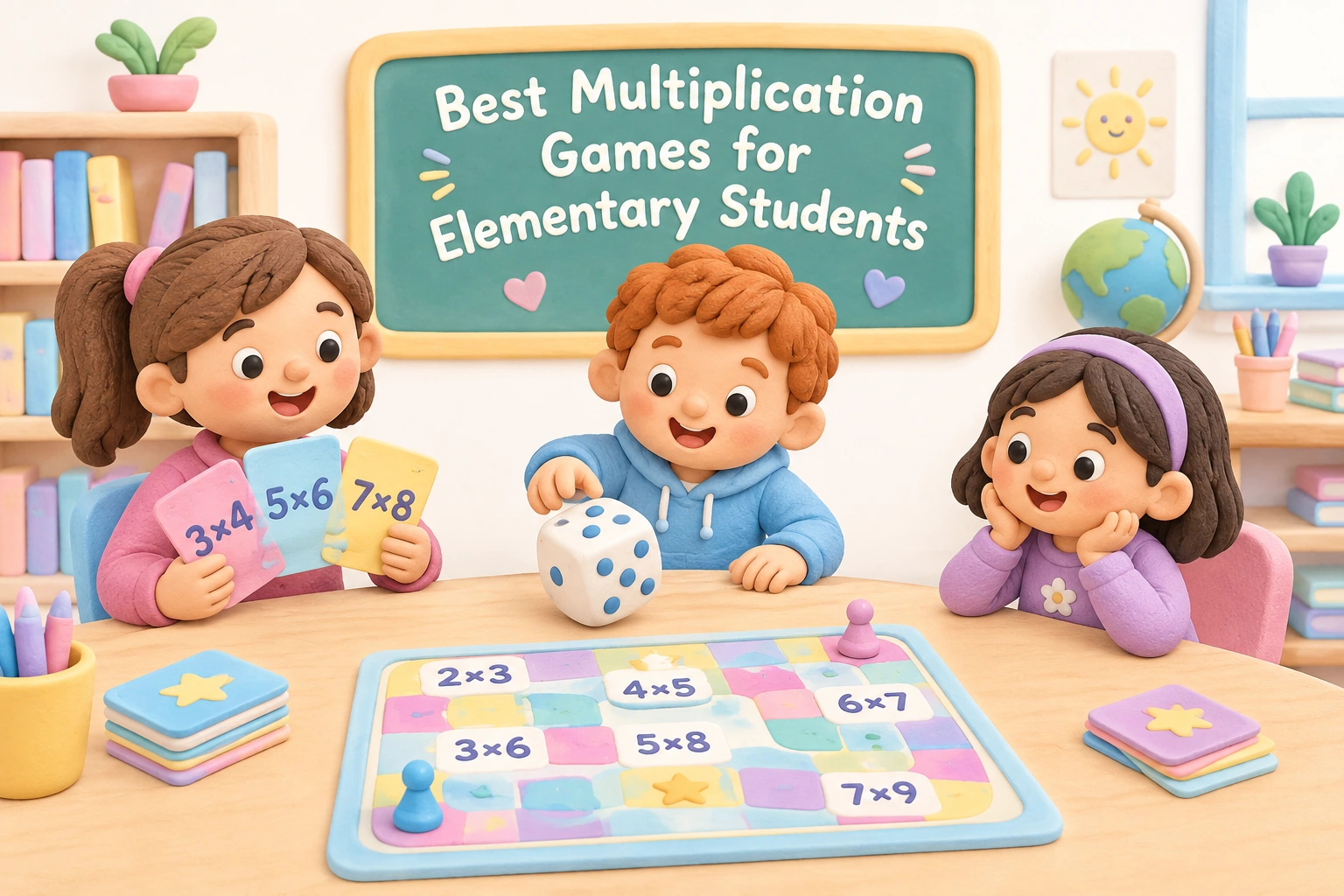
Multiplication is one of the most important mathematical milestones in elementary school, and the path to genuine fluency rarely runs through worksheets alone. Multiplication math games — whether played online, printed at home, or acted out in the classroom — give children repeated, low-pressure exposure to times tables in a context that feels rewarding rather than stressful. This guide covers the most effective game types for students in 2nd through 5th grade, explains the developmental reasons games work, and helps parents and teachers choose the right activity for each child’s current skill level.
Key Takeaways
- Game-based learning can support multiplication fact fluency more effectively than timed drills alone, because it reduces math anxiety while increasing the number of practice repetitions.
- The best approach combines online, printable, and hands-on multiplication activities rather than relying on a single format.
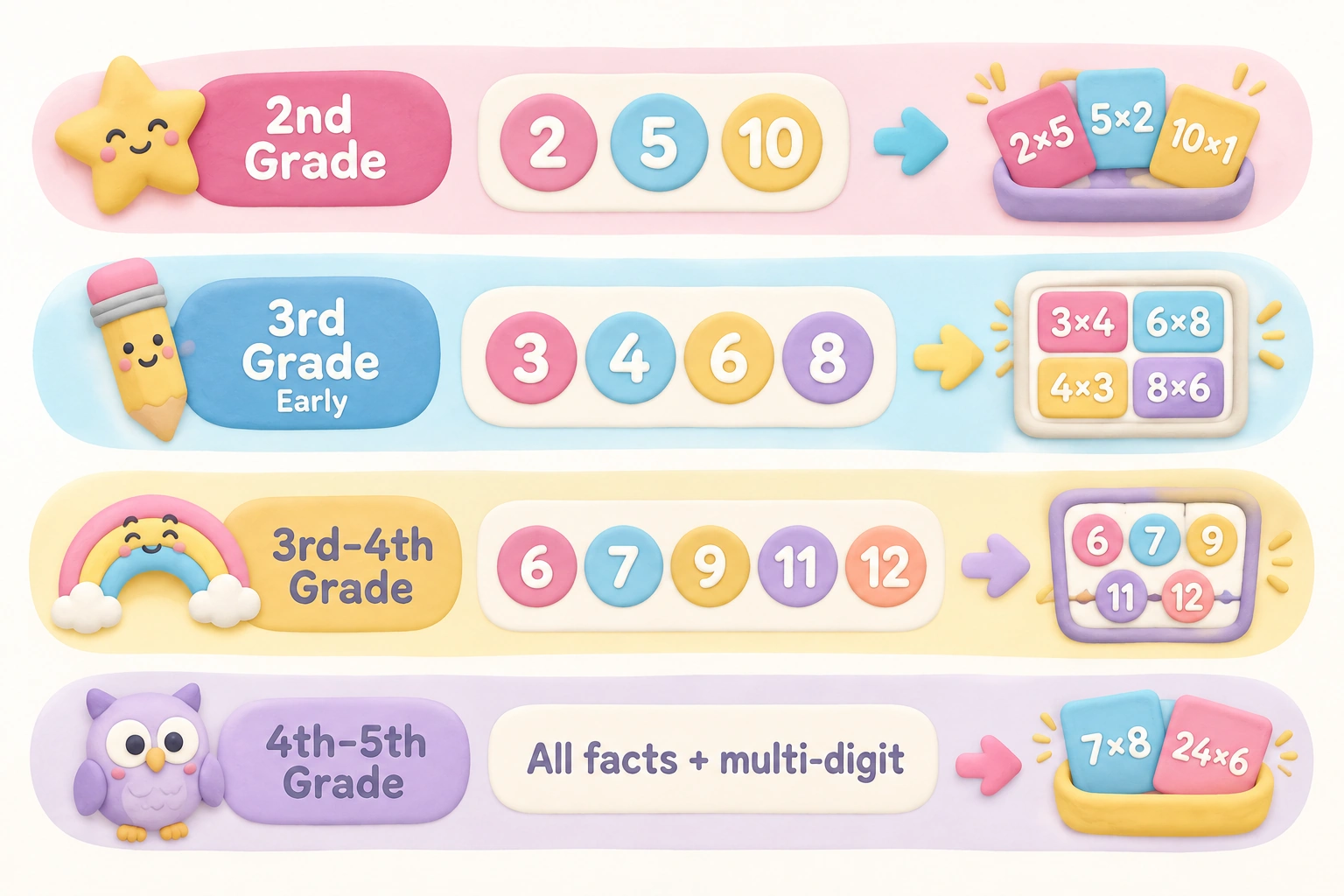
- Grade-level matching matters: easy tables (2, 5, 10) suit most 2nd graders; medium tables (3, 4, 8) suit 3rd graders; harder tables (6, 7, 9, 11, 12) are typically introduced in 3rd–4th grade.
- Short, frequent sessions using spaced repetition are more effective for building lasting math fact memory than occasional long practice blocks.
- Many high-quality multiplication games are free and require no login, making them accessible for both classroom and home use.
Why Games Work for Multiplication Practice
Research into game-based learning consistently suggests that interactive and play-based strategies can enhance both conceptual understanding and retention of math facts compared with traditional drill methods. When children play a multiplication game, they encounter the same fact multiple times across different contexts — rolling dice, flipping cards, answering a question to move a game piece — which mirrors the principle of spaced repetition: distributing practice across time and situations strengthens long-term memory more reliably than massed repetition in a single sitting.
Games also reduce the performance anxiety that timed speed tests can create in some children. A student who freezes during a timed quiz may answer the same multiplication facts confidently when the stakes feel lower and the feedback is immediate. This matters developmentally because math anxiety, which can emerge as early as 2nd grade, is associated with avoidance of math tasks and lower long-term achievement. Framing multiplication practice as play rather than assessment can help children build a more positive relationship with numbers.
Beyond motivation, well-designed multiplication games naturally reinforce conceptual foundations — arrays and equal groups, repeated addition, the commutative property of multiplication — alongside fact recall. A child who understands that 4 × 6 means four groups of six, not just a memorized string, is better positioned to extend that knowledge to multi-digit multiplication, division, fractions, and area models in later grades. Knowing the times tables by heart also makes fractions and division significantly more accessible, so the investment in multiplication fluency pays forward across the entire elementary curriculum.
Grade-by-Grade Progression: Matching Games to Skill Level
Choosing a game that matches a child’s current stage is more important than choosing the most popular title. Most US schools follow Common Core standards, which expect students to know every multiplication fact up to 10 × 10 by the end of 3rd grade, with 11s and 12s commonly extended into 4th grade. The table below summarizes a practical progression that parents and teachers can use to select appropriately challenging games.
| Grade Level | Typical Age | Target Times Tables | Recommended Game Complexity |
|---|---|---|---|
| 2nd Grade | 7–8 years | 2, 5, 10 | Simple card flips, skip counting games, arrays |
| 3rd Grade (early) | 8–9 years | 3, 4, 6, 8 | Dice games, bingo, partner card games |
| 3rd Grade (late) / 4th Grade | 9–10 years | 6, 7, 9, 11, 12 | Strategy games, online adaptive games, Kaboom! |
| 4th–5th Grade | 10–12 years | All facts + multi-digit | Competitive games, multi-digit multiplication challenges |
Children who are still consolidating easier tables should not be pushed into games that require rapid recall of harder facts. Struggling with 7 × 8 while trying to win a fast-paced game can reinforce frustration rather than fluency. Conversely, a child who has mastered all facts to 10 × 10 benefits from games that extend into multi-digit multiplication or connect multiplication to division and factors and multiples.
Best Online Multiplication Games (Free, No Login Required)
Online multiplication games offer immediate feedback, adaptive difficulty, and the ability to track progress over time — features that are difficult to replicate with paper alone. The platforms below are widely used in elementary classrooms and are accessible at home. Several are free and require no login, which removes a common barrier for teachers setting up math centers or parents looking for quick practice options.
Math Playground
Math Playground hosts several well-regarded free online multiplication games, including Meteor Multiplication and Grand Prix Multiplication. Meteor Multiplication asks students to solve multiplication facts to destroy incoming meteors, providing rapid-fire practice in a low-stakes arcade format. Grand Prix Multiplication is a racing game where correct answers accelerate a car, making it suitable for competitive learners who enjoy a speed element. Both games are free, require no login, and work on most browsers, making them practical for classroom use or independent home practice for students in 3rd through 5th grade.
Multiplication.com
Multiplication.com offers more than 100 arcade-style games alongside flashcards, quizzes, and printable worksheets. The site organizes games by individual times table, so a teacher can direct a student specifically to practice their 7s without navigating through unrelated content. The games range from simple matching activities suitable for early 3rd graders to more complex challenges for 4th and 5th graders working on multi-digit multiplication. Most core games are free and require no sign-up.
Timestables.com
Timestables.com provides structured online practice for tables 1 through 12, with games such as Figo and Friends designed specifically for 3rd, 4th, and 5th grade students. The site includes a diploma system where students can earn certificates for each table they master, which can serve as a motivating milestone for children who respond well to visible progress markers. The platform is free and does not require account creation for basic use.
SplashLearn and Prodigy Math
SplashLearn offers curriculum-aligned, standards-aligned multiplication games with an adaptive engine that adjusts difficulty based on a child’s responses. Prodigy Math uses a fantasy role-playing game format in which students answer math questions — including multiplication facts — to progress through battles and quests. Both platforms offer free tiers with meaningful content, though premium features require a subscription. These platforms are better suited to children who benefit from a narrative or progression structure rather than standalone arcade games. Parental account setup is required for both, which adds a brief onboarding step but also enables progress monitoring.
A Practical Note on Screen Time
Online multiplication games are most effective when used as one component of a broader practice routine rather than as the sole method. The American Academy of Pediatrics recommends that screen time for school-age children be purposeful and balanced with offline activities. A reasonable approach for most elementary students is 15–20 minutes of focused online multiplication practice per session, complemented by hands-on or printable games on other days. Co-engagement — where a parent or teacher briefly plays alongside the child, asks questions, or discusses strategies — tends to produce better learning outcomes than independent screen use alone.
Best Printable Multiplication Games
Printable multiplication games require minimal preparation and no technology, making them ideal for math centers, homework folders, or family game nights. The games below can be adapted for different grade levels by adjusting which times tables are included.
Multiplication Bingo
Multiplication Bingo is one of the most versatile printable multiplication games available. A caller reads out a multiplication fact (for example, “6 times 7”), and players mark the product on their bingo card. The game can be played with whole numbers for 3rd graders or extended to include larger products for 4th and 5th graders. Bingo works well for whole-class or small-group settings and can be differentiated easily: struggling learners receive cards with products from easier tables, while advanced students use cards covering harder facts or multi-digit multiplication. Free printable bingo card generators are available on sites such as Edu-Games.org.
Multiplication War
Multiplication War uses a standard deck of playing cards. Each player flips two cards and multiplies them together; the player with the higher product wins all four cards. The game requires no preparation beyond removing face cards (or assigning them values), making it a genuinely zero-cost option. It naturally reinforces the commutative property of multiplication — students quickly notice that 3 × 7 and 7 × 3 produce the same product — and provides dense, rapid practice of multiplication facts in a competitive but low-pressure format. Multiplication War is appropriate for 2nd through 4th grade and can be played at home with a single standard deck.
Multiplication Tic Tac Toe
In Multiplication Tic Tac Toe, a grid of products replaces the standard empty squares. Two players take turns choosing two factors from a separate list; if the product of their chosen factors appears on the grid, they claim that square. The strategic element — choosing factors that block an opponent while building toward three in a row — adds a layer of thinking beyond simple recall, which can engage children who find pure drill activities tedious. This game is particularly effective for partner practice in math centers.
Multiplication Concentration (Memory Match)
Multiplication Concentration pairs a multiplication fact card with its product card. Students lay all cards face down and take turns flipping two at a time, trying to match each fact with its correct product. The memory element slows the pace compared with War or Bingo, making it better suited to children who benefit from a more deliberate, less competitive format. It also reinforces the connection between a multiplication sentence and its numerical result in a way that supports conceptual understanding alongside fact recall.
Best Hands-On Multiplication Activities
Hands-on multiplication activities engage children kinesthetically — through movement, physical objects, and tactile interaction — which can be especially valuable for learners who struggle to stay engaged with screen-based or paper-based practice alone. Many of these activities cost nothing or use materials already available at home or in a classroom.
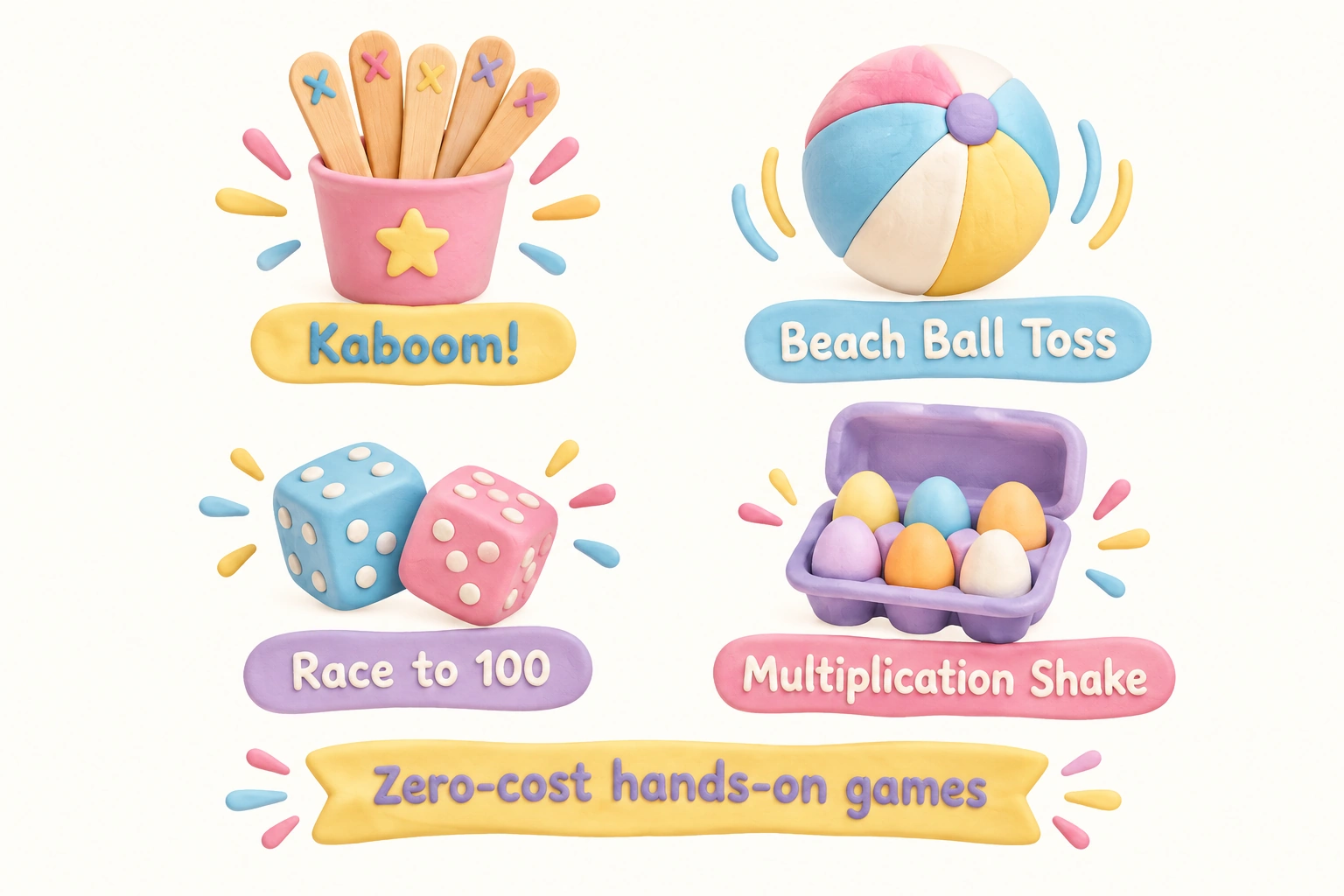
Multiplication Kaboom!
Multiplication Kaboom! uses a cup filled with popsicle sticks, each labeled with a multiplication fact. Students take turns drawing a stick and answering the fact; if they answer correctly, they keep the stick. If they draw a stick labeled “KABOOM!”, they must return all their sticks to the cup. The game continues until the cup is empty, and the player with the most sticks wins. Kaboom! is highly effective for math centers because it is self-managing — students can play independently in small groups without teacher supervision — and the KABOOM element introduces an element of chance that keeps even students with strong fact fluency engaged.
Beach Ball Toss
Beach Ball Toss involves writing multiplication facts directly on an inflatable beach ball with a permanent marker. Students stand in a circle and toss the ball; wherever a student’s right thumb lands when they catch it, they must answer that multiplication fact before passing the ball on. This active game is particularly effective for whole-class warm-ups or transitions, as it combines physical movement with multiplication practice — a combination that research on embodied cognition suggests may support memory encoding in young learners.
Race to 100
In Race to 100, students roll two dice, multiply the numbers shown, and add the product to a running total. The first player to reach 100 wins. The game provides dense multiplication practice within a simple structure that requires no preparation beyond two dice and a pencil. It is well suited to 3rd graders consolidating their 1–6 tables and can be extended for older students by using 10-sided dice to include larger factors.
Multiplication Shake (Egg Carton Game)
The Multiplication Shake game uses an egg carton with numbers written inside each cup and two small beans or counters. A student closes the carton, shakes it, opens it, and multiplies the numbers in the two cups where the beans landed. This zero-cost DIY game is easy to make at home and provides genuinely random, varied multiplication practice across whichever number range is written in the cups. Parents can customize the carton to focus on whichever times tables their child is currently working on.
Adapting Games for Struggling and Advanced Learners
Differentiated instruction is one of the most important and least-discussed aspects of multiplication game use. A single game format can often serve a wide range of skill levels with minor adjustments, which makes games more practical for mixed-ability classrooms or households with children at different stages.
For children who are still building foundational understanding, prioritize games that connect multiplication to arrays and equal groups or repeated addition before moving to pure fact recall. For example, before playing Multiplication War with standard cards, a child might first practice building arrays with counters to represent each fact physically. Skip counting games — counting by 3s, 4s, or 5s along a number line — can bridge the gap between addition and multiplication for children who are not yet ready for abstract fact recall.
For advanced learners who have mastered all facts to 12 × 12, extend games into multi-digit multiplication by using larger number cards, or introduce the multiplication and division connection explicitly: after winning a round of Multiplication War, ask the child to state the related division fact. Games can also be extended to include factors and multiples challenges, where students must identify all factor pairs of a given product rather than simply computing a single answer.
Children with diverse learning needs may benefit from games that allow more processing time, such as Concentration or Tic Tac Toe, rather than speed-based games. Reducing the number of facts in play at any one time — focusing on one or two tables per session — can also make games more accessible without removing the game-based learning structure entirely.
Building a Sustainable Practice Routine
The most effective multiplication practice is consistent and varied rather than intensive and infrequent. Playing a little most days — even 10 to 15 minutes — is more effective for building lasting multiplication fact fluency than a single long session each week, because spaced repetition distributes retrieval practice across time, which strengthens long-term memory consolidation.
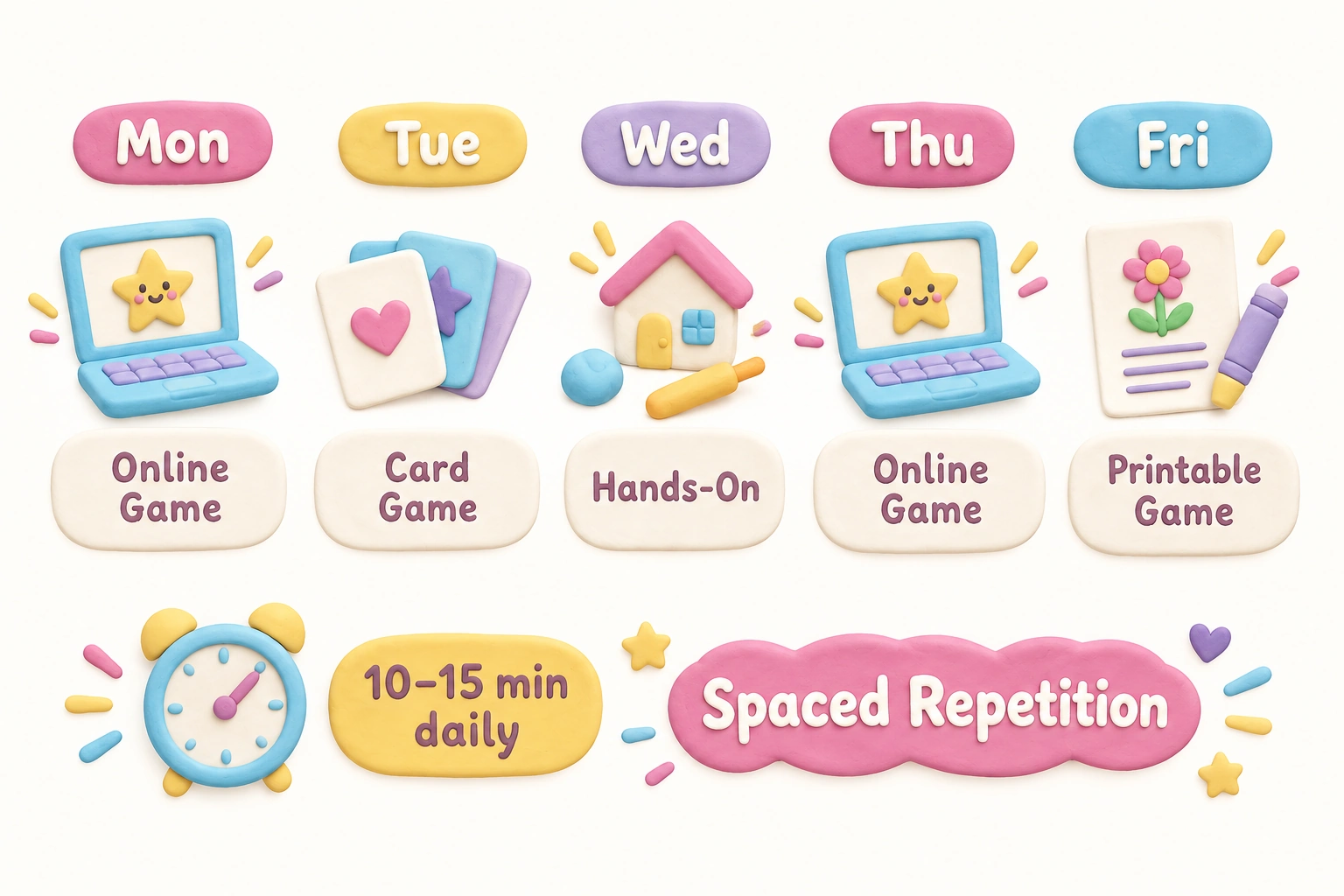
A practical weekly structure might alternate between one online game session, one printable or card game session, and one hands-on activity, rotating through different game formats to keep practice fresh and to engage different learning modalities. Mixing game types also prevents children from becoming dependent on a single format’s cues — for example, a child who only practices online may struggle to recall facts in a paper test context if the visual and auditory cues of the game are absent.
Parents and teachers should also monitor whether a child is genuinely retrieving facts from memory or using counting strategies during games. Counting on fingers or skip counting to reach an answer is a valid early strategy, but the goal of multiplication fact fluency is automaticity — the ability to recall a fact in approximately three seconds or less without counting. If a child consistently relies on counting strategies after several weeks of game-based practice, it may be worth consulting their teacher about whether additional conceptual support or a different instructional approach would help.
Frequently Asked Questions
At what age should children start learning multiplication?
Most children begin formal multiplication instruction in 2nd or 3rd grade, typically around ages 7–9. Early exposure through skip counting and arrays in 1st and 2nd grade builds the conceptual foundation. Formal times table memorization is generally introduced in 3rd grade under Common Core standards, though readiness varies by child.
How long should a child practice multiplication games each day?
Short, frequent sessions of 10–20 minutes are generally more effective than longer, less frequent ones. Daily or near-daily practice that uses spaced repetition — returning to previously learned facts regularly — tends to produce stronger long-term retention than cramming before a test.
Are free online multiplication games as effective as paid platforms?
Many free, no-login-required platforms such as Math Playground and Multiplication.com offer high-quality practice that is comparable to paid alternatives for basic fact fluency. Paid platforms like Prodigy Math or SplashLearn may offer more adaptive personalization and progress tracking, which can be useful for children who need more structured differentiation, but free options are sufficient for most students’ core practice needs.
How do multiplication games help with future math skills?
Strong multiplication fact fluency reduces cognitive load when students encounter more complex topics. Children who can recall times tables automatically find long division, fraction simplification, area calculations, and algebraic reasoning significantly more manageable, because they are not using working memory to compute basic facts while simultaneously processing a more complex procedure.
Can multiplication games replace traditional instruction?
Games work best as a complement to, not a replacement for, direct instruction. A child needs to understand what multiplication means — equal groups, arrays, repeated addition — before games can reinforce that understanding efficiently. Games are most effective when they follow initial conceptual teaching and are used to build fluency through repeated, varied practice.
What if my child finds multiplication games frustrating rather than fun?
Frustration during games usually signals a mismatch between the game’s difficulty and the child’s current skill level. Try stepping back to easier times tables, choosing a slower-paced game format such as Concentration rather than a speed game, or playing cooperatively rather than competitively. If frustration persists across multiple game types and difficulty levels, it may be worth discussing the child’s multiplication progress with their classroom teacher.
Choosing the Right Multiplication Games for Your Child or Classroom
The most effective multiplication math games are not necessarily the most elaborate or the most expensive — they are the ones that match a child’s current skill level, hold their attention long enough to generate meaningful practice repetitions, and fit naturally into the time and resources available. A free card game played at the kitchen table three times a week can build stronger times table fluency than an underused premium app, simply because consistent engagement matters more than platform sophistication.
For parents, the most practical starting point is to identify which times tables a child is currently working on, choose one online game and one physical game that target those specific facts, and rotate between them across the week. For teachers, combining a whole-class active game such as Beach Ball Toss with small-group math center games like Kaboom! or Multiplication Bingo provides both breadth of exposure and the differentiation that mixed-ability classrooms require.
The connection between multiplication fluency and later mathematical success — in division, fractions, area, and algebra — makes this an investment worth sustaining through the elementary years. Games make that sustained practice feel less like work, which is ultimately the most important thing they do.

Take a short quiz to find out what your everyday choices say about your parenting style
When your child is curious about something new, what’s your instinct?
Take a short quiz to find out what your everyday choices say about your parenting style
“Can I download this app?” What happens next?
Take a short quiz to find out what your everyday choices say about your parenting style
When it comes to rules at home, which sounds most like you?
Take a short quiz to find out what your everyday choices say about your parenting style
If you could give your child one life skill today, what would you pick?
Take a short quiz to find out what your everyday choices say about your parenting style
Your child gets to choose what to watch. What would your ideal setup look like?
Take a short quiz to find out what your everyday choices say about your parenting style
Pick your parenting superpower ✨