

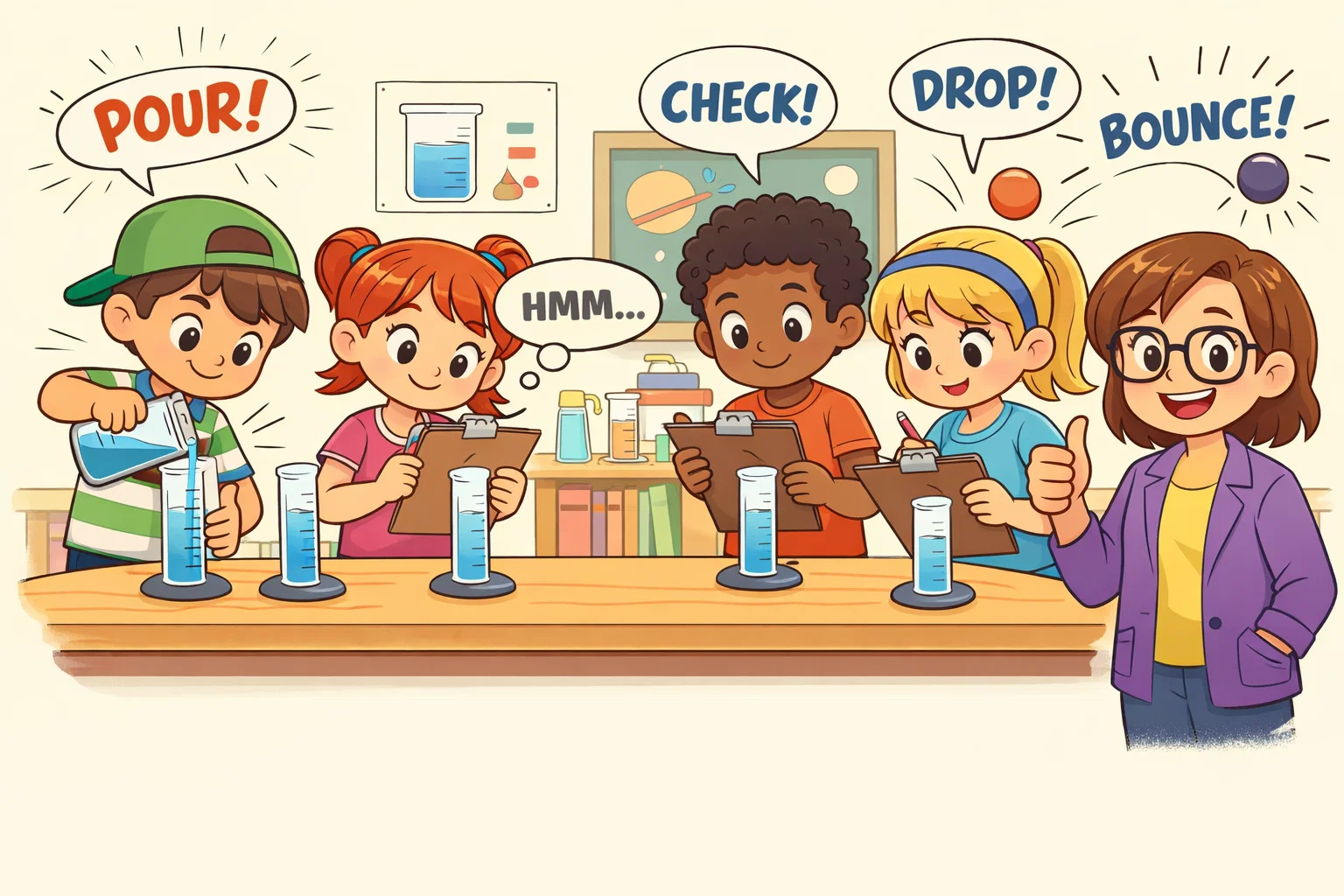
Have you ever noticed that your child’s first attempt at a science project looks nothing like the second? Perhaps their paper airplane soared across the kitchen on Tuesday but plummeted to the floor on Wednesday. In the world of child development, these “oops” moments are actually the foundation of working scientifically. Encouraging children to move beyond a “one and done” mindset helps them develop critical thinking and persistence. By teaching them how to conduct an experiment more than once, we help them understand that scientific measurements aren’t just about getting the “right” answer; they’re about finding a more reliable value through consistency.
Teaching kids about repeatable experiments goes beyond school grades; it’s about building a toolkit for life. When children learn to evaluate the validity of their own work, they are practicing academic research skills in a way that feels like play. This guide will walk you through the world of reliability and validity, explaining how multiple trials lead to reliable data and why repeating the experiment is the secret sauce to becoming a young scientist.
Working Scientifically with Repeatable Experiments
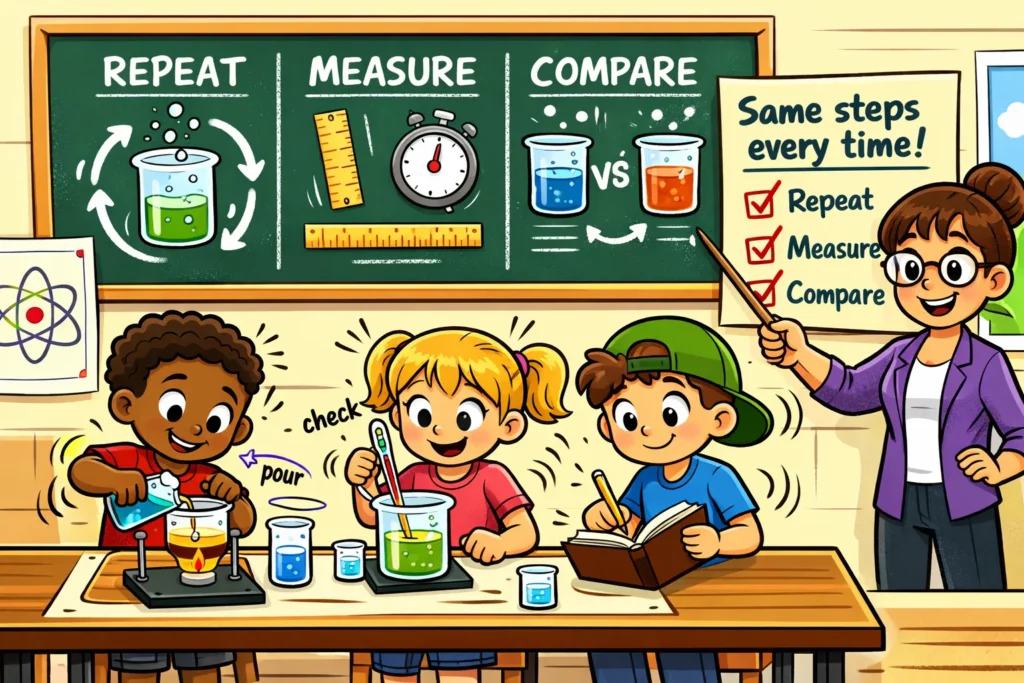
Working scientifically is a core part of the primary and secondary school curriculum. It isn’t just about wearing a lab coat; it’s about a specific way of thinking. When children conduct an experiment, they are following a process that requires them to be observant, patient, and precise.
Role of Repeatability in Kids’ Science Experiments
The main goal of repeatability is to ensure that the results obtained aren’t just a fluke. If a child drops a ball and it bounces 50cm, that is a single piece of data. If they drop it five more times and it reaches 50 cm each time, they have repeatable results. This consistency tells the child (and their teacher!) that their experimental results are solid. It teaches them that repetition reduces the role of luck and strengthens the evidence.
Connection Between Repeatability and Reliability Testing
In school science, a reliability test often simply means repeating the experiment to see if you get similar outcomes. If the results vary widely, the reliability of an experiment is low. By performing repeated trials, kids can increase the reliability of their project. It’s like a quality control check that they perform themselves.
Differences between one-time experiment and repeatable experiment
Think of a one-time experiment like a “lucky shot” in basketball. You might make the hoop once, but can you do it again? A repeatable experiment is like practicing your free throws until you can make ten in a row.
| Feature | One-Time Experiment | Repeatable Experiment |
| Data Points | Single set of data | Multiple sets of data |
| Trustworthiness | Low (could be a fluke) | High (more statistically sound) |
| Error Detection | Hard to see random errors | Easy to identify outliers |
| Scientific Value | Minimal | High (closer to academic research methods) |
Reliability Test Explained for Kids
Scientific terms like “reliability” can be tricky for younger learners, so it helps to use analogies they encounter in daily life, like a bathroom scale or a game of darts.
Meaning of reliability in experiments for kids
Reliability means being dependable. If you ask your friend what time it is and they say “10:00,” then you ask again a minute later and they say “2:00,” they aren’t reliable! In a laboratory (or your kitchen table), an experiment is reliable if it gives consistent results under similar conditions.
Reliability versus accuracy in kids experiments
This is a common point of confusion. Accuracy is how close a measurement is to the true value. Reliability (also called repeatability) is how close the measurements are to each other.
- High Reliability, Low Accuracy: You throw three darts and they all hit the “1” together. You are consistent, but you missed the bullseye.
- High Reliability, High Accuracy: You throw three darts and they all hit the bullseye.
Reliability versus validity in school science projects
You might have reliable data that is totally invalid. Validity asks: “Are you actually testing what you think you’re testing?” For example, if you want to see if temperature affects the rate of salt dissolving, but you use different amounts of water each time, your experimental data isn’t valid because you didn’t control your variables properly. To evaluate the validity, you must ensure your controlled variables stay the same.
Importance of Repeatable Experiments in Science Learning
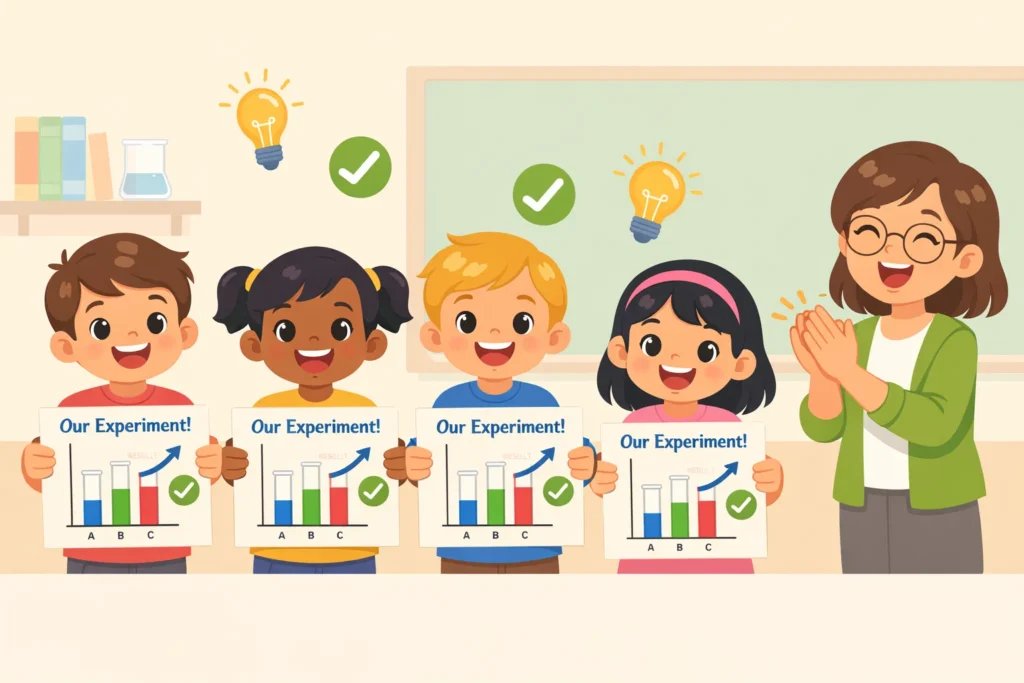
Why do we make kids do the same thing over and over? It’s not just busy work; it’s about the effect of random errors.
Error reduction through repeated trials
Even the best scientists make mistakes. Maybe a child started the stopwatch a split-second late or misread the volume of water in a beaker. These are random errors. By repeating the experiment, the mean value of all trials will likely be closer to the truth than any single measurement.
Result verification in kids experiments
When a child says, “I found that sugar dissolves faster in hot water,” a teacher will ask, “How do you know?” Being able to show multiple trials acts as verification. It proves that the results are consistent and not just a one-off random fluctuation.
Confidence building through consistent outcomes
There is a specific “aha!” moment when a child sees the same result three times in a row. It builds their confidence in their ability to conduct the experiment and their understanding of the hypothesis they are testing. They stop guessing and start knowing.
Types of Repeatable Experiments for Kids
Not all science experiments are measured with a ruler. Different types of inquiry require different ways of repeating the experiment.
Measurement-based experiments
These involve hard numbers. A classic example is the pendulum experiment.
- The Task: Measure how long it takes for a weight on a string to swing 10 times.
- The Repetition: Do this five times without changing the string length.
- Goal: Look for small differences between times (or calculate standard deviation for advanced learners) to see how consistent the swings are.
Observation-based experiments
These are about what you see. For instance, observing how a celery stalk changes color in dyed water. Since you can’t easily reverse the colour change in celery, you would set up multiple sets of the same experiment at the same time to see if the results obtained are the same across all plants.
Cause-and-effect experiments
These test a hypothesis. For example: “If I increase the temperature of the water, the tablet will fizz faster.” Here, the independent variable is the temperature. Kids must experiment with different temperatures but repeat each temperature setting at least three times to ensure reliable data.
How to Perform Reliability Test Step by Step
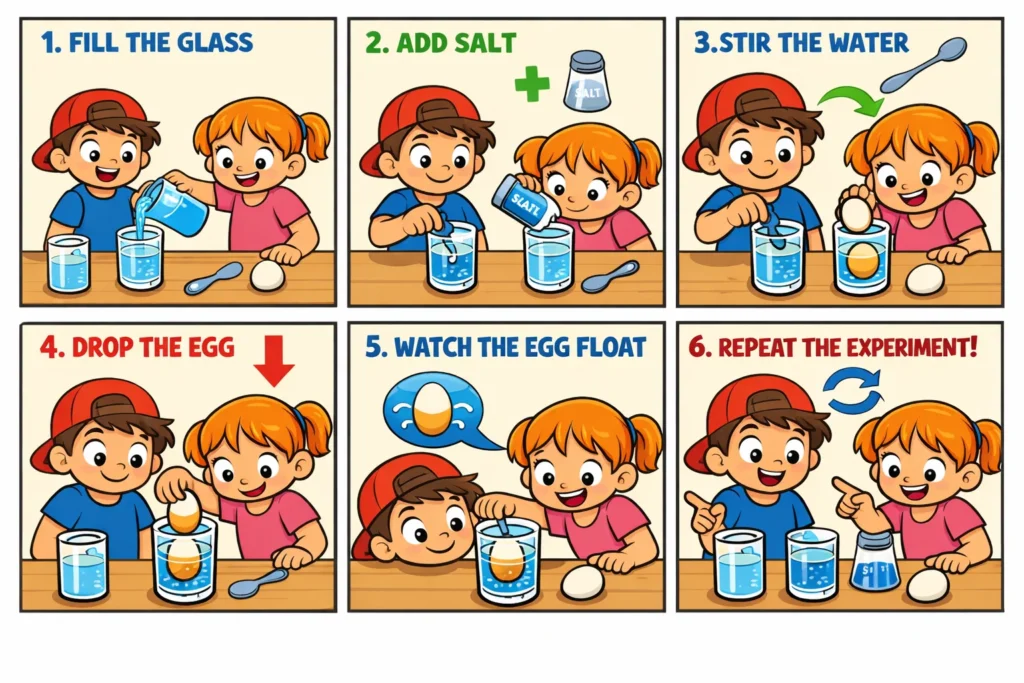
To increase the reliability of a project, kids should follow a structured approach. This mirrors the way work is accepted by the scientific community.
1. Choosing a single variable to test
In a measurement or experiment, you only change one thing at a time (the independent variable). Everything else—the dependent variables and controlled variables—must stay the same. If you change two things, you won’t know which one caused the change in results!
2. Keeping conditions the same in each trial
This is where kids need to calibrate their environment. If they are testing how far a toy car rolls, they need to use the same floor, the same push, and the same car every time. Even a small change can lead to systematic errors.
3. Repeating the experiment multiple times
How many times is enough? For most school projects, the “Rule of Three” is a great start. Repeating the experiment three times allows you to find a mean value and easily identify outliers.
4. Recording results clearly
Using a table is the best way to keep experimental data organized. It makes it easy to see if the results are consistent at a glance.
Sample Repeatable Experiments for Kids
| Experiment | Independent Variable | What to Repeat |
| Water Evaporation | Surface Area (Cup vs. Plate) | Measure the volume of water left after 24 hours, three times. |
| Paper Airplane | Wing Shape | Throw each design 5 times and measure distance. |
| Plant Growth | Amount of Light | Measure height of 3 plants in the same light every day. |
Water evaporation experiment
By placing three identical cups of water in the same spot, kids can see if they evaporate at the same rate. If one cup is different, they can look for a reason—was it near a draft? This helps them understand random fluctuations.
Paper airplane flight distance test
A single throw could be affected by a gust of wind or a shaky hand. By repeating the experiment 10 times, the child can look at how much the distances vary to see if their plane is a “steady flyer” or “unpredictable.”
Assessing Reliability in Kids Science Projects
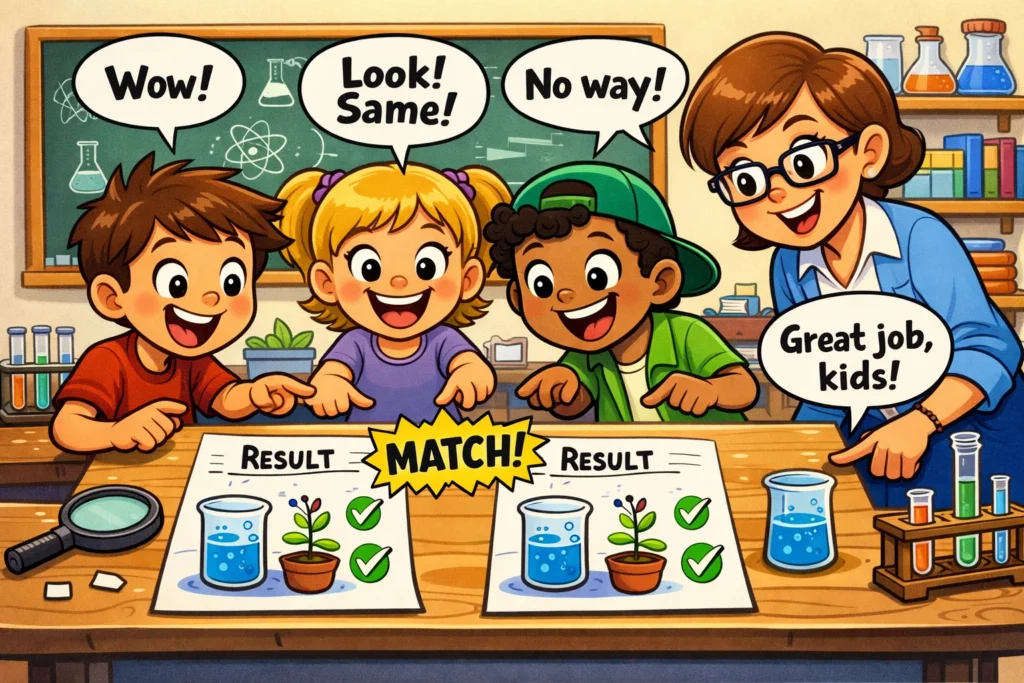
Once the data is in, it’s time to evaluate the validity and reliability.
Signs of reliable experiment results
If the results are consistent (e.g., 5.1s, 5.0s, 5.2s), the experiment is repeatable. The variation between results is small, and the child can be confident in their mean value.
Reasons results may vary
If the results are 5.0s, 9.0s, and 4.0s, something is wrong. Common causes include:
- Human error: Forgetting to stop the timer.
- Measurement system flaws: Using a ruler that is broken.
- Random errors: A sudden breeze or a change in room temperature.
- Outlier: A result that is very different from the rest.
“A single experiment can suggest a truth, but only repeatable experiments can prove it.” — Common Science Saying
Simple reliability checklist for kids
- Did I do the test at least 3 times?
- Did I use the same tools every time?
- Are my numbers close to each other?
- Did I change ONLY one thing?
Improving Reliability in Kids Experiments
If a child’s results are messy, don’t worry! This is the best time for working scientifically.
- Using the same tools for each trial: Don’t switch from a plastic ruler to a metal tape measure halfway through. This avoids systematic errors caused by a faulty measuring system.
- Increasing number of trials: If 3 trials are confusing, try 5 or 10. Multiple trials usually smooth out the effect of random errors.
- Careful measurement techniques: Teach kids to look at the “meniscus” when measuring liquids or to calibrate scales to zero before starting.
Reliable but Incorrect Experiment Results
Can an experiment be repeatable but wrong? Yes! This happens when there is a systematic error.
Example of consistent but wrong results
Imagine a child is measuring the temperature of the water, but their thermometer is broken and always reads 5 degrees too high. They will get consistent results every time they repeat the experiment, but those results will never reach the true value.
How to fix experiment design
To fix this, we calibrate our tools or experiment with different equipment to see if the results obtained change. This teaches kids to question their tools, not just their skills.
Common Questions About Reliability Tests for Kids
For most primary school projects, three repetitions are standard. For competitive science fairs or academic research at the high school level, 5 to 10 trials are often preferred to achieve statistically significant results.
Absolutely. This is the repeatability vs accuracy debate. If you consistently make the same mistake, your results are reliable (consistent) but inaccurate (wrong).
Teachers want to see a set of data, not just a single number. They look for a clear mean value and an explanation of any outlier that was found during repetition.