

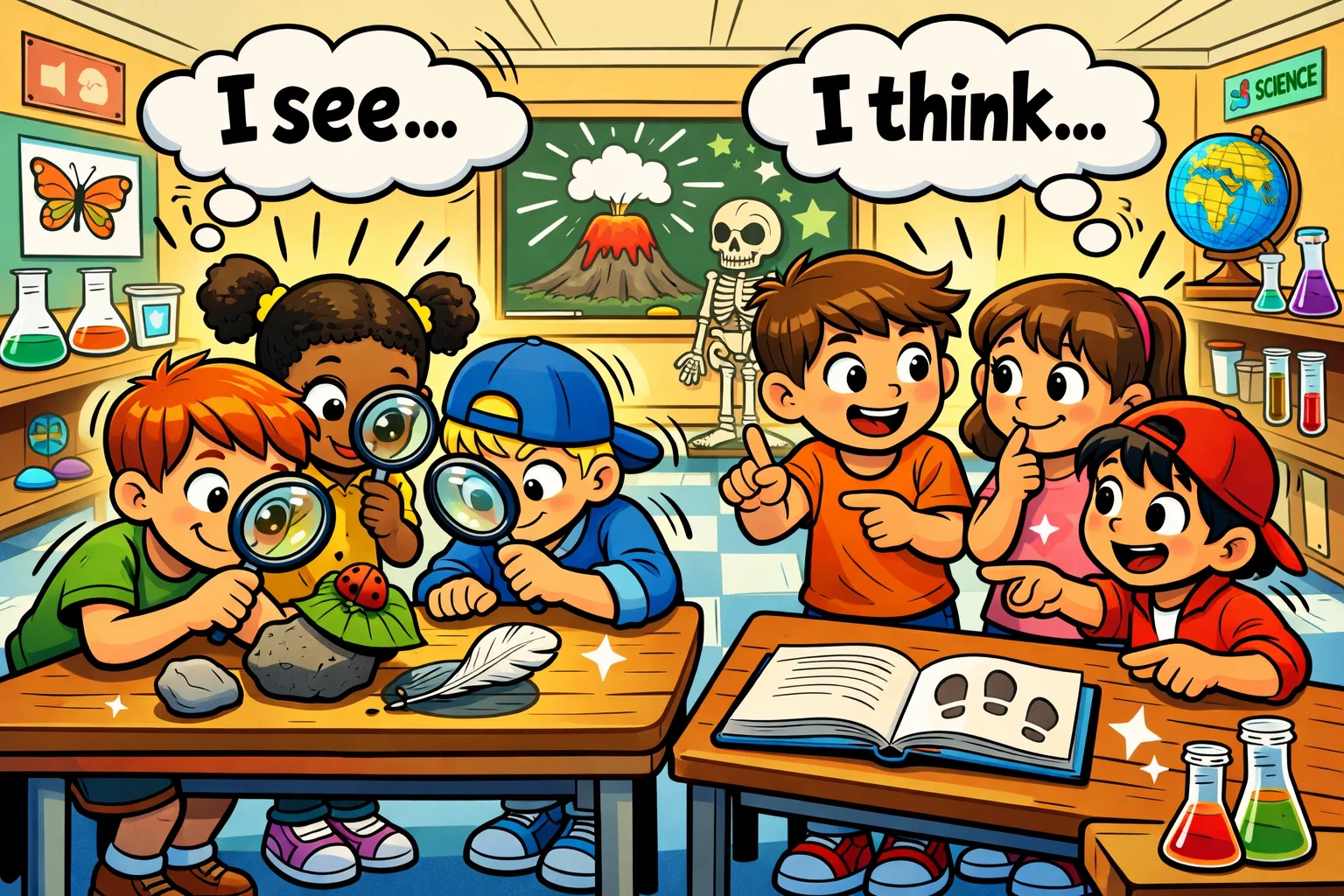
In the world of elementary and middle school science, teaching the difference between observation and inference is the cornerstone of the scientific method. Young learners are naturally curious, but they often struggle to separate what they actually see from what they think is happening. By introducing hands-on science activities that focus on these two distinct thinking skills, students can move from passive observation to active scientific thinking. This guide is designed to provide you with a comprehensive resource library – from lesson plan ideas to worksheet suggestions – to ensure your learners can differentiate between observation and inference in science.
The search intent for this topic usually revolves around finding practical, engaging ways to help students master the nature of science. Whether you are a teacher looking for classroom inspiration or a parent facilitating home learning, the goal is to provide instruction that makes the abstract concrete. By utilizing five senses and logical reasoning, kids can learn to make observations and inferences that are grounded in evidence rather than guesses. Below are practical ways to transform a standard science class into an interactive laboratory of discovery.
Observation vs Inference Basics
Before we can ask students to identify complex patterns in data, we must establish a solid definition for our core concepts. At its core, science relies on accurate data collection and logical interpretation. In a middle school or elementary setting, this starts with understanding how we gather information about the world around us.
Difference Between Observation and Inference
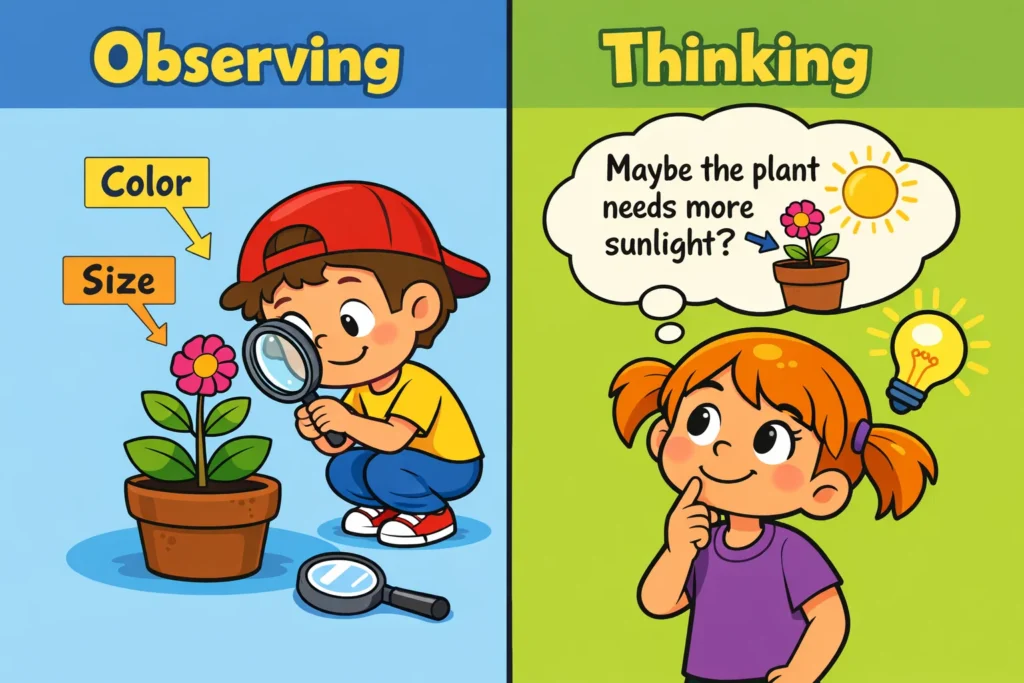
The difference between an observation and an inference is often the first “aha!” moment for a young learner. An observation is information gathered using the five senses (sight, smell, touch, taste, hearing). It is what is happening right now, right in front of you. An inference, on the other hand, is an explanation or conclusion based on the observation.
Think of it this way:
- Fact: The grass is wet.
- Inference: It rained last night (or the sprinklers were on).
Observation Skills in Kids Science
To collect data effectively, kids must learn to use their five senses as tools. In a science activity, we encourage them to observe an object and record its characteristic traits. This is where we introduce the difference between qualitative and quantitative data.
- Qualitative: Descriptions like “the leaf is fuzzy” or “the liquid is blue.”
- Quantitative: Measurements like “the leaf is 5cm long” or “there are 3 bubbles.”
Inference Skills in Science Activities
To infer is to take those sensory facts and relate them to prior knowledge. Inference skills involve drawing conclusions that are logical but not directly visible. When students make observations, they provide the “what”; when they draw inferences, they provide the “why.” This step is crucial for forming a hypothesis later in the scientific method.
Common Confusion Between Observation and Inference
A common error in the classroom occurs when a student says, “The girl is sad,” while looking at a picture of a girl crying. You must help your students realize that “the girl is crying” is the data point, while “the girl is sad” is the inference. She might be crying because she’s happy, or because she’s peeling an onion! Practice activities that clarify the difference between observation and inference are essential to prevent “guessing” in the lab.
Observation vs Inference Science Activities
Science skills are best developed through hands-on practice. Here are several activity ideas to get students excited about observation versus interpretation.
Hands-On Observation Activities
- The Mystery Bag: Place a common object (like a seashell or a pinecone) inside a bag. Have students explore using only their sense of touch. In their notebook, they should record qualitative traits.
- Liquid Layering: Use different densities of liquids. Ask the learner to note several details about how the layers sit without explaining why yet.
Inference Activities Using Visual Clues
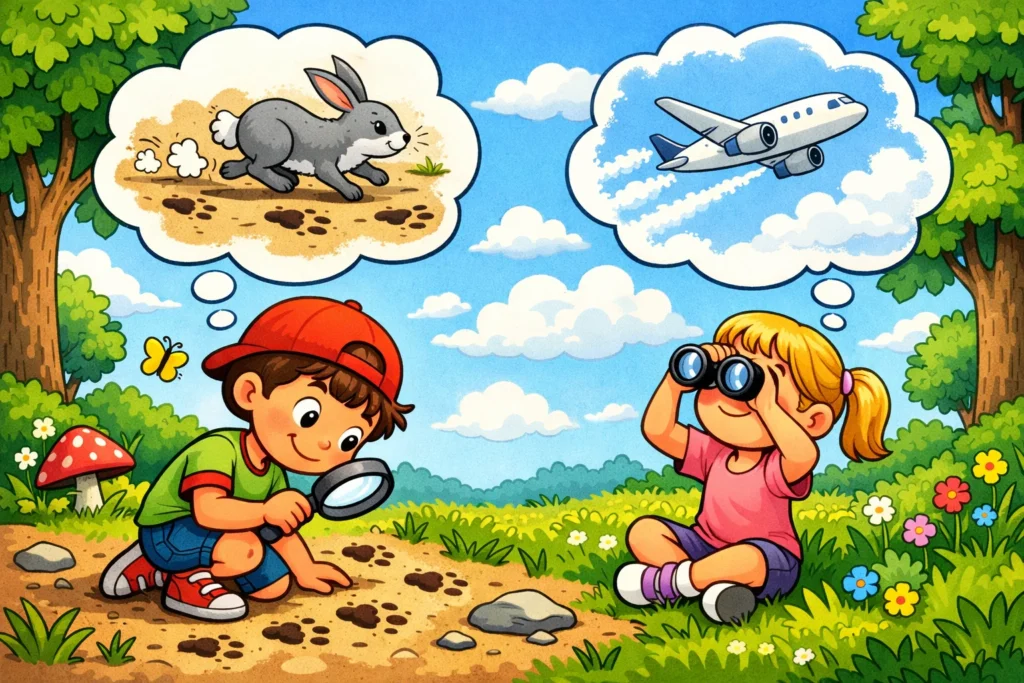
Use a PowerPoint or a series of statements about a photo to help students practice. Show a picture of a footprint in the mud.
- Task: Identify three observations about the item (size, depth, shape).
- Task: Make two inferences based on those facts (e.g., “A heavy animal walked here”).
Group Activities for Classroom Use
Divide the class into small groups. Give each pair a scenario card. One student describes the evidence, and the other must interpret what it means. This collaborative approach encourages students to justify the reasoning behind a specific conclusion.
Independent Activities for Home Learning
For parents, a simple activity is “The Kitchen Detective.” Have the child examine a mystery powder (flour, salt, or sugar). They should make observations regarding texture and color, then infer what it is based on those traits before tasting, if appropriate and supervised.
Lesson Plan Structure for Observation vs Inference
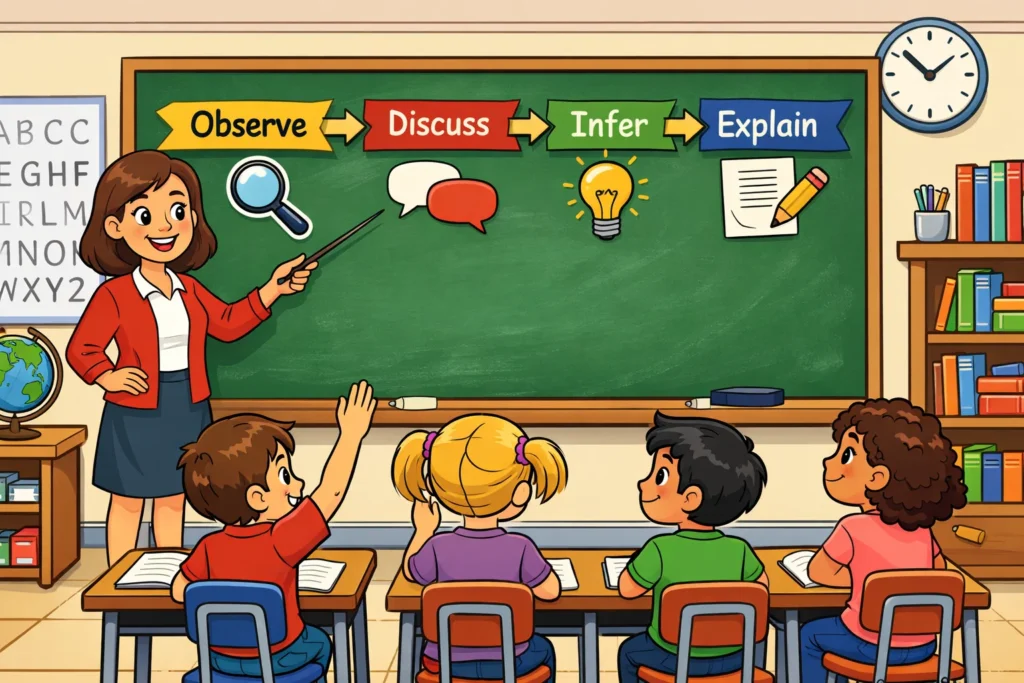
A well-rounded lesson plan ensures that students learn the concepts deeply. Below is a suggested framework for a 60-minute science class.
Learning Goals for Kids Science
- Identify the difference between observation and inference.
- Record qualitative and quantitative data in a notebook.
- Develop thinking skills to draw inferences from evidence.
Activity Timing and Lesson Flow
| Phase | Time | Description |
| Warm-Up | 10 min | Show a “Mystery Photo” and ask them to make 3 observations. |
| Instruction | 15 min | Define vocabulary using a PowerPoint presentation. |
| Main Task | 25 min | Small groups complete a “Cracking the Code” inference worksheet. |
| Wrap-Up | 10 min | Discussion: “What were the facts that led to your conclusion?” |
Materials and Preparation
- Interactive notebook or worksheet.
- Magnifying glasses.
- Assorted objects (rocks, feathers, fruit).
- PowerPoint slides with real world images.
Discussion Questions for Reflection
- “Was your statement a fact or an interpretation?”
- “How did your five senses help you gather information?”
- “Could someone else have a different inference from the same observation?”
Worksheets for Observation and Inference Activities
A good resource or worksheet acts as a scaffold. It should guide the learner through the process of recording data before jumping to conclusions.
Printable Observation Worksheets
Look for layouts that include a T-chart. On the left: “I see/hear/smell…” On the right: “I think this means…” This visually separates observations from inferences.
Inference Practice Worksheets
These often feature a scenario. For example: “The sky is dark, the wind is picking up, and birds are flying low.” Students must know the difference and check boxes to label observations or inferences.
Differentiated Worksheets by Age
- Lower Elementary: Focus on pictures and circling “See” or “Think.”
- Middle School: Require full sentences and the use of vocabulary like hypothesis and prediction.
Differentiation and Skill Levels
Not every learner starts at the same place. Additional support may be needed for some, while others might need a challenge.
Activities for Early Elementary Students
Use both indoor and outdoor activities. Take the kids for a walk. Ask students to find something red (fact) and guess why it’s there (inference).
Activities for Upper Elementary Students
Introduce a prediction vs. inference debate. A prediction is about the future, while an inference explains the present or past. Using an interactive notebook, have them track a plant’s growth over a week.
Support Strategies for Mixed-Ability Groups
Use sentence starters like:
- “I observe that…”
- “This inference is based on the observation that…”
Observation Vocabulary for Kids Science
Building a scientific vocabulary is essential for science language development.
Observation Word Lists
Encourage words beyond “good” or “weird.”
- Texture: Rough, grainy, sticky or thick, brittle.
- Appearance: Transparent, opaque, iridescent.
Inference Sentence Starters
- “Based on the fact that [observation], I infer that…”
- “The evidence suggests that…”
Assessment and Feedback Methods
How do you know if they understand the difference?
Formative Assessment During Activities
Circulate through the classroom while they work in small groups. Listen for inferences rather than observations. If a child says, “This rock is old,” ask, “What observation makes you say that?” (Is it the smoothed edges? The fossils?).
Written Assessment Using Worksheets
A simple “Sort” activity works well. Provide a series of statements and have students categorize them.
Digital Observation vs Inference Activities
In today’s hybrid learning environment, digital tools are a great resource.
Interactive Slides and Online Worksheets
Use interactive digital platforms or online classroom tools to create “drag-and-drop” activities. Students can identify elements of a photo and tag them as observations or inferences.
Use in Remote or Hybrid Learning
Virtual labs allow students to watch chemical reactions via video. They can record their findings in a digital notebook and share them with the class via screen sharing.
Real-World Observation vs Inference Examples
Nature Observation Activities
Take the lesson outdoors. Observe a bird’s nest.
- Observation: The nest is made of twigs and mud.
- Inference: The bird used local materials for stability.
Everyday Life Examples for Kids
Consider a lunchbox.
- Observation: There is an uneaten apple.
- Inference: The student may not have been hungry, or they don’t like apples.
Frequently Asked Questions
An observation is using your senses to note a fact. An inference uses observations to explain what may be happening.
These activities are most effective for middle school and elementary students, typically ages 7 to 14.
An inference explains something that has already happened or is happening now. A prediction is a guess about what will happen in the future based on observations.