
12 Best Memory Games for Kids to Boost Recall and Focus

 Discover a Free Education Video App for Kids
Pastory uses AI to personalize educational video content based on your child’s interests and personality. Safe, engaging, and built for curious young minds. Sign up now to stay updated and enjoy early access with a free trial
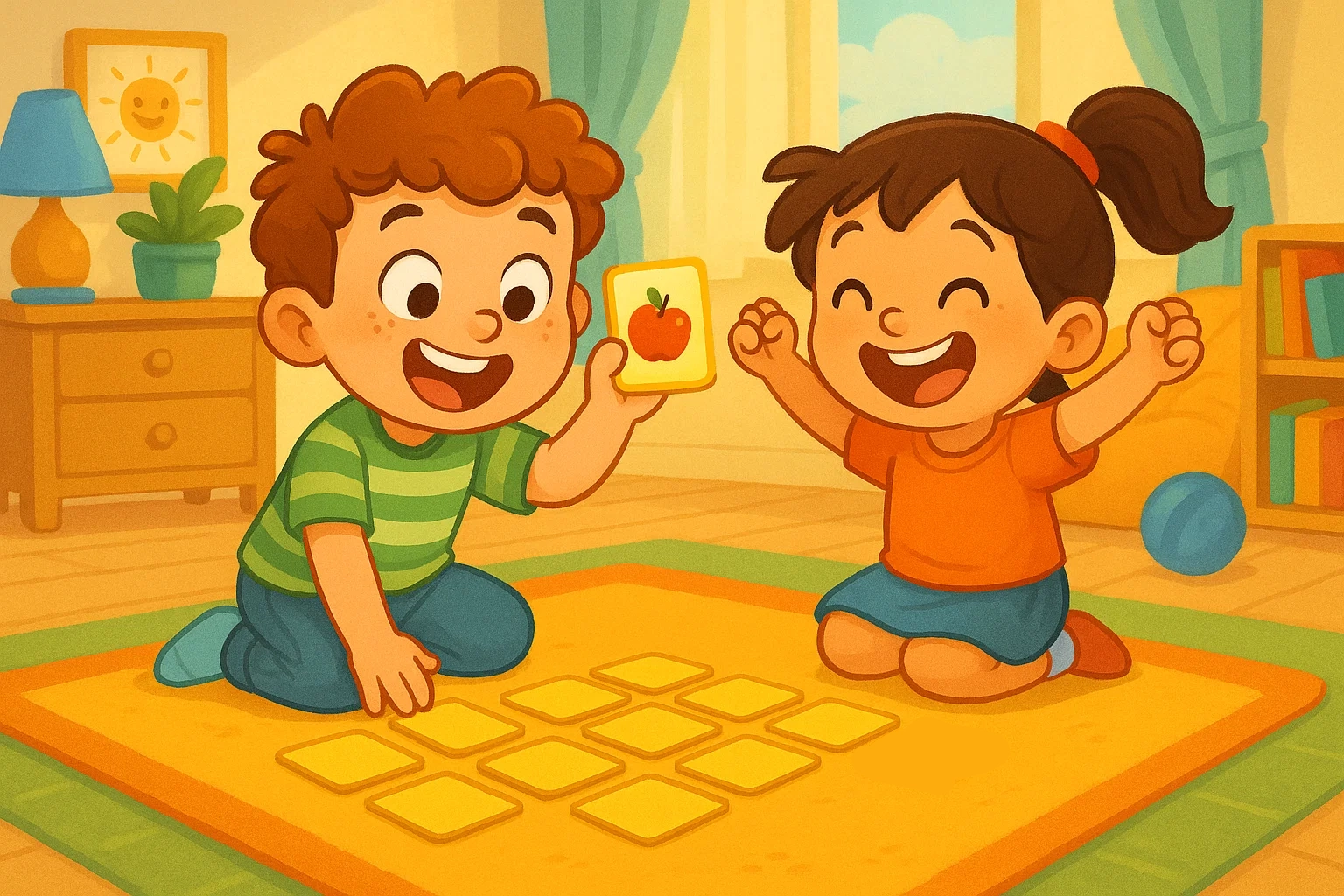
Memory games for kids do more than pass the time — they actively strengthen how children store, retrieve, and use information. This guide covers 12 games and activities organized by age and skill level, from classic matching card games and the tray game to rhyming challenges, trivia, and board games like Chess and Rummikub.
Each option supports short-term recall, focus, and critical thinking in a way that feels like play. Whether your child is a preschooler or a teenager, the picks here are practical enough to fit into everyday routines without special equipment or preparation.
Key Takeaways
- This guide covers 12 memory games and activities for children ages 3 through the teen years.
- Games are organized by age band: rhyme and object games for ages 3–6, focused picks for ages 6–8, board games and trivia for ages 7–11, and advanced challenges for older kids and teens.
- Activities include classic games (matching cards, Simon Says, the tray game) and no-prep everyday recall challenges — no special equipment required.
- Research suggests regular memory game practice supports short-term recall, working memory, focus, critical thinking, confidence, and communication skills — so yes, memory games do work when practiced consistently.
- App-based memory tools are also available for kids who enjoy screen-based practice; a curated list of reputable options is included below.
- Practical daily techniques, including mnemonic devices and storytelling chains, are covered in the final section.
Benefits of Memory Games for Improving Memory Skills
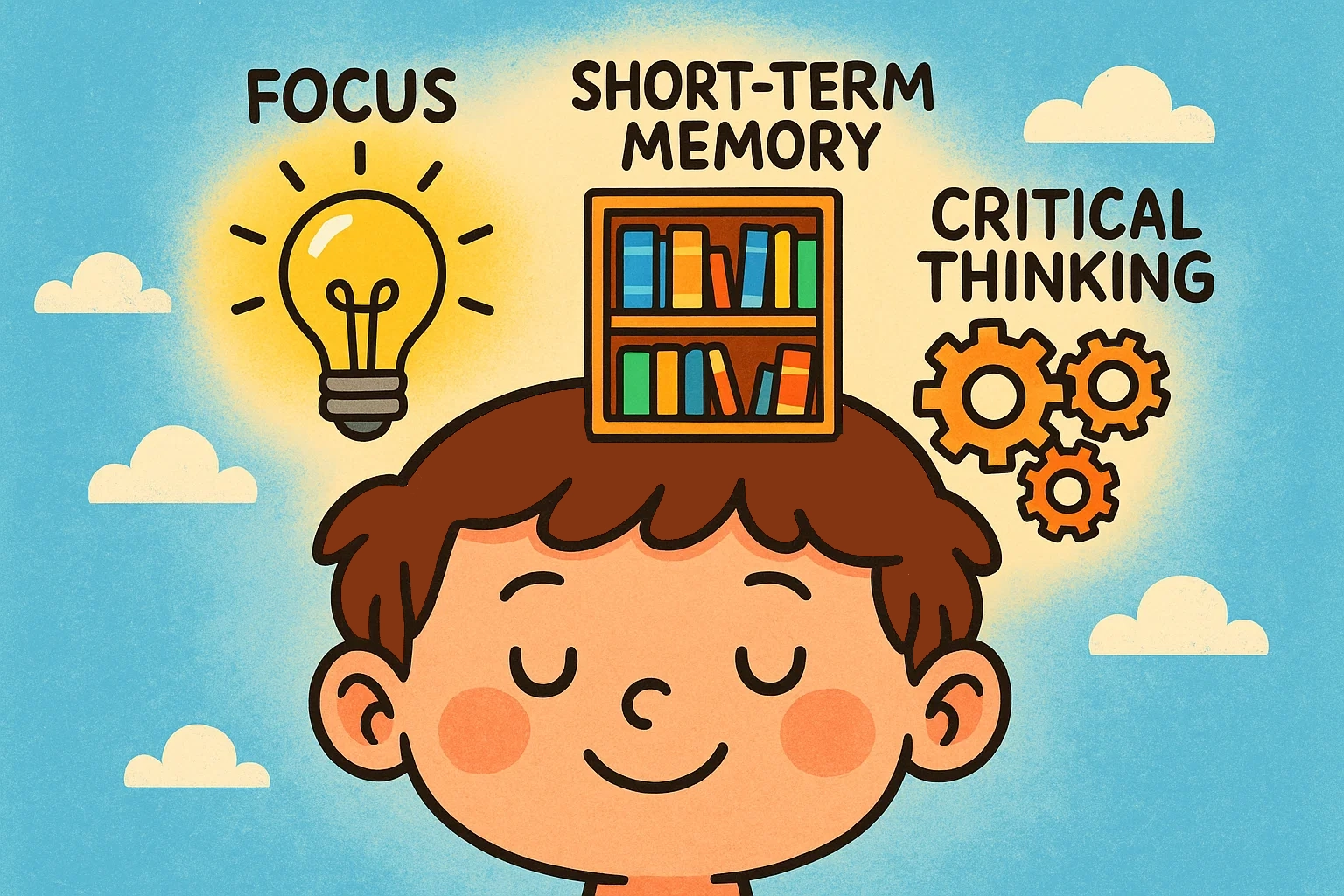
Memory games do far more than help children remember where they left their shoes. These engaging activities create measurable changes in how young minds process, store, and retrieve information. Understanding these benefits can help you appreciate why dedicating time to such play is worthwhile.
Develop Memory, Focus, and Short-Term Recall
When children play memory games, they exercise their working memory—the mental workspace that temporarily holds information while they use it. Think of working memory as a mental notepad where your child jots down important details before filing them away or acting on them.
Short-term memory improvements often appear within weeks of consistent practice. A child who struggles to remember three-step instructions may, after regular memory game sessions, successfully follow more complex directions. This skill transfers directly to classroom settings where teachers frequently give multi-step assignments.
Studies posted on ResearchGate indicate that children who engage in memory games for just 15-20 minutes daily show measurable improvements in attention span.
The connection between memory and focus is bidirectional. As children strengthen their memory skills, their ability to concentrate improves, which in turn allows them to encode memories more effectively. This creates a positive feedback loop that supports overall cognitive development.
Games Improve Learning Ability and Critical Thinking
Memory serves as the foundation for virtually all learning. When children can effectively recall information, they build knowledge upon existing frameworks rather than starting from scratch each time. Memory games help develop this essential ability to remember and connect concepts.
Consider how a child learning multiplication tables benefits from strong memory skills. Without the ability to quickly recall basic facts, more complex mathematical concepts become unnecessarily difficult. The same principle applies across all subjects—reading comprehension depends on remembering what happened earlier in the text, science builds on previously learned principles, and history requires connecting events across time.
Logical thinking develops naturally through many memory games. When playing matching pairs, children must devise strategies: Do they flip cards randomly or systematically work through rows? Should they prioritize remembering locations of specific high-value cards? These decisions mirror real-world problem-solving where success requires planning, recall, and adaptation.
| Cognitive Skill | How Memory Games Help | Real-World Application |
| Pattern Recognition | Identifying card positions, sequences | Math skills, reading fluency |
| Strategic Planning | Deciding which moves to make | Academic planning, time management |
| Information Processing | Quickly assessing and remembering details | Test-taking, following instructions |
| Adaptive Thinking | Adjusting strategies based on results | Problem-solving, flexibility |
Games Help Build Confidence and Communication Skills
Memory games often involve social interaction, creating natural opportunities for children to practice communication. When kids play together, they take turns, celebrate successes, and navigate disappointments—all valuable social-emotional skills.
A child who successfully remembers card locations or recalls a long sequence experiences genuine accomplishment. This positive reinforcement builds confidence that extends beyond the game itself. You might notice your child becoming more willing to attempt challenging tasks in other areas after experiencing success in memory activities.
Turn-taking in games teaches patience and respect for others. When the game starts, even young children learn to wait for their moment, understand rules, and accept outcomes gracefully. These soft skills prove invaluable in classroom settings and social situations throughout life.
Research posted on MDPI suggests that children who regularly engage in cooperative memory games demonstrate higher emotional intelligence scores. They develop better skills at reading social cues, managing frustration, and supporting peers—qualities that contribute to academic and personal success.
Support Decision-Making Skill Development
Every game requires decisions, and memory games are no exception. Should your child focus on finding matches or on memorizing locations for future turns? Is it better to play it safe or take a calculated risk? These micro-decisions build the neural pathways associated with executive function.
Decision-making in games provides a low-stakes environment where children can experiment with different approaches and immediately see results. Unlike real-world decisions with potentially serious consequences, game choices allow for experimentation and learning from mistakes.
The ability to recall previous outcomes and adjust strategies accordingly represents sophisticated cognitive processing. When a child remembers that choosing cards from a specific area yielded matches before, they’re applying memory to inform future decisions—a skill that translates directly to academic and personal contexts.
Top Memory Games and Activities for Kids of All Ages
Selecting the right memory activities makes the difference between engaged participation and frustrated boredom. The following games have proven effective across diverse age groups and learning styles, offering flexibility to match your child’s current developmental stage.
Matching Card Games: A Classic Memory Skill Builder
The classic memory card game remains popular because it works. Lay pairs of cards face-down in a grid, and players take turns flipping two cards, attempting to find matches. This simple format provides powerful cognitive benefits.
Card games exercise visual memory as children must remember the location and appearance of previously revealed cards. With younger children, start with fewer pairs—perhaps 6 to 8 matches. As their skills develop, gradually increase complexity by adding more pairs or introducing variations.
Consider these adaptations to maintain engagement:
- Theme variations: Use cards featuring your child’s favorite characters, animals, or educational content like sight words or numbers
- Speed rounds: Set a timer to add excitement and challenge older children
- Progressive difficulty: Begin each session with an achievable challenge, then increase pairs as your child succeeds
- Rule modifications: Allow younger players extra time to study the board before starting, or let them flip three cards instead of two
Parents report that consistency matters more than session length. Playing for 10 minutes daily yields better results than occasional hour-long sessions. The repetition helps children develop systematic approaches to memorization rather than relying on random guessing.
The Tray Game to Develop Memory and Object Recall
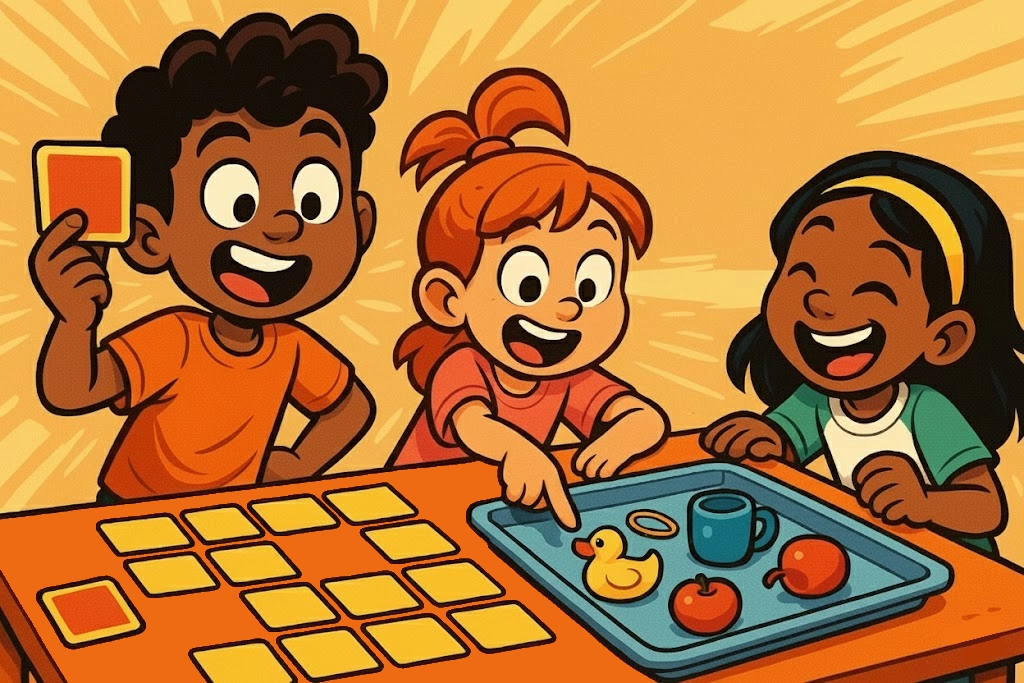
Place various objects on a tray—start with 5-7 items for younger children, up to 15-20 for older kids. Let your child study the items for 30 seconds to a minute, then cover the tray and ask them to recall as many objects as possible. This straightforward activity strengthens several memory dimensions simultaneously.
Visual memory gets an intense workout during the tray game. Children must quickly create mental snapshots of multiple items, then retrieve those images from memory. This skill directly supports reading (recognizing sight words), mathematics (recalling number patterns), and general observation.
The game becomes more challenging by introducing variations. Remove one item while the tray is covered and ask which disappeared. Rearrange items and request your child to identify what moved. These modifications keep the activity fresh while targeting different aspects of memory and attention.
Research from Springer Nature indicates that children who practice object recall games show improved performance in classroom settings where they must remember materials, instructions, and information presented visually by teachers. The ability to create detailed mental images proves valuable across academic subjects.
Spot the Difference: A Visual Memory Game
Present two nearly identical images and challenge your child to identify differences. This game helps develop careful observation and memory for details—skills that support reading comprehension, scientific observation, and careful work habits.
Many puzzle books offer spot-the-difference challenges at various difficulty levels. Digital versions add interactive elements that some children find engaging. The key is ensuring the challenge level matches your child’s current abilities while providing room for growth.
As children improve, introduce time limits or ask them to find differences without looking back and forth between images. These modifications increase the memory component, requiring children to hold details in mind rather than simply comparing side-by-side.
Simon Says: Copying Sequence Games
“Simon Says” and similar sequence games challenge children to remember and reproduce increasingly complex patterns. These activities specifically target working memory and sequential processing—the ability to remember information in the correct order.
In the traditional game, the leader gives commands prefaced with “Simon says,” and players follow only those instructions. The memory component intensifies when you introduce sequences: “Simon says touch your nose, then jump twice, then clap.”
Electronic versions of sequence games (like the classic Simon toy) require children to observe, memorize, and replicate light and sound patterns that grow progressively longer. Studies posted on Springer Nature show that regular practice with sequence games can improve children’s ability to follow multi-step directions and remember ordered information like phone numbers or alphabetical lists.
Consider creating homemade versions using colored paper squares or household objects. The sequence game concept adapts easily to whatever materials you have available, making it accessible regardless of budget.
The Rhyming Train: A Word Memory Game
Start with a simple rhyme or word, then take turns adding words that rhyme while recalling all previous additions. This game combines auditory memory with phonological awareness—understanding sound patterns in language.
For example, the game might progress: “cat,” “cat, bat,” “cat, bat, hat,” “cat, bat, hat, mat.” Each player must recall the entire sequence before adding their contribution. This cumulative structure provides intense memory practice in an engaging format.
Rhyme activities support early literacy development. Children who can identify and generate rhyming words typically find learning to read easier because they’ve developed phonemic awareness—the understanding that words consist of individual sounds that can be manipulated.
The rhyming train works particularly well during car rides or waiting situations. It requires no materials and naturally adapts to various skill levels by adjusting sequence length or difficulty of rhyme patterns.
The Magic Cups Game for Hiding Objects
Place a small object under one of three (or more) cups, then shuffle the cups while your child watches. Can they track which cup hides the object? This classic game exercises visual tracking and spatial memory.
Start slowly with younger children, making movements obvious and easy to follow. As skills develop, increase speed and complexity. Add more cups, use identical cups to eliminate distinguishing features, or include fake movements to increase difficulty.
The magic cups game teaches children to maintain focus on relevant information while filtering out distractions. This selective attention skill proves crucial in classroom environments where children must concentrate despite surrounding activity.
As eyes move across text, readers must track position and remember what they’ve already read—skills that the cups game helps build.
The Shopping List Recall Game
Create an imaginary shopping list, adding items one by one. “We need to buy milk.” “We need to buy milk and bread.” “We need to buy milk, bread, and apples.” Each person adds an item while recalling the complete list.
This game strengthens sequential memory and provides practical life skills. Children learn organizational strategies naturally as they discover techniques for remembering longer lists—perhaps grouping items by category or creating mental images of the items in order.
Organization skills develop organically through repeated play. Children might begin by randomly recalling items but gradually develop systematic approaches. Some create mental pictures of moving through store aisles, others group foods by type. These self-discovered strategies represent valuable metacognitive development—learning how to learn.
You can adapt the shopping list game to various themes: packing for vacation, planning a party, or listing things found in specific locations. These variations keep the game interesting while providing memory practice in different contexts.
Drawing a Picture By Memory
Show your child a simple drawing for 30 seconds, then remove it and ask them to recreate it from memory. This activity combines visual memory with fine motor skills and attention to detail.
Start with basic shapes and gradually introduce more complex images. A circle with two dots might progress to a house with windows and a door, then to more detailed scenes. The goal is challenging your child to remember increasingly complex visual information.
Hand-eye coordination develops alongside memory during drawing activities. As children work to recreate remembered images, they practice translating mental pictures into physical actions—a skill supporting handwriting, sports, and many other activities.
Consider discussing what strategies help your child remember details. Did they notice colors first? Shapes? Positioning? These conversations build metacognitive awareness, helping children understand their own learning processes and develop more effective memory techniques.
Memory Games and Activities by Age Group (Ages 3–6, 6–8, 7–11, and Teens)
Developmental stages significantly impact which memory activities prove most effective. What engages a preschooler might bore a teenager, while challenges appropriate for older children could frustrate younger ones. Matching activities to developmental stage ensures success and continued engagement.
Rhyme Games to Improve Memory for Preschoolers (Ages 3-6)
Preschoolers thrive with short, playful memory activities that incorporate movement and sound. Their attention spans typically range from 5-15 minutes, so brief, engaging sessions work best.
Younger children respond well to:
- Rhyming picture books: Read stories with strong rhyme patterns, then ask your child to predict rhyming words
- Action rhymes: Combine simple movements with rhyming words (“Jump for ‘cat,’ clap for ‘bat’”)
- Rhyme sorting: Provide picture cards and help children group images of rhyming objects
- Fill-in rhymes: Start familiar rhymes but pause before the last word, allowing your child to supply the rhyming completion
Memory activities at this age should feel like play rather than instruction. The goal is building positive associations with cognitive challenges while developing foundational skills that support later learning.
Research posted on ResearchGate suggests that preschoolers who engage in regular rhyming activities show measurable advantages in early reading skills.
For children ages 3–5 specifically, a few additional no-prep activities work especially well before they are ready for card-based games:
- Object-hiding game: Place three familiar toys on a table, let your child study them for 20 seconds, then hide one under a cloth and ask which is missing. Start with three objects and work up to five as confidence grows. This simple activity builds the visual recall and object permanence skills that underpin later reading and maths.
- Name-that-sound: Play short recordings of everyday sounds (a dog barking, water running, a bell ringing) and ask your child to identify and remember the sequence. Auditory recall practice at this age supports phonemic awareness and early literacy.
- What did we see?: After a short walk or a trip to the shops, ask your child to recall three things they noticed. Gradually increase the number over weeks. This low-effort habit builds episodic memory and observation skills that transfer directly to kindergarten readiness.
These activities require no equipment and take under five minutes, making them easy to weave into morning or bedtime routines. Children who practise simple recall games regularly before starting school tend to find it easier to follow multi-step classroom instructions — a key kindergarten readiness marker.
Memory Games for 6, 7, and 8 Year Olds (Early Elementary)
Children in the 6–8 age band are ready for games with more rules and longer play sessions, but still benefit most from activities that feel fun rather than academic. This age group is the most-searched for memory game recommendations, and the following options are well suited to their developmental stage.
- Classic Concentration (matching pairs): A standard 24-card deck (12 pairs) is a good starting point for 6 year olds. By age 7–8, children can handle 36–48 cards and benefit from timed rounds that add a gentle challenge without frustration.
- Guess Who?: Players hold a hidden character card and ask yes/no questions to identify the opponent’s character. The game builds working memory (tracking which characters have been eliminated) and deductive reasoning — skills that transfer directly to reading comprehension and maths problem-solving.
- Go Fish: This card game requires children to remember which cards other players have asked for, anticipate what opponents need, and recall their own hand — a natural working memory workout that most 6–8 year olds already enjoy.
- The tray game with categories: For this age group, add a twist by grouping tray objects into categories (three animals, three kitchen items, three toys). Asking children to recall items by category introduces chunking — a memory strategy they will use throughout school.
Aim for 10–15 minute sessions, two to three times a week. At this age, consistency matters more than duration, and short regular practice builds stronger recall habits than occasional long sessions.
Board Games for Memory Skill Enhancement (Chess, Rummikub)
Elementary-age children (7-11) can handle more complex games requiring strategic memory. Board games provide structured challenges that build multiple cognitive skills simultaneously.
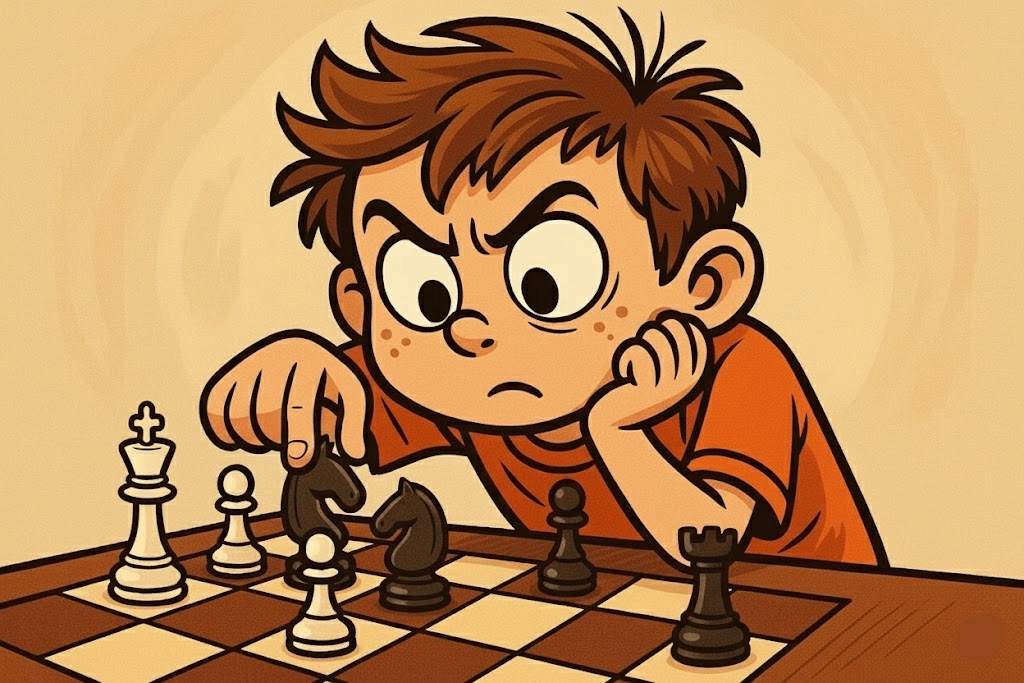
Chess demands players remember piece movements, plan several moves ahead, and recall opponent strategies. While it may seem advanced, simplified versions introduce young children to strategic thinking. Studies posted on frontiers indicate that children who play chess regularly show improvements in mathematical ability, reading comprehension, and executive function skills.
Rummikub challenges players to remember which tiles have been played, track what opponents might need, and identify opportunities to use their own pieces. The game develops number sense, pattern recognition, and strategic planning alongside skills.
Other beneficial board games include:
| Game | Primary Memory Skills | Additional Benefits |
| Memory/Concentration | Visual recall, spatial memory | Turn-taking, patience |
| Sequence | Pattern recognition, strategy | Logical thinking, planning |
| Mastermind | Deductive reasoning, recall | Problem-solving, persistence |
| Ticket to Ride | Route planning, resource management | Geography, strategic thinking |
The social aspects of board games provide additional benefits. Children learn to manage emotions during wins and losses, follow rules, and interact cooperatively or competitively in appropriate ways.
Trivia Games to Boost Brain Power and Recall
Trivia games challenge children to retrieve previously learned information quickly, strengthening long-term pathways. These games work well for children aged 8 and up, depending on content difficulty.
Creating family trivia nights using age-appropriate questions makes learning fun while building your child’s knowledge base. Questions might cover school subjects, current events, family history, or topics your child finds interesting.
Brain power increases when children regularly practice information retrieval. The act of searching memory for answers strengthens neural connections, making future recall easier. This principle—that retrieving information strengthens memory more effectively than simply re-reading it—is.
Digital trivia apps offer another option, providing immediate feedback and adaptive difficulty levels. However, ensure screen time remains balanced with physical activities and face-to-face social interaction.
Advanced Memory Games for Older Kids and Teens
Older children and teenagers benefit from sophisticated memory challenges that prepare them for academic demands and real-world situations.
Sudoku requires players to remember which numbers they’ve already placed while deducing what must go in empty cells. This puzzle strengthens working memory, logical thinking, and persistence.
Advanced matching games with larger grids (30+ pairs) provide intense memory workouts for teens. Consider thematic versions related to subjects they’re studying—matching historical figures with their achievements, chemical elements with their symbols, or vocabulary words with definitions.
Memory palaces represent a classical technique where individuals visualize a familiar location and mentally place items they need to remember in specific spots. Teaching teenagers this method provides a powerful tool for memorizing information for exams, speeches, or other situations requiring recall of specific details.
Code-breaking activities challenge teens to remember symbol systems, recognize patterns, and apply logical reasoning. These activities mirror the kind of abstract thinking required in advanced mathematics and science courses.
Best Apps for Memory Improvement for Kids
App-based memory games give children a structured way to practise recall skills independently, and several reputable options are designed with age-appropriate challenges and progress tracking. The following apps are widely used and cover a range of ages and skill levels.
- Lumosity (ages 10+): One of the most recognised brain-training platforms, Lumosity includes memory games targeting working memory, attention, and processing speed. The kids’ mode adjusts difficulty automatically based on performance, making it suitable for older children and teens.
- Elevate (ages 13+): Focused on language and maths skills alongside memory, Elevate is particularly useful for teens who want to sharpen recall in an academic context. Sessions are short (5–10 minutes) and fit easily into a daily routine.
- Khan Academy Kids (ages 2–8): While primarily a learning app, Khan Academy Kids includes memory and matching activities designed for preschool and early elementary children. It is free, ad-free, and well regarded by educators.
- Osmo (ages 3–12): Osmo combines physical play with a tablet screen, using tangible pieces that children manipulate to solve memory and pattern challenges. The hands-on format is especially effective for younger children who benefit from tactile engagement.
- Peak (ages 10+): Peak offers a variety of memory and cognitive games with clear progress metrics. Its memory-specific games focus on spatial recall, sequence memory, and working memory — skills that map directly to classroom demands.
A few practical guidelines when using memory apps with children: keep daily screen sessions to 15–20 minutes, choose apps that offer progress tracking so you can celebrate improvement, and balance app-based practice with the offline games and activities described throughout this guide. Apps work best as a supplement to, rather than a replacement for, face-to-face memory play.
Practical Techniques to Develop Memory Skills Daily
Beyond structured games, everyday activities offer countless opportunities to strengthen memory. Integrating these techniques into daily routines normalizes cognitive challenges and demonstrates that skills apply to real-world situations.
Mnemonic Devices: Ways to Improve Memory Retention
Mnemonics—memory aids that organize information into memorable formats—provide powerful tools for retaining specific information. Teaching your child various mnemonic techniques equips them with lifelong learning strategies.
Common mnemonic types include:
- Acronyms: Creating words from first letters (ROY G. BIV for rainbow colors)
- Acrostics: Sentences where first letters represent items to remember (“Every Good Boy Does Fine” for musical notes E, G, B, D, F)
- Rhymes: Information set to memorable rhythms (“In 1492, Columbus sailed the ocean blue”)
- Chunking: Breaking long numbers or lists into smaller groups (phone numbers: 555-123-4567)
Encourage your child to create their own mnemonics for information they need to memorize. Self-generated memory aids typically work better than those provided by others because the creation process itself strengthens memory encoding.
Storytelling Chain Games for Sequence Development
Collaborative storytelling strengthens sequential memory while encouraging creativity. Start a story with a simple sentence, then take turns adding details while recalling everything that came before.
“Once there was a dragon.” “Once there was a dragon who loved to read books.” “Once there was a dragon who loved to read books, especially mysteries.” The story grows more complex with each addition, requiring players to remember increasing amounts of information in proper sequence.
This activity mimics how we naturally remember events in our lives—as narratives with beginning, middle, and end. By practicing story structure, children strengthen the neural pathways they’ll use for comprehending complex texts and organizing their own written work.
Listening skills develop naturally through storytelling games. Children must pay careful attention to others’ contributions to continue the narrative coherently. This active listening translates directly to classroom success where missing key information can derail understanding.
Daily Activities Fostering Visual Memory Skills
Everyday situations provide natural opportunities for visual practice. When leaving a location, ask your child to describe the room they just left: “What color was the couch? How many windows were there? What pictures hung on the walls?”
Observation skills sharpen through regular practice. Children become more attentive to their surroundings when they know you might ask them to recall details later. This heightened awareness supports safety (remembering where they left belongings, noticing changes in familiar environments) and academic performance (carefully observing experiments, noting details in reading passages).
License plate games during car trips exercise visual memory. Challenge your child to remember plates from multiple vehicles, recalling numbers, letters, or state names. These simple activities transform mundane travel time into valuable cognitive practice.
Cooking together provides excellent visual memory opportunities. Ask your child to gather ingredients from the pantry without referring back to the recipe. Have them help set the table, then check whether they’ve included all necessary items from memory.
Auditory Memory Games and Activities For Learning
Auditory memory—remembering information heard rather than seen—requires dedicated practice since modern life emphasizes visual input. Children with strong auditory memory skills find following verbal instructions, learning through lectures, and remembering conversations much easier.
Try these activities to enhance auditory memory:
- Telephone game: Whisper a phrase to your child, who passes it to another person, testing how accurately the message transmits
- Memorize songs or poems: Learning verses strengthens memory for sound patterns and meaning
- Follow multi-step verbal directions: Give increasingly complex instructions without visual cues
- Audio stories: After listening to a story together, discuss plot points and details without referring back to the text
Musical training provides particularly powerful auditory memory development. Learning instruments requires remembering sequences of notes, rhythms, and techniques—all auditory-spatial information.
When possible, minimize background noise during auditory memory activities. Children develop stronger listening skills when they practice in quiet environments before progressing to filtering relevant sounds from distractions.

Take a short quiz to find out what your everyday choices say about your parenting style
When your child is curious about something new, what’s your instinct?
Take a short quiz to find out what your everyday choices say about your parenting style
“Can I download this app?” What happens next?
Take a short quiz to find out what your everyday choices say about your parenting style
When it comes to rules at home, which sounds most like you?
Take a short quiz to find out what your everyday choices say about your parenting style
If you could give your child one life skill today, what would you pick?
Take a short quiz to find out what your everyday choices say about your parenting style
Your child gets to choose what to watch. What would your ideal setup look like?
Take a short quiz to find out what your everyday choices say about your parenting style
Pick your parenting superpower ✨



