Best Party Games for 5-Year-Olds: Indoor Birthday Picks

 Discover a Free Education Video App for Kids
Pastory uses AI to personalize educational video content based on your child’s interests and personality. Safe, engaging, and built for curious young minds. Sign up now to stay updated and enjoy early access with a free trial
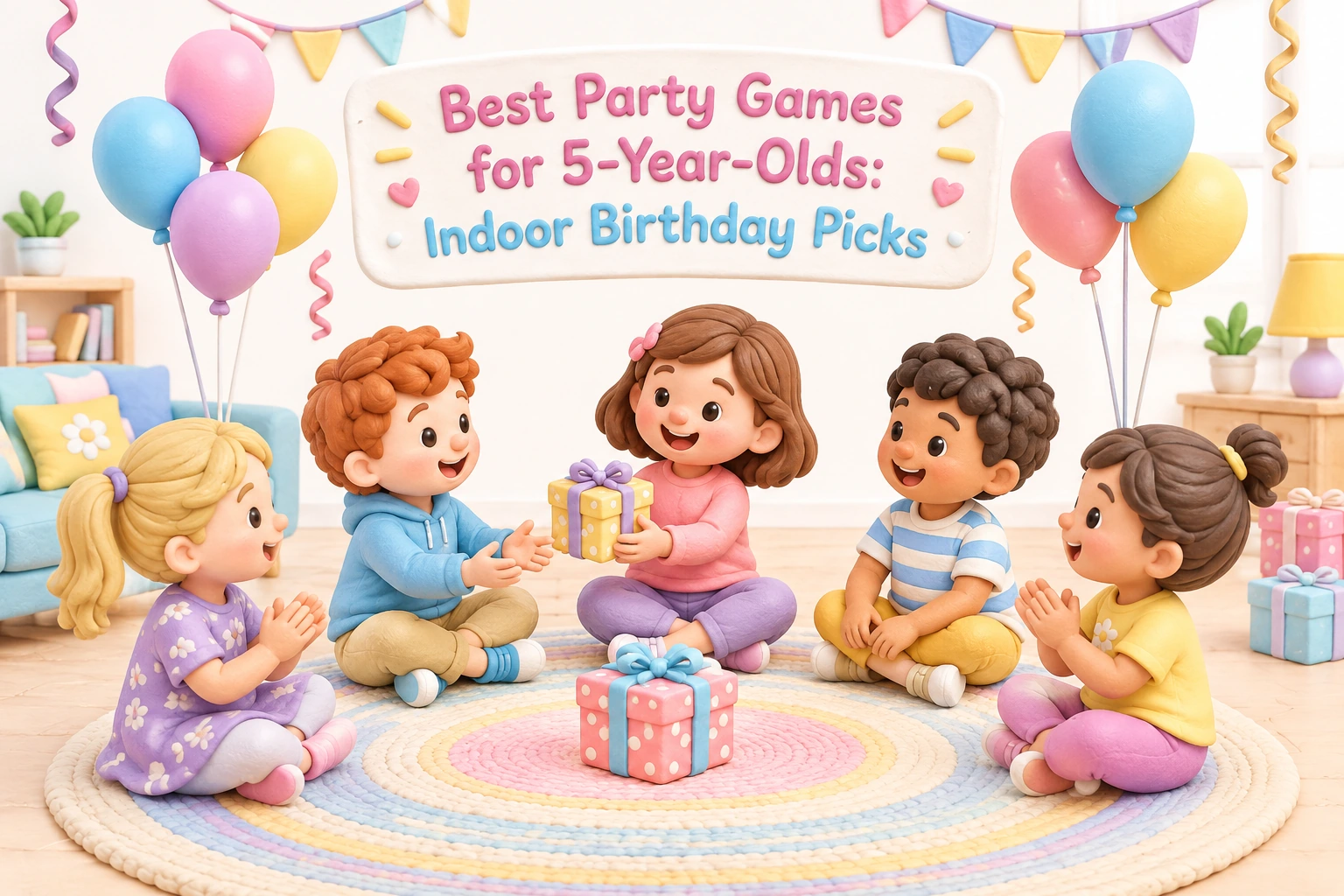
Planning indoor birthday party games for 5-year-olds is genuinely different from organizing activities for older children. At this age, kids are enthusiastic, energetic, and eager to join in — but their attention span typically runs between five and fifteen minutes per activity, and the gap between a child who grasps rules quickly and one who needs a little more time can be wide. The good news is that five-year-olds are also at a developmental sweet spot: they love cooperative play, they respond brilliantly to silliness, and they are motivated by participation rather than winning. This guide covers the best indoor games for a fifth birthday party, organized by energy level, with practical timing guidance, no-elimination adaptations, themed variations, and a sample two-hour party schedule to help you plan with confidence.
Key Takeaways
- Five-year-olds have short attention spans, so plan games that last 5–12 minutes each and keep transitions brisk.
- No-elimination rules keep every child engaged and prevent tears — most classic games can be adapted easily.
- Sequence games deliberately: start with an icebreaker, build to high-energy games, then use a calm-down game before food.
- Six to ten games is a realistic target for a two-hour indoor birthday party, including a snack break.
- Participation prizes and small stickers work better than competitive rewards for this age group.
Why Game Structure Matters at Age Five
Five-year-olds are in the kindergarten and preschool-age developmental window, a period when gross motor skills are expanding rapidly and social skills such as turn-taking and following directions are still being consolidated. Research in early childhood development consistently shows that children this age learn best through play, and that cooperative play — where everyone works toward a shared goal or simply enjoys the activity together — tends to produce more positive social outcomes than purely competitive formats. This does not mean competition is harmful; it means that when one child is eliminated and must sit and watch, the experience can feel disproportionately disappointing at this age.
Practically, this means the best party games for 5-year-olds share a few characteristics: simple rules that can be explained in under a minute, enough physical movement to channel energy, and a structure that keeps every child active for as long as possible. When you choose games with these qualities, you reduce the chance of meltdowns and increase the chance that every child — including shy guests or younger siblings — leaves feeling like they had a great time.
Classic Party Games That Still Work Brilliantly
Classic games remain popular for a reason: children already have a rough sense of how they work from nursery or preschool, which shortens the explanation time considerably. Below are the most reliable classics for an indoor birthday party, each with a no-elimination adaptation and an approximate running time.
Musical Chairs and Musical Statues
Musical Chairs is one of the most recognized indoor birthday party games for 5-year-olds, but the traditional version — where one child is eliminated each round — can cause distress. The no-elimination version is simple: when the music stops, children find a chair, but instead of removing a chair each round, you simply celebrate whoever sat down fastest. Everyone stays in the game until the final round, when one chair remains and the child who reaches it wins a small prize. Musical Statues works similarly: when the music stops, children freeze, and rather than eliminating anyone who moves, the host simply picks the most impressive freeze pose to celebrate. Both games run comfortably for 8–10 minutes.
Pass the Parcel
Pass the parcel is a perennial favourite for good reason. Wrap a small prize in multiple layers of paper, with a tiny treat or sticker between each layer. Children sit in a circle and pass the parcel while music plays; when the music stops, the child holding the parcel unwraps one layer. If you plan the layers carefully — one per child — every guest gets a turn to unwrap, which eliminates the frustration of never getting a go. The final layer reveals the main prize. Running time: 8–12 minutes depending on group size.
Simon Says
Simon Says requires zero supplies and zero preparation, making it one of the most useful backup games in a host’s toolkit. The leader calls out instructions prefaced by “Simon says” — children must only follow instructions that include that phrase. For five-year-olds, keep instructions physical and silly: “Simon says hop on one foot,” “Simon says make a dinosaur face.” Rather than eliminating children who follow a command without “Simon says,” simply celebrate the children who caught the trick and keep everyone playing. Running time: 5–8 minutes.
Duck Duck Goose
Duck Duck Goose is a circle game that works well as an icebreaker game at the start of a party, when children are still arriving and may not know each other well. Children sit in a circle; one child walks around tapping heads and saying “duck” until they choose someone and say “goose,” then runs back to the empty spot. The developmental value here is genuine: the game builds anticipation, turn-taking, and light physical coordination. It runs naturally for 6–10 minutes before energy shifts elsewhere.
High-Energy Games for Peak Party Excitement
After the initial icebreaker, five-year-olds are ready for high-energy games that let them run, jump, and be loud. These work best in an open living room, hallway, or cleared floor space. Lay down any breakable items beforehand and ensure the floor surface is safe for movement.
Freeze Dance
Freeze dance is arguably the easiest high-energy game to run at an indoor birthday party. Play music — ideally from the birthday child’s favourite playlist — and children dance freely. When the music stops, everyone freezes. The host can award a small sticker to the most creative freeze pose, but the game works just as well without any prize at all. Freeze dance supports gross motor skills and body awareness, and it is genuinely inclusive: there is no way to be bad at it. Running time: 8–10 minutes, or longer if the children are loving it.
Balloon Games
Balloon games are a category rather than a single game, and they are consistently among the most popular indoor birthday party games for 5-year-olds. Balloon keepy-uppy — where children try to keep a balloon off the floor — can be played individually or as a team. Balloon stomp involves tying a balloon to each child’s ankle and trying to pop others’ balloons while protecting your own; for a no-elimination version, simply count how many balloons each child pops rather than eliminating anyone whose balloon is popped. A balloon relay race, where children carry a balloon between their knees from one end of the room to the other, adds a coordination challenge that five-year-olds find hilarious. Allow 8–12 minutes for balloon games and have spare balloons ready.
Obstacle Course
An indoor obstacle course can be assembled from cushions, hula hoops, masking tape lines on the floor, and chairs to crawl under. Children take turns navigating the course while others cheer. The host can time each child with a phone stopwatch, and every child receives a participation sticker for completing the course. An obstacle course is particularly good for mixed-age groups because it can be adjusted in difficulty on the fly — younger siblings can take a simpler route. Running time: 10–15 minutes depending on group size.
Red Light Green Light
Red Light Green Light is a classic movement game where the host calls “green light” for children to move forward and “red light” for them to freeze. Children who move on red light traditionally go back to the start, but for five-year-olds, simply celebrating the children who froze perfectly keeps the energy positive. The game builds listening skills and impulse control — both genuinely relevant developmental skills at this age. Running time: 6–8 minutes.
Hot Potato
Hot Potato involves passing an object — a beanbag, a soft toy, or a wrapped parcel — around a circle while music plays. When the music stops, the child holding the object is “out” in the traditional version. For a no-elimination adaptation, the child holding the object simply performs a silly challenge (a funny dance, an animal noise) before the game continues with everyone still playing. Running time: 6–8 minutes.
Calm-Down Games: The Wind-Down Before Cake
One of the most overlooked elements of party game planning is the wind-down before cake. After 30–40 minutes of high-energy games, five-year-olds need a transition activity that brings their heart rate and noise level down before they sit for food. Skipping this step often results in overexcited children who struggle to sit still, which makes the cake moment more chaotic than celebratory.
Sleeping Lions
Sleeping Lions is the gold standard calm-down game for this age group. Children lie on the floor as still and quiet as possible, pretending to be sleeping lions. The host walks around trying to make them move or laugh — without touching them — using funny faces, silly voices, or gentle commentary. Children who move become “hunters” and help the host. The game naturally quiets the room within two minutes and can run for 5–8 minutes. It is also genuinely useful for children with sensory sensitivities who may have found the louder games overwhelming.
Copycat and Follow the Leader
Follow the Leader is a cooperative game where children line up behind the birthday child and copy every movement the leader makes — tiptoeing, stretching, spinning slowly, pretending to swim. The leader role can rotate so every child gets a turn. This game is calm enough to serve as a wind-down activity while still keeping children engaged and moving gently. Running time: 5–8 minutes.
Bubble Pop
Blowing bubbles and letting children pop them is a deceptively effective calm-down activity. It requires minimal coordination, produces genuine delight, and naturally slows children’s breathing and movement. It works particularly well outdoors but can be managed indoors with a towel on the floor. Running time: 5 minutes as a transition activity.
Zero-Prep Games for When You Need a Backup
Every party host should have two or three games in reserve that require absolutely no supplies. These are invaluable when a planned game finishes faster than expected, when a prop goes missing, or when the energy in the room shifts unexpectedly.
- Simon Says — described above; genuinely requires nothing.
- The Floor is Lava — children must avoid touching the floor by stepping on cushions, mats, or designated safe zones. Announce “the floor is lava” and watch the room transform instantly. No supplies needed beyond whatever cushions are already in the room.
- Animal Parade — the host calls out an animal and children move around the room imitating it. Rotate animals every 20–30 seconds. Completely supply-free and endlessly adaptable.
- Copycat Circle — children sit in a circle; one child makes a movement and everyone copies it. Simple, cooperative, and calming.
Theme-Based Game Variations
One of the most effective ways to make standard games feel special is to apply a party theme as a simple overlay. The game mechanics stay the same — which means children can follow the rules easily — but the theming adds excitement and cohesion to the party experience.
- Superhero party: Freeze Dance becomes “Hero Freeze” — children strike a superhero pose when the music stops. Simon Says becomes “Captain [Child’s Name] Says.”
- Pirate party: A picture-clue treasure hunt works perfectly here. Draw simple picture clues rather than written ones (since many five-year-olds are still developing reading skills) and hide a small treasure chest of party favors at the end. This is one of the most memorable indoor birthday party games for 5-year-olds when executed with a theme.
- Dinosaur party: The obstacle course becomes a “dinosaur escape route.” Animal Parade uses only dinosaur movements.
- Princess or unicorn party: Pass the Parcel uses a wand as the object. Musical Statues becomes “Enchanted Freeze” — children must freeze in a magical pose.
- Science lab party: Balloon games become “science experiments.” The obstacle course is a “laboratory challenge course.”
Theme-based variations require almost no extra preparation — the key is simply renaming the game and framing it with a short, enthusiastic introduction from the host.
A Sample Two-Hour Party Game Schedule
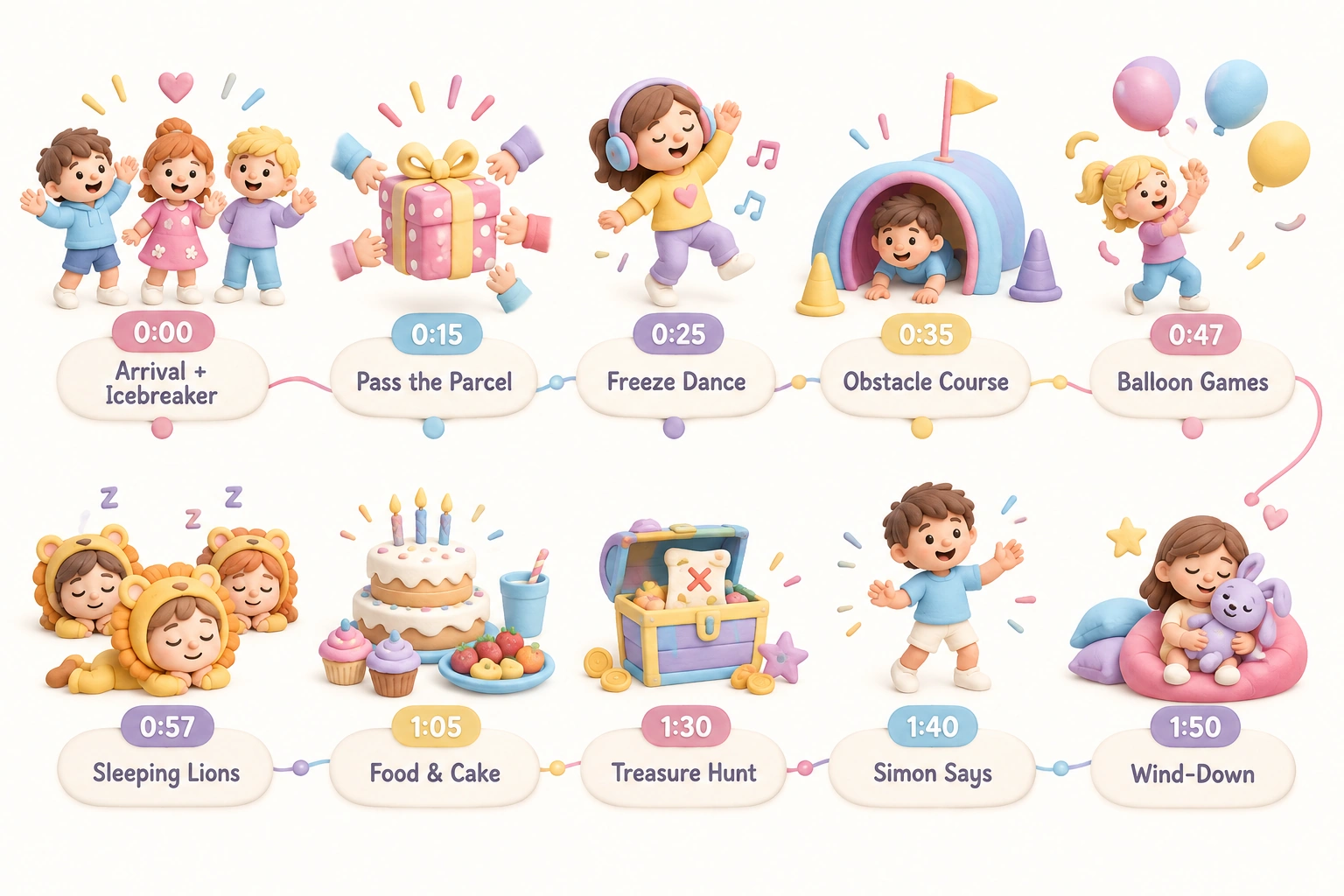
Game sequencing logic matters more than most party planning guides acknowledge. Starting with a calm icebreaker game gives arriving children something to do immediately and helps shy guests settle in. Building to high-energy games in the middle of the party captures peak energy. Placing a calm-down game before food prevents the chaos that comes from transitioning directly from running games to sitting for cake.
| Time | Activity | Duration | Notes |
|---|---|---|---|
| 0:00–0:15 | Arrival + Duck Duck Goose or free play | 15 min | Icebreaker game as guests arrive |
| 0:15–0:25 | Pass the Parcel | 10 min | Settle the group into a circle |
| 0:25–0:35 | Freeze Dance | 10 min | First high-energy game |
| 0:35–0:47 | Obstacle Course | 12 min | Peak energy activity |
| 0:47–0:57 | Balloon Games | 10 min | Team or individual balloon keepy-uppy |
| 0:57–1:05 | Sleeping Lions | 8 min | Wind-down before cake |
| 1:05–1:30 | Food, cake, and singing | 25 min | Snack break |
| 1:30–1:40 | Picture-Clue Treasure Hunt | 10 min | Post-food re-engagement |
| 1:40–1:50 | Simon Says or Musical Statues | 10 min | Final active game |
| 1:50–2:00 | Follow the Leader + goody bags | 10 min | Calm wind-down, farewell |
This party game schedule is a guide rather than a rigid script. If a game is going exceptionally well, let it run a few minutes longer. If children lose interest quickly, move on without hesitation — five-year-olds will not notice or mind.
Prize and Reward Strategy: Keeping It Fair
Prize management is one of the most underplanned aspects of birthday party games for 5-year-olds, and it is a common source of tears. At this age, children understand fairness acutely but do not yet have the emotional regulation to handle losing gracefully every time. A few practical principles help significantly.
Participation prizes — small stickers, a stamp on the hand, or a single wrapped sweet — work better than competitive prizes for most games. Reserve one slightly larger prize (a small toy, a packet of stickers, a mini colouring set) for the final game of the party, and frame it as a reward for everyone who played so well all afternoon. This approach means every child leaves with something, which reduces the risk of a child feeling singled out as a loser.
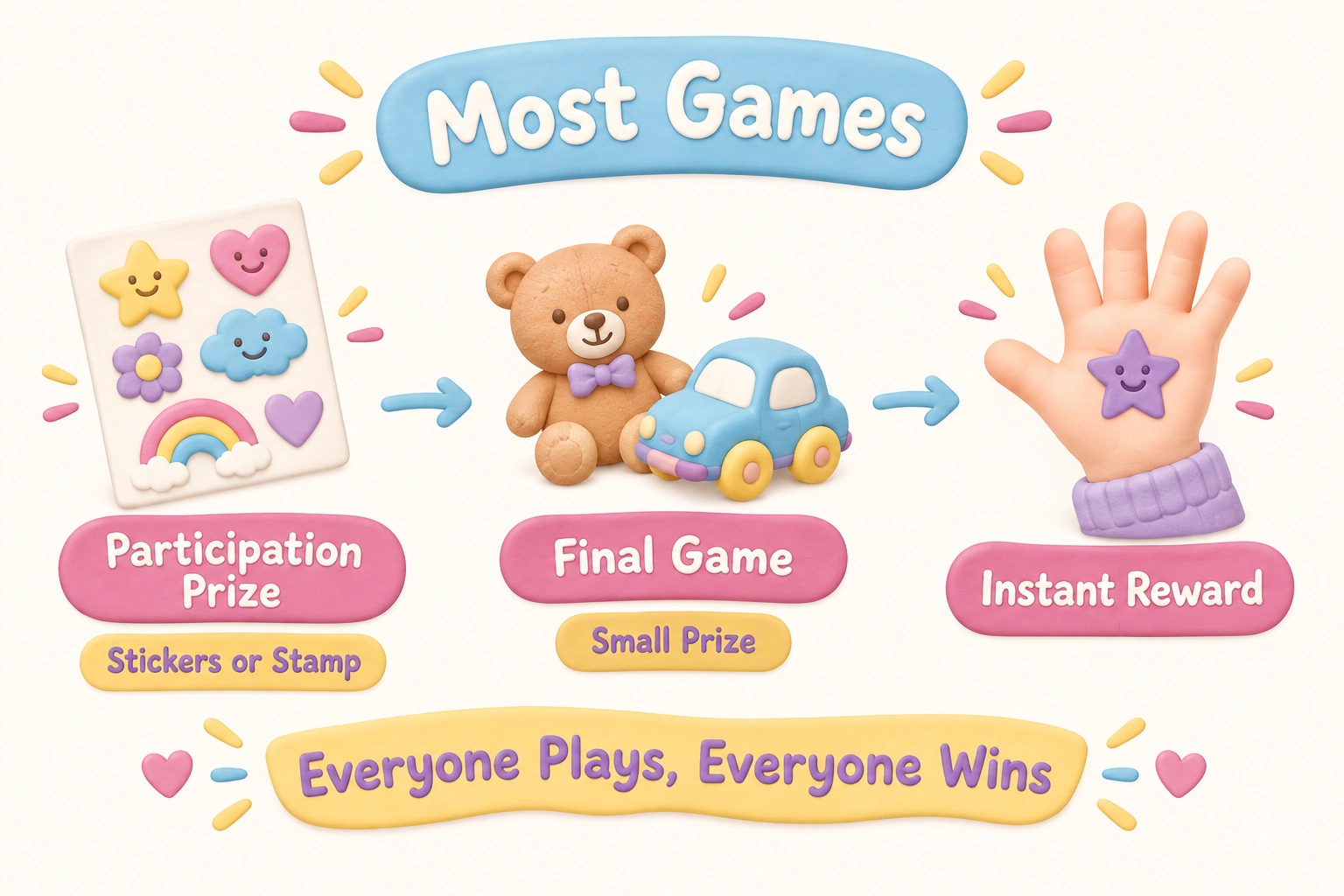
When a game does have a clear winner, acknowledge the winner warmly and briefly, then immediately redirect the group’s attention to the next activity. Dwelling on the result gives other children more time to feel disappointed. Small prizes and stickers are genuinely sufficient at this age — the experience of playing is the primary reward.
Tips for Running Games Smoothly: The Host’s Role
The host — whether a parent, a hired entertainer, or an older sibling — has a significant effect on how well games land. A few practical principles make a meaningful difference with five-year-olds.
- Explain rules with a demonstration, not just words. Show children what to do rather than describing it. Five-year-olds process visual information more readily than verbal instructions at this stage.
- Keep explanations to 30–60 seconds. If a game requires more than a minute to explain, simplify it or save it for an older age group.
- Have one adult per 6–8 children. For a party of 12 children, two adults managing games is a realistic minimum. One adult can run the game while the other manages the edges of the group.
- Know when to pivot. If a game is not working — children are confused, bored, or upset — it is completely fine to stop and move to the next activity. Announce it cheerfully: “That was brilliant! Now we’re going to do something even more fun.” Children this age will follow your energy.
- Adapt for shy or sensitive children. Some five-year-olds find large group games overwhelming. Offer a quieter role — holding the music device, being the official sticker-giver, or being the host’s helper — so every child can participate at a level that feels comfortable.
Inclusive Play: Mixed Ages and Different Abilities
Many birthday parties include a range of ages — younger siblings as young as two or three, and older siblings or cousins up to seven or eight. Most of the games listed here can be adapted for mixed-age groups with minimal adjustment. For younger children, pair them with an older child or adult during team games. For older children, give them a slightly more challenging role — being the Simon in Simon Says, or navigating the obstacle course in reverse.
For children with sensory sensitivities, loud music and balloon-popping sounds can be genuinely distressing. Having a quieter corner with a simple activity available — sticker sheets, a colouring page, or a puzzle — means these children can participate in the party at their own pace without feeling excluded. Cooperative play formats, where no child is singled out or eliminated, are naturally more inclusive for children who find competitive pressure difficult.
Frequently Asked Questions
How many games should I plan for a two-hour birthday party for 5-year-olds?
Plan for six to ten games or activities, including a snack break. Each game should run approximately 5–12 minutes. Having more games prepared than you think you need is always wise — some will finish faster than expected, and having a backup means you are never scrambling to fill time.
What is the best icebreaker game for a 5-year-old’s birthday party?
Duck Duck Goose and Follow the Leader both work well as icebreaker games because they require no supplies, have simple rules, and allow children to join in gradually as they arrive. Pass the Parcel also works if all guests arrive at roughly the same time.
How do I run Musical Chairs without children being eliminated?
Use the no-elimination version: keep all chairs in place throughout the game and simply celebrate whoever sits down fastest each round. In the final round, use one chair and award a small prize to the child who reaches it, but give participation prizes to everyone else. This keeps all children engaged for the full game.
What calm-down game works best before birthday cake?
Sleeping Lions is the most effective calm-down game for five-year-olds. It quiets the room quickly, requires no supplies, and transitions naturally into sitting for food. Bubble Pop is a good alternative if you want something slightly more active but still gentle.
What should I do if a game is not working?
Stop it cheerfully and move on. Announce the next activity with enthusiasm and children will follow. Five-year-olds are not invested in finishing a game that is not working — they are invested in having fun. Keeping your energy positive is the most important tool a party host has.
Are competitive games appropriate for 5-year-olds?
Light competition is developmentally appropriate at age five, but children this age vary considerably in their ability to handle losing. Using no-elimination rules and participation prizes for most games, while reserving one competitive moment for the final game, tends to produce the most positive experience for the whole group.
How do I adapt games for a small indoor space?
Clear the floor of furniture as much as possible and use masking tape to mark boundaries. Games like Freeze Dance, Simon Says, Pass the Parcel, and Sleeping Lions work in very small spaces. Obstacle courses can be scaled to fit a single room using cushions and chairs. Balloon keepy-uppy works well in small spaces because it naturally keeps children in a contained area.
Building a Party That Every Five-Year-Old Remembers
The most successful indoor birthday parties for five-year-olds are not the ones with the most elaborate setups — they are the ones where children feel included, energized, and celebrated throughout. Choosing games with simple rules, adapting classics with no-elimination rules, sequencing activities from calm to energetic and back again, and keeping the host’s energy warm and flexible are the practical factors that make the biggest difference.
A picture-clue treasure hunt, a round of freeze dance, a few minutes of Sleeping Lions before cake, and a goody bag at the door will be remembered far more vividly than any expensive entertainment. The developmental sweet spot of age five — curious, cooperative, enthusiastic, and still genuinely delighted by simple things — means that with a little planning, an indoor birthday party can be genuinely joyful for every child in the room.

Take a short quiz to find out what your everyday choices say about your parenting style
When your child is curious about something new, what’s your instinct?
Take a short quiz to find out what your everyday choices say about your parenting style
“Can I download this app?” What happens next?
Take a short quiz to find out what your everyday choices say about your parenting style
When it comes to rules at home, which sounds most like you?
Take a short quiz to find out what your everyday choices say about your parenting style
If you could give your child one life skill today, what would you pick?
Take a short quiz to find out what your everyday choices say about your parenting style
Your child gets to choose what to watch. What would your ideal setup look like?
Take a short quiz to find out what your everyday choices say about your parenting style
Pick your parenting superpower ✨