Best Party Games for 6-Year-Olds: Active Group Challenges

 Discover a Free Education Video App for Kids
Pastory uses AI to personalize educational video content based on your child’s interests and personality. Safe, engaging, and built for curious young minds. Sign up now to stay updated and enjoy early access with a free trial
Planning a 6-year-old birthday party means finding games that match a genuinely exciting developmental moment: the age at which most children begin to understand team loyalty, follow multi-step rules, and care deeply about fairness. The right party games for 6 year olds channel that energy productively, build social confidence, and keep a room full of first-graders happily engaged from the first relay race to the final calm-down game. This guide covers the best active group challenges — indoors and outdoors — with setup instructions, group size guidance, party flow advice, and practical tips for handling the inevitable disputes and shy guests.
Key Takeaways
- Six is a pivotal age for team play: children at this stage can follow rules, take turns, and begin to understand cooperative play, making structured group games highly effective.
- Plan four to six games for a 2–2.5 hour 6-year-old birthday party, alternating high-energy active group challenges with calmer activities to manage excitement levels.
- Keep teams small — four to six children per side — and balance them by speed and size rather than letting children self-select, to reduce tears and disputes.
- Low-prep party games and no-equipment games are often the most successful: familiar mechanics let children focus on fun rather than learning complicated rules mid-party.
- Including at least one cooperative, non-competitive game ensures no child sits out feeling excluded, which matters especially for shy or anxious guests.
Why Six Is the Right Age for Team and Group Games
At around age six, children experience a meaningful shift in social cognition. They begin to understand that rules apply equally to everyone, that fairness and turn-taking matter, and that belonging to a team carries real emotional weight. This is the developmental stage at which most children transition from parallel play — playing alongside others — to genuinely cooperative play, where they coordinate actions toward a shared goal. Gross motor skills also reach a level of coordination that makes relay races, obstacle courses, and chase games physically manageable and genuinely fun rather than frustrating.
Attention span at six is still relatively short — typically 10 to 15 minutes of focused engagement per activity — which is why game rotation matters. A well-sequenced party game flow keeps children stimulated without overwhelming them. Research on group play in early childhood consistently suggests that structured games with clear, age-appropriate rules provide a predictable social framework that can actually reduce anxiety, particularly for shy children who find unstructured free play harder to navigate. The clear start, middle, and end of a game gives every child an equal entry point.
It is worth noting that individual children vary considerably. Some six-year-olds are ready for complex team strategy; others are still developing the emotional regulation needed to lose gracefully. Choosing games with short rounds, frequent role changes, and low stakes helps the whole group stay positive.
How to Structure Your Party Game Flow
One of the most overlooked aspects of planning a 6-year-old birthday party is game sequencing. Most party planning advice simply lists games without explaining how to order them across a two-hour event. A practical party game flow follows a simple arc: open with a familiar, easy-to-join game that settles arriving children; build to the highest-energy active group challenges in the middle; then use a calm-down game before cake or food; and close with a cooperative or low-stakes activity as guests begin to tire.
A workable sequence for eight to twelve children might look like this: start with Simon Says or Freeze Dance (five to eight minutes, no setup required) while latecomers arrive; move into a team relay race or obstacle course (fifteen to twenty minutes); follow with a scavenger hunt or team challenge (fifteen minutes); use Sleeping Lions or Pass the Parcel as a calm-down game before food (ten minutes); then finish with a cooperative balloon game or parachute activity (ten minutes). Planning four to six games and actually running four to five is a realistic target — always have one game in reserve in case a round ends faster than expected.
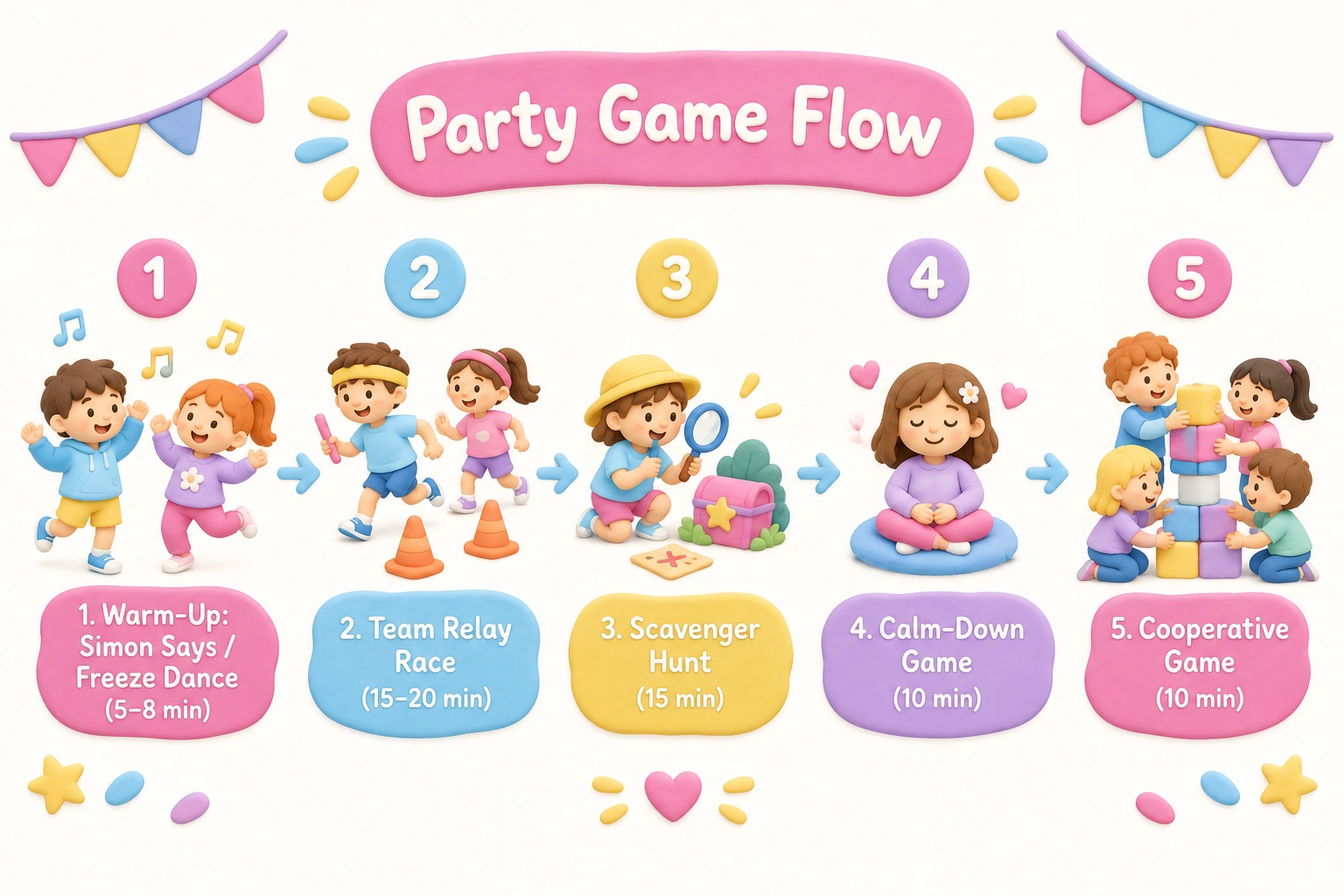
One adult per five children is a sensible supervision ratio for active group challenges. Assign one adult as the game caller and at least one other to manage transitions, hand out small prizes, and watch for children who need a quiet moment.
Team-Balancing and Rules: Getting It Right Before You Start
Balanced teams are essential for keeping a 6-year-old birthday party running smoothly. At this age, children are acutely aware of fairness, and a lopsided team — whether by speed, size, or number — can derail a game within minutes. Rather than letting children pick their own teams (which almost always produces imbalanced groups and hurt feelings), an adult should assign teams in advance, mixing faster and slower runners, older and younger guests, and children who know each other well with those who do not.
Keep teams to four to six children per side for most relay races and team games. Larger groups mean longer waiting times, which tests the attention span of six-year-olds and increases the chance of disruptive behaviour at the back of the line. Smaller teams also mean each child participates more frequently, which sustains engagement.
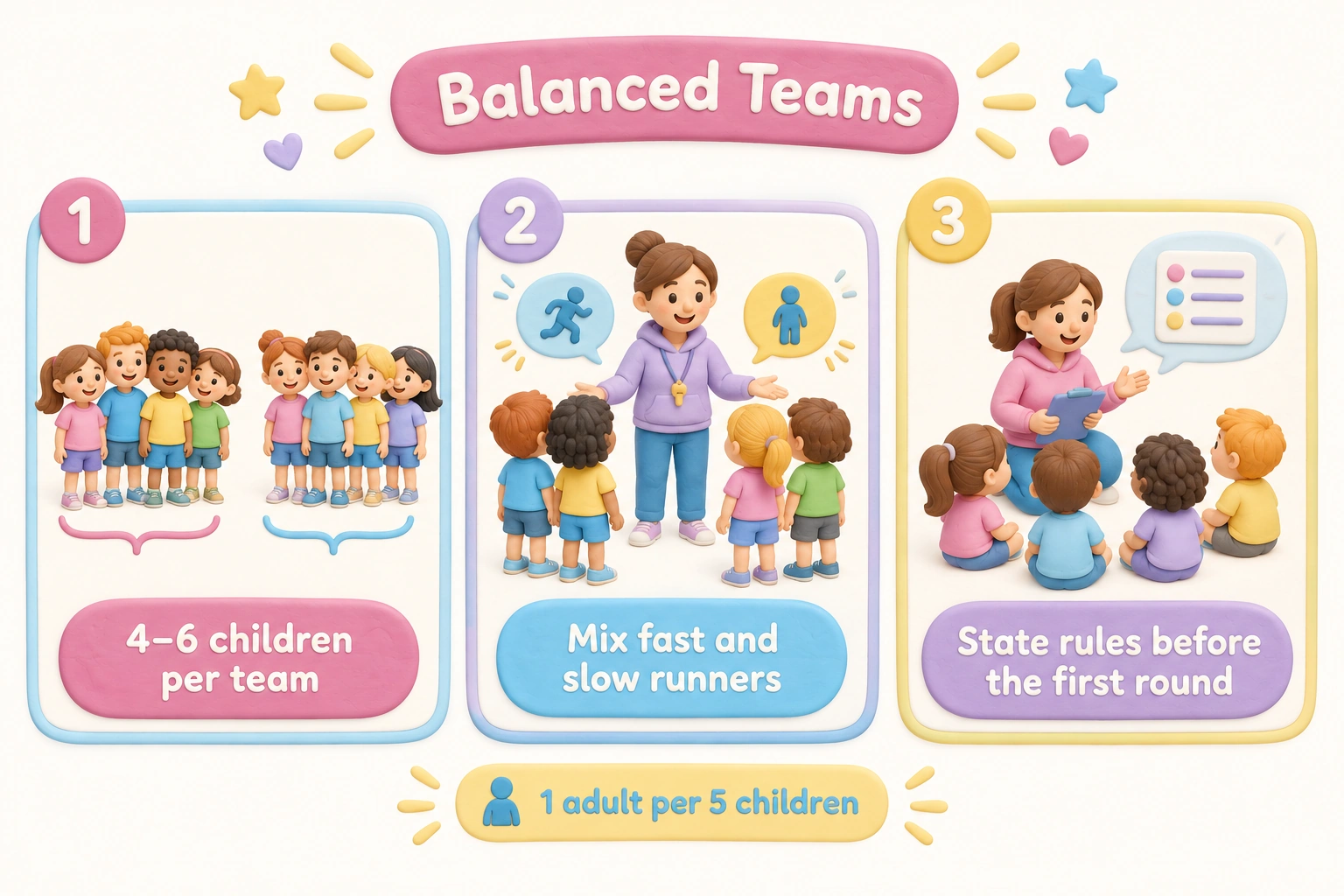
State the rules out loud before the first round begins — not after the first dispute. At six, children understand rules well when they are explained clearly and briefly, but they will argue passionately if a rule is introduced mid-game to correct behaviour. A simple pre-game ritual — gathering everyone in a circle, explaining the rules in two or three sentences, and asking if anyone has a question — prevents most conflicts. If a dispute does arise, acknowledge both sides briefly, restate the rule calmly, and move on without dwelling on the incident.
Best Relay Race Ideas for 6-Year-Olds
The team relay race is the backbone of most active party game lists for this age group, and for good reason: relay races combine gross motor skills, turn-taking, and team loyalty in a format that is easy to explain and endlessly adaptable. Set up a starting line and a turning point — a cone, a chair, or a piece of tape — at a distance appropriate for the space. Each child runs, walks, hops, or carries an object to the turning point and back before tagging the next teammate.
Classic Egg and Spoon Race
Each child balances a plastic egg (or a small ball) on a spoon and walks or runs to the turning point and back without dropping it. If the egg drops, the child stops, replaces it, and continues. This game works well indoors on a smooth floor or outdoors on grass. It develops balance and concentration alongside the relay format. Works best for six to twelve children split into two or three teams.
Balloon Relay
Children carry a balloon between their knees — no hands allowed — from the starting line to the turning point and back. If the balloon drops, they pick it up and continue from where they stopped. This low-prep party game requires only balloons and a clear space. It is easily adapted for indoors by reducing the distance. Works for eight to sixteen children.
Crab Walk Relay
Children travel to the turning point and back in a crab-walk position — hands and feet on the floor, belly facing up. This is a high-energy, genuinely funny game that develops core strength and coordination. It works equally well indoors on carpet or outdoors on grass. Four to eight children per team keeps waiting times short.
Sack Race Relay
Using pillowcases or purpose-made sacks, children jump from the starting line to the turning point and back. This is a classic outdoor game, though it can be adapted for a large indoor space such as a hall. Rainy-day swap: replace the sack with a hula hoop that children step into, hold at waist height, and shuffle to the turning point.
Water Sponge Relay
Best for outdoor summer parties. Each child soaks a sponge in a bucket of water, runs to the turning point, squeezes the water into an empty cup, and runs back. The team that fills their cup first wins. This game is best kept outdoors and is not suitable for indoor adaptation. Works for eight to twenty children.
Active Circle and Chase Games
Circle and chase games require no equipment and almost no setup, making them ideal no-equipment games for the start of a party or as a filler between structured rounds. They also tend to be the most familiar to children, which means rules need minimal explanation.
Freeze Dance
Play music and have children dance freely. When the music stops, everyone freezes. Any child who moves after the music stops sits out for one round — or, in a non-elimination version, simply does a silly pose and rejoins immediately. Freeze Dance is one of the most reliable openers for a 6-year-old birthday party because it requires no teams, no equipment, and works for any group size from four to thirty children. It also serves as an excellent energy-release game for the first five minutes while latecomers arrive.
Simon Says
A classic no-equipment game that tests listening skills and self-control. The game caller gives instructions prefaced by “Simon says” — children must only follow instructions that include that phrase. This game works for any group size and can be themed to the party (“Simon says roar like a dinosaur”). Keep rounds short — three to five minutes — and rotate the role of Simon to give multiple children a turn in the spotlight.
What’s the Time, Mr Wolf?
One child plays Mr Wolf and stands at one end of the space with their back to the group. The other children call out “What’s the time, Mr Wolf?” and Mr Wolf calls back a time — children take that many steps forward. When Mr Wolf calls “Dinner time!” they turn and chase the group back to the starting line. Anyone caught becomes the next wolf. This game works outdoors or in a large indoor space and suits six to twenty children.
Duck Duck Goose
Children sit in a circle. One child walks around the outside, tapping each seated child’s head and saying “duck” until they choose someone and say “goose.” The chosen child chases the tapper around the circle. This is a gentle, low-intensity game that works well as a calm-down game between more energetic rounds. Suitable for five to fifteen children.
Obstacle Course Challenges
An obstacle course is one of the most versatile active group challenges for a 6-year-old birthday party. It can be built from household items — cushions to crawl over, chairs to weave between, a hula hoop to jump through, a line of tape to balance along — and adapted for both indoor and outdoor settings. Children can run the course individually against the clock, or teams can compete in relay format with each child completing the course before tagging the next.
For indoor obstacle courses, use soft cushions, low chairs, and tape markers on the floor. Keep the course linear rather than circular to avoid collisions. For outdoor courses, add physical challenges such as crawling under a rope, jumping over a pool noodle, or weaving through cones. A well-designed obstacle course takes ten to fifteen minutes to run for a group of eight to twelve children and develops gross motor skills including balance, coordination, and spatial awareness. Rainy-day swap: an indoor cushion-and-tape course is a direct equivalent that requires no outdoor space.
Team Scavenger Hunt and Cooperative Challenges
A team scavenger hunt is an excellent mid-party activity that shifts the energy from pure physical competition to problem-solving and cooperation. Divide children into teams of three to four and give each team a simple picture-based list of items to find around the party space. At six, children can read basic words, but picture clues ensure every child can participate regardless of reading level. The team that finds all items first wins, but a cooperative version — where all teams work together to find items hidden around a larger space — removes the competitive element entirely.
Cooperative play at this age supports the development of communication, negotiation, and shared decision-making. A cooperative scavenger hunt, where the goal is for the whole group to succeed rather than one team to beat another, is particularly valuable for mixed-age groups or parties where some children are more competitive than others. It also tends to produce less conflict, which is a practical advantage mid-party when energy levels are high.
Non-Competitive and Cooperative Games
Non-competitive games are underrepresented in most party game lists, yet they serve a genuinely important function: they ensure no child is eliminated, sits out feeling excluded, or becomes upset about losing. For a 6-year-old birthday party with a mixed group of children — some highly competitive, some shy, some still developing emotional regulation — at least one cooperative game in the rotation significantly improves the overall atmosphere.
Balloon Keep-Up
The entire group works together to keep one or more balloons in the air without letting them touch the floor. No teams, no winners, no losers — just a shared goal. This game can be made progressively harder by adding more balloons or by introducing a rule that each child can only touch the balloon once before someone else must hit it. Works for four to twenty children indoors or outdoors.
Sleeping Lions
All children lie on the floor as still as possible, pretending to be sleeping lions. One or two adults walk around trying to make the lions move — by talking to them, making funny faces, or telling jokes — without touching them. Any child who moves joins the adults. This calm-down game is invaluable between high-energy rounds and before food. It also gives adults a natural moment to reset the space for the next activity.
Pass the Parcel
A wrapped parcel is passed around a circle while music plays. When the music stops, the child holding the parcel unwraps one layer. A small prize or forfeit (a silly action to perform) is hidden between each layer. Every child receives something if the layers are planned to match the number of guests. This is a reliable calm-down game that works for five to fifteen children and requires minimal adult facilitation once the music is controlled.
Tips for Including Shy or Anxious Children
Group games with clear, age-appropriate rules and predictable patterns can actually reduce social anxiety for shy children compared to unstructured free play, because every child knows exactly what is expected of them. However, some children still find large-group games overwhelming, particularly at the start of a party when the environment is unfamiliar.
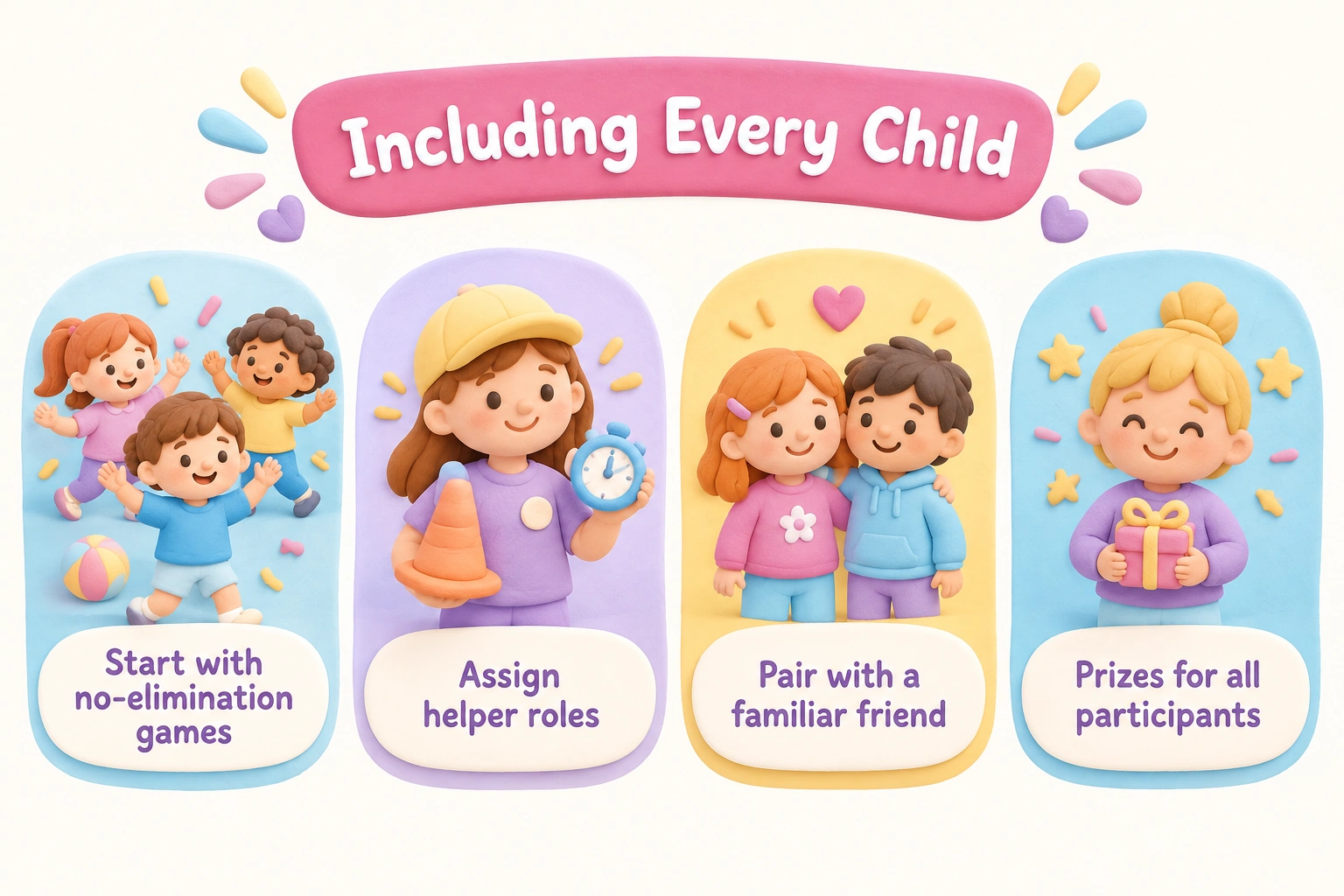
Practical strategies include: starting with a no-elimination game such as Freeze Dance so no child faces the social pressure of being “out” early; assigning roles within games — timekeeper, cone-holder, music controller — so quieter children can participate at a level that feels comfortable; and pairing a shy child with a familiar friend when assigning teams. Avoid singling out any child for praise or correction in front of the group, as this can increase self-consciousness. Small prizes distributed to all participants — stickers, mini toys, or party favors — rather than only to winners help every child feel the party was a success.
Supplies Checklist for Active Party Games
Most of the games in this guide require minimal equipment. Gathering supplies in advance prevents last-minute scrambling and keeps the party game flow smooth. The following list covers the core items needed for a well-rounded selection of active group challenges.
- Balloons (at least two per child, plus spares)
- Plastic spoons and lightweight balls or plastic eggs
- Pillowcases or sacks for sack races
- Cones or tape for marking starting lines and turning points
- A music source with a reliable pause function (for Freeze Dance, Pass the Parcel)
- A pre-wrapped Pass the Parcel with one layer per guest
- Picture-based scavenger hunt lists (one per team)
- Hula hoops and pool noodles for obstacle courses
- Sponges and buckets for water relay (outdoor summer parties)
- Small prizes and party favors: stickers, mini toys, pencils
Indoor and Outdoor Options at a Glance
| Game | Setting | Group Size | Energy Level | Equipment Needed | Duration |
|---|---|---|---|---|---|
| Freeze Dance | Indoor / Outdoor | 4–30 | Medium | Music source | 5–8 min |
| Simon Says | Indoor / Outdoor | 4–30 | Low–Medium | None | 5–10 min |
| Egg and Spoon Relay | Indoor / Outdoor | 6–16 | Medium | Spoons, balls/eggs | 10–15 min |
| Balloon Relay | Indoor / Outdoor | 8–16 | High | Balloons | 10–15 min |
| Obstacle Course | Indoor / Outdoor | 6–16 | High | Cushions, cones, tape | 15–20 min |
| Scavenger Hunt | Indoor / Outdoor | 6–20 | Medium | Picture lists | 15–20 min |
| What’s the Time, Mr Wolf? | Indoor / Outdoor | 6–20 | High | None | 10–15 min |
| Balloon Keep-Up | Indoor / Outdoor | 4–20 | Medium | Balloons | 5–10 min |
| Sleeping Lions | Indoor | 5–20 | Very Low | None | 5–10 min |
| Pass the Parcel | Indoor | 5–15 | Low | Wrapped parcel, music | 10–15 min |
| Sack Race Relay | Outdoor | 6–16 | High | Sacks/pillowcases | 10–15 min |
| Water Sponge Relay | Outdoor | 8–20 | High | Sponges, buckets, cups | 10–15 min |
| Crab Walk Relay | Indoor / Outdoor | 4–16 | High | None | 10–15 min |
| Duck Duck Goose | Indoor / Outdoor | 5–15 | Low–Medium | None | 5–10 min |
Frequently Asked Questions
How many games should I plan for a 6-year-old birthday party?
Plan four to six games for a two to two-and-a-half hour party, but expect to run four to five. Always have one game in reserve in case a round ends faster than anticipated. Alternating high-energy active group challenges with calmer activities prevents overstimulation and keeps the group manageable throughout the event.
Are 6-year-olds old enough for team games?
Yes — six is generally the age at which children begin to understand team loyalty, follow multi-step rules, and engage meaningfully with cooperative play. However, individual readiness varies. Keeping teams small (four to six children), using age-appropriate rules, and keeping rounds short helps all children participate successfully regardless of where they fall on the developmental spectrum.
What are the best no-equipment games for a 6-year-old party?
Simon Says, Freeze Dance, What’s the Time Mr Wolf?, Duck Duck Goose, Sleeping Lions, and the Crab Walk Relay all require no equipment beyond a music source for Freeze Dance. These low-prep party games are ideal for the start of a party or as fillers between structured rounds.
How do I handle arguments during party games?
State all rules clearly before the first round begins — not after the first dispute. If a conflict arises, acknowledge both children’s perspectives briefly, restate the rule calmly, and move on without dwelling on the incident. Avoid lengthy negotiations mid-game, as this loses the attention of the wider group. Having an adult designated as the neutral game caller helps establish authority without singling out individual children.
How do I include a shy child in party games?
Start with non-elimination games such as Freeze Dance or Balloon Keep-Up so no child faces early social pressure. Assign roles within games — timekeeper, cone-holder — that allow quieter children to participate at a comfortable level. Pair shy children with a familiar friend when assigning teams. Distribute small prizes to all participants rather than only to winners.
What is a good calm-down game between active rounds?
Sleeping Lions, Pass the Parcel, and Duck Duck Goose all work well as calm-down games. Sleeping Lions is particularly effective because it requires complete stillness, giving children a genuine physical and emotional reset before the next high-energy activity or before food is served.
Can outdoor games be adapted for indoors?
Most outdoor relay races adapt well to indoor spaces by reducing the distance between the starting line and the turning point. Replace the sack race with a hula hoop shuffle indoors. Replace the water sponge relay with a dry bean bag carry. Obstacle courses built from cushions, chairs, and tape work effectively in a living room or hall. The main indoor consideration is floor surface — ensure it is not slippery for running games.
Planning Active Games That Work for Every Child at the Party
The best party games for 6 year olds share a few consistent qualities: they are easy to explain in under a minute, they give every child frequent turns, they balance physical challenge with emotional accessibility, and they leave room for laughter when things go wrong. A well-planned 6-year-old birthday party does not need expensive equipment or elaborate setups — it needs a thoughtful game rotation, balanced teams, clearly stated rules, and at least one cooperative game that ensures every child feels included.
Mixing indoor and outdoor options gives you flexibility regardless of weather. Alternating active group challenges with calm-down games keeps energy levels manageable and reduces the chance of tears or conflict. And remembering that six-year-olds are still developing emotional regulation — that losing can feel genuinely devastating at this age — helps adults respond with patience rather than frustration when a game does not go perfectly. With a little preparation and a clear plan, a group of first-graders can have an energetic, joyful, and genuinely memorable party afternoon.

Take a short quiz to find out what your everyday choices say about your parenting style
When your child is curious about something new, what’s your instinct?
Take a short quiz to find out what your everyday choices say about your parenting style
“Can I download this app?” What happens next?
Take a short quiz to find out what your everyday choices say about your parenting style
When it comes to rules at home, which sounds most like you?
Take a short quiz to find out what your everyday choices say about your parenting style
If you could give your child one life skill today, what would you pick?
Take a short quiz to find out what your everyday choices say about your parenting style
Your child gets to choose what to watch. What would your ideal setup look like?
Take a short quiz to find out what your everyday choices say about your parenting style
Pick your parenting superpower ✨