Best Party Games for 7-Year-Olds: Indoor and Outdoor Picks

 Discover a Free Education Video App for Kids
Pastory uses AI to personalize educational video content based on your child’s interests and personality. Safe, engaging, and built for curious young minds. Sign up now to stay updated and enjoy early access with a free trial
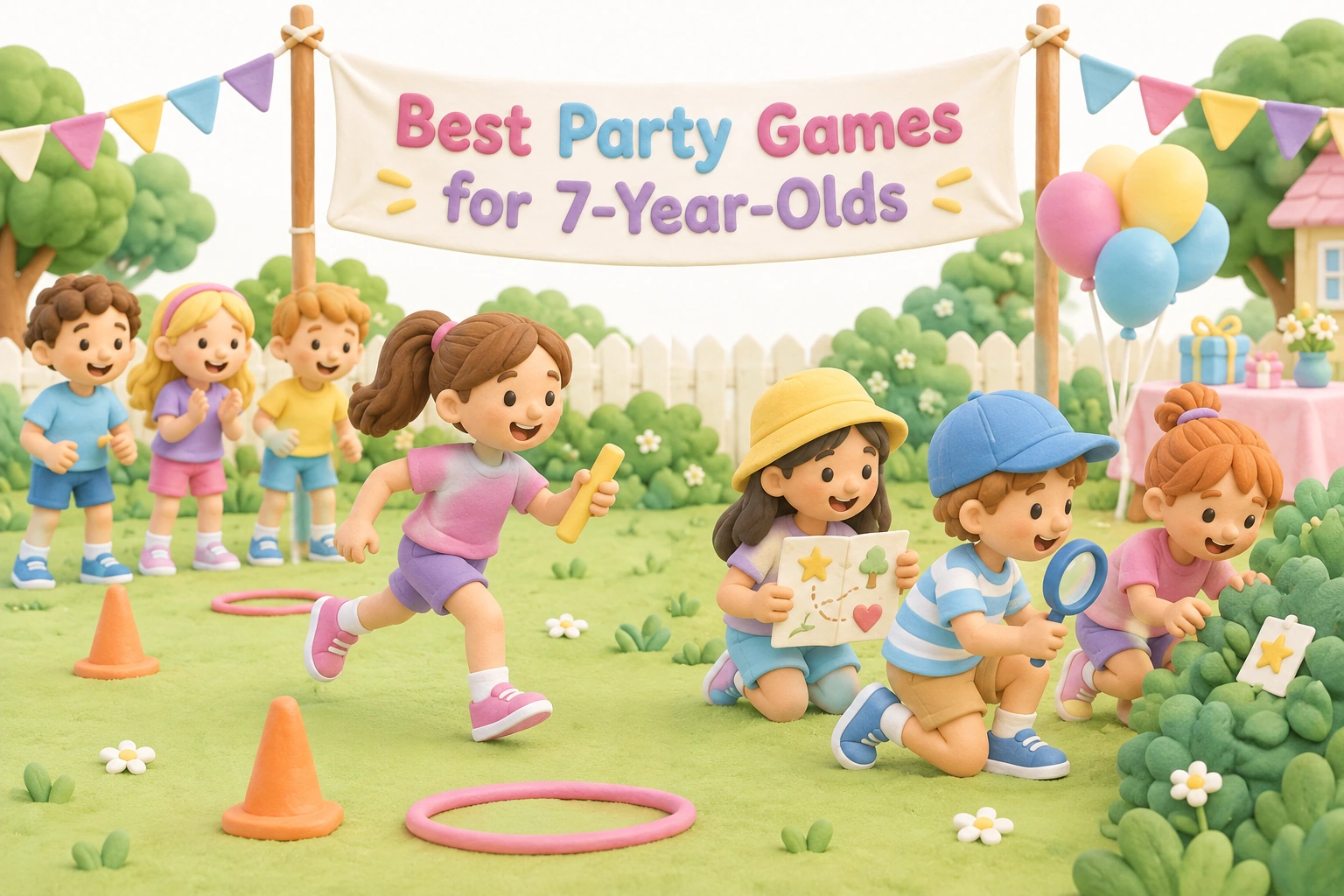
Seven is often described as a sweet spot for birthday party games. Children this age have longer attention spans than they did at five or six, can follow multi-step rules, and are genuinely excited by mild competition — yet they still need thoughtful game choices to keep everyone engaged and feeling good. This guide covers the best birthday party games for 7-year-olds across indoor and outdoor settings, with practical notes on group size, energy level, and how to sequence games so the party flows smoothly from start to finish.
Key Takeaways
- Seven-year-olds are developmentally ready for games with clear rules, mild competition, and team cooperation — making this an ideal age for a wider variety of structured party games.
- Alternating high-energy games with calmer activities helps prevent overstimulation and keeps the group manageable throughout a two-hour party.
- Inclusive, no-elimination variants of classic games reduce tears and keep every child participating rather than sitting on the sidelines.
- Having five to eight games prepared — and expecting to use five or six — gives you flexibility without over-scheduling.
- Many of the best party games for this age require little or no equipment, making last-minute planning much easier.
Why Age 7 Is a Great Age for Party Games
At age 7, children are in a transitional developmental phase. Their attention spans have grown meaningfully compared to preschool years, and most can sustain focus on a structured activity for roughly 20 to 30 minutes when the activity is engaging. They understand and can remember multi-step rules, which opens up games that would have been too complex just a year or two earlier. Cognitively, 7-year-olds are beginning to think more logically and strategically, which means games involving simple tactics — like capture the flag or a relay race — become genuinely exciting rather than confusing.
Socially, children this age are developing a real awareness of fairness, winning, and losing. They enjoy competition but can still be sensitive to feeling left out or singled out. This is why inclusive party games — formats where no child is eliminated and sent to sit alone — tend to work better than strict elimination games, even if the children themselves sometimes request the classic versions. Cooperative games and team formats also tap into the growing teamwork readiness that characterizes this developmental stage.
Understanding this context helps you choose age-appropriate party games that match what 7-year-olds are actually capable of and genuinely enjoy, rather than defaulting to games designed for younger or older children.
How to Structure a Two-Hour Party Around Games
A well-sequenced game schedule makes the difference between a party that feels chaotic and one that flows naturally. A practical structure for a two-hour birthday party might look like this:
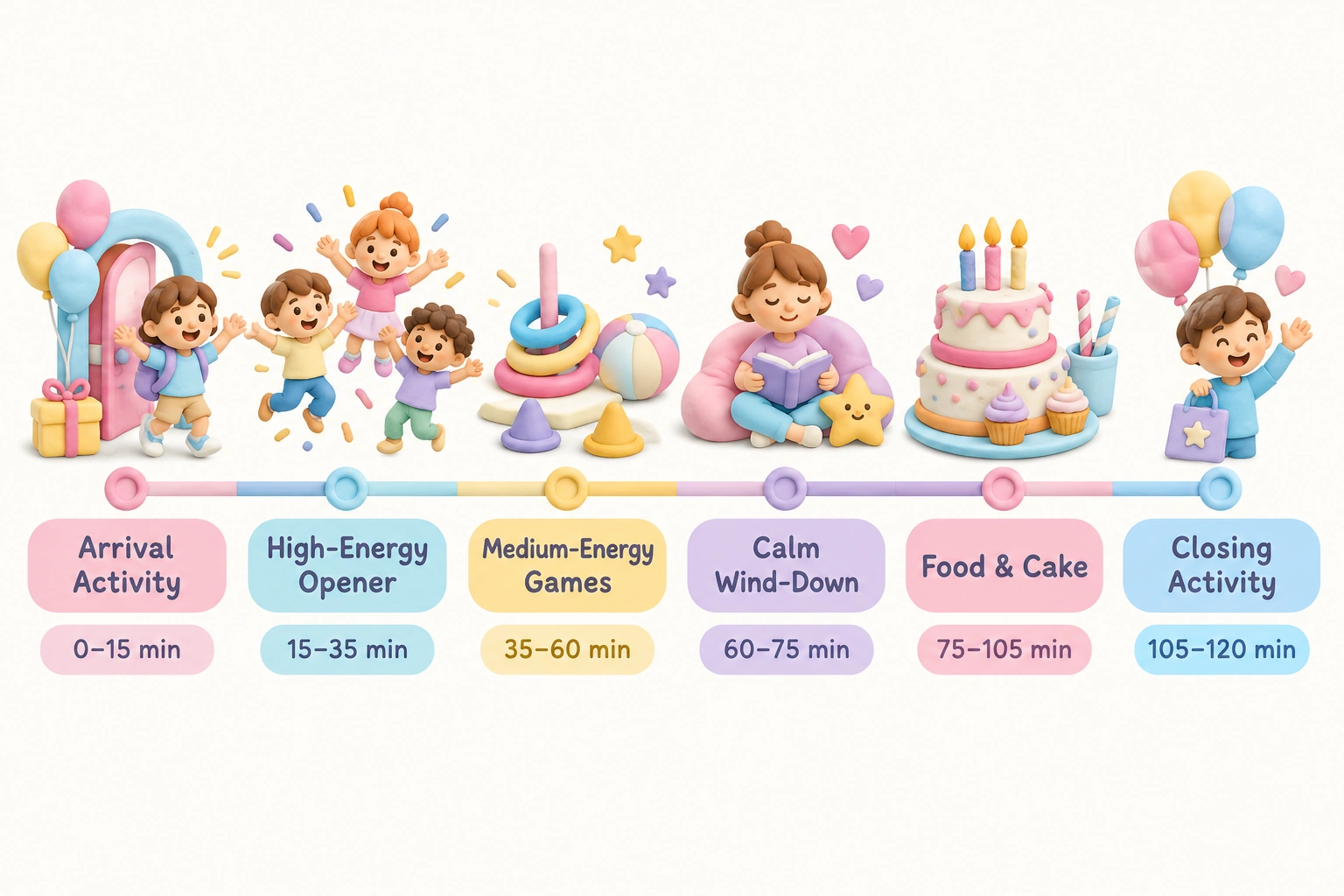
- Arrival activity (0–15 min): A low-key, drop-in activity such as a craft, colouring sheet, or free play so early arrivals are occupied while others arrive.
- High-energy opener (15–35 min): Start with one or two active outdoor party games or high-energy indoor games to burn off initial excitement — freeze dance, a relay race, or an obstacle course work well here.
- Medium-energy games (35–60 min): Transition to games that are still active but require more focus — scavenger hunts, team relay races, or Simon Says.
- Calm wind-down (60–75 min): Use quieter games such as pass the parcel, musical statues (played slowly), or sleeping lions to bring energy levels down before food.
- Food and cake (75–105 min): Lunch, snacks, or birthday cake. Children are naturally calmer after physical activity.
- Optional closing activity (105–120 min): A final low-key game, a craft, or party bag distribution as children are collected.
Keeping individual games to roughly 10 to 15 minutes each prevents boredom and means you can swap in a backup game if something is not landing with the group. Always have one or two no-prep party games ready as fillers.
Indoor Party Games for 7-Year-Olds
Indoor birthday party games need to work in a living room, hall, or classroom-sized space. The best options balance movement with enough structure to avoid furniture casualties.
Freeze Dance
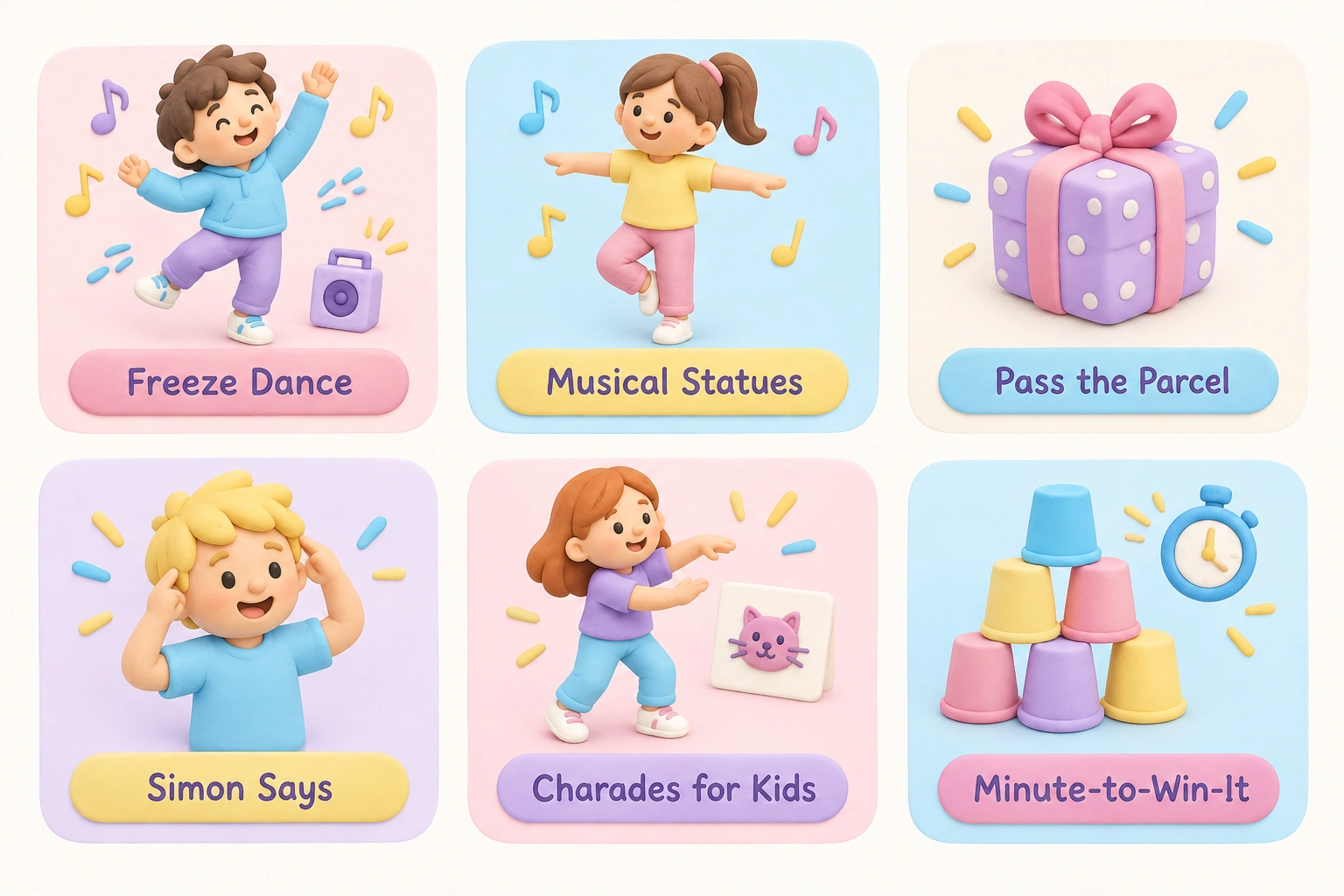
Freeze dance is one of the most reliably popular indoor party games for this age group. Play music and have children dance freely; when the music stops, everyone freezes in position. Anyone who moves is not eliminated — instead, they become a “judge” who watches for the next round, keeping them involved. This inclusive twist removes the sting of being out and keeps the energy high. Freeze dance works well for groups of any size and requires only a music source.
Musical Statues (Inclusive Version)
Musical statues follows the same format as freeze dance but children must hold a specific pose — like a superhero, an animal, or a letter of the alphabet — when the music stops. Rather than eliminating children who move, award a small sticker or token to the child holding the best pose each round. Every child collects tokens throughout the game, and everyone receives a small prize at the end. This inclusive party games approach keeps all children engaged and avoids the upset that traditional elimination formats can cause at this age.
Pass the Parcel
Pass the parcel remains a classic for good reason. Wrap a small prize in multiple layers of paper, with a small treat or activity card between each layer. Children sit in a circle and pass the parcel while music plays; whoever is holding it when the music stops unwraps one layer. The child who removes the final layer wins the main prize. To keep it fair, consider placing a small sweet or sticker between every layer so no child leaves empty-handed. This is an excellent wind-down game after high-energy activities.
Simon Says
Simon Says is a no-prep party game that works for groups of 4 to 20 children. One child or an adult plays “Simon” and gives instructions — only those prefaced with “Simon says” should be followed. Children who follow an instruction without the prefix sit down, but in an inclusive version they simply wait one round before rejoining. Simon Says develops listening skills and self-regulation, and 7-year-olds are old enough to take turns being Simon, which adds an extra layer of excitement.
Charades for Kids
Charades for kids uses simple categories — animals, film characters, sports — and has children act out a word or phrase without speaking while their team guesses. Split the group into two teams and use a timer (one minute per turn works well). Seven-year-olds are generally confident enough to perform in front of peers and enjoy the silliness of the format. Charades also works well as a theme-adaptable game: a pirate party can use pirate-themed words, a superhero party can use superhero actions.
Minute-to-Win-It Challenges
Minute-to-win-it games are timed individual or team challenges using simple household items — stacking biscuits on a forehead, moving cotton balls with a spoon, or keeping a balloon in the air for 60 seconds. These games are highly flexible: you can run them as individual challenges or as a team relay race format where each team member completes one challenge before tagging the next. They are particularly good for mixed-ability groups because the tasks are short, varied, and often funny regardless of outcome.
Sleeping Lions
Sleeping lions is the ideal wind-down game before food or cake. All children lie on the floor as still as possible, pretending to be sleeping lions. One or two adults walk around trying to make the lions move or laugh — without touching them. The last child to remain still wins. This game is remarkably effective at calming a group after high-energy activities and requires zero equipment.
Outdoor Party Games for 7-Year-Olds
A backyard birthday party or park setting opens up a much wider range of active games. Outdoor party games for 7-year-olds tend to be the highlight of the event, especially when the weather cooperates.
Scavenger Hunt
A scavenger hunt is one of the most engaging outdoor party games for this age group. Prepare scavenger hunt clues in advance — either written clues leading from one location to the next, or a list of items to find in the garden or park. Divide children into small teams of three or four so everyone participates actively. Theme the hunt to match the party: pirate treasure hunt clues, superhero mission briefings, or a nature discovery list all work well. A scavenger hunt typically runs for 20 to 30 minutes and can be adjusted in length by adding or removing clues.
Capture the Flag
Capture the flag is a team game that works best with groups of eight or more children. Divide the space into two territories, each with a flag (a coloured cloth or cone). Teams try to capture the opposing team’s flag and return it to their base without being tagged. Tagged players go to a “jail” area and can be freed by a teammate. Capture the flag develops strategic thinking, teamwork, and spatial awareness — all well-matched to 7-year-old developmental capabilities. It requires a reasonably large outdoor space and works best with clear boundary markers.
Obstacle Course
Setting up an obstacle course in the backyard is a versatile option that can be themed to match the party. Use hula hoops to jump through, cones to weave around, a crawl tunnel, a balance beam made from a plank, and a finish-line sprint. Run it as a timed individual challenge or as a team relay race where each child completes the course before tagging the next teammate. An obstacle course can be set up in about 20 minutes using items most families already own, making it a practical choice for a backyard birthday party.
Egg and Spoon Race
The egg and spoon race is a classic outdoor game that requires concentration and balance rather than pure speed, which levels the playing field nicely. Use hard-boiled eggs or plastic eggs for safety. Children race to a finish line while balancing an egg on a spoon — dropping the egg means returning to the start. Run it as individual heats or as a team relay race. This game works well for groups of 6 to 20 children and requires minimal setup.
Sack Race and Three-Legged Race
Sack races and three-legged races are perennial favourites that generate a lot of laughter. For the three-legged race, pair children and tie their adjacent legs together with a soft scarf or bandana before racing to a finish line. These games work best on grass to cushion inevitable tumbles. Both formats can be run as heats or as a team relay, and neither requires significant preparation beyond the sacks or ties.
Water Balloon Games
For summer birthday parties, water balloon games are an almost guaranteed hit. Options include a water balloon toss (pairs take a step back after each successful catch until the balloon breaks), water balloon dodgeball, or a simple water balloon piñata hung from a tree. Prepare balloons in advance and have a bucket ready. Note that water balloon games require a change of clothes or swimwear, so communicate this to parents beforehand. These games work best for groups of 6 or more.
Freeze Tag and Stuck in the Mud
Freeze tag is a high-energy game where one or two children are “it” and freeze anyone they tag. Frozen players stand with legs apart until a free player crawls through their legs to unfreeze them. Stuck in the mud follows the same principle. Both games are self-regulating — children naturally take turns being it — and can run continuously without adult management once the rules are established. They work for any group size of six or more and require no equipment.
Tug of War
Tug of war is a straightforward team game that works well for groups of 8 to 20 children. Divide into two roughly equal teams and use a long rope with a ribbon tied at the centre. The team that pulls the ribbon past a marked line wins. Tug of war is best played on grass and requires adult supervision to ensure safety. It is a good high-energy opener or mid-party game and takes only a few minutes per round.
No-Prep Party Games That Need Zero Equipment
Sometimes the best backup plan is a game that requires nothing at all. These no-prep party games can be started instantly if a planned activity falls through or if you need to fill time between activities.
- Duck Duck Goose: Children sit in a circle; one child walks around tapping heads and saying “duck” until they say “goose” — the goose chases them around the circle. Works for 6 to 20 children.
- Follow the Leader: One child leads a line of children through actions and movements; everyone must copy. Rotate the leader every minute or two.
- Simon Says: As described above — no equipment needed, works indoors or outdoors.
- Freeze Dance: Requires only a phone or speaker for music.
- Red Light, Green Light: One child faces away and calls “green light” (children move forward) or “red light” (children freeze). Anyone caught moving on red light returns to the start.
- Sleeping Lions: Zero equipment, zero preparation, and genuinely effective at calming a group.
Rainy-Day Alternatives for Outdoor Games
Weather is unpredictable, and having rainy-day alternatives ready for your outdoor party games is essential planning. Most outdoor games have a workable indoor equivalent that preserves the spirit of the activity.
- Obstacle course → Indoor version: Use sofa cushions, pillows, and taped floor lines to create a crawl-and-balance course in a hallway or living room.
- Scavenger hunt → Indoor version: Hide scavenger hunt clues around the house rather than the garden. The format works identically indoors.
- Capture the flag → Balloon stomp: Each child ties a balloon to their ankle; the last child with an intact balloon wins. Works in a large room or hallway.
- Relay race → Minute-to-win-it relay: Replace running with seated challenges passed from child to child.
- Water balloon toss → Sponge pass: Teams pass a wet sponge down a line as quickly as possible without dropping it.
Communicating a backup plan to parents in advance — and having a few indoor party games ready regardless of the forecast — removes significant stress from the day.
Tips for Running Party Games Smoothly
Even well-chosen games can go sideways without a few practical safeguards. These tips address the most common pitfalls when running birthday party games for 7-year-olds.
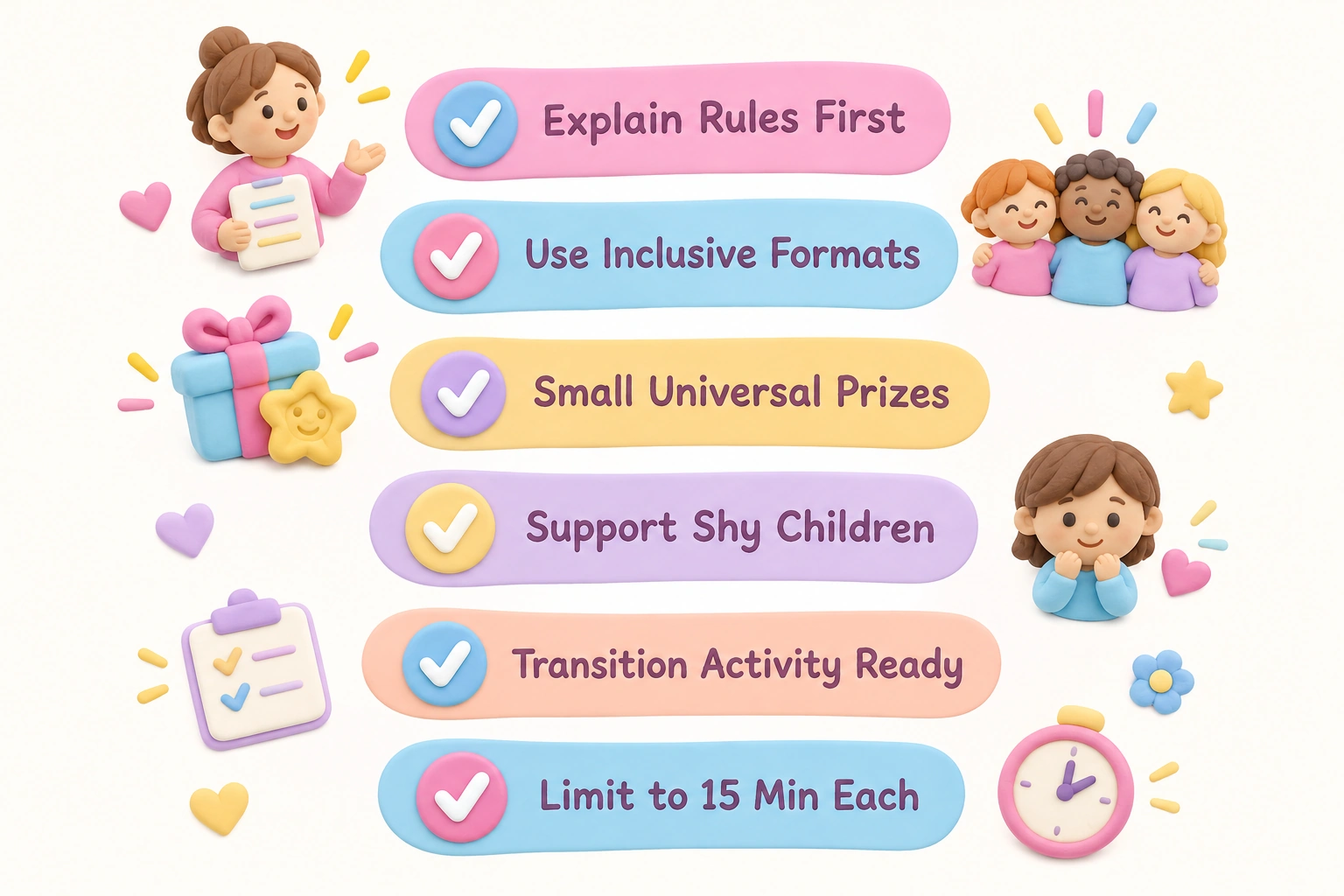
- Explain rules before starting, not during: Gather children in a circle, demonstrate the game briefly, and answer questions before play begins. Mid-game rule explanations cause confusion and arguments.
- Use inclusive formats where possible: Modify elimination games so that “out” children become judges, helpers, or simply wait one round before rejoining. This prevents the upset of being excluded for the rest of a game.
- Keep prizes small and universal: Rather than prizes only for winners, give all children a small party bag prize at the end of each game. This reduces competitive tension and keeps the focus on fun rather than winning.
- Watch for shy children: Some 7-year-olds hang back in large groups. Pair them with a confident partner for team games, or choose a role (scorekeeper, timer-holder) that lets them participate without being in the spotlight.
- Have a transition activity ready: Between games, a 2-minute free-dance or a quick round of Simon Says prevents the chaos that often erupts during unstructured transitions.
- Limit game duration: Even the most popular game should run no longer than 15 minutes. Ending while children are still enjoying it is far better than running it until interest drops.
- Prepare more than you need: Plan 7 or 8 games and expect to use 5 or 6. Having unused games is far less stressful than running out of activities.
Adapting Classic Games to a Party Theme
Themed birthday parties are popular at age 7, and most classic games can be adapted with minimal effort to match a theme. A pirate party can turn a scavenger hunt into a treasure map quest with scavenger hunt clues written as riddles. A superhero party can frame the obstacle course as a “hero training academy.” A princess or fairy-tale party can rename pass the parcel as “the enchanted parcel” and use themed wrapping paper. These small adaptations cost almost nothing but significantly increase children’s investment in the games, because the narrative context makes the activity feel more purposeful and imaginative.
Frequently Asked Questions
How many games should I plan for a 7-year-old’s birthday party?
Plan 7 to 8 games and expect to use 5 to 6. Having extras means you can skip anything that is not working and fill unexpected gaps. For a two-hour party, you will typically run 4 to 6 games of 10 to 15 minutes each, plus transition time and food.
What is the best group size for party games at this age?
Most games work well for 6 to 15 children. Games like freeze dance, Simon Says, and pass the parcel scale easily to larger groups. Games like capture the flag and tug of war need at least 8 to 10 children to work properly. For very small groups of 4 to 6, focus on cooperative games, minute-to-win-it challenges, and scavenger hunts rather than team-versus-team formats.
Should I give prizes for every game?
Small, inclusive party bag prizes work better than winner-only prizes at this age. Giving every child a sticker, small sweet, or token after each game keeps the atmosphere positive and reduces competitive tension. Save a slightly larger prize for the final game of the party if you want a memorable moment.
How do I handle a child who is upset about losing?
Prevention is more effective than management. Using inclusive game formats — where no child is fully eliminated — significantly reduces upset. If a child does become distressed, acknowledge their feeling briefly (“I know it’s disappointing”), redirect them to a helper role, and move the group on quickly. Dwelling on the moment tends to prolong it.
What are the best no-prep games if I have no time to prepare?
Duck Duck Goose, Simon Says, freeze dance, Red Light Green Light, follow the leader, and sleeping lions all require zero equipment and can be started immediately. These no-prep party games are also excellent fillers between planned activities.
Are water games appropriate for a 7-year-old’s party?
Water balloon games and water-based activities are excellent for summer birthday parties, but require advance communication with parents so children arrive in appropriate clothing or swimwear. Always supervise water activities and ensure the play area is safe underfoot to prevent slipping.
Choosing the Right Mix of Games for Your Child’s Party
The most successful birthday party games for 7-year-olds are not necessarily the most elaborate — they are the ones that match the group’s size and energy, keep every child included, and flow naturally from one to the next. A mix of one or two high-energy outdoor games, a team-based activity like a scavenger hunt or relay race, and a calm wind-down game before food covers the developmental and practical needs of most groups at this age.
If you are planning an outdoor party, have two or three rainy-day alternatives ready. If your group is on the smaller side, lean toward cooperative formats and minute-to-win-it challenges rather than large-team games. And if a child is shy or hesitant, a helper role or a paired activity can make the difference between a child who participates joyfully and one who spends the party on the edges. With a little advance thought about group size, energy flow, and inclusivity, a 7-year-old’s birthday party can be genuinely memorable for every child there.

Take a short quiz to find out what your everyday choices say about your parenting style
When your child is curious about something new, what’s your instinct?
Take a short quiz to find out what your everyday choices say about your parenting style
“Can I download this app?” What happens next?
Take a short quiz to find out what your everyday choices say about your parenting style
When it comes to rules at home, which sounds most like you?
Take a short quiz to find out what your everyday choices say about your parenting style
If you could give your child one life skill today, what would you pick?
Take a short quiz to find out what your everyday choices say about your parenting style
Your child gets to choose what to watch. What would your ideal setup look like?
Take a short quiz to find out what your everyday choices say about your parenting style
Pick your parenting superpower ✨