Best Board Games for 9-Year-Olds: Strategy and Replay Value

 Discover a Free Education Video App for Kids
Pastory uses AI to personalize educational video content based on your child’s interests and personality. Safe, engaging, and built for curious young minds. Sign up now to stay updated and enjoy early access with a free trial
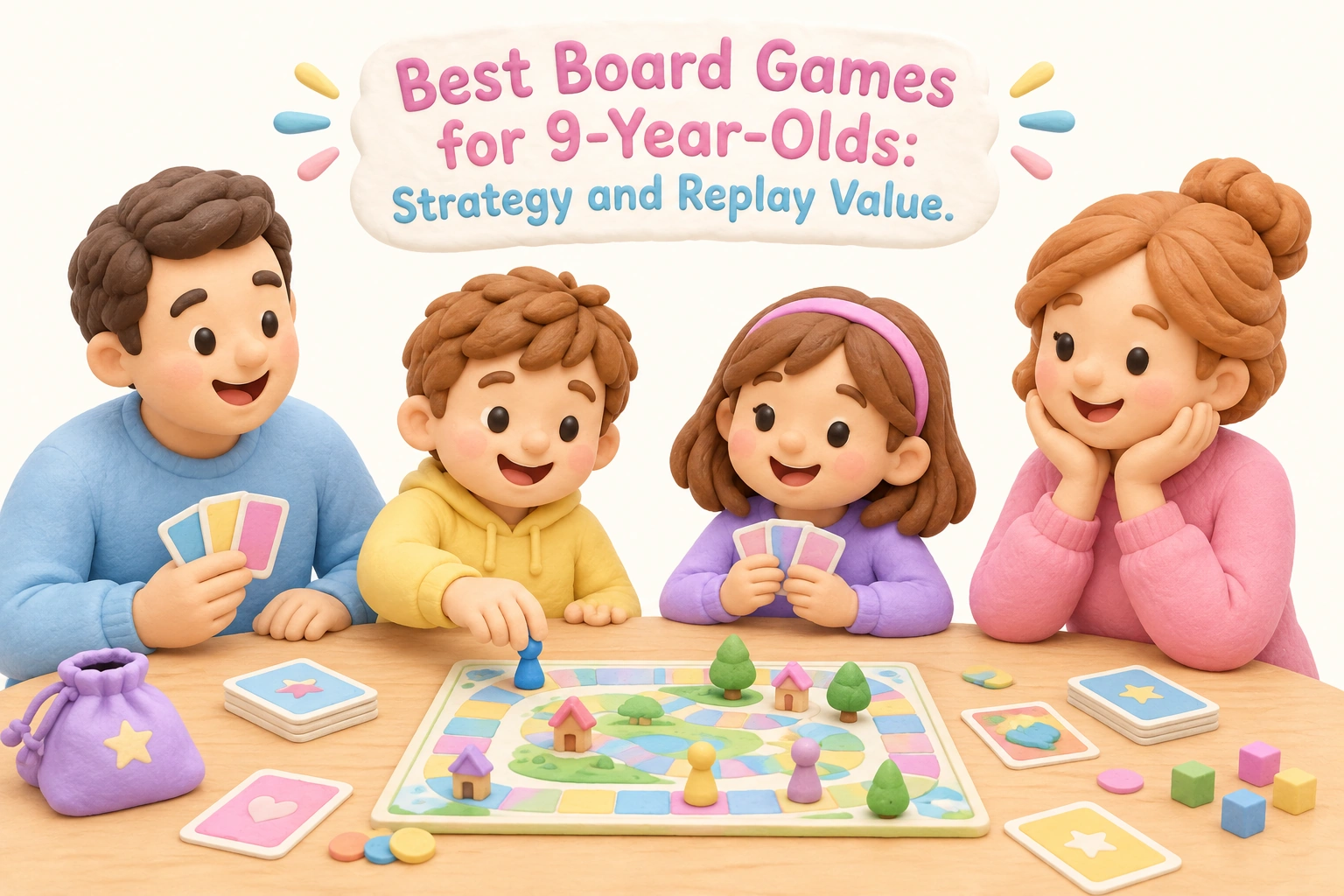
Nine-year-olds sit at a genuinely rewarding sweet spot for board games. They have the working memory to hold multi-step rules, the patience for games lasting 30 to 45 minutes, and enough social awareness to handle both winning and losing with some grace. The challenge for parents and gift-givers is finding games that match that cognitive readiness without feeling babyish in six months — games with real strategic thinking, strong replay value, and enough depth to stay interesting as children grow. This guide covers the most worthwhile options, explains what to look for, and addresses the developmental reasons why board games matter at this age.
Key Takeaways
- Nine-year-olds are developmentally ready for games with genuine strategic depth, variable setup, and multi-step decision-making — not just luck-based roll-and-move mechanics.
- Replay value depends on specific design features: randomized components, asymmetric roles, or variable board layouts that make each session feel different.
- The 20–40 minute playtime range tends to match a 9-year-old’s sustained attention span without requiring a full evening commitment.
- Cooperative board games can be especially valuable when sibling age gaps or conflict avoidance make head-to-head competition less appealing.
- The best games at this age grow with the child — remaining genuinely engaging at age 11 or 12 as strategic thinking deepens.
Why Board Games Matter for 9-Year-Olds Developmentally
At age nine, children are in the middle childhood stage of cognitive development. Logical reasoning, planning ahead, and understanding cause-and-effect relationships are all strengthening rapidly. Board games that require strategic thinking give these emerging skills a structured workout in a low-stakes, enjoyable context. Research published in developmental and educational psychology literature suggests that tabletop games may support executive functioning skills — including working memory, cognitive flexibility, and inhibitory control — because players must hold rules in mind, adapt plans when circumstances change, and resist impulsive moves.
Mathematical reasoning also benefits. Games involving resource management, probability, or pattern recognition give children repeated, meaningful practice with numerical concepts in a context that feels nothing like a worksheet. A study highlighted by Popular Science found associations between number-based board game play and improved early math skills, though researchers note that outcomes vary by child, game type, and frequency of play. Board games also build social skills: turn-taking, reading opponents, communicating under pressure, and managing the emotional experience of losing are all practiced naturally during family game night.
Perhaps most practically, board games are a screen-free activity that the whole family can genuinely enjoy together — including adults. That shared engagement matters. When caregivers play alongside children rather than simply supervising, the social and language benefits of game play tend to be stronger.
What Makes a Board Game Right for a 9-Year-Old?
Not every game marketed for ages 8 and up is equally suitable. The box age rating is a starting point, not a guarantee of age-appropriate complexity. When evaluating a game for a 9-year-old, consider these practical criteria.
Playtime in the 20–40 Minute Range
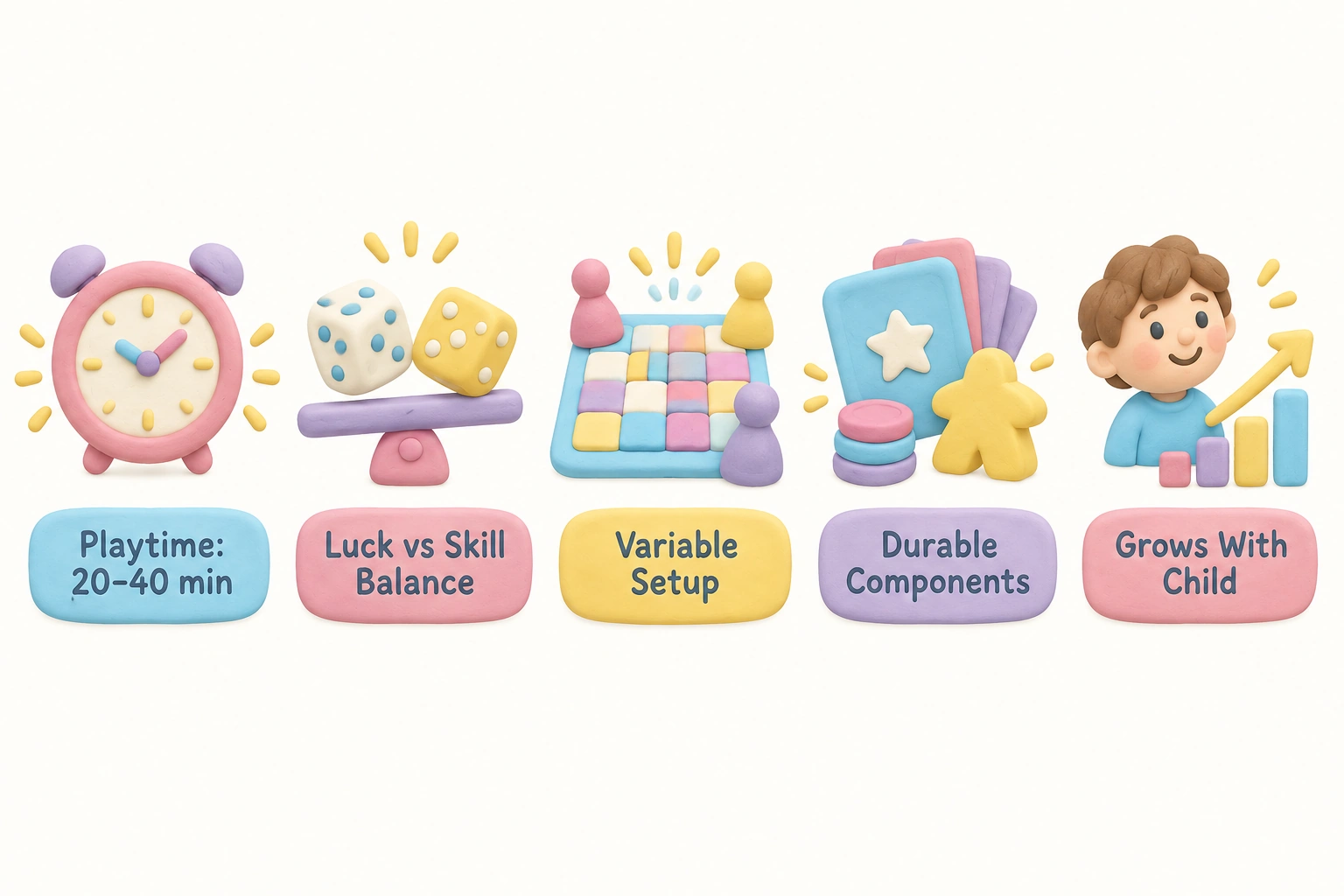
Most 9-year-olds can sustain focused attention for roughly 30 to 45 minutes on an engaging task. Games that run 20 to 40 minutes hit a practical sweet spot: long enough to feel satisfying, short enough to fit into an evening without frustration. Games that regularly exceed 90 minutes — classic Monopoly being the obvious example — often end in abandoned sessions or family tension rather than genuine strategic play.
Meaningful Luck vs. Skill Balance
Pure luck games feel hollow to children who are developing genuine strategic thinking. Pure skill games with no randomness can feel punishing for beginners. The most engaging games for this age group balance luck and skill so that a child’s decisions genuinely matter, but a lucky draw or dice roll occasionally shifts the outcome — keeping the game accessible and exciting without making strategy feel pointless.
Replay Value Through Variable Setup
Replay value is one of the most important and most underexplained criteria in game selection. A game has strong replay value when each session feels meaningfully different from the last. The design features that create this are specific: randomized tile or card draws, variable board layouts, asymmetric player roles, or modular components that combine differently each game. Games with fixed boards and predictable progressions — where the optimal strategy becomes obvious after a few plays — tend to lose a 9-year-old’s interest quickly.
Component Quality and Durability
Component quality matters more than it might seem. Flimsy cards that bend after three plays, tokens that are too small for younger siblings to handle safely, or boards that don’t lie flat undermine the experience. Durable components signal a game designed for repeated use — which is exactly what strong replay value requires.
Grows With the Child
The best investment at this age is a game that a child will still want to play at 11 or 12. Games with genuine strategic depth — where experienced players discover new layers of decision-making over time — offer far better long-term value than games that feel mastered after a handful of sessions.
Best Strategy Board Games for 9-Year-Olds
The games below are selected for strategic depth, replay value, age-appropriate complexity, and longevity. They are organized roughly from accessible gateway games to those with greater strategic depth.
Ticket to Ride (and Ticket to Ride: First Journey)
Ticket to Ride is widely regarded as the definitive gateway game for families moving beyond simple roll-and-move mechanics. Players collect colored train cards and use them to claim railway routes across a map, completing destination tickets for points. The route-building mechanic is immediately intuitive, but blocking opponents and managing which tickets to attempt introduces genuine strategic thinking. A full game runs approximately 45 to 75 minutes, which is slightly above the ideal range for some 9-year-olds; Ticket to Ride: First Journey is a shorter, simpler version designed specifically for ages 6 and up that works well as an introduction. Replay value is strong because destination tickets are drawn randomly each game, creating different strategic priorities every session.
Kingdomino
Kingdomino is an excellent gateway game with a playtime of around 15 to 20 minutes, making it ideal for shorter sessions or playing multiple rounds. Players draft domino-style tiles to build a kingdom, scoring points for connected terrain types. The drafting mechanic — where choosing a better tile means going later in the next round — introduces meaningful strategic trade-offs without overwhelming complexity. Variable setup and the randomized tile draw give Kingdomino strong replay value for its simplicity. It also scales well across a wider age range, making it a good choice when 9-year-olds play with younger siblings.
Azul
Azul is an abstract strategy game in which players draft colored tiles to complete patterns on a personal board, scoring points for completed rows and columns while losing points for leftover tiles. The rules are simple enough to learn in ten minutes, but the decisions — which tiles to take, which to deny opponents, how to manage overflow — create genuine strategic depth. Azul has exceptional replay value because the tile bag is randomized each game and player interaction changes with different opponents. It plays in 30 to 45 minutes and remains engaging for adults, making it a strong family game night choice that genuinely grows with the child.
Carcassonne
Carcassonne is a tile-placement game in which players build a shared landscape of cities, roads, and fields, placing wooden followers (called meeples) to score points. Each game produces a completely different map because tiles are drawn randomly, giving Carcassonne outstanding replay value. The base game plays in 30 to 45 minutes and is accessible to most 9-year-olds, while a large library of expansion packs allows the game to grow in complexity over years. Carcassonne is particularly good for developing spatial reasoning and forward planning — players must think several moves ahead about where a city or road might eventually close.
Blokus
Blokus is an abstract strategy game in which players take turns placing geometric pieces on a grid, with the rule that each new piece must touch a corner — but not a side — of the player’s own previous pieces. The spatial reasoning demands are significant and genuinely rewarding for 9-year-olds whose visual-spatial skills are developing rapidly. Games play in 20 to 30 minutes, component quality is typically excellent, and the two-player option (Blokus Duo) makes it versatile. Replay value is moderate — the board and pieces are fixed — but the interaction between four players creates enough variability to sustain interest over many sessions.
Forbidden Island
Forbidden Island is a cooperative board game in which players work together to collect four treasures and escape a sinking island before it floods completely. Because all players win or lose together, Forbidden Island removes the competitive pressure that can make some 9-year-olds anxious or cause sibling conflict. It introduces genuine strategic planning — players must coordinate movement, manage flooding, and make collective decisions under time pressure — while remaining accessible. Playtime is approximately 30 minutes. The variable setup (island tiles are placed randomly each game) and adjustable difficulty levels give it solid replay value. Forbidden Island is an excellent first cooperative game and a strong recommendation when the goal is teamwork over competition.
Sushi Go!
Sushi Go! is a fast card-drafting game in which players simultaneously choose one card from a hand and pass the rest, collecting sets of sushi dishes for points. It plays in 15 to 20 minutes, accommodates two to five players, and is easy to learn. The strategic element — anticipating what opponents are collecting and adjusting your own choices accordingly — is meaningful without being overwhelming. Replay value is strong because the card distribution varies each game. Sushi Go! Party!, the expanded version, adds more card types and player count flexibility, extending the game’s longevity considerably.
Santorini
Santorini is a two-player abstract strategy game with deceptively simple rules: players move workers and build towers on a grid, winning by reaching the third level of a building. The base game is accessible to most 9-year-olds within minutes, but the optional God Power cards — each giving a player a unique special ability — add asymmetric depth that keeps the game interesting for years. Santorini is one of the clearest examples of a game that grows with the child: beginners enjoy the base rules, while experienced players explore the strategic interactions between different God Powers. Playtime is 20 to 30 minutes.
Codenames (Pictures)
Codenames is a team-based word association game in which a Spymaster gives one-word clues to help teammates identify secret agents on a grid of words. Codenames Pictures uses illustrated cards rather than words, making it more accessible for children who find the word version challenging. The game builds lateral thinking, vocabulary, and communication skills in a genuinely fun format. Replay value is very high because the grid layout and card selection change every game. Codenames works best with four or more players, making it ideal for larger family gatherings rather than two-player sessions.
Cooperative vs. Competitive: Choosing the Right Dynamic
Whether to choose a cooperative board game or a competitive one depends on the specific context more than any universal rule. Cooperative games — where all players work toward a shared goal — tend to reduce conflict between siblings of different ages or skill levels, encourage communication and joint problem-solving, and make losing feel less personal since the group loses together. Forbidden Island, Outfoxed, and Pandemic (for older or more experienced players) are strong cooperative options.
Competitive games, by contrast, give 9-year-olds valuable practice in managing the emotional experience of losing, reading opponents, and developing individual strategic thinking. The key is choosing competitive games where the outcome feels fair — where a child’s decisions genuinely influenced the result — rather than games where luck dominates and a loss feels arbitrary. When sibling age gaps are significant (for example, a 9-year-old playing with a 6-year-old), cooperative games or games with adjustable difficulty tend to produce more enjoyable sessions for everyone.
Replay Value Explained: What Actually Makes a Game Replayable
Replay value is mentioned on almost every board game review site, but rarely explained in a way that helps parents make a practical decision. A game has genuine replay value when specific design features prevent any single session from feeling identical to the last. The main mechanisms are: randomized card or tile draws that change available options each game; variable board setup that creates a different spatial puzzle each time; asymmetric player roles or powers that change how each player approaches the game; and modular components that can be combined in different configurations. Games that rely on a fixed board with a single optimal strategy — where experienced players simply execute the same plan more efficiently — tend to lose their appeal for curious 9-year-olds within a few months.
Board Games Across a Budget: Practical Price Guidance
Board game prices vary considerably, and cost-per-play is a more useful measure than sticker price alone. A $35 game played 40 times costs less per session than a $15 game played twice and forgotten.
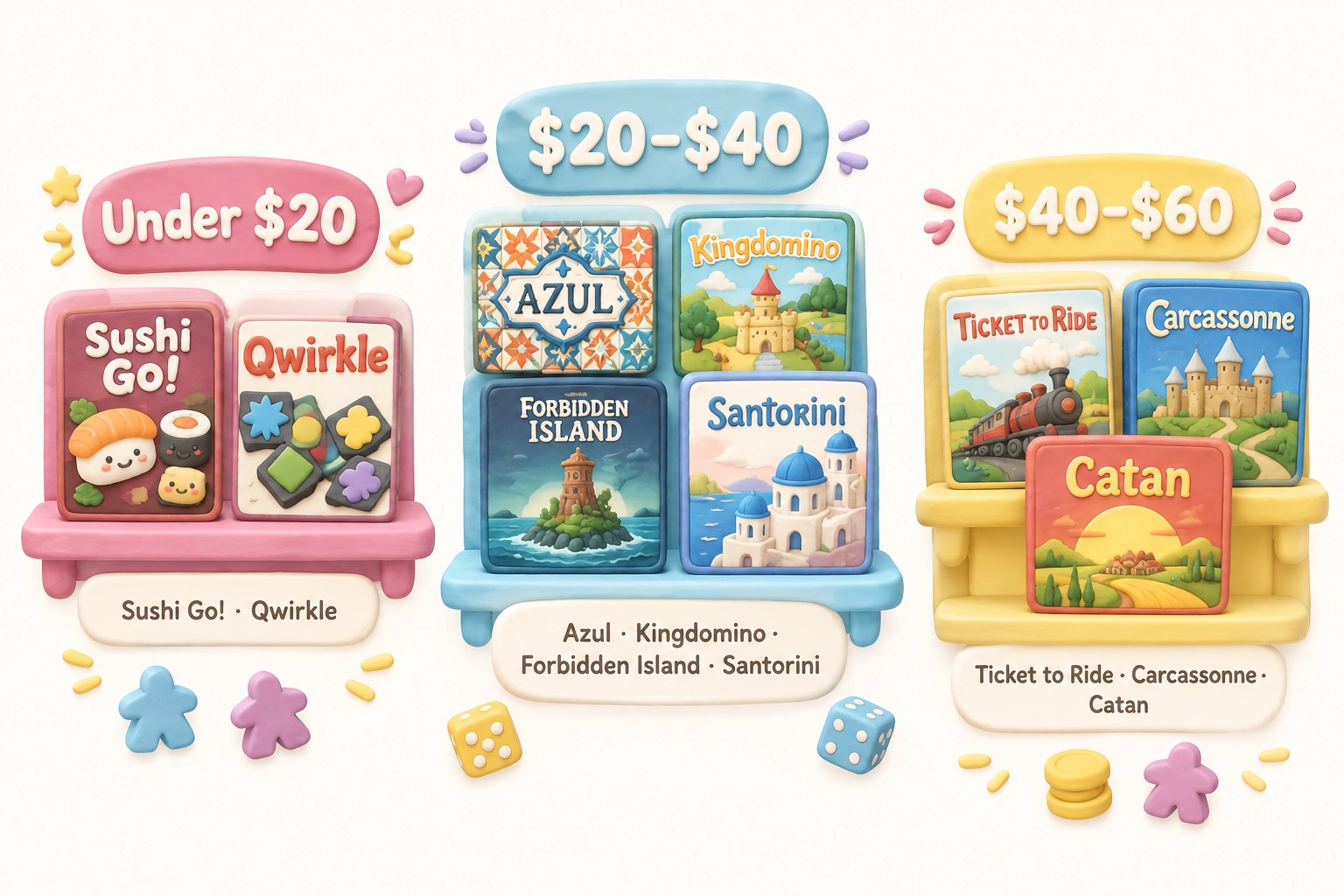
- Under $20: Sushi Go!, Blokus (often discounted), Qwirkle. Strong value for money, simple rules, good for introducing game night habits.
- $20–$40: Kingdomino, Azul, Forbidden Island, Codenames, Santorini. This range offers the best combination of component quality, strategic depth, and replay value for most families.
- $40–$60: Ticket to Ride, Carcassonne (with expansions), Catan. Higher upfront cost, but these games are frequently played for years and often become permanent family favorites.
Expansion packs for games like Carcassonne and Ticket to Ride extend longevity further, making the base game a lower-risk first purchase before investing in additional content.
Games to Approach With Caution at This Age
Not every popular game is a good fit for 9-year-olds, and a few common choices are worth reconsidering.
- Classic Monopoly: Sessions routinely exceed two hours, the luck-to-skill ratio is high, and the elimination mechanic (players are knocked out early and must watch others continue) tends to produce frustration rather than strategic engagement. Monopoly Deal — the card game version — is faster and more strategic.
- Risk: The playtime is unpredictable and often very long. The luck element in combat can feel unfair to children developing strategic thinking. Better reserved for ages 12 and up.
- Games marketed as educational but built around rote recall: Trivia games that test memorized facts rather than reasoning skills offer limited developmental value compared to games that require active decision-making.
- Overly complex games with long rule books: Games designed for adult hobbyists — even if technically playable at age 9 — can create a frustrating first experience that puts children off board games entirely. Complexity should be introduced gradually.
Sibling Compatibility: Games That Work Across Age Ranges
Many 9-year-olds play regularly with younger or older siblings, and choosing a game that works across a wider age range significantly increases how often it gets played. Kingdomino works well from age 6 upward. Forbidden Island is accessible from around age 7 and remains engaging for teenagers. Sushi Go! accommodates ages 8 and up without feeling condescending to older players. Azul and Carcassonne both have simple enough rules for a confident 7-year-old but enough strategic depth to engage adults. When the age gap is large — say, a 9-year-old and a 5-year-old — cooperative games are almost always the better choice, since they remove the competitive dynamic that can make younger children feel outmatched.
Frequently Asked Questions
Are strategy board games too complex for a 9-year-old?
Most 9-year-olds are developmentally ready for genuine strategy games, provided the rules can be explained in under ten minutes and the first game serves as a learning session. Games like Azul, Kingdomino, and Forbidden Island are designed so that the core mechanics are simple but the strategic decisions are meaningful. Starting with a gateway game and progressing to more complex titles as confidence grows is a practical approach.
What is the ideal playtime for a 9-year-old’s attention span?
Research on middle childhood attention suggests that 20 to 40 minutes is a practical target for sustained, focused game play at this age. Games in this range — Azul, Kingdomino, Sushi Go!, Forbidden Island — tend to produce complete, satisfying sessions without the fatigue or abandonment that longer games risk. Some 9-year-olds comfortably manage 45 to 60 minutes, particularly for games they are highly motivated to play.
Can adults genuinely enjoy these games, or are they just for children?
The games recommended here — Azul, Carcassonne, Ticket to Ride, Santorini, Codenames — are all regularly played by adults in their own right. This is one of the most useful features of a well-chosen family game: adults are not simply tolerating the experience. Genuine adult engagement makes family game night more enjoyable for children and models the kind of sustained, thoughtful play that builds strategic thinking.
Which games work best for two players?
Santorini is specifically designed as a two-player abstract strategy game and is excellent in that format. Blokus Duo is the two-player version of Blokus. Ticket to Ride and Azul both work with two players, though some players find them more dynamic with three or four. Codenames requires at least four players to work as intended.
Are cooperative board games better than competitive ones for this age?
Neither is universally better. Cooperative games reduce conflict, support teamwork, and work well across age gaps. Competitive games build resilience, individual strategic thinking, and the ability to manage winning and losing gracefully. The right choice depends on the specific children involved, the context, and what skills parents want to prioritize in a given session.
Do board games have educational value beyond entertainment?
Board games can support a range of skills that have genuine educational relevance: mathematical reasoning, pattern recognition, spatial thinking, working memory, planning, and communication. The educational value is strongest when games require active decision-making rather than passive luck, and when caregivers engage alongside children rather than simply supervising. Outcomes vary by child, game type, and frequency of play.
Which games offer expansion packs for long-term use?
Carcassonne has one of the largest expansion libraries of any family game, adding new tile types, mechanics, and complexity over many years. Ticket to Ride has map expansions for different countries and regions. Sushi Go! Party! is itself an expanded version of the base game. Santorini’s God Power cards function as a built-in expansion system.
Choosing a Board Game That Will Actually Get Played
The most strategically sophisticated game on this list is worthless if it stays in the box. The practical test for any board game purchase is whether it will be requested again — and that depends on the specific child as much as the game itself. A child who loves puzzles and solo challenges may gravitate toward Santorini or Azul. A child who prefers social, collaborative experiences will likely get more from Forbidden Island or Codenames. A child who plays regularly with younger siblings needs a game that scales across ages without feeling dumbed down for the older player.
The games recommended here share a common quality: they reward repeated play. Each session of Carcassonne produces a different map. Each game of Azul presents a different tile distribution. Each round of Sushi Go! involves different card combinations. That variability — built into the design through randomized components and variable setup — is what separates a game that gets played for years from one that gets played twice. For a 9-year-old whose strategic thinking is actively developing, that depth is not just a nice feature. It is the reason the game continues to matter.

Take a short quiz to find out what your everyday choices say about your parenting style
When your child is curious about something new, what’s your instinct?
Take a short quiz to find out what your everyday choices say about your parenting style
“Can I download this app?” What happens next?
Take a short quiz to find out what your everyday choices say about your parenting style
When it comes to rules at home, which sounds most like you?
Take a short quiz to find out what your everyday choices say about your parenting style
If you could give your child one life skill today, what would you pick?
Take a short quiz to find out what your everyday choices say about your parenting style
Your child gets to choose what to watch. What would your ideal setup look like?
Take a short quiz to find out what your everyday choices say about your parenting style
Pick your parenting superpower ✨