Best Board Games for 11-Year-Olds: Cooperative and Competitive Picks

 Discover a Free Education Video App for Kids
Pastory uses AI to personalize educational video content based on your child’s interests and personality. Safe, engaging, and built for curious young minds. Sign up now to stay updated and enjoy early access with a free trial
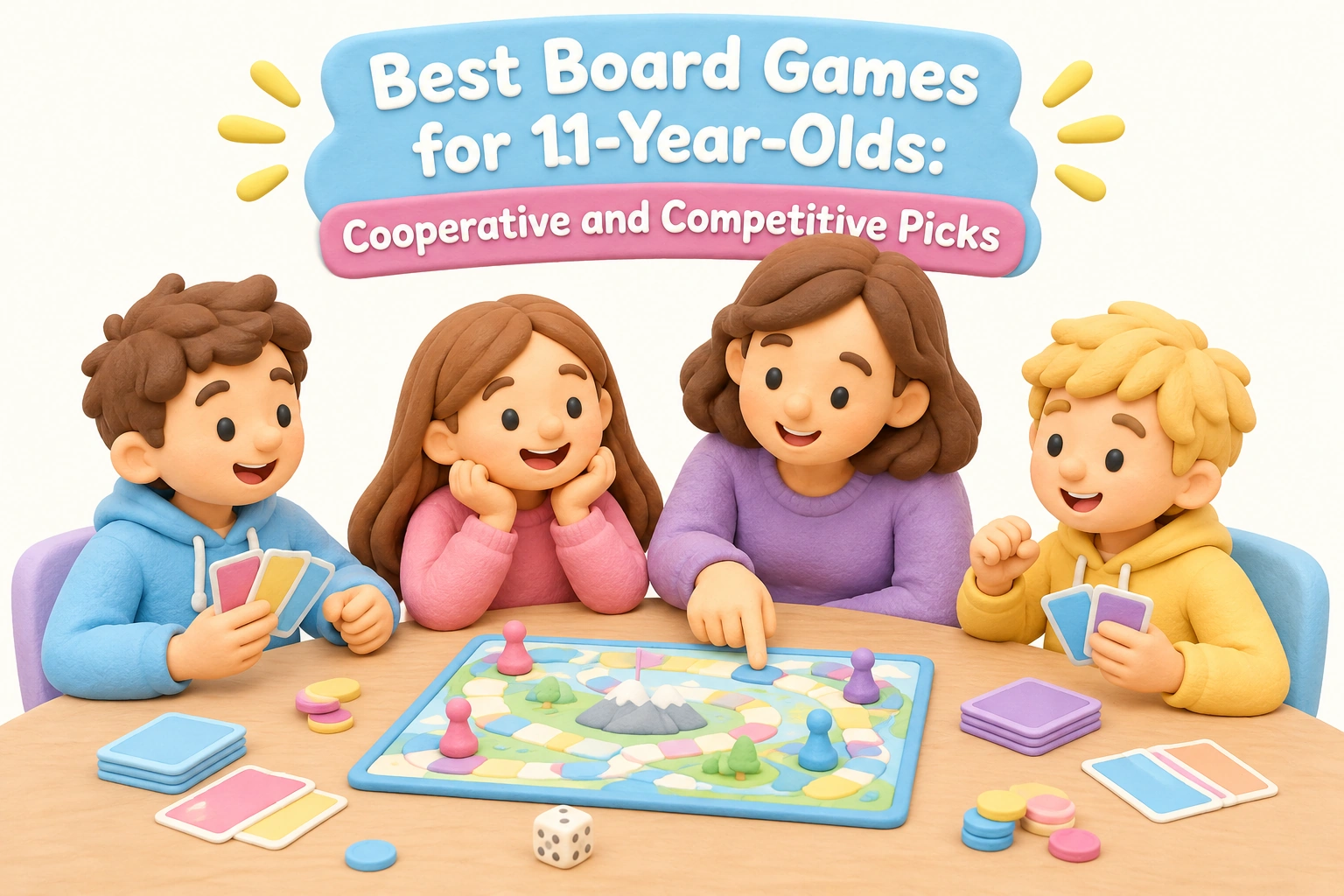
Eleven-year-olds occupy a genuinely interesting developmental position: they can follow multi-step rules, hold a strategy in mind across a long game, and engage meaningfully with negotiation and social dynamics — yet they still want games that feel fun rather than like homework. Finding board games for tweens that hit this balance is easier when you understand what this age group is actually ready for, and what developmental value different game formats offer. This guide covers cooperative and competitive picks, explains how each format supports different skills, and helps you choose the right game for your child’s personality, your family’s situation, and your budget.
Key Takeaways
- Eleven-year-olds are developmentally ready for strategy games with moderate complexity, 30–90 minute play times, and meaningful decision-making.
- Cooperative board games build teamwork and communication skills; competitive board games develop strategic thinking, patience, and sportsmanship — both formats offer genuine developmental value.
- Replay value, player count, and adjustable difficulty are the most practical factors when choosing a game for this age group.
- The best board games for tweens feel age-appropriate without being childish — abstract enough to challenge, accessible enough to learn in one sitting.
- Screen-free play through board games supports social development and critical thinking skills in ways that complement, rather than replace, other learning activities.
Why 11-Year-Olds Are in the Board Game Sweet Spot
Child development research consistently shows that middle childhood — roughly ages 9 to 12 — is a period of rapid growth in logical reasoning, perspective-taking, and the ability to manage complex rule systems. By age 11, most children can hold multiple variables in mind simultaneously, anticipate an opponent’s moves, and regulate the frustration that comes with losing. These are precisely the cognitive and emotional capacities that make strategy board games genuinely engaging rather than overwhelming.
At the same time, 11-year-olds are navigating an important social transition. Peer relationships become more central, and games that require negotiation, communication, or collaborative problem-solving give children a structured, low-stakes environment to practise these skills. Board games for this age group are not simply entertainment — they can support the development of critical thinking skills, emotional regulation, and the kind of flexible social reasoning that researchers associate with healthy tween development.
The practical challenge for parents is that many games marketed to children feel too young for an 11-year-old, while adult strategy games can be genuinely inaccessible. The games recommended below are chosen specifically because they occupy that tween sweet spot: complex enough to respect an 11-year-old’s growing capabilities, easy to learn within a single session, and engaging enough to sustain replay value over months or years.
Cooperative vs. Competitive Board Games: Which Format Suits Your Child?
Before selecting a specific title, it helps to understand what each game format actually offers developmentally — and which situations each format suits best.
What Cooperative Board Games Offer
In cooperative board games, all players work together against the game itself rather than against each other. Every player typically has a role or special ability, and the group must decide collectively how to use those strengths. This format is particularly well-suited to children who find losing discouraging, to mixed-ability groups where skill gaps might otherwise create an uneven experience, and to family game night situations where the goal is connection rather than competition.
Cooperative play may support teamwork and communication skills, shared decision-making, and the ability to listen to perspectives different from one’s own. Research in developmental psychology suggests that collaborative problem-solving tasks — including structured games — can strengthen children’s capacity for perspective-taking and flexible thinking. One practical limitation worth noting is the so-called alpha player problem: in some cooperative games, a more experienced or assertive player can end up directing everyone else’s moves, which reduces the developmental benefit for quieter participants. Rotating the role of lead decision-maker each round is a simple way to address this.
What Competitive Board Games Offer
Competitive board games place players in direct opposition, with one winner and one or more losers. For 11-year-olds, this format can be genuinely valuable: it creates real stakes that motivate strategic thinking, and navigating the experience of losing — without becoming overwhelmed — is itself an important developmental skill. Competitive gameplay may help children develop patience, sportsmanship, and the ability to self-regulate under pressure.
Competitive games are generally a better fit when players have roughly similar skill levels, when the child enjoys the challenge of outthinking an opponent, or when the group is small enough that wait times between turns stay manageable. For children who are particularly sensitive to losing, starting with cooperative formats and gradually introducing competitive games can ease the transition.
A Practical Decision Framework
Neither format is universally better. The right choice depends on the child’s temperament, the group composition, and the occasion. A useful rule of thumb: choose cooperative games for mixed-age play, for children who are new to strategy games, or for situations where the priority is connection and fun. Choose competitive games when the group has similar experience levels and the child is ready to engage with the challenge of winning and losing gracefully.
Best Cooperative Board Games for 11-Year-Olds
The following cooperative picks are consistently recommended for this age group because they offer genuine strategic depth without requiring hours of rules explanation.
Pandemic
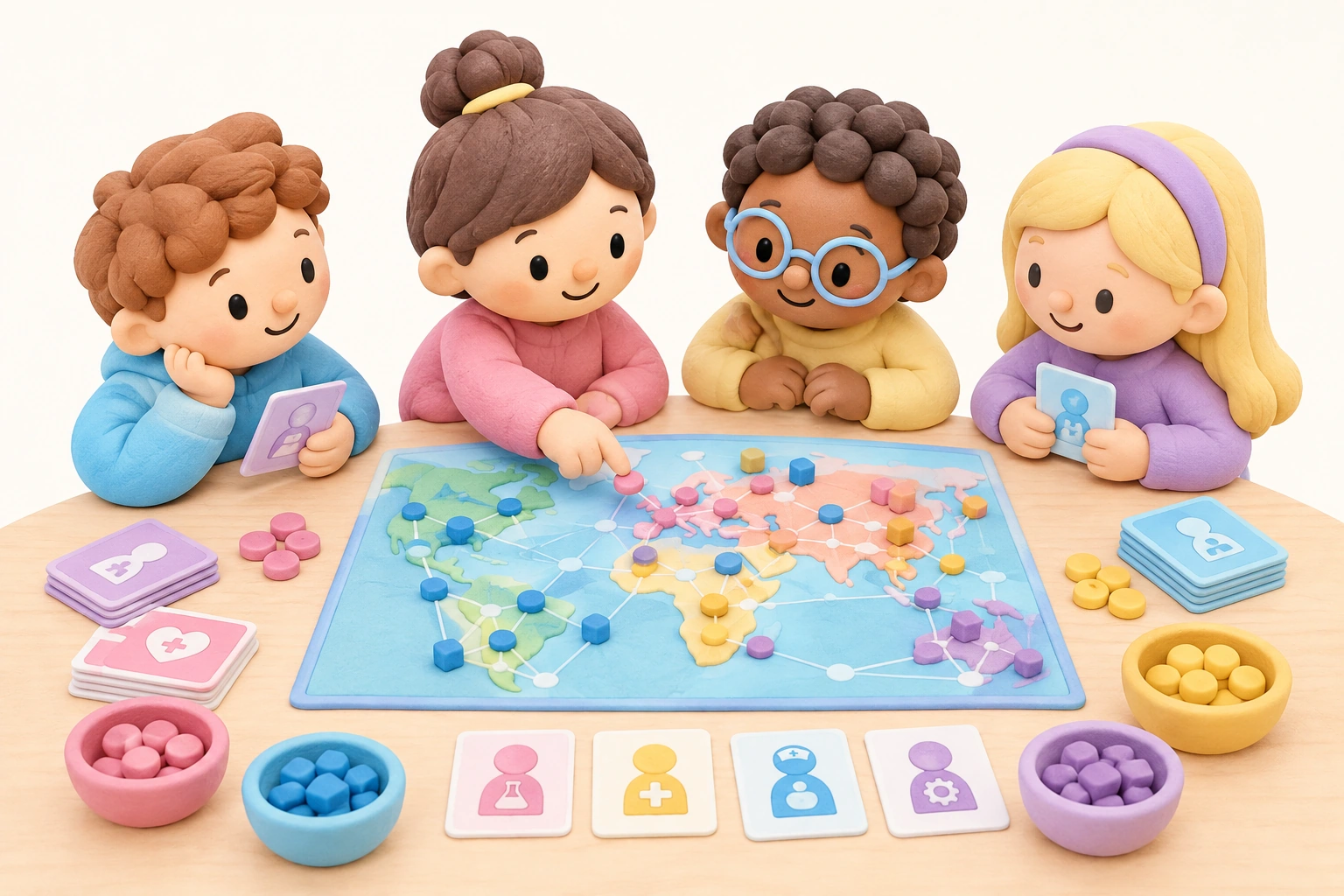
Pandemic is widely regarded as the gold standard cooperative strategy game for tweens and adults alike. Players take on specialist roles — medic, scientist, researcher — and work together to contain and cure four diseases spreading across a global map. The game scales in difficulty through a straightforward adjustment to the starting infection rate, making it genuinely accessible for first-time players while remaining challenging for experienced groups. Player count is 2–4, play time is typically 45–60 minutes, and the game has strong replay value because the board state changes significantly each session. Pandemic is an excellent gateway game into cooperative strategy for 11-year-olds who enjoy problem-solving under pressure.
Forbidden Island
Forbidden Island is a shorter, slightly more accessible cooperative game that works well for 2–4 players and typically runs 30–45 minutes. Players collect treasures from a sinking island before it disappears beneath the water. The game’s adjustable difficulty makes it suitable for a wide range of experience levels, and its compact format makes it a practical choice for family game night when time is limited. Forbidden Island is often recommended as a stepping stone toward Pandemic for younger or less experienced players.
Horrified
Horrified tasks players with defeating classic movie monsters — Dracula, the Mummy, Frankenstein’s Monster — before they terrorize the town. The cooperative format works well for mixed-age play because each monster has different mechanics, allowing the group to adjust complexity by choosing which monsters to include. Play time is 60–90 minutes, player count is 1–5, and the thematic content is age-appropriate for most 11-year-olds. The game’s modular structure gives it strong replay value.
The Crew: The Quest for Planet Nine
The Crew is a cooperative trick-taking card game for 2–5 players that uses a space exploration theme to frame a series of increasingly complex mission objectives. It is notable for being genuinely challenging without a long setup time — most missions take 15–20 minutes — and for offering a solo mode alongside multiplayer. The Crew is an excellent choice for families who already enjoy card games and want to introduce cooperative mechanics without committing to a full board game setup.
Harry Potter: Hogwarts Battle
Hogwarts Battle is a deck-building cooperative game in which players take on the roles of Harry, Hermione, Ron, and Neville to defend Hogwarts from villains. The game introduces new mechanics across seven progressively complex boxes, making it an ideal choice for children who want a game that grows with them. Player count is 2–4, and play time is 30–60 minutes depending on the game number. The familiar theme makes it particularly accessible for children who are fans of the series, and the deck-building mechanic introduces a layer of resource management that supports strategic thinking.
Best Competitive Board Games for 11-Year-Olds
These competitive picks offer meaningful strategic decisions, manageable play times, and enough variety to sustain interest across multiple sessions.
Catan
Catan — sometimes called the gateway game of modern board gaming — introduces resource management, negotiation, and route planning through a modular board that changes with every game. Players collect and trade resources to build settlements, cities, and roads, with the first player to reach ten victory points winning. The negotiation element is particularly valuable for 11-year-olds: it requires reading social dynamics, making and evaluating offers, and deciding when to cooperate and when to compete. Player count is 3–4, play time is 60–90 minutes, and the game has exceptional replay value. Catan is a strong choice for children who enjoy social interaction alongside strategy.
Ticket to Ride
Ticket to Ride is a route-building strategy game in which players collect coloured train cards and use them to claim railway routes across a map. The game is easy to learn — most players understand the core rules within ten minutes — but offers genuine strategic depth through route planning and the decision of when to block an opponent. Player count is 2–5, play time is 45–75 minutes, and multiple map expansions give the game strong long-term replay value. Ticket to Ride is an excellent first competitive strategy game for 11-year-olds who are new to the genre.
Azul
Azul is an abstract tile-placement game in which players draft coloured tiles to complete patterns on their personal boards. The game has that particular quality that makes it ideal for tweens: it does not feel like a children’s game, but it is accessible enough to learn in a single session. Strategic decisions involve both optimising your own board and disrupting your opponent’s plans, which introduces competitive thinking without aggressive confrontation. Player count is 2–4, play time is 30–45 minutes, and the physical quality of the tiles makes the game tactilely satisfying. Azul has won multiple international board game awards, including the Spiel des Jahres, which is a useful credibility signal when evaluating quality.
Codenames
Codenames is a word association and social deduction game for 2–8 players in which two spymasters give one-word clues to help their teams identify secret agents on a grid of words. The game is fast — most rounds take 15–30 minutes — and scales well to larger groups, making it an excellent choice for sleepovers or birthday parties. Codenames develops vocabulary, lateral thinking, and the ability to communicate precisely under time pressure. It is one of the few competitive games that works well with a high player count, which makes it a practical option when the group is larger than four.
Splendor
Splendor is a card drafting and resource management game in which players collect gem tokens to purchase development cards, building an engine that generates permanent resources. The game is easy to learn, plays in 30–45 minutes, and supports 2–4 players. Splendor rewards forward planning and the ability to anticipate what opponents are building toward, making it a strong choice for children who enjoy optimisation puzzles. Its relatively short play time and clean rules make it a practical option for family game night when time is limited.
7 Wonders
7 Wonders is a card drafting strategy game for 3–7 players in which each player develops an ancient civilization across three ages. The simultaneous card selection mechanic means there is almost no downtime — everyone plays at the same time — which makes it particularly well-suited to larger groups. Play time is 30–45 minutes regardless of player count, which is unusual for a game of this strategic depth. 7 Wonders is a strong upgrade path for children who have mastered simpler card games and are ready for more complex resource management decisions.
Scenario-Based Recommendations
Choosing the right game often depends less on the game itself and more on the specific situation. The following recommendations are organized by common use cases.
Best for Family Game Night with Mixed Ages
Mixed-age play benefits from games with adjustable difficulty and simple enough rules that younger siblings can participate without slowing the game down. Ticket to Ride, Forbidden Island, and Codenames all work well for mixed-age groups spanning roughly ages 8 to adult. Cooperative formats are generally more inclusive in mixed-age situations because they remove the skill-gap problem that can make competitive games frustrating for younger players.
Best for Two Players
Azul, Splendor, and Pandemic all play well with two players. Azul in particular is designed to be equally engaging at two players as at four, which is not true of all games in this category. For families with one child and one parent, or two siblings, these titles offer a genuinely satisfying two-player experience without feeling like a compromise.
Best for Sleepovers and Large Groups
For groups of five or more, prioritise games with high player caps and fast rounds. Codenames handles up to eight players and plays quickly enough to fit multiple rounds into an evening. 7 Wonders supports up to seven players with no increase in play time. Exploding Kittens — a fast, humorous card game — works well as a warm-up or wind-down game for larger groups.
Best as a First Strategy Game
For children who are new to modern board games, Ticket to Ride and Forbidden Island are the most accessible entry points. Both are easy to learn, play in under an hour, and offer enough strategic depth to remain interesting beyond the first session. From there, Catan and Pandemic represent natural next steps for children who want more complexity.
Board Game Buying Guide for Parents
When evaluating board games for 11-year-olds, the following factors are the most practically useful.
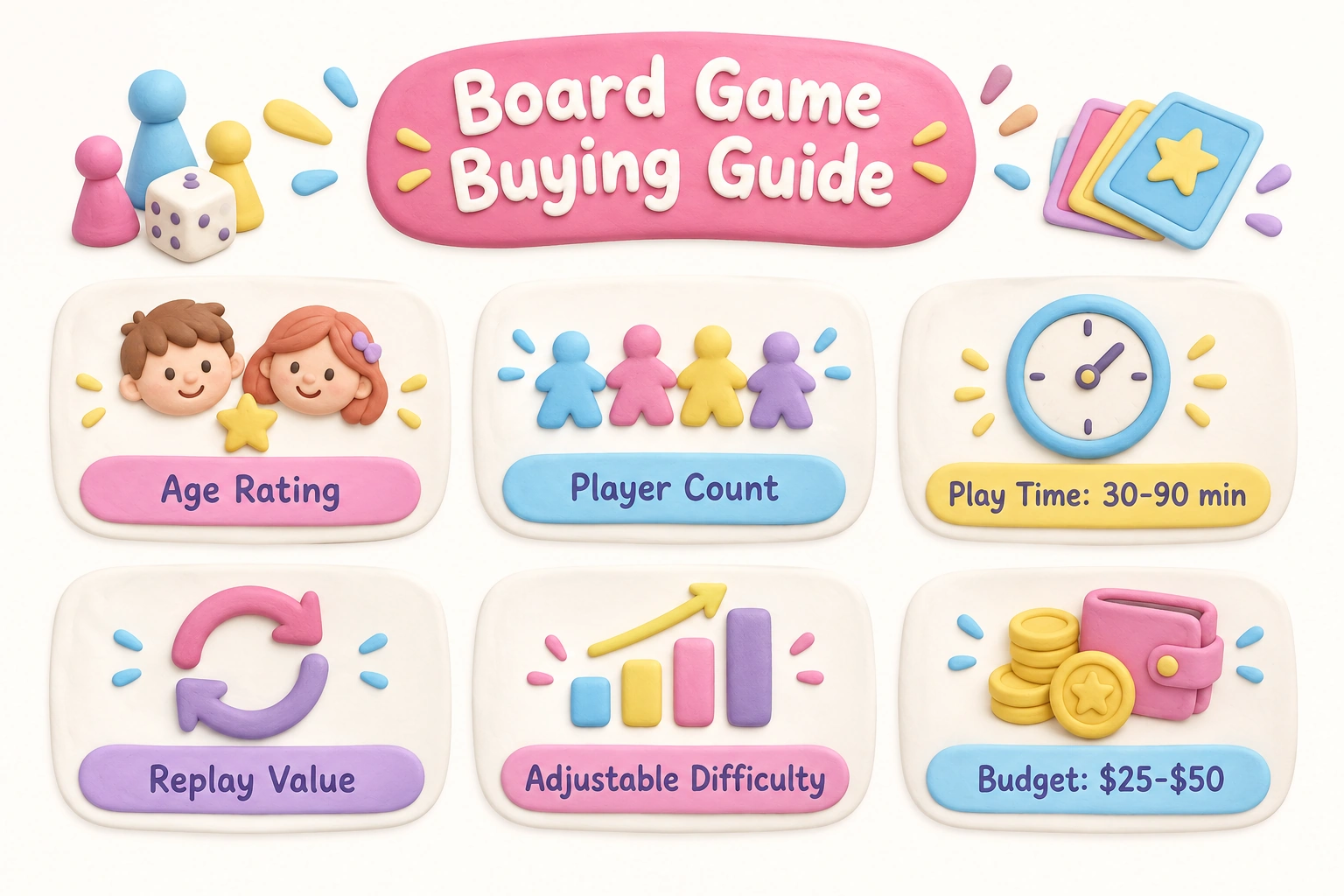
- Age rating: Most games in this guide are rated 10+ or 12+, which aligns well with an 11-year-old’s cognitive readiness. Age ratings are a useful starting point but should be considered alongside your individual child’s experience with strategy games.
- Player count: Check the minimum and maximum player count before purchasing. A game rated for 2–4 players will not work well at a birthday party with eight children.
- Play time: Games in the 30–60 minute range are the most practical for family game night. Longer games (60–90 minutes) are better suited to dedicated gaming sessions.
- Replay value: Games with modular boards, variable setups, or expanding card pools tend to sustain interest longer. Catan, Pandemic, and Azul all have strong replay value because no two games play out identically.
- Adjustable difficulty: Games that allow you to scale complexity — through difficulty settings, optional rules, or modular components — are more versatile and grow with the child.
- Budget: Most of the games in this guide fall in the $25–$45 range. Codenames and Splendor are typically available for under $25. Catan and Pandemic are mid-range at $35–$45. Hogwarts Battle and 7 Wonders can reach $50 or more for the full version.
- Award recognition: The Spiel des Jahres (Game of the Year) and Kennerspiel des Jahres (Connoisseur Game of the Year) are internationally recognised awards that signal quality design and broad accessibility. Azul, Ticket to Ride, Codenames, and Catan have all received major award recognition, which is a useful independent quality signal.
Developmental Benefits of Board Games for Tweens
Board games are not a substitute for other forms of learning, but they offer a distinctive combination of benefits that is difficult to replicate through screen-based activities. The social, cognitive, and emotional demands of a board game session are simultaneous and interactive — players must think strategically, communicate clearly, manage their emotional responses, and adapt their plans in real time.
Research in developmental psychology suggests that structured play activities — including board games — may support the development of executive function skills such as working memory, cognitive flexibility, and inhibitory control. These are the same skills that underpin academic performance and social competence in middle childhood. Cooperative board games in particular may support perspective-taking and collaborative problem-solving, while competitive games may help children practise emotional regulation and develop a more resilient relationship with failure.
It is worth noting that outcomes vary by child, and the developmental benefits of board games depend significantly on how they are played. A game session in which an adult models gracious losing, encourages strategic discussion, and creates a relaxed atmosphere is likely to be more developmentally valuable than one played under pressure or with high emotional stakes. The game itself is a tool; the quality of the interaction around it matters at least as much.
Frequently Asked Questions
What makes a board game age-appropriate for an 11-year-old?
Age-appropriate board games for 11-year-olds typically involve multi-step rules that can be learned in one session, play times of 30–90 minutes, and strategic decisions that reward planning without requiring specialist knowledge. Games that feel too young tend to rely on luck alone; games that feel too adult often have rules that take multiple sessions to learn. The games in this guide are chosen because they sit between those extremes.
Are cooperative games better than competitive games for this age group?
Neither format is universally better. Cooperative games are generally more inclusive for mixed-ability or mixed-age groups and are a good starting point for children who find losing discouraging. Competitive games offer valuable practice in strategic thinking and emotional regulation. Many families find that having one or two games from each category gives them flexibility for different occasions.
How do I handle the alpha player problem in cooperative games?
The alpha player problem occurs when one player — often the most experienced — effectively directs everyone else’s decisions, reducing the game to a solo experience with an audience. Practical solutions include rotating the role of lead decision-maker each round, using a house rule that limits how much advice players can give each other, or choosing cooperative games with hidden information (such as The Crew) that structurally prevent one player from seeing everyone’s options.
Can these games be played with fewer than the recommended player count?
Many of the games in this guide play well with two players. Azul, Splendor, Pandemic, and Forbidden Island are all designed to be satisfying at two players. Codenames and 7 Wonders are better with larger groups. Always check the minimum player count on the box, and look for reviews that specifically address the two-player experience if that is your primary use case.
What should I try next if my child has mastered these games?
Children who have mastered the gateway games in this guide — Ticket to Ride, Forbidden Island, Codenames — are typically ready for deeper strategy games such as Wingspan, Carcassonne, or Mysterium. Wingspan introduces engine-building and resource management at a higher level of complexity. Carcassonne is a tile-placement game with elegant rules and significant strategic depth. Mysterium combines cooperative deduction with asymmetric roles in a way that rewards experienced players. These titles represent a natural upgrade path for tweens who are ready for more challenge.
Are board games a useful screen-free alternative for tweens?
Board games are one of the most well-established screen-free activities for this age group, and they offer social and cognitive engagement that passive screen time does not. That said, board games are most valuable when they complement a broader range of activities — outdoor play, reading, creative projects — rather than simply replacing one screen with another form of structured entertainment. The key advantage of board games is that they require active participation, communication, and decision-making from every player.
Choosing the Right Board Game for Your 11-Year-Old
The best board game for any individual child depends on their temperament, their experience with strategy games, and the people they are most likely to play with. A child who enjoys social dynamics and negotiation will probably love Catan or Codenames. A child who prefers quiet problem-solving may gravitate toward Azul or Splendor. A family that wants a shared cooperative experience will find Pandemic or Forbidden Island more satisfying than a competitive title.
If you are buying a first modern board game for an 11-year-old, Ticket to Ride is the most reliably accessible starting point: it is easy to learn, plays in under an hour, works for 2–5 players, and has enough strategic depth to remain interesting well beyond the first session. For cooperative play, Forbidden Island offers a similar combination of accessibility and genuine challenge. Both are available at a mid-range price point and have strong replay value.
Whatever you choose, the most important factor is not the game itself but the environment around it. Board games for tweens are most developmentally valuable — and most enjoyable — when played in a relaxed atmosphere where the process of playing matters more than the outcome. An 11-year-old who learns to think strategically, communicate clearly, and handle a loss with good humour is gaining skills that extend well beyond the game table.

Take a short quiz to find out what your everyday choices say about your parenting style
When your child is curious about something new, what’s your instinct?
Take a short quiz to find out what your everyday choices say about your parenting style
“Can I download this app?” What happens next?
Take a short quiz to find out what your everyday choices say about your parenting style
When it comes to rules at home, which sounds most like you?
Take a short quiz to find out what your everyday choices say about your parenting style
If you could give your child one life skill today, what would you pick?
Take a short quiz to find out what your everyday choices say about your parenting style
Your child gets to choose what to watch. What would your ideal setup look like?
Take a short quiz to find out what your everyday choices say about your parenting style
Pick your parenting superpower ✨