Best Games for 5-Year-Olds: Beginner Strategy and Digital Picks

 Discover a Free Education Video App for Kids
Pastory uses AI to personalize educational video content based on your child’s interests and personality. Safe, engaging, and built for curious young minds. Sign up now to stay updated and enjoy early access with a free trial
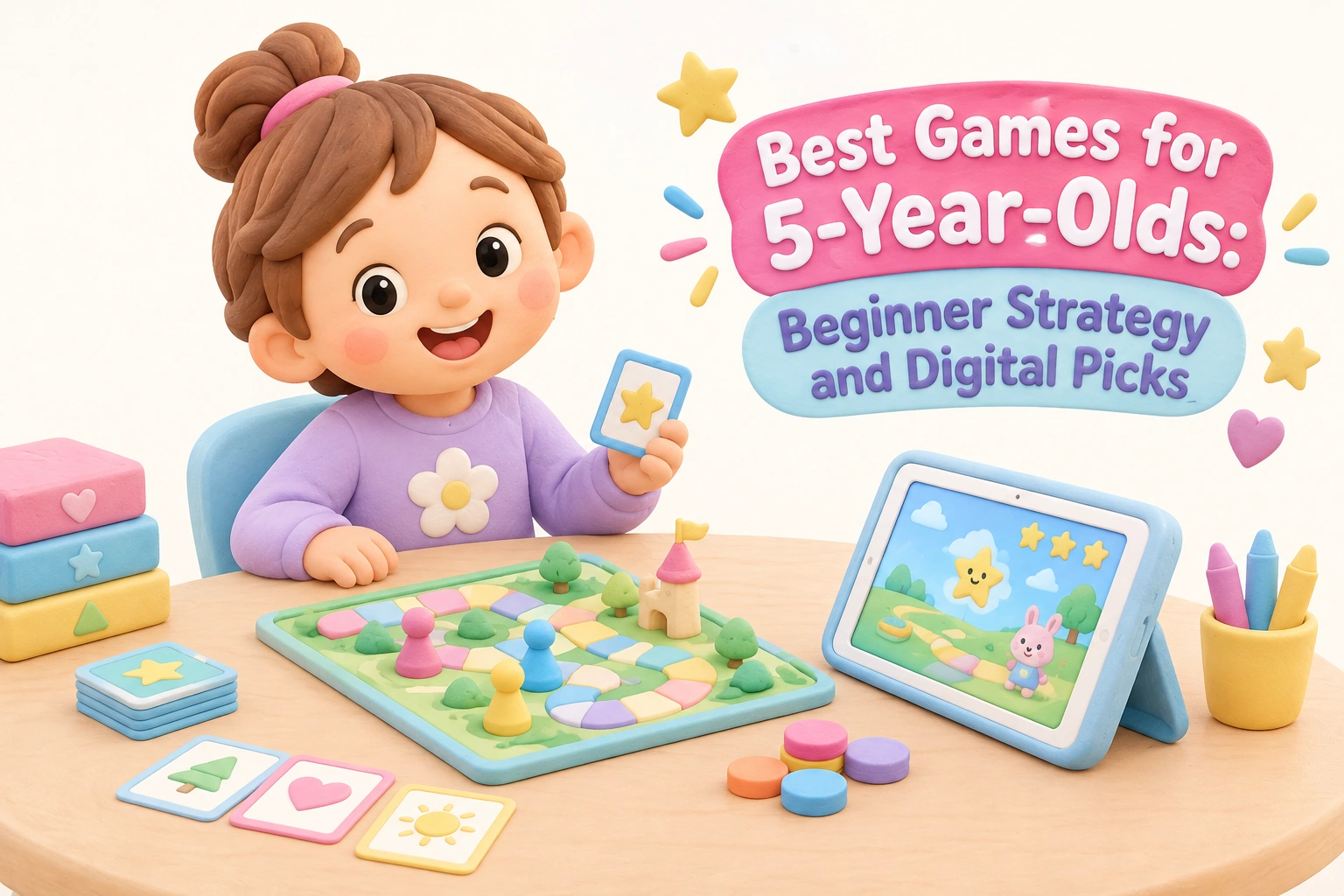
Five-year-olds are at a remarkable developmental crossroads: their attention span is growing, they are beginning to understand rules, and they are ready to experience the satisfaction of planning a move and seeing it pay off. The right games at this age can support critical thinking, turn-taking, emotional regulation, and early social skills — but choosing well matters. This guide covers the best board games for 5-year-olds, including beginner strategy picks, cooperative options, and carefully selected digital games and educational apps, along with practical guidance on what to look for and what to avoid.
Key Takeaways
- Five-year-olds are developmentally ready for beginner strategy games that require simple planning, but games with no reading required and short play times (15–25 minutes) tend to work best at this age.
- Cooperative games may support prosocial behavior and emotional regulation, making them a strong choice alongside competitive options for kindergarten-age children.
- Digital games and educational apps can complement board game play, but pediatric guidance recommends limiting recreational screen time and prioritizing interactive, ad-free content.
- The most developmentally useful games at age five build more than one skill simultaneously — combining spatial reasoning, problem-solving, and turn-taking in a single session.
- Choosing games that grow with your child (scalable difficulty) offers better long-term value than games a child will outgrow in a few months.
What Makes a Game Right for a 5-Year-Old?
Before diving into specific recommendations, it helps to understand what a five-year-old is actually capable of — and where their limits lie. At this age, most children are in the preoperational stage of cognitive development, meaning they are beginning to think symbolically and understand cause and effect, but abstract reasoning is still emerging. Working memory is limited compared to older children, so games with too many simultaneous rules can quickly become frustrating rather than fun.
The most age-appropriate games for five-year-olds share a few consistent features. They have a short play time, ideally under 25 minutes, which aligns with a typical kindergarten-age attention span. They use pictures, colors, or simple symbols rather than requiring reading. They involve clear, consistent rules that can be explained in under two minutes. And they offer enough variability that the outcome is not entirely predictable, which keeps engagement alive across multiple sessions.
Games that are purely luck-based — like classic Candy Land or Chutes and Ladders — are perfectly valid entry points for very young five-year-olds or children new to structured play. However, developmental research suggests that introducing light strategy elements, even simple ones like choosing which piece to move or where to place a tile, begins to build executive function skills including planning ahead and flexible thinking. The goal is a gentle progression, not a sudden leap.
The Strategy Ladder: A Progression Path for 5-Year-Olds
One of the most useful frameworks for parents choosing games for 5-year-olds is thinking in terms of a strategy ladder — a gradual progression from pure luck to genuine beginner strategy. Rather than jumping straight to complex games, this approach meets children where they are and builds confidence alongside skill.
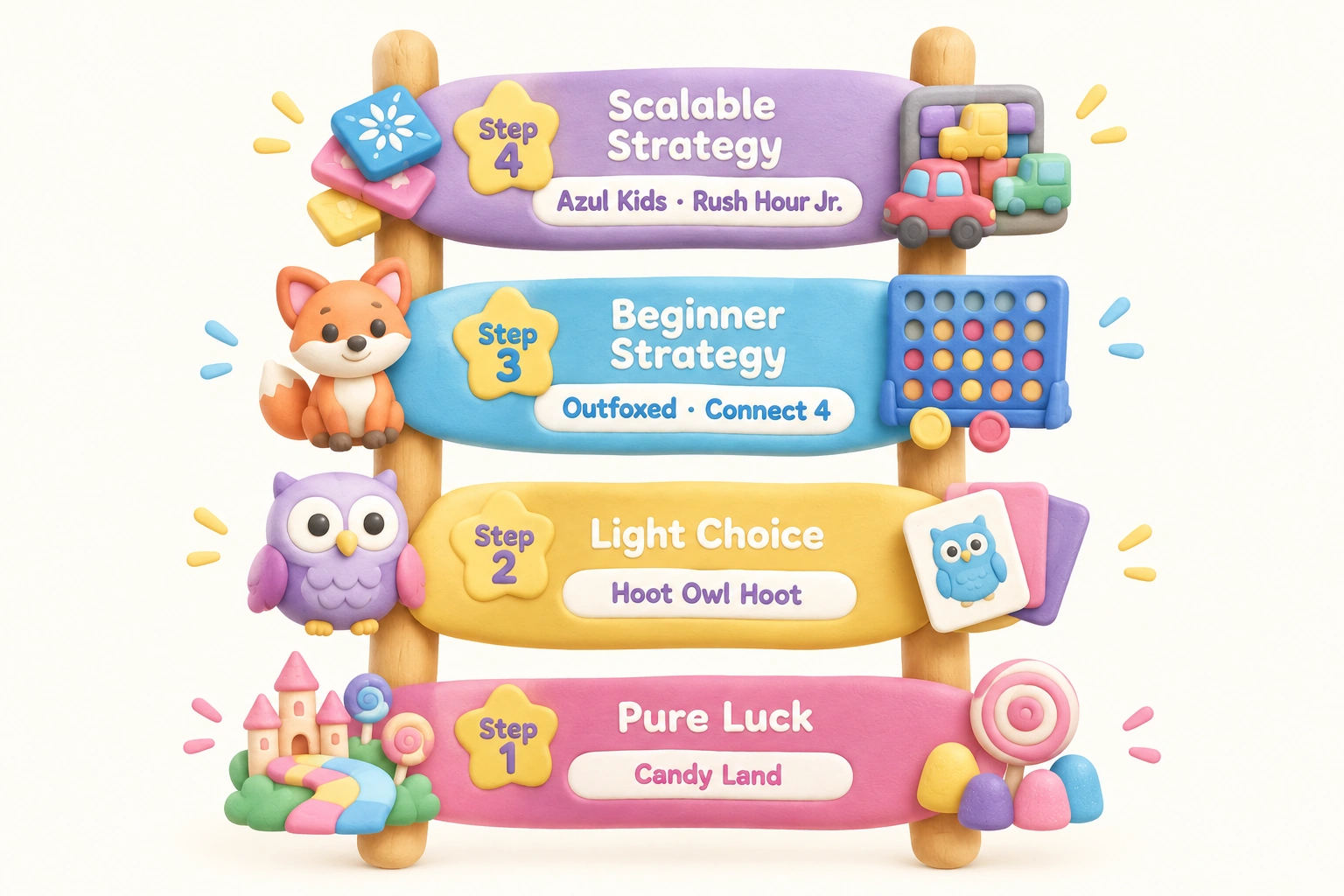
Step 1 — Pure luck (entry point): Games like Candy Land, Chutes and Ladders, and First Orchard involve no decision-making. They are ideal for children who are new to structured games, learning turn-taking, and developing the emotional regulation needed to handle losing gracefully. These games are not intellectually demanding, but they teach the social architecture of game play.
Step 2 — Light choice with luck: Games like Zingo, Spot It!, and Hoot Owl Hoot introduce a small element of choice or matching skill. Children begin to scan, compare, and react — early forms of problem-solving skills within a low-stakes context. Cooperative games like Hoot Owl Hoot and Race to the Treasure! also belong here, where players work together rather than against each other.
Step 3 — Beginner strategy: Games like Sequence for Kids, Connect 4, and Outfoxed require children to think one or two moves ahead, recognize patterns, and make deliberate decisions. Outfoxed, a cooperative deductive game, is consistently cited as one of the most developmentally appropriate beginner strategy games for this age group. Connect 4 introduces spatial reasoning in a direct, visual way that five-year-olds can grasp.
Step 4 — Growing strategy (scalable difficulty): Games like Azul Kids, Monza, and Rush Hour Jr. offer scalable difficulty — meaning they can be played at a simpler level now and revisited with greater strategic depth as the child develops. These are excellent investments for families who want games that grow with your child rather than becoming obsolete within a year.
Best Board Games for 5-Year-Olds: Curated Picks by Category
Cooperative Games
Research published in peer-reviewed developmental psychology literature suggests that cooperative game play among children aged four to seven is associated with increased prosocial behavior, including sharing, empathy, and collaborative problem-solving. Cooperative games are particularly valuable for five-year-olds because they remove the pressure of direct competition while still requiring strategic thinking and communication.
Outfoxed is the most frequently recommended cooperative game for this age group across developmental and parenting resources. Players work together to identify which fox stole a pot pie before the fox escapes. It introduces deductive reasoning — a genuine form of critical thinking — in a format that is entirely picture-based and no reading required. Play time is typically 20 minutes, which suits the average kindergarten-age attention span well.
Hoot Owl Hoot is a color-matching cooperative game in which players work together to fly owls back to their nest before sunrise. It is one of the most accessible cooperative games for younger five-year-olds or children with shorter attention spans, with sessions often completing in 15 minutes. The cooperative structure means that more experienced players (including older siblings or parents) can naturally support less experienced ones without the game feeling unfair.
Race to the Treasure! and Monster Chase follow a similar cooperative model and are well-suited to family game night with mixed-age siblings. Both games are no reading required and involve simple path-building or movement decisions that introduce light strategic thinking without overwhelming young players.
Beginner Strategy Games
Sequence for Kids is a picture-based version of the classic Sequence game, designed specifically for younger players. Children match animal cards to spaces on the board and try to create a row of four tokens. It introduces pattern recognition and spatial reasoning in a format that five-year-olds can manage independently after a few sessions. It also works well as a two-to-four player game, making it flexible for different family sizes.
Connect 4 remains one of the most enduring beginner strategy games for this age group. The visual grid makes spatial reasoning concrete and immediate — children can see exactly where their discs land and begin to recognize winning patterns over time. While a five-year-old will not play at the level of an older child, the game genuinely rewards repeated play and grows in strategic depth as the child develops.
Monza is a racing game that introduces multi-step color planning — children must plan a sequence of moves based on the colors they roll. It is a genuine beginner strategy game that feels like a race (exciting and fast-paced) while quietly building planning and decision-making skills. It supports up to six players, making it one of the better options for larger families or classroom settings.
Story Time Chess deserves a mention for families interested in introducing chess concepts early. It uses narrative and character-based storytelling to teach how each chess piece moves, making the abstract rules of chess accessible to five-year-olds. It is not a replacement for chess itself, but it is a thoughtful bridge for children who show interest in more complex strategy.
Classic and Luck-Based Entry Points
Classic games like Candy Land, Chutes and Ladders, Trouble, and Go Fish remain valuable for five-year-olds who are new to structured game play or who need lower-stakes practice with turn-taking and emotional regulation. These games are widely available, inexpensive, and familiar to most caregivers, which reduces the learning curve for adults as well as children. Their limitation is that they offer little strategic depth, so children may outgrow them relatively quickly once they are ready for more complex play.
Cooperative vs. Competitive Games: What the Research Suggests
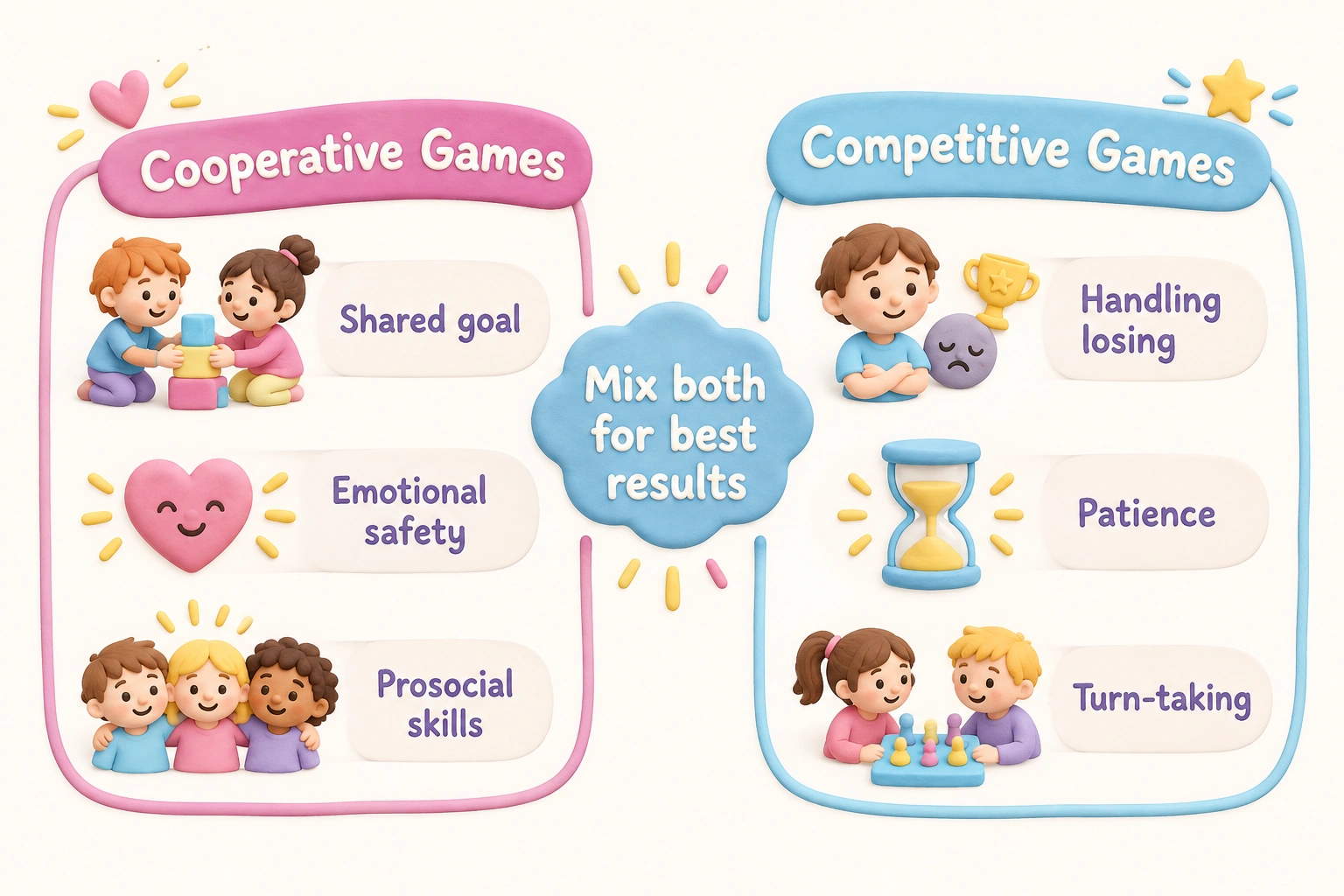
Parents often wonder whether cooperative or competitive games are better for five-year-olds. The honest answer is that both have developmental value, and the best approach is likely a mix of both over time. Cooperative games tend to be particularly useful during the kindergarten years because they reduce the emotional intensity of losing — a significant challenge for many five-year-olds who are still developing emotional regulation skills. When the whole group wins or loses together, the social experience of the game shifts from rivalry to shared problem-solving.
Competitive games, on the other hand, offer important practice in handling disappointment, waiting patiently, and recognizing that outcomes are not always within our control. These are genuine life skills, and age-appropriate competitive games provide a safe, low-stakes environment to practice them. The key is ensuring that the competitive game is genuinely age-appropriate — meaning the rules are simple enough that a five-year-old can participate meaningfully rather than simply losing repeatedly to older players or adults.
A practical approach for family game night is to rotate between cooperative and competitive options, observing how your child responds to each. Some five-year-olds thrive in cooperative settings; others are energized by friendly competition. Individual temperament matters as much as developmental stage.
Best Digital Games for 5-Year-Olds
Digital games can be a legitimate part of a five-year-old’s play environment when chosen carefully. The American Academy of Pediatrics recommends that children aged two to five limit recreational screen time to one hour per day of high-quality content, and that caregivers engage with digital content alongside children where possible. For five-year-olds, who are at the upper edge of this guidance, the quality and interactivity of the content matters more than the platform itself.
When evaluating digital games for this age group, look for an ESRB rating of Everyone (E), no in-app purchases or advertising directed at children, genuine interactivity rather than passive viewing, and content that connects to real skills such as early literacy, number sense, or spatial reasoning.
Console and PC Games
Minecraft (Creative Mode) is one of the most developmentally rich digital environments available for five-year-olds, provided it is used in Creative Mode rather than Survival Mode. Creative Mode removes combat and resource scarcity, leaving an open-ended play environment in which children build, explore, and experiment freely. This kind of open-ended play supports spatial reasoning, creative problem-solving, and early STEM thinking. Parental involvement is recommended initially to set up a safe world and establish boundaries around session length.
LEGO video games — including titles based on Star Wars, Marvel, and other familiar franchises — are consistently recommended for this age group. They feature cooperative two-player modes, humor-driven storytelling, and puzzle-solving that is genuinely accessible to five-year-olds. The ESRB rating is Everyone (E), and the games do not require reading to navigate. They are particularly well-suited to sibling or parent-child co-play, which aligns with pediatric guidance on shared screen time.
Kirby and the Forgotten Land and Sackboy: A Big Adventure are both platform games with gentle difficulty curves, colorful visuals, and cooperative play options. They are appropriate for five-year-olds who have some experience with controllers and are ready for a light challenge. Neither game requires reading to enjoy, and both have ESRB Everyone ratings.
PAW Patrol: Grand Prix is a racing game built around a familiar franchise for this age group. It is straightforward enough for independent play, which is useful for parents who need a child to engage independently for a short period. Its developmental ceiling is lower than the games above, but it is a reliable, age-appropriate choice for younger or less experienced five-year-olds.
Educational Apps for 5-Year-Olds
Educational apps occupy a distinct category from console games. The best educational apps for 5-year-olds combine genuine curriculum content — phonics, number sense, early literacy — with engaging interactive design that keeps children motivated. The most important practical filter for parents is whether the app is ad-free and free from in-app purchases, since advertising directed at young children raises both ethical and developmental concerns.
Khan Academy Kids is one of the most consistently recommended free educational apps for this age group. It covers early literacy, math, social-emotional learning, and creative activities in a fully ad-free environment. The content is editorially curated rather than purely algorithm-driven, which means children are guided through a structured learning progression rather than simply served whatever keeps them engaged longest.
ABCmouse offers a broad curriculum covering reading, math, science, and art for children aged two to eight. It is subscription-based and ad-free, with a structured learning path that supports kindergarten readiness. The platform’s breadth means it can serve as a supplementary learning environment rather than a single-skill tool.
Endless Alphabet focuses on vocabulary and phonics through animated, interactive word puzzles. It is ad-free, requires no reading from the child to navigate, and is particularly effective for building sight-word recognition and early literacy in an engaging format. It works well for independent play once a child is familiar with the interface.
DragonBox Numbers and Thinkrolls are both strong choices for building early math skills and logic puzzle thinking respectively. DragonBox Numbers uses visual, tactile-feeling interactions to build number sense without rote drilling. Thinkrolls presents age-appropriate logic puzzles that grow in complexity, offering genuine scalable difficulty within a single app. Both are ad-free.
Osmo deserves special mention as a hybrid physical-digital platform that uses a tablet camera to interact with physical game pieces. Osmo’s games for this age group cover letter formation, number sense, and creative drawing in a format that bridges screen time and hands-on play. The physical component means children are not simply tapping a screen — they are manipulating real objects, which supports fine motor skills alongside cognitive development.
Screen Time Guidance for 5-Year-Olds
Integrating digital games into a five-year-old’s routine requires some practical structure. Pediatric guidance consistently recommends that screen time for this age group be limited, interactive rather than passive, and balanced with substantial offline play. A useful approach is to treat digital game time as one component of a broader play diet rather than a default activity.
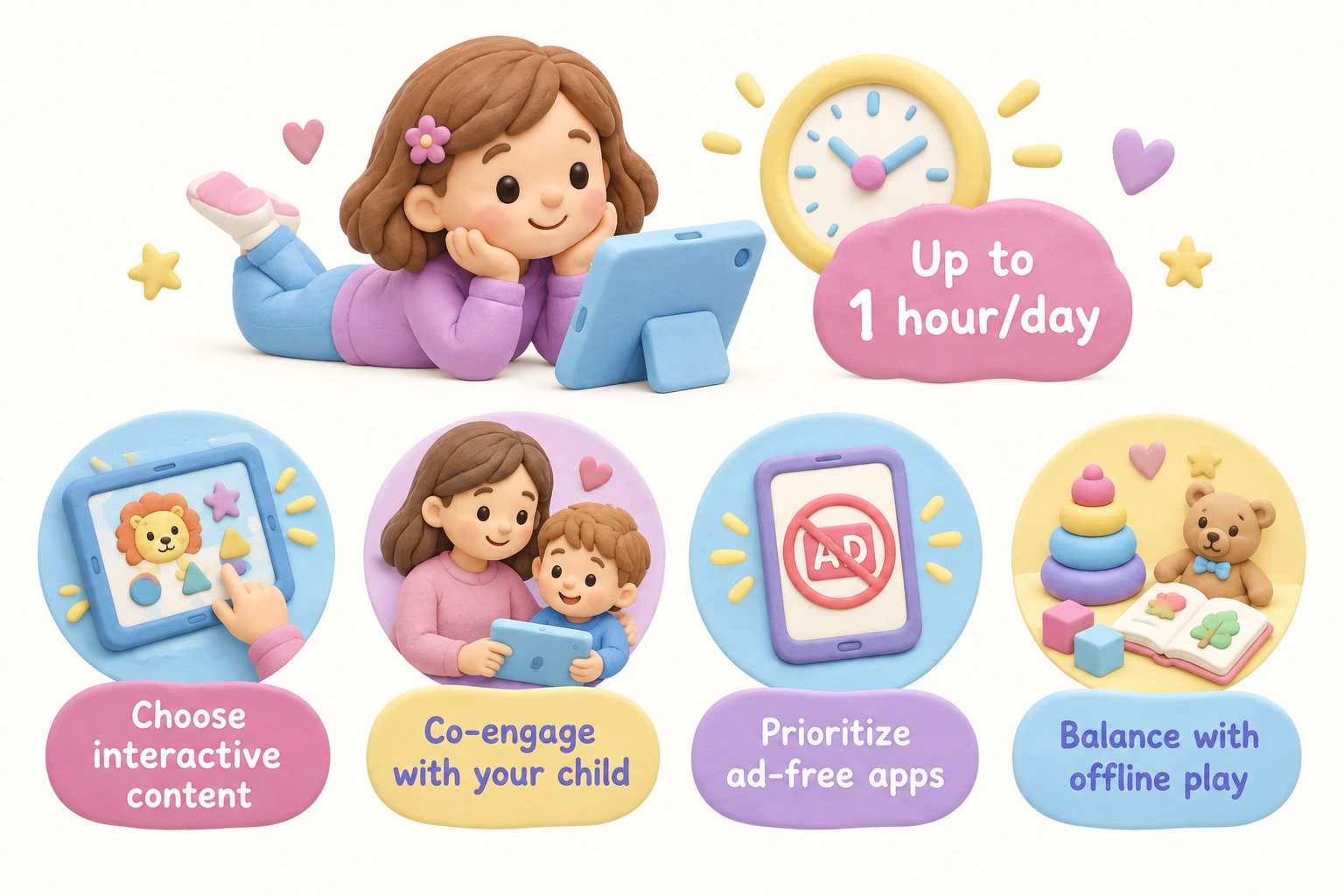
For educational apps specifically, co-engagement — where a caregiver plays alongside the child, asks questions, and connects the app content to real-world experiences — tends to produce better learning outcomes than independent use alone. This does not mean a parent must be present for every minute of app use, but occasional shared sessions significantly increase the developmental value of the content.
When selecting digital games, prioritize content that is genuinely interactive over content that is primarily passive. A child tapping through an animated story with no meaningful choices is receiving a different cognitive experience than a child solving a logic puzzle or building a structure in a creative game environment. Both may be enjoyable, but only one is actively building problem-solving skills.
Games That Work for Mixed-Age Siblings
One practical consideration that is often overlooked in game recommendations is whether a game works well when siblings of different ages play together. A five-year-old playing with a seven- or eight-year-old faces a significant skill gap in most strategy games, which can make the experience frustrating for the younger child and unstimulating for the older one.
Cooperative games solve this problem elegantly. In Outfoxed, Hoot Owl Hoot, or Race to the Treasure!, all players work toward the same goal, which means an older sibling can naturally support a younger one without the game feeling unfair. Monza works well across a wider age range because the luck element of dice rolling keeps outcomes variable regardless of skill level. Spot It! and Zingo are fast-paced enough that age differences matter less than reaction speed, which can actually favor younger children in some rounds.
For digital games, LEGO video games are particularly well-suited to mixed-age sibling play because the cooperative two-player mode allows a more experienced player to support a less experienced one without either player being excluded from the action.
Frequently Asked Questions
At what age can children start playing strategy games?
Most children are ready for very simple beginner strategy games — those requiring one or two steps of planning — around age four to five. Games like Connect 4 and Sequence for Kids are designed with this developmental window in mind. More complex strategy games, such as chess or Catan Junior, are generally better suited to children aged six and above, though individual readiness varies considerably.
Are cooperative games better than competitive games for 5-year-olds?
Neither type is universally better. Cooperative games tend to be easier for five-year-olds to manage emotionally, since losing together is less distressing than losing individually. However, competitive games provide valuable practice in handling disappointment and waiting patiently. A mix of both types over time is likely the most developmentally balanced approach.
How long should a game session be for a 5-year-old?
Most five-year-olds can sustain focused attention on a structured game for approximately 15 to 25 minutes. Games with play times in this range are generally the best fit. Longer games can be played in stages if the child remains engaged, but forcing a child to continue past their natural attention limit tends to create negative associations with game play rather than positive ones.
What are good games for 5-year-olds with no reading required?
Many of the best games for this age group are entirely picture-based or use color and symbol systems. Strong no reading required options include Outfoxed, Hoot Owl Hoot, Connect 4, Sequence for Kids, Spot It!, Zingo, and most LEGO video games. For educational apps, Khan Academy Kids, Endless Alphabet, and DragonBox Numbers are all navigable without reading ability.
How much screen time is appropriate for a 5-year-old?
Pediatric guidance from organizations including the American Academy of Pediatrics recommends that children aged two to five limit recreational screen time to approximately one hour per day of high-quality, interactive content. For five-year-olds specifically, the emphasis should be on interactive content — games and apps that require active engagement — rather than passive video viewing. Co-engagement with a caregiver is recommended where possible.
Which educational apps for 5-year-olds have no ads?
Khan Academy Kids is free and completely ad-free. Endless Alphabet, DragonBox Numbers, and Thinkrolls are paid apps with no advertising. ABCmouse is subscription-based and ad-free within the platform. When evaluating any app for this age group, check both the advertising policy and whether in-app purchases are present, as both can disrupt the learning experience and raise child safety concerns.
Do board games genuinely help 5-year-olds learn?
Research supports the view that structured game play can support a range of developmental skills in young children, including working memory, turn-taking, early math skills, and social-emotional learning. The developmental benefit depends on the quality of the game, the child’s engagement, and whether a caregiver is involved in play. Board games are not a substitute for broader play-based learning, but they can be a meaningful and enjoyable component of a child’s developmental environment.
Choosing Games That Will Actually Get Played
The most developmentally valuable game is the one your child actually wants to play repeatedly. A beautifully designed strategy game that sits on a shelf because it frustrated your child the first time offers no developmental benefit at all. When introducing a new game, especially a beginner strategy game, it helps to play a few practice rounds without keeping score, allow the child to make mistakes without correction, and celebrate the process of playing rather than the outcome of winning.
Look for games with scalable difficulty — those that can be played at a simpler level now and revisited with greater complexity as your child grows. Azul Kids, Katamino, and Rush Hour Jr. all offer this quality, making them genuinely long-term investments rather than single-season purchases. For digital picks, platforms like Khan Academy Kids and apps like Thinkrolls adjust content difficulty based on the child’s progress, which serves a similar function in the digital space.
Finally, consider the independent play factor. Some games require adult setup and participation every time; others a five-year-old can set up and play with a peer or sibling without adult involvement after a few guided sessions. Both types have value, but knowing which category a game falls into helps you plan realistically for how it will fit into your family’s routine. The best games for 5-year-olds are those that balance developmental richness with genuine playability — games that feel like fun to the child while quietly building the skills that will serve them well into the school years and beyond.

Take a short quiz to find out what your everyday choices say about your parenting style
When your child is curious about something new, what’s your instinct?
Take a short quiz to find out what your everyday choices say about your parenting style
“Can I download this app?” What happens next?
Take a short quiz to find out what your everyday choices say about your parenting style
When it comes to rules at home, which sounds most like you?
Take a short quiz to find out what your everyday choices say about your parenting style
If you could give your child one life skill today, what would you pick?
Take a short quiz to find out what your everyday choices say about your parenting style
Your child gets to choose what to watch. What would your ideal setup look like?
Take a short quiz to find out what your everyday choices say about your parenting style
Pick your parenting superpower ✨