12 Best Classroom Spelling Games for Elementary Kids

 Discover a Free Education Video App for Kids
Pastory uses AI to personalize educational video content based on your child’s interests and personality. Safe, engaging, and built for curious young minds. Sign up now to stay updated and enjoy early access with a free trial
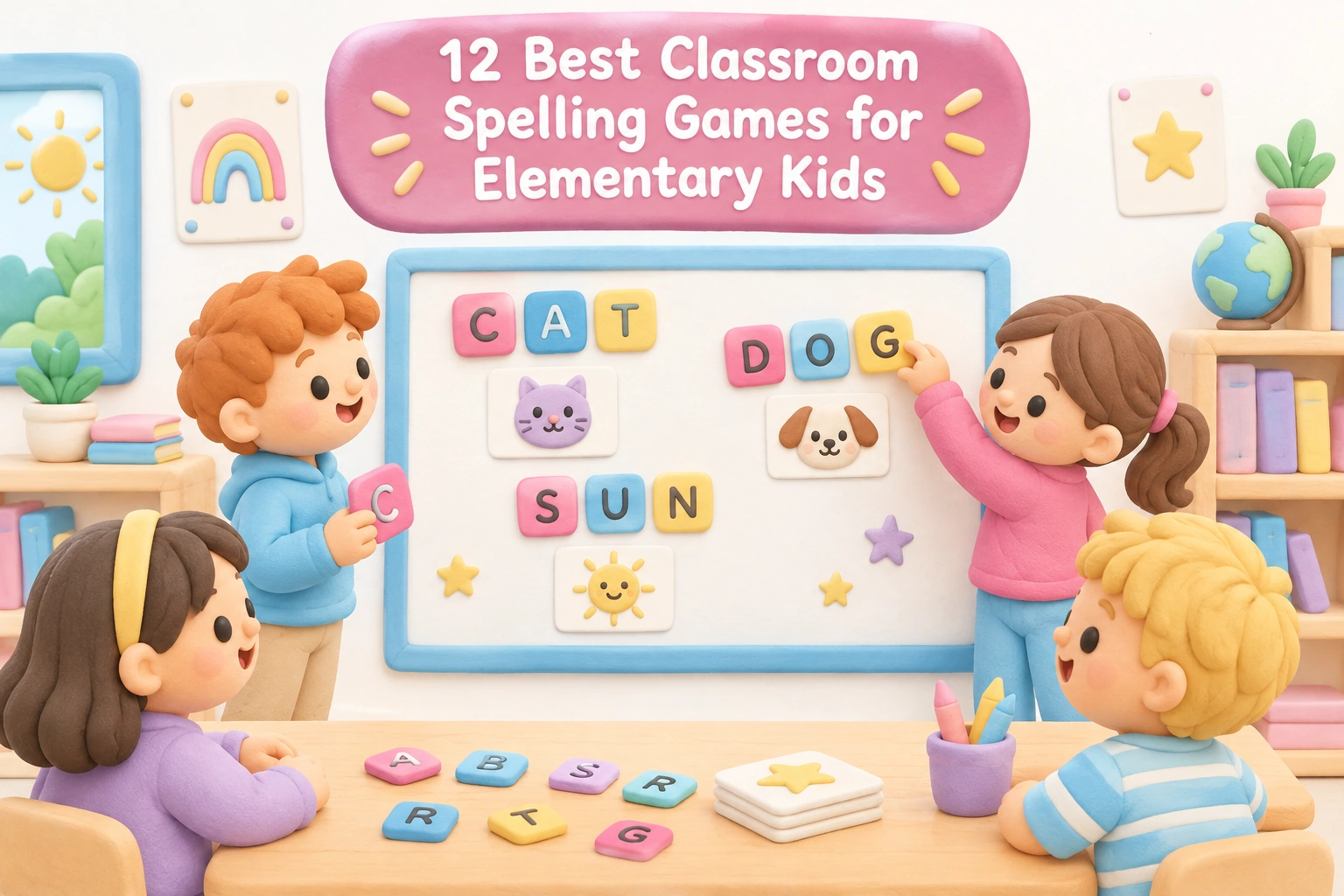
Spelling games for the classroom can transform a routine weekly spelling words review into something students genuinely look forward to. Rather than relying solely on rote memorization and written drills, game-based learning creates a low-stress environment where children practice spelling patterns repeatedly without feeling the pressure of a formal test. This article covers 12 of the best classroom spelling games for elementary students, complete with how-to-play instructions, grade-level guidance, differentiation tips, and practical notes for teachers managing real classrooms.
Key Takeaways
- Game-based spelling practice can support word retention and orthographic memory more effectively than drill-and-repeat methods alone, particularly when games involve active recall and immediate feedback.
- The 12 games below span whole-class, team, partner, and movement-based formats, making it easy to match the right activity to your available time, space, and group size.
- Most games work with any spelling list, so you can rotate them throughout the year without needing new materials each week.
- Differentiated spelling practice is built into each game description, with specific suggestions for lower elementary (K–2) and upper elementary (grades 3–5) students.
- Several games require no materials at all, while others need only index cards or a whiteboard — making low-prep and no-prep spelling games genuinely accessible.
Why Spelling Games Work: The Research Behind Game-Based Learning
Game-based learning in literacy contexts is supported by a growing body of research suggesting that playful, low-stakes practice environments can improve student engagement and support longer-term word retention. When children play spelling games, they encounter target words multiple times across varied contexts — hearing them called out, writing them quickly, checking a peer’s answer — which reinforces orthographic memory, the brain’s stored visual representation of how a word is spelled. This repeated, varied exposure is more cognitively demanding than copying a word list, and that productive challenge appears to support deeper encoding.
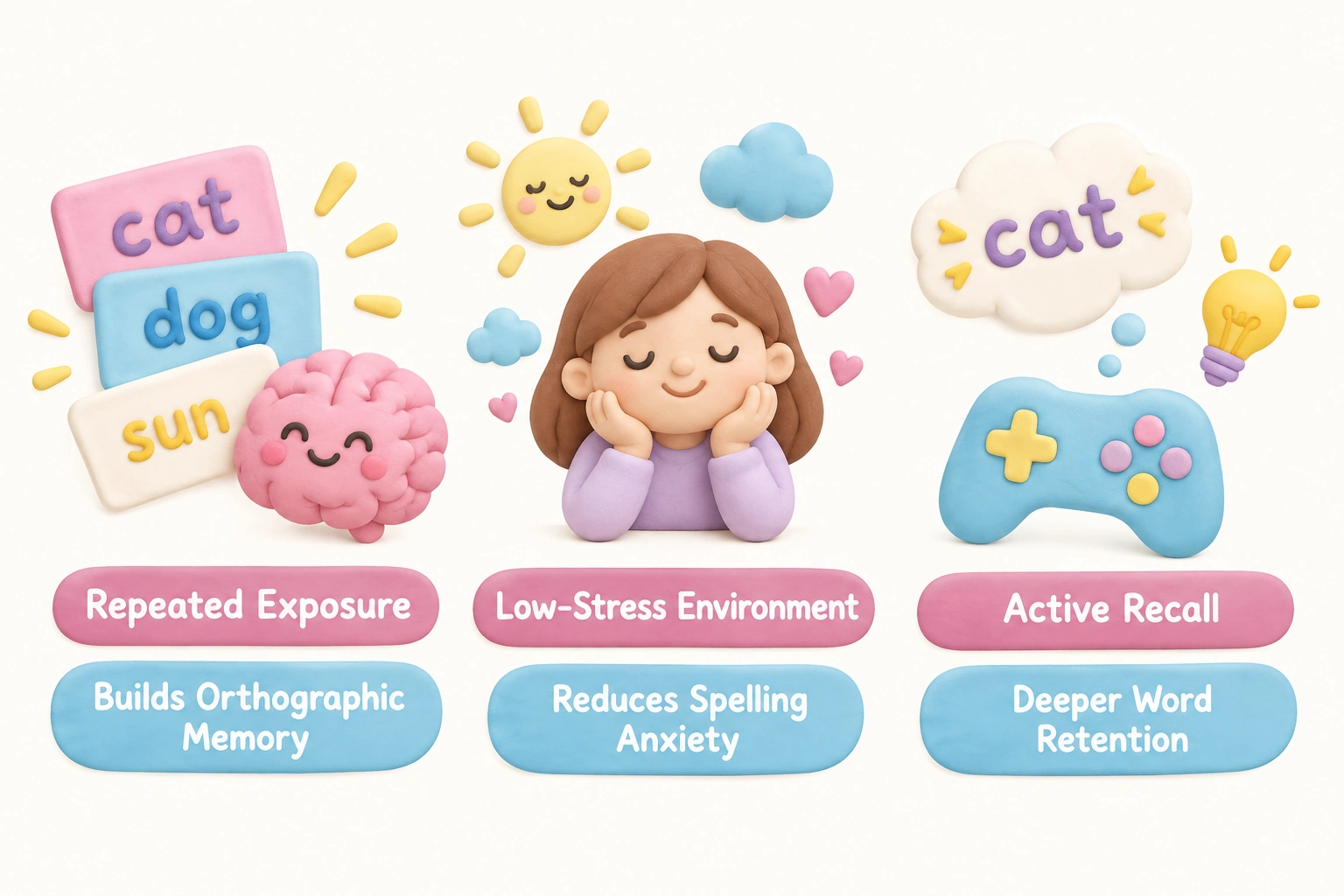
Classroom spelling games also reduce spelling anxiety, which is a genuine barrier for many elementary students. A child who freezes during a written spelling test may perform far better when the same words appear in a fast-paced team game where the social stakes feel lower and mistakes are quickly forgotten. Research published in peer-reviewed educational journals has found that game-based spelling activities can improve both accuracy and student motivation compared to traditional worksheet-based practice, though outcomes vary depending on implementation quality, word list difficulty, and individual student factors.
From a developmental standpoint, elementary-aged children are at a stage where peer interaction, mild competition, and physical movement all support learning. Spelling games tap into these natural motivators, making them a practical complement to explicit spelling instruction rather than a replacement for it.
Quick-Reference Table: All 12 Games at a Glance
| Game | Grade Range | Group Size | Prep Level | Best For |
|---|---|---|---|---|
| Spelling Bee | K–5 | Whole class | No prep | Spelling test prep, review |
| Around the World | 1–5 | Whole class | No prep | Spelling warm-up, engagement |
| Spelling BINGO | K–4 | Whole class / small group | Low prep | Literacy centers, Friday review |
| Spelling Relay Race | 1–5 | Teams of 4–6 | No prep | Movement break, team review |
| Snowball Spelling | 2–5 | Whole class | Low prep | Engagement, whole-class review |
| Kaboom | K–3 | Small group | Low prep | Literacy centers, early finishers |
| Spelling Tic-Tac-Toe | 1–4 | Partner | No prep | Partner practice, early finishers |
| Wordketball | 2–5 | Whole class / teams | Low prep | Movement break, team review |
| Spelling Baseball | 2–5 | Teams | No prep | Whole-class review, engagement |
| Shaving Cream Spelling | K–2 | Individual / pairs | Low prep | Hands-on spelling, tactile learners |
| Spelling Scavenger Hunt | 1–4 | Small group / pairs | Low prep | Literacy centers, active learning |
| Roll and Spell | K–3 | Partner / small group | Low prep | Spelling rotations, early finishers |
Whole-Class Spelling Games
1. Spelling Bee
The classic spelling bee remains one of the most effective whole-class spelling games because it requires zero preparation and works with any spelling list. Students stand in a line or around the room. The teacher calls out a word, uses it in a sentence, and the student at the front attempts to spell it aloud. A correct spelling keeps the student in; an incorrect spelling sits them down. The game continues until one student remains.
How to differentiate: For K–1 students, use three-letter CVC words (cat, hop, big) and allow students to use letter tiles or point to letters on a word wall before saying them aloud. For grades 4–5, use multisyllabic words with complex spelling patterns such as digraphs, silent letters, or Greek and Latin roots. To reduce elimination anxiety, consider a team format where a missed word passes to the next team rather than sitting a child down permanently.
Classroom management tip: Keep rounds moving quickly — no more than 10 seconds per word — to maintain engagement for students who are waiting their turn.
2. Around the World
Around the World is a fast-paced whole-class spelling game that works well as a spelling warm-up at the start of a literacy block. One student stands beside a seated classmate. The teacher calls out a spelling word and both students race to spell it correctly — either aloud or on a small whiteboard. The first to spell it correctly moves to the next desk; the other sits. The goal is to travel all the way around the classroom.
How to differentiate: Lower elementary students can write the word on a whiteboard rather than spelling it aloud, which reduces performance pressure. Upper elementary students can be challenged with bonus words from previous weeks to reinforce long-term retention. For English Language Learners, pairing the spoken word with a quick picture cue on a flashcard can support comprehension without removing the spelling challenge.
Best for: Spelling warm-up, whole-class engagement, spelling test prep.
3. Spelling BINGO
Spelling BINGO adapts the classic game for spelling practice. Each student receives a blank 5×5 BINGO card and fills it in with words from the current weekly spelling words list (plus a few from previous weeks to fill the grid). The teacher calls out definitions, gives a sentence, or describes the word without saying it, and students find and mark the matching word on their card. The first student to complete a row calls out the words to verify.
How to differentiate: For kindergarten and grade 1, use a 3×3 grid with high-frequency sight words. For grades 3–5, require students to write a sentence using each marked word before calling BINGO, adding a writing component to the spelling practice. BINGO cards can also be tiered by difficulty, with different word lists for different student groups.
Best for: Literacy centers, Friday review, spelling rotations.
Team Spelling Games
4. Spelling Relay Race
Spelling relay races are among the most effective movement-based spelling games for elementary students because they combine physical activity with spelling practice. Divide the class into teams of four to six students. Each team lines up facing a whiteboard or a large sheet of paper. The teacher calls out a spelling word, and the first student in each line runs to the board, writes the first letter, then passes the marker to the next teammate, who adds the next letter. The team that completes the correctly spelled word first earns a point.
How to differentiate: For lower elementary students, use shorter words so every team member gets to contribute a letter. For upper elementary, use longer multisyllabic words and require the last student to also underline the stressed syllable. This game works particularly well tied to seasonal themes — for example, using winter vocabulary words during a snowball spelling unit or sports vocabulary during a March Madness-themed week.
Classroom management tip: Establish a clear signal (a raised hand or a bell) for when a team finishes, and designate a walking path to avoid collisions during the relay.
5. Snowball Spelling
Snowball Spelling is a high-energy whole-class game that works well mid-week when students need a change of pace. Each student writes a spelling word on a piece of paper, crumples it into a ball, and on the teacher’s signal, everyone throws their snowball across the room. Students pick up the nearest snowball, uncrumple it, check the spelling, and write the next word from the list on the same paper before crumpling and throwing again. After several rounds, students share the words they collected and the class checks for any misspellings together.
Best for: Whole-class engagement, mid-week review, movement break. Prep level: Low (requires scrap paper). Noise note: This game is genuinely loud — plan it for a time when neighboring classrooms won’t be disrupted, or take it outside.
6. Spelling Baseball
Spelling Baseball maps the structure of a baseball game onto spelling practice. Divide the class into two teams. Set up four bases (chairs or floor markers) in the classroom. A student from the batting team is given a spelling word. A correct spelling advances them to first base; an incorrect spelling is an out. Three outs and the teams switch. Students already on base advance when a new batter gets a hit. Runs are scored when a student reaches home base.
How to differentiate: Assign different difficulty levels to different bases — a single requires a short word, a double requires a medium word, and a home run attempt requires a challenging word from an advanced list. This gives students agency and allows differentiated spelling practice within the same game.
Partner and Small-Group Spelling Games
7. Spelling Tic-Tac-Toe
Spelling Tic-Tac-Toe is a no-prep partner game that works well during literacy centers or as an early finisher activity. Two students draw a standard tic-tac-toe grid. To claim a square, a student must correctly spell a word called out by their partner. If they misspell it, the square stays empty and play passes to the other student. The first to get three in a row wins.
How to differentiate: Partners can use the same word list or different tiered lists depending on their level. For students who need additional support, allow them to check a word wall or personal spelling dictionary before writing their answer. This game is particularly useful for spelling rotations because it requires no teacher supervision once students understand the rules.
8. Kaboom
Kaboom is a small-group game that works exceptionally well in literacy centers. Write spelling words on individual Popsicle sticks and add several sticks labeled KABOOM. Place all sticks word-side down in a cup. Students take turns drawing a stick and reading the word aloud, then spelling it. A correct spelling lets the student keep the stick; an incorrect spelling returns it to the cup. If a student draws a KABOOM stick, they must return all their sticks to the cup. The student with the most sticks when time is called wins.
How to differentiate: Prepare separate cups for different ability groups, each containing words from an appropriately leveled list. For K–1 students, include picture cues on the sticks alongside the written word. Kaboom is one of the most popular no-prep spelling games for literacy centers because once the sticks are made, the game runs itself with minimal teacher involvement.
Movement-Based Spelling Games
9. Wordketball
Wordketball combines spelling practice with a basketball-style shooting challenge, making it one of the most engaging movement-based spelling games for upper elementary students. Set up a small basket or bin at the front of the room. A student is given a spelling word. If they spell it correctly, they earn a shot at the basket. A successful shot earns a bonus point for their team. This game works particularly well tied to sports seasons — for example, during March Madness — to add a timely, motivating context.
Classroom management tip: Use a soft foam ball and keep the basket at a reasonable distance to ensure most students can make the shot. The spelling, not the shooting, should be the primary challenge.
10. Spelling Relay Race (Outdoor Variation)
For classes with access to an outdoor space or gymnasium, a chalk-based spelling relay adds a kinesthetic dimension to spelling practice. Write individual letters in chalk squares on the pavement, similar to a hopscotch grid. Call out a spelling word and students hop or jump to each letter in sequence to spell the word. Teams can compete simultaneously on parallel grids. This hands-on spelling activity is particularly effective for kinesthetic learners and for students who benefit from physical movement to consolidate learning.
Hands-On and Tactile Spelling Games
11. Shaving Cream Spelling
Shaving Cream Spelling is a tactile spelling activity best suited to kindergarten through grade 2. Spray a small amount of unscented shaving cream onto each student’s desk (or a tray). Students use their finger to write spelling words in the cream, then smooth it flat and write the next word. The sensory experience of writing in shaving cream engages tactile learners and makes the activity memorable, which may support word retention for students who struggle with traditional pencil-and-paper practice.
Practical note: Check for skin sensitivities before using shaving cream. An alternative is a small tray of sand, salt, or a reusable gel writing mat, which provides a similar tactile experience without the foam. This activity works best as an individual or paired hands-on spelling station rather than a whole-class game.
Station and Independent Spelling Games
12. Roll and Spell
Roll and Spell is a low-prep partner or small-group game that fits naturally into spelling rotations. Each student has a copy of the current weekly spelling words list numbered 1 through 12 (or however many words are on the list). Students take turns rolling a die, find the corresponding numbered word, and spell it aloud or write it on a whiteboard. Their partner checks the spelling against the list. Correct spellings earn a tally mark; the student with the most tally marks after a set time wins.
How to differentiate: For K–1 students, use a list of six words and a single die. For grades 3–5, use a 12-sided die and a longer word list that includes words from previous weeks, turning the game into a cumulative spelling review. Roll and Spell requires minimal materials — just a die and the existing word list — making it one of the most practical no-prep spelling games for literacy centers.
How to Differentiate Spelling Games for Every Learner
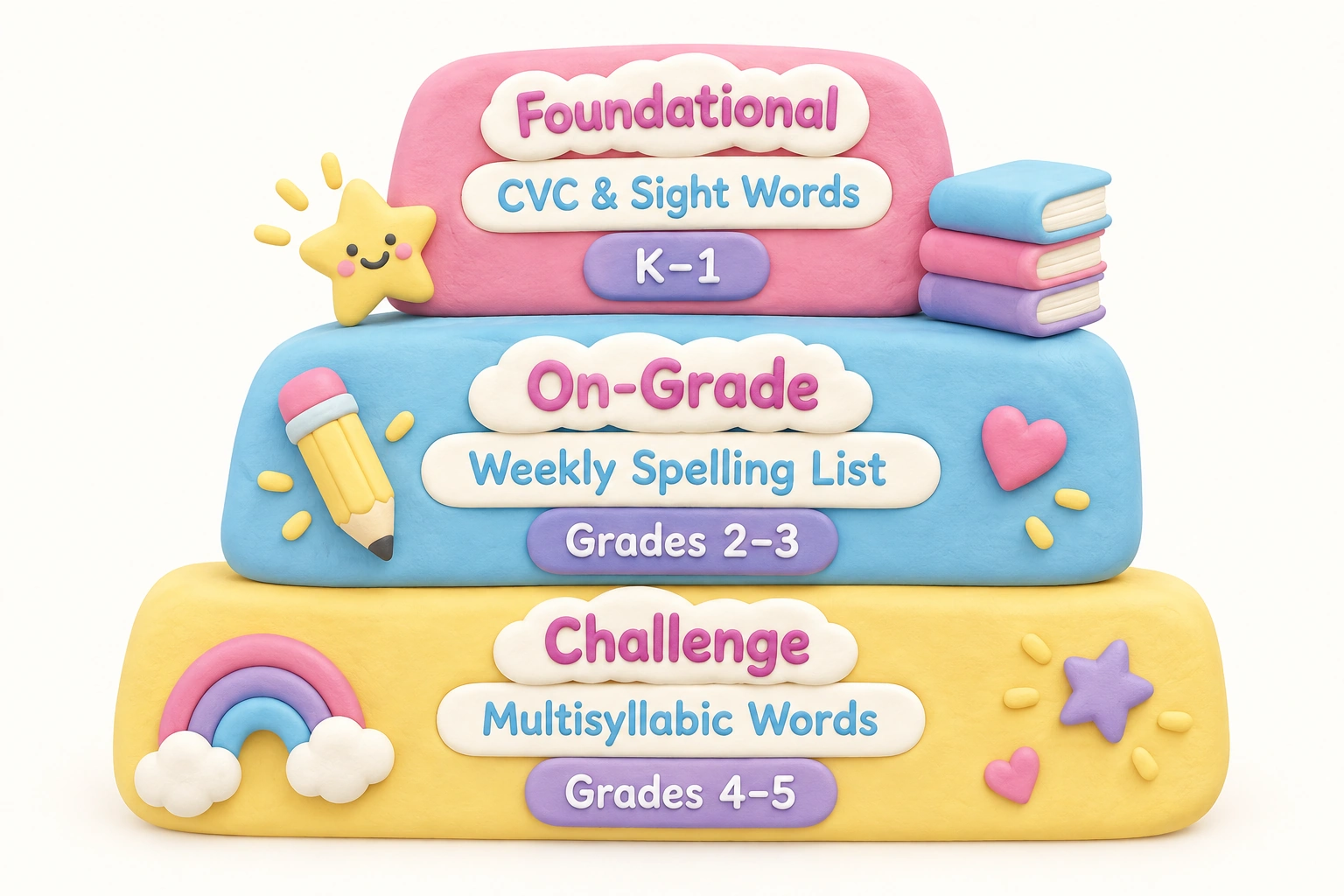
Differentiated spelling practice within a single classroom game is achievable with a few straightforward strategies. The most practical approach is to maintain tiered word lists: a foundational list for students working below grade level (often focusing on CVC words, digraphs, or high-frequency sight words), an on-grade list for most students, and a challenge list for students who have already mastered the weekly words. Most of the games above can run simultaneously with different word lists without any student being aware that others are working with different words.
For English Language Learners, pairing spoken words with visual supports — a picture card, a word wall reference, or a bilingual vocabulary card — can make classroom spelling games accessible without removing the spelling challenge. Students with dyslexia or other language-based learning differences may benefit from games that allow them to use letter tiles or magnetic letters rather than writing from memory, which reduces the motor and retrieval demands while keeping the orthographic practice intact.
Classroom management during differentiated spelling games is most straightforward when students understand the rules thoroughly before differentiation is introduced. Teach each game to the whole class using the same word list first, then introduce tiered lists once the game structure is familiar.
Tips for Using Spelling Games Effectively in the Classroom
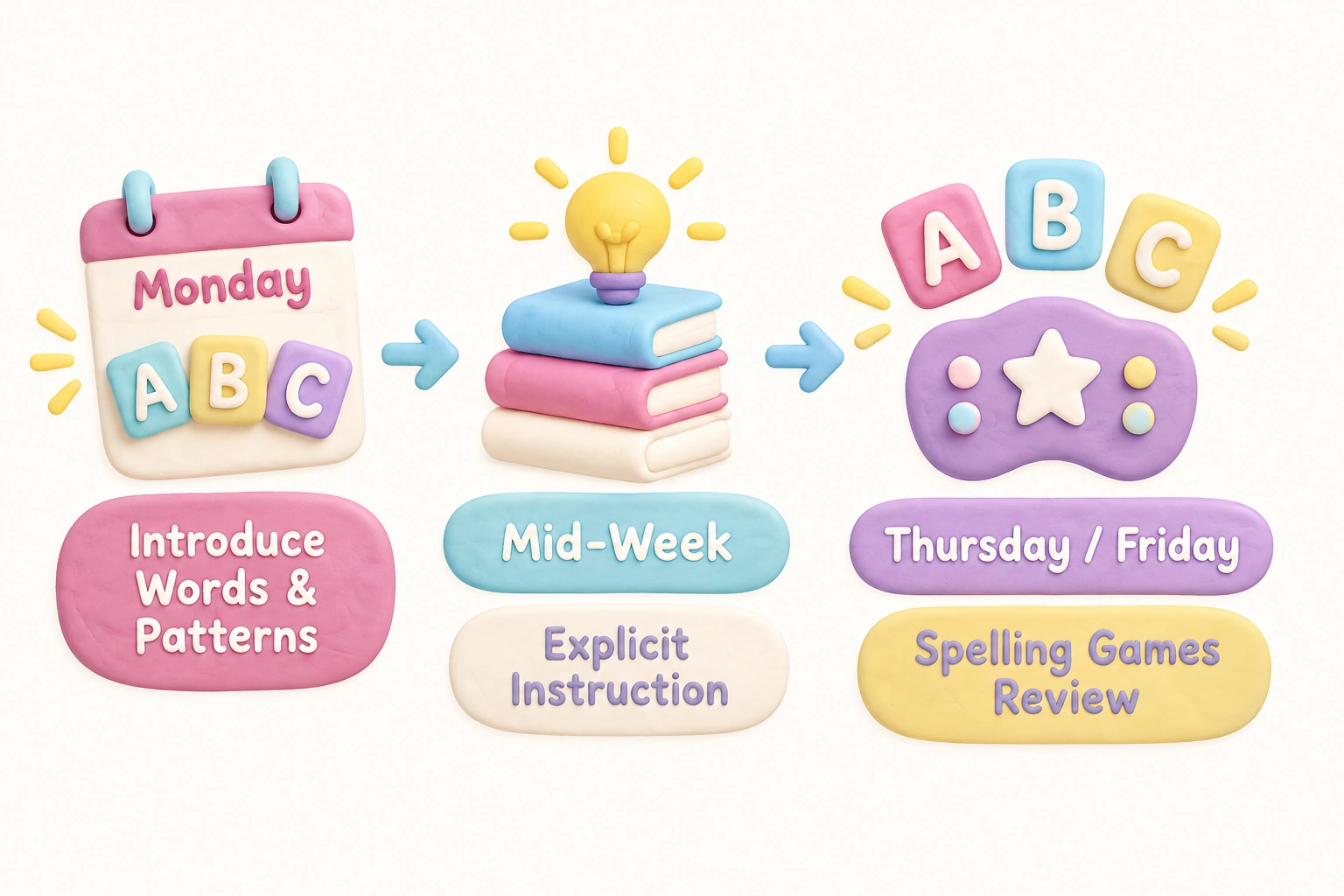
Spelling games work best as a complement to explicit spelling instruction, not a replacement for it. Research consistently suggests that students benefit from direct teaching of spelling patterns and word structures before practicing those patterns in game contexts. A useful sequence is: introduce new words and their patterns on Monday, practice through explicit instruction mid-week, and use games on Thursday or Friday as a review and consolidation activity before a spelling test.
Frequency matters. Using one or two spelling games per week — rather than games every day — tends to maintain novelty and motivation. Rotating through a repertoire of five or six familiar games keeps students engaged without requiring constant new game instruction. Once students know how to play Kaboom, Spelling BINGO, and Roll and Spell, for example, those games can be deployed in literacy centers throughout the year with nothing more than a new word list each week.
Consider aligning game choices with your school’s spelling curriculum. Programs such as Words Their Way organize words by spelling pattern and developmental stage, which maps naturally onto tiered game formats. Using games that reinforce the specific word patterns students are studying — rather than random vocabulary — maximizes the instructional value of game time.
Frequently Asked Questions
Do spelling games actually improve spelling outcomes?
Research suggests that game-based spelling practice can support word retention and student engagement compared to drill-only approaches, particularly when games involve active recall rather than passive recognition. However, outcomes vary by student, word list difficulty, and how well games are integrated with explicit instruction. Games are most effective as a complement to direct teaching of spelling patterns, not as a standalone spelling program.
How often should I use spelling games in the classroom?
One to two times per week is a practical starting point for most elementary classrooms. Using games too frequently can reduce their novelty and motivational value. Many teachers find that reserving games for Thursday or Friday review — after explicit instruction earlier in the week — creates a natural and effective rhythm for spelling practice.
Can these games be used with any spelling list?
Yes. All 12 games described above are designed to work with any spelling list, whether it comes from a published curriculum, a teacher-created list, or a student’s individualized word list. This flexibility makes classroom spelling games easy to integrate into existing literacy programs without additional planning.
Are these games suitable for spelling test prep?
Several games — particularly Spelling Bee, Around the World, and Spelling BINGO — function effectively as spelling test prep because they require students to retrieve and produce correct spellings under mild time pressure, which mirrors the conditions of a spelling test. Using these games in the days before a test can help students consolidate their knowledge in a low-stress environment.
How do I manage noise levels during active spelling games?
Movement-based games like Spelling Relay Race and Snowball Spelling are inherently louder than partner games like Tic-Tac-Toe or Roll and Spell. Plan high-energy games for times when noise is less likely to disrupt neighboring classrooms, or take them outdoors. Establish clear start and stop signals before beginning any active game, and practice transitions so students know exactly what to do when the signal sounds.
Can spelling games be adapted for students with learning differences?
Most of the games above can be adapted for students with dyslexia, language processing differences, or other learning needs. Common adaptations include allowing the use of letter tiles instead of writing from memory, providing a word wall or personal spelling dictionary as a reference, reducing the number of words in play, and pairing students strategically so that peer support is available. For students with significant learning differences, consulting with a specialist or special education teacher before adapting games is recommended.
Choosing the Right Spelling Game for Your Classroom
The best spelling games for the classroom are the ones that fit your available time, space, and student needs — not necessarily the most elaborate ones. A no-prep game like Around the World or Spelling Tic-Tac-Toe can be just as effective as a more involved activity if it is well-matched to the students’ current spelling level and used consistently. Start with two or three games from this list, teach them thoroughly, and rotate them across your literacy centers and whole-class review sessions throughout the term.
As you build a repertoire of classroom spelling games, pay attention to which formats generate the most genuine engagement for your particular group. Some classes respond strongly to competitive whole-class games; others thrive in collaborative small-group formats. Differentiated spelling practice works best when the game structure itself is familiar enough that students can focus on the words rather than the rules. Over time, a small collection of well-understood, grade-level appropriate spelling games — used regularly and aligned with your weekly spelling words — can meaningfully support student engagement, word retention, and spelling confidence across your entire elementary classroom.
Take a short quiz to find out what your everyday choices say about your parenting style
When your child is curious about something new, what’s your instinct?
Take a short quiz to find out what your everyday choices say about your parenting style
“Can I download this app?” What happens next?
Take a short quiz to find out what your everyday choices say about your parenting style
When it comes to rules at home, which sounds most like you?
Take a short quiz to find out what your everyday choices say about your parenting style
If you could give your child one life skill today, what would you pick?
Take a short quiz to find out what your everyday choices say about your parenting style
Your child gets to choose what to watch. What would your ideal setup look like?
Take a short quiz to find out what your everyday choices say about your parenting style
Pick your parenting superpower ✨