15 Best Indoor Games for Ages 6–12: No-Screen Group Picks

 Discover a Free Education Video App for Kids
Pastory uses AI to personalize educational video content based on your child’s interests and personality. Safe, engaging, and built for curious young minds. Sign up now to stay updated and enjoy early access with a free trial
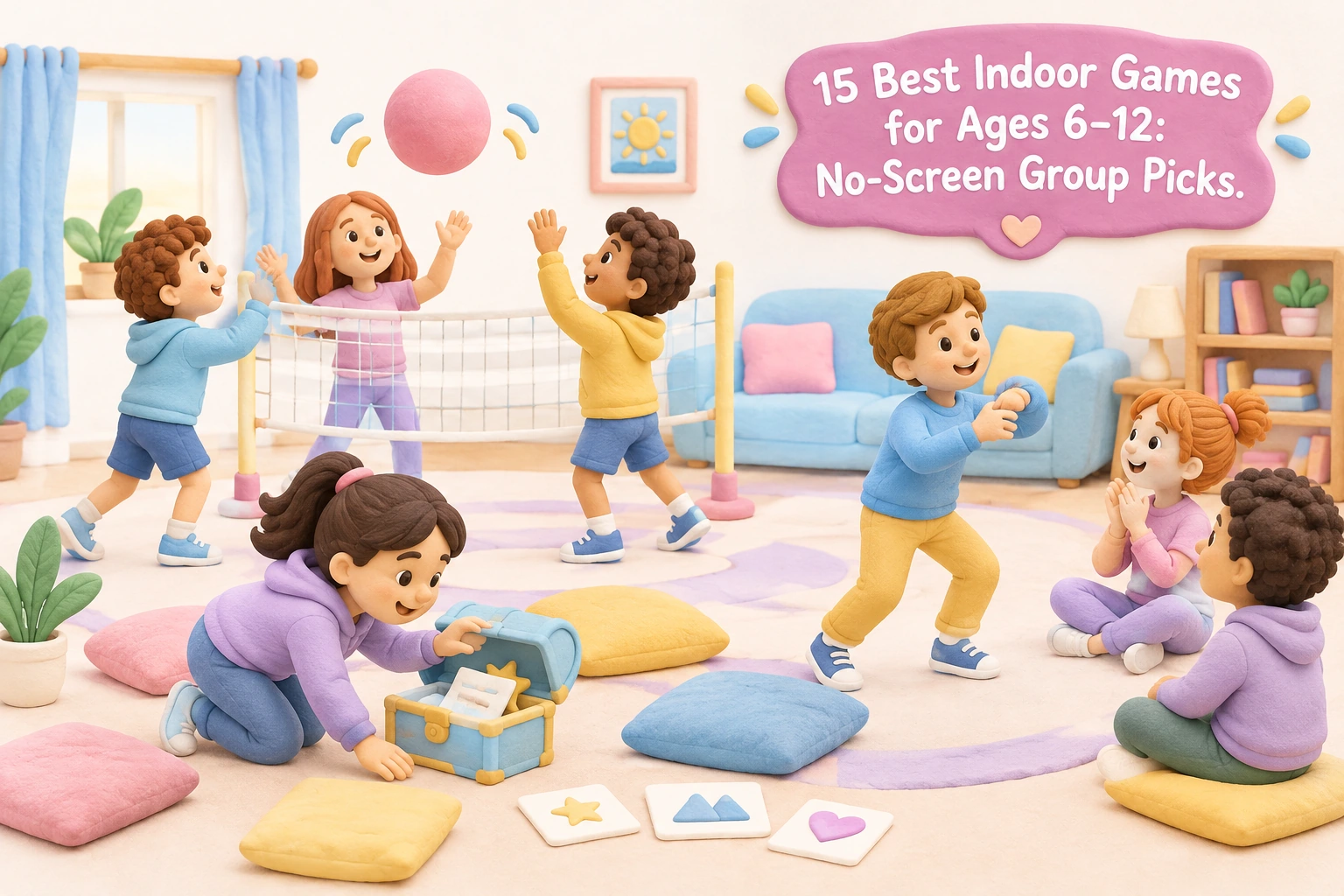
Finding indoor games for 6–12 year olds that genuinely hold children’s attention—without defaulting to a screen—is one of the most practical challenges parents and caregivers face. This article covers 15 carefully chosen screen-free group games, each with clear how-to-play steps, player counts, time estimates, space requirements, and the specific developmental skills each game may support. Games are also split by age sub-range where the difference in readiness genuinely matters.
Key Takeaways
- Screen-free group games for school-age children can support cognitive development, social-emotional skills, gross motor skills, and problem-solving depending on the game type and how it is structured.
- Children aged 6–8 and those aged 9–12 have meaningfully different attention spans, rule-processing abilities, and competitive readiness—game choice should reflect this.
- Most of the games below require little or no equipment, making them practical rainy day activities for kids with low-prep setup.
- Mixing cooperative and competitive games across a session helps manage energy levels and keeps mixed-personality groups engaged.
- Research on structured play in elementary-age children suggests that games involving turn-taking, strategy, and negotiation may support executive function skills, though outcomes vary by child and context.
Why Indoor Play Still Matters for School-Age Children
School-age children between 6 and 12 are in a period of rapid cognitive and social growth. Structured indoor play—especially group play—gives children repeated practice in turn-taking, negotiation, reading social cues, and managing both winning and losing. These are not incidental benefits; they are the mechanisms through which cooperative play builds social-emotional intelligence over time. Research in developmental psychology consistently links structured group games to improvements in executive function skills such as working memory, cognitive flexibility, and impulse control, particularly when games involve rule-following and planning multiple steps ahead.
Physical indoor games also matter for gross motor skills and hand-eye coordination during a stage when children are refining these abilities. Even low-intensity living room games that involve throwing, catching, balancing, or moving to a beat contribute to physical coordination in ways that sedentary screen time does not. The games below are selected to cover a range of energy levels, group sizes, and developmental goals so that parents can build a balanced session rather than relying on a single activity.
How to Use This List: Age, Space, and Energy
The 6–12 age range is wide enough that a game perfectly suited to a seven-year-old may feel too simple for an eleven-year-old, and vice versa. Each game entry below includes an age-fit note, a players-needed count, an approximate game duration, a space requirement, and a cooperative-or-competitive label. Use these tags to sequence games sensibly: a useful pattern for a two-hour rainy day session or birthday party is active game → quieter game → active game, which helps regulate energy without children becoming either overstimulated or bored.
For mixed-age groups where siblings of different ages play together, look for games tagged as suitable for the full 6–12 range and consider adjusting rules slightly—for example, giving younger children a head start in a relay race or allowing them to use simpler clue categories in charades.
Games Best Suited for Ages 6–8
1. Simon Says
One player acts as Simon and gives instructions prefixed with “Simon says.” Players must only follow instructions that include that phrase. Anyone who follows an instruction without the prefix is out. This is one of the most effective no-equipment indoor games for building listening skills and impulse control in younger children.
- Players needed: 3 or more
- Game duration: 10–15 minutes
- Space needed: Small room
- Type: Competitive
- Developmental benefit: Attention, impulse control, listening
2. Freeze Dance
Play music and have children dance freely. When the music stops, everyone must freeze in place. Anyone who moves after the music stops is out. Freeze dance is an excellent boredom buster that combines gross motor activity with self-regulation practice in a format that six- and seven-year-olds find immediately engaging.
- Players needed: 3 or more
- Game duration: 10–20 minutes
- Space needed: Open living room
- Type: Competitive
- Developmental benefit: Gross motor skills, self-regulation, rhythm
3. Hot Potato
Children sit in a circle and pass an object—a ball, a stuffed animal, or a rolled-up sock—while music plays. When the music stops, whoever is holding the object is out. Hot potato builds turn-taking and anticipatory awareness in a format that works well for ages 6 and up.
- Players needed: 4 or more
- Game duration: 10–15 minutes
- Space needed: Small room
- Type: Competitive
- Developmental benefit: Turn-taking, hand-eye coordination, social interaction
4. Musical Chairs
Arrange chairs in a row or circle with one fewer chair than players. When music plays, children walk around the chairs. When it stops, everyone scrambles for a seat. The player left standing is out, and one chair is removed each round. Musical chairs is a classic birthday party game for kids that teaches graceful elimination and spatial awareness.
- Players needed: 4 or more
- Game duration: 15–20 minutes
- Space needed: Open living room
- Type: Competitive
- Developmental benefit: Spatial awareness, physical coordination, emotional regulation
5. Balloon Volleyball
Stretch a piece of string or tape across a room as a net and use an inflated balloon as the ball. Teams hit the balloon back and forth without letting it touch the floor on their side. Balloon volleyball is a safe, low-prep living room game that develops hand-eye coordination and introduces basic team cooperation without the injury risk of a real ball indoors.
- Players needed: 2–8
- Game duration: 15–25 minutes
- Space needed: Open living room
- Type: Cooperative or competitive
- Developmental benefit: Hand-eye coordination, gross motor skills, teamwork
6. The Floor Is Lava
Announce that the floor is lava and give children five seconds to get off it using cushions, pillows, or furniture as stepping stones. This imaginative game requires no equipment beyond household items and is one of the most naturally engaging no-equipment indoor games for children aged 6–9. It builds spatial reasoning, balance, and creative problem-solving.
- Players needed: 2 or more
- Game duration: 10–20 minutes
- Space needed: Open living room
- Type: Cooperative or competitive
- Developmental benefit: Balance, spatial reasoning, imaginative play
7. Indoor Obstacle Course
Use cushions, chairs, tunnels made from blankets, and tape lines on the floor to build a course children must crawl through, jump over, or balance along. Time each child individually or run it as a relay race. An indoor obstacle course is one of the most versatile rainy day activities for kids because the difficulty can be scaled up or down easily—add more steps or tighter balance beams for older children.
- Players needed: 2 or more
- Game duration: 20–35 minutes including setup
- Space needed: Open living room or hallway
- Type: Competitive or cooperative
- Developmental benefit: Gross motor skills, physical coordination, problem-solving, teamwork
Games Best Suited for Ages 9–12
8. Charades
Divide players into two teams. One player draws a card or slip of paper with a word or phrase and acts it out silently while their team guesses within a time limit. Clue categories can include movie titles, animals, actions, or book characters, and difficulty scales naturally with age. Charades is one of the most effective screen-free group games for developing non-verbal communication, creative thinking, and team cooperation in older children.
- Players needed: 4 or more
- Game duration: 20–30 minutes
- Space needed: Small room
- Type: Cooperative within teams, competitive between teams
- Developmental benefit: Non-verbal communication, creativity, teamwork
9. Team-Based Treasure Hunt
Prepare a series of written clues that lead teams from one location to the next around the home, with a small prize or activity at the end. For ages 9–12, clues can involve simple riddles, coded messages, or math puzzles that require genuine problem-solving skills. A team-based treasure hunt typically lasts 20–30 minutes and is one of the most engaging birthday party games for kids in this age range because it combines physical movement with cognitive challenge.
- Players needed: 4 or more, split into teams
- Game duration: 20–35 minutes
- Space needed: Whole home or multiple rooms
- Type: Competitive between teams, cooperative within teams
- Developmental benefit: Problem-solving skills, communication, logical thinking, teamwork
10. DIY Escape Room
Set up a room with a series of linked puzzles—combination locks, coded messages, hidden keys—that a team must solve within a set time to “escape.” DIY escape rooms are particularly well-suited to ages 9–12 because children at this stage are beginning to enjoy games that require planning multiple steps ahead and coordinating with teammates. Preparation takes 30–60 minutes for the adult, but the game itself can run for 30–45 minutes of highly engaged cooperative play.
- Players needed: 3–6
- Game duration: 30–45 minutes
- Space needed: One room
- Type: Cooperative
- Developmental benefit: Logical thinking, problem-solving, communication, patience
11. Group Storytelling
One player begins a story with two or three sentences. The next player continues it, and so on around the group. Set a rule that each contribution must connect logically to what came before. Group storytelling is a genuinely low-prep game that builds narrative thinking, listening skills, and sequential reasoning. It works especially well as a wind-down activity after more physical games.
- Players needed: 3 or more
- Game duration: 15–25 minutes
- Space needed: Small room
- Type: Cooperative
- Developmental benefit: Imagination, listening, sequential thinking, narrative development
12. Team Trivia
Prepare a set of questions across categories such as nature, geography, pop culture, and history, pitched at an appropriate difficulty level. Divide children into teams and award points per correct answer. Team trivia is an excellent indoor game for school-age children aged 9–12 because it rewards general knowledge, encourages discussion within teams, and introduces friendly competition in a format that does not disadvantage children who are less physically active.
- Players needed: 4 or more
- Game duration: 20–30 minutes
- Space needed: Small room
- Type: Competitive between teams, cooperative within teams
- Developmental benefit: General knowledge, communication, turn-taking, concentration
Games That Work Across the Full 6–12 Range
13. Human Knot
Players stand in a circle, reach across, and each grab the hands of two different people who are not standing directly next to them. The group must then untangle itself back into a circle without releasing hands. The human knot is a cooperative play classic that works across a wide age range because the challenge scales naturally with group size. It builds communication, spatial reasoning, and patience.
- Players needed: 6–12
- Game duration: 10–20 minutes
- Space needed: Open living room
- Type: Cooperative
- Developmental benefit: Communication, spatial reasoning, patience, cooperation
14. Indoor Relay Races
Set up simple relay challenges—carrying a balloon between the knees, balancing a book on the head, or passing a spoon with a small object—across a hallway or living room. Relay races are highly adaptable indoor games for school-age children because the tasks can be made simpler for younger children and more complex for older ones, making them ideal for mixed-age groups. They also provide genuine gross motor activity in a small space.
- Players needed: 4 or more
- Game duration: 15–25 minutes
- Space needed: Hallway or open living room
- Type: Competitive between teams
- Developmental benefit: Gross motor skills, physical coordination, teamwork, friendly competition
15. Pictionary or Drawing Charades
One player draws a word or phrase on paper or a whiteboard while their team guesses within a time limit. No letters or numbers are allowed in the drawing. Pictionary-style games work across the 6–12 range because drawing ability is not the point—creative visual communication is. Younger children enjoy the silliness of imperfect drawings, while older children engage more strategically with how to represent abstract concepts visually.
- Players needed: 4 or more
- Game duration: 20–30 minutes
- Space needed: Small room
- Type: Competitive between teams, cooperative within teams
- Developmental benefit: Creativity, visual communication, turn-taking, teamwork
Quick Reference: Game Selector by Need
| Need | Best Game Picks |
|---|---|
| Burn energy indoors | Freeze Dance, Indoor Obstacle Course, Balloon Volleyball, Relay Races |
| No equipment at all | Simon Says, Freeze Dance, The Floor Is Lava, Human Knot, Group Storytelling |
| Cooperative play only | Human Knot, DIY Escape Room, Group Storytelling, Indoor Obstacle Course (team mode) |
| Birthday party games for kids | Musical Chairs, Hot Potato, Team Treasure Hunt, Charades, Pictionary |
| Quiet wind-down | Group Storytelling, Team Trivia, Pictionary |
| Mixed ages (6–12 together) | Human Knot, Relay Races, Balloon Volleyball, Pictionary, The Floor Is Lava |
| Small space only | Simon Says, Hot Potato, Charades, Team Trivia, Group Storytelling, Pictionary |
How to Sequence Games for a Two-Hour Session
The order in which games are played matters as much as the games themselves. Starting with a high-energy active game warms children up and releases initial restlessness, but running two or three high-energy games back to back often leads to overstimulation and conflict. A more effective pattern is to alternate between active and quieter games: begin with Freeze Dance or Simon Says, move into a cooperative game like Human Knot, follow with a team-based treasure hunt or escape room challenge, and wind down with Group Storytelling or Team Trivia. This active-cooperative-cognitive-quiet arc manages energy levels naturally and tends to keep mixed-personality groups engaged throughout.
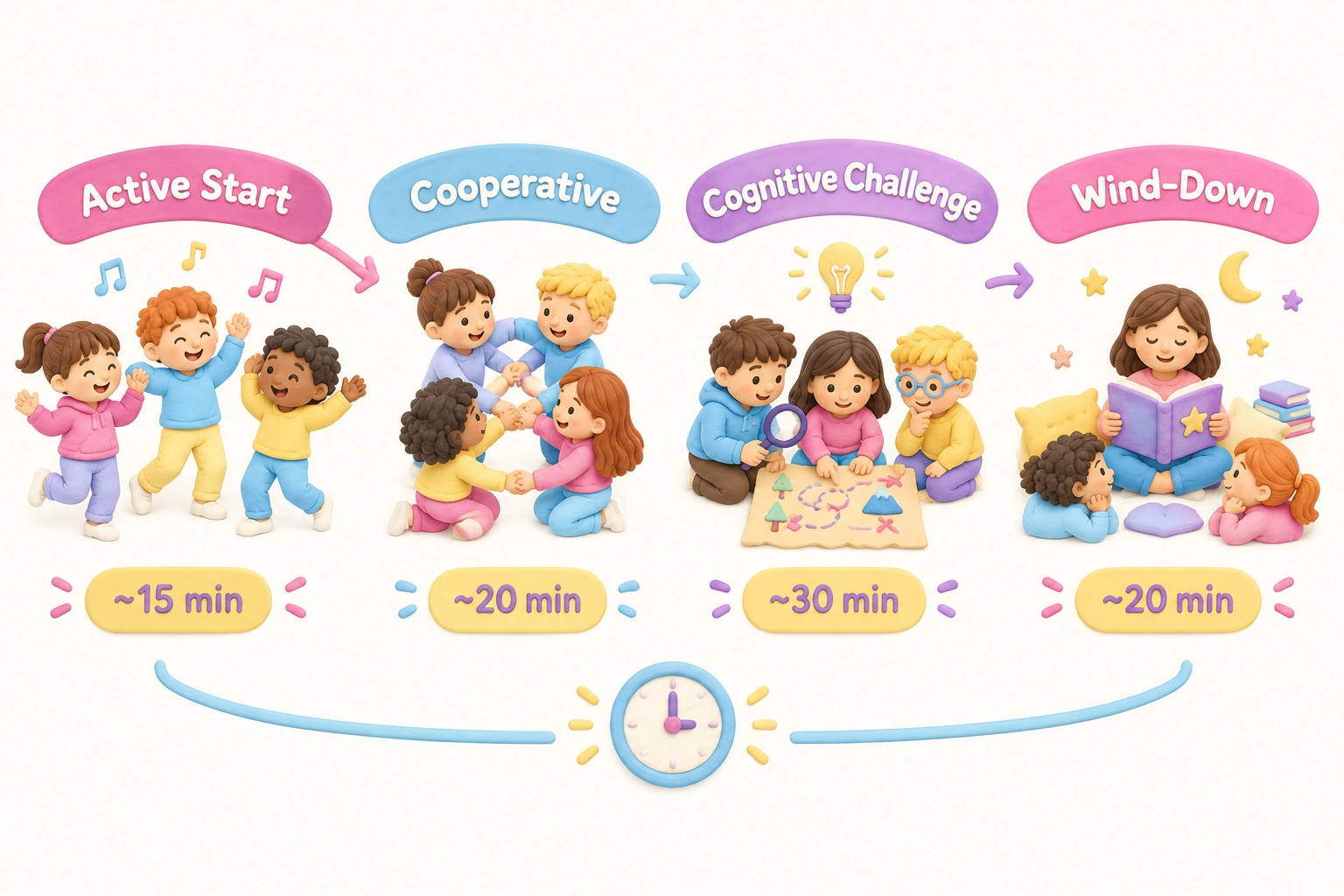
For birthday party planning specifically, developmental guidance suggests that children aged 6–8 typically benefit from three to four structured activities across a two-hour party, while children aged 9–12 can sustain engagement with two or three longer, more complex activities. Building in five-minute transition breaks between games also reduces friction and gives children time to process the previous activity before starting the next.
Cooperative vs. Competitive Games: What the Research Suggests
Both cooperative and competitive games offer developmental value, but they serve different social-emotional goals. Competitive games—where there is a clear winner—give children practice in managing disappointment, developing resilience, and understanding fair play. Cooperative games, where the group works toward a shared goal, build communication, negotiation, and the ability to subordinate individual preferences for a collective outcome. Research in educational settings suggests that activities encouraging cooperation rather than competition tend to maintain harmony among groups with different personality types and ability levels, which is particularly relevant when children of different ages or temperaments are playing together.
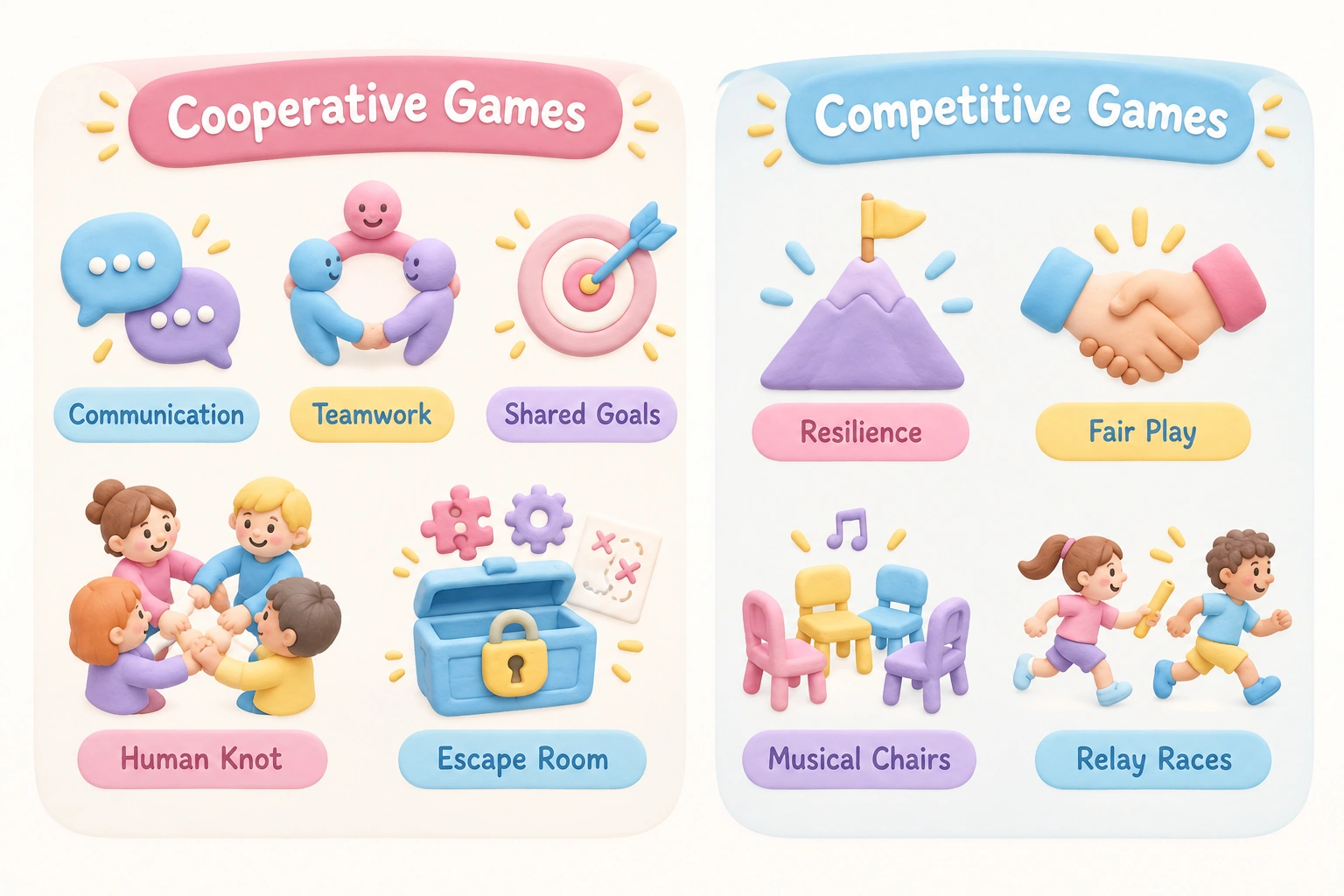
Neither type is universally better. A well-balanced session includes both. If a child consistently struggles with losing in competitive games, introducing more cooperative formats—such as the Human Knot or a team-based escape room—can help build confidence before reintroducing competitive elements gradually.
Frequently Asked Questions
What indoor games need no supplies at all?
Simon Says, Freeze Dance, The Floor Is Lava, Human Knot, and Group Storytelling all require zero equipment. Freeze Dance and Musical Chairs need music, which a phone or tablet can provide without counting as screen-based play for the children.
Which games work best for small spaces like a single room?
Simon Says, Hot Potato, Charades, Team Trivia, Group Storytelling, and Pictionary all work comfortably in a single room with no furniture rearrangement needed. Balloon Volleyball can also be adapted to a small space by lowering the net height and reducing the court size.
How do I adapt these games for mixed-age groups where siblings are different ages?
For relay races, give younger children a shorter course or simpler task. In charades or Pictionary, allow younger children to draw or act out simpler categories. In a treasure hunt, pair a younger child with an older one on the same team so the older child can help decode harder clues without the younger child feeling excluded.
What are good noncompetitive indoor games for kids who dislike losing?
Human Knot, DIY Escape Room, Group Storytelling, and Indoor Obstacle Course in team-completion mode (where the goal is to finish rather than to beat another team) are all fully cooperative. These games are particularly useful for children who find competitive elimination games distressing.
How long should indoor game sessions last for school-age children?
For children aged 6–8, individual games of 10–20 minutes with short breaks between them tend to match typical attention spans. Children aged 9–12 can sustain engagement with longer games of 20–45 minutes, particularly when the game involves genuine problem-solving or strategy. A full session of two hours works well when it includes three to five varied activities rather than one extended game.
Do these games genuinely support child development, or is that overstated?
Structured group play does appear to support social-emotional skills, executive function, and physical coordination in school-age children, based on research in developmental psychology and educational settings. However, outcomes vary by child, context, and how consistently children engage with structured play. These games are not a substitute for professional support where a child has specific developmental needs, but they are a meaningful and evidence-informed complement to everyday learning.
Building a Screen-Free Play Habit That Actually Sticks
The most common reason screen-free indoor games fall flat is not that children dislike them—it is that the games are introduced without structure or context, leaving children to drift back to screens within minutes. The games in this list are most effective when they are presented as a genuine event: a game afternoon, a rainy day challenge, or a birthday party format. Giving the session a name, a loose schedule, and a small reward at the end (a favourite snack, a choice of movie later) signals to children that this is a real activity worth engaging with.
Starting with one or two games that the children already know—Simon Says and Freeze Dance are almost universally familiar—builds early momentum before introducing newer formats like a DIY escape room or team trivia. Over time, children who regularly engage in structured indoor games for school-age children tend to develop a broader repertoire of social skills and a greater tolerance for the mild frustration that comes with competitive play, both of which are genuinely useful beyond the game itself.

Take a short quiz to find out what your everyday choices say about your parenting style
When your child is curious about something new, what’s your instinct?
Take a short quiz to find out what your everyday choices say about your parenting style
“Can I download this app?” What happens next?
Take a short quiz to find out what your everyday choices say about your parenting style
When it comes to rules at home, which sounds most like you?
Take a short quiz to find out what your everyday choices say about your parenting style
If you could give your child one life skill today, what would you pick?
Take a short quiz to find out what your everyday choices say about your parenting style
Your child gets to choose what to watch. What would your ideal setup look like?
Take a short quiz to find out what your everyday choices say about your parenting style
Pick your parenting superpower ✨