15 Best PE Games for Elementary Students: Active Group Picks

 Discover a Free Education Video App for Kids
Pastory uses AI to personalize educational video content based on your child’s interests and personality. Safe, engaging, and built for curious young minds. Sign up now to stay updated and enjoy early access with a free trial
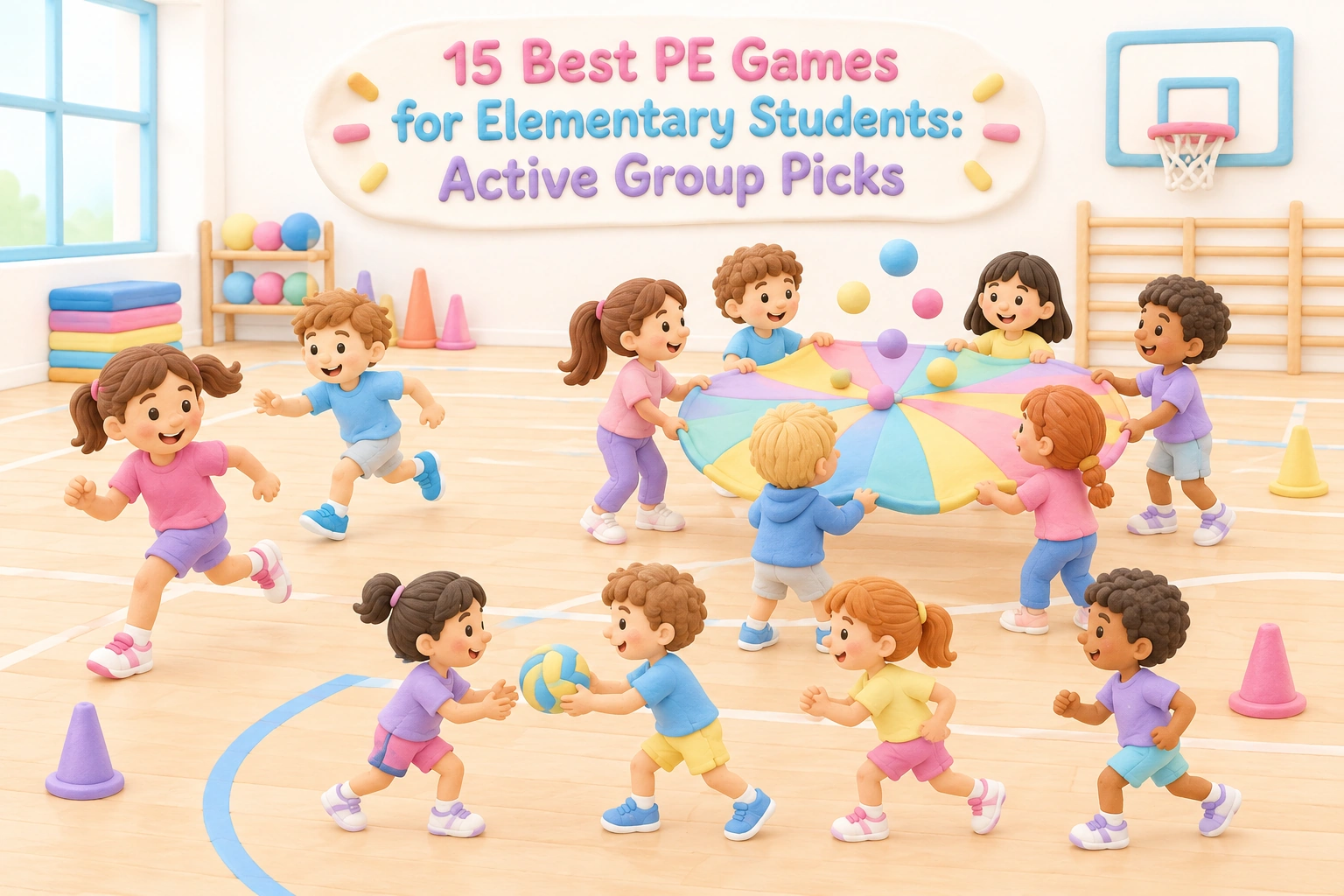
Finding PE games for elementary students that genuinely engage a full class, build fundamental motor skills, and keep energy levels productive is one of the most practical challenges PE teachers and classroom educators face. This guide covers 15 of the best active group games for K–5 students, organized by category, with setup guidance, skill outcomes, grade-level recommendations, energy ratings, and inclusive modifications — so you can plan a complete lesson period with confidence.
Key Takeaways
- The most effective gym games for kids combine movement variety with clear rules, making them accessible across ability levels without long setup times.
- Tag games, relay races, cooperative games, and invasion games each develop distinct but overlapping physical literacy skills — mixing categories across a lesson period supports broader motor development.
- Group size, energy level, and indoor or outdoor suitability vary significantly between games; matching these factors to your setting improves both safety and engagement.
- Simple modifications — such as using foam balls instead of rubber ones, or allowing walking instead of running — make most games inclusive for students with limited mobility or mixed ability levels.
- Research consistently links moderate-to-vigorous physical activity (MVPA) in structured PE settings to improvements in cardiovascular fitness, attention, and social skills in elementary-aged children.
Why Game Selection Matters in Elementary PE
Elementary-aged children between approximately 5 and 11 years old are in a critical window for developing locomotor skills, object control skills, and spatial awareness. Structured PE games that require dodging, chasing, throwing, catching, and cooperative decision-making give children repeated, varied practice with these fundamental movement patterns in a social context. SHAPE America’s national physical education standards emphasize that students should demonstrate competency in a variety of motor skills and movement patterns — and well-chosen group games are one of the most efficient ways to address multiple standards within a single lesson.
Beyond physical development, active group games support teamwork and communication, emotional regulation under mild competitive pressure, and problem-solving in real time. The key is selecting games that match the developmental stage of your students, the available space, and the equipment on hand. The 15 games below are organized into five categories to help you build a balanced lesson plan or field day schedule.
Tag Games for Elementary PE
Tag games are among the most universally effective PE games for elementary students because they require no equipment, scale easily from 10 to 35 players, and naturally develop agility, body control, and cardiovascular fitness. The chasing and fleeing patterns involved are foundational locomotor skills that children at every K–5 grade level can practice simultaneously, even when ability levels differ.
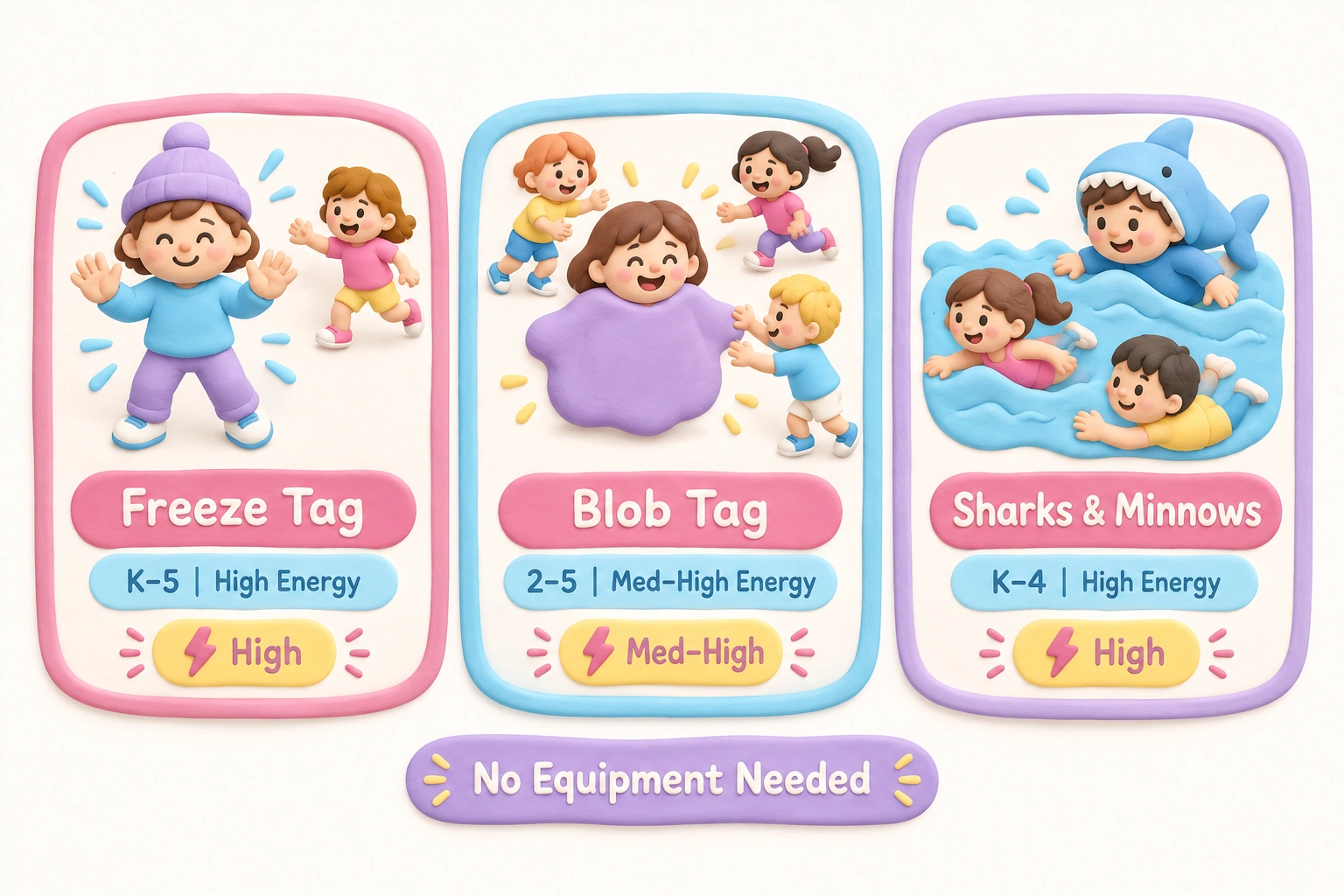
1. Freeze Tag
How to play: One or two students are designated as taggers. When tagged, a player freezes in place. Frozen players can be unfrozen when a free teammate crawls through their legs or touches their hand, depending on the variation you choose. The round ends when all players are frozen or after a set time limit.
Skills developed: Agility, cardiovascular fitness, spatial awareness, teamwork.
Grade level: K–5 (simplify unfreezing rules for K–1).
Group size: 10–35 players.
Energy level: High.
Setting: Indoor gym or outdoor field.
Inclusive modification: Allow students with mobility limitations to serve as a designated unfreezer who can unfreeze players by calling their name rather than physical contact.
2. Blob Tag
How to play: One student starts as the tagger. When they tag someone, that person joins hands with them, forming a growing blob. Only the two end players of the blob can tag others. The game ends when everyone is part of the blob.
Skills developed: Cooperation, communication, agility, body control.
Grade level: 2–5.
Group size: 15–30 players.
Energy level: Medium–High.
Setting: Outdoor field or large gym.
Safety note: Establish a boundary and remind students that the blob must stay connected — no pulling or dragging.
3. Sharks and Minnows
How to play: One or two students are sharks and stand in the middle of the play area. All other students (minnows) line up at one end. On the signal, minnows try to cross to the other side without being tagged. Tagged minnows become seaweed and must stand still, but can tag passing minnows with their outstretched arms. The last minnow standing becomes the next shark.
Skills developed: Dodging, fleeing, spatial awareness, decision-making.
Grade level: K–4.
Group size: 12–35 players.
Energy level: High.
Setting: Indoor or outdoor.
Why it works for groups: The seaweed mechanic keeps tagged players physically active and engaged rather than sitting out, which maintains MVPA across the whole class.
Relay Races and Relay-Style Games
Relay races are a staple of K–5 PE activities because they combine individual skill practice with team motivation. The relay format naturally differentiates effort — faster students contribute without penalizing slower ones — and the turn-based structure gives teachers a moment to observe and coach individual technique. These low-prep PE games require minimal equipment and adapt easily to indoor or outdoor settings.
4. Over-Under Relay
How to play: Divide students into teams of five to eight. Teams stand in single-file lines. The first player passes a foam ball or playground ball over their head to the next player, who passes it under their legs, alternating over and under down the line. When the ball reaches the end, the last player runs to the front and the relay continues until the original front player is at the front again.
Skills developed: Hand-eye coordination, balance, teamwork, object control.
Grade level: K–5.
Group size: Teams of 5–8; works with any class size.
Energy level: Medium.
Setting: Indoor or outdoor.
Equipment: One foam ball per team.
5. Hula Hoop Pass Relay
How to play: Teams stand in a line holding hands. A hula hoop is placed over the first player’s arm. Without releasing hands, the team must pass the hoop from one end of the line to the other by stepping through it. The first team to move the hoop all the way down wins the round.
Skills developed: Cooperation, balance, body control, communication skills.
Grade level: 1–5.
Group size: Teams of 6–10.
Energy level: Low–Medium.
Setting: Indoor or outdoor.
Equipment: One hula hoop per team.
Why it works for groups: This cooperative relay requires every team member to contribute equally, making it one of the best group games for elementary PE when the goal is building teamwork rather than rewarding athletic speed.
6. Scooter Relay
How to play: Students sit on scooter boards and propel themselves across the gym to a cone and back, then tag the next teammate. Variations include carrying a beanbag on their lap or pushing a foam ball with their hands while scooting.
Skills developed: Upper body strength, coordination, spatial awareness, cardiovascular fitness.
Grade level: K–4.
Group size: Teams of 4–6.
Energy level: Medium–High.
Setting: Indoor gym only.
Equipment: Scooter boards, cones.
Safety note: Establish clear rules about keeping fingers away from wheels and not standing on scooters.
Cooperative Games and Team-Building Activities
Cooperative games shift the focus from competition to shared problem-solving, making them particularly valuable for building classroom community and developing communication skills alongside physical literacy. Research in physical education consistently supports including cooperative activities as part of a balanced PE curriculum, especially for younger elementary students who are still developing the emotional regulation needed for competitive play.
7. Parachute Popcorn
How to play: Students stand around the edge of a large parachute, each holding a handle. Place several foam balls on top. Students shake the parachute rhythmically to make the balls bounce like popcorn. Variations include trying to keep all balls on the parachute, or trying to launch them off. You can also call a color and have students with that color handle run under the parachute and switch places while it billows up.
Skills developed: Cooperation, rhythm, upper body strength, listening skills.
Grade level: K–3.
Group size: 10–30 players.
Energy level: Low–Medium.
Setting: Indoor or outdoor.
Equipment: Parachute, foam balls.
Why it works for groups: Parachute games are among the most inclusive active group games because every student participates simultaneously and the activity does not require speed or competitive skill.
8. Human Knot
How to play: Groups of eight to twelve students stand in a circle, reach across, and each grab the hands of two different people who are not standing directly next to them. Without releasing hands, the group must untangle itself back into a circle. If the group gets stuck, allow one “free pass” where they can release and re-grip one pair of hands.
Skills developed: Problem-solving, communication, spatial awareness, cooperation.
Grade level: 3–5.
Group size: 8–12 per group.
Energy level: Low.
Setting: Indoor or outdoor.
Note: This game works best as a warm-up or cool-down activity rather than a main cardiovascular game. It is particularly effective for building teamwork and communication in upper elementary grades.
9. Pipeline Challenge
How to play: Each student holds a half-pipe or cut pool noodle section. Teams must transport a marble or small ball from one end of the gym to the other by passing it through their connected pipes without dropping it. Students cannot move their feet while the ball is in their pipe.
Skills developed: Hand-eye coordination, cooperation, problem-solving, communication.
Grade level: 2–5.
Group size: Teams of 8–15.
Energy level: Low–Medium.
Setting: Indoor gym.
Equipment: Pool noodles cut lengthwise, small balls or marbles.
Cross-curricular connection: Teachers can integrate math by having students measure the distance traveled or calculate the number of passes needed.
Invasion Games and Ball Games
Invasion games — where one team attempts to move into the other team’s territory to score — are a recognized category in physical education curriculum frameworks and are particularly effective for developing strategic thinking alongside fundamental motor skills. These gym games for kids typically require more space and slightly more complex rule understanding, making them better suited to grades 2–5.
10. Crab Soccer
How to play: Students move in crab position (hands and feet on the floor, belly facing up) and try to kick a large foam ball into the opposing team’s goal. One student per team can stand upright as goalkeeper. Rotate the goalkeeper role every two minutes.
Skills developed: Upper body and core strength, kicking, spatial awareness, teamwork.
Grade level: 1–5.
Group size: Teams of 6–12.
Energy level: High.
Setting: Indoor gym or outdoor field.
Equipment: Large foam ball, cones for goals.
Safety note: Ensure the floor surface is appropriate for crab walking and remind students to keep fingers pointed sideways to avoid hand injuries.
11. Rob the Nest
How to play: Place a large pile of beanbags or foam balls in the center of the gym. Divide students into four teams, each with a hula hoop in a corner as their nest. On the signal, students run to collect one item at a time and bring it to their nest. Once the center pile is empty, students may steal from other teams’ nests — one item at a time. After a set time, the team with the most items wins.
Skills developed: Cardiovascular fitness, agility, strategic thinking, locomotor skills.
Grade level: K–5.
Group size: 20–35 players.
Energy level: High.
Setting: Indoor or outdoor.
Equipment: Beanbags or foam balls, four hula hoops.
Why it works for groups: Rob the Nest keeps every student moving continuously throughout the game, making it one of the highest-MVPA options in this list.
12. Tic-Tac-Throw
How to play: Set up a three-by-three grid on the floor using poly spots or tape. Divide students into two teams. Teams take turns throwing beanbags onto the grid, trying to get three in a row like tic-tac-toe. Use two colors of beanbags to distinguish teams. Students must throw from a designated line and retrieve their beanbag if they miss.
Skills developed: Throwing accuracy, hand-eye coordination, strategic thinking, taking turns.
Grade level: 1–5.
Group size: Teams of 5–15 (multiple grids can run simultaneously).
Energy level: Low–Medium.
Setting: Indoor or outdoor.
Equipment: Beanbags in two colors, poly spots or tape.
Cross-curricular connection: Reinforces spatial reasoning and basic strategy concepts aligned with early math thinking.
Warm-Up Games and Instant Activities
Warm-up games and instant activities serve a dual purpose: they raise heart rate and body temperature to prepare students for more vigorous activity, and they establish focus and listening skills at the start of a lesson. The best warm-up games for elementary PE are no-equipment PE games or very low-prep PE games that can begin the moment students enter the gym.
13. Red Light, Green Light
How to play: One student or the teacher stands at one end of the gym as the caller. When they call “green light,” all students move toward them using a designated locomotor skill (running, skipping, hopping, galloping). When they call “red light,” everyone freezes. Students who move on red light return to the starting line. The first student to reach the caller wins and becomes the next caller.
Skills developed: Listening skills, body control, locomotor skills, reaction time.
Grade level: K–3.
Group size: 10–35 players.
Energy level: Medium.
Setting: Indoor or outdoor.
Variation: Call out different locomotor skills between rounds to increase the movement vocabulary students practice.
14. Four Corners
How to play: Label the four corners of the gym with numbers or colors. One student stands in the center with eyes closed and counts to ten while all other students quietly move to any corner. The center student calls a corner without looking; everyone in that corner sits out for one round. The last student standing becomes the new center caller.
Skills developed: Decision-making, listening, spatial awareness, mild cardiovascular activity.
Grade level: K–4.
Group size: 15–35 players.
Energy level: Low–Medium.
Setting: Indoor gym.
Why it works as a warm-up: Four Corners is one of the most effective instant activities for settling a class quickly while still keeping students on their feet and moving between corners.
15. Animal Walks Race
How to play: Mark a start and finish line. Call out an animal and the corresponding movement — bear crawl, crab walk, frog jump, inchworm, bunny hop — and students race to the finish line using that movement. Rotate through several animals in sequence. This can be run as a relay or as an individual race depending on class size and available space.
Skills developed: Gross motor skills, upper and lower body strength, balance, coordination, body control.
Grade level: K–3.
Group size: Any class size.
Energy level: Medium–High.
Setting: Indoor or outdoor.
Inclusive modification: Students with mobility limitations can choose their own version of the movement or act as the caller who announces the next animal.
Quick-Reference Guide: All 15 Games at a Glance
| Game | Category | Grades | Energy Level | Equipment | Setting |
|---|---|---|---|---|---|
| Freeze Tag | Tag | K–5 | High | None | Indoor/Outdoor |
| Blob Tag | Tag | 2–5 | Med–High | None | Outdoor/Large gym |
| Sharks and Minnows | Tag | K–4 | High | None | Indoor/Outdoor |
| Over-Under Relay | Relay | K–5 | Medium | Foam balls | Indoor/Outdoor |
| Hula Hoop Pass Relay | Relay/Cooperative | 1–5 | Low–Med | Hula hoops | Indoor/Outdoor |
| Scooter Relay | Relay | K–4 | Med–High | Scooters, cones | Indoor only |
| Parachute Popcorn | Cooperative | K–3 | Low–Med | Parachute, foam balls | Indoor/Outdoor |
| Human Knot | Cooperative | 3–5 | Low | None | Indoor/Outdoor |
| Pipeline Challenge | Cooperative | 2–5 | Low–Med | Pool noodles, balls | Indoor |
| Crab Soccer | Invasion | 1–5 | High | Foam ball, cones | Indoor/Outdoor |
| Rob the Nest | Invasion | K–5 | High | Beanbags, hula hoops | Indoor/Outdoor |
| Tic-Tac-Throw | Target/Invasion | 1–5 | Low–Med | Beanbags, poly spots | Indoor/Outdoor |
| Red Light, Green Light | Warm-up | K–3 | Medium | None | Indoor/Outdoor |
| Four Corners | Warm-up | K–4 | Low–Med | None | Indoor |
| Animal Walks Race | Warm-up/Locomotor | K–3 | Med–High | None | Indoor/Outdoor |
Planning a Balanced PE Lesson with These Games
A well-structured elementary PE lesson typically follows a warm-up, main activity, and cool-down sequence. Using the energy level ratings in this guide, a practical 40-minute lesson might open with a low-prep warm-up game such as Red Light, Green Light or Four Corners (5–7 minutes), move into a high-energy main game such as Rob the Nest or Crab Soccer (15–20 minutes), and close with a cooperative or low-energy activity such as Human Knot or Tic-Tac-Throw (8–10 minutes) before a brief cool-down stretch.
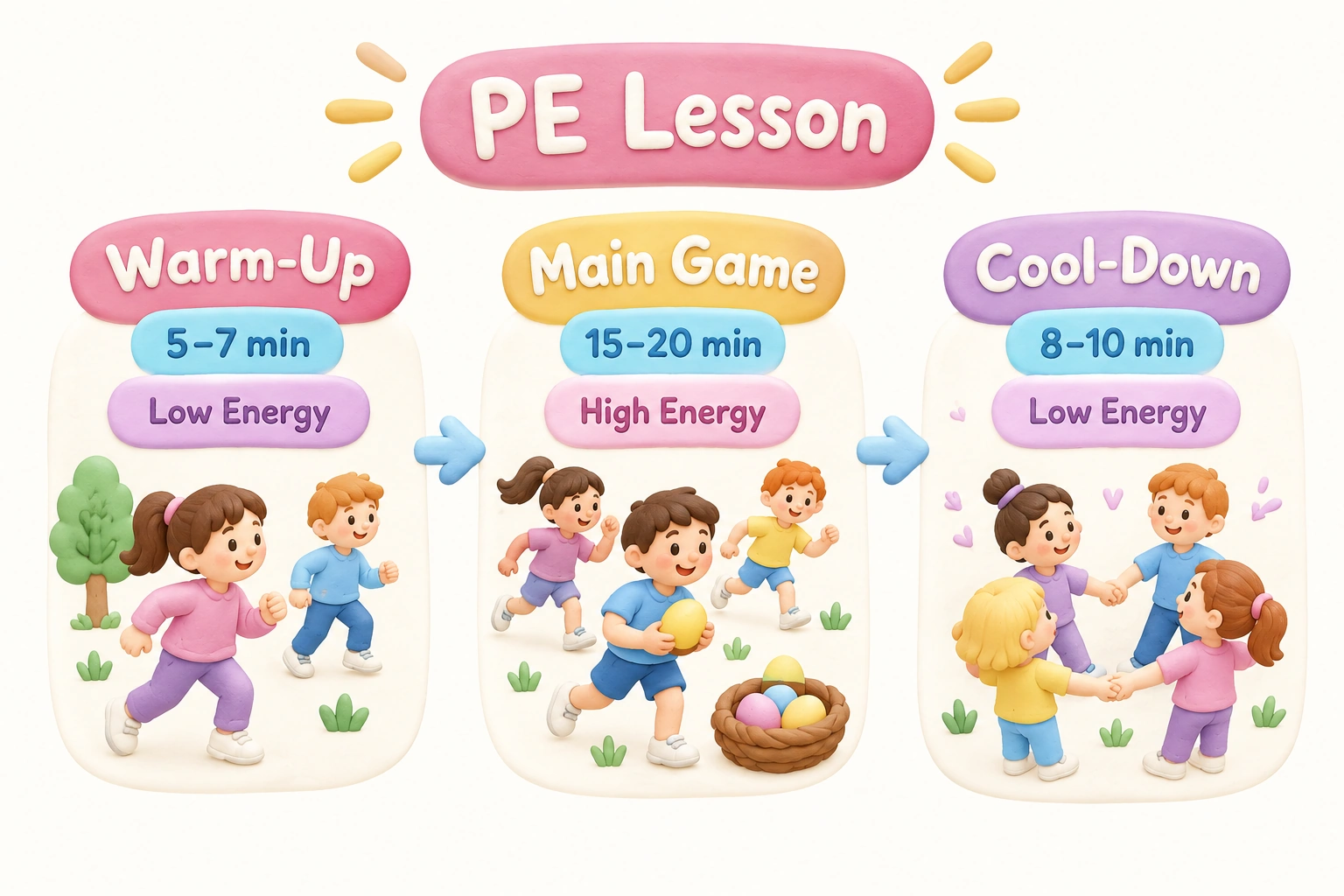
Mixing game categories across a lesson — for example, pairing a tag game with a cooperative activity — ensures students practice a broader range of fundamental motor skills rather than repeating the same movement pattern. This variety also helps maintain engagement across different learning styles and temperaments within the same class. For field day planning, selecting two or three games from each category creates a natural rotation that keeps all students active throughout the event.
Inclusive Modifications and Mixed-Ability Considerations
Elementary classrooms include students with a wide range of physical abilities, and effective PE games for elementary students should be adaptable without singling out individual children. The most practical approach is to build modifications into the game rules from the start rather than creating separate activities. For example, allowing any locomotor skill — walking, skipping, or rolling a wheelchair — in tag games means every student participates in the same game with the same rules. Foam balls reduce the impact risk in invasion games and make catching more accessible for students still developing hand-eye coordination. Reducing the throwing distance in target games like Tic-Tac-Throw allows students to experience success while still practicing the same skill as their peers.
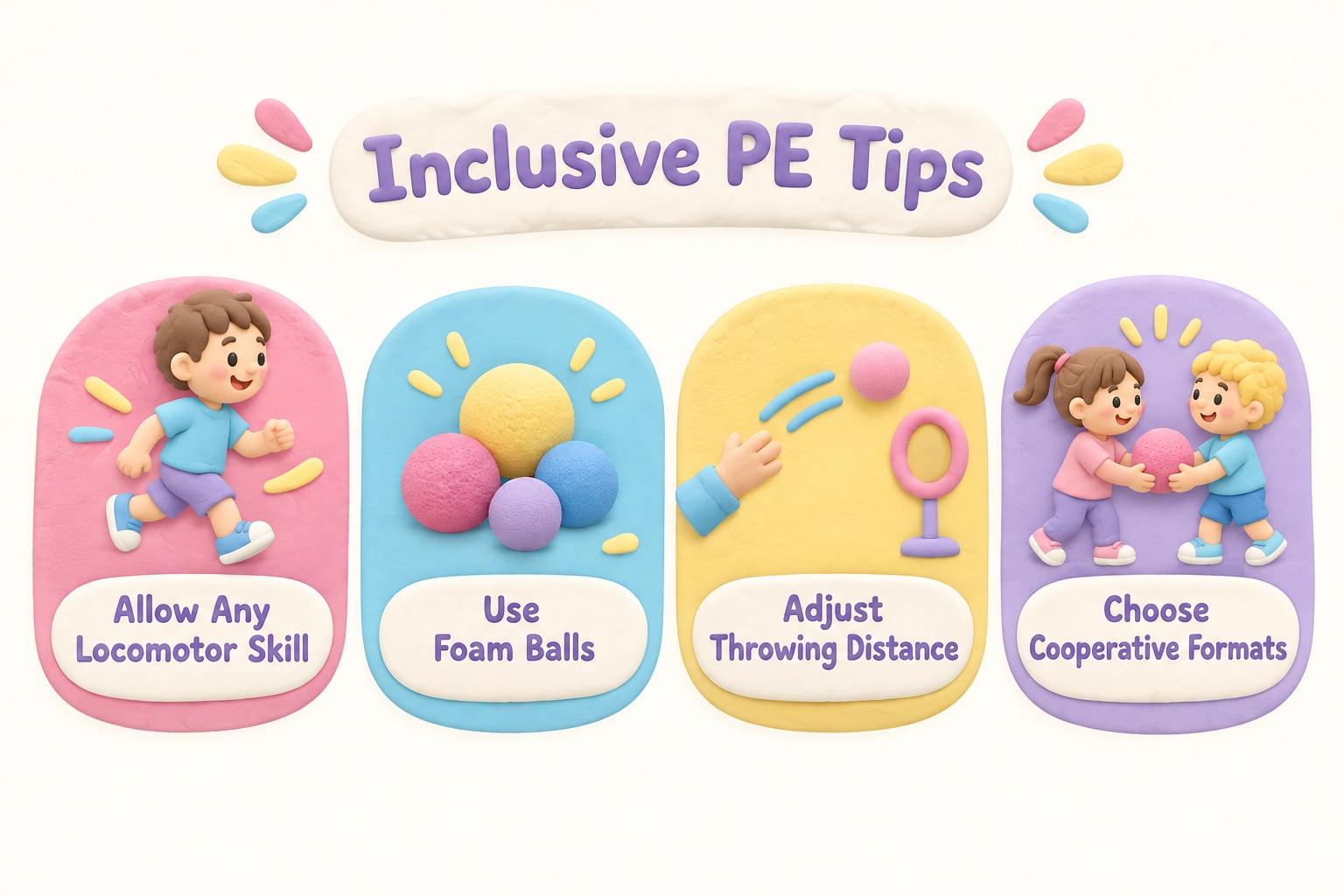
For students who find competitive formats stressful, cooperative games such as Parachute Popcorn and Pipeline Challenge offer full participation without a win-or-lose outcome. These games also tend to generate more natural communication between students, which supports social development alongside physical literacy goals.
Frequently Asked Questions
What are the best no-equipment PE games for elementary students?
Freeze Tag, Blob Tag, Sharks and Minnows, Red Light Green Light, Four Corners, Human Knot, and Animal Walks Race all require no equipment and can begin immediately. These no-equipment PE games are ideal for rainy-day indoor sessions, substitute teachers, or situations where the equipment storage area is unavailable.
Which games work best for kindergarteners and grade 1?
Younger students in K–1 benefit most from games with simple, consistent rules and immediate feedback. Freeze Tag, Red Light Green Light, Animal Walks Race, Parachute Popcorn, and Sharks and Minnows are all well-suited to this age group. Avoid games that require complex strategy or extended waiting time, as attention spans and impulse control are still developing at this stage.
How do I keep all students active and avoid long wait times?
Choose games where tagged or eliminated players re-enter quickly, or where elimination does not occur at all. Sharks and Minnows keeps tagged players active as seaweed. Rob the Nest keeps every student moving continuously. Running multiple small-group games simultaneously — for example, four groups playing Tic-Tac-Throw at four different grids — also eliminates waiting and increases individual practice time.
Which games align with SHAPE America PE standards?
Most games in this list address SHAPE America Standard 1 (motor skills and movement patterns) and Standard 2 (movement concepts including spatial awareness and effort). Cooperative games such as Human Knot and Pipeline Challenge also address Standard 4 (personal and social behavior). Cardiovascular games like Rob the Nest and Crab Soccer support Standard 3 (physical activity and fitness knowledge). Checking your specific state’s PE framework alongside SHAPE America standards is recommended, as state-level requirements may vary.
Can these games be used as brain breaks in the classroom?
Several of these games adapt well to small classroom spaces as brief brain breaks. Four Corners works in any room with four corners. Simon Says and Animal Walks can be done beside desks. Human Knot works in a cleared area. These short movement breaks may support attention and focus, though they are not a substitute for dedicated PE time that meets recommended daily physical activity guidelines.
How long does each game typically take to run?
Warm-up games such as Red Light Green Light and Four Corners typically run 3–7 minutes. Tag games like Freeze Tag and Sharks and Minnows work well in 8–12 minute rounds with brief rule reminders between rounds. Relay races typically take 10–15 minutes depending on team size and number of rounds. Cooperative challenges like Pipeline and Human Knot usually need 10–20 minutes to allow genuine problem-solving. The quick-reference table above can help you sequence games to fill a 30–45 minute lesson period.
Building a PE Game Toolkit That Grows with Your Students
The 15 PE games for elementary students in this guide are not a fixed curriculum — they are a starting toolkit that can be layered, modified, and combined as your students develop. A class that begins the year with basic Freeze Tag can progress to Blob Tag as their spatial awareness and cooperation improve. Students who master the Over-Under Relay can take on the Pipeline Challenge as a more cognitively demanding cooperative alternative. Introducing new locomotor skills in Animal Walks Race keeps the game fresh across grade levels while continuing to build the gross motor foundation that supports more complex sports and movement activities in middle school.
The most important factor in selecting group games for elementary PE is not the game itself but the match between the game’s demands and your students’ current developmental stage. Games that are slightly challenging but achievable build confidence and physical literacy simultaneously. Games that are too complex or too competitive for the group’s readiness can undermine both engagement and the social benefits that make PE a valuable part of the school day. Use the grade-level guidance, energy ratings, and inclusive modifications in this guide as a starting point, then adjust based on what you observe in your own students.

Take a short quiz to find out what your everyday choices say about your parenting style
When your child is curious about something new, what’s your instinct?
Take a short quiz to find out what your everyday choices say about your parenting style
“Can I download this app?” What happens next?
Take a short quiz to find out what your everyday choices say about your parenting style
When it comes to rules at home, which sounds most like you?
Take a short quiz to find out what your everyday choices say about your parenting style
If you could give your child one life skill today, what would you pick?
Take a short quiz to find out what your everyday choices say about your parenting style
Your child gets to choose what to watch. What would your ideal setup look like?
Take a short quiz to find out what your everyday choices say about your parenting style
Pick your parenting superpower ✨