12 Best PE Games for Kindergarten: Fun Movement Activities

 Discover a Free Education Video App for Kids
Pastory uses AI to personalize educational video content based on your child’s interests and personality. Safe, engaging, and built for curious young minds. Sign up now to stay updated and enjoy early access with a free trial
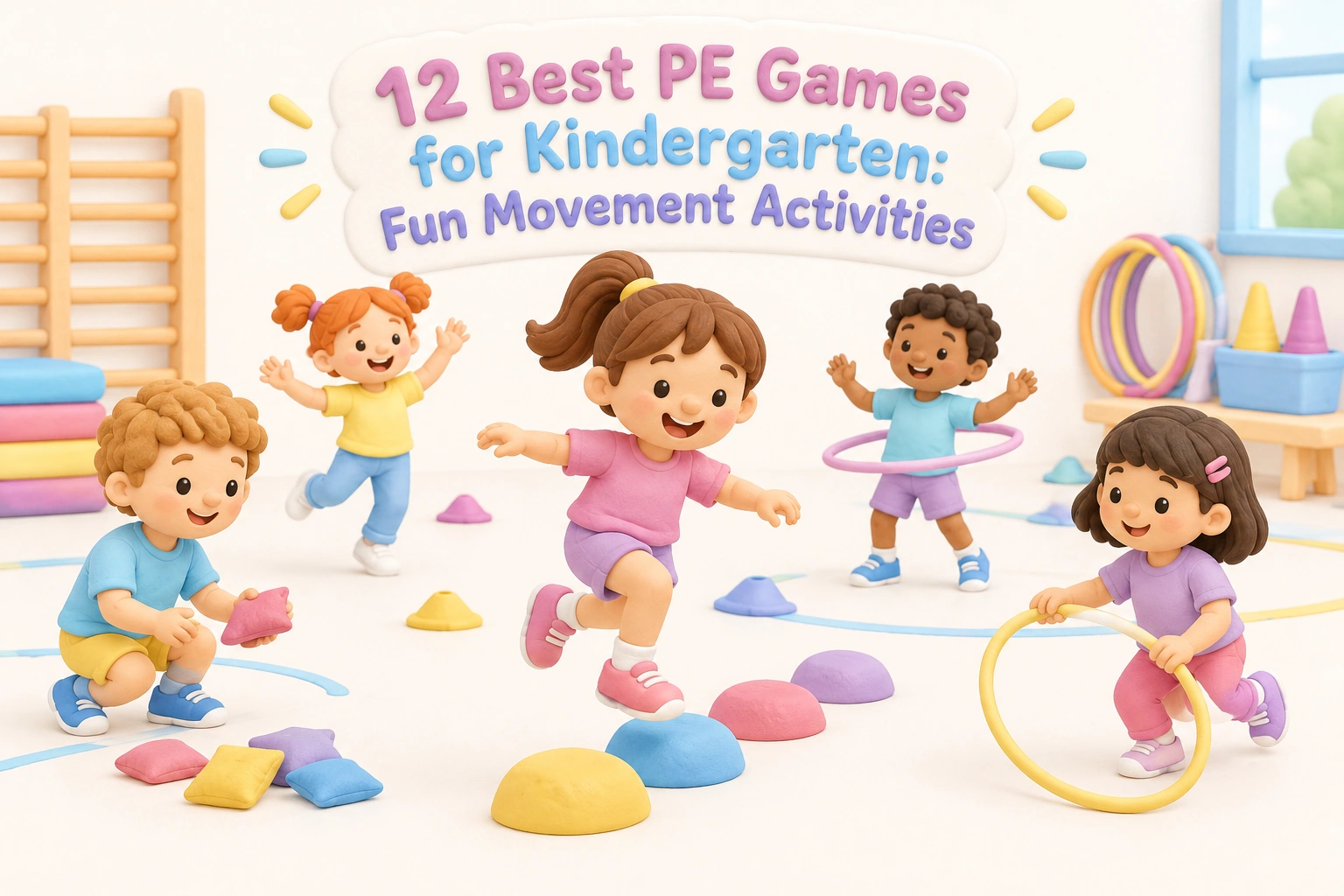
Finding the right PE games for kindergarten means balancing genuine physical challenge with the developmental realities of five- and six-year-olds: short attention spans, emerging rule-following ability, and a powerful drive to move, explore, and play imaginatively. The twelve games below are chosen because they support fundamental movement skills, require minimal setup, and can be adapted for mixed ability levels — whether you are a PE specialist, a classroom teacher looking for a brain break, or a homeschool parent planning an active session outdoors.
Key Takeaways
- Kindergartners are developing locomotor skills — hopping, skipping, galloping — for the first time, so games that practise these movements have direct developmental value.
- The best PE games for kindergarten build gross motor development, spatial awareness, listening skills, and cooperative play simultaneously.
- Most of the games below are low-prep and can be run indoors or outdoors with little or no equipment.
- Modifying difficulty up or down for each game keeps activities inclusive and appropriate for all skill levels in the same class.
- Short time estimates are included for each game to support practical lesson planning.
Why Physical Education Matters in Kindergarten
Research published in peer-reviewed journals consistently links structured physical education in the early years to stronger fundamental movement skills, better school readiness, and improved social-emotional outcomes. Kindergartners are at a critical window for gross motor development: most five-year-olds are just beginning to coordinate hopping on one foot, skipping in a rhythmic pattern, and galloping with an even lead leg. Structured PE games give children repeated, playful practice of these emerging locomotor skills in a way that free play alone may not reliably provide.
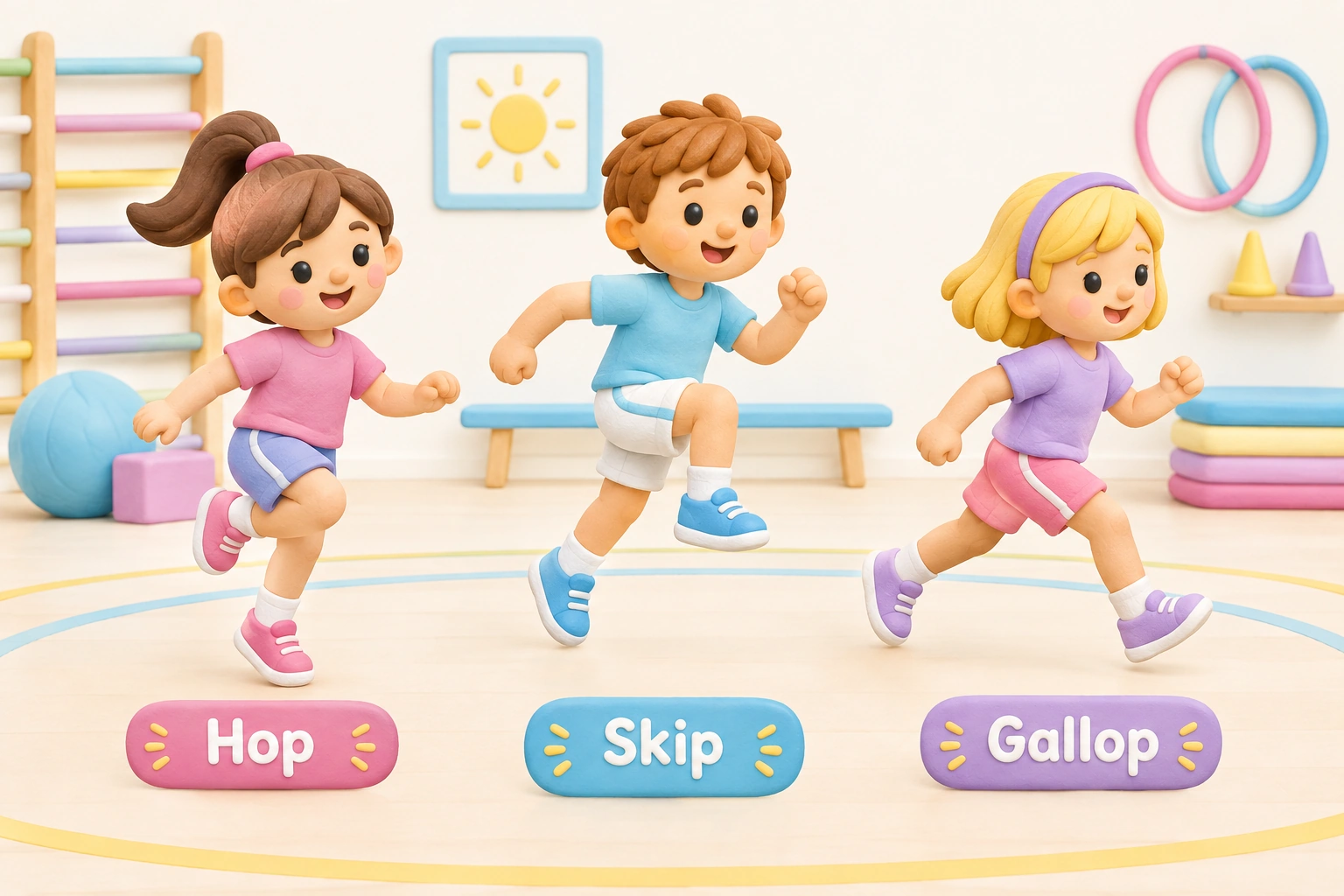
Beyond the physical, a well-designed kindergarten PE class supports cognitive development through rule-following and motor planning, language development through listening to and interpreting verbal cues, and social-emotional growth through turn-taking, managing wins and losses, and cooperative play with peers. SHAPE America’s national physical education standards for kindergarten specifically emphasize competency in fundamental movement skills and the ability to work safely with others — goals that every game in this list directly addresses.
Physical education at this age also establishes early habits around cardiovascular fitness and body awareness that may carry forward into later childhood. The goal is not athletic performance but confident, joyful movement — and that starts with games children genuinely want to play.
What Kindergartners Can Realistically Do
Before selecting PE games, it helps to understand the developmental milestone context for five- and six-year-olds. At this stage, most children can run with reasonable control, jump with a two-foot takeoff and landing, hop briefly on one foot, and are beginning to skip and gallop. Catching a large ball with two hands is emerging; throwing with accuracy is still developing. Balance on one foot for several seconds is possible but momentary stillness during a freeze game may require genuine effort. Following two- or three-step instructions is within reach, but complex rule sets will cause confusion and frustration.
This developmental picture explains why the most effective PE games for kindergarten are simple in structure, physically active throughout, and forgiving of mistakes. Games that require long waiting turns, precise throwing accuracy, or multi-step strategy are better suited to older primary children. The games below are chosen with these realities in mind.
The 12 Best PE Games for Kindergarten
1. Freeze Dance
Freeze Dance is one of the most reliable warm-up activities in a kindergarten PE class. Play upbeat music and invite children to dance freely around the space; when the music stops, every child freezes in whatever position they are in. Resume the music and repeat. The game develops body awareness, listening skills, and balance — children must hold a momentary still position, which directly challenges one-foot or wide-stance balance depending on how they freeze. It also doubles as an excellent brain break for classroom settings.
Time estimate: 5–8 minutes. Equipment: Music source only. Teacher tip: Call out a locomotor skill before each music segment — “this time, gallop!” — to layer in fundamental movement skills practice. Make it harder: Ask children to freeze in a shape you name (“freeze like a tree” or “freeze on one foot”). Make it easier: Allow any freeze position with no balance requirement.
2. Red Light, Green Light
One child or the teacher acts as the traffic light at one end of the space. When “green light” is called, children move toward the caller using a designated locomotor skill — walking, running, hopping, or skipping. “Red light” means freeze immediately. Anyone still moving goes back to the start. The first child to reach the caller wins and becomes the next traffic light. Red Light, Green Light builds chasing and fleeing awareness, listening skills, and motor planning in a format that kindergartners find immediately engaging.
Time estimate: 8–10 minutes. Equipment: None — a true no-equipment PE game. Teacher tip: Vary the locomotor skill each round to cover the full range of fundamental movement skills. Make it harder: Add a “yellow light” that means slow motion. Make it easier: Remove the elimination rule so all children stay active throughout.
3. Simon Says
Simon Says is a classic listening game that doubles as a body awareness and motor planning activity. The leader gives movement commands prefaced by “Simon says” — children must only follow commands that include that phrase. Commands can target any body part or movement: “Simon says hop on your left foot,” “Simon says touch your knees,” or “Simon says do five jumping jacks.” The game develops listening skills, body awareness, and the ability to inhibit an automatic response — an important cognitive skill for kindergartners.
Time estimate: 5–10 minutes. Equipment: None. Teacher tip: Use Simon Says as a low-prep instant activity at the start of a lesson to settle the group and focus attention before more active games. Make it harder: Increase the speed of commands. Make it easier: Remove the elimination element and play purely for movement practice.
4. Tag Games
Tag games are a cornerstone of kindergarten physical education because they naturally develop running, dodging, spatial awareness, and chasing and fleeing skills in an open-ended format. Classic tag — one child is “it” and tries to touch others — is the simplest version. Variations that work especially well for kindergartners include Shadow Tag (step on a classmate’s shadow instead of touching them, ideal for outdoor play), Turtle Tag (children are safe when they lie on their backs with arms and legs in the air, encouraging cooperative play as peers can “rescue” turtles by helping them up), and Blob Tag (tagged children join hands with the tagger, growing the blob until everyone is caught).
Time estimate: 10–15 minutes. Equipment: None for most versions; pool noodles can replace hand-touching for hygiene or sensory reasons. Teacher tip: Define clear boundaries with cones or painted lines before starting any tag game to support spatial awareness and safe play. Safety note: Remind children to keep eyes up and avoid collisions by watching where they are going, not just who they are chasing.
5. Parachute Games
A parachute is one of the most versatile pieces of equipment in a physical education curriculum for young children. Children stand around the edge holding the parachute and can shake it to make waves, lift it high to create a mushroom shape, or run underneath it before it falls. Classic parachute games include Popcorn (place foam balls on top and shake to pop them off), Cat and Mouse (one child crawls under while another tries to tag them through the fabric), and Color Call (children holding a named color let go and run to a new spot before the parachute falls). Parachute games are naturally inclusive PE activities because every child participates simultaneously and the cooperative nature means no one is singled out.
Time estimate: 10–15 minutes. Equipment: Parachute, optional foam balls. Teacher tip: Parachute activities are excellent for building cooperative play and a sense of shared purpose — reinforce this by praising the group effort rather than individual performance.
6. Bean Bag Activities
Bean bags are low-cost, safe, and endlessly versatile for kindergarten PE. Children can balance a bean bag on their head while walking or performing locomotor skills, toss and catch with a partner to develop hand-eye coordination, or use bean bags in relay races. A simple relay involves children carrying a bean bag on a body part — head, shoulder, or back of the hand — to a cone and back without dropping it. Bean bag activities develop hand-eye coordination, balance, and body awareness, and the soft material makes them safe for indoor use.
Time estimate: 8–12 minutes. Equipment: One bean bag per child or pair. Teacher tip: For a cross-curricular twist, label bean bags with letters or numbers and call out a target for children to toss their bag onto — integrating literacy or numeracy into the physical education curriculum. Make it harder: Increase tossing distance or use the non-dominant hand. Make it easier: Use a larger target such as a hula hoop on the floor.
7. Hula Hoop Games
Hula hoops can be used in multiple ways during a kindergarten PE class. Lay them flat on the floor as stepping stones for a locomotor skills obstacle course — children hop from hoop to hoop on one foot, jump with two feet, or gallop around the outside. In Hoop Freeze, each child stands inside their own hoop; when music plays they move around the space, and when it stops they must find any empty hoop to stand in. Remove one hoop each round. Hula hoop games develop spatial awareness, balance, and agility in a format that feels like imaginative play.
Time estimate: 8–12 minutes. Equipment: One hula hoop per child (or slightly fewer for Hoop Freeze). Teacher tip: Hoop Freeze is a cooperative alternative to musical chairs — consider keeping all children active by having those without a hoop perform a movement challenge rather than sitting out.
8. Relay Races
Relay races introduce kindergartners to teamwork, turn-taking, and the concept of working toward a shared goal — all key elements of cooperative play. Keep relay formats simple: a Penguin Waddle Relay has children squeeze a foam ball between their knees and waddle to a cone and back; a Crab Walk Relay has children travel on hands and feet with their belly facing up. These formats are more developmentally appropriate than baton-passing relays, which require fine motor precision that many kindergartners have not yet developed. Relay races also provide natural cardiovascular fitness benefits through repeated bursts of effort.
Time estimate: 10–15 minutes. Equipment: Cones, foam balls or bean bags depending on the relay type. Teacher tip: Keep teams small — three or four children — to minimize waiting time and maximize active participation. Safety note: Ensure adequate spacing between relay lanes to prevent collisions.
9. Balloon Volleyball
Balloon volleyball replaces a standard ball with a balloon, dramatically slowing the pace of play and making successful rallies achievable for kindergartners who are still developing hand-eye coordination and throwing and catching skills. Children can play in pairs or small groups, keeping the balloon in the air using hands, forearms, or any body part. The slow arc of a balloon gives children time to track the object visually and position their body — a key element of motor planning that is much harder with a faster ball.
Time estimate: 8–10 minutes. Equipment: One balloon per pair or small group. Safety note: Check for latex allergies before using balloons; mylar balloons are a safe alternative. Teacher tip: Set a group counting goal — “let’s see if we can keep it up for ten hits” — to encourage cooperative play rather than competition.
10. Four Corners
Four Corners is a low-prep listening and movement game that works well as a transition activity or brain break. Label the four corners of the gym or classroom with numbers or colors. One child stands in the center with eyes closed and counts to ten while the other children quietly move to any corner. The center child calls a corner; everyone in that corner sits down (or performs a movement challenge). The last child standing becomes the new caller. Four Corners develops listening skills, decision-making, and spatial awareness while keeping the whole group moving between rounds.
Time estimate: 8–10 minutes. Equipment: Four signs or cones to label corners. Teacher tip: Instead of eliminating children, have those in the called corner perform five jumping jacks and then re-enter the game — this keeps everyone active and avoids the disengagement that comes with long waiting periods.
11. Animal Movement Freeze
Animal Movement Freeze combines imaginative play with gross motor development in a format that kindergartners find highly motivating. Call out an animal and a corresponding movement — “hop like a frog,” “stomp like an elephant,” “slither like a snake” — and children move around the space imitating that animal. When you call “freeze,” everyone stops. This game develops body awareness, creativity, and a wide range of locomotor skills and non-locomotor movements (twisting, stretching, bending) in a single activity. It is also an excellent inclusive PE activity because there is no wrong way to interpret an animal movement.
Time estimate: 5–8 minutes. Equipment: None — a fully no-equipment PE game. Teacher tip: Use Animal Movement Freeze as a warm-up activity at the start of a lesson; the imaginative play element captures attention quickly and transitions children into a movement mindset.
12. Trains and Tunnels
Trains and Tunnels is a cooperative partner game that builds spatial awareness, body awareness, and teamwork. Children pair up: one child is the “train” and one is the “tunnel.” The tunnel child stands with feet wide apart; the train child crawls through the tunnel’s legs, then stands up and the roles switch. In a larger group version, children form a long line and the child at the back crawls through everyone’s legs to reach the front, becoming the new engine. This game develops cooperative play, gross motor skills, and the ability to navigate shared space safely.
Time estimate: 8–10 minutes. Equipment: None. Teacher tip: Trains and Tunnels works particularly well as a cool-down activity at the end of a lesson because the pace is naturally lower and the cooperative element encourages positive social interaction to close the session.
Quick-Reference Guide: Skills and Setup
| Game | Key Skills | Equipment | Indoor / Outdoor | Time |
|---|---|---|---|---|
| Freeze Dance | Body awareness, balance, listening | Music source | Both | 5–8 min |
| Red Light, Green Light | Locomotor skills, motor planning | None | Both | 8–10 min |
| Simon Says | Listening, body awareness | None | Both | 5–10 min |
| Tag Games | Running, spatial awareness, chasing | None / pool noodles | Both | 10–15 min |
| Parachute Games | Cooperative play, gross motor | Parachute | Both | 10–15 min |
| Bean Bag Activities | Hand-eye coordination, balance | Bean bags | Both | 8–12 min |
| Hula Hoop Games | Spatial awareness, agility | Hula hoops | Both | 8–12 min |
| Relay Races | Teamwork, cardiovascular fitness | Cones, foam balls | Both | 10–15 min |
| Balloon Volleyball | Hand-eye coordination, tracking | Balloons | Indoor | 8–10 min |
| Four Corners | Listening, decision-making | Corner labels | Both | 8–10 min |
| Animal Movement Freeze | Imaginative play, locomotor skills | None | Both | 5–8 min |
| Trains and Tunnels | Cooperative play, gross motor | None | Both | 8–10 min |
Tips for Running PE Games Effectively With Kindergartners
Class management is one of the most consistent challenges in kindergarten physical education, and it is rarely addressed in game lists. A few practical strategies make a significant difference. First, establish a clear signal for stopping — a whistle, a clap pattern, or a verbal cue — and practise it before the first game begins. Kindergartners need to know exactly what “stop and listen” looks like before they are in the middle of an exciting chase game. Second, keep instructions to three steps or fewer; demonstrate physically rather than relying on verbal explanation alone.
Transitions between games are a common source of lost time and behaviour challenges. Having children perform a simple locomotor skill — “skip to the wall and sit down” — during transitions keeps bodies moving and minds engaged rather than creating an unstructured gap. Third, use inclusive PE activities that keep all children active simultaneously rather than games with long elimination sequences. When children sit out, they disengage physically and socially, which undermines the developmental goals of the session.
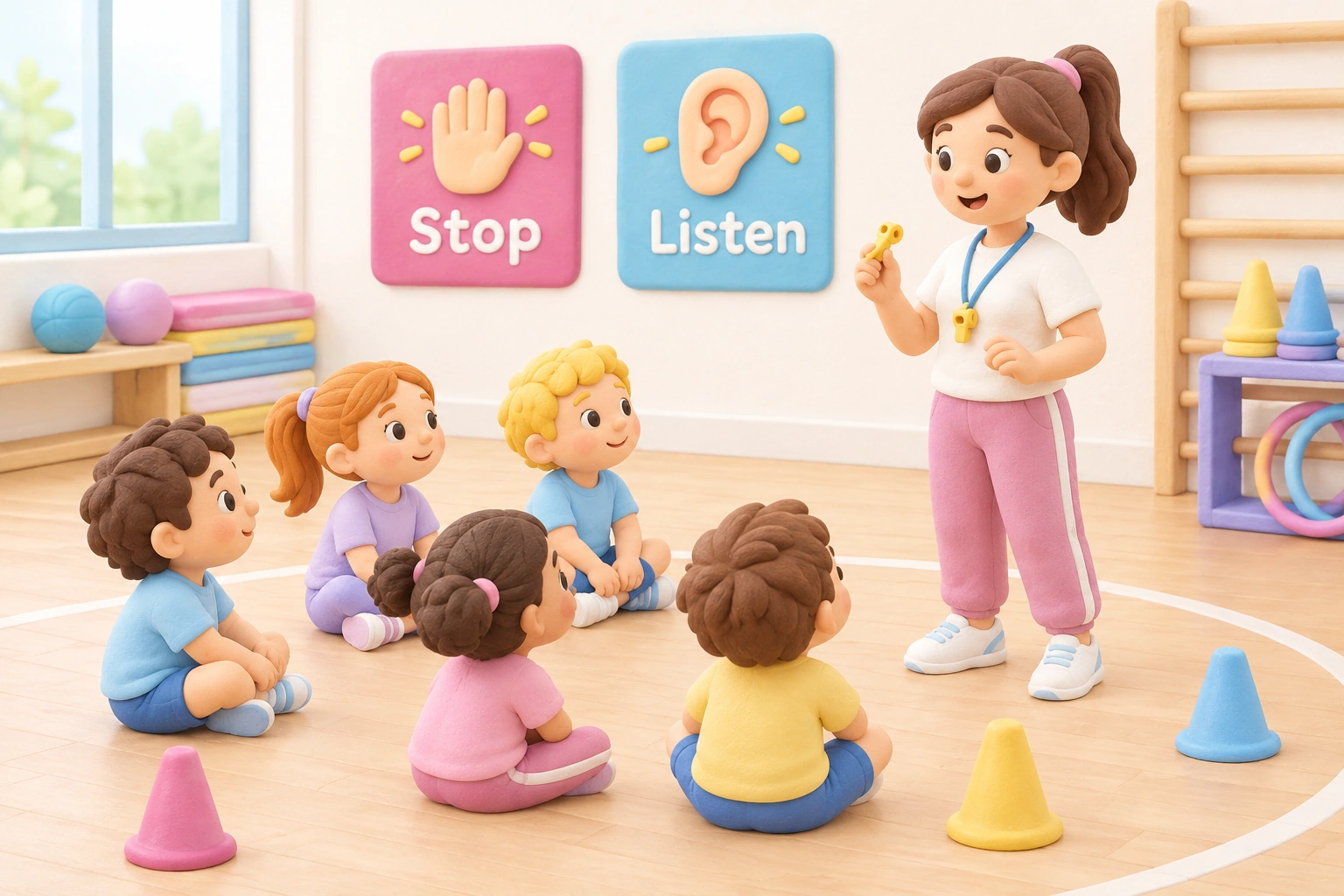
Finally, consider the physical space carefully. Spatial awareness is a skill kindergartners are actively developing, which means they genuinely struggle to judge safe distances from peers. Marking boundaries clearly with cones or painter’s tape, and reminding children to keep their eyes up during chasing games, reduces collision risk without removing the physical challenge.
Adapting Games for All Skill Levels
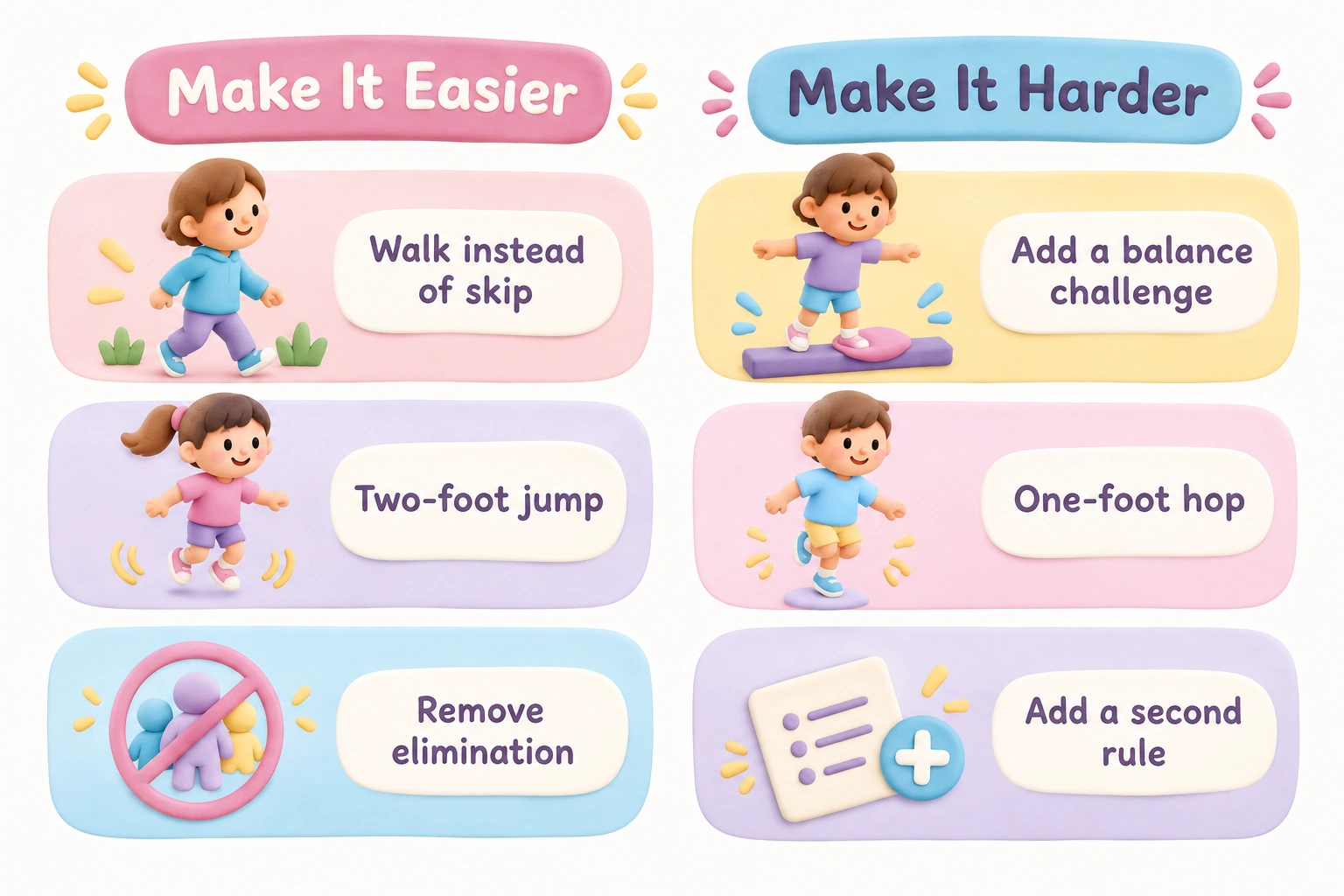
Inclusive PE activities are most effective when modifications are built into the game design rather than applied as an afterthought. For children who are still developing basic locomotor skills, simplify the movement requirement — walking instead of skipping, two-foot jumping instead of one-foot hopping. For children who are more physically confident, add a challenge layer: balance a bean bag while performing the locomotor skill, or add a second rule to a tag game. Framing modifications as “level choices” rather than ability groupings helps preserve every child’s sense of competence and belonging.
Children with sensory sensitivities may find loud music, physical contact, or unpredictable movement from peers challenging. No-equipment PE games like Simon Says, Animal Movement Freeze, and Four Corners can be run with reduced noise and predictable structure, making them more accessible. Pool noodles as taggers replace physical contact in tag games for children who find touching uncomfortable. The goal of an inclusive physical education curriculum is for every child to experience success and genuine physical engagement, not just participation in name.
Frequently Asked Questions
How long should a kindergarten PE class be?
Most early childhood physical education guidelines suggest 30 minutes of structured PE per day for kindergartners, though many schools offer two or three dedicated sessions per week of 30–45 minutes each. Even short 10–15 minute movement sessions — such as a brain break using Freeze Dance or Simon Says — contribute meaningfully to daily physical activity goals when a full PE class is not available.
Can these PE games be played indoors in a small space?
Most of the games in this list work in a standard gymnasium or a cleared classroom. No-equipment PE games like Simon Says, Animal Movement Freeze, Four Corners, and Trains and Tunnels require minimal space and are well suited to indoor settings. Tag games and relay races benefit from a larger outdoor or gym space. Balloon Volleyball is specifically designed for indoor use because the slow-moving balloon is safe in confined areas.
What equipment is essential for a kindergarten PE program?
Many of the most effective PE games for kindergarten require no equipment at all. If budget allows, a set of bean bags, a parachute, hula hoops, foam balls, and cones covers the equipment needs for the full range of games in this list. A parachute is the single most versatile investment for cooperative group games. Painter’s tape is a low-cost way to mark boundaries and targets on gym floors.
How do I handle children who do not want to participate?
Reluctance to participate is common in kindergarten PE and usually reflects anxiety about performance, unfamiliarity with the game, or sensory discomfort rather than defiance. Offering a low-stakes role — such as being the music controller in Freeze Dance or the corner-caller in Four Corners — gives hesitant children a way to engage without the physical exposure they may find overwhelming. Gradually increasing participation expectations as children build confidence is more effective than requiring immediate full involvement.
Do these games align with national PE standards?
The games in this list are designed to support the kinds of fundamental movement skills, cooperative play, and body awareness that SHAPE America’s kindergarten physical education standards emphasize. However, alignment with specific national or local curriculum standards will depend on your school district or country. PE specialists should cross-reference their local physical education curriculum requirements when planning formal lesson sequences.
Are these games suitable for homeschool PE?
Yes. Most of the no-equipment PE games — Red Light, Green Light, Simon Says, Animal Movement Freeze, and Freeze Dance — work well with one or two children and can be run in a backyard, living room, or local park. Games that require larger groups, such as parachute games and relay races, can be adapted for homeschool co-ops or playdates. The developmental benefits of gross motor development and fundamental movement skills practice apply regardless of the setting.
Building a PE Game Rotation That Works All Year
The twelve games in this list are not meant to be used in a single session — they form a rotation that can be varied across a full school year to maintain engagement and progressively develop skills. A practical approach is to anchor each lesson with one familiar game that children already know and enjoy, then introduce one new game or variation. Familiarity with the rules reduces transition time and allows children to focus on the physical challenge rather than the cognitive load of learning new instructions.
As the year progresses, revisit earlier games with added difficulty modifications — faster music in Freeze Dance, a “yellow light” in Red Light, Green Light, or a non-dominant hand requirement in bean bag activities. This progressive challenge supports ongoing gross motor development without requiring new equipment or preparation. Rotating between tag games, cooperative games, music-based games, and equipment games also ensures that children with different strengths and preferences each have regular opportunities to feel confident and successful in their kindergarten PE class.
Physical education in kindergarten is most effective when it is joyful, inclusive, and developmentally matched to where five- and six-year-olds actually are — not where we wish they were. The games above are chosen because they meet children at that stage and give them a genuinely positive experience of movement that may support lifelong physical activity habits.

Take a short quiz to find out what your everyday choices say about your parenting style
When your child is curious about something new, what’s your instinct?
Take a short quiz to find out what your everyday choices say about your parenting style
“Can I download this app?” What happens next?
Take a short quiz to find out what your everyday choices say about your parenting style
When it comes to rules at home, which sounds most like you?
Take a short quiz to find out what your everyday choices say about your parenting style
If you could give your child one life skill today, what would you pick?
Take a short quiz to find out what your everyday choices say about your parenting style
Your child gets to choose what to watch. What would your ideal setup look like?
Take a short quiz to find out what your everyday choices say about your parenting style
Pick your parenting superpower ✨