15 Best Halloween Classroom Games for Elementary Kids

 Discover a Free Education Video App for Kids
Pastory uses AI to personalize educational video content based on your child’s interests and personality. Safe, engaging, and built for curious young minds. Sign up now to stay updated and enjoy early access with a free trial
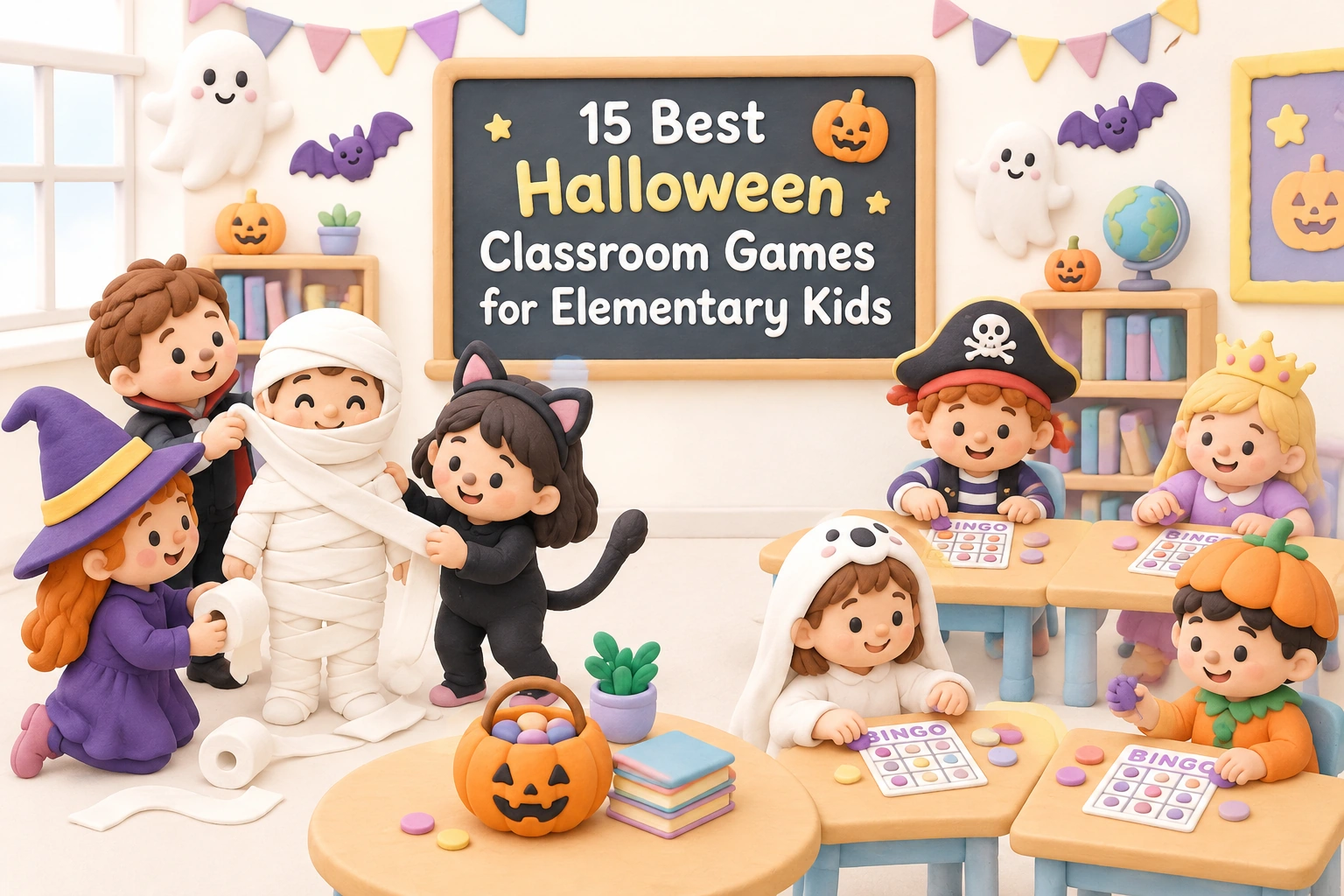
Halloween classroom games can transform an ordinary October afternoon into a memorable celebration that keeps every student engaged, included, and genuinely excited about being at school. Whether you are a teacher planning a 30-minute classroom party or a room parent volunteering to run stations, the right mix of active, quiet, and educational games makes all the difference. This guide covers 15 of the best Halloween games for elementary students, with grade-level notes, supply lists, and practical tips for keeping things fun, inclusive, and low-stress for everyone involved.
Key Takeaways
- A mix of active games, quiet seated games, and educational tie-ins keeps all learning styles engaged during a Halloween classroom party.
- Labeling each game with a grade-level range helps teachers and room parents quickly match activities to their students’ developmental stage.
- Elimination-free game formats are strongly recommended for younger elementary students, where being “out” can cause distress and reduce participation.
- Many of the best Halloween classroom games require little to no preparation and use supplies already available in most classrooms or from a dollar store.
- A sample 30-minute party schedule helps teachers manage transitions smoothly and ensures every planned activity actually gets played.
Why Game Choice Matters for Elementary Halloween Parties
Elementary students span a wide developmental range — from kindergarteners who are still building turn-taking skills to fifth graders who thrive on strategy and friendly competition. Choosing age-appropriate Halloween classroom games is not just about fun; it also supports social-emotional learning, cooperation, and self-regulation in a low-stakes, festive context. Research in developmental psychology consistently shows that structured play with clear rules helps children practice impulse control, perspective-taking, and collaborative problem-solving. A well-chosen game can reinforce these skills while keeping the holiday spirit alive.
It is equally important to consider the tone of your game selection. In an inclusive elementary classroom, games should lean toward spooky-silly rather than genuinely frightening. Themes involving friendly ghosts, goofy monsters, and cartoon pumpkins are broadly accessible, whereas jump-scare or horror-adjacent content may distress younger children or those with anxiety. When in doubt, frame everything as playful and humorous rather than scary.
A Note on Allergy Awareness and Classroom Safety
Before finalizing any Halloween party plan, check with the classroom teacher about food allergies, dietary restrictions, and school policies on candy or food-based games. Several popular Halloween games — including candy corn estimation and certain relay races — involve food items that may not be safe for every student. Non-food alternatives such as plastic pumpkin tokens, foam balls, or printed cards can substitute in almost every game without losing any of the fun. Confirming these details in advance prevents last-minute scrambles and ensures every child can participate fully.
The 15 Best Halloween Classroom Games
1. Halloween Bingo
Best for: K–5 | Format: Whole class or small group | Prep level: Low (free printable cards available online)
Halloween bingo is a perennial favorite because it works for every grade level and requires almost no active management once cards are distributed. Players mark off spooky images — pumpkins, bats, witches, black cats, cauldrons — as the caller announces them. For K–2 students, use picture-only cards. For grades 3–5, use vocabulary bingo where students match Halloween-themed words to definitions, turning the game into a low-key literacy activity. Supplies needed: printed bingo cards, bingo markers or small candy corn pieces (check allergies), and a caller card set.
2. Mummy Wrap Relay
Best for: 1st–5th grade | Format: Team relay | Prep level: No prep
The mummy wrap is one of the most beloved active Halloween classroom games. Divide students into teams of three or four. One student stands still while teammates wrap them from shoulders to ankles using a single roll of toilet paper. The first team to use their entire roll wins. For a classroom-safe version, wrap only from the waist down or set a 60-second timer and judge by coverage rather than speed. Supplies needed: one roll of toilet paper per team. This game works best in a hallway or cleared classroom space and takes approximately eight to ten minutes including setup.
3. Spooky Freeze Dance
Best for: K–3 | Format: Whole class brain break | Prep level: No prep
The spooky freeze dance is an ideal brain break that doubles as a Halloween classroom game. Play a Halloween-themed playlist — think “Monster Mash” or spooky instrumental tracks — and have students dance freely. When the music stops, everyone freezes in their best monster pose. For younger students, make this elimination-free: everyone stays in the game regardless of whether they freeze in time. This keeps energy high and avoids the tears that can follow early elimination. Supplies needed: a speaker and a Halloween playlist. Total time: five to eight minutes.
4. Halloween Charades
Best for: 2nd–5th grade | Format: Team or whole class | Prep level: Low (free printable cards available)
Halloween charades builds vocabulary, expressive communication, and cooperative play. Divide the class into two or three teams. One student draws a card and acts out a Halloween word or phrase — “flying witch,” “zombie shuffle,” “carving a pumpkin” — while teammates guess within 60 seconds. For grades 2–3, use simple single-word prompts. For grades 4–5, use multi-word phrases or short scenarios. Supplies needed: a printed set of Halloween charades cards and a timer. This game runs well as a 10-minute station during a classroom party rotation.
5. Candy Corn Estimation Jar
Best for: K–5 (math tie-in) | Format: Individual or partner | Prep level: Low
Candy corn estimation is a simple Halloween math game that takes almost no class time to run. Fill a clear jar with candy corn before the party and have each student write down their estimate on a slip of paper. After all guesses are submitted, count the candy corn together as a class — this itself becomes a math activity involving grouping, skip-counting, or multiplication depending on grade level. The student with the closest estimate wins a small prize. If candy is not permitted, substitute small plastic pumpkin tokens or orange pom-poms. Supplies needed: a clear jar, candy corn or substitute items, slips of paper, and pencils.
6. Ghost Hunt Scavenger Hunt
Best for: K–4 | Format: Small group or whole class | Prep level: Low (free printable clue sheets available)
A ghost hunt scavenger hunt sends students searching the classroom for hidden paper ghosts, each printed with a clue, a sight word, or a math fact. For K–1, hide ten simple picture ghosts around the room and have students collect as many as they can find. For grades 2–4, create a sequential clue chain where each ghost leads to the next hiding spot. This game encourages movement, reading, and problem-solving simultaneously. Supplies needed: printed ghost cutouts or small paper ghosts, tape, and a clue sheet per team. Allow 10–15 minutes for this activity.
7. Monster Bowling
Best for: K–3 | Format: Station game | Prep level: Low
Monster bowling transforms a classic activity into a Halloween classroom game using decorated plastic bottles or cardboard tubes as pins. Draw or tape monster faces onto ten empty water bottles, set them up at the end of a short hallway or cleared aisle, and let students roll a small pumpkin-shaped ball or a regular foam ball to knock them down. Keep score on a whiteboard for older students or simply count knocked-down monsters for younger ones. Supplies needed: ten plastic bottles, a foam ball or small rubber ball, and optional monster face stickers. This works beautifully as a station rotation game.
8. Halloween Pictionary
Best for: 2nd–5th grade | Format: Team game | Prep level: Low
Halloween Pictionary follows the same rules as the classic drawing game but uses Halloween-themed vocabulary. One student draws a word from a card — “haunted house,” “skeleton,” “cauldron” — while their team guesses within 60 seconds. Use a whiteboard, chart paper, or individual mini whiteboards. For grades 4–5, increase difficulty with abstract Halloween concepts like “eerie silence” or “trick-or-treat.” This game naturally reinforces vocabulary and visual communication skills. Supplies needed: a whiteboard or large paper, markers, and a printed set of Halloween Pictionary cards.
9. Pumpkin Relay Race
Best for: 1st–5th grade | Format: Team relay | Prep level: No prep
The pumpkin relay race is a high-energy active game that works well in a gymnasium, hallway, or cleared classroom. Students carry a small plastic pumpkin bucket between their knees (no hands allowed) from one end of the course to the other and pass it to the next teammate. Dropped pumpkins must be picked up without using hands. For a quieter classroom version, have students balance a small foam pumpkin on a plastic spoon while walking heel-to-toe. Supplies needed: one small plastic pumpkin bucket or foam pumpkin per team. This game takes approximately eight minutes and is a natural energy release before a quieter activity.
10. Witch’s Hat Ring Toss
Best for: K–4 | Format: Station game | Prep level: Low
Set up three to five witch’s hats (plastic party hats or cone-shaped paper hats) at varying distances and have students toss glow-stick rings or paper rings to land on the hats. Assign point values to each hat based on distance. This game works perfectly as a station rotation activity during a Halloween classroom party, allowing small groups of four to six students to rotate through every five to seven minutes. Supplies needed: plastic witch’s hats or paper cones, glow-stick rings or homemade paper rings, and a score sheet. Total station time: five to seven minutes per group.
11. Haunted Corners (Four Corners)
Best for: K–3 | Format: Whole class | Prep level: No prep
Haunted corners is a Halloween twist on the classic four corners game. Label each corner of the classroom with a Halloween character — Ghost, Witch, Skeleton, Pumpkin. One student stands in the center with eyes closed and counts to ten while classmates quietly move to any corner. The center student calls out one corner; everyone in that corner sits down for one round. For a fully elimination-free version, students in the called corner simply do a silly monster action before returning to play rather than sitting out. This keeps all students active and avoids the frustration of early elimination. Supplies needed: four corner labels (paper signs). Total time: five to eight minutes.
12. Spooky Sound Detective
Best for: K–2 | Format: Whole class listening game | Prep level: Low
Spooky sound detective is a calm, seated Halloween classroom game that works well as a transition activity or a wind-down after active games. Play short Halloween sound clips — an owl hoot, a creaking door, a cauldron bubbling, wind howling — and have students write or whisper their guess to a partner before the answer is revealed. This game builds listening skills, vocabulary, and descriptive language in a low-key format. For K–1, use picture response cards so non-writers can participate fully. Supplies needed: a speaker, a short Halloween sounds playlist or video, and optional picture response cards. Total time: five to seven minutes.
13. Halloween Word Scramble Race
Best for: 2nd–5th grade | Format: Individual or partner | Prep level: Low (free printable available)
A Halloween word scramble is a no-prep literacy game that can fill five to fifteen minutes depending on how many words are included. Students unscramble Halloween-themed vocabulary words — PUMKPIN, SKEELTON, WTICHES — as quickly as possible. For grades 2–3, use five to eight simple words. For grades 4–5, use ten to fifteen words including multi-syllable vocabulary. Turn it into a friendly race by having students raise their hand when finished, or use it as a calm individual activity. Supplies needed: one printed word scramble sheet per student and a pencil. Free printable versions are widely available online.
14. Halloween STEM Pumpkin Tower Challenge
Best for: 3rd–5th grade | Format: Small group STEM challenge | Prep level: Low
The Halloween STEM pumpkin tower challenge asks small groups to build the tallest freestanding tower they can using only marshmallows and toothpicks, topped with a small plastic pumpkin. Groups have ten minutes to plan and build, then present their towers for measurement. This activity reinforces engineering thinking, collaborative problem-solving, and measurement skills in a festive context. For a mess-free alternative, substitute mini sticky notes and craft sticks. Supplies needed: marshmallows, toothpicks, small plastic pumpkins, and a ruler. Check for food allergies before using marshmallows. Total time: 15–20 minutes including debrief.
15. The Quiet Pumpkin
Best for: K–5 | Format: Whole class calming game | Prep level: No prep
The quiet pumpkin is a Halloween version of the classic “quiet game” and is invaluable as a transition tool or a wind-down activity at the end of a party. Pass a small plastic pumpkin around the circle; whoever holds it must stay completely silent. The last student still silent when the teacher calls time wins. For older students, add a challenge: hold the pumpkin while balancing it on one finger or passing it without using thumbs. This game naturally resets the room’s energy level before returning to regular instruction. Supplies needed: one small plastic pumpkin. Total time: three to five minutes.
Grade-Level Quick Reference
| Game | Best Grade Range | Energy Level | Prep Needed | Group Format |
|---|---|---|---|---|
| Halloween Bingo | K–5 | Low | Low | Whole class |
| Mummy Wrap Relay | 1–5 | High | None | Teams |
| Spooky Freeze Dance | K–3 | High | None | Whole class |
| Halloween Charades | 2–5 | Medium | Low | Teams |
| Candy Corn Estimation | K–5 | Low | Low | Individual |
| Ghost Hunt Scavenger Hunt | K–4 | Medium | Low | Small group |
| Monster Bowling | K–3 | Medium | Low | Station |
| Halloween Pictionary | 2–5 | Medium | Low | Teams |
| Pumpkin Relay Race | 1–5 | High | None | Teams |
| Witch’s Hat Ring Toss | K–4 | Medium | Low | Station |
| Haunted Corners | K–3 | Medium | None | Whole class |
| Spooky Sound Detective | K–2 | Low | Low | Whole class |
| Word Scramble Race | 2–5 | Low | Low | Individual |
| STEM Pumpkin Tower | 3–5 | Medium | Low | Small group |
| The Quiet Pumpkin | K–5 | Low | None | Whole class |
Elimination-Free Play: Why It Matters in Elementary Classrooms
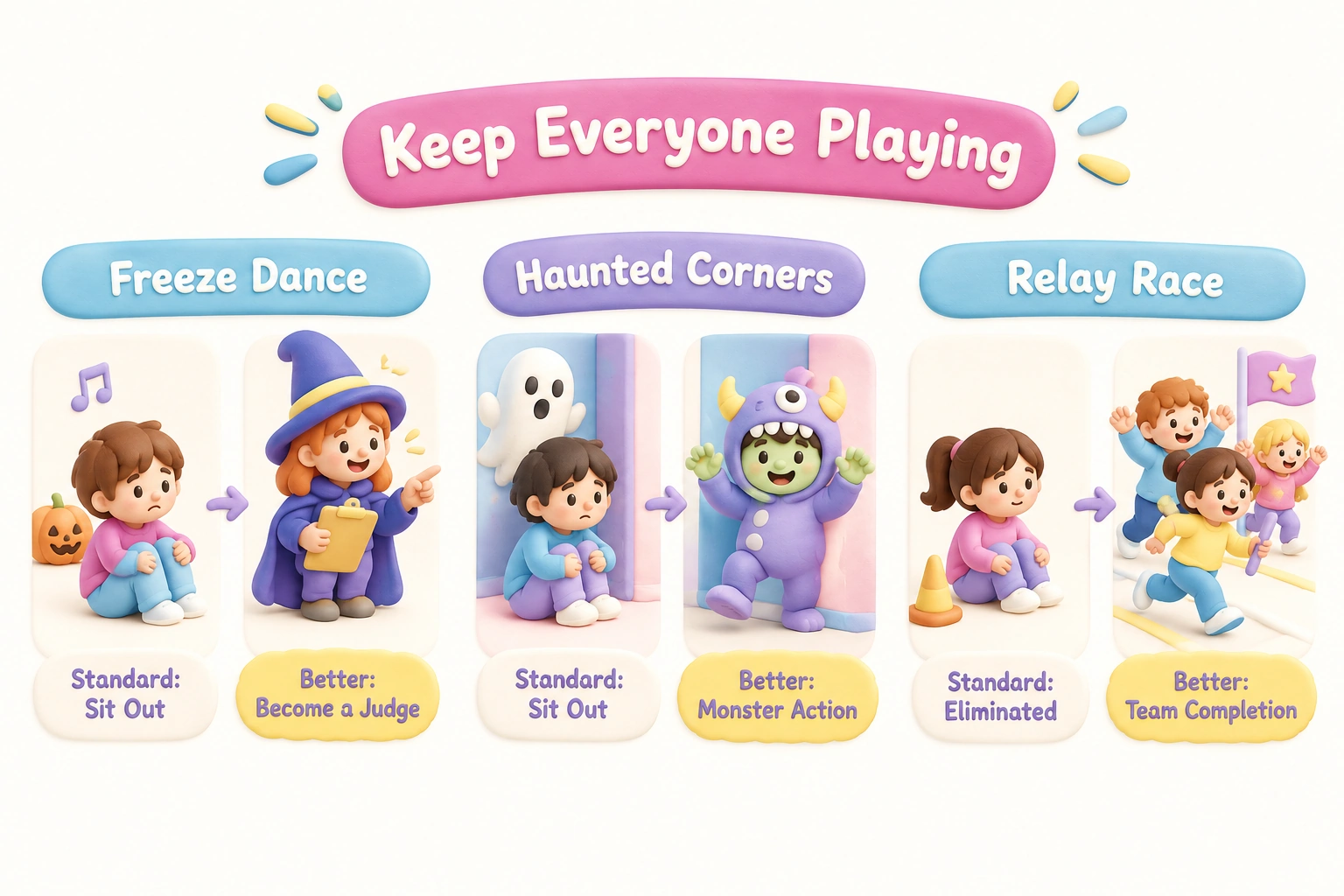
Many traditional party games eliminate players early, leaving some children sitting on the sidelines for the majority of the activity. For younger elementary students — particularly those in kindergarten through second grade — being eliminated can feel genuinely upsetting and may overshadow the fun of the event. Developmental research on social-emotional learning suggests that games structured around participation rather than elimination support a stronger sense of belonging and reduce anxiety in group settings.
Practical adjustments are straightforward. In freeze dance, eliminated students become “judges” who watch for the funniest frozen pose. In haunted corners, students in the called corner perform a monster action rather than sitting out. In any relay race, focus on team completion time rather than individual elimination. These small changes preserve the competitive energy that older students enjoy while keeping every child actively involved throughout the game.
How to Run a Station Rotation Halloween Party
Station rotation is one of the most effective formats for a Halloween classroom party because it allows small groups of students to cycle through multiple games simultaneously, reducing wait times and keeping energy levels manageable. A typical station rotation for a 45-minute party might include four stations of eight to ten minutes each, with two to three minutes for transitions between them.
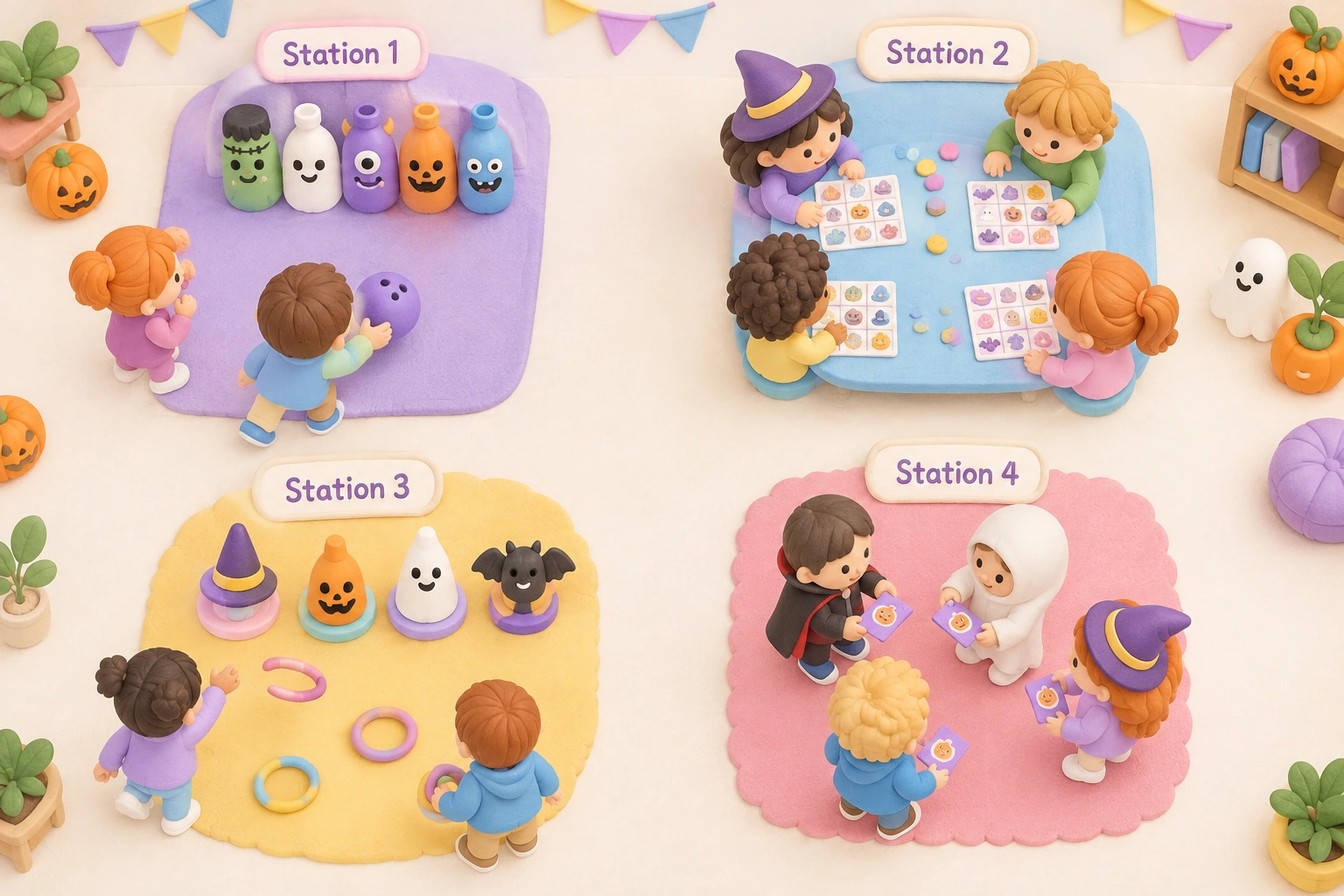
Effective station rotation for Halloween classroom games works best when each station has a clear visual instruction card so students can self-manage without constant teacher direction. Pair a high-energy station such as monster bowling or the pumpkin relay with a quieter station such as Halloween bingo or the word scramble to balance the room’s overall energy. Assign a parent volunteer or responsible student helper to each station if possible. Use a visible timer — projected on the board or a physical sand timer — so students know when to rotate without needing verbal reminders.
Sample 30-Minute Halloween Classroom Party Schedule
A focused 30-minute classroom party schedule helps teachers make the most of limited celebration time without losing instructional momentum. The following sequence balances active and quiet games and ends with a calming transition back to regular class routines.
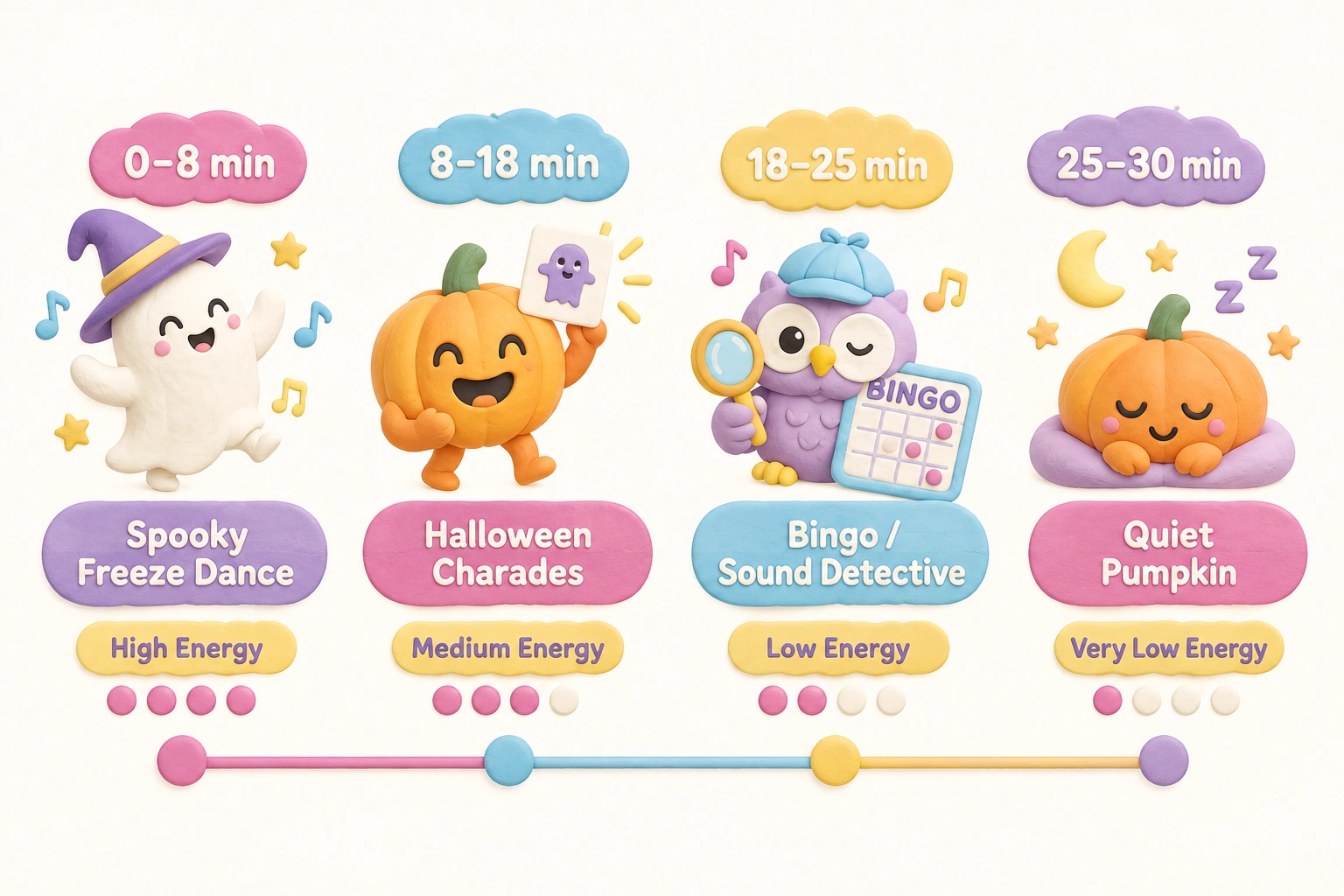
- 0–8 minutes: Spooky Freeze Dance (whole class, high energy, no prep)
- 8–18 minutes: Halloween Charades in two or three teams (medium energy, builds vocabulary)
- 18–25 minutes: Spooky Sound Detective or Halloween Bingo (low energy, seated, calming)
- 25–30 minutes: The Quiet Pumpkin (very low energy, transitions the room back to calm)
This schedule requires minimal supplies, no station setup, and can be run by a single teacher without parent volunteers. Adjust timing based on your class size and the energy level of your specific group on the day.
Tips for Managing Transitions Between Games
Transitions between Halloween classroom games are often where parties lose momentum or become chaotic. A few simple strategies can keep things running smoothly. First, announce the next game before ending the current one so students know what is coming and can mentally prepare. Second, use a consistent signal — a clap pattern, a countdown, or a short Halloween sound effect — to indicate that it is time to reset. Third, assign cleanup roles in advance: two students collect supplies, two students rearrange chairs, and the rest return to their seats. Keeping transition time under two minutes prevents the energy drift that makes it hard to re-engage students for the next activity.
For teachers running a station rotation, a visual rotation chart posted on the board eliminates confusion about which group goes where. Color-coded group cards that match colored station signs make the process nearly self-managing, even for younger elementary students.
Adapting Halloween Games for Small Classrooms
Not every elementary classroom has the floor space for a full relay race or a bowling lane. Most of the 15 Halloween classroom games listed here can be adapted for tight spaces with minor modifications. The mummy wrap relay works in the space between two rows of desks. Monster bowling can be set up on a single table using smaller bottles and a rolled-up sock as the ball. The pumpkin relay race becomes a desk-to-desk spoon balance challenge. Ghost hunt scavenger hunts work in any size room by hiding clues inside books, under chairs, or taped to the underside of desks. The key principle is to match the physical scale of the game to the available space rather than trying to force a large-space game into a small room.
Frequently Asked Questions
What are the best no-prep Halloween classroom games?
The best no-prep Halloween classroom games include the spooky freeze dance, haunted corners, the mummy wrap relay (requires only toilet paper), the pumpkin relay race, and the quiet pumpkin. These games need no printed materials, no advance setup, and no special supplies beyond items most classrooms already have.
How do I keep Halloween games inclusive for all students?
Use elimination-free formats wherever possible, particularly for K–2 students. Modify rules so that “eliminated” players take on a helper or judge role rather than sitting out entirely. Choose themes that are spooky-silly rather than frightening, and always check in advance for any sensory sensitivities or anxiety concerns that might affect individual students.
Can Halloween classroom games be educational?
Yes. Many Halloween classroom games naturally reinforce curriculum skills. Candy corn estimation supports math and measurement. Halloween bingo with vocabulary words supports literacy. The word scramble race reinforces spelling. The STEM pumpkin tower challenge builds engineering and collaborative problem-solving skills. Ghost hunt scavenger hunts can be designed around sight words, math facts, or reading comprehension clues.
How long should each Halloween classroom game last?
Most Halloween classroom games work best when kept to five to fifteen minutes each. Shorter games of five to eight minutes suit K–2 students whose attention spans are naturally briefer. Longer games of ten to fifteen minutes work well for grades 3–5, particularly for team-based games like charades or Pictionary. A 30-minute party can comfortably fit three to four games; a 45-minute party can accommodate four to six games or a full station rotation.
What supplies do I need for a Halloween classroom party?
Most of the games in this list require only dollar store items or classroom staples. A basic supply list for a well-rounded Halloween classroom party includes: toilet paper rolls (mummy wrap), a small plastic pumpkin bucket (relay race, quiet pumpkin), printed bingo cards and charades cards (free printables available online), a speaker and Halloween playlist (freeze dance, sound detective), and a clear jar with candy corn or tokens (estimation game). Total cost for supplies is typically under ten dollars when sourced from a dollar store.
Are these games suitable for kindergarten?
Several games on this list are well-suited to kindergarten, including Halloween bingo with picture cards, spooky freeze dance, haunted corners, spooky sound detective, and the quiet pumpkin. For kindergarten, prioritize elimination-free formats, keep game durations short (five to seven minutes), use visual instructions rather than lengthy verbal explanations, and choose themes that are clearly silly and friendly rather than spooky.
Making Your Halloween Classroom Party Work for Every Student
The most successful Halloween classroom games share a few common qualities: they are easy to explain in under a minute, they keep most or all students active at the same time, and they can be adjusted on the fly if a particular group needs more or less challenge. The 15 games in this guide cover the full elementary range from kindergarten through fifth grade, balance high-energy and low-energy formats, and include both no-prep options for last-minute planning and slightly more structured activities for teachers who want to incorporate curriculum connections.
When selecting games for your specific class, consider the group’s energy level on the day, the available space, any individual student needs, and how much time you realistically have. A shorter, well-run party with three great games will always be more enjoyable than an overpacked schedule where no single activity gets enough time to land properly. Start with one active whole-class game, move to a team or station game, and close with something calm that eases the transition back to regular learning. That simple structure — active, collaborative, calm — is the foundation of a Halloween classroom party that students will talk about long after October ends.

Take a short quiz to find out what your everyday choices say about your parenting style
When your child is curious about something new, what’s your instinct?
Take a short quiz to find out what your everyday choices say about your parenting style
“Can I download this app?” What happens next?
Take a short quiz to find out what your everyday choices say about your parenting style
When it comes to rules at home, which sounds most like you?
Take a short quiz to find out what your everyday choices say about your parenting style
If you could give your child one life skill today, what would you pick?
Take a short quiz to find out what your everyday choices say about your parenting style
Your child gets to choose what to watch. What would your ideal setup look like?
Take a short quiz to find out what your everyday choices say about your parenting style
Pick your parenting superpower ✨