15 Best Video Games for 12-Year-Olds: Adventure and Strategy

 Discover a Free Education Video App for Kids
Pastory uses AI to personalize educational video content based on your child’s interests and personality. Safe, engaging, and built for curious young minds. Sign up now to stay updated and enjoy early access with a free trial
Choosing the right video games for 12-year-olds means balancing genuine fun with age-appropriate content, meaningful challenge, and the kind of engagement that supports growing minds. At 12, children are entering a developmental stage marked by longer attention spans, stronger abstract reasoning, and a growing appetite for independence and competition — qualities that make adventure and strategy games particularly well-suited to this age group. This guide covers 15 carefully selected titles across both genres, with honest notes on ratings, platforms, online safety, and what parents should realistically expect.
Key Takeaways
- The best video games for 12-year-olds combine engaging gameplay with age-appropriate content, typically rated E10+ or T (Teen) by the ESRB or PEGI 12 by European standards.
- Adventure and strategy games can support problem-solving skills, critical thinking, and creative planning — though outcomes vary by child and depend on how gaming fits into a broader daily routine.
- Parental controls on Nintendo Switch, PlayStation, and Xbox allow families to manage screen time, restrict online chat, and limit in-game purchases without removing access to quality games.
- Free-to-play titles like Fortnite and Roblox carry different considerations than paid games, particularly around in-game purchases and online safety.
- A brief section at the end covers games parents may want to approach with caution, along with practical screen time guidance for tween gamers.
Why 12 Is a Particularly Good Age for Adventure and Strategy Games
Child development research consistently shows that the 10–14 age range is a period of significant growth in executive function — the set of cognitive skills that includes planning, flexible thinking, and impulse control. Strategy games, in particular, place direct demands on these emerging abilities by asking players to manage resources, anticipate consequences, and adapt plans when circumstances change. Adventure games complement this by rewarding exploration, narrative comprehension, and persistence through challenge. Neither genre is a guaranteed developmental tool, but when chosen thoughtfully, both can offer meaningful cognitive engagement that aligns with where 12-year-olds are developmentally.
At this age, children are also developing a stronger sense of identity and social belonging. Multiplayer co-op games can support teamwork and communication, while single-player story-driven titles offer a safe space to explore complex themes like courage, consequence, and moral choice. The key for parents is matching the game’s content maturity to the child’s actual readiness — not just their age on paper.
How to Read Age Ratings: ESRB, PEGI, and Common Sense Media
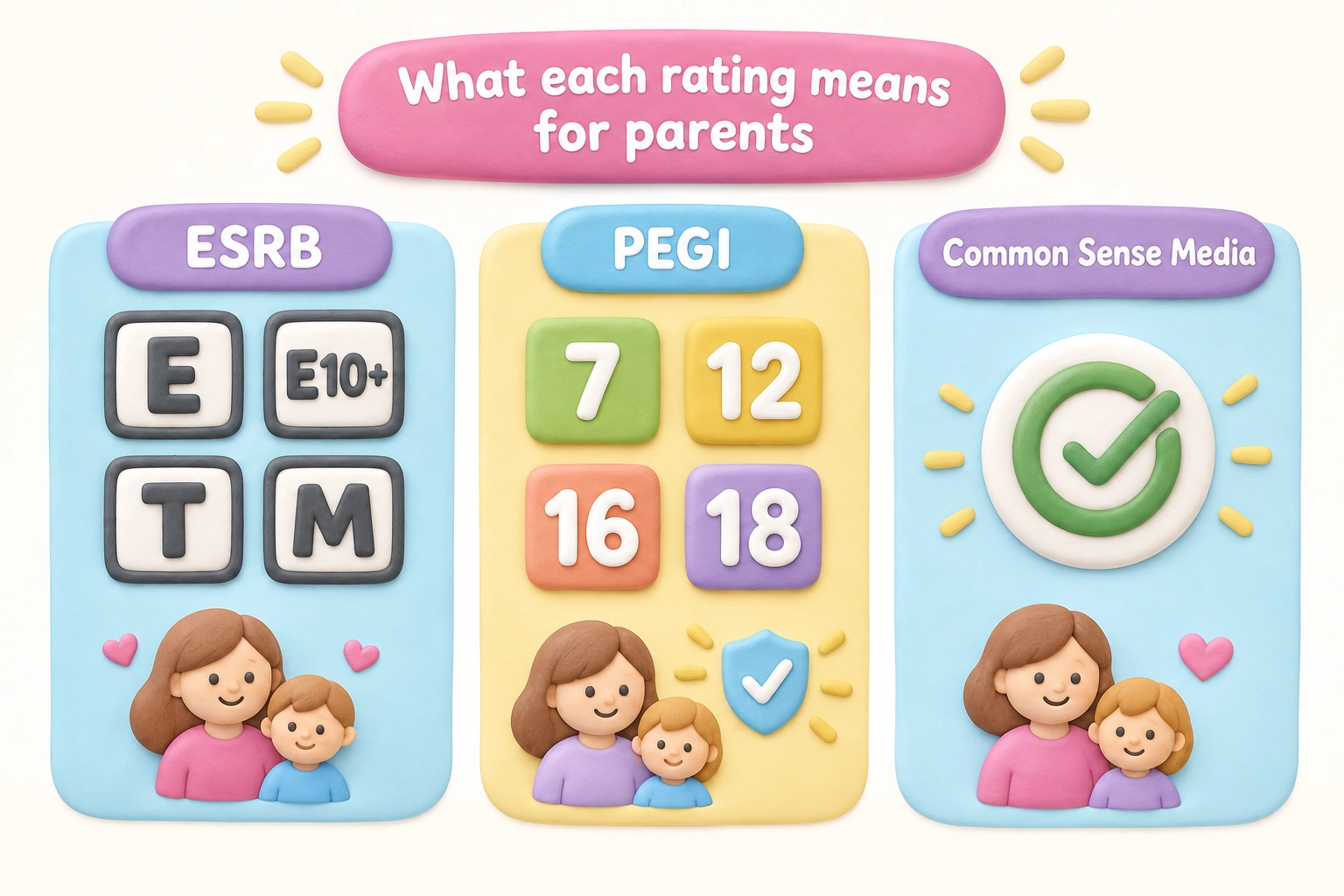
Every game in this list includes an age rating. In North America, the ESRB (Entertainment Software Rating Board) uses categories including E (Everyone), E10+ (Everyone 10 and older), T (Teen, 13+), and M (Mature, 17+). In Europe and many other regions, PEGI ratings apply: PEGI 7, PEGI 12, PEGI 16, and PEGI 18. A PEGI 12 rating indicates content that may include mild violence, slightly frightening scenes, or mild language — broadly comparable to an ESRB T rating, though the two systems are not identical.
Common Sense Media provides independent, parent-focused reviews that go beyond the official rating to describe specific content concerns such as fantasy violence, online interaction risks, and in-game purchases. For any game your 12-year-old is interested in, checking the Common Sense Media rating alongside the official ESRB or PEGI rating gives a more complete picture. Content descriptors such as “Users Interact” (meaning players can communicate with strangers online) and “In-Game Purchases” are particularly worth noting for tween gamers.
15 Best Video Games for 12-Year-Olds
1. The Legend of Zelda: Tears of the Kingdom (Nintendo Switch)
Tears of the Kingdom is one of the most celebrated open-world adventure games available on Nintendo Switch. Players explore a vast version of Hyrule, solve environmental puzzles, and build contraptions using a physics-based crafting system. The game rewards creative thinking and patience, and its difficulty scales in a way that suits both experienced and newer players. ESRB rating: E10+ (Fantasy Violence, Mild Suggestive Themes). No online multiplayer; no in-game purchases. This is a single-player experience with exceptional replay value and a campaign that can last 60–100 hours depending on how thoroughly a player explores.
2. Minecraft (Nintendo Switch, PS5, Xbox, PC)
Minecraft remains one of the most versatile sandbox games available for tween gamers. Its creative mode encourages open-ended building and spatial reasoning, while survival mode introduces resource management, planning, and problem-solving under pressure. The game is cross-platform and supports both local co-op and online multiplayer. ESRB rating: E10+ (Fantasy Violence). Parents should be aware that online servers can expose children to other players; enabling parental controls and using curated Realms (private servers) is recommended. In-game purchases exist through the Marketplace but are not required to enjoy the core game.
3. Pokémon Scarlet and Violet (Nintendo Switch)
Pokémon Scarlet and Violet introduced an open-world structure to the long-running Pokémon series, allowing players to explore freely and tackle story objectives in any order. The turn-based battle system builds strategic thinking, and the game’s social features allow trading and battling with friends. ESRB rating: E (Mild Fantasy Violence). The game is well-suited to 12-year-olds who enjoy role-playing games with a lighter tone, and it supports both solo play and online interaction with friends. No aggressive monetization in the base game.
4. Sid Meier’s Civilization VI (PC, Nintendo Switch, PS4, Xbox One)
Civilization VI is a turn-based strategy game in which players guide a civilization from ancient times through the modern era, managing diplomacy, science, culture, and military power. For 12-year-olds with an interest in history or strategy, it offers genuinely deep engagement with concepts like resource management, long-term planning, and cause-and-effect thinking. ESRB rating: E10+ (Mild Violence, Mild Language). The game has no online chat in its base form and no aggressive in-game purchases, making it one of the safer strategy options for this age group. It does have a learning curve, so it suits children who already enjoy strategy or board games.
5. Splatoon 3 (Nintendo Switch)
Splatoon 3 is a team-based action game in which players compete to cover the most territory with ink rather than eliminate opponents. This design makes it one of the most age-appropriate competitive multiplayer games available, with cartoon violence and no realistic combat. ESRB rating: E10+ (Cartoon Violence). The game supports online multiplayer and local co-op, and Nintendo’s online infrastructure includes robust parental controls. There are in-game cosmetic purchases, but the core competitive experience is fully accessible without spending extra money.
6. It Takes Two (PS4/PS5, Xbox, PC)
It Takes Two is a co-op action-adventure game designed to be played by exactly two players, making it an excellent choice for a parent and child or two siblings to enjoy together. Each level introduces a completely new gameplay mechanic, keeping the experience fresh and encouraging communication and coordination. ESRB rating: T (Fantasy Violence, Mild Language, Suggestive Themes). The game’s story involves adult themes of divorce and relationship repair, which may prompt useful conversations. No online multiplayer is required; it can be played locally or via online co-op. No in-game purchases.
7. Ratchet and Clank: Rift Apart (PS5)
Rift Apart is a visually stunning action-adventure platformer exclusive to PlayStation 5. Players switch between two characters across dimension-hopping worlds, using creative weapons and gadgets to solve puzzles and defeat enemies. The game’s tone is humorous and family-friendly, with a story that emphasizes friendship and resilience. ESRB rating: E10+ (Cartoon Violence, Mild Language). It is a single-player experience with no in-game purchases and strong replay value for completionists. The PS5’s haptic feedback and adaptive triggers add a tactile dimension that many 12-year-olds find engaging.
8. Kirby and the Forgotten Land (Nintendo Switch)
Kirby and the Forgotten Land is a 3D platformer with a post-apocalyptic setting rendered in a cheerful, colorful style. Players absorb enemy abilities to solve puzzles and progress through levels, with a two-player local co-op option. ESRB rating: E10+ (Cartoon Violence). While the game is accessible enough for younger children, its later stages offer genuine challenge that keeps 12-year-olds engaged. It is a paid title with no in-game purchases and no online multiplayer, making it a straightforward, low-risk choice for parents.
9. Stardew Valley (PC, Nintendo Switch, PS4, Xbox, Mobile)
Stardew Valley is a farming and life simulation game in which players restore a neglected farm, build relationships with townspeople, and explore mines for resources. Its open-ended structure rewards patience and long-term planning, and the game’s gentle pace makes it a useful counterbalance to more intense competitive titles. ESRB rating: E10+ (Mild Violence, Mild Language, Simulated Gambling). The game supports up to four-player online co-op. It is a paid title with no in-game purchases and is available across nearly every platform, including mobile, at a relatively low price point.
10. Super Mario Odyssey (Nintendo Switch)
Super Mario Odyssey is a 3D platformer that sends Mario through a series of diverse kingdoms, each filled with creative challenges and hidden collectibles. The game’s design encourages exploration and experimentation, and its difficulty is well-calibrated for players of varying experience levels. ESRB rating: E10+ (Cartoon Violence, Comic Mischief). It supports two-player local co-op in a limited form. There are no in-game purchases, and the game’s replay value is high for players who enjoy collecting every Power Moon. It remains one of the strongest Nintendo Switch games for 12-year-olds who enjoy platformers.
11. Terraria (PC, Nintendo Switch, PS4, Xbox, Mobile)
Terraria is a 2D sandbox game that blends exploration, crafting, and combat in a procedurally generated world. Players dig, build, and fight their way through progressively harder boss encounters, with a depth of content that rivals much larger games. ESRB rating: E10+ (Fantasy Violence, Mild Blood). The game supports local and online multiplayer and is available on most platforms at a low price. Its combination of creative freedom and structured progression makes it particularly appealing to 12-year-olds who enjoy both Minecraft-style building and action-oriented challenge.
12. Overcooked 2 (Nintendo Switch, PS4, Xbox, PC)
Overcooked 2 is a cooperative cooking game in which teams of up to four players work together to prepare and serve meals in increasingly chaotic kitchens. The game is an excellent choice for family play because it demands communication, task division, and quick thinking under pressure. ESRB rating: E (Comic Mischief). It supports both local and online co-op. There are no in-game purchases. While the game is accessible to younger children, its later levels are genuinely difficult and provide real challenge for 12-year-olds playing with friends or family.
13. Immortals Fenyx Rising (PS4/PS5, Xbox, Nintendo Switch, PC)
Immortals Fenyx Rising is an open-world action-adventure game set in a world inspired by Greek mythology. Players solve puzzles, battle mythological creatures, and explore a colorful landscape while uncovering a story told with humor and warmth. ESRB rating: T (Fantasy Violence, Mild Language, Mild Suggestive Themes). The game draws frequent comparisons to Breath of the Wild in its structure and is a strong alternative for players who have already completed that title. It is a paid single-player experience with optional DLC but no aggressive in-game monetization in the base game.
14. Rocket League (PS4/PS5, Xbox, Nintendo Switch, PC)
Rocket League combines soccer with rocket-powered cars in a competitive multiplayer format that is easy to learn but takes considerable skill to master. The game’s physics-based mechanics reward practice and spatial reasoning, and its competitive ranking system gives motivated 12-year-olds a clear sense of progression. ESRB rating: E (No Descriptors). The game is free-to-play and supports online multiplayer and local split-screen. Parents should be aware that the game includes a text and voice chat system; these can be disabled through parental controls. Cosmetic in-game purchases are present but do not affect gameplay.
15. Tchia (PS4/PS5, PC)
Tchia is an open-world adventure game inspired by the culture and landscape of New Caledonia, a French archipelago in the Pacific. Players can inhabit animals and objects, sail, climb, and explore a richly detailed world accompanied by an original soundtrack. ESRB rating: T (Fantasy Violence, Mild Language). The game is a single-player experience with no in-game purchases and no online multiplayer. Its cultural specificity and gentle tone make it a distinctive choice for 12-year-olds who enjoy exploration-focused games with a strong sense of place and story.
Quick Reference: Ratings and Platform Overview
| Game | ESRB Rating | Platform(s) | Multiplayer | In-Game Purchases |
|---|---|---|---|---|
| Zelda: Tears of the Kingdom | E10+ | Switch | No | No |
| Minecraft | E10+ | Switch, PS5, Xbox, PC | Yes (online + local) | Optional |
| Pokémon Scarlet/Violet | E | Switch | Yes (online) | No |
| Civilization VI | E10+ | PC, Switch, PS4, Xbox | Yes (online) | Optional DLC |
| Splatoon 3 | E10+ | Switch | Yes (online + local) | Cosmetic only |
| It Takes Two | T | PS4/5, Xbox, PC | Co-op only | No |
| Ratchet and Clank: Rift Apart | E10+ | PS5 | No | No |
| Kirby: Forgotten Land | E10+ | Switch | Local co-op | No |
| Stardew Valley | E10+ | PC, Switch, PS4, Xbox, Mobile | Yes (online) | No |
| Super Mario Odyssey | E10+ | Switch | Limited local | No |
| Terraria | E10+ | PC, Switch, PS4, Xbox, Mobile | Yes (online + local) | No |
| Overcooked 2 | E | Switch, PS4, Xbox, PC | Yes (online + local) | No |
| Immortals Fenyx Rising | T | PS4/5, Xbox, Switch, PC | No | Optional DLC |
| Rocket League | E | PS4/5, Xbox, Switch, PC | Yes (online + local) | Cosmetic only |
| Tchia | T | PS4/5, PC | No | No |
Games to Approach With Caution
A few titles frequently come up in conversations about gaming for this age group but deserve a more careful look before purchasing. Call of Duty and similar military shooters carry an ESRB M (Mature 17+) rating for realistic violence, strong language, and online interaction with adult players. These ratings exist for meaningful reasons, and most child development professionals recommend against M-rated games for 12-year-olds regardless of how mature a particular child may seem. The online environments in these games are largely unmoderated and expose children to adult language, aggressive behavior, and potentially distressing content.
Fortnite and Roblox occupy a more nuanced middle ground. Both are free-to-play and rated T and E10+ respectively, but both involve open online interaction with strangers and contain in-game purchase systems that can be difficult for children to self-regulate. If your 12-year-old plays either title, enabling parental controls, setting spending limits, and discussing online safety expectations beforehand are strongly recommended steps rather than optional ones.
Online Safety and Parental Controls: A Practical Overview
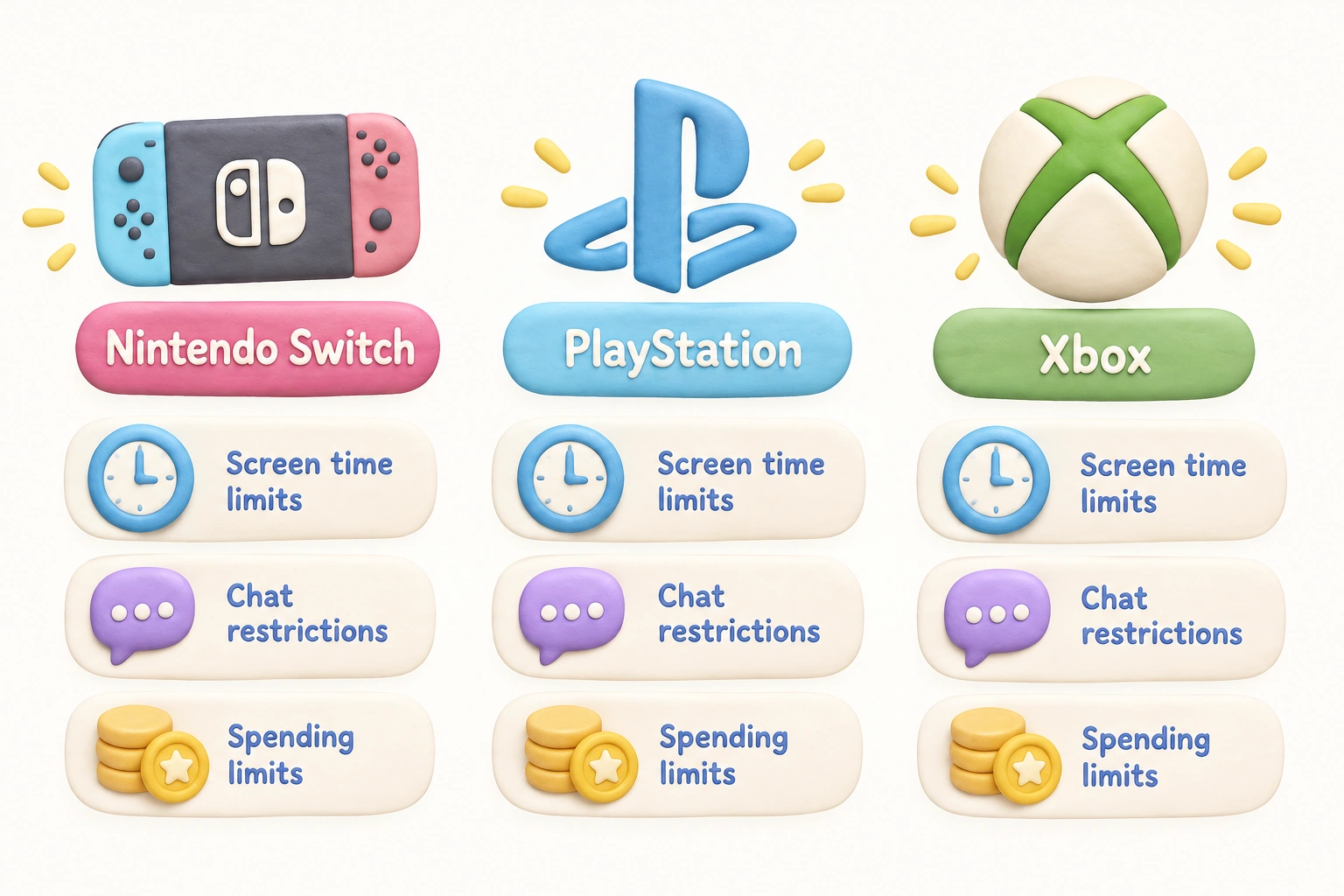
Every major gaming platform offers parental control tools that allow families to manage screen time, restrict online communication, and limit or block in-game purchases. On Nintendo Switch, the Nintendo Switch Parental Controls app provides granular control over play time, communication settings, and content age restrictions. PlayStation’s Family Management system allows parents to set spending limits and restrict online features per child account. Xbox Family Settings offers similar functionality through a dedicated app. Setting these controls up before handing over a device is significantly easier than trying to restrict access after a child has already established habits.
For games with voice chat or text chat — including Minecraft, Rocket League, and Splatoon 3 — it is worth discussing online safety expectations with your child directly. Conversations about not sharing personal information, recognizing inappropriate behavior, and knowing when to report or block another player are more effective when they happen before an incident rather than after. The ESRB content descriptor “Users Interact” on a game’s packaging or store page is a reliable signal that online communication with strangers is possible.
Screen Time Guidance for Tween Gamers
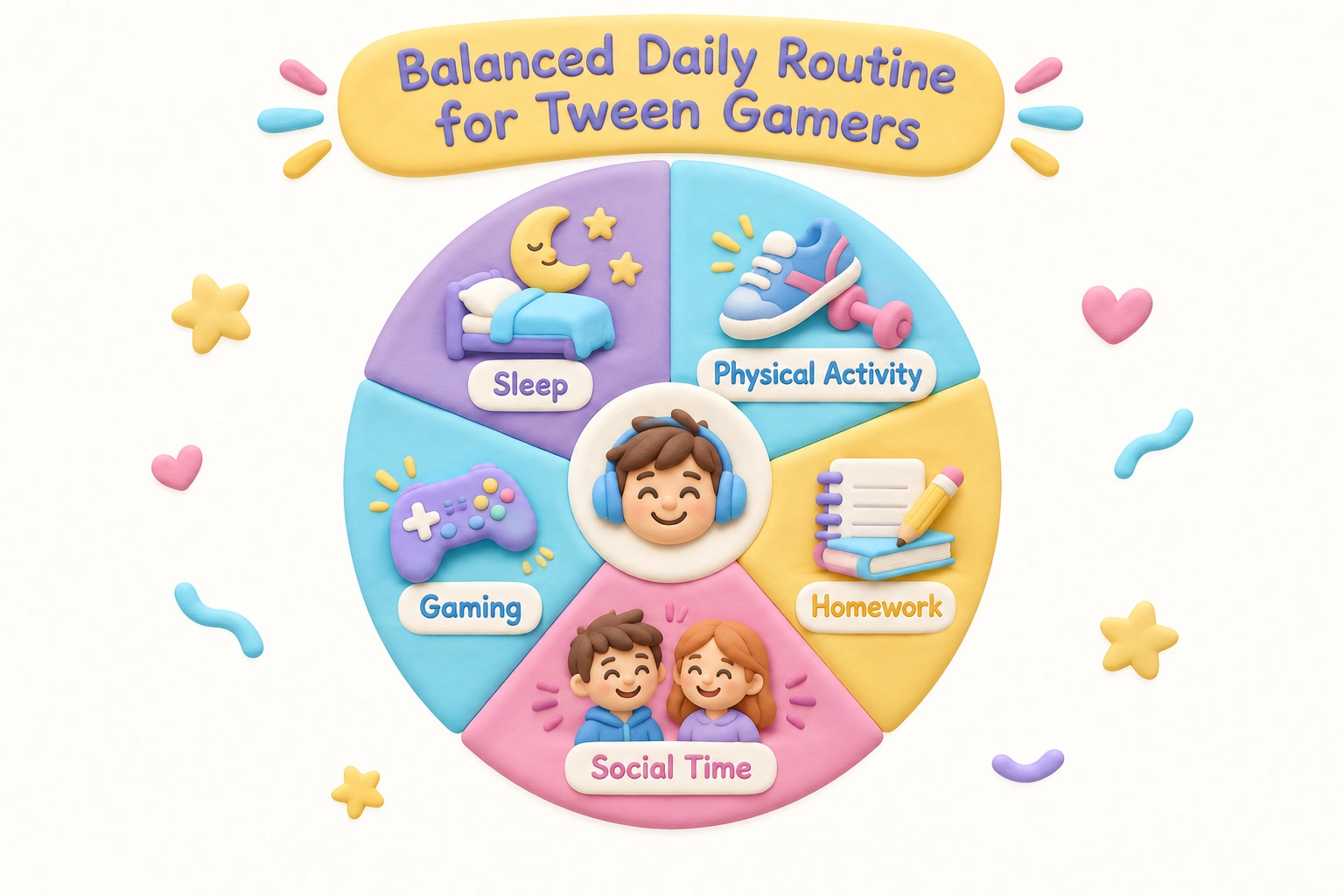
The American Academy of Pediatrics (AAP) moved away from strict hour-based screen time limits for children over six, instead recommending that families prioritize consistent sleep, physical activity, homework, and face-to-face social time — and that screen time fit around these rather than replace them. For most 12-year-olds, this means gaming works best in defined sessions with clear start and end times, rather than open-ended play. Many parents find that 45–90 minute sessions on school days and longer weekend sessions work reasonably well, though the right balance depends on the individual child’s other commitments and temperament.
Strategy games like Civilization VI and adventure games with long campaign modes can make session limits feel abrupt, since these games do not always have natural stopping points. Discussing save points and agreeing on stopping conditions in advance — rather than interrupting mid-mission — tends to reduce conflict and helps children develop self-regulation skills around gaming. Using the platform’s built-in screen time tools to send a 10-minute warning before a session ends is a practical approach many families find helpful.
Free-to-Play vs. Paid Games: What Parents Should Know
Several popular games for this age group are free to download but generate revenue through in-game purchases. Fortnite, Roblox, and Rocket League all use this model. In each case, the core gameplay is genuinely free, but cosmetic items, battle passes, and virtual currencies create ongoing spending pressure that can be difficult for 12-year-olds to manage independently. Setting a clear monthly spending limit through the platform’s parental controls — or agreeing on a fixed allowance for in-game spending — gives children some autonomy while preventing unexpected charges.
Paid games like Zelda: Tears of the Kingdom, Stardew Valley, and Terraria involve a one-time purchase with no ongoing monetization pressure. For parents who prefer a simpler financial arrangement, these titles offer better value over time and remove the social pressure that can accompany cosmetic-driven free-to-play games. Optional DLC (downloadable content) exists for some paid titles, but it is generally not required to enjoy the complete core experience.
Frequently Asked Questions
What ESRB rating is appropriate for a 12-year-old?
Games rated E (Everyone), E10+ (Everyone 10 and older), and T (Teen, 13+) are generally considered age-appropriate for 12-year-olds, though T-rated games may include mild violence, suggestive themes, or language that some families prefer to preview first. M-rated games are intended for players 17 and older and are not recommended for this age group by most child development guidance.
Is Minecraft appropriate for a 12-year-old?
Yes. Minecraft carries an ESRB E10+ rating and is widely considered one of the most age-appropriate and developmentally rich games available for tween gamers. Parents should configure online settings carefully if their child plays on public servers, and the game’s Marketplace does include optional in-game purchases. Using a private Realm with known friends significantly reduces online safety concerns.
Are strategy games good for 12-year-olds’ development?
Strategy games can support the development of planning, critical thinking, and resource management skills that align with the cognitive growth typical of this age group. However, outcomes vary by child, and the developmental benefit depends on how the game fits into a balanced routine that includes physical activity, social interaction, and adequate sleep. Strategy games are not a substitute for other forms of learning but can be a meaningful complement to them.
How do I set up parental controls for gaming?
Each platform has its own system. Nintendo Switch uses the Nintendo Switch Parental Controls app (available on iOS and Android) to set play time limits, restrict online features, and filter content by age rating. PlayStation uses Family Management through a PSN account. Xbox uses the Xbox Family Settings app. Setting up a child account rather than sharing an adult account gives parents the most control and keeps the child’s data separate.
What is the difference between ESRB and PEGI ratings?
ESRB ratings are used in North America, while PEGI ratings are used in Europe and many other regions. A PEGI 12 rating broadly corresponds to content suitable for ages 12 and above, similar to an ESRB T rating, though the two systems use different criteria and are not directly interchangeable. Both systems include content descriptors that explain why a particular rating was assigned, which is often more useful than the rating number alone.
Which games on this list are free to play?
Rocket League and Fortnite are free to download and play. Roblox is also free, though it is not included in this specific list. All three use in-game purchase systems for cosmetics or virtual currency. All other games on this list require a one-time purchase, with some offering optional paid DLC.
Choosing the Right Games for Your 12-Year-Old
The 15 games in this guide represent a range of genres, platforms, and price points, but no single title will be the right fit for every child. A 12-year-old who enjoys history and board games may find Civilization VI deeply engaging, while one who prefers fast-paced action and social play may gravitate toward Splatoon 3 or Rocket League. Starting with a game that matches your child’s existing interests and experience level — rather than the most popular title among their peers — tends to produce a more positive and sustainable gaming experience.
For parents who are new to gaming or uncertain about a specific title, checking the Common Sense Media rating alongside the official ESRB or PEGI rating provides a reliable, parent-focused perspective. Setting up parental controls before play begins, agreeing on session lengths in advance, and keeping communication open about what your child is playing and who they are playing with are the most practical steps any family can take to make gaming a positive part of a 12-year-old’s life rather than a source of conflict or concern.

Take a short quiz to find out what your everyday choices say about your parenting style
When your child is curious about something new, what’s your instinct?
Take a short quiz to find out what your everyday choices say about your parenting style
“Can I download this app?” What happens next?
Take a short quiz to find out what your everyday choices say about your parenting style
When it comes to rules at home, which sounds most like you?
Take a short quiz to find out what your everyday choices say about your parenting style
If you could give your child one life skill today, what would you pick?
Take a short quiz to find out what your everyday choices say about your parenting style
Your child gets to choose what to watch. What would your ideal setup look like?
Take a short quiz to find out what your everyday choices say about your parenting style
Pick your parenting superpower ✨