12 Best Video Games for 7-Year-Olds: Family-Friendly Picks

 Discover a Free Education Video App for Kids
Pastory uses AI to personalize educational video content based on your child’s interests and personality. Safe, engaging, and built for curious young minds. Sign up now to stay updated and enjoy early access with a free trial
Choosing video games for a 7-year-old involves more than picking something colorful off a shelf. At this age, children are developing problem-solving skills, learning to manage frustration, and beginning to enjoy cooperative experiences with family and friends. The right game can support those skills in a genuinely enjoyable way — but not every title marketed to children is equally appropriate, and the sheer number of options can feel overwhelming. This guide covers 12 of the best family-friendly video games for 7-year-olds, explains what makes each one suitable, and gives parents the practical information they need to make a confident choice.
Key Takeaways
- Games rated E for Everyone or PEGI 7 are generally the most appropriate starting point for 7-year-olds, though content descriptors matter as much as the overall rating.
- The Nintendo Switch remains the most child-friendly platform for this age group, but strong options exist on PlayStation, Xbox, and PC as well.
- Co-op and local multiplayer games offer meaningful opportunities for family play and can support social development alongside screen time.
- Features like adjustable difficulty, no fail states, and simple controls significantly reduce frustration for early-primary-age children.
- Parental controls on every major platform allow families to set screen time limits, restrict online chat, and manage in-game purchases independently of game ratings.
What Makes a Game Right for a 7-Year-Old?
Seven-year-olds are in what developmental psychologists often call the early concrete operational stage. They can follow multi-step instructions, understand basic cause and effect, and are beginning to enjoy rule-based play with peers. However, reading fluency varies considerably at this age, fine motor control is still developing, and emotional regulation — particularly around losing or failing — is a work in progress. These factors directly shape which games are genuinely enjoyable rather than frustrating.
When evaluating age-appropriate games for this group, look for a gentle learning curve that introduces mechanics gradually rather than front-loading complexity. Games with adjustable difficulty, generous checkpoints, or no fail states at all tend to produce longer, calmer play sessions. Bright, readable graphics and simple controls reduce the cognitive load of just operating the game, freeing children to focus on the creative or problem-solving elements. Cooperative play options are a particular bonus: research in child development consistently links collaborative play to improved communication skills and perspective-taking, and co-op games give parents a natural reason to sit alongside their child.
On the content side, the ESRB rating system used in North America and the PEGI system used in Europe and the UK are both useful starting points. An E for Everyone ESRB rating or a PEGI 3 or PEGI 7 label indicates the content has been reviewed for age-appropriateness. However, ratings alone do not capture everything: a game rated E may still include in-game purchases, online chat features, or reading-heavy menus that affect real-world suitability for a specific child. Always check the content descriptors listed beneath the main rating.
Understanding ESRB and PEGI Ratings for Parents
The ESRB and PEGI systems use different scales, which can cause confusion — particularly for families who buy games from international retailers or use both North American and European platforms. The ESRB’s E for Everyone rating covers content suitable for all ages, while E10+ indicates content that may be more appropriate from age 10 onward. PEGI 7 is broadly comparable to E for Everyone, though the two systems do not map perfectly onto each other.
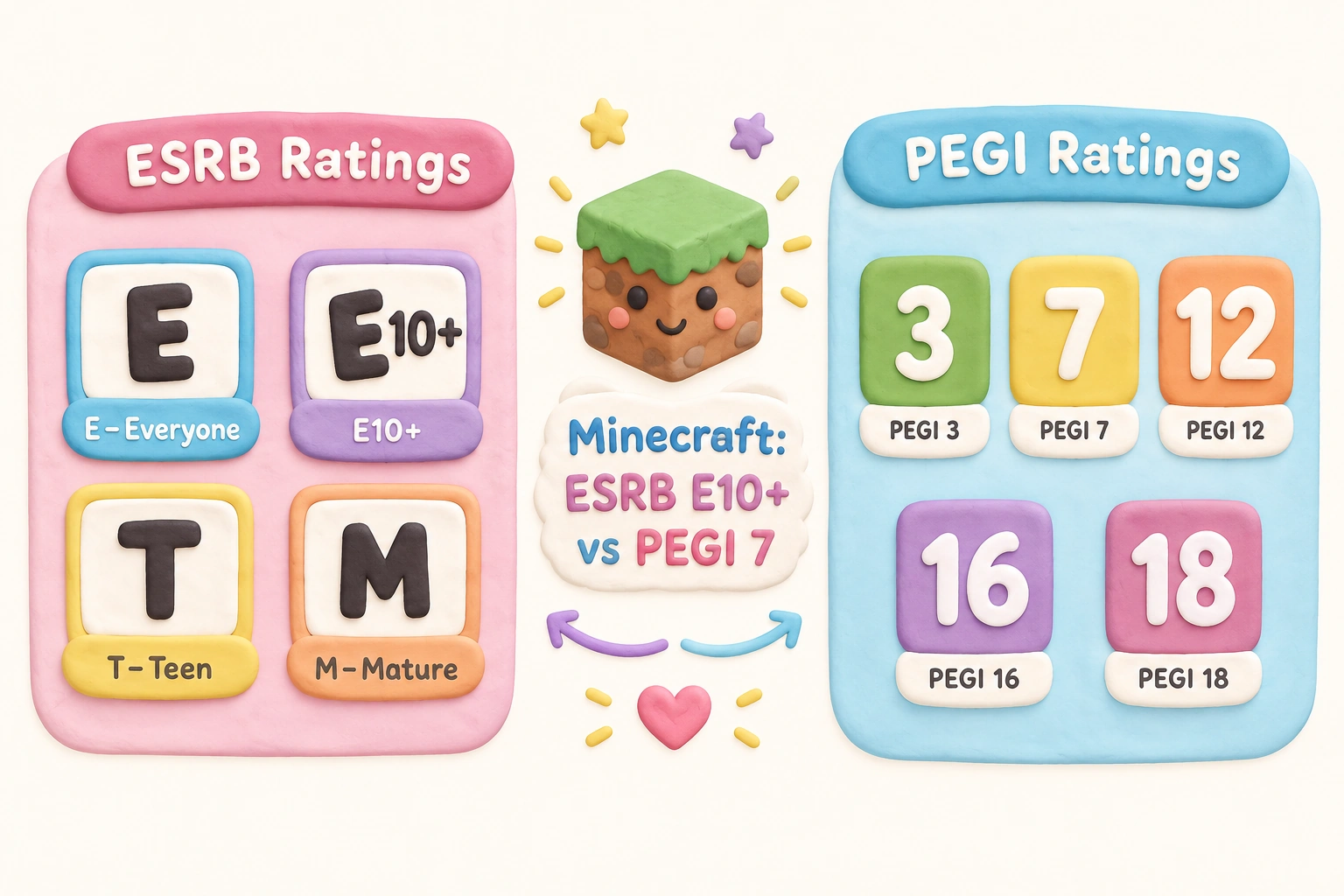
A notable example of this discrepancy is Minecraft. In North America, Minecraft carries an ESRB rating of E10+, partly because of mild fantasy violence and the complexity of online interactions. In Europe, the same game is rated PEGI 7. This does not mean one rating is wrong — the two bodies apply different criteria. What it means practically is that parents should treat ratings as a starting point and read the accompanying content descriptors, which flag specific elements such as Fantasy Violence, In-Game Purchases, or Online Interactions. Common Sense Media, an independent nonprofit, provides supplementary reviews that many parents find helpful alongside official ratings.
The 12 Best Video Games for 7-Year-Olds
1. Mario Kart 8 Deluxe (Nintendo Switch)
Mario Kart 8 Deluxe is one of the most consistently recommended Nintendo Switch games for kids, and for good reason. The racing mechanics are immediately understandable, and the optional Smart Steering and Auto-Accelerate features allow younger or less experienced players to participate without constant frustration. Local multiplayer supports up to four players on a single console, making it an excellent choice for family play sessions. The game carries an E for Everyone ESRB rating with no content concerns beyond mild cartoon action. Session length is naturally self-regulating: a single Grand Prix cup takes roughly 15–20 minutes, which aligns well with recommended screen time intervals for this age group. What parents should know: Online play is available but can be restricted through Nintendo Switch parental controls. No in-game purchases are required to access the full game.
2. Super Mario Bros. Wonder (Nintendo Switch)
Super Mario Bros. Wonder is a side-scrolling platformer that introduces inventive level mechanics through its Wonder Flower system, keeping gameplay fresh without dramatically increasing difficulty. The game supports up to four players simultaneously in cooperative play, and crucially, players cannot eliminate each other — a feature that significantly reduces sibling conflict during shared sessions. The difficulty curve is gentle enough for a 7-year-old playing independently, while the creative level design offers enough variety to hold the interest of older family members playing alongside. ESRB rating: E for Everyone. What parents should know: No online chat, no in-game purchases. One of the most frustration-free co-op experiences currently available on Switch.
3. Minecraft (Nintendo Switch, PlayStation, Xbox, PC)
Minecraft remains the most widely cited sandbox game for children, and its Creative Mode — which removes resource gathering, enemies, and survival pressure entirely — makes it genuinely accessible to 7-year-olds. In Creative Mode, children can build freely, experiment with structures, and express imaginative ideas without any fail states. The game may support spatial reasoning and creative thinking, though individual outcomes vary considerably. ESRB rating: E10+ (PEGI 7 in Europe). What parents should know: The online multiplayer environment carries real risks, including exposure to strangers and unmoderated chat. Enabling Peaceful Mode in Survival or restricting play to Creative Mode offline significantly reduces these concerns. In-game purchases exist through the Minecraft Marketplace; spending limits should be set through platform parental controls before a child plays independently.
4. LEGO Star Wars: The Skywalker Saga (Nintendo Switch, PlayStation, Xbox, PC)
The LEGO game series has long been a reliable choice for family-friendly video games, and The Skywalker Saga is among the most polished entries. It covers all nine mainline Star Wars films in a humorous, accessible format, with simple controls and a forgiving checkpoint system that prevents significant progress loss. The game features local co-op for two players and is rated E10+ for mild cartoon violence — the LEGO aesthetic keeps all action lighthearted. What parents should know: The game is content-rich and can occupy children for many hours, which makes it useful for managing session variety. Some menus involve reading, which may require occasional adult support for younger 7-year-olds. No online multiplayer means no chat risks.
5. Kirby and the Forgotten Land (Nintendo Switch)
Kirby and the Forgotten Land is a 3D platformer designed with accessibility at its core. Kirby’s copy ability mechanic — absorbing enemy powers — is intuitive and rewarding, and the game includes a two-player cooperative mode where a second player controls a helper character. The difficulty is low enough that most 7-year-olds can progress independently, while the imaginative environments and boss designs provide genuine engagement. ESRB rating: E for Everyone. What parents should know: No in-game purchases, no online chat. Session chapters are relatively short, making it easy to establish natural stopping points — a practical advantage for screen time management.
6. Animal Crossing: New Horizons (Nintendo Switch)
Animal Crossing: New Horizons is a cozy, open-ended life simulation game in which players develop a deserted island community at their own pace. There are no enemies, no fail states, and no time pressure — the game runs on a real-time clock, naturally encouraging short daily sessions rather than extended play. The game may support planning skills, creativity, and a sense of responsibility through its gentle task structure. ESRB rating: E for Everyone. What parents should know: Online visiting features allow players to visit other players’ islands; this can be restricted to friends-only or disabled entirely through Nintendo Switch parental controls. The game’s real-time structure means children may want to check in daily, so discussing expectations around session frequency is worthwhile.
7. Overcooked 2 (Nintendo Switch, PlayStation, Xbox, PC)
Overcooked 2 is a cooperative cooking game in which players work together to prepare and serve meals under time pressure. It is one of the most effective co-op games for kids in terms of encouraging genuine teamwork, communication, and task division — skills that align directly with early social development goals. The game supports two to four players locally and is rated E for Everyone. What parents should know: Overcooked 2 can become genuinely stressful at higher difficulty levels, and some 7-year-olds may find the time pressure frustrating. Starting on easier levels and framing the experience as collaborative rather than competitive helps considerably. This is one of the best games for parents who want to play actively with their child rather than supervise from a distance.
8. Pokémon: Let’s Go, Pikachu! / Let’s Go, Eevee! (Nintendo Switch)
The Pokémon: Let’s Go titles offer a gentler entry point into the Pokémon series than the mainline games, with simplified catching mechanics and a more linear structure. The games involve a moderate amount of reading, which can actually support literacy development for children who are progressing readers — though younger or less confident readers may need occasional adult support with menus and dialogue. ESRB rating: E for Everyone. What parents should know: Two-player cooperative play is available, with a second player joining by shaking a second Joy-Con. No online chat is required to enjoy the core game. The games do not include in-game purchases beyond the base title.
9. Sackboy: A Big Adventure (PlayStation 4, PlayStation 5)
Sackboy: A Big Adventure is a platformer exclusive to PlayStation consoles that features charming handcrafted visuals and a cooperative mode for up to four players. The game’s difficulty is well-calibrated for early primary-age children, with generous checkpoints and a visual style that avoids any content concerns. ESRB rating: E for Everyone. What parents should know: This is one of the strongest options for families on PlayStation who want a family-friendly alternative to Nintendo’s lineup. No in-game purchases are required, and there is no online chat in the cooperative mode. The game is a particularly good choice for families with multiple children who want to play together on a single console.
10. Rayman Legends (Nintendo Switch, PlayStation, Xbox, PC)
Rayman Legends is a 2D platformer with exceptionally polished level design, vibrant visuals, and a cooperative mode for up to four players. The game includes music-based levels that synchronize platforming challenges to rhythm, which many children find particularly engaging. ESRB rating: E10+ for mild cartoon violence. What parents should know: Some later levels increase in difficulty significantly, which may frustrate younger players. However, the early and mid-game content is well-suited to 7-year-olds, and the game’s generous checkpoint system prevents excessive repetition. No online multiplayer means no associated safety concerns.
11. Super Mario Party Jamboree (Nintendo Switch)
Super Mario Party Jamboree is a digital board game featuring minigames, and it is one of the most accessible multiplayer experiences available for mixed-age family groups. Individual minigames last between one and three minutes, making it easy to play in short bursts and to involve family members of varying gaming experience. ESRB rating: E for Everyone. What parents should know: The competitive nature of board game play can occasionally cause frustration for children who are still developing emotional regulation around losing. Framing sessions around participation rather than winning, and keeping early sessions short, helps manage this. Online play is available but can be disabled through parental controls.
12. Bluey: The Videogame (Nintendo Switch, PlayStation, Xbox, PC)
Bluey: The Videogame is based on the popular children’s animated series and is specifically designed for younger players. The game features simple controls, cooperative play for up to four players, and content drawn directly from the show’s episodes. It is one of the most genuinely non-violent, low-frustration options on this list. ESRB rating: E for Everyone. What parents should know: The game is relatively short compared to other titles on this list, which makes it better suited as an introductory gaming experience or a complement to other games rather than a primary long-term option. It is an excellent first game for a child who is new to video games entirely, particularly if they are already fans of the show.
Quick Comparison: Key Details at a Glance
| Game | Platform(s) | ESRB Rating | Co-op? | Solo-Friendly? | In-Game Purchases? |
|---|---|---|---|---|---|
| Mario Kart 8 Deluxe | Switch | E | Yes (up to 4) | Yes | No |
| Super Mario Bros. Wonder | Switch | E | Yes (up to 4) | Yes | No |
| Minecraft | Switch, PS, Xbox, PC | E10+ | Yes | Yes | Yes (optional) |
| LEGO Star Wars: Skywalker Saga | Switch, PS, Xbox, PC | E10+ | Yes (2 players) | Yes | No |
| Kirby and the Forgotten Land | Switch | E | Yes (2 players) | Yes | No |
| Animal Crossing: New Horizons | Switch | E | Yes (online) | Yes | No |
| Overcooked 2 | Switch, PS, Xbox, PC | E | Yes (up to 4) | Limited | No |
| Pokémon: Let’s Go | Switch | E | Yes (2 players) | Yes | No |
| Sackboy: A Big Adventure | PS4, PS5 | E | Yes (up to 4) | Yes | No |
| Rayman Legends | Switch, PS, Xbox, PC | E10+ | Yes (up to 4) | Yes | No |
| Super Mario Party Jamboree | Switch | E | Yes (up to 4) | Limited | No |
| Bluey: The Videogame | Switch, PS, Xbox, PC | E | Yes (up to 4) | Yes | No |
Setting Up Parental Controls Before Your Child Plays
Every major gaming platform offers parental controls that go well beyond simply blocking inappropriate content. On the Nintendo Switch, the dedicated Nintendo Switch Parental Controls app allows parents to set daily screen time limits, restrict online communication, disable in-game purchases, and receive activity reports directly to a smartphone. PlayStation Family Management provides similar functionality for PS4 and PS5, including spending limits and playtime scheduling. Xbox has its own family settings app, and PC platforms such as Steam offer Steam Family View, which restricts access to specific games and features.
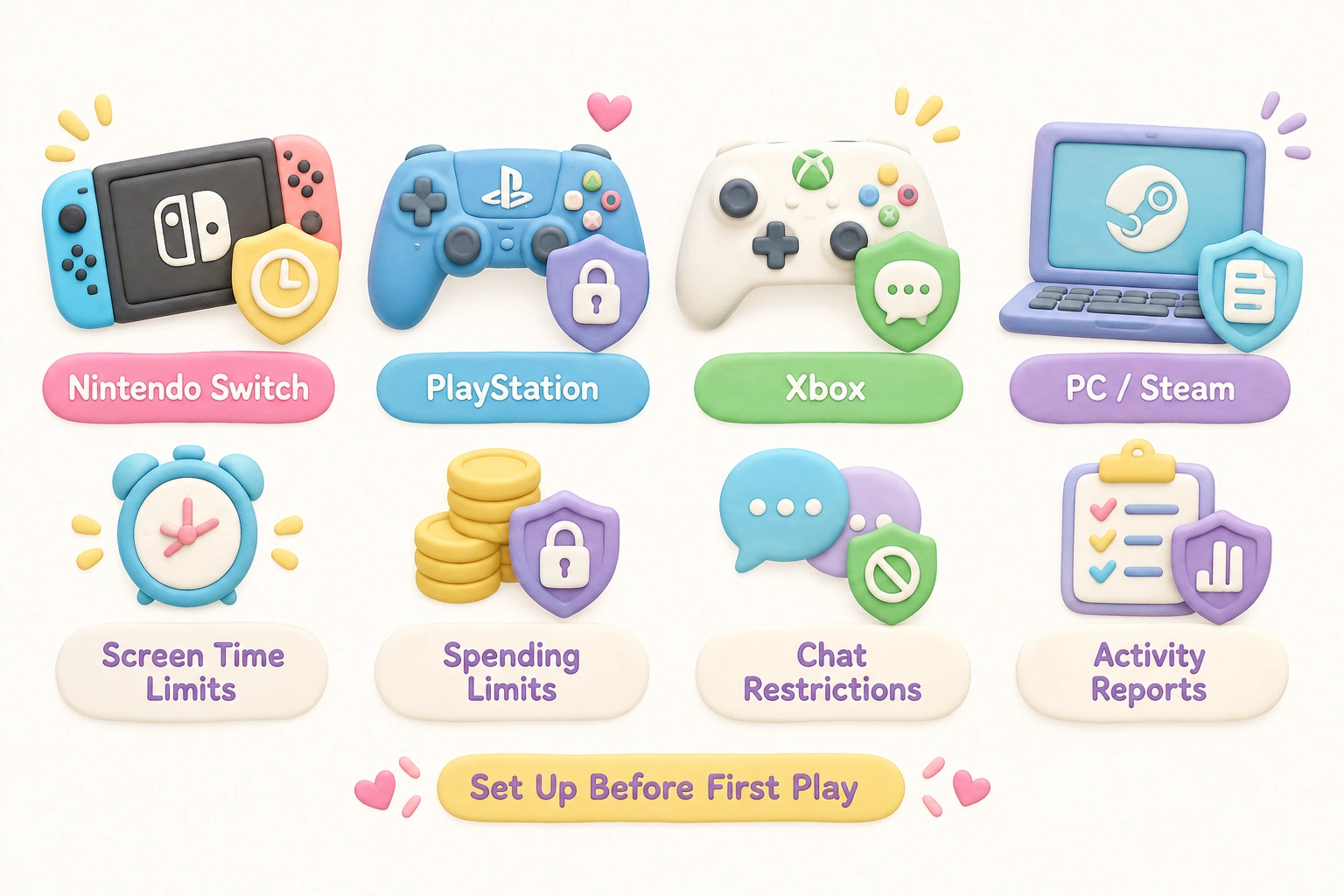
Setting up these controls before a child’s first session is strongly recommended, regardless of which games you choose. Even games with an E for Everyone rating may include online interaction features that expose children to strangers. Restricting online chat and limiting online play to known contacts are practical steps that do not require removing a game from the household entirely. The FTC and organizations such as Internet Matters provide accessible guidance on online gaming safety for parents who want a more detailed overview of the risks and mitigation strategies available.
In-game purchases deserve particular attention. Several games on this list — most notably Minecraft — include optional marketplace content that can accumulate costs quickly if spending limits are not set in advance. Enabling purchase restrictions through platform settings, rather than relying on a child’s self-regulation, is the most reliable approach for this age group.
Screen Time Guidance for 7-Year-Olds
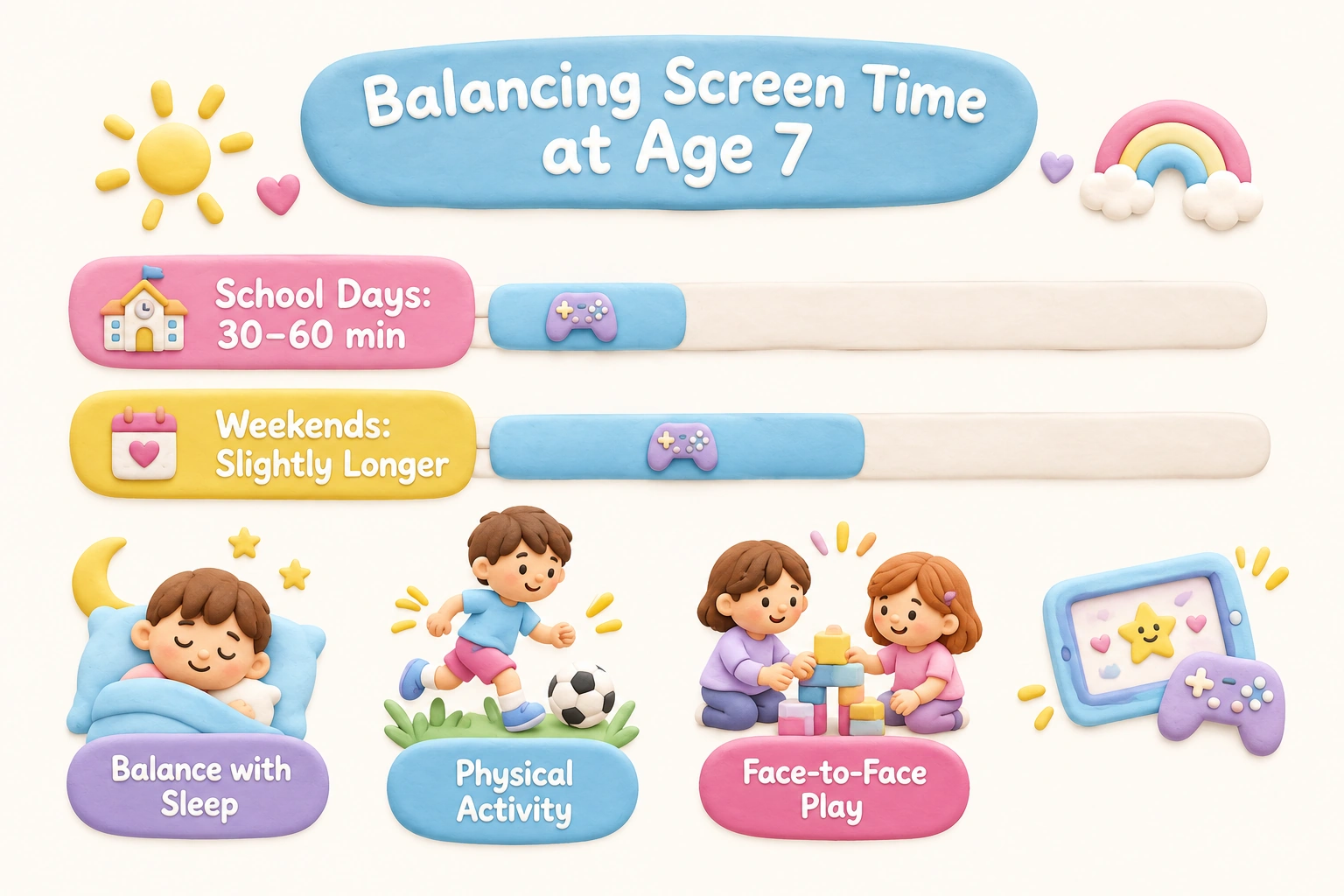
The American Academy of Pediatrics (AAP) recommends that for children aged 6 and older, screen time should be consistent, limited, and balanced with adequate sleep, physical activity, and face-to-face interaction. The AAP does not specify a single daily hour limit for this age group but emphasizes that the quality and context of screen time matter alongside quantity. Playing a cooperative game with a parent or sibling is a meaningfully different experience from passive solo consumption, and this distinction is worth keeping in mind when setting household rules.
Practically, many families find that 30–60 minutes of gaming on school days and slightly longer sessions on weekends work well for 7-year-olds, though individual children vary considerably in how they respond to screen time. Games with natural stopping points — such as the end of a Mario Kart cup, the completion of a Kirby level, or Animal Crossing’s real-time daily structure — make it easier to enforce limits without conflict. Discussing stopping points before a session begins, rather than interrupting mid-game, tends to reduce resistance significantly at this age.
Games That May Not Yet Be the Right Fit
Not every popular game is appropriate for a 7-year-old, even if it appears child-friendly on the surface. Games with persistent online multiplayer environments, unmoderated voice or text chat, or significant reading requirements may be better suited to children aged 9 and older. Titles rated T for Teen (ESRB) or PEGI 12 and above typically contain content — including more realistic violence, mature themes, or complex social dynamics — that most developmental guidance suggests is not appropriate for early primary-age children.
Free-to-play games with aggressive in-game purchase mechanics deserve particular caution. Even when the base content is age-appropriate, the psychological design of some monetization systems — including limited-time offers, randomized reward boxes, and social pressure mechanics — is not well-suited to children who are still developing impulse control and an understanding of real-world financial value. If a free-to-play title is chosen, enabling strict spending restrictions through platform parental controls before the child accesses the game is essential.
Frequently Asked Questions
Is Minecraft appropriate for a 7-year-old?
Minecraft can be appropriate for a 7-year-old with the right settings in place. Playing in Creative Mode or Peaceful Mode removes enemies and survival pressure, making the experience genuinely non-violent and open-ended. The main concerns for this age group are online chat exposure and in-game purchases through the Minecraft Marketplace. Both can be managed through platform parental controls. The ESRB rates Minecraft E10+ in North America; PEGI rates it 7 in Europe. Parents should read both ratings’ content descriptors and decide based on their individual child’s maturity.
What ESRB rating is most appropriate for a 7-year-old?
Games rated E for Everyone are the safest starting point for 7-year-olds. Some E10+ titles — such as LEGO Star Wars or Rayman Legends — are also well-suited to this age group because their content descriptors involve only mild cartoon action. Always read the specific content descriptors beneath the main rating rather than relying on the letter alone.
Which platform is best for a 7-year-old’s first gaming experience?
The Nintendo Switch is widely considered the most child-friendly platform for this age group, largely because of its extensive library of family-friendly titles, its portable design, and the quality of its parental controls app. PlayStation 5 is a strong alternative for families who already own Sony hardware, with titles like Sackboy: A Big Adventure offering comparable quality. PC gaming is viable but typically requires more active parental involvement in content management.
How do I manage in-game purchases for my child?
Every major platform — Nintendo Switch, PlayStation, Xbox, and PC via Steam — allows parents to require a password or PIN for any purchase. Setting this up before your child plays is the most reliable method. Avoid storing payment details in a form that a child can access independently. For games like Minecraft that include a built-in marketplace, consider discussing with your child in advance which types of content are and are not available for purchase.
Are co-op games better than solo games for 7-year-olds?
Neither is universally better — both serve different developmental purposes. Cooperative play can support communication, turn-taking, and shared problem-solving, particularly when a parent or older sibling plays alongside the child. Solo games can support independent concentration, self-directed creativity, and frustration tolerance. A mix of both, chosen based on the child’s current interests and the family’s available time, is generally the most balanced approach.
What is the Nintendo Switch 2, and does it affect game choices?
The Nintendo Switch 2 is Nintendo’s updated console, which launched in mid-2025 and is backward compatible with the majority of Nintendo Switch game cards. This means that titles like Mario Kart 8 Deluxe, Kirby and the Forgotten Land, and Animal Crossing: New Horizons remain playable on the new hardware. New Switch 2 exclusive titles, including Mario Kart World, are also becoming available and are worth considering as the library grows. Families purchasing a new console should confirm backward compatibility for specific titles before buying.
Choosing the Right Game for Your Child and Family
The best video games for 7-year-olds share a set of practical qualities: age-appropriate content confirmed by ESRB or PEGI ratings, simple enough controls to allow genuine enjoyment rather than constant frustration, and meaningful opportunities for family co-play. None of the 12 games on this list requires a child to engage with violent content, unmoderated online strangers, or manipulative purchase mechanics — provided parental controls are configured correctly before play begins.
The most important factor is not which specific title you choose, but how gaming fits into your child’s broader daily routine. A 30-minute session of Mario Kart with a parent present is a very different experience — developmentally and socially — from an hour of unsupervised online play. Choosing games with natural session endpoints, setting up platform parental controls before the first session, and occasionally playing alongside your child will do more to make gaming a positive experience than any individual title selection. Common Sense Media’s independent reviews are a useful supplementary resource if you want a second opinion on any specific game before purchasing.

Take a short quiz to find out what your everyday choices say about your parenting style
When your child is curious about something new, what’s your instinct?
Take a short quiz to find out what your everyday choices say about your parenting style
“Can I download this app?” What happens next?
Take a short quiz to find out what your everyday choices say about your parenting style
When it comes to rules at home, which sounds most like you?
Take a short quiz to find out what your everyday choices say about your parenting style
If you could give your child one life skill today, what would you pick?
Take a short quiz to find out what your everyday choices say about your parenting style
Your child gets to choose what to watch. What would your ideal setup look like?
Take a short quiz to find out what your everyday choices say about your parenting style
Pick your parenting superpower ✨