12 Best Video Games for 6-Year-Olds: Easy Controls and Co-Op

 Discover a Free Education Video App for Kids
Pastory uses AI to personalize educational video content based on your child’s interests and personality. Safe, engaging, and built for curious young minds. Sign up now to stay updated and enjoy early access with a free trial
Choosing video games for a 6-year-old involves more than picking something colorful off a shelf. At this age, children are developing fine motor skills, building hand-eye coordination, and beginning to understand cause and effect — all of which can be supported by the right game. The challenge for parents is finding titles with genuinely easy controls, forgiving gameplay, and ideally a co-op mode that lets you play alongside your child without the experience becoming frustrating for either of you. This guide covers 12 age-appropriate picks across multiple platforms, explains what makes each one suitable for this age group, and addresses the practical concerns parents most often have.
Key Takeaways
- The best video games for 6-year-olds combine simple controls, bright visuals, and forgiving gameplay — ideally with a no fail state or infinite respawns so frustration stays low.
- Local co-op and couch co-op games are particularly valuable at this age because they allow a parent and child to play together, supporting communication and shared problem-solving.
- Asymmetric co-op mechanics — where one player acts as a helper or sidekick — are especially well suited to the skill gap between adults and young children.
- ESRB ratings (E or E10+) provide a useful starting point, but reading the specific content descriptors gives a more accurate picture of what a game actually contains.
- Parental controls on Nintendo Switch, PlayStation, and Xbox allow you to set daily time limits and restrict purchases before your child ever picks up a controller.
What Makes a Game Right for a 6-Year-Old?
A 6-year-old’s motor control and reading ability are still developing, which means games designed for older children or adults can quickly become overwhelming. The most important features to look for are easy controls with few simultaneous button presses, clear visual feedback so the child understands what is happening on screen, and forgiving gameplay that does not punish mistakes harshly. Games with a no fail state — where the player cannot permanently lose progress — are particularly well suited to this age group because they allow exploration without anxiety.
The ESRB rating system provides a useful first filter. An ESRB E rating (Everyone) indicates content suitable for all ages, while ESRB E10+ suggests content may be more appropriate from age 10 onward. However, the letter grade alone does not tell the full story. Reading the specific content descriptors — such as “Mild Fantasy Violence” or “Comic Mischief” — gives a much clearer picture of what your child will actually encounter. In Europe, the equivalent PEGI 3 and PEGI 7 ratings serve a similar purpose.
One factor that is often overlooked is the skill gap between parent and child. When a 6-year-old plays alongside an adult, the difference in reaction time and spatial reasoning can make co-op feel unbalanced. Games that use asymmetric co-op — where one player takes a supporting or sidekick role — solve this problem elegantly, because the less experienced player can contribute meaningfully without needing to match the adult’s skill level.
At a Glance: 12 Age-Appropriate Games Compared
| Game | Platform | ESRB | Players | Co-Op Type | Best For |
|---|---|---|---|---|---|
| Mario Kart 8 Deluxe | Nintendo Switch | E | 1–4 | Split-screen local | Racing, first-time players |
| Kirby and the Forgotten Land | Nintendo Switch | E10+ | 1–2 | Drop-in/drop-out co-op | Platforming, easy mode |
| Super Mario Bros. Wonder | Nintendo Switch | E | 1–4 | Local co-op, sidekick mode | Platforming, creativity |
| Yoshi’s Crafted World | Nintendo Switch | E | 1–2 | Drop-in/drop-out co-op | Gentle platforming, mellow mode |
| Snipperclips | Nintendo Switch | E | 2–4 | Required co-op | Teamwork, problem-solving |
| LEGO Star Wars: The Skywalker Saga | Switch / PS5 / Xbox / PC | E10+ | 1–2 | Split-screen local co-op | Story, exploration |
| Minecraft (Creative Mode) | Switch / PS5 / Xbox / PC | E10+ | 1–4 | Local or online co-op | Creativity, spatial reasoning |
| Luigi’s Mansion 3 | Nintendo Switch | E | 1–2 | Asymmetric co-op (Gooigi) | Puzzle-solving, gentle scares |
| Super Mario Odyssey | Nintendo Switch | E10+ | 1–2 | Asymmetric co-op (Cappy) | Exploration, 3D platforming |
| Nintendo Switch Sports | Nintendo Switch | E | 1–4 | Local multiplayer | Motion controls, physical activity |
| Disney Illusion Island | Nintendo Switch | E | 1–4 | Drop-in/drop-out co-op | Gentle platforming, sharing lives |
| Bluey: The Videogame | Switch / PS5 / Xbox / PC | E | 1–4 | Local co-op | Familiar characters, very young players |
The 12 Best Video Games for 6-Year-Olds
1. Mario Kart 8 Deluxe
Mario Kart 8 Deluxe on Nintendo Switch remains one of the most reliably enjoyable games for young children, largely because of its smart steering assist feature. When enabled, smart steering assist automatically keeps the kart on the track, which means a 6-year-old can focus on the fun of racing without repeatedly driving off cliffs. The game supports up to four players in split-screen local multiplayer, making it a genuine family activity. The ESRB E rating reflects content that is appropriate for all ages, and there are no in-game purchases in the base game. Developmentally, racing games at this age may support hand-eye coordination and basic cause-and-effect understanding as children learn that steering input changes the kart’s direction.
2. Kirby and the Forgotten Land
Kirby and the Forgotten Land is widely regarded as one of the most accessible 3D platformers available for young children. The game features a dedicated Mellow Mode that gives Kirby unlimited flight, dramatically reducing the difficulty and making the experience far less frustrating for a 6-year-old. A second player can join at any time using drop-in/drop-out co-op, taking control of Bandana Waddle Dee — a character who is straightforward to control and cannot cause the main player to fail. The ESRB E10+ rating reflects mild cartoon action, but the content is generally considered appropriate for children around 6 with parental awareness. The game’s bright visuals and clear objectives make it easy for young players to understand what they are supposed to do.
3. Super Mario Bros. Wonder
Super Mario Bros. Wonder introduces a sidekick mode that is particularly well designed for the parent-and-child dynamic. In sidekick mode, a second player joins as a floating character who cannot be harmed and can assist the main player by carrying them across difficult sections. This asymmetric co-op structure means a 6-year-old can participate meaningfully even if their platforming skills are still developing. The game supports up to four players in local co-op, and the Wonder Flower mechanic — which transforms levels in unexpected ways — keeps the experience surprising and engaging. The ESRB E rating and the game’s emphasis on exploration over punishment make it one of the most family-friendly platformers currently available on Nintendo Switch.
4. Yoshi’s Crafted World
Yoshi’s Crafted World is a 2D platformer built around a craft-paper aesthetic that tends to appeal strongly to young children. The game’s Mellow Mode wraps Yoshi in wings, allowing continuous flight and removing most of the challenge from platforming sections. Two players can join in drop-in/drop-out co-op at any point, and neither player can cause the other to fail. The pacing is gentle, the objectives are clear, and the visual design is consistently cheerful. For a 6-year-old who is new to video games, Yoshi’s Crafted World may be one of the most forgiving entry points available, with an ESRB E rating and no content that is likely to concern parents.
5. Snipperclips — Cut It Out, Together!
Snipperclips is a puzzle game that requires two players to cooperate — it cannot be completed alone. Players control paper characters who can cut shapes out of each other to solve increasingly creative puzzles. The game demands communication and joint problem-solving, which makes it genuinely educational in a social sense. Because the puzzles have no time pressure and no fail state in the traditional sense, a 6-year-old can experiment freely without anxiety. Snipperclips is one of the few games on this list where the child’s input is as important as the adult’s, which can be particularly motivating. The ESRB E rating and the absence of any violence or mature content make it straightforwardly appropriate for this age group.
6. LEGO Games (e.g., LEGO Star Wars: The Skywalker Saga)
LEGO games as a series are consistently well suited to young children because they combine familiar characters with forgiving gameplay mechanics. In LEGO Star Wars: The Skywalker Saga, defeated characters simply reassemble from LEGO bricks rather than disappearing permanently, which removes the sting of failure. The split-screen local co-op mode allows a parent and child to explore the game world together, and the humor is pitched at a level that works for both audiences. The ESRB E10+ rating reflects mild cartoon action consistent with the Star Wars films. One practical note: LEGO games are available across Nintendo Switch, PlayStation 5, Xbox, and PC, making them one of the more platform-agnostic options on this list. Parents should be aware that some LEGO titles offer downloadable content, so checking parental controls settings before play is advisable.
7. Minecraft (Creative Mode)
Minecraft in creative mode is a fundamentally different experience from the survival mode that older players typically use. In creative mode, hostile mobs can be disabled, resources are unlimited, and there is no health bar — the child simply builds and explores freely. This makes Minecraft in creative mode one of the most open-ended and low-stress environments available for a 6-year-old. Research in child development suggests that open-ended construction play may support spatial reasoning and creative thinking, and Minecraft’s digital building environment shares some of those characteristics. The ESRB E10+ rating applies to the full game; parents who restrict play to creative mode with mobs disabled will encounter content that is considerably milder. Minecraft is available on Nintendo Switch, PlayStation, Xbox, and PC, and the local co-op feature allows a parent and child to build together on the same screen.
8. Luigi’s Mansion 3
Luigi’s Mansion 3 uses an asymmetric co-op mechanic that is particularly well suited to the skill gap between adults and young children. A second player controls Gooigi — a green, gelatinous version of Luigi — who can pass through grates and solve puzzles that Luigi cannot. Gooigi can be defeated by water but simply respawns immediately, meaning a 6-year-old playing as Gooigi can participate without the risk of ending the game for both players. The game’s ghost-hunting theme involves mild cartoon scares rather than anything genuinely frightening, and the ESRB E rating reflects this. Luigi’s Mansion 3 is one of the clearest examples of asymmetric co-op done well for young children, and the puzzle structure encourages communication between players.
9. Super Mario Odyssey
Super Mario Odyssey offers a two-player mode in which the second player controls Cappy, Mario’s hat companion. The Cappy role involves throwing the hat at enemies and objects, which is mechanically simpler than controlling Mario’s full movement set. This asymmetric co-op structure allows a 6-year-old to contribute to the game without needing to manage the more complex 3D platforming controls. The game’s ESRB E10+ rating reflects mild cartoon action, and the content is generally considered appropriate for children around 6 with parental awareness. Super Mario Odyssey’s open sandbox kingdoms encourage exploration at the child’s own pace, which tends to suit younger players better than games with strict time limits or linear progression.
10. Nintendo Switch Sports
Nintendo Switch Sports uses motion controls to simulate sports including tennis, bowling, badminton, football, volleyball, and chambara (sword fighting). Because the controls are based on physical movement rather than button combinations, the game is accessible to children who have not yet developed the fine motor skills needed for traditional controllers. Up to four players can participate locally, making it a natural choice for family play sessions. The ESRB E rating and the absence of any mature content make Nintendo Switch Sports straightforwardly appropriate for 6-year-olds. From a developmental perspective, motion-controlled games may support gross motor development and physical activity, though they should complement rather than replace outdoor play.
11. Disney Illusion Island
Disney Illusion Island is a 2D platformer featuring Mickey Mouse, Minnie Mouse, Donald Duck, and Goofy, which gives it immediate appeal for children familiar with Disney characters. The game’s co-op system allows players to share lives with each other — if one player runs out of health, another can donate a life — which is a particularly thoughtful mechanic for mixed-skill groups. Up to four players can join in drop-in/drop-out co-op, and the difficulty can be adjusted to suit younger players. The ESRB E rating and the game’s gentle tone make it one of the more straightforwardly family-friendly options on Nintendo Switch. The platforming is accessible without being trivial, which means a 6-year-old can make genuine progress.
12. Bluey: The Videogame
Bluey: The Videogame is designed specifically for very young players and draws directly on the characters and scenarios from the popular animated series. The controls are intentionally simple, the objectives are clearly communicated through familiar Bluey games such as Keepy Uppy and Shadowlands, and up to four players can participate in local co-op. The ESRB E rating and the game’s origin in a series known for its positive family dynamics make it one of the most straightforwardly appropriate options for 6-year-olds, particularly those who are new to video games entirely. The game is available on Nintendo Switch, PlayStation, Xbox, and PC. Parents should note that the game is relatively short, which may be a consideration for older or more experienced players in the household.
Understanding Asymmetric Co-Op: The Skill Gap Solution
The skill gap between an adult and a 6-year-old is one of the most common reasons that couch co-op sessions end in frustration. Adults have faster reaction times, more developed spatial reasoning, and years of gaming experience — all of which can make a child feel left behind even in games marketed as family-friendly. Asymmetric co-op addresses this directly by giving each player a role suited to their ability level.
In Super Mario Odyssey, the Cappy role requires simpler inputs than controlling Mario, so a 6-year-old can contribute without managing complex 3D movement. In Luigi’s Mansion 3, Gooigi respawns instantly, so a child playing that role cannot cause a permanent setback. In Super Mario Bros. Wonder’s sidekick mode, the second player is invincible and can assist the main player physically. These mechanics are not workarounds — they are deliberate design choices that make the games genuinely playable for mixed-skill households. When choosing a co-op game for a 6-year-old, looking specifically for asymmetric co-op or sidekick mechanics is one of the most practical steps a parent can take.
Setting Up Parental Controls Before You Start
Before a 6-year-old begins playing any video game, setting up parental controls on the relevant platform takes only a few minutes and provides meaningful protection. On Nintendo Switch and Nintendo Switch 2, the Nintendo Switch Parental Controls app allows parents to set daily play time limits, restrict which games can be played by ESRB rating, disable communication with other players, and prevent purchases on the Nintendo eShop — all from a smartphone. PlayStation offers a similar Family Management system through the PlayStation app, and Xbox provides family settings through the Xbox Family Settings app.
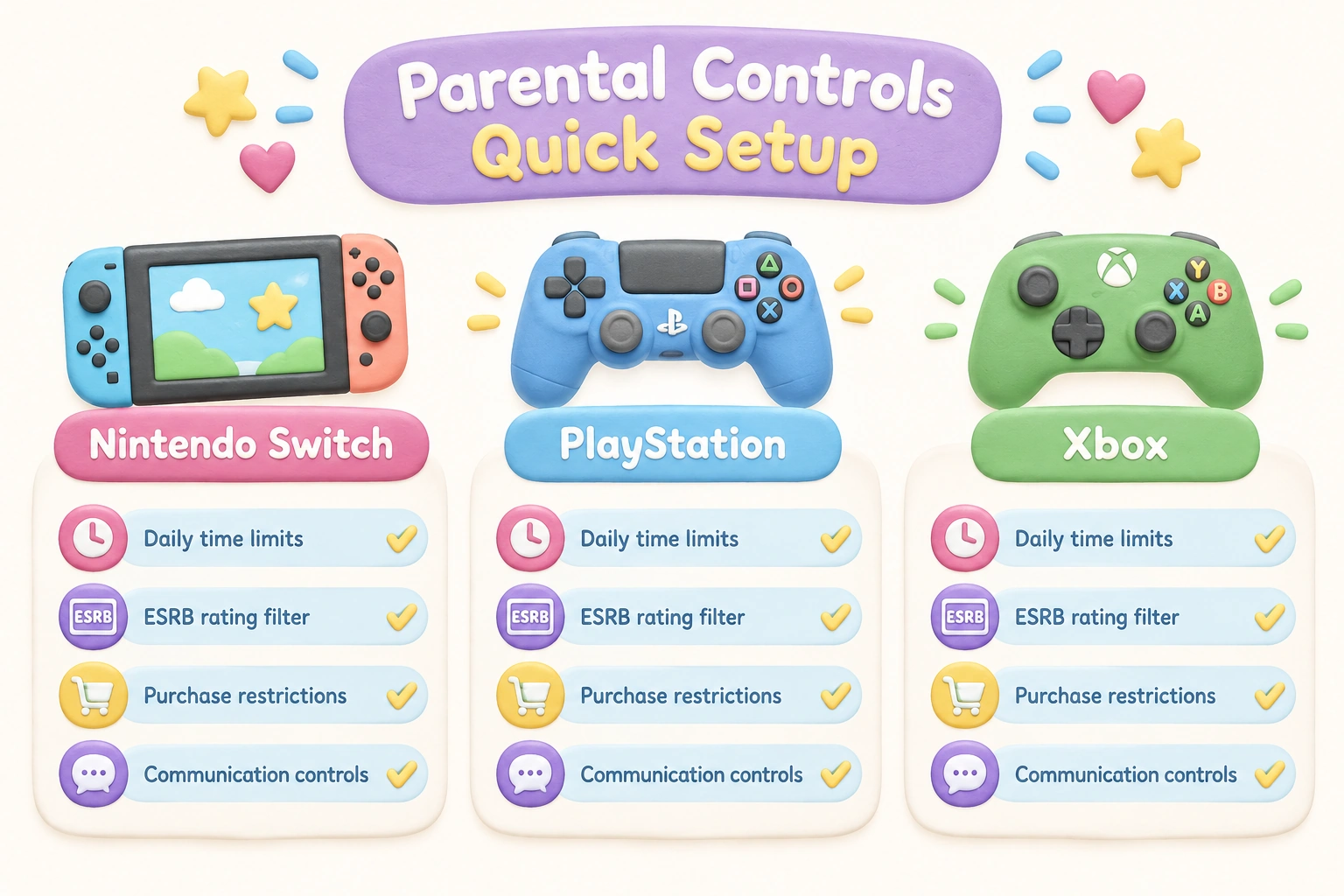
For Minecraft specifically, parents should verify that the game is set to creative mode with hostile mobs disabled before a young child plays independently. If the game is played online, the “Users Interact” content descriptor — which appears on games with open chat or social features — is worth noting, as online communication with strangers is generally more significant than the game’s violence rating for this age group. The American Academy of Pediatrics recommends that parents remain involved in their child’s media use, which includes co-viewing or co-playing where possible rather than leaving young children to play unsupervised.
What to Avoid: Games That Look Kid-Friendly But Aren’t Quite Right for Age 6
Some games are marketed broadly as family-friendly but contain elements that may not suit a 6-year-old specifically. Overcooked! All You Can Eat is a popular co-op cooking game, but its timer-based mechanics create significant time pressure that can be genuinely stressful for children under 7. The game is better suited to ages 8 and above when children can manage the cognitive load of multiple simultaneous tasks under a countdown.
Games with a “Users Interact” ESRB label — indicating open chat or social features — require careful parental oversight regardless of the overall rating. Online multiplayer environments expose children to communication from strangers, which is a more pressing concern than the game’s content rating for most parents of 6-year-olds. Games with in-game purchases or microtransactions should also be approached carefully; enabling purchase restrictions through parental controls before play begins is strongly advisable. Finally, some games that are technically rated E or E10+ have control schemes that are genuinely too complex for a 6-year-old’s fine motor development, so checking gameplay videos before purchasing can save frustration.
Developmental Benefits of Age-Appropriate Video Games
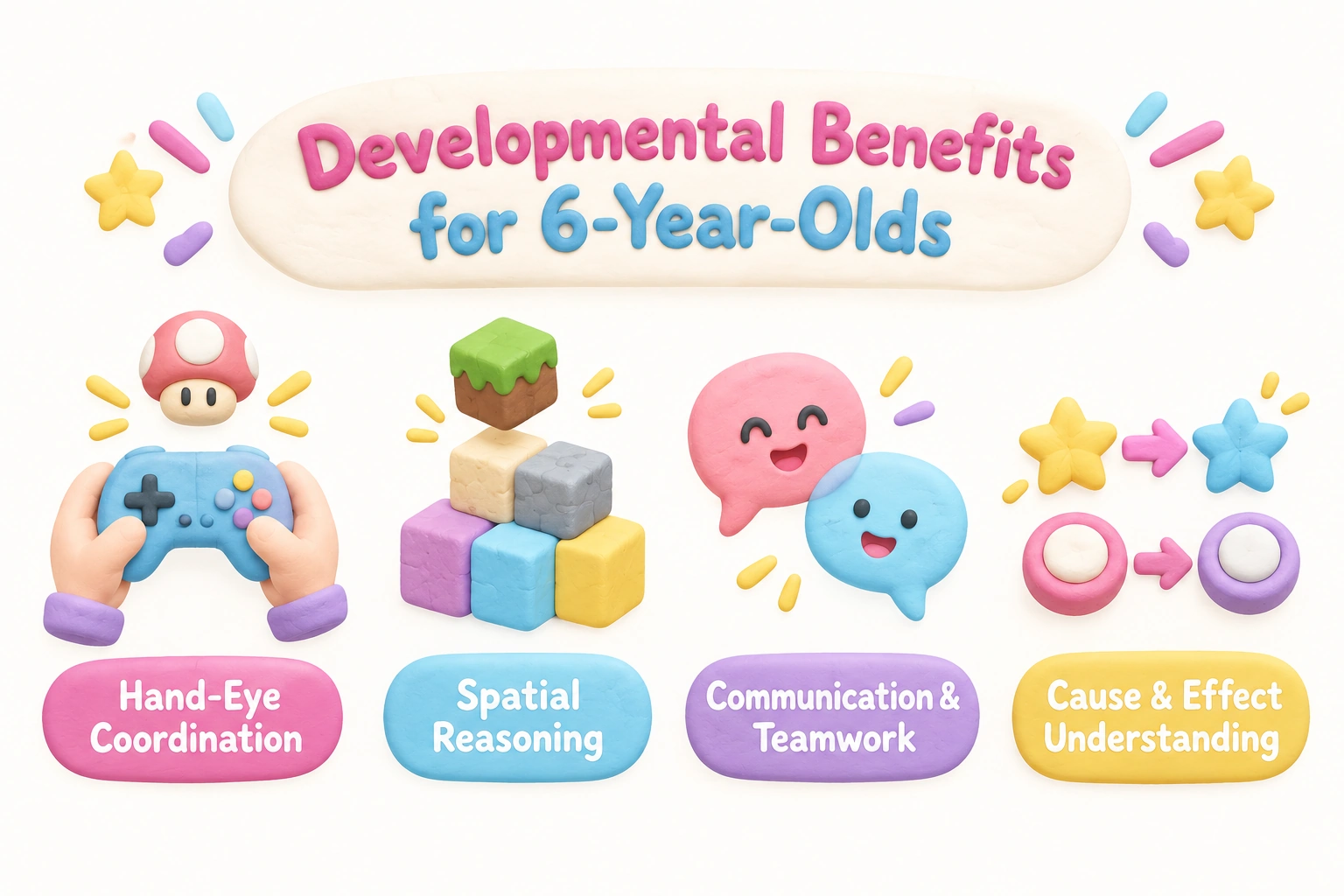
When chosen carefully and played with appropriate time limits, video games may support several developmental domains relevant to 6-year-olds. Hand-eye coordination and fine motor skills may be supported by games requiring precise controller input, such as Mario Kart 8 Deluxe. Spatial reasoning may be encouraged by open-ended building games like Minecraft in creative mode. Communication and teamwork may be practiced through cooperative games like Snipperclips, where players must verbally coordinate to solve puzzles. Cause-and-effect understanding — a key cognitive milestone at this age — is reinforced by virtually every game on this list, as children learn that their inputs produce predictable outcomes on screen.
It is important to note that these potential benefits depend on the quality of the game, the level of parental involvement, the duration and frequency of play, and the balance with offline activities. Video games should complement rather than replace physical play, social interaction, and creative activities away from screens. The American Academy of Pediatrics recommends that screen time for children aged 6 and older be consistent, limited, and balanced with other healthy behaviors, and that parents remain engaged with the content their children are consuming.
Frequently Asked Questions
What ESRB rating is appropriate for a 6-year-old?
ESRB E (Everyone) is the most straightforwardly appropriate rating for 6-year-olds. ESRB E10+ games may also be suitable depending on the specific content descriptors and the individual child, but parents should read those descriptors rather than relying on the letter grade alone. Games rated T (Teen) or M (Mature) are generally not appropriate for this age group.
Which platform has the most games suitable for 6-year-olds?
Nintendo Switch currently has the largest library of age-appropriate games for 6-year-olds, including most of the titles on this list. However, several strong options — including LEGO games, Minecraft, and Bluey: The Videogame — are available across PlayStation, Xbox, and PC as well, making those platforms viable depending on what your household already owns.
Is Minecraft safe for a 6-year-old?
Minecraft in creative mode with hostile mobs disabled is generally considered appropriate for 6-year-olds. The survival mode, which involves combat with hostile creatures, is better suited to older children. If your child plays Minecraft online, enabling parental controls to restrict communication with other players is strongly advisable, as the game carries a “Users Interact” content descriptor.
What does drop-in/drop-out co-op mean?
Drop-in/drop-out co-op means a second player can join or leave the game at any point without interrupting the session or requiring a restart. This is particularly practical for parents who want to play alongside their child for part of a session and then step away. Games like Kirby and the Forgotten Land and Yoshi’s Crafted World use this mechanic.
How long should a 6-year-old play video games each day?
The American Academy of Pediatrics recommends that screen time for children aged 6 and older be consistent and limited, with parents setting boundaries that allow adequate time for sleep, physical activity, and other healthy behaviors. There is no single universally recommended daily limit, but many families find that 30–60 minutes on school days and slightly longer on weekends works well. Using the parental controls timer on Nintendo Switch or other platforms can help enforce these limits without conflict.
Are there good video games for 6-year-olds on Xbox or PlayStation?
Yes. LEGO games, Minecraft, Bluey: The Videogame, and Disney Illusion Island are all available on PlayStation and Xbox. Xbox Game Pass also includes a rotating selection of family-friendly titles that may be worth exploring. PlayStation and Xbox both offer robust parental control systems that allow time limits and content restrictions by ESRB rating.
Choosing the Right Game for Your Child and Your Household
The best video game for a 6-year-old is ultimately the one that matches your child’s current motor skills, interests, and temperament — and that you are willing to engage with alongside them. If your child is new to gaming entirely, starting with a game that uses motion controls (Nintendo Switch Sports) or has a dedicated easy mode (Kirby and the Forgotten Land’s Mellow Mode, Yoshi’s Crafted World’s Mellow Mode) reduces the likelihood of early frustration. If your child already has some gaming experience, asymmetric co-op titles like Luigi’s Mansion 3 or Super Mario Odyssey offer more depth while still accommodating the skill gap between parent and child.
Platform availability matters too. If your household already owns a Nintendo Switch, the majority of the strongest options for this age group are available there. If you are on PlayStation, Xbox, or PC, the LEGO series, Minecraft, and Bluey: The Videogame provide solid starting points. Whichever platform you use, setting up parental controls before your child’s first session — including time limits, ESRB rating restrictions, and purchase controls — takes only a few minutes and provides meaningful peace of mind. Playing together, even occasionally, remains one of the most effective ways to ensure that your child’s gaming experience is both enjoyable and developmentally appropriate.

Take a short quiz to find out what your everyday choices say about your parenting style
When your child is curious about something new, what’s your instinct?
Take a short quiz to find out what your everyday choices say about your parenting style
“Can I download this app?” What happens next?
Take a short quiz to find out what your everyday choices say about your parenting style
When it comes to rules at home, which sounds most like you?
Take a short quiz to find out what your everyday choices say about your parenting style
If you could give your child one life skill today, what would you pick?
Take a short quiz to find out what your everyday choices say about your parenting style
Your child gets to choose what to watch. What would your ideal setup look like?
Take a short quiz to find out what your everyday choices say about your parenting style
Pick your parenting superpower ✨