12 Best Free Cool Math Games Online for Kids

 Discover a Free Education Video App for Kids
Pastory uses AI to personalize educational video content based on your child’s interests and personality. Safe, engaging, and built for curious young minds. Sign up now to stay updated and enjoy early access with a free trial
Free online math games have become one of the most practical tools parents and teachers reach for when a child needs extra practice without the pressure of a worksheet. The best platforms combine genuine math skill-building with engaging game formats, making it easier for children to develop math fluency without the stress that often accompanies traditional drill practice. This guide reviews 12 of the best cool math games free online, covering what each platform offers, which age groups it suits best, what skills it targets, and what parents should know about safety and cost before clicking play.
Key Takeaways
- Most of the platforms listed here are genuinely free to play with no sign-up required, though some have optional premium tiers worth understanding before you start.
- Free online math games can support math fluency, number sense, and critical thinking skills when used alongside other learning activities rather than as a replacement for them.
- Age-appropriateness varies significantly across platforms; matching the game to your child’s current grade level and skill set matters more than picking the most popular site.
- Research suggests that gamified math practice may help reduce math anxiety in children who feel intimidated by traditional methods, though outcomes vary by child and context.
- Screen time guidance from organizations such as the American Academy of Pediatrics recommends that digital learning tools be used intentionally, with caregiver involvement where possible.
Why Math Games Work: The Developmental Case for Playful Practice
Learning through play is not simply a slogan. Developmental research consistently shows that children engage more deeply with material when it is embedded in a meaningful, low-stakes context. Browser-based math games create an instant feedback loop — a child attempts a problem, receives an immediate response, and adjusts their approach. This cycle mirrors the kind of responsive learning environment that supports skill consolidation in early and middle childhood. Unlike timed paper tests, well-designed math games allow children to practice addition, subtraction, multiplication, and division at their own pace, which may help reduce the math anxiety that affects a meaningful proportion of school-age children.
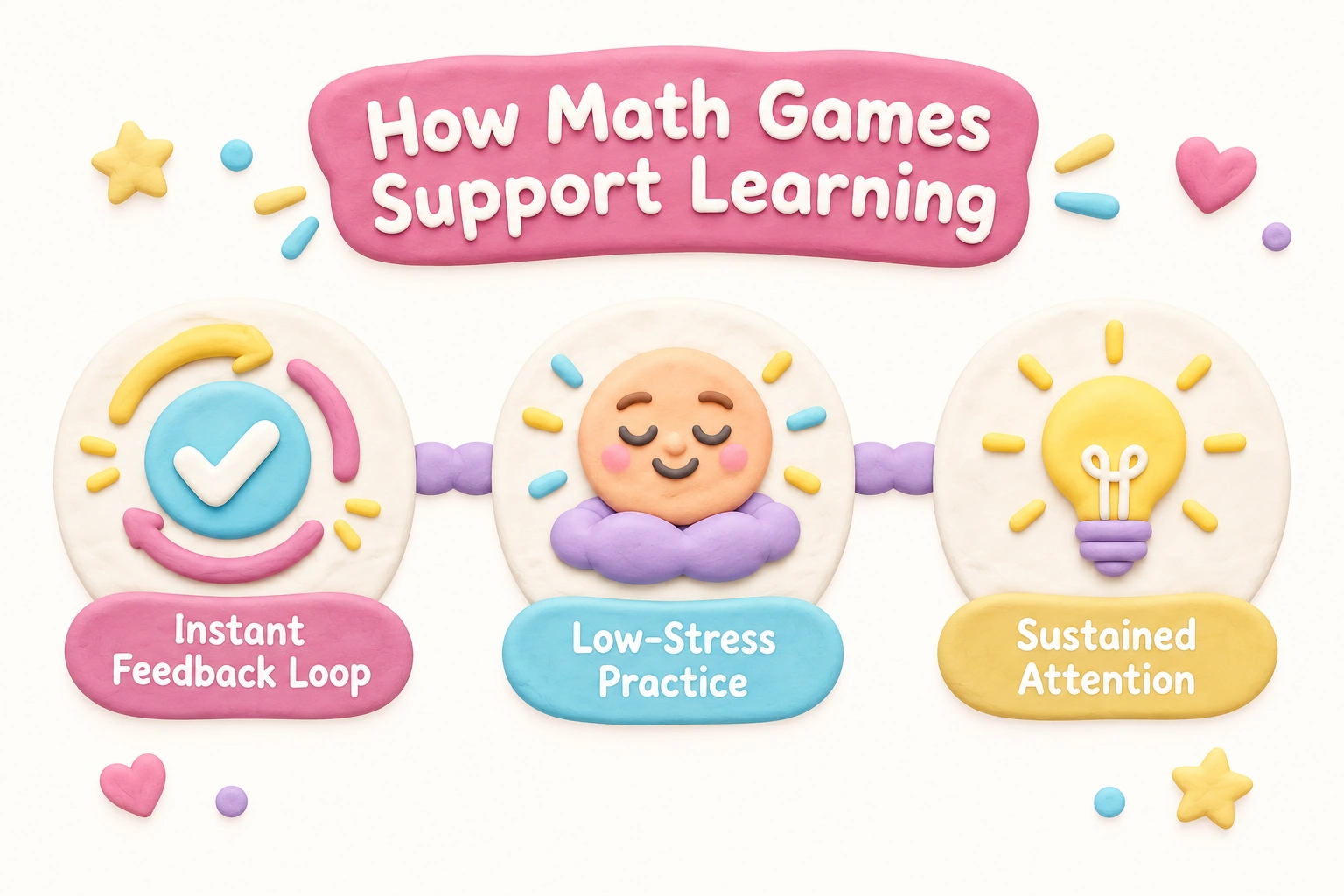
Gamified math practice also tends to sustain attention longer than passive study methods, particularly for children in the six-to-twelve age range whose working memory and self-regulation are still developing. The key distinction for parents is between games that embed math as the core mechanic — where solving a problem advances the game — and games that simply reward correct answers with unrelated animations. The former tends to produce more durable learning because the math itself becomes purposeful within the game’s logic.
Platform Comparison at a Glance
| Platform | Best Age Range | Core Skills | Truly Free? | No Sign-Up? | Ad Policy |
|---|---|---|---|---|---|
| Coolmath Games | 8–14 | Logic, strategy, pre-algebra | Yes | Yes | Some ads |
| Math Playground | 6–12 | All core operations, fractions | Yes | Yes | Limited ads |
| SplashLearn | 3–11 | Curriculum-aligned, all topics | Freemium | No | Ad-free |
| Khan Academy Kids | 2–8 | Counting, early operations | Yes | No (account) | Ad-free |
| Prodigy Math | 6–13 | Full curriculum, adaptive | Freemium | No | Ad-free |
| Arcademics | 6–12 | Math facts, fluency | Yes | Yes | Some ads |
| Hooda Math | 8–14 | Logic, escape rooms, geometry | Yes | Yes | Some ads |
| Math Game Time | 3–13 | All topics, Pre-K to Grade 7 | Yes | Yes | Some ads |
| PBS Kids | 2–8 | Counting, shapes, patterns | Yes | Yes | Ad-free |
| KidsDoMath | 5–14 | All K–8 topics | Yes | Yes | No ads |
| Toy Theater | 5–11 | Number sense, geometry | Yes | Yes | Ad-free |
| Room Recess | 6–12 | Fractions, integers, estimation | Yes | Yes | Some ads |
The 12 Best Free Cool Math Games Online
1. Coolmath Games — Best for Logic and Strategy (Ages 8–14)
Coolmath Games (coolmathgames.com) is the platform most people picture when they search for cool math games free online. Launched in 1997 with the tagline “Where logic and thinking meets fun and games,” it hosts hundreds of browser-based math games and logic puzzles that require no sign-up to access. Popular titles such as Run 3, Bloxorz, and Fireboy and Watergirl are not strictly arithmetic games — they are spatial reasoning and strategic thinking challenges that develop problem-solving skills through gameplay. For children who need explicit arithmetic practice, the site also offers number-focused games covering multiplication, division, and pre-algebra concepts. The platform works on most devices including Chromebooks, though some older Flash-based titles have been retired. Parents should be aware that the site carries advertising, so it is worth previewing content before handing a device to a younger child.
2. Math Playground — Best All-Round Platform (Grades K–6)
Math Playground hosts more than 300 free online math games for kids spanning kindergarten through Grade 6, covering addition, subtraction, multiplication, division, fractions, decimals, and geometry. The site organizes games clearly by grade level and topic, making it straightforward for parents and teachers to find curriculum-aligned content without browsing through unrelated material. Many games on Math Playground use a puzzle-based or arcade-style format that keeps children engaged while reinforcing specific math facts. The platform is classroom-ready and widely used by teachers as a brain break tool or supplementary practice resource. No account is required, and the site is generally considered kid-safe, though it does carry some third-party advertising on certain pages.
3. SplashLearn — Best Curriculum-Aligned Option (Pre-K to Grade 5)
SplashLearn offers a colorful, structured learning environment that is closely curriculum-aligned with common elementary school standards. The platform covers a wide range of math topics from early counting and number sense through fractions, place value, and geometry, with adaptive difficulty that adjusts to a child’s performance over time. SplashLearn is genuinely ad-free and COPPA-compliant, which makes it a strong choice for parents who prioritize child privacy. However, it is important to note that SplashLearn operates on a freemium model — a meaningful portion of its content requires a paid subscription. The free tier provides access to a limited number of games and activities, so parents should explore what is available without a subscription before committing to the platform as a primary resource.
4. Khan Academy Kids — Best for Early Learners (Ages 2–8)
Khan Academy Kids is a fully free, ad-free educational platform designed for children aged two through eight. It covers early math concepts including counting, number recognition, basic addition and subtraction, shapes, and pattern recognition through interactive games, animated stories, and guided activities. The platform is COPPA-compliant and does not collect data for advertising purposes, which makes it one of the most trusted options for young children. Khan Academy Kids requires a free account to track progress, which some parents may find useful for monitoring their child’s development. The platform is available as a mobile app for iOS and Android as well as through a web browser, making it accessible for families without reliable desktop access.
5. Prodigy Math — Best Gamified RPG Experience (Ages 6–13)
Prodigy Math takes a different approach from most free online math games by embedding math practice inside a role-playing game world where children answer curriculum-aligned questions to advance their character and complete quests. This format can be highly motivating for children who enjoy narrative-driven games, and the platform’s adaptive difficulty adjusts question difficulty based on each child’s responses. Prodigy Math is free to play at its core level, but parents should understand clearly that it uses a freemium model — premium memberships unlock additional in-game content, and the platform actively markets upgrades to children during gameplay. The math curriculum itself is accessible without payment, but the upsell mechanics are worth discussing with your child before they start playing.
6. Arcademics — Best for Math Fluency and Speed Practice (Grades 1–6)
Arcademics specializes in arcade-style racing and multiplayer games that build math fluency through timed practice. Children race cars, animals, or spaceships by answering math facts quickly and correctly, which makes the platform particularly effective for developing automaticity with addition, subtraction, multiplication, and division facts. The competitive multiplayer format can be motivating for children who respond well to friendly competition, and teachers frequently use Arcademics as a classroom-ready tool for whole-group or small-group practice. The platform is free to use with no sign-up required for most games, though it carries some advertising. Parents of children who experience math anxiety should note that the timed, competitive format may not suit every child — for some, speed-based games increase rather than reduce pressure.
7. Hooda Math — Best for Escape Room and Puzzle Fans (Ages 8–14)
Hooda Math offers a distinctive collection of escape room games and puzzle-based challenges that embed math skills within problem-solving scenarios. Children must use logic, geometry, and numerical reasoning to unlock clues and progress through themed escape rooms, which makes the math feel purposeful rather than isolated. The platform is entirely browser-based, requires no sign-up, and works on Chromebooks and tablets, making it a practical classroom-ready option. Hooda Math covers a wide range of topics including fractions, decimals, geometry, and pre-algebra, and its escape room format tends to appeal particularly to older elementary and middle school students who find standard drill games less engaging. Some advertising is present on the site.
8. Math Game Time — Best Wide-Age-Range Resource (Pre-K to Grade 7)
Math Game Time covers one of the broadest age ranges of any free platform on this list, offering games, worksheets, and instructional videos for children from preschool through Grade 7. The site organizes content by grade level and topic, and its game library includes both arcade-style and puzzle-based formats covering all core math skills. Math Game Time is free to use with no account required, and it works on most browsers and devices. The combination of games, videos, and printable worksheets makes it a useful resource for parents who want to supplement school learning across multiple formats rather than relying solely on interactive games.
9. PBS Kids — Best for Preschool and Early Elementary (Ages 2–8)
PBS Kids offers free math games built around familiar animated characters such as Curious George, Peg and Cat, and Dinosaur Train. The games focus on foundational math concepts including counting, number recognition, basic addition, shapes, patterns, and telling time, presented in a low-pressure, visually engaging format appropriate for young children. PBS Kids is ad-free, COPPA-compliant, and does not require an account, making it one of the most straightforward and parent-friendly options for early learners. The platform works in most browsers and also has a free app available for tablets and smartphones, which is useful for families who primarily use mobile devices.
10. KidsDoMath — Best No-Ads, No-Sign-Up Option (Grades K–8)
KidsDoMath hosts approximately 290 math games covering the full K–8 curriculum with no advertising and no account required. The platform’s clean, distraction-free design makes it particularly well suited for children who are easily pulled off-task by banner ads or pop-ups, and its broad topic coverage — from basic counting through integers, probability, and early algebra — means it can grow with a child across multiple school years. KidsDoMath is a strong choice for parents who want a genuinely free, ad-free resource without the freemium limitations found on some larger platforms. The site is browser-based and works on most devices including Chromebooks.
11. Toy Theater — Best for Classroom and Whiteboard Use (Ages 5–11)
Toy Theater offers a collection of HTML5 math games and interactive tools designed to work reliably on classroom whiteboards, tablets, and Chromebooks without requiring plugins or downloads. The platform covers number sense, counting, place value, geometry, and basic operations through simple, visually clear games that are easy for younger children to navigate independently. Toy Theater is free, ad-free, and requires no sign-up, which makes it a practical choice for teachers who need classroom-ready resources that can be launched quickly without account management. The game library is smaller than some competitors, but the quality and reliability of the HTML5 format make it a dependable option for school settings.
12. Room Recess — Best for Fractions and Mixed-Topic Practice (Grades 1–6)
Room Recess offers a varied collection of free online math games covering fractions, integers, estimation, place value, and mixed operations for children in Grades 1 through 6. The platform is organized by subject and grade level, and its game formats range from puzzle-based challenges to arcade-style activities. Room Recess requires no sign-up and works in most browsers, making it easy to access as a quick brain break or supplementary practice tool. Some advertising is present on the site. The platform’s particular strength is its coverage of fractions and estimation — topics that many children find challenging and that are underrepresented on some competing platforms.
Skill-to-Platform Quick Reference
| Math Skill | Recommended Platforms |
|---|---|
| Counting and number sense | PBS Kids, Khan Academy Kids, Toy Theater |
| Addition and subtraction | Math Playground, Arcademics, Math Game Time |
| Multiplication and division (times tables) | Arcademics, Coolmath Games, KidsDoMath |
| Fractions and decimals | Room Recess, SplashLearn, Math Playground |
| Geometry and shapes | Hooda Math, Toy Theater, Math Game Time |
| Logic and strategy | Coolmath Games, Hooda Math, Math Playground |
| Pre-algebra and algebra | Coolmath Games, KidsDoMath, Prodigy Math |
| Early learner foundations | Khan Academy Kids, PBS Kids, SplashLearn |
Safety, Privacy, and the Free vs. Freemium Question
One of the most common questions parents ask about free online math games is whether they are genuinely free and whether they are safe for children to use independently. The honest answer is that “free” means different things across platforms. Sites such as KidsDoMath, PBS Kids, Khan Academy Kids, and Toy Theater are fully free with no premium tiers and no advertising directed at children. Platforms such as SplashLearn and Prodigy Math offer meaningful free content but actively market paid upgrades, which can create friction — particularly when children encounter locked content mid-session.
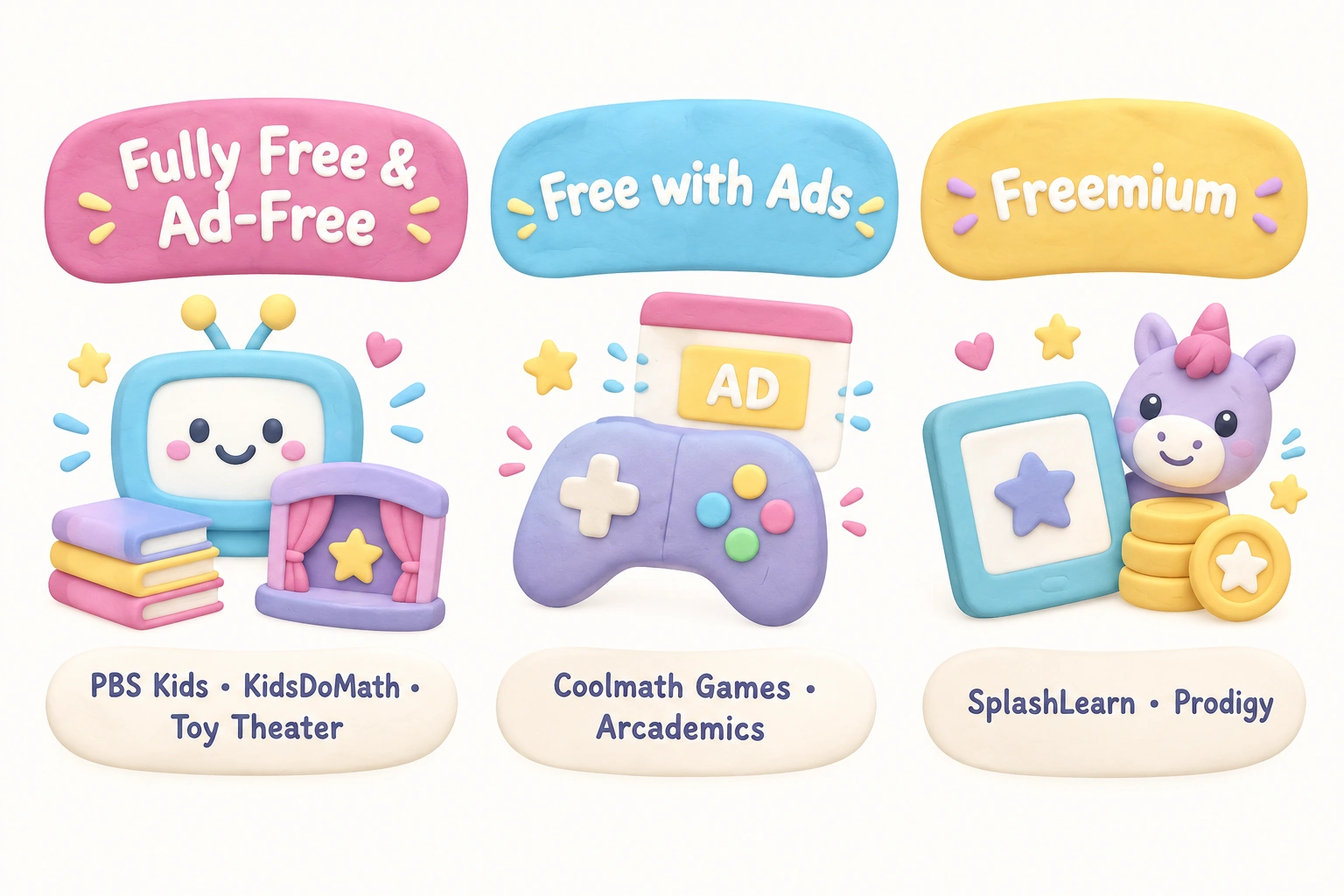
On the safety and privacy side, COPPA-compliant platforms — those that comply with the Children’s Online Privacy Protection Act in the United States — are required to limit data collection from children under 13 and to obtain verifiable parental consent before collecting personal information. Khan Academy Kids, PBS Kids, and SplashLearn are among the platforms that explicitly reference COPPA compliance. For platforms that carry advertising, it is worth previewing the site on your own device first to assess whether the ad content is appropriate and whether ads are clearly distinguishable from game content for a child of your child’s age.
Device compatibility is another practical consideration that most platform reviews overlook. All twelve platforms listed here are browser-based and work on standard desktop and laptop computers. Math Playground, Coolmath Games, Hooda Math, KidsDoMath, and Toy Theater are confirmed to work well on Chromebooks, which is relevant for families whose children use school-issued devices at home. Khan Academy Kids and PBS Kids have dedicated mobile apps for iOS and Android, making them accessible for families who primarily use tablets or smartphones.
How to Use Math Games Effectively Without Overdoing Screen Time
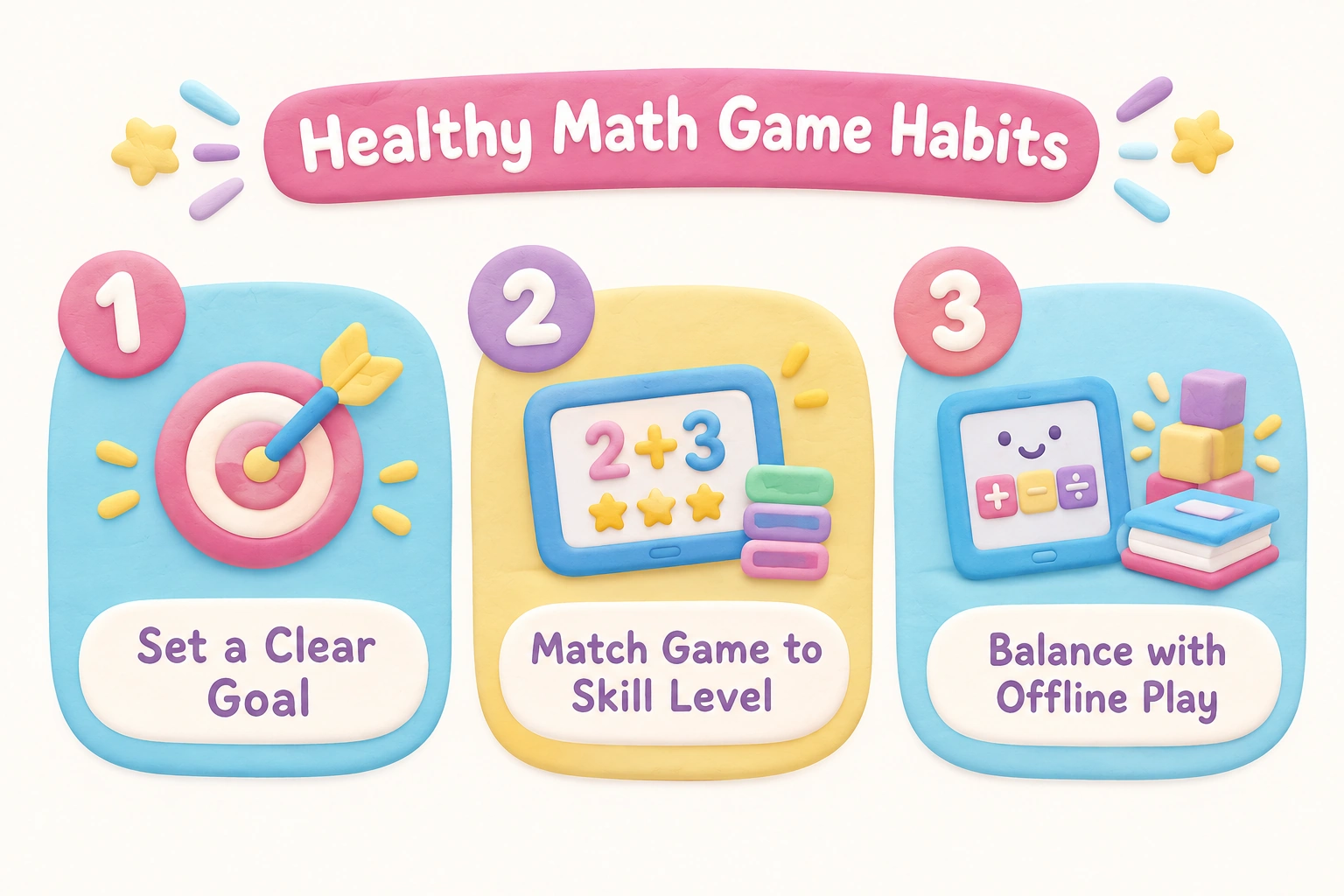
The American Academy of Pediatrics recommends that parents prioritize the quality of digital content over strict time limits for school-age children, while still encouraging balance with physical activity, sleep, and offline play. Free online math games are most developmentally useful when they are used intentionally — as a focused brain break between other activities, as targeted practice for a specific skill a child is working on at school, or as a low-pressure way to revisit concepts that caused frustration in a classroom setting.
Using math games as a complete substitute for structured learning or caregiver interaction is not recommended. The platforms reviewed here work best as one component of a broader learning environment that includes reading, hands-on activities, and conversation about mathematical ideas. For younger children in the preschool and early elementary range, co-playing alongside a caregiver — asking questions, celebrating progress, and discussing what the game involves — tends to produce more meaningful engagement than independent screen time alone.
A practical approach for most families is to set a clear purpose before a session begins: “We’re going to practice multiplication facts for fifteen minutes” is more effective than open-ended browsing across a platform. Many of the platforms listed here, including Math Playground and KidsDoMath, organize their games clearly enough by topic and grade level that a parent can identify a specific game in under a minute and hand the device to a child with a clear goal in mind.
Frequently Asked Questions
Are these math game sites really free, or do they require a subscription?
Most platforms on this list — including Coolmath Games, Math Playground, KidsDoMath, PBS Kids, Toy Theater, Room Recess, Arcademics, Hooda Math, and Math Game Time — are genuinely free to use with no subscription required. SplashLearn and Prodigy Math operate on freemium models where core content is free but premium features require payment. Khan Academy Kids is fully free but requires a free account to track progress.
Do any of these sites require a sign-up or account?
Most do not. Coolmath Games, Math Playground, Arcademics, Hooda Math, Math Game Time, KidsDoMath, Toy Theater, Room Recess, and PBS Kids can all be accessed immediately with no sign-up required. Khan Academy Kids, SplashLearn, and Prodigy Math require a free account to access their full features or to save progress.
Are these platforms safe for children to use independently?
Safety varies by platform. PBS Kids, Khan Academy Kids, Toy Theater, and KidsDoMath are among the most straightforward choices for independent use by younger children, as they are ad-free and do not include chat or social features. Platforms that carry advertising — including Coolmath Games, Math Playground, and Arcademics — are generally considered kid-safe but are worth previewing before a child uses them unsupervised, particularly for children under eight. No platform should be treated as a fully supervised environment, and caregiver check-ins are always advisable.
Which platforms work on Chromebooks or school tablets?
All twelve platforms listed here are browser-based and work on standard Chromebooks. Toy Theater is specifically designed with classroom whiteboard and Chromebook compatibility in mind. Khan Academy Kids and PBS Kids also have dedicated tablet apps for iOS and Android if browser access is not available.
Can math games actually help with math anxiety?
Research suggests that low-stakes, game-based math practice may help reduce math anxiety in some children by removing the pressure associated with timed tests and graded assignments. The key factors appear to be the absence of negative consequences for wrong answers and the presence of immediate, encouraging feedback. However, outcomes vary significantly by child, and a child with significant math anxiety may benefit from additional support from a teacher or learning specialist alongside game-based practice.
What age range do these platforms cover?
Collectively, the twelve platforms cover ages two through fourteen. PBS Kids and Khan Academy Kids are best suited for ages two through eight. Math Playground, Arcademics, Room Recess, and Toy Theater are strongest for Grades 1 through 6 (roughly ages six through twelve). Coolmath Games, Hooda Math, and KidsDoMath extend well into middle school, covering pre-algebra and logic content appropriate for ages eleven through fourteen.
Is it better to use one platform consistently or rotate between several?
For skill-building purposes, consistency tends to be more effective than frequent platform-switching. Choosing one or two platforms that match your child’s current grade level and sticking with them long enough to see progress is generally more productive than sampling many sites briefly. Rotating platforms can be useful when a child has mastered content on one site and needs more challenging material, or when variety helps sustain motivation over a longer period.
Choosing the Right Free Math Game Platform for Your Child
The most important factor in choosing among these platforms is not which site is most popular but which one matches your child’s current developmental stage, specific skill gaps, and learning style. A six-year-old who is just beginning to develop number sense will get far more from PBS Kids or Khan Academy Kids than from Coolmath Games, which is designed for older children who already have foundational arithmetic in place. Conversely, a ten-year-old who finds basic arithmetic games unstimulating may engage much more readily with the logic and strategy games on Coolmath Games or the escape room format on Hooda Math.
For parents who want a curriculum-aligned platform that mirrors what their child is learning at school, SplashLearn and Prodigy Math offer the closest match to standard elementary curricula, though both involve freemium trade-offs worth understanding in advance. For parents who want the simplest, most distraction-free experience with no ads and no account management, KidsDoMath and Toy Theater are the most straightforward choices. For teachers looking for classroom-ready resources that can be launched quickly on shared devices, Math Playground and Toy Theater are consistently reliable options.
Whatever platform you choose, the developmental benefit of free online math games is most likely to be realized when the games are used purposefully, matched to the child’s actual skill level, and balanced with offline mathematical experiences — whether that is counting objects at home, playing board games that involve numbers, or simply talking through a math problem together. The platforms reviewed here are genuinely useful tools; they work best as part of a broader approach to supporting a child’s mathematical development rather than as a standalone solution.

Take a short quiz to find out what your everyday choices say about your parenting style
When your child is curious about something new, what’s your instinct?
Take a short quiz to find out what your everyday choices say about your parenting style
“Can I download this app?” What happens next?
Take a short quiz to find out what your everyday choices say about your parenting style
When it comes to rules at home, which sounds most like you?
Take a short quiz to find out what your everyday choices say about your parenting style
If you could give your child one life skill today, what would you pick?
Take a short quiz to find out what your everyday choices say about your parenting style
Your child gets to choose what to watch. What would your ideal setup look like?
Take a short quiz to find out what your everyday choices say about your parenting style
Pick your parenting superpower ✨