Best Nintendo Switch Games for 7-Year-Olds

 Discover a Free Education Video App for Kids
Pastory uses AI to personalize educational video content based on your child’s interests and personality. Safe, engaging, and built for curious young minds. Sign up now to stay updated and enjoy early access with a free trial
Choosing the right Nintendo Switch games for a 7-year-old involves more than picking whatever looks fun on the shelf. At this age, children are developing stronger hand-eye coordination, beginning to read more fluently, and growing in their capacity for problem-solving and cooperative play. The best games for this age group support those emerging skills while remaining genuinely enjoyable — and manageable — for a child who may still be building gaming confidence. This guide covers the strongest age-appropriate Nintendo Switch games available, with honest notes on difficulty, reading demands, co-op options, and what parents should know before buying.
Key Takeaways
- Most of the best Nintendo Switch games for 7-year-olds carry an ESRB Everyone or E10+ rating and include built-in assist modes that make them accessible without being boring.
- Co-op and local multiplayer options are plentiful, making the Switch an excellent console for family game night and sibling play.
- Reading demands vary significantly between titles — flagging this per game helps parents match choices to their child’s current reading level.
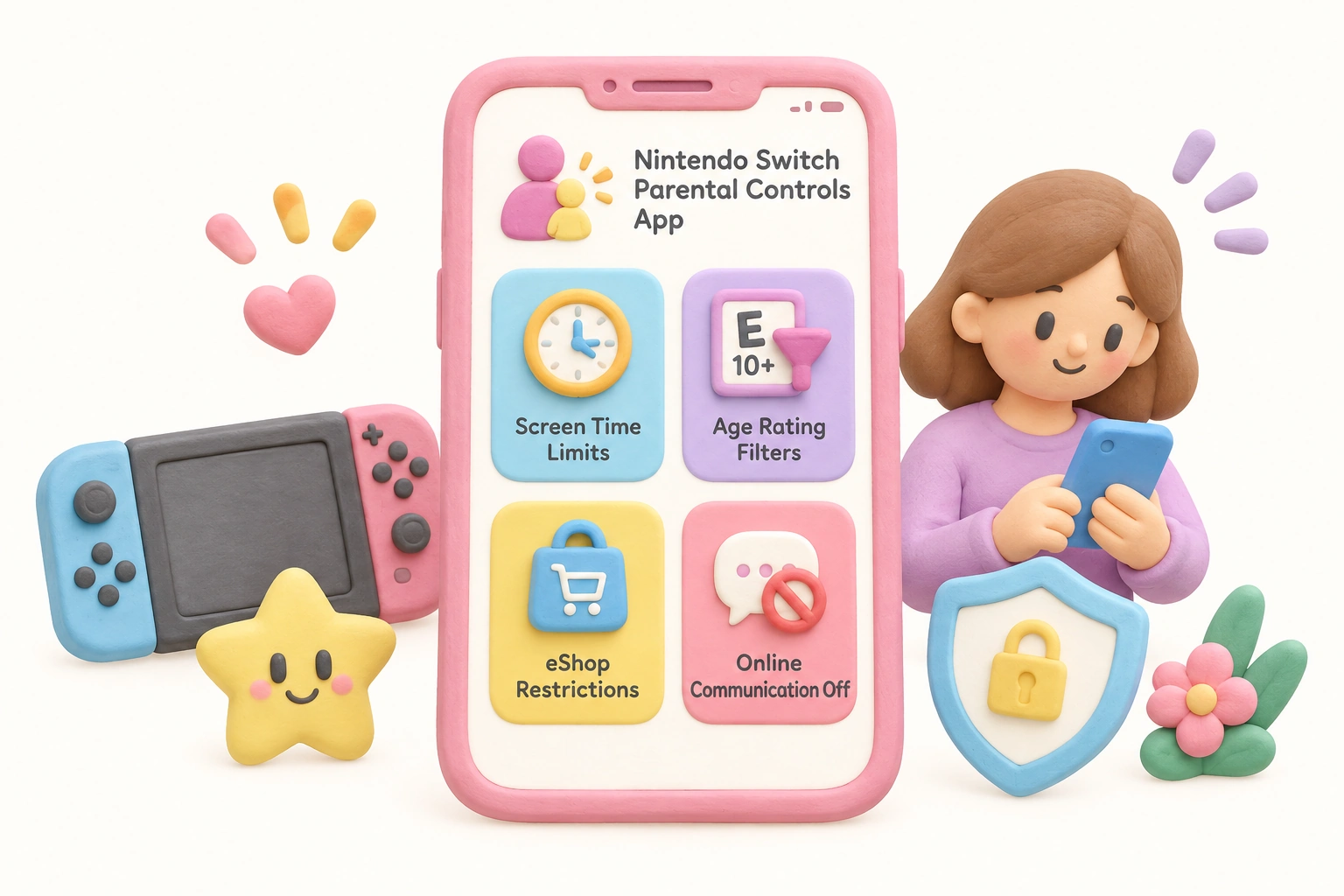
- The Nintendo Switch Parental Controls app allows parents to set screen time limits, restrict online play, and manage content ratings directly from a smartphone.
- Several top titles are compatible with both the original Switch and the Nintendo Switch 2, though parents should verify compatibility before purchasing.
What Makes a Nintendo Switch Game Right for a 7-Year-Old?
Seven-year-olds sit at an interesting developmental crossroads. Most have enough fine motor control to handle Joy-Con inputs comfortably, and many are beginning to read independently — though reading stamina and fluency vary widely at this age. Cognitively, children around this age are moving into what developmental psychologists describe as the concrete operational stage, meaning they can follow multi-step rules, understand cause and effect, and begin to plan ahead in simple ways. Games that reward exploration, light strategy, and persistence tend to land well.
From a practical standpoint, parents should look for games with forgiving gameplay — titles that use checkpoints generously, avoid permanent failure states, or include an assist mode that reduces frustration without removing the sense of achievement. Games with adjustable difficulty, short natural stopping points, and clear visual feedback are particularly well-suited to this age group. ESRB ratings provide a useful starting point: an ESRB Everyone rating indicates content suitable for all ages, while E10+ suggests mild content that most 7-year-olds can handle comfortably depending on individual sensitivity.
Top Nintendo Switch Games for 7-Year-Olds
Mario Kart 8 Deluxe
Mario Kart 8 Deluxe remains one of the most reliably enjoyable age-appropriate Nintendo Switch games for children around this age. The game’s steering assist feature — which gently guides karts back onto the track — makes it genuinely accessible for newer players without removing the fun of racing. The Smart Steering option can be toggled on or off, so children can gradually reduce assistance as their confidence grows. Local multiplayer supports up to four players on one console, making it a natural choice for family game night. Reading demands are minimal: menus are simple and race names are short. Online play requires a Nintendo Switch Online subscription, but the local multiplayer experience is complete without one.
ESRB rating: Everyone | Co-op: Yes, local multiplayer up to 4 players | Reading required: Minimal | Frustration level: Low — assist modes available | Skills it develops: Hand-eye coordination, reaction time, turn-taking
Kirby and the Forgotten Land
Kirby and the Forgotten Land is widely regarded as one of the most accessible 3D platformers on the Switch for younger players. Kirby’s copy abilities — which let the character absorb enemy powers — give children a sense of creative agency, and the game’s generous health system means mistakes rarely feel punishing. A two-player co-op mode allows a parent or sibling to join as Bandana Waddle Dee, making it an excellent shared experience. The game’s pacing is gentle, levels are clearly structured, and the story is easy to follow visually even for children who are still developing their reading fluency. Some reading is present in item descriptions and ability names, but it is not required to progress.
ESRB rating: Everyone | Co-op: Yes, 2-player local co-op | Reading required: Some, but not essential | Frustration level: Low | Skills it develops: Problem-solving, spatial awareness, creativity
Super Mario Bros. Wonder
Super Mario Bros. Wonder brings the classic side-scrolling Mario formula into a vibrant, unpredictable world where Wonder Flowers transform each level in surprising ways. The game includes Nabbit and Yoshi as playable characters who take no damage from enemies — a built-in assist mode that allows less experienced players to participate fully alongside more skilled family members. Up to four players can play locally, and the game’s online features allow asynchronous co-op where players can see ghost versions of other players’ runs. Reading demands are low. The level design rewards curiosity and exploration, which aligns well with the developmental interests of most 7-year-olds.
ESRB rating: Everyone | Co-op: Yes, up to 4 players local | Reading required: Minimal | Frustration level: Low to moderate — invincible character options available | Skills it develops: Spatial reasoning, persistence, pattern recognition
Animal Crossing: New Horizons
Animal Crossing: New Horizons is a gentle life-simulation game in which players build and manage an island community at their own pace. There are no fail states, no enemies, and no time pressure — the game runs on a real-time clock, meaning activities change with the actual time of day and season. This makes it particularly well-suited to children who find competitive or action-heavy games stressful. The game does involve a moderate amount of reading through character dialogue and crafting menus, so it works best for children who are reading independently or with light adult support. One important note for families: Animal Crossing uses a one-island-per-console system, which means siblings sharing a console will share one island rather than having separate ones — a common source of conflict worth discussing before purchasing.
ESRB rating: Everyone | Co-op: Yes, local and online multiplayer | Reading required: Moderate | Frustration level: Very low — no fail states | Skills it develops: Planning, resource management, creativity, independence
Super Mario Odyssey
Super Mario Odyssey is a 3D platformer that gives players enormous freedom to explore large, imaginative worlds. Mario’s hat companion Cappy can be thrown to capture enemies and objects, creating a wide variety of gameplay moments. The game is not as forgiving as Kirby or Super Mario Bros. Wonder — some sections require precise platforming — but it includes an Assist Mode that adds more health and helpful hints. Most 7-year-olds with some gaming experience will find it engaging and manageable. Reading demands are low to moderate. Super Mario Odyssey is compatible with the Nintendo Switch 2.
ESRB rating: Everyone | Co-op: Limited — a second player can control Cappy | Reading required: Low to moderate | Frustration level: Moderate — some challenging sections | Skills it develops: Problem-solving, hand-eye coordination, exploration
Nintendo Switch Sports
Nintendo Switch Sports uses motion controls to simulate six sports: soccer, volleyball, bowling, tennis, badminton, and chambara (sword fighting). The physical engagement makes it a natural choice for children who find traditional controller-based games less intuitive, and the motion-based gameplay can support gross motor development in a way that most other Switch titles do not. It works well as a family activity and is easy to pick up without prior gaming experience. Online play is available with a Nintendo Switch Online subscription, but local play is fully functional without one. Reading demands are minimal.
ESRB rating: Everyone | Co-op: Yes, local and online multiplayer | Reading required: Minimal | Frustration level: Very low | Skills it develops: Gross motor skills, coordination, sportsmanship
Super Mario Party Jamboree
Super Mario Party Jamboree is a digital board game in which players compete across a variety of mini-games. It is one of the most social Switch games available, supporting up to four local players and offering a wide range of mini-game types — from motion-controlled challenges to simple button-press reactions. The variety means that children with different skill levels can all find moments to succeed. Some reading is involved in mini-game instructions, but visual demonstrations help bridge the gap. This title is particularly well-suited to mixed-age family play.
ESRB rating: Everyone | Co-op: Yes, up to 4 players local | Reading required: Some | Frustration level: Low — luck-based elements level the playing field | Skills it develops: Teamwork, turn-taking, quick decision-making
Yoshi’s Crafted World
Yoshi’s Crafted World is a side-scrolling platformer with a distinctive arts-and-crafts visual style. Its Mellow Mode — an assist mode that gives Yoshi wings and makes the game significantly easier — is one of the most thoughtfully implemented accessibility features on the Switch. The game is designed to be explored at a relaxed pace, with hidden collectibles rewarding curiosity rather than speed. Two players can play together locally. Reading demands are very low. This title is particularly well-suited to children on the younger end of the 7-year-old range or those who are newer to gaming.
ESRB rating: Everyone | Co-op: Yes, 2-player local | Reading required: Minimal | Frustration level: Very low — Mellow Mode available | Skills it develops: Observation, creativity, patience
LEGO Star Wars: The Skywalker Saga
LEGO Star Wars: The Skywalker Saga covers all nine mainline Star Wars films in LEGO form, offering an enormous amount of content at a relatively accessible difficulty level. The LEGO game formula — where characters respawn quickly after defeat and currency is lost rather than progress — makes it one of the most forgiving action-adventure games available. Two players can play in local co-op throughout the entire game. Some reading is involved in menus and dialogue, though the humor is largely visual. Children who are fans of Star Wars will find the fan-service moments particularly rewarding, but the game is enjoyable without prior franchise knowledge.
ESRB rating: Everyone 10+ | Co-op: Yes, 2-player local co-op throughout | Reading required: Some | Frustration level: Low — respawn system removes permanent failure | Skills it develops: Problem-solving, teamwork, exploration
Minecraft (Nintendo Switch Edition)
Minecraft on the Switch offers the same open-world building and survival experience as other platforms. Creative Mode — which gives players unlimited resources and removes survival threats — is particularly well-suited to 7-year-olds who want to build and explore without pressure. Survival Mode introduces resource gathering and mild combat, which suits children who want more challenge. Minecraft involves moderate reading in crafting menus and item descriptions, and parents should be aware that the Marketplace (in-game store) offers paid content; this can be managed through parental controls. The game supports local split-screen multiplayer and online play with a Nintendo Switch Online subscription.
ESRB rating: Everyone 10+ | Co-op: Yes, local split-screen and online | Reading required: Moderate | Frustration level: Low in Creative Mode, moderate in Survival | Skills it develops: Creativity, spatial reasoning, planning, resource management
Assist Modes and Accessibility: What Parents Should Know
One of the most underappreciated features across Nintendo’s game library is the range of built-in accessibility options designed to reduce frustration without removing the sense of accomplishment. These features are particularly valuable for 7-year-olds, whose gaming experience and fine motor precision vary considerably. Understanding which games offer meaningful assist options can help parents choose titles that grow with their child rather than causing early discouragement.
Key assist features to look for include: steering assist in Mario Kart 8 Deluxe, which prevents karts from falling off edges; Mellow Mode in Yoshi’s Crafted World, which gives Yoshi wings; invincible character options (Nabbit and Yoshi) in Super Mario Bros. Wonder; co-op assist in Kirby and the Forgotten Land, where a second player can revive the first; and Assist Mode in Super Mario Odyssey, which provides additional health and guidance. These features can be introduced gradually and reduced as a child’s confidence grows, making them a genuinely useful developmental scaffold rather than a permanent crutch.
Nintendo Switch Parental Controls: A Practical Overview
The Nintendo Switch Parental Controls app (available free for iOS and Android) gives parents meaningful oversight of their child’s gaming habits. Through the app, parents can set daily screen time limits, restrict access to games above a chosen age rating, disable online communication features, and receive monthly play-activity reports. The console itself also allows PIN-protected restrictions without the app, though the smartphone app offers more granular control and remote management.
For 7-year-olds, the most relevant settings include restricting online communication with strangers, limiting the Nintendo eShop to prevent unauthorized purchases, and setting a daily playtime alarm. The alarm does not force the console off immediately but notifies the child that their session is ending — a useful tool for managing transitions. Parents who are concerned about online interactions should note that most of the games recommended in this article are fully enjoyable in local multiplayer mode without any online connectivity.
Matching Games to Your Child’s Interests
Rather than choosing purely by age rating, matching a game to a child’s specific interests tends to produce better engagement and longer-lasting enjoyment. The table below offers a simple interest-based starting point.
| Child’s Interest | Recommended Starting Point | ESRB Rating | Co-op? |
|---|---|---|---|
| Racing and speed | Mario Kart 8 Deluxe | Everyone | Yes |
| Animals and nature | Animal Crossing: New Horizons | Everyone | Yes |
| Building and creating | Minecraft (Creative Mode) | E10+ | Yes |
| Exploring and adventure | Kirby and the Forgotten Land | Everyone | Yes |
| Sports and movement | Nintendo Switch Sports | Everyone | Yes |
| Party games and family fun | Super Mario Party Jamboree | Everyone | Yes |
| Movies and pop culture | LEGO Star Wars: The Skywalker Saga | E10+ | Yes |
| Classic platforming | Super Mario Bros. Wonder | Everyone | Yes |
Physical Cartridge vs. Digital Download: What to Consider
Parents choosing between a physical cartridge vs. digital download face a genuine trade-off. Physical cartridges can be shared, resold, or lent to friends, and they do not consume internal storage space on the console. They are also a more tangible gift experience. Digital downloads, purchased through the Nintendo eShop, are tied to the Nintendo account rather than the physical console, which means they are accessible on any Switch the account is linked to — useful for families with multiple consoles. Digital games cannot be resold, but they are often available at a discount during eShop sales. For a 7-year-old who may not yet be careful with small cartridges, digital downloads also eliminate the risk of a lost or damaged game card.
Parents should also be aware of the distinction between Nintendo Switch 1 and Nintendo Switch 2 compatibility. Most of the games listed in this article were developed for the original Switch and are playable on the Switch 2 in backward-compatible mode, though the Switch 2 may offer enhanced performance for some titles. Before purchasing, it is worth checking Nintendo’s official compatibility information if your household uses a Switch 2, as a small number of titles may have limitations.
Screen Time and Session Length Guidance
The American Academy of Pediatrics recommends that screen time for children aged 6 and older be consistent, limited, and balanced with other activities — rather than setting a single universal daily limit. For gaming specifically, the quality and type of engagement matters alongside duration. Active, problem-solving gameplay with a caregiver present is meaningfully different from passive, unstructured screen consumption. Parents of 7-year-olds may find it helpful to choose games with natural stopping points — level completions, save prompts, or round endings — rather than open-ended games that make it harder to identify a good moment to stop.
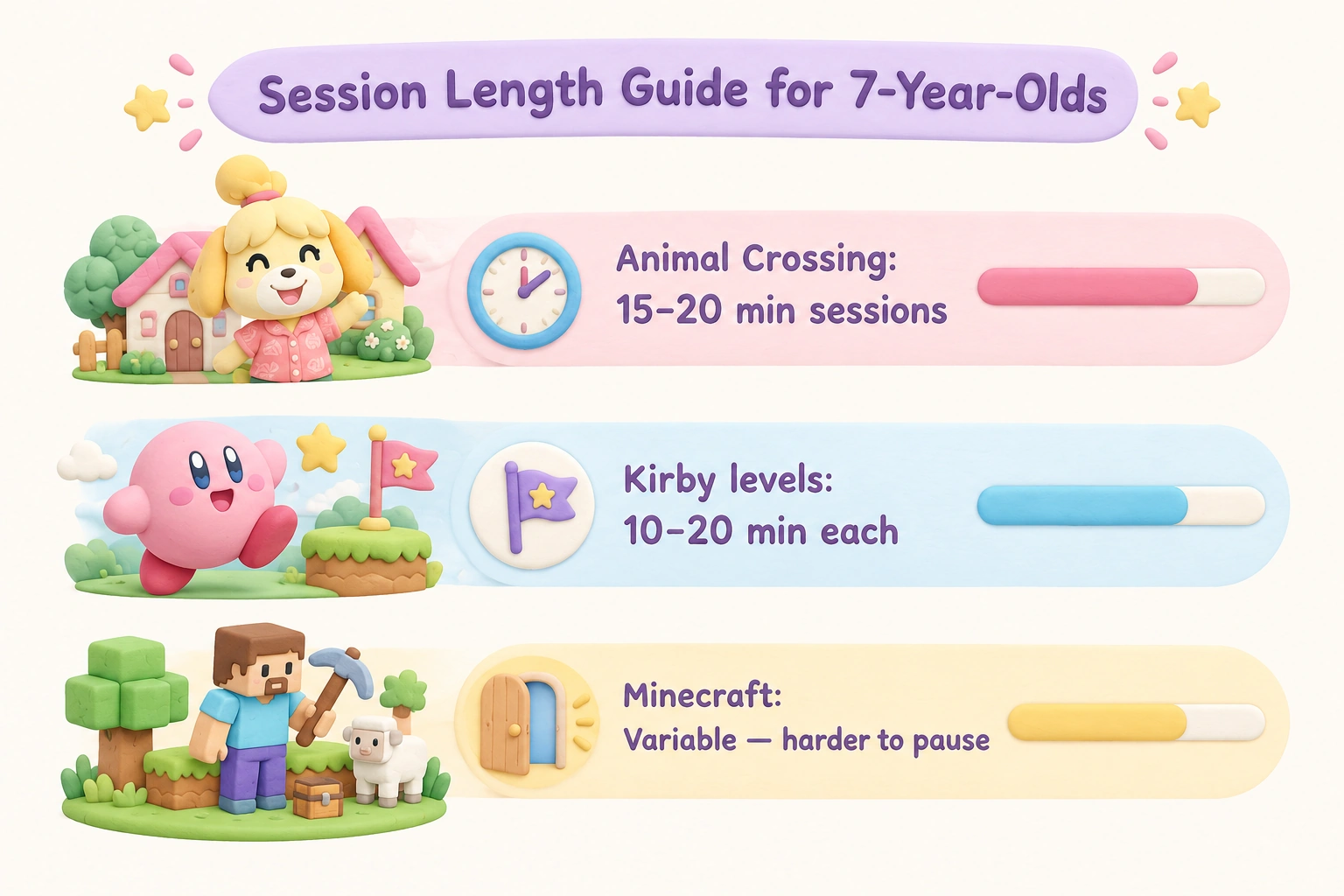
Games like Animal Crossing run on a real-time clock and can be played in short, satisfying sessions of 15–20 minutes. Platformers like Kirby and the Forgotten Land are structured around discrete levels that typically take 10–20 minutes each, making them easier to manage within a defined session. Open-world games like Minecraft can be harder to pause naturally, which is worth factoring in when setting expectations with a child. Using the Nintendo Switch Parental Controls app’s playtime alarm in combination with a consistent pre-agreed stopping rule tends to reduce conflict around session endings.
Frequently Asked Questions
What is the single best Nintendo Switch game for a 7-year-old who has never played before?
Mario Kart 8 Deluxe is the most commonly recommended starting point for new young players. Its steering assist feature makes it immediately accessible, the racing format is intuitive, and it works well as a shared family activity. Yoshi’s Crafted World is an equally gentle alternative for children who prefer exploration over competition.
Do 7-year-olds need a Nintendo Switch Online subscription?
Not necessarily. The majority of the games recommended in this article are fully enjoyable in local multiplayer mode without an online subscription. Nintendo Switch Online (currently around $20 per year for an individual plan) is required for online multiplayer in games like Mario Kart 8 Deluxe and Splatoon 3, but local co-op and solo play are unaffected. For most 7-year-olds, local play with family members is the more appropriate starting point anyway.
Are Nintendo Switch games safe for 7-year-olds in terms of online content?
Most recommended titles carry an ESRB Everyone rating and contain no inappropriate content. Online interactions carry more variability — children can encounter unknown players in online modes. The Nintendo Switch Parental Controls app allows parents to disable online communication features entirely, which is a sensible precaution for this age group. Restricting online play to local multiplayer removes this concern for most families.
My child gets frustrated easily. Which games are the most forgiving?
Yoshi’s Crafted World (with Mellow Mode), Kirby and the Forgotten Land, and Nintendo Switch Sports are the most forgiving options in this list. Animal Crossing has no fail states at all. Mario Kart 8 Deluxe with steering assist enabled is also very low-frustration. Avoid starting with Super Mario Odyssey or Minecraft’s Survival Mode if frustration tolerance is a concern.
Can my 7-year-old play these games on a Nintendo Switch Lite?
Yes, all the games listed are playable on the Switch Lite in handheld mode. The key limitation is that the Switch Lite does not connect to a TV and does not support detachable Joy-Con controllers, which means local multiplayer on a single console is not possible in the same way. Nintendo Switch Sports, which relies on motion controls with detachable Joy-Con, is not compatible with the Switch Lite.
How much reading is involved in these games?
Reading demands vary significantly. Mario Kart 8 Deluxe, Nintendo Switch Sports, and Yoshi’s Crafted World require minimal reading. Animal Crossing and Minecraft involve moderate reading through dialogue and menus. LEGO Star Wars: The Skywalker Saga involves some reading but uses visual humor effectively. For children who are still developing reading fluency, co-playing with a parent who can read aloud as needed is a practical solution.
Choosing the Right Game for Your 7-Year-Old
The strongest Nintendo Switch games for 7-year-olds share a few consistent qualities: they are genuinely fun without being overwhelming, they include meaningful assist options that reduce frustration without removing challenge, and they offer co-op or local multiplayer modes that make them suitable for family play. The best choice for any individual child will depend on their gaming experience, reading level, frustration tolerance, and personal interests — factors that vary considerably even within the same age group.
Parents who are new to gaming alongside their child may find that starting with a co-op title — Kirby and the Forgotten Land, Super Mario Bros. Wonder, or Mario Kart 8 Deluxe — creates a more connected experience than handing a child a solo game and stepping away. Using the Nintendo Switch Parental Controls app from the outset, setting clear session expectations, and choosing games with natural stopping points will help establish healthy gaming habits alongside the enjoyment. The Switch’s library at this age level is genuinely strong, and with the right starting point, gaming can be a meaningful source of shared family time rather than a source of conflict.

Take a short quiz to find out what your everyday choices say about your parenting style
When your child is curious about something new, what’s your instinct?
Take a short quiz to find out what your everyday choices say about your parenting style
“Can I download this app?” What happens next?
Take a short quiz to find out what your everyday choices say about your parenting style
When it comes to rules at home, which sounds most like you?
Take a short quiz to find out what your everyday choices say about your parenting style
If you could give your child one life skill today, what would you pick?
Take a short quiz to find out what your everyday choices say about your parenting style
Your child gets to choose what to watch. What would your ideal setup look like?
Take a short quiz to find out what your everyday choices say about your parenting style
Pick your parenting superpower ✨