20 Best Classroom Games for Kids: Quick No-Prep Activities

 Discover a Free Education Video App for Kids
Pastory uses AI to personalize educational video content based on your child’s interests and personality. Safe, engaging, and built for curious young minds. Sign up now to stay updated and enjoy early access with a free trial
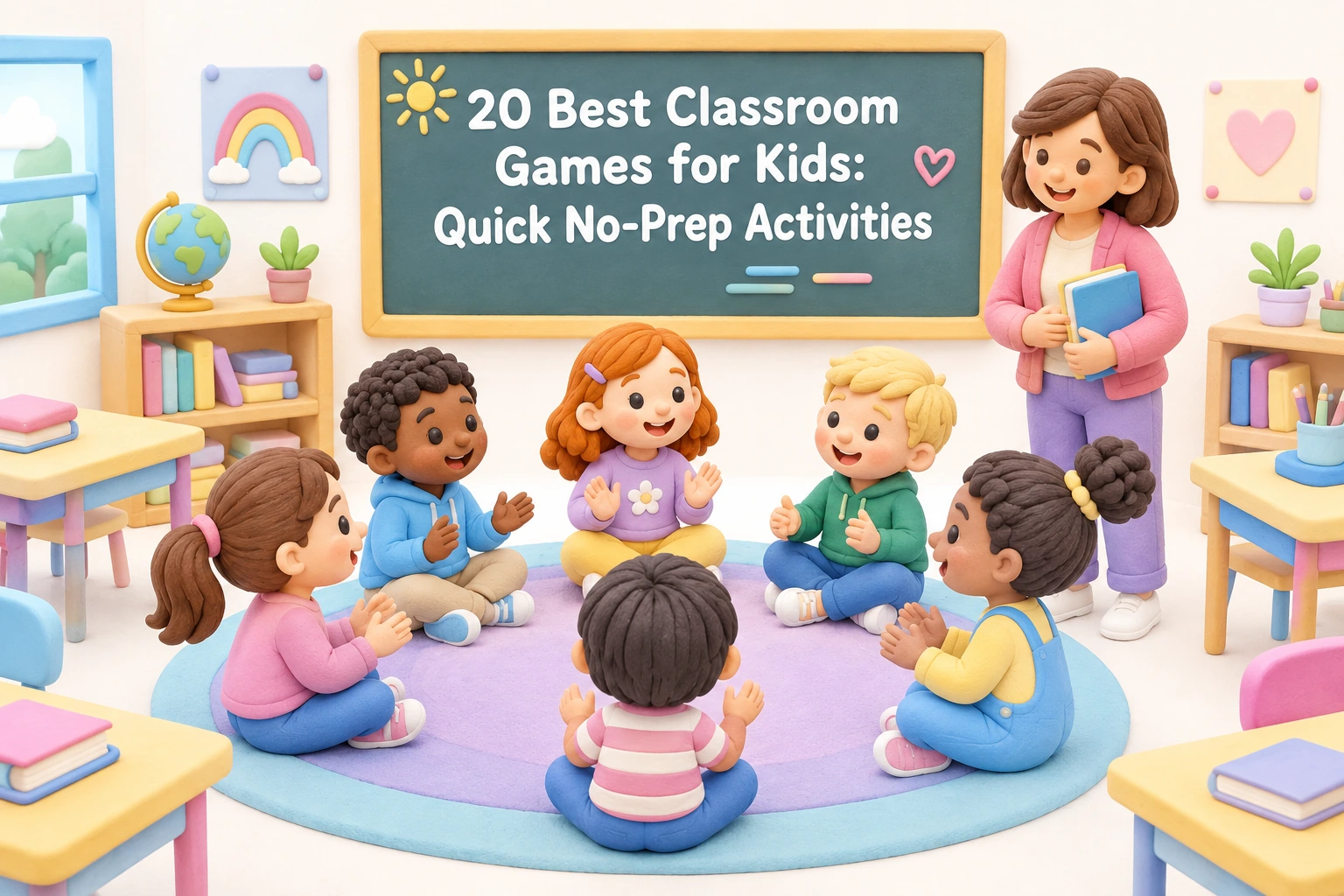
Finding classroom games that require zero preparation, keep every student engaged, and actually support learning is one of the most practical challenges teachers face daily. Whether you need a five-minute filler before lunch, a brain break between lessons, or a rainy-day indoor recess activity, the right game can reset attention, build classroom community, and reinforce academic skills — all without a single printed worksheet or special supply. This article presents 20 of the best no-prep classroom games for elementary students, organized by skill domain, with grade-level guidance, classroom management tips, and notes on how each game supports child development.
Key Takeaways
- No-prep classroom games can serve as effective brain breaks, transition activities, and indoor recess options without requiring any materials or advance planning.
- Game-based learning may support student engagement, content retention, and social-emotional development when games are matched to the right grade level and learning goal.
- Movement-based games help kinesthetic learners refocus, while word and thinking games reinforce vocabulary review, spelling practice, and critical thinking.
- Simple classroom management strategies — such as establishing signal words and clear rules before play — can prevent noise and disruption during whole-class games.
- Most games on this list are 100% no-tech, though a small number work best with optional music or a timer.
Why Classroom Games Support Learning and Development
Research in educational psychology consistently suggests that game-based learning can improve motivation, knowledge retention, and active participation compared with passive instruction alone. When students play structured games, they practice skills in a low-stakes context, which may reduce anxiety and increase willingness to take academic risks. Games also create natural opportunities for social-emotional learning: children practice turn-taking, self-regulation, listening, and collaboration without those skills being the explicit lesson. For elementary students in particular, whose attention spans are still developing, a well-timed classroom game can restore focus more effectively than a verbal reminder to pay attention.
The benefits are not automatic, however. Game-based learning works best when the game is matched to the developmental stage of the students, when clear expectations are set before play begins, and when the teacher actively monitors engagement rather than stepping back entirely. Games that are too complex for the grade level can increase frustration, while games that are too simple may not hold attention. The 20 games below have been selected because they are genuinely accessible across a range of elementary grade levels, require little or no prep, and can be adapted for different learning needs.
Quick-Reference: Game-to-Skill Mapping
| Game | Primary Skill | Grade Level | Time | Tech Needed? |
|---|---|---|---|---|
| Simon Says | Listening, self-control | K–3 | 3–5 min | No |
| Four Corners | Decision-making, movement | K–5 | 5–8 min | No |
| 20 Questions | Critical thinking, vocabulary | 2–5 | 5–10 min | No |
| Sparkle | Spelling fluency | 1–5 | 5–8 min | No |
| Around the World | Math facts review | 2–5 | 8–12 min | No |
| Silent Ball | Self-regulation, focus | 1–5 | 5–10 min | No |
| Freeze Dance | Movement, self-control | K–3 | 3–5 min | Optional music |
| I Spy | Observation, vocabulary | K–2 | 3–5 min | No |
| Heads Up Seven Up | Social skills, suspense | K–4 | 8–10 min | No |
| Telephone | Listening, communication | K–5 | 5–8 min | No |
| Would You Rather | Reasoning, SEL | K–5 | 3–5 min | No |
| Categories | Vocabulary, fast recall | 2–5 | 5–8 min | No |
| Mirror Me | Focus, coordination | K–3 | 3–5 min | No |
| Red Light Green Light | Self-regulation, movement | K–3 | 5–8 min | No |
| Charades | Creativity, teamwork | 2–5 | 8–12 min | No |
| Rock Paper Scissors Tournament | Social skills, probability | K–5 | 5–8 min | No |
| Vocabulary Pictionary | Vocabulary review, creativity | 2–5 | 8–12 min | No |
| Minute to Win It Challenges | Coordination, teamwork | 2–5 | 5–10 min | Optional timer |
| Scattergories (Verbal) | Critical thinking, vocabulary | 3–5 | 8–10 min | No |
| Multiplication Bingo (Mental) | Math facts, fast-paced review | 3–5 | 8–12 min | No |
Movement-Based Classroom Games
Movement-based games are among the most effective brain break tools available to elementary teachers. Brief physical activity has been associated with improved attention and on-task behavior in children, making these games particularly useful between academic blocks or after extended seated work. All five games below are whole-class games that require no materials and no advance preparation.
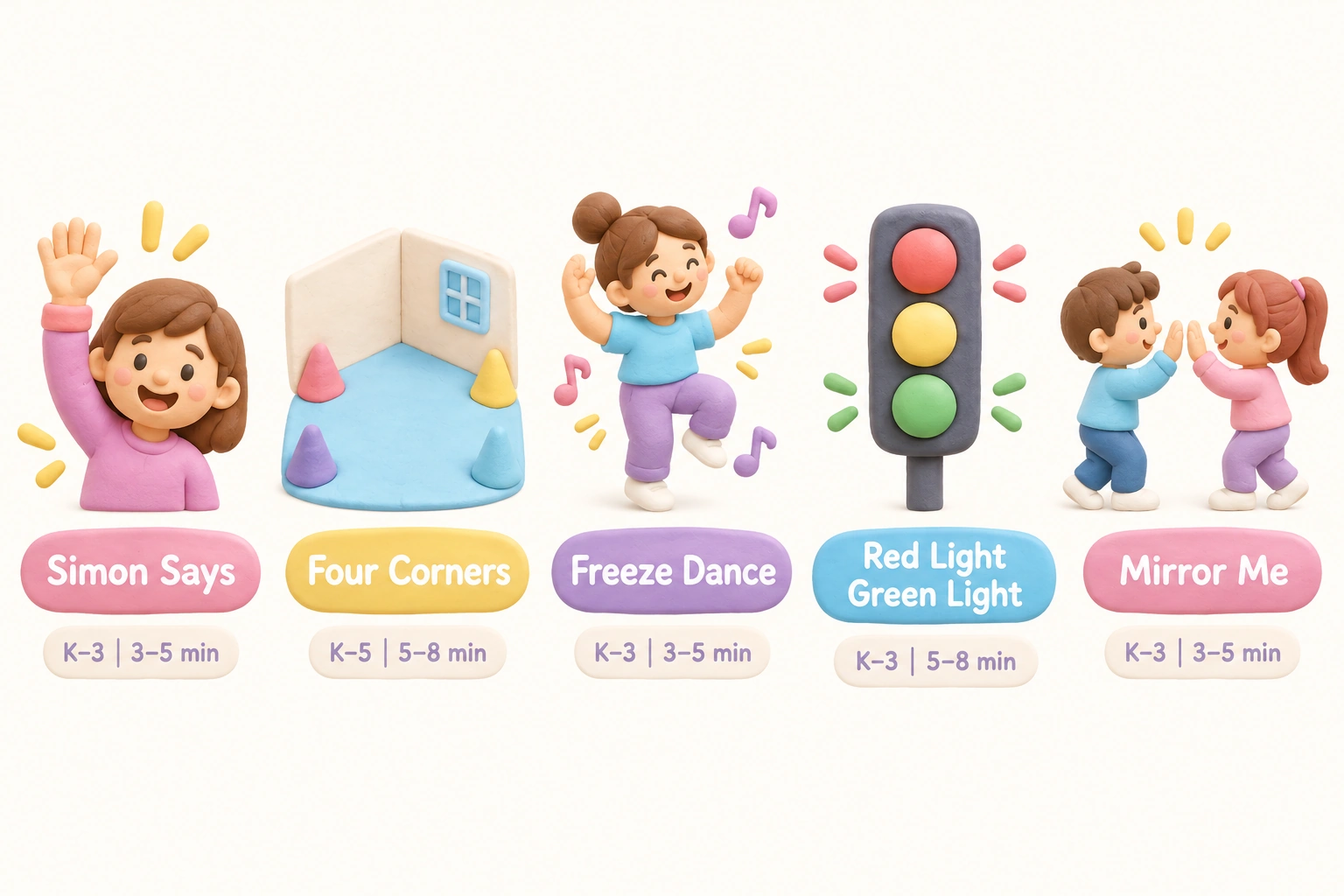
1. Simon Says
Best for: Grades K–3 | Time: 3–5 min | Supplies: None
Simon Says is a classic listening and self-control game in which the teacher (or a student leader) gives movement commands prefaced by “Simon says.” Students must only follow commands that include the phrase; those who move on an unprefaced command sit down. The game directly targets impulse control and auditory processing — two skills that underpin classroom readiness. To keep it inclusive, consider allowing seated students to continue playing with hand movements rather than eliminating them from the round.
Teacher tip: Use academic content as commands (“Simon says show me a right angle with your arms”) to turn this movement-based game into a quick content review.
2. Four Corners
Best for: Grades K–5 | Time: 5–8 min | Supplies: None
Label the four corners of the room 1 through 4. One student stands in the center with eyes closed while the rest quietly move to a corner. The center student calls a number; everyone in that corner sits down. Play continues until one student remains. Four Corners is an excellent transition activity because it gets students moving without requiring any materials. It also works well as an indoor recess game on rainy days when outdoor play is unavailable.
Teacher tip: For older students, replace corner numbers with vocabulary words, math terms, or historical figures to add a content layer.
3. Freeze Dance
Best for: Grades K–3 | Time: 3–5 min | Supplies: Optional music source
Students dance freely while music plays and freeze completely when it stops. Any student who moves after the music stops sits down. Freeze Dance is one of the most effective movement-based games for younger elementary students because it combines physical release with self-regulation practice. While music is optional, even clapping or a drum tap can serve as the signal, making this a genuinely zero-prep option in most classrooms.
4. Red Light Green Light
Best for: Grades K–3 | Time: 5–8 min | Supplies: None
One student acts as the traffic light at the front of the room. When they call “green light,” students move forward; “red light” means freeze. Students who move on red light return to the start. This game builds self-regulation and listening skills while providing meaningful physical movement. It is particularly well-suited as a morning meeting energizer or an end-of-day wind-down activity.
5. Mirror Me
Best for: Grades K–3 | Time: 3–5 min | Supplies: None
Students pair up and face each other. One partner leads slow movements while the other mirrors them exactly. After one minute, partners switch roles. Mirror Me is a calming, focus-building partner game that supports coordination and social connection. It works especially well as a transition activity after a high-energy lesson or before a quiet independent work period. For students with sensory sensitivities, this game is low-noise and low-stimulation compared with most movement games.
Word and Language Classroom Games
Word games serve double duty in the elementary classroom: they function as engaging quick classroom activities while simultaneously reinforcing vocabulary review, spelling practice, and oral language skills. The games below require no printed materials and can be adapted to any subject area by changing the word bank or category.
6. Sparkle
Best for: Grades 1–5 | Time: 5–8 min | Supplies: None
Students stand in a circle. The teacher calls out a spelling word, and students take turns saying one letter each. The student who says the final letter calls out “Sparkle!” and the next student sits down. Sparkle is one of the most popular no-prep classroom games for spelling fluency because it creates a fast-paced, low-pressure format for spelling practice. Students who are out can continue listening and self-checking, which maintains engagement even after elimination.
Teacher tip: Use current spelling list words to align the game directly with weekly curriculum goals.
7. 20 Questions
Best for: Grades 2–5 | Time: 5–10 min | Supplies: None
One student thinks of a person, place, animal, or object. The class asks up to 20 yes-or-no questions to identify it. This game builds critical thinking, deductive reasoning, and question-formation skills — all valuable academic language competencies. For English language learners, 20 Questions provides structured, low-stakes speaking practice within a supportive whole-class context.
8. Telephone
Best for: Grades K–5 | Time: 5–8 min | Supplies: None
Students sit in a line or circle. The teacher whispers a phrase to the first student, who passes it along by whispering to the next. The final student says the phrase aloud, and the class compares it to the original. Telephone is a memorable way to illustrate the importance of careful listening and clear communication. For older students, use content-specific phrases (a science definition, a historical fact) to add curriculum relevance.
9. I Spy
Best for: Grades K–2 | Time: 3–5 min | Supplies: None
One student selects a visible object in the classroom and says, “I spy with my little eye something beginning with the letter ___” (or a color, shape, or descriptive word). Classmates take turns guessing. I Spy is an ideal five-minute filler for younger students because it requires no setup, builds observation and vocabulary skills, and can be played from any seating arrangement. It is also naturally inclusive for students with mobility limitations since no movement is required.
10. Categories (Verbal Scattergories)
Best for: Grades 2–5 | Time: 5–8 min | Supplies: None
The teacher names a category (animals, countries, foods, verbs) and a starting letter. Students take turns calling out a word that fits both criteria. Anyone who repeats a word or cannot think of one sits down. This fast-paced review game sharpens vocabulary recall and category knowledge while keeping the whole class alert. It can be themed to any subject: science categories (types of rocks, body systems), social studies categories (state capitals, continents), or language arts categories (adjectives, compound words).
Math and Academic Review Games
Academic review games are among the most efficient uses of classroom game time because they combine student engagement with direct content reinforcement. The games below function as fast-paced review games that can replace traditional drill practice without requiring any printed materials.
11. Around the World
Best for: Grades 2–5 | Time: 8–12 min | Supplies: None
One student stands next to a seated classmate. The teacher asks a math fact or review question; the first student to answer correctly moves to the next desk. The goal is to travel “around the world” by beating every classmate. Around the World is a classic fast-paced review game for math facts, but it works equally well for vocabulary review, science facts, or any content with clear right-or-wrong answers. To reduce anxiety for students who struggle with speed, consider allowing all students to write answers on mini whiteboards simultaneously before revealing them.
Teacher tip: Pair Around the World with a “personal best” challenge for students who feel intimidated by competition — they track how many desks they travel each round rather than competing against peers.
12. Multiplication Bingo (Mental Math Version)
Best for: Grades 3–5 | Time: 8–12 min | Supplies: None (students draw their own grid)
Students draw a 4×4 or 5×5 grid and fill each square with a number from a specified range (for example, 1–50 for multiplication facts up to 5×10). The teacher calls multiplication problems aloud; students cross off the product if it appears on their grid. The first student to complete a row calls “Bingo!” This mental math version of Multiplication Bingo requires no printed cards and takes under two minutes to set up, making it a genuinely zero-prep option for grades 3–5.
13. Scattergories (Verbal, Whole-Class)
Best for: Grades 3–5 | Time: 8–10 min | Supplies: None
The teacher announces a letter and five categories. Students have 60 seconds to mentally generate one answer per category starting with that letter. Students share answers aloud; any answer that no other student chose earns a point. This verbal version of Scattergories builds critical thinking, creative vocabulary use, and quick recall. It is particularly effective as a morning meeting warm-up or an end-of-day activity because it is low-energy but mentally engaging.
Social-Emotional and Team-Building Games
Social-emotional learning (SEL) does not require a dedicated curriculum block. Many no-prep classroom games naturally build the skills that SEL programs target — empathy, cooperation, self-regulation, and communication — simply through structured play. The games below are particularly effective for building classroom community at the start of the year or after a long break.
14. Would You Rather
Best for: Grades K–5 | Time: 3–5 min | Supplies: None
The teacher poses a choice between two options (“Would you rather have the ability to fly or be invisible?”). Students move to one side of the room based on their answer, then a few students share their reasoning. Would You Rather is one of the most versatile quick classroom activities because it requires no materials, works at any grade level, and naturally generates respectful discussion. It is an excellent morning meeting opener and a low-risk way for quieter students to share opinions in a structured format.
15. Heads Up Seven Up
Best for: Grades K–4 | Time: 8–10 min | Supplies: None
Seven students stand at the front. The rest put their heads down and extend one thumb. The seven students quietly move through the room, each pressing one thumb down. When all seven have chosen someone, the chosen students try to guess who pressed their thumb. Heads Up Seven Up is a beloved classroom game because it is calm, quiet, and self-managing — making it an ideal indoor recess game or reward-day activity. It also builds social awareness and observation skills in a low-pressure format.
16. Rock Paper Scissors Tournament
Best for: Grades K–5 | Time: 5–8 min | Supplies: None
Students pair up and play Rock Paper Scissors. The winner stays in the game; the loser becomes the winner’s enthusiastic supporter, cheering them on through subsequent rounds. The tournament continues until one champion remains, surrounded by the entire class cheering. This whole-class game builds sportsmanship, community spirit, and graceful losing — all important social-emotional skills. It is also one of the most genuinely joyful no-prep classroom games available, suitable for any grade level and any time of day.
Creative and Thinking Games
Creative games engage students who may not respond as strongly to competitive or movement-based formats. These games support divergent thinking, imagination, and collaborative problem-solving — skills that complement structured academic learning and are increasingly recognized as important outcomes of elementary education.
17. Charades
Best for: Grades 2–5 | Time: 8–12 min | Supplies: None
One student acts out a word, phrase, book title, or concept without speaking while classmates guess. Charades builds creativity, nonverbal communication, and vocabulary in a highly engaging format. For curriculum alignment, restrict the word bank to current unit vocabulary, historical figures, or science concepts. Students who are shy about performing can be paired with a partner for team charades, which reduces individual pressure while maintaining engagement.
18. Vocabulary Pictionary
Best for: Grades 2–5 | Time: 8–12 min | Supplies: Whiteboard or paper (optional)
One student draws a vocabulary word or concept while classmates guess. If a whiteboard is unavailable, students can draw in the air or on paper. Vocabulary Pictionary is one of the most effective vocabulary review games because it requires students to think deeply about word meaning in order to represent it visually. Research in cognitive science suggests that generating a visual representation of a concept may strengthen memory encoding compared with simply reading or writing a definition.
Teacher tip: Use this game as a low-stakes formative assessment — the drawings reveal which concepts students understand well and which need reteaching.
19. Minute to Win It Challenges
Best for: Grades 2–5 | Time: 5–10 min | Supplies: Optional timer
Students compete in 60-second physical or mental challenges — stacking books with one hand, balancing a pencil on a finger, or recalling as many state capitals as possible. Minute to Win It challenges work well as a reward-day or Fun Friday activity because they are inherently motivating and can be tailored to any skill level. The competitive element is low-stakes since the challenge is against the clock rather than against peers, which makes this format more inclusive for students who find direct competition stressful.
20. Two Truths and a Lie
Best for: Grades 3–5 | Time: 5–8 min | Supplies: None
Each student shares three statements about themselves (or about a curriculum topic): two true, one false. Classmates vote on which statement is the lie. Two Truths and a Lie is an outstanding back-to-school icebreaker and classroom community builder, but it also works as a content review game when students create statements about science facts, historical events, or math concepts. It builds critical thinking, persuasive reasoning, and careful listening — all within a genuinely fun and engaging format.
Classroom Management Tips for Game Time
Even the best no-prep classroom games can become chaotic without a few simple management strategies in place. Establishing a clear signal — a clap pattern, a raised hand, or a specific word — before any game begins gives students a reliable way to know when to stop and listen. Reviewing two or three non-negotiable rules (voices at a certain level, hands to yourself, freeze when the signal sounds) takes under 60 seconds and significantly reduces disruption during play.
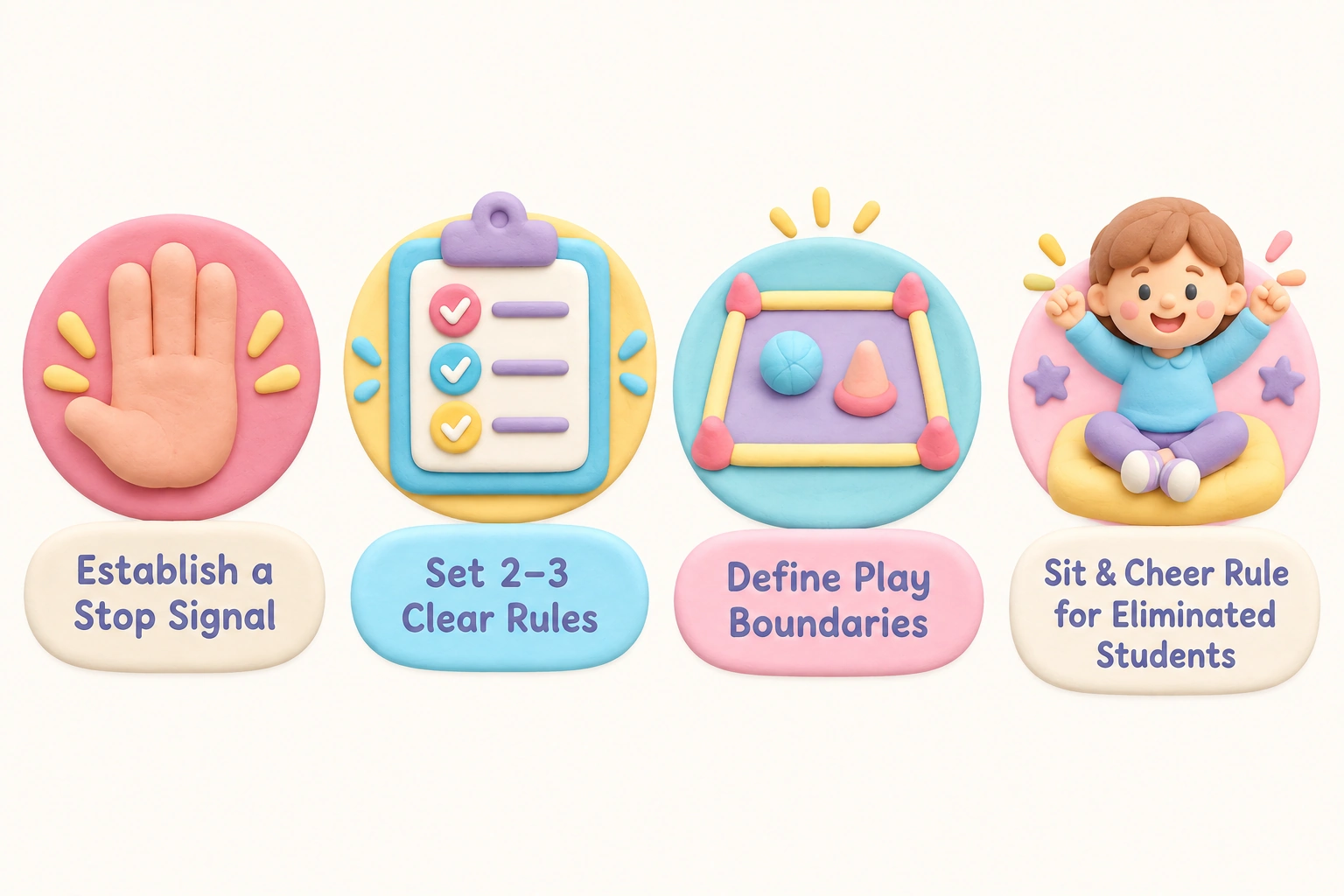
For movement-based games, define the physical boundaries of the play space before students leave their seats. For competitive games, briefly discuss what respectful winning and losing look like. For whole-class games that involve elimination, consider a “sit and cheer” rule so that eliminated students remain engaged rather than disengaged. These small adjustments protect both the learning value of the game and the emotional safety of every student in the room.
Students with sensory sensitivities may find high-noise or high-movement games overwhelming. Offering a quiet observer role or a modified participation option — such as keeping score or acting as the game referee — allows these students to remain part of the classroom community without being forced into an uncomfortable situation. Similarly, for students with mobility limitations, most games on this list can be adapted to seated participation with minimal modification.
Adapting Games for Different Grade Levels and Learners
Most of the games in this list span a wide grade-level range precisely because they can be adjusted in complexity without changing the core format. For younger students in kindergarten through grade 2, simplify vocabulary, reduce the pace, and prioritize participation over competition. For upper elementary students in grades 3 through 5, increase the academic content layer, introduce time pressure, and allow student leaders to run the game rather than the teacher.
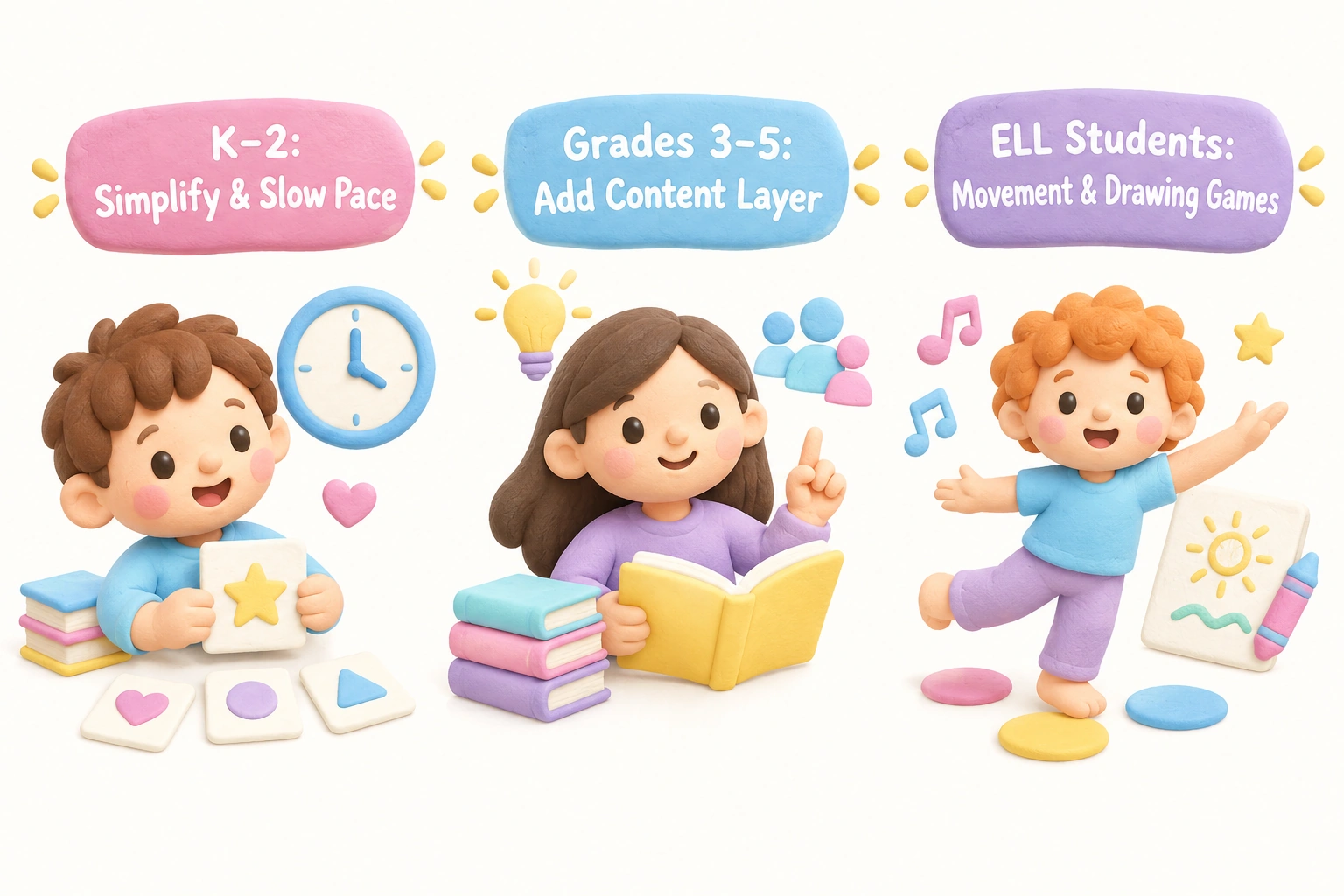
For English language learners, games that involve physical movement, drawing, or nonverbal communication — such as Charades, Mirror Me, and Vocabulary Pictionary — provide meaningful participation opportunities that do not depend entirely on English fluency. For advanced learners, adding a creative constraint (“your answer must be a word no one else has used”) increases the cognitive demand without requiring different materials or a separate activity.
Frequently Asked Questions
What are the easiest no-prep classroom games to start with?
Simon Says, Would You Rather, and Four Corners are the easiest starting points because they require no materials, have simple rules that can be explained in under a minute, and work across a wide range of grade levels. All three are effective brain break options that can be used on the same day you read about them.
How do I keep classroom games from getting too noisy or rowdy?
Establish a clear stop signal before the game begins and practice it once before play starts. Set a specific noise level expectation (“indoor voices only” or “silent game”) and briefly explain what happens if the signal is ignored. Games like Silent Ball and Heads Up Seven Up are naturally self-regulating because the rules themselves require quiet.
Which games work best for indoor recess on rainy days?
Four Corners, Heads Up Seven Up, Silent Ball, and Rock Paper Scissors Tournament are particularly well-suited for indoor recess because they use classroom space efficiently, require no materials, and are self-managing once students know the rules. All four can run with minimal teacher supervision once the class is familiar with the format.
Can these games be used as academic review tools?
Yes. Around the World, Sparkle, Multiplication Bingo, Vocabulary Pictionary, and Scattergories are all designed to reinforce specific academic content. Even games that are not explicitly academic — such as 20 Questions or Charades — can be adapted by restricting the word bank to current curriculum vocabulary or concepts.
How long should a classroom game last?
Most effective brain break games run between 3 and 8 minutes. Review games and team-building games can extend to 10–12 minutes without losing student engagement. Stopping a game while students are still enjoying it — rather than waiting until energy drops — tends to leave a positive impression and makes students more receptive the next time a game is introduced.
Are these games appropriate for students with special educational needs?
Many games on this list can be adapted for students with a range of learning needs. Games that involve movement can be modified for seated participation; games that require fast verbal responses can allow written or gestured answers instead. Consulting with a special education co-teacher or support staff before introducing a new game format is always a reasonable step when students have specific documented needs.
Which Classroom Games Are Worth Adding to Your Regular Routine?
The most valuable no-prep classroom games are the ones that serve multiple purposes at once: they give students a genuine break, reinforce a skill, and strengthen the social fabric of the classroom — all without requiring any preparation time from an already stretched teacher. Starting with three or four games that match your grade level and your students’ energy patterns is more sustainable than trying to introduce all 20 at once.
Movement-based games like Simon Says and Four Corners work well as daily brain breaks. Word games like Sparkle and 20 Questions are natural fits for morning meeting or transition slots. Review games like Around the World and Multiplication Bingo can replace traditional drill practice on days when student engagement is low. Social-emotional games like Would You Rather and Two Truths and a Lie are particularly effective at the start of the school year or after a long holiday break when classroom community needs rebuilding.
Game-based learning is not a replacement for structured instruction, but used intentionally and consistently, these quick classroom activities can meaningfully support student engagement, content retention, and the kind of positive classroom culture that makes learning easier for everyone in the room.

Take a short quiz to find out what your everyday choices say about your parenting style
When your child is curious about something new, what’s your instinct?
Take a short quiz to find out what your everyday choices say about your parenting style
“Can I download this app?” What happens next?
Take a short quiz to find out what your everyday choices say about your parenting style
When it comes to rules at home, which sounds most like you?
Take a short quiz to find out what your everyday choices say about your parenting style
If you could give your child one life skill today, what would you pick?
Take a short quiz to find out what your everyday choices say about your parenting style
Your child gets to choose what to watch. What would your ideal setup look like?
Take a short quiz to find out what your everyday choices say about your parenting style
Pick your parenting superpower ✨