12 Best Christmas Games for Preschoolers: Party, Classroom and App Picks

 Discover a Free Education Video App for Kids
Pastory uses AI to personalize educational video content based on your child’s interests and personality. Safe, engaging, and built for curious young minds. Sign up now to stay updated and enjoy early access with a free trial
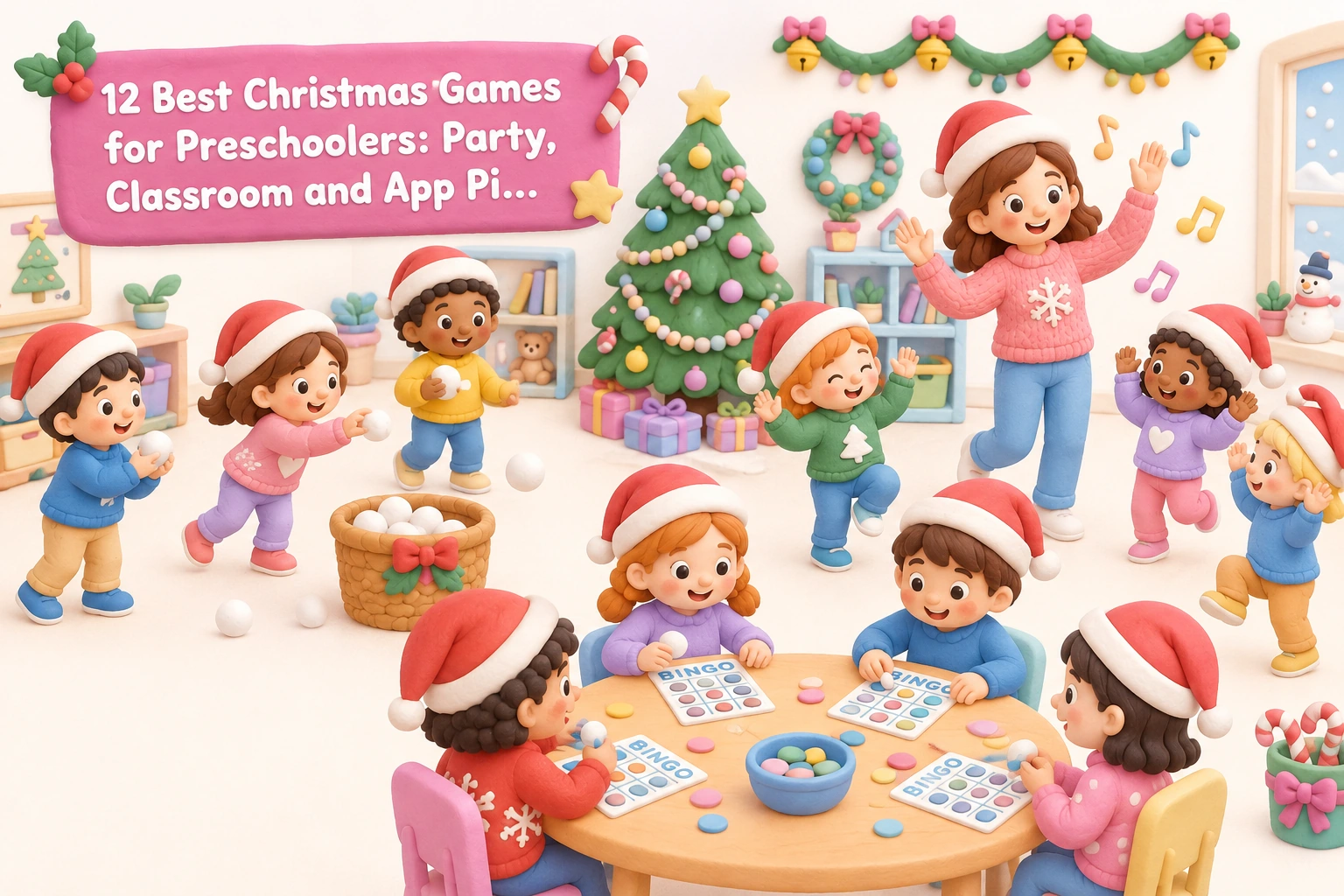
Finding the right christmas games for preschoolers means balancing genuine fun with the developmental realities of three- to five-year-olds: short attention spans, emerging turn-taking skills, and a need for movement. Whether you are planning a preschool christmas party, looking for circle time activities, or searching for a screen-based option to round out a rainy afternoon, this guide covers twelve carefully chosen games across three settings — party, classroom, and app — with notes on what each one actually builds in young children.
Key Takeaways
- The most effective christmas games for preschoolers combine physical movement or hands-on engagement with simple rules that children aged three to five can follow independently.
- Active party games such as freeze dance and snowball toss support gross motor skills and self-regulation, while quieter classroom games like christmas bingo and santa says build early literacy, number recognition, and turn-taking.
- Low-prep and no-prep games are practical for busy teachers and parents; many of the best options require only common household items or free printables.
- A small selection of age-appropriate christmas apps for kids can complement physical play, but screen time should remain within AAP-aligned guidelines and ideally involve a caregiver.
- Adapting games for different ability levels and group sizes makes holiday activities more inclusive and enjoyable for every child in the room.
Why Christmas Games Matter for Preschool Development
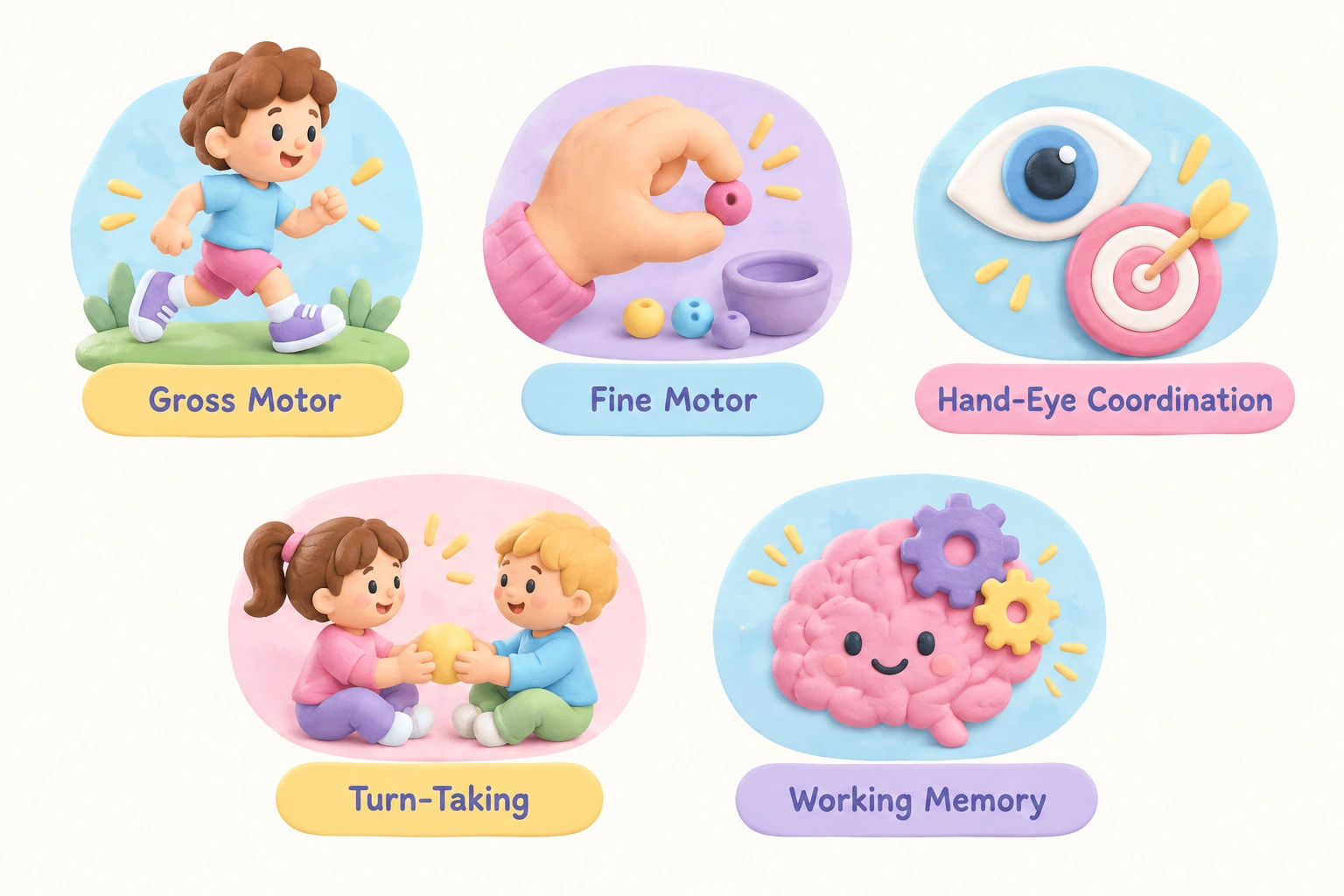
Play is the primary vehicle through which preschool-aged children develop cognitive, social, and physical skills. Holiday-themed games add motivational novelty — the excitement of Christmas naturally increases engagement — but the developmental benefits come from the structure of the game itself, not the theme alone. Games that involve movement may support gross motor skills such as balance and coordination. Games requiring children to wait for their turn, follow spoken instructions, or remember rules can strengthen executive function, including impulse control and working memory. Social games build turn-taking and early cooperation skills that researchers consistently link to later school readiness.
Age-appropriateness matters significantly here. A three-year-old is still developing the ability to hold a rule in mind while acting on it, which is why games with one or two simple rules work far better than complex multi-step activities. Four- and five-year-olds can manage slightly more structure, mild competition, and short waiting periods. Keeping this developmental window in mind helps adults choose games that challenge children just enough without tipping into frustration.
Christmas Party Games for Preschoolers: Active and Movement-Based
Active games are the backbone of any successful preschool christmas party. Young children need to move, and channelling that energy into structured play reduces the chaos that often accompanies large group gatherings. The games below require minimal materials and can be adapted for small living rooms or larger classroom spaces.
1. Freeze Dance — Christmas Edition
Freeze dance is one of the most reliably successful christmas party games for preschoolers because it requires no materials beyond a playlist of Christmas music and open floor space. Children dance freely while the music plays and freeze in place the moment it stops. The developmental payoff is substantial: freeze dance builds gross motor skills through free movement, supports self-regulation as children learn to stop on cue, and provides a natural brain break between quieter activities. For younger preschoolers aged two to three, simply pausing and resuming is enough. Older children aged four to five can be challenged to freeze in a specific pose — like a reindeer or a snowflake — adding body awareness and creative thinking.
2. Santa Says (Simon Says Variant)
Santa says replaces the traditional caller’s name with Santa, making the classic Simon Says game feel seasonally fresh. One adult or child acts as Santa and gives instructions such as “Santa says touch your nose” or “Santa says jump like a reindeer.” Children must only follow instructions prefaced with “Santa says” — acting on instructions without the phrase means sitting out briefly. This game builds listening comprehension, impulse control, and body awareness. It is a strong circle time option for preschool classrooms because it requires no materials and can be played with groups of any size. For younger children, the elimination element can be removed so everyone continues playing throughout.
3. Snowball Toss
Snowball toss uses crumpled white paper balls or white pom-poms as indoor “snowballs” that children toss into a bucket, basket, or hula hoop on the floor. The game can be played individually, in pairs, or as a relay. Snowball toss develops hand-eye coordination and gross motor throwing skills, and the adjustable distance makes it easy to calibrate for different ability levels. For a classroom setting, children can count how many snowballs land in the target, adding a simple numeracy element. Budget-conscious teachers and parents will appreciate that the only materials needed are scrap paper and a container.
4. Santa Hat Musical Chairs
This is the familiar musical chairs format with Santa hats placed on chairs instead of the chairs themselves being removed. Children walk around a circle of hats while Christmas music plays; when the music stops, each child grabs a hat. One hat is removed each round. Santa hat musical chairs supports listening skills, spatial awareness, and the early social-emotional skill of managing mild disappointment when a child does not secure a hat. To keep the game inclusive and low-stress for younger preschoolers, consider a non-elimination version where children simply find any hat and the game continues without anyone sitting out.
5. Ornament Spoon Race
Children carry a plastic ornament balanced on a large spoon from one end of a space to the other without dropping it. The ornament spoon race is an excellent fine motor and hand-eye coordination activity that also builds concentration and patience. Plastic ornaments are safer than glass and widely available at dollar stores. For a party relay format, children can pass the spoon to the next teammate. For a classroom version, each child can complete the course individually while others cheer, removing the competitive pressure. The slow, deliberate movement required makes this a useful calming activity between higher-energy games.
6. Pin the Nose on Rudolph
Pin the nose on rudolph adapts the classic pin the tail on the donkey format for Christmas. A large image of Rudolph is posted on the wall, and children are gently blindfolded or asked to close their eyes before trying to place a red pom-pom nose in the correct spot. This game builds spatial reasoning, body awareness, and the ability to follow simple directional instructions. It also introduces children to the concept of perspective — understanding that what they see with eyes open differs from what they can navigate without sight. For children who are uncomfortable with blindfolds, allowing them to simply close their eyes is an easy adaptation.
Classroom Christmas Party Games: Structured and Educational
Classroom christmas party games work best when they feel festive but still align with the learning goals teachers maintain throughout the year. The games in this section are low-prep or no-prep, manageable in small group or whole-class formats, and designed to reinforce developmental skills without feeling like formal instruction.
7. Christmas Bingo
Christmas bingo uses picture-based bingo cards featuring holiday images — a stocking, a candy cane, a star, a snowman — rather than numbers, making it accessible to children who are not yet reading. Children use candy canes, jingle bells, or small pom-poms as markers. Christmas bingo builds visual discrimination, listening comprehension, and early matching skills. It also provides a structured opportunity for turn-taking and patience as children wait for their image to be called. Free printable christmas bingo cards are widely available online, making this a genuinely no-prep option once printed. For pre-K children aged four to five, number-based bingo cards can introduce number recognition in a low-pressure context.
8. Christmas Memory Match
Christmas memory match uses pairs of holiday-themed picture cards placed face-down in a grid. Children take turns flipping two cards at a time, trying to find matching pairs. This game directly supports working memory, visual attention, and concentration — cognitive skills that underpin early reading and mathematics. The turn-taking structure also gives children repeated practice in waiting and managing the mild frustration of a non-matching turn. For younger preschoolers, use a smaller grid of six to eight cards. Older pre-K children can manage twelve or more. Printable card sets are available at low or no cost, and the game works equally well in small groups or as a paired activity.
9. Christmas Scavenger Hunt
A christmas scavenger hunt can be adapted for almost any setting. In a classroom, hide small holiday-themed objects or picture cards around the room and give children a simple picture checklist to find each item. At home, the hunt can extend to multiple rooms. The christmas scavenger hunt builds problem-solving, visual scanning, and early literacy when picture checklists include printed words alongside images. It also encourages physical movement and independent exploration. For younger children, the hunt works best in pairs with an adult nearby. For older preschoolers, small teams of two or three children can work together, adding a cooperative social element.
10. Christmas I Spy
Christmas I Spy can be played with a printed I Spy sheet featuring a busy holiday scene, or simply by looking around a decorated classroom or home. One player says “I spy with my little eye something that is red and round” and others search for the matching object. This game builds visual attention, descriptive language, and early vocabulary. It is a strong low-prep option for circle time because it requires no materials beyond a decorated environment or a single printed sheet. For children who are still developing colour and shape vocabulary, the adult can model the clue format before inviting children to take a turn as the caller.
Developmental Skills at a Glance
Understanding which developmental skills each game targets helps teachers and parents choose activities that complement what children are working on at a given stage. The table below maps each game to its primary skill areas and indicates the preparation level required.
| Game | Primary Skills | Age Range | Prep Level |
|---|---|---|---|
| Freeze Dance | Gross motor, self-regulation | 2–5 | No-prep |
| Santa Says | Listening, impulse control | 3–5 | No-prep |
| Snowball Toss | Hand-eye coordination, numeracy | 2–5 | Low-prep |
| Santa Hat Musical Chairs | Listening, spatial awareness | 3–5 | Low-prep |
| Ornament Spoon Race | Fine motor, concentration | 3–5 | Low-prep |
| Pin the Nose on Rudolph | Spatial reasoning, body awareness | 3–5 | Low-prep |
| Christmas Bingo | Visual matching, turn-taking | 3–5 | Low-prep |
| Christmas Memory Match | Working memory, attention | 3–5 | Low-prep |
| Christmas Scavenger Hunt | Problem-solving, early literacy | 3–5 | Low-prep |
| Christmas I Spy | Visual attention, vocabulary | 2–5 | No-prep |
| Google Santa Tracker | Geography curiosity, counting | 4–5 | No-prep |
| Christmas Puzzle Apps | Fine motor (touch), problem-solving | 3–5 | No-prep |
Christmas Apps for Kids: Digital Picks with Developmental Context
Digital options represent a smaller but legitimate category of christmas games for preschoolers, particularly useful for rainy days, travel, or as a short wind-down activity. The key distinction for parents and educators is between passive consumption — watching holiday videos without interaction — and genuinely interactive engagement that requires a child to make decisions, solve problems, or respond to prompts. The apps below lean toward the interactive end of that spectrum.
11. Google Santa Tracker (Web and Android)
Google Santa Tracker is a free, browser-based and Android platform that becomes active in the weeks leading up to Christmas. It offers a collection of short mini-games and interactive activities including simple coding puzzles, geography exploration, and counting games. For preschoolers aged four to five, the simpler activities — such as dragging and dropping gifts or watching animated elves — provide light interactive engagement without requiring reading skills. The platform is ad-free and does not require account creation, which addresses common parent concerns about data privacy. Google Santa Tracker works best as a co-viewing or co-playing experience with a caregiver, who can narrate what is happening and extend the learning through conversation.
12. Christmas Puzzle and Matching Apps
A range of christmas-themed puzzle and matching apps are available on iOS and Android platforms, typically featuring holiday images that children drag, tap, or sort. When selecting a christmas app for kids in this category, look for apps that are free of in-app purchases, contain no advertising, and offer adjustable difficulty levels. High-quality examples in this genre present children with simple jigsaw puzzles, picture matching tasks, or shape-sorting activities using Christmas imagery. These apps may support fine motor development through touch-screen interaction and reinforce the same visual matching skills practised in physical christmas memory match games. Screen time for preschoolers should remain within the guidance provided by organisations such as the American Academy of Pediatrics, which recommends limiting recreational screen use and prioritising interactive, high-quality content over passive viewing. A session of ten to fifteen minutes with a caregiver present is a reasonable approach for this age group.
Screen Time Guidance for Holiday App Use
When christmas apps for kids are used thoughtfully, they can complement rather than replace physical play. The most important factor is not the app itself but how it is used. Co-engagement — where a caregiver sits alongside the child, asks questions, and connects the on-screen activity to real-world concepts — significantly increases the developmental value of any digital experience. An adult asking “How many presents did the elf wrap?” or “What colour is that ornament?” transforms a passive tapping exercise into a language-rich interaction.
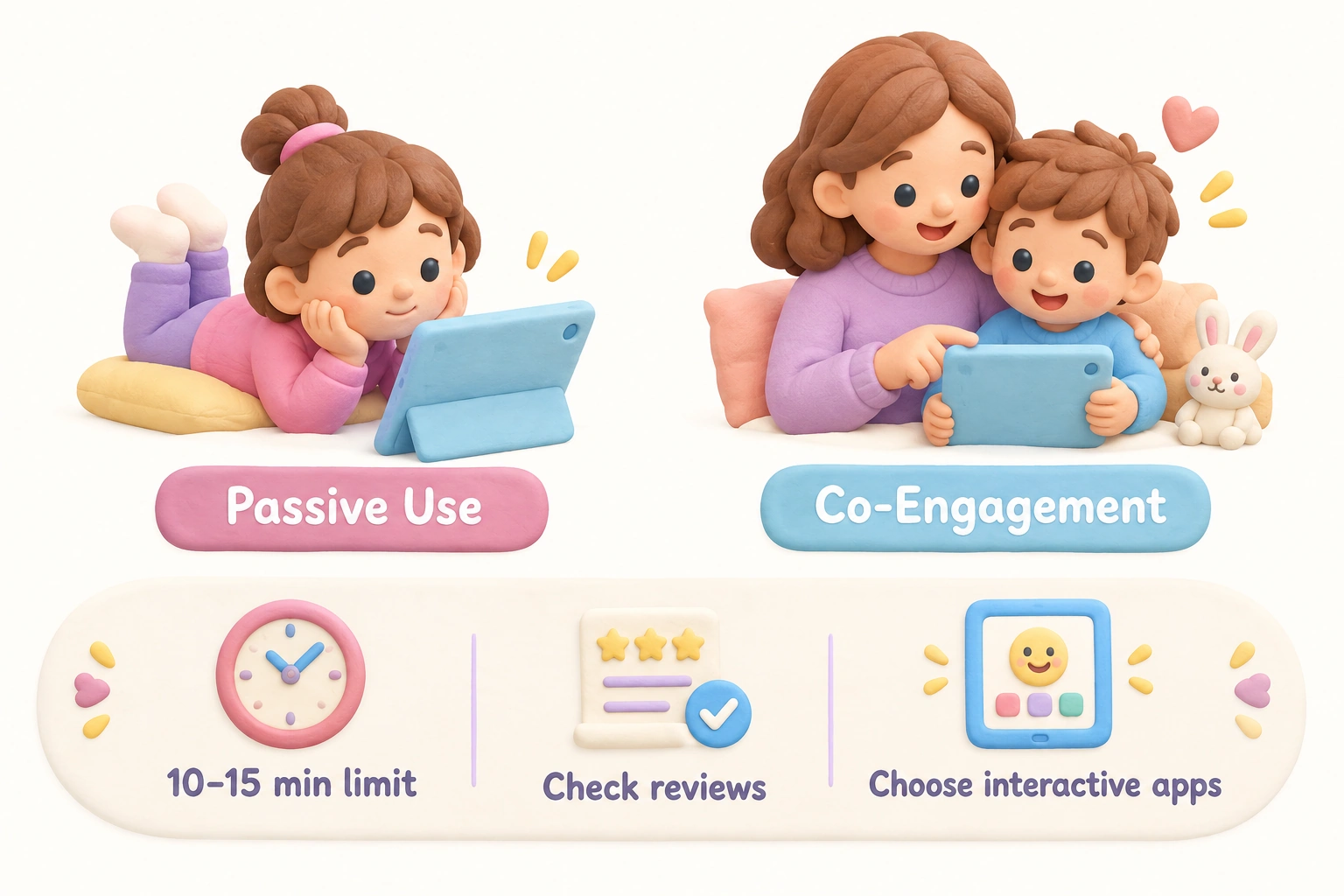
Parents should also be aware that not all holiday apps marketed for young children meet the same quality standards. Apps that rely heavily on reward animations, autoplay features, or escalating difficulty without child input tend to encourage passive consumption rather than active thinking. Before downloading, checking reviews on trusted platforms such as Common Sense Media can help identify apps that are genuinely age-appropriate and educationally sound. Setting a consistent time limit and transitioning to a physical activity afterward helps children understand that screen time is one part of a varied day rather than the default activity.
Adapting Games for Different Needs and Group Sizes
One practical gap in most christmas game guides is specific advice on adaptation. Not every child in a preschool classroom or family gathering will have the same physical abilities, sensory tolerances, or developmental stage. A few straightforward adjustments can make most of the games above accessible to a wider range of children.
For children with sensory sensitivities, the blindfold in pin the nose on rudolph can be replaced with simply closing eyes, and freeze dance can be offered at a lower volume for children who find loud music overwhelming. For children with mobility differences, snowball toss can be played from a seated position, and the ornament spoon race can be adapted so the child rolls the ornament along a table rather than carrying it. For mixed-age groups that include toddlers alongside preschoolers, no-prep games like freeze dance and christmas I spy work well because the rules can be applied loosely for younger children without disrupting the experience for older ones.
Group size also affects game choice. Santa says and freeze dance scale easily to large groups. Christmas memory match and the ornament spoon race work better in small groups of two to six children where each child gets frequent turns and waiting time stays short. For a classroom christmas party with twenty or more children, rotating stations — one active game, one table game, one craft — keeps engagement high and reduces the restlessness that comes from extended waiting.
Planning a Simple Preschool Christmas Party Game Sequence
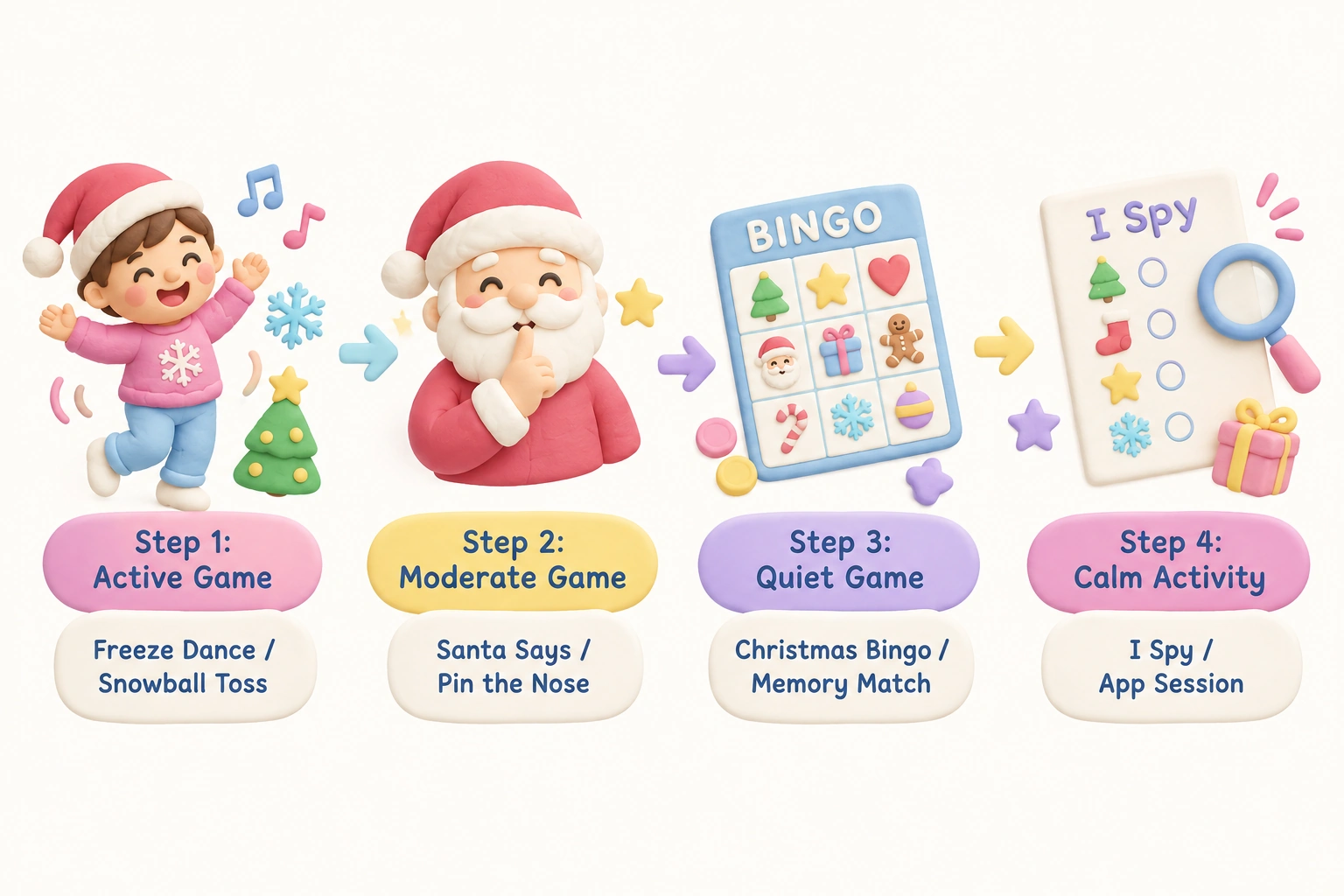
A structured game order helps a preschool christmas party flow smoothly and prevents the energy spikes and crashes that can derail young children’s enjoyment. A practical sequence for a sixty-to-ninety-minute party might look like this: begin with a high-energy active game such as freeze dance or snowball toss as children arrive and settle in; transition to a moderate-energy game like santa says or pin the nose on rudolph once the full group has gathered; move to a quieter table activity such as christmas bingo or christmas memory match before snack time; and close with a calm, open-ended activity like christmas I spy or a short app session if devices are available. This arc — active, moderate, quiet, calm — mirrors the natural rhythm of preschool programming and helps children regulate their energy across the event.
Frequently Asked Questions
What makes a christmas game age-appropriate for preschoolers?
Age-appropriate christmas games for preschoolers have one or two simple rules, require no reading, involve short waiting periods, and allow for movement or hands-on engagement. Games that can be adapted for non-elimination play are particularly well-suited to three- and four-year-olds who are still developing the emotional resilience to handle being “out.”
How many games should I plan for a preschool christmas party?
For a sixty-to-ninety-minute party, three to four games is typically sufficient. Preschoolers engage most deeply when they can repeat an activity or explore it at their own pace rather than rushing through a long list. Build in transition time between games and keep snack time as a natural break point.
Can toddlers join in christmas games designed for preschoolers?
Many of the games listed here — particularly freeze dance, snowball toss, and christmas I spy — work well for toddlers aged two to three with minor adjustments. Toddlers benefit from looser rule enforcement and more adult guidance. Games with elimination rounds or complex turn-taking are better reserved for children aged four and above.
Are christmas apps safe for preschoolers?
Safety depends on the specific app and how it is used. Look for apps that are free of advertising and in-app purchases, do not collect personal data, and offer genuinely interactive rather than purely passive content. Co-engagement with a caregiver significantly improves both the safety and the developmental value of any app session.
How do I keep christmas games inclusive for children with different abilities?
Most physical games can be adapted by adjusting distance, removing elimination, offering seated alternatives, or reducing sensory intensity such as lowering music volume. Framing every game as cooperative rather than competitive also reduces the pressure on children who may find certain physical or cognitive tasks more challenging.
What are the best no-prep christmas games for a classroom?
Santa says, freeze dance, and christmas I spy require no materials at all and can be started immediately. Christmas scavenger hunts require only a few minutes of hiding objects beforehand. These no-prep christmas games are particularly useful for teachers who need a quick activity during transition times or unexpected schedule gaps.
Choosing the Right Christmas Games for Your Preschooler or Classroom
The twelve games covered in this guide span a range of settings, preparation levels, and developmental goals — which means there is no single “best” option for every child or group. For a home christmas party with a small group of mixed-age children, active no-prep games like freeze dance and santa says are the most practical starting point. For a preschool classroom, a combination of circle time games such as christmas bingo and santa says alongside a fine motor activity like the ornament spoon race gives children variety across developmental domains. For families who want to include a short digital component, Google Santa Tracker or a well-chosen puzzle app can round out the day when used briefly and with caregiver involvement.
What matters most is matching the game to the children in front of you — their current developmental stage, their energy level, and the size and setup of your space. The holiday theme adds genuine excitement, but the lasting value comes from the skills children practise along the way: moving their bodies, waiting their turn, solving a small problem, and sharing a moment of fun with the people around them. Starting with one or two games from each category and observing how children respond will quickly reveal which formats work best for your particular group.
Take a short quiz to find out what your everyday choices say about your parenting style
When your child is curious about something new, what’s your instinct?
Take a short quiz to find out what your everyday choices say about your parenting style
“Can I download this app?” What happens next?
Take a short quiz to find out what your everyday choices say about your parenting style
When it comes to rules at home, which sounds most like you?
Take a short quiz to find out what your everyday choices say about your parenting style
If you could give your child one life skill today, what would you pick?
Take a short quiz to find out what your everyday choices say about your parenting style
Your child gets to choose what to watch. What would your ideal setup look like?
Take a short quiz to find out what your everyday choices say about your parenting style
Pick your parenting superpower ✨