Best Educational Nintendo Switch Games for Kids

 Discover a Free Education Video App for Kids
Pastory uses AI to personalize educational video content based on your child’s interests and personality. Safe, engaging, and built for curious young minds. Sign up now to stay updated and enjoy early access with a free trial
The Nintendo Switch has become one of the most versatile gaming platforms available to families, and a growing library of titles genuinely supports children’s cognitive development, problem-solving skills, and subject-area learning. This guide helps parents and caregivers identify which educational Nintendo Switch games are worth exploring, how they align with different developmental stages, and how to use them responsibly alongside other learning activities.
Key Takeaways
- Several Nintendo Switch titles are designed specifically to build skills in math, coding, logic, science, and language — making them a meaningful addition to a child’s learning environment when chosen thoughtfully.
- Age-appropriateness matters: games that challenge a six-year-old may frustrate a four-year-old and bore a twelve-year-old. Matching a title to your child’s developmental stage improves both engagement and learning outcomes.
- Many mainstream Switch games — including Minecraft, Animal Crossing, and Super Mario Maker 2 — offer genuine educational value even though they are not marketed as edutainment products.
- Screen time guidance from organizations such as the American Academy of Pediatrics recommends consistent limits and caregiver co-engagement, regardless of content quality.
- The ESRB rating system provides a useful starting point for age-appropriate selection, but parents should also review gameplay mechanics and learning goals before purchasing.
What Makes a Nintendo Switch Game Educational?
The term “educational” covers a wide spectrum when applied to games. At one end sit purpose-built edutainment titles that teach specific curriculum content — arithmetic, spelling, biology — through structured gameplay. At the other end are mainstream games that develop transferable cognitive skills such as spatial reasoning, strategic planning, and creative problem-solving without any explicit teaching intent. Both categories have genuine value, and the most useful approach for parents is to consider what skill or developmental domain a game actually exercises rather than relying solely on whether it carries an educational label.
Gamified learning works best when it provides immediate, meaningful feedback, adjusts difficulty to the child’s current level, and keeps the child intrinsically motivated. Research in educational psychology consistently finds that children learn more effectively when they are engaged and when errors feel like part of the game rather than a source of shame. The Nintendo Switch’s combination of TV mode, handheld mode, and tabletop mode also means children can engage in different physical contexts — at a desk, on a journey, or at a table with a sibling — which can support varied learning habits.
Educational Nintendo Switch Games by Age Group
The table below maps widely available Switch titles to approximate age ranges, primary subject areas, and the core skills each game may help develop. Age ranges are approximate and should be adjusted based on your child’s individual reading level, attention span, and prior gaming experience.
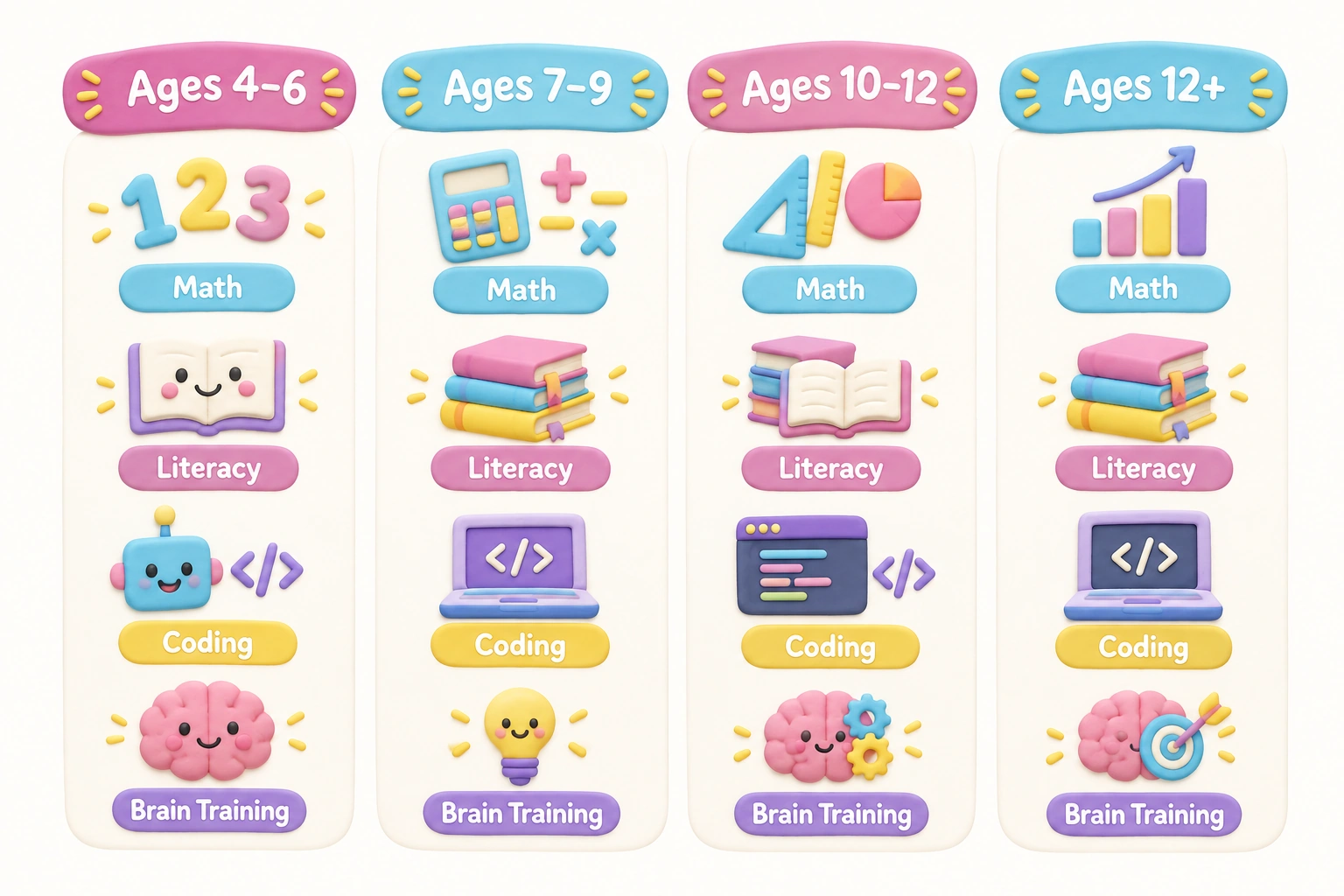
| Game Title | Approximate Age Range | Subject / Domain | Key Skills |
|---|---|---|---|
| Numbala | 4–7 | Mathematics | Number recognition, basic arithmetic |
| MathLand | 5–9 | Mathematics | Addition, subtraction, multiplication, division |
| Captain Toad: Treasure Tracker | 5–10 | Spatial reasoning, logic | Puzzle-solving, spatial awareness, patience |
| Letter Quest Remastered | 7–12 | Literacy | Vocabulary, spelling, word recognition |
| BodyQuest | 7–12 | Science / Biology | Human anatomy, science comprehension |
| Scribblenauts Mega Pack | 7–12 | Literacy, creativity | Vocabulary, creative problem-solving |
| Island Saver | 7–12 | Financial literacy, environment | Basic finance, sustainability, resource management |
| Game Builder Garage | 9–14 | Coding and programming | Conditionals, loops, inputs, outputs, game design |
| Big Brain Academy: Brain vs. Brain | 8+ | Cognitive skills | Memory, visual reasoning, reflexes, logic |
| 51 Worldwide Games | 8+ | Strategy, culture | Critical thinking, rules comprehension, geography |
| Dr Kawashima’s Brain Training | 10+ | Brain training | Mental arithmetic, memory, processing speed |
| Minecraft | 7+ | STEM, creativity | Engineering, spatial reasoning, resource planning |
| Super Mario Maker 2 | 8+ | Logic, design | Problem-solving, physics concepts, game design |
| Animal Crossing: New Horizons | 7+ | Life skills, social skills | Financial literacy, time management, emotional awareness |
Purpose-Built Educational Titles Worth Knowing
Several Switch games are designed from the ground up as learning tools, making them a natural starting point for parents specifically seeking curriculum-aligned content.
MathLand and Numbala: Mathematics Through Adventure
MathLand frames arithmetic practice as a pirate adventure, asking children to solve addition, subtraction, multiplication, and division problems to progress through levels. The game adjusts difficulty incrementally, which may help children build confidence before tackling harder operations. Numbala targets a younger audience — broadly ages four to seven — using number recognition and basic counting within a colourful, low-pressure environment. Neither title replaces structured classroom instruction, but both can provide useful supplementary practice for children who respond well to skill-based gameplay.
BodyQuest: Human Biology Made Accessible
BodyQuest takes players on a journey through the human body, covering anatomy and biological systems in a format designed for middle-primary-aged children. The game presents science content through exploration and light puzzle mechanics, which may support comprehension and retention better than passive reading for some learners. It is one of the few Switch titles to address science and biology directly, making it a useful option for parents looking to extend STEM skills beyond mathematics and coding.
Letter Quest Remastered: Vocabulary and Spelling
Letter Quest Remastered is a word-building RPG in which players defeat enemies by spelling words from a set of available letters. The game naturally expands vocabulary and reinforces spelling patterns, and its role-playing game structure provides ongoing motivation through character progression. It is broadly suitable for children aged seven and above who have foundational reading skills, though the difficulty can be adjusted to suit different levels.
Island Saver: Financial Literacy and Environmental Themes
Island Saver, developed in partnership with NatWest, introduces children to basic financial concepts — saving, spending, and budgeting — through an eco-adventure in which players rescue animals and restore polluted islands. The environmental and sustainability themes are woven throughout the gameplay, giving children exposure to ideas about recycling and resource conservation in a context that feels purposeful rather than didactic. This title addresses a genuine content gap: financial literacy and environmental education are rarely covered by other Switch games, yet both are increasingly recognized as important life skills. Island Saver is available free through the Nintendo eShop, which removes the cost barrier for families.
STEM and Coding Games on Nintendo Switch
For parents specifically seeking to develop coding and programming skills, the Switch library offers a small but meaningful selection of titles that introduce computational thinking in age-appropriate ways.
Game Builder Garage: Visual Programming for Children
Game Builder Garage is one of the most substantive coding and programming experiences available on any home console. The game uses a visual programming environment called Nodons — connectable character-like nodes that represent inputs, outputs, conditionals, and loops — to guide children through the logic of game design. Nintendo’s structured lesson sequence walks players through increasingly complex programming concepts, and a free-build mode allows children to apply what they have learned to create their own games. The game is broadly appropriate for children aged nine and above, though motivated younger children with adult support may engage with the introductory lessons. Game Builder Garage develops genuine computational thinking skills, including the ability to break problems into steps, identify cause-and-effect relationships, and debug errors — all of which are foundational to formal coding education.
Nintendo Labo: Hands-On STEM Learning
Nintendo Labo Toy-Con kits combine physical cardboard construction with Switch software, asking children to build functional objects — a piano, a fishing rod, a robot suit — and then understand how the Joy-Con controllers interact with the structures they have made. This hands-on learning approach bridges physical making and digital interaction, supporting basic STEM concepts including engineering principles, cause and effect, and simple electronics logic. Labo is particularly well suited to children aged six to twelve, and the construction element means it naturally involves caregivers or older siblings, supporting co-engagement. The physical components do add to the cost, and the cardboard structures require careful handling.
Super Mario Maker 2: Informal Coding Logic
Super Mario Maker 2 is not marketed as an educational game, but its level-design tools introduce children to many of the same logical principles that underpin formal coding: sequencing, conditional triggers, cause-and-effect chains, and iterative testing. Children who design levels must think about how a player will experience their creation, which develops perspective-taking and systems thinking alongside the more obvious creativity benefits. For children who find dedicated coding tools too abstract, Super Mario Maker 2 can serve as an accessible entry point to design thinking.
Brain Training and Cognitive Development Games
Brain training games target cognitive skills such as working memory, processing speed, visual reasoning, and mental arithmetic. The evidence base for commercial brain training products is mixed — research suggests that improvements tend to be task-specific rather than broadly transferable — but these games can still provide structured mental exercise and may be particularly engaging for children who enjoy measurable progress.
Big Brain Academy: Brain vs. Brain
Big Brain Academy: Brain vs. Brain is one of the strongest family-friendly multiplayer options in the educational Switch library. Up to four players compete across five categories — Think, Memorize, Analyze, Compute, and Identify — using activities that test memory, visual reasoning, reflexes, and basic arithmetic. The game’s handicap system allows players of different ages and abilities to compete meaningfully, making it genuinely suitable for mixed-age family sessions. The multiplayer format also adds a social dimension that purely solo brain training games lack, and shared play sessions with caregivers are associated with greater engagement and more natural conversation about what children are learning.
Dr Kawashima’s Brain Training for Nintendo Switch
Dr Kawashima’s Brain Training is a long-running series that uses rapid mental arithmetic, memory tasks, and reading exercises to provide daily cognitive workouts. The Switch version adds multiplayer modes and uses the Joy-Con for some activities. The series is broadly aimed at older children and adults — the mental arithmetic tasks in particular assume solid foundational numeracy — making it more appropriate for children aged ten and above. As with all brain training products, parents should treat it as one component of a varied cognitive diet rather than a standalone solution.
Mainstream Games with Genuine Educational Value
Some of the most educationally rich experiences on the Nintendo Switch come from games that are not classified as educational at all. Parents who dismiss these titles may miss significant learning opportunities.
Minecraft: STEM Skills Through Open-World Building
Minecraft on Nintendo Switch supports spatial reasoning, resource planning, basic engineering, and creative problem-solving through its open-ended survival and creative modes. Children who engage seriously with Minecraft often develop a practical understanding of geometry, material properties, and systems thinking. The game also has an active community dimension that can support collaboration and communication skills, though online multiplayer requires appropriate parental supervision and privacy settings. Minecraft is Nintendo Switch Lite compatible and is one of the most widely played games among children aged seven to fourteen globally.
Animal Crossing: New Horizons: Life Skills and Emotional Awareness
Animal Crossing: New Horizons introduces children to financial literacy concepts — earning, saving, and managing in-game debt — alongside time management, community building, and emotional awareness through its gentle social simulation. The game’s real-time calendar means children experience consequences of planning and patience in a low-stakes environment. While Animal Crossing is not a curriculum tool, its life-skills content is meaningful and the game’s calm, creative tone makes it one of the most emotionally accessible titles on the platform for younger players.
Captain Toad: Treasure Tracker and 51 Worldwide Games
Captain Toad: Treasure Tracker develops spatial awareness and logical thinking through compact, three-dimensional puzzle levels that require children to rotate their perspective mentally before acting. The game is accessible to children as young as five with some support and becomes progressively more challenging. 51 Worldwide Games offers a broad collection of traditional board, card, and tabletop games — including chess, mahjong, and backgammon — that develop critical thinking, rule comprehension, and strategic planning. The cultural variety of the games also provides informal exposure to geography and global traditions.
Understanding ESRB Ratings for Educational Game Selection
The Entertainment Software Rating Board (ESRB) provides age-based content ratings that are a useful first filter when selecting age-appropriate games. The most relevant ratings for children are Early Childhood (EC), designed for ages three and above with no content unsuitable for young children, and Everyone (E), suitable for all ages with minimal content concerns. Everyone 10+ (E10+) indicates content that may be more appropriate for children aged ten and above. Parents should use ESRB ratings as a starting point rather than a definitive guide, since ratings reflect content rather than developmental suitability or educational quality. A game rated E may still be too cognitively complex for a five-year-old, or too simple to engage a ten-year-old.
Screen Time Guidance for Parents Using Educational Games
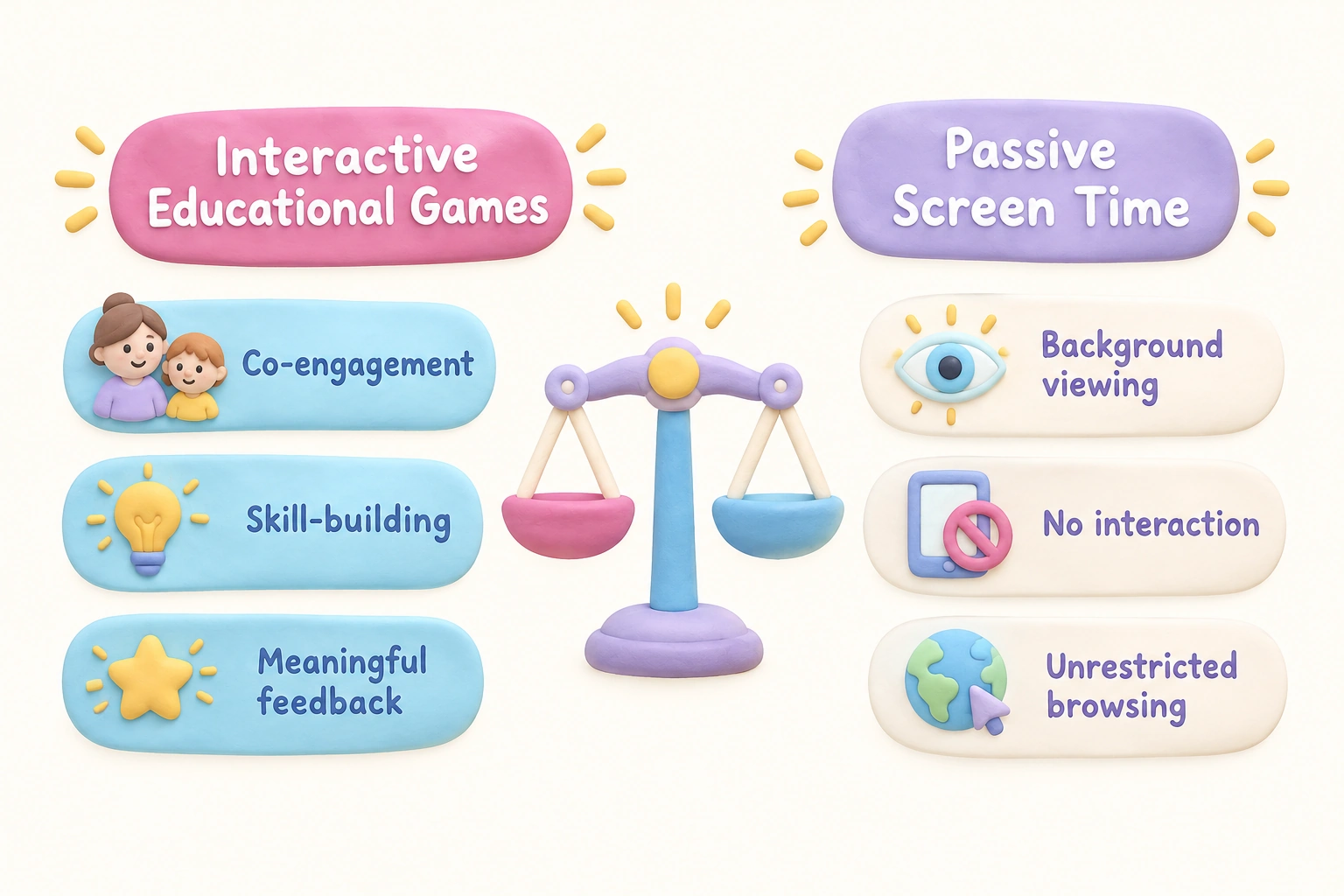
The American Academy of Pediatrics recommends that caregivers prioritize content quality over raw screen time quantity, and that interactive digital media — including educational games — should ideally involve co-engagement with a caregiver, particularly for younger children. For children aged two to five, the AAP suggests limiting recreational screen time to one hour per day of high-quality content. For children aged six and above, consistent limits and balance with offline activities are recommended, though specific daily limits are left to family judgment.
Educational Nintendo Switch games are interactive rather than passive, which places them in a more favorable category than background television or unrestricted video browsing. However, interactive screen time still displaces other valuable activities — physical play, reading, face-to-face social interaction, and unstructured creative play — if it becomes the dominant leisure activity. A practical approach is to treat educational Switch games as one component of a varied daily routine rather than a primary learning tool, and to set consistent session lengths that the child understands in advance.
Parents can increase the educational value of any gaming session by playing alongside their child occasionally, asking open questions about what the child is doing and why, and connecting in-game concepts to real-world examples. A child who has just solved a geometry puzzle in Captain Toad may be more receptive to a conversation about shapes than they would be in a formal learning context.
Nintendo Switch 2 Compatibility: What Parents Should Know
The Nintendo Switch 2 launched in 2025, and most existing Switch game cartridges and Nintendo eShop purchases are compatible with the new hardware through Nintendo’s backward compatibility support, though parents should verify individual titles before assuming compatibility. Educational games purchased for the original Switch — including Game Builder Garage, Big Brain Academy, and Island Saver — are expected to remain playable on Switch 2 hardware. New titles developed specifically for Switch 2 may offer enhanced graphics and performance, but the educational content library for the new platform is still developing. Families considering a hardware upgrade should check Nintendo’s official compatibility guidance before purchasing.
Frequently Asked Questions
What makes a Nintendo Switch game genuinely educational?
A genuinely educational game should actively develop a specific skill or area of knowledge — such as arithmetic, vocabulary, coding logic, or spatial reasoning — through its core mechanics rather than as a superficial overlay. Look for games where the learning content is integral to progression, where difficulty adjusts to the child’s level, and where the child receives meaningful feedback on their performance. Games that simply add a quiz between action sequences are less likely to produce durable learning than those where the educational content drives the gameplay itself.
Are there educational Switch games suitable for children aged four to six?
Yes, though the options are more limited for this age group. Numbala is designed for early number recognition and counting at preschool level. Captain Toad: Treasure Tracker is accessible to children aged five and above with caregiver support. Nintendo Labo kits can engage children in this age range through the physical construction element, though the software interaction is more suited to ages six and above. For children under five, co-play with a caregiver is strongly recommended to support comprehension and manage frustration.
Is Minecraft a genuinely educational game?
Minecraft supports a range of skills that have educational value — spatial reasoning, resource management, basic engineering, and creative problem-solving — though it is not a curriculum-aligned tool. Its educational value depends significantly on how a child engages with it: open-ended building and survival challenges tend to develop more transferable skills than passive exploration. Some schools use Minecraft Education Edition as a teaching tool, which suggests the platform has recognized learning potential, but the standard Switch version does not include the structured lesson content of the education-specific version.
How do I choose the right educational Switch game for my child’s age and skill level?
Start by identifying the developmental domain you want to support — mathematics, literacy, coding, science, or cognitive skills — and then match a title to your child’s current ability level rather than their age alone. Check the ESRB rating as a content filter, read gameplay descriptions carefully, and if possible watch short gameplay videos before purchasing. Many educational titles are available through the Nintendo eShop, where some — including Island Saver — are free. Starting with a free or lower-cost title reduces the risk of purchasing a game that does not suit your child’s learning style.
Is the Nintendo Switch a good educational tool overall?
The Nintendo Switch is a capable platform for educational gaming, particularly because its flexible play modes support different learning contexts and its library includes a meaningful range of skill-building titles. However, it is a gaming console first, and its educational value depends entirely on which games are selected and how they are used. The Switch works best as a supplementary learning tool alongside reading, physical play, and direct instruction rather than as a primary educational resource. Parental involvement in game selection and occasional co-play significantly increases the educational return from any title.
Can educational Switch games help children with different learning styles?
Educational games on the Switch can accommodate a range of learning preferences. Visual learners may benefit from games with strong graphical representations of concepts, such as BodyQuest’s anatomical diagrams. Kinesthetic learners may engage more with Nintendo Labo’s physical construction activities. Children who learn through repetition and measurable progress may respond well to brain training titles like Big Brain Academy. However, no single game or platform suits every child, and outcomes vary depending on individual temperament, attention span, and prior knowledge. If a child consistently disengages from a game after a short period, it may not be the right match regardless of its educational credentials.
Choosing Educational Switch Games That Fit Your Family’s Goals
The Nintendo Switch library offers a genuinely useful range of educational and skill-building games, from purpose-built mathematics and coding tools to mainstream titles with meaningful cognitive benefits. The most effective approach is to select games based on a specific developmental goal — whether that is building arithmetic fluency, introducing programming logic, expanding vocabulary, or developing spatial reasoning — rather than choosing broadly on the basis of an educational label.
Age-appropriateness, ESRB ratings, and your child’s current skill level are all worth considering before purchasing. Free options such as Island Saver on the Nintendo eShop allow families to explore educational gaming without financial commitment. For younger children especially, occasional co-play with a caregiver tends to increase both engagement and the transfer of in-game learning to real-world understanding. Used thoughtfully and within consistent screen time boundaries, educational Nintendo Switch games can be a valuable — if modest — part of a child’s broader learning environment.

Take a short quiz to find out what your everyday choices say about your parenting style
When your child is curious about something new, what’s your instinct?
Take a short quiz to find out what your everyday choices say about your parenting style
“Can I download this app?” What happens next?
Take a short quiz to find out what your everyday choices say about your parenting style
When it comes to rules at home, which sounds most like you?
Take a short quiz to find out what your everyday choices say about your parenting style
If you could give your child one life skill today, what would you pick?
Take a short quiz to find out what your everyday choices say about your parenting style
Your child gets to choose what to watch. What would your ideal setup look like?
Take a short quiz to find out what your everyday choices say about your parenting style
Pick your parenting superpower ✨