15 Best Kindergarten Games: Online, Classroom and Hands-On Picks

 Discover a Free Education Video App for Kids
Pastory uses AI to personalize educational video content based on your child’s interests and personality. Safe, engaging, and built for curious young minds. Sign up now to stay updated and enjoy early access with a free trial
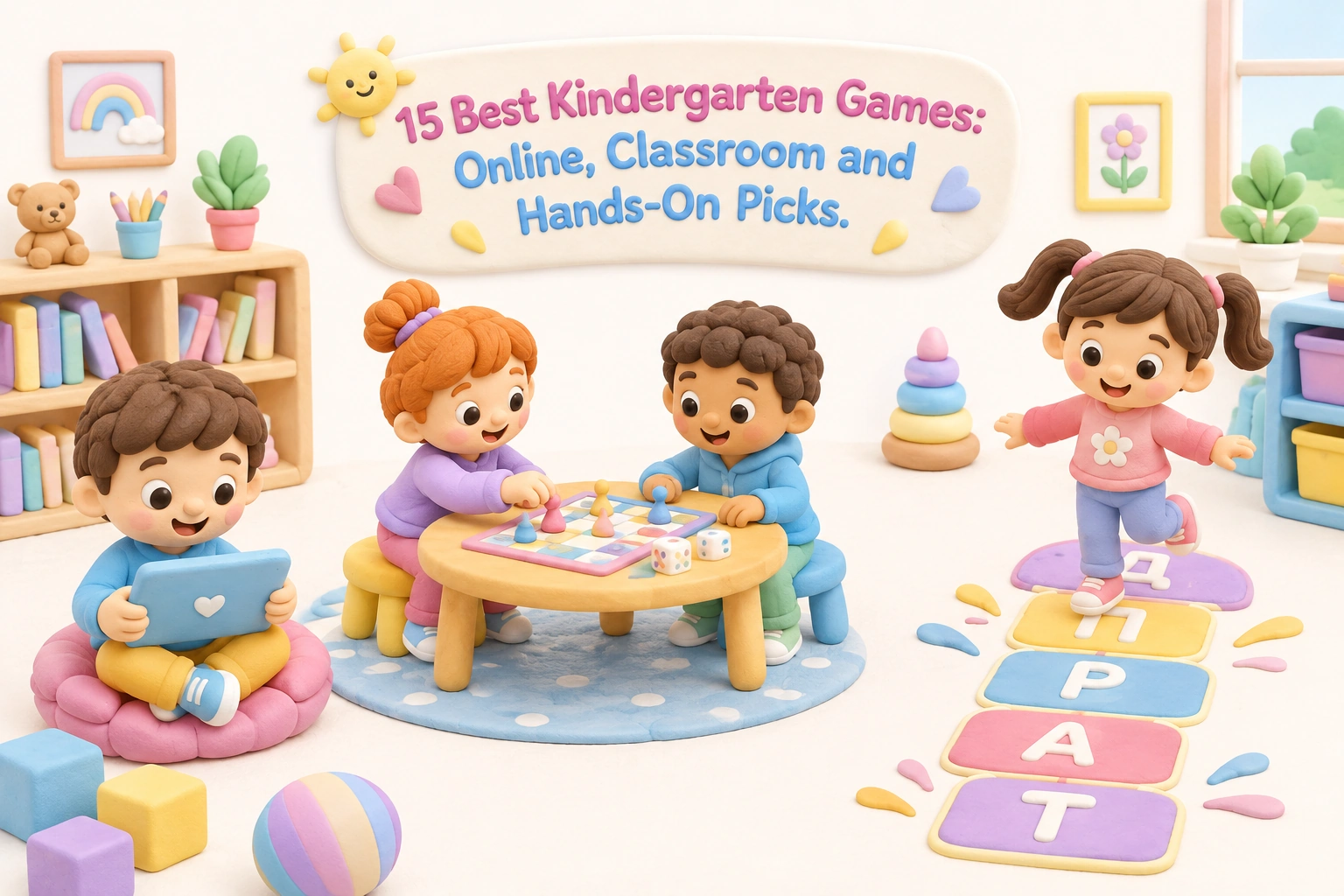
Choosing the right kindergarten games can make a genuine difference in how a five- or six-year-old builds early literacy skills, number sense, and social confidence. The challenge for parents and teachers is that “kindergarten game” covers an enormous range: free online platforms, teacher-led classroom activities, physical board games, and movement-based play. This guide organizes 15 carefully selected picks across all three formats, explains what each one actually develops, and offers practical guidance on balancing digital and hands-on play for children at this stage.
Key Takeaways
- Kindergarten games work best when they target specific developmental skills — phonics, number sense, fine motor control, or social-emotional learning — rather than offering general entertainment.
- A healthy mix of online, classroom, and hands-on games supports different learning styles and avoids over-reliance on screens at an age when physical play remains developmentally important.
- Many high-quality kindergarten learning games are free or low-cost; paid subscriptions are not necessary to provide rich, varied play experiences.
- Caregiver involvement — even brief co-play or discussion after a game — consistently strengthens the learning value of any format.
- Screen time for children aged five to six should remain purposeful and time-limited; the American Academy of Pediatrics recommends prioritizing high-quality, interactive content over passive consumption.
Why Games Matter for Kindergarten Development
Play-based learning is not simply a pleasant way to pass time — it is the primary mode through which kindergarten-aged children consolidate new knowledge. When a child plays a phonics game, they are practising phonemic awareness in a low-stakes context that encourages repetition without frustration. When they take turns in a board game, they are building self-regulation and executive function alongside counting skills. Research in early childhood education consistently supports game-based learning as an effective bridge between informal play and structured academic instruction, particularly for ages five and six when attention spans are still developing and motivation is closely tied to enjoyment.
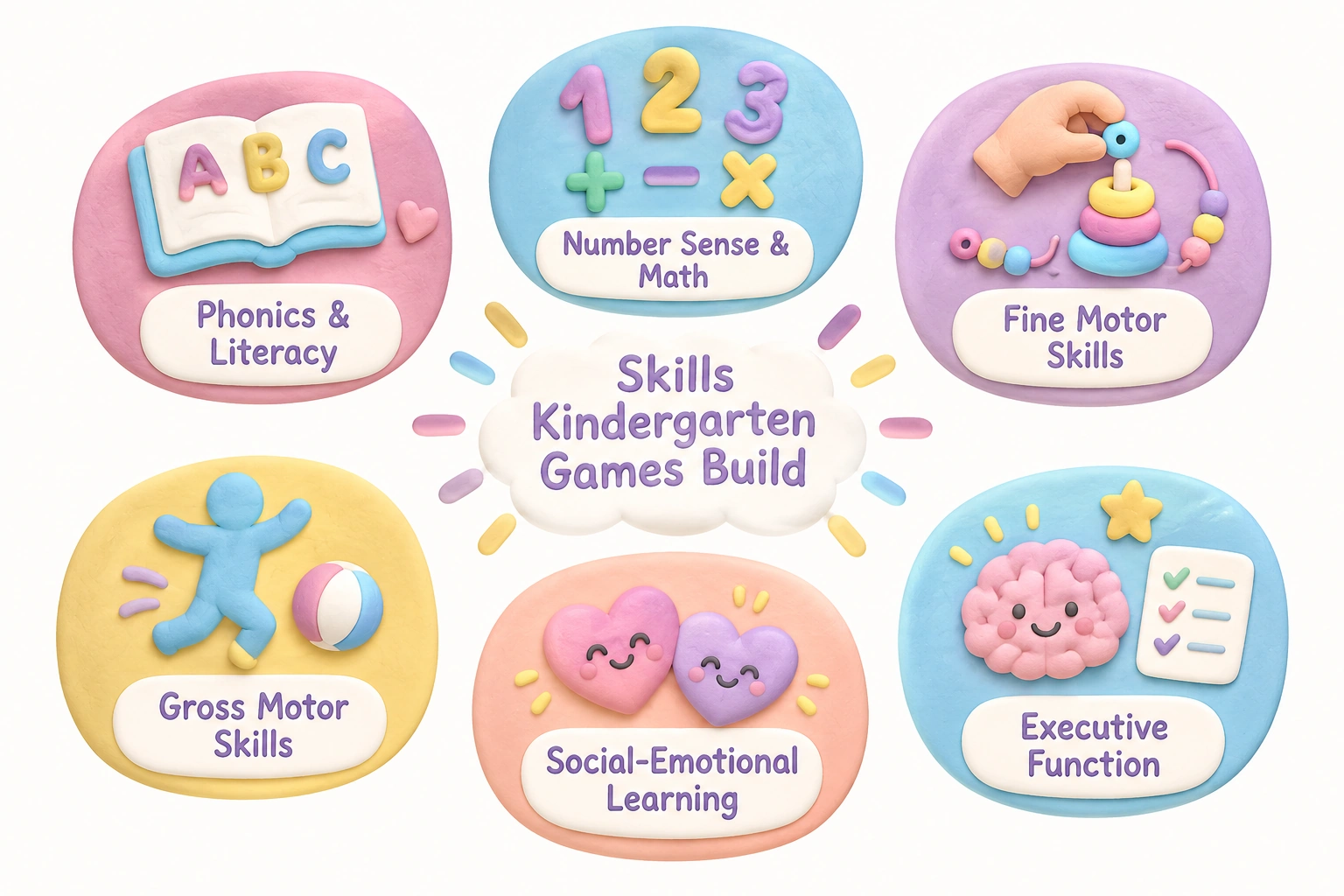
Kindergarten readiness encompasses far more than letter recognition and counting to twenty. Social skills, gross motor skills, fine motor skills, emotional regulation, and the ability to follow multi-step instructions all develop through well-chosen games. This is why a balanced game diet — mixing digital interactivity with physical and social play — tends to produce broader developmental benefits than any single format alone.
5 Best Online Games for Kindergarten
Online games for kindergarten are most valuable when they are interactive rather than passive, offer adaptive difficulty so the child is neither bored nor overwhelmed, and keep sessions short enough to suit a five-year-old’s attention span. The picks below are widely used by teachers and parents, cover both literacy and mathematics, and are either fully free or offer a meaningful free tier.
1. Starfall — Phonics and Early Reading
Starfall is a structured, teacher-aligned platform focused on phonics, letter recognition, and early reading. Its core reading activities are free and follow a clear phonics progression from individual letter sounds through CVC words (consonant-vowel-consonant patterns) and simple sentences. The interface is calm, uncluttered, and designed for independent use by kindergarteners, making it a reliable choice for both classroom and home practice. Skills developed include phonemic awareness, decoding, and early literacy fluency. Best for: independent reading practice at home or as a literacy centre activity in class.
2. ABCya! — Mixed Skills, Browser-Based
ABCya! offers a large library of free online games organized by grade level, covering letter recognition, sight word practice, basic addition and subtraction, and shapes. The games vary considerably in quality, so it rewards a little parental or teacher curation — selecting specific titles rather than allowing open browsing. Many games include a light reward system that motivates repeated play. Best for: supplementary practice across multiple skill areas; works well as a short brain break activity between structured lessons.
3. Khan Academy Kids — Comprehensive Free Learning
Khan Academy Kids is one of the most complete free educational apps available for children aged two to seven. For kindergarten-aged children specifically, it covers early literacy (phonics, sight words, comprehension), mathematics (number sense, counting, basic geometry), and social-emotional learning through animated characters. The app uses a form of adaptive difficulty, adjusting content based on the child’s responses. It is available on iOS and Android and contains no advertisements. Best for: homeschool families or parents seeking a structured, curriculum-aligned daily learning tool.
4. PBS Kids Games — Familiar Characters, Curriculum-Linked Content
PBS Kids Games uses characters from well-known children’s television programmes to deliver interactive games targeting early literacy and mathematics. Because children already have an emotional connection to characters like Daniel Tiger and Curious George, engagement tends to be high. Many games are explicitly linked to early childhood learning standards and include cooperative elements that work well for co-play with a caregiver. The platform is free and browser-based. Best for: co-play sessions between a parent and child; also effective as a classroom reward activity.
5. SplashLearn — Adaptive Math and Reading
SplashLearn offers a structured progression through kindergarten mathematics — covering counting to one hundred, ten frames, subitizing, addition and subtraction, and basic geometry — alongside phonics and reading activities. The platform tracks progress and adjusts difficulty, which can help parents and teachers identify where a child needs additional support. A free tier is available, though some features require a subscription. Best for: targeted mathematics practice; particularly useful for teachers who want progress data to inform differentiation.
5 Best Classroom Games for Kindergarten
Classroom games for kindergarten are most effective when they are low prep or no prep, can accommodate a whole class or small groups, and build skills that align with what children are learning in their current unit. The games below are teacher-tested, require minimal materials, and can be adapted for different skill levels.
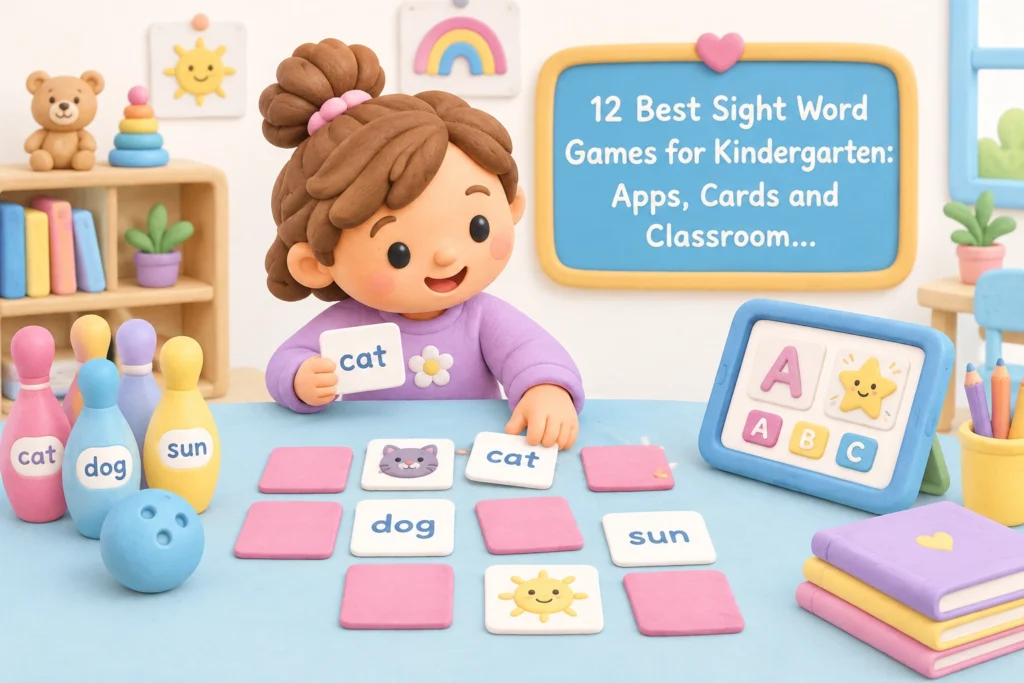
6. Sight Word Bingo
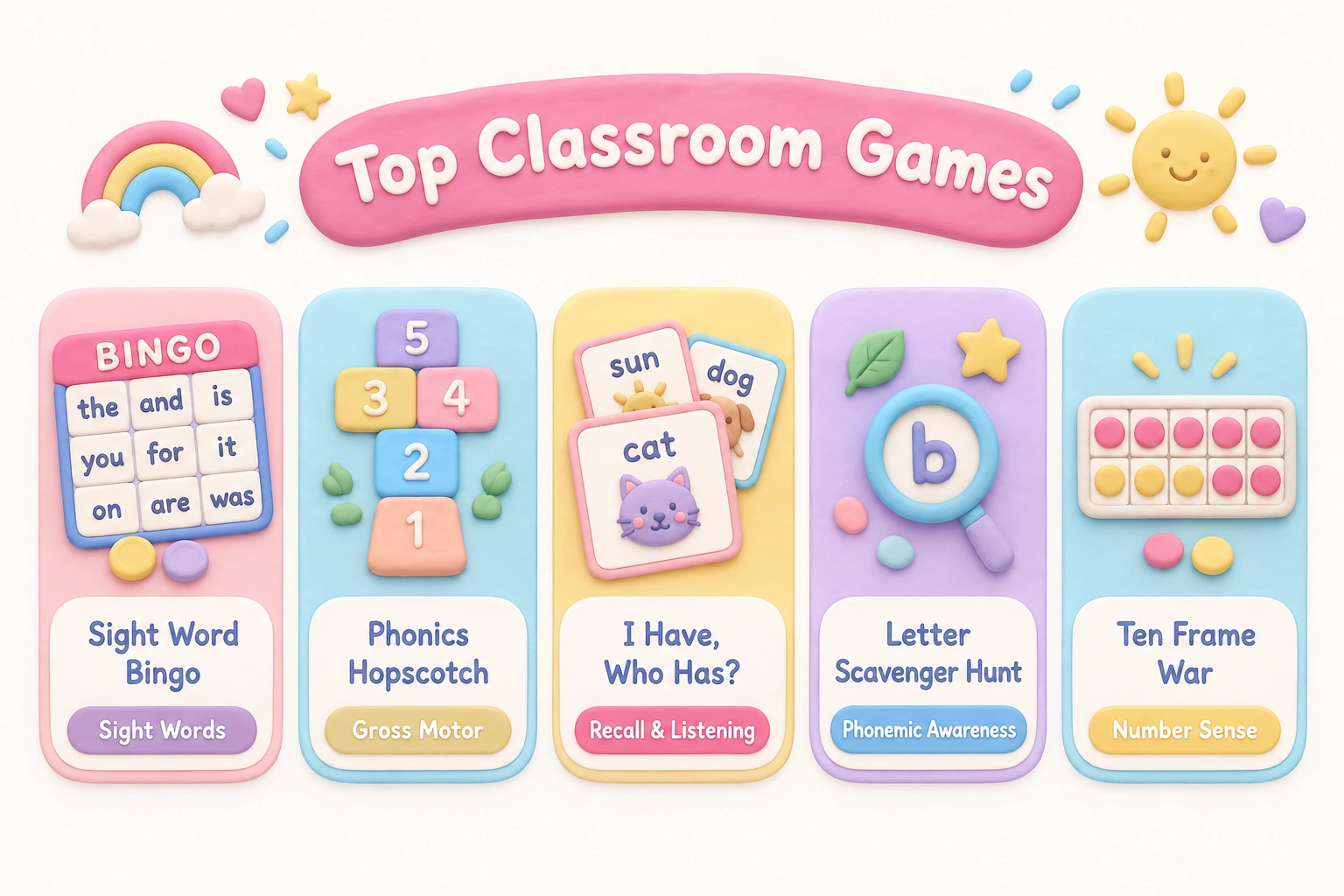
Sight Word Bingo is one of the most versatile and widely used kindergarten learning games for early literacy. Each child receives a bingo card printed with Dolch sight words from the pre-primer or primer list. The teacher calls words aloud, and children mark them on their cards. The game builds automatic word recognition — a critical component of reading fluency — while also practising listening skills and turn-taking. Cards can be differentiated by difficulty, making it easy to support children at different stages. Prep level: low (printable cards available free online). Best for: whole-class or small-group literacy instruction.
7. Phonics Hopscotch
Phonics Hopscotch transforms a classic gross motor activity into a phonics game. Letter tiles or chalk-written letters are arranged in a hopscotch grid. As children hop, they say the sound of each letter they land on, blend a CVC word, or identify a word beginning with that letter. This game is particularly effective for kinesthetic learners who benefit from movement-integrated learning. It also develops gross motor skills and spatial awareness simultaneously. Prep level: no prep if using chalk outdoors; minimal prep indoors with foam tiles. Best for: outdoor learning time or movement breaks.
8. I Have, Who Has?
I Have, Who Has? is a whole-class chain game in which each child holds a card reading “I have [answer]. Who has [question]?” The child with the matching answer responds, creating a continuous loop until every card has been played. It works equally well for sight words, letter sounds, number bonds, and shapes. The game builds listening skills, attention, and rapid recall under gentle social pressure. Because every child must stay alert to recognize their card, it naturally sustains engagement across the whole group. Prep level: low (free printable sets are widely available). Best for: whole-class review of any current unit.
9. Letter Scavenger Hunt
A Letter Scavenger Hunt sends children around the classroom or outdoor space to find objects beginning with a target letter or sound. This game develops phonemic awareness and letter recognition in a highly active, exploratory format that suits the natural curiosity of five- and six-year-olds. It can be run as a timed individual activity or a cooperative team challenge, adding a social-emotional learning dimension when children work together. Teachers can differentiate by assigning different target sounds to different groups. Prep level: no prep. Best for: phonics units; works indoors or outdoors.
10. Ten Frame War
Ten Frame War is a card game adaptation that builds number sense and subitizing — the ability to instantly recognize a quantity without counting. Two children each flip a ten-frame card showing a number of dots; the child with the larger number wins both cards. The game develops quantity comparison, early addition thinking, and turn-taking. It is a no-prep activity once a set of ten-frame cards is printed, and it works well as a mathematics centre game during independent work time. Prep level: low (one-time printable). Best for: small-group mathematics centres; ages five to six.
5 Best Hands-On Games for Kindergarten
Hands-on activities and physical games are irreplaceable at the kindergarten stage. Fine motor skills, spatial reasoning, hand-eye coordination, and the social skills developed through face-to-face play all depend on children engaging with physical objects and other people in real space. The picks below range from classic board games to movement-based activities.
11. Zingo Sight Words
Zingo Sight Words is a fast-paced matching game in which a spring-loaded “Zinger” device slides out tiles printed with sight words. Children race to match tiles to their game boards. The game builds automatic sight word recognition in a highly motivating, competitive-but-friendly format. It supports fine motor skills through tile handling and develops the rapid visual processing that underpins reading fluency. The game is self-contained, requires no screens, and is suitable for two to six players. Best for: family game nights at home; also effective as a literacy centre game in class.
12. Candy Land
Candy Land is a classic board game that introduces kindergarten-aged children to colour recognition, turn-taking, rule-following, and the experience of winning and losing graciously — all foundational social-emotional learning skills. Because the game requires no reading or counting, it is genuinely accessible to all kindergarteners regardless of academic readiness. It also provides a natural context for conversations about emotions, patience, and fairness. Best for: social-emotional learning at home; a gentle introduction to structured board game play for younger kindergarteners.
13. Memory Match (Homemade or Commercial)
Memory Match — whether using a commercial set or homemade cards with letters, numbers, or pictures — develops working memory, concentration, and visual discrimination. For kindergarten, themed sets (alphabet pairs, number-picture pairs, shape pairs) add an academic layer to the cognitive challenge. The game is quiet, portable, and works for one to four players, making it one of the most flexible hands-on activities available. Homemade versions using index cards cost almost nothing and can be tailored to whatever the child is currently learning. Best for: independent or paired play at home; quiet time activities in class.
14. Obstacle Course
A simple indoor or outdoor obstacle course — using cushions, hula hoops, balance beams, or chalk lines — is one of the most developmentally rich gross motor activities available for kindergarteners. Obstacle courses build balance, coordination, spatial awareness, and body control. When children design their own course, they also practise problem-solving and sequential thinking. Adding a language element (naming shapes they jump over, counting steps between stations) integrates early academic skills into physical play. Prep level: low; uses household or playground items. Best for: active learning days; kinesthetic learners; movement breaks.
15. Osmo Kindergarten Kit
The Osmo Kindergarten Kit bridges physical and digital play by using a tablet camera to recognize physical letter tiles, number pieces, and drawing responses. Children manipulate real objects while the tablet responds to their actions, creating an interactive game experience that combines fine motor engagement with early literacy and mathematics practice. Because children are handling tangible pieces rather than tapping a screen, the experience feels more like hands-on play than screen time, though it does require a compatible tablet. Best for: families comfortable with a one-time hardware investment who want a hybrid physical-digital learning experience; also used in some classroom settings.
Balancing Online and Offline Kindergarten Games
The American Academy of Pediatrics recommends that screen time for children aged five and six be purposeful, time-limited, and ideally co-viewed or co-played with a caregiver where possible. For kindergarten-aged children, this means online games are most beneficial when they are used in focused sessions of fifteen to twenty minutes rather than as extended independent entertainment. Rotating between online games, classroom games, and hands-on activities across the week ensures children develop the full range of skills — including gross motor skills and face-to-face social skills — that screen-based play alone cannot provide.
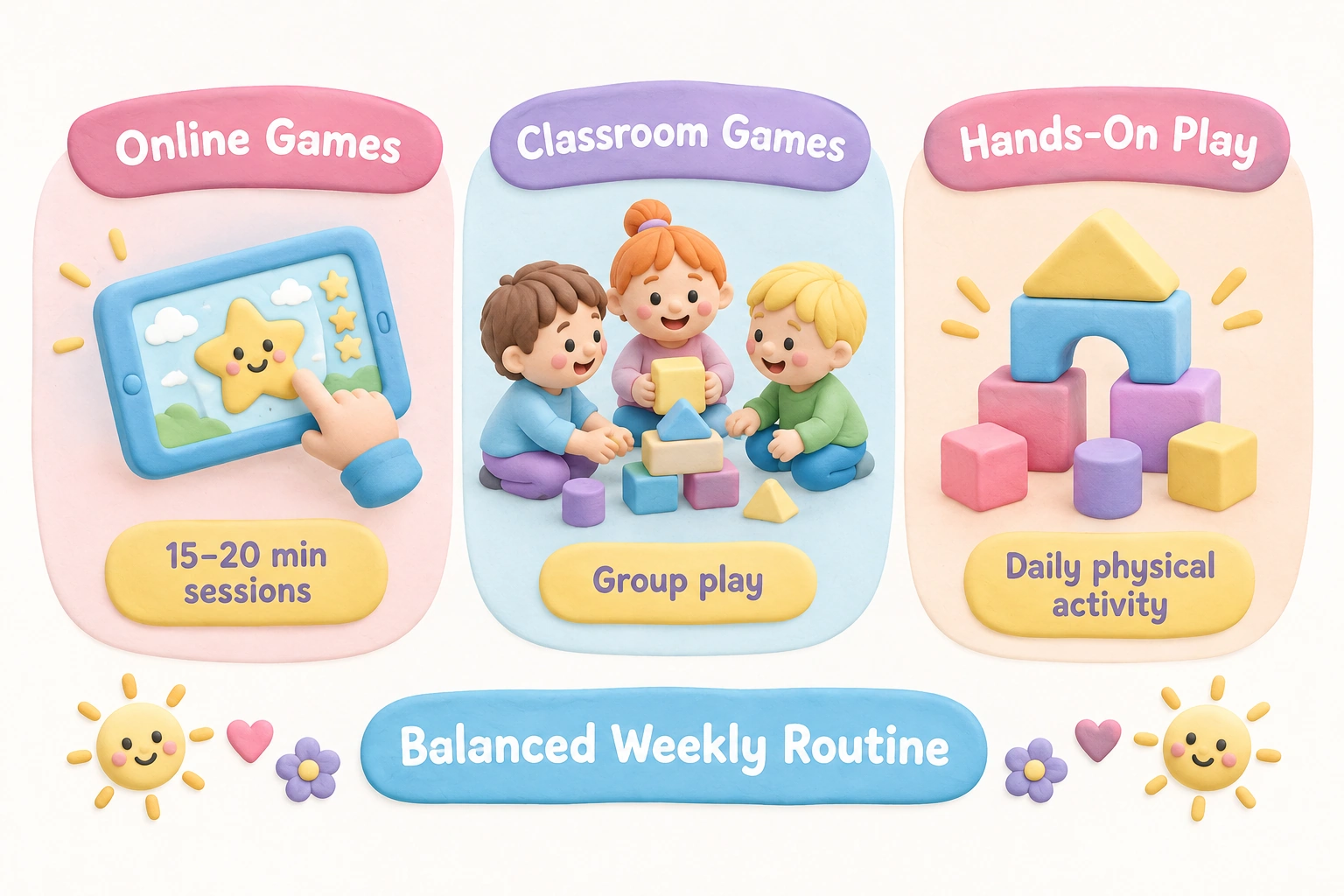
A practical weekly structure might include two or three short online game sessions targeting specific skills (phonics one day, number sense another), one or two classroom or group games that build social-emotional learning and listening skills, and daily physical or hands-on play that develops fine motor skills and spatial reasoning. This kind of intentional rotation prevents over-reliance on any single format and keeps learning varied enough to sustain a kindergartener’s motivation.
Quick Reference: Skills by Game Format
| Game | Format | Primary Skills | Prep Level | Free? |
|---|---|---|---|---|
| Starfall | Online | Phonics, early literacy | None | Yes (core) |
| ABCya! | Online | Mixed literacy & math | None | Yes |
| Khan Academy Kids | Online/App | Literacy, math, SEL | None | Yes |
| PBS Kids Games | Online | Literacy, math, co-play | None | Yes |
| SplashLearn | Online/App | Math, phonics, tracking | None | Freemium |
| Sight Word Bingo | Classroom | Sight words, listening | Low | Yes |
| Phonics Hopscotch | Classroom | Phonics, gross motor | None | Yes |
| I Have, Who Has? | Classroom | Recall, listening, any skill | Low | Yes |
| Letter Scavenger Hunt | Classroom | Phonemic awareness | None | Yes |
| Ten Frame War | Classroom | Number sense, subitizing | Low | Yes |
| Zingo Sight Words | Hands-On | Sight words, fine motor | None | No (purchase) |
| Candy Land | Hands-On | SEL, turn-taking, colours | None | No (purchase) |
| Memory Match | Hands-On | Working memory, visual skills | Low | DIY free |
| Obstacle Course | Hands-On | Gross motor, spatial reasoning | Low | Yes |
| Osmo Kindergarten Kit | Hybrid | Literacy, math, fine motor | Low | No (purchase) |
Tips for Teachers: Implementing Games in the Kindergarten Classroom
Introducing a new game to a kindergarten class works best when the teacher models the game with a small group before releasing it to independent centres. A brief five-minute demonstration — thinking aloud about rules, showing what a turn looks like, and naming the skill being practised — significantly reduces confusion and off-task behaviour during independent play. For games involving competition, explicitly discussing how to respond to winning and losing before play begins supports social-emotional learning and prevents the emotional dysregulation that can derail a session.
Differentiation is straightforward with most of the classroom games listed above. In Sight Word Bingo, different card sets can target different Dolch word lists — pre-primer for children still building basic recognition, primer or first-grade lists for those who are ready. In Ten Frame War, children who are ready can be asked to add the two cards together rather than simply comparing them, extending the same game into early addition practice without requiring separate materials.
Choosing Kindergarten Games for Children with Different Learning Needs
Not every game suits every child, and kindergarten classrooms typically include children with a wide range of developmental profiles. For children who are developing fine motor skills more slowly, games that use larger pieces — foam tiles, oversized cards, or bean bags — reduce frustration and keep the focus on the academic skill rather than the physical challenge. For children who find competitive games emotionally difficult, cooperative alternatives such as a team-based scavenger hunt or a collaborative obstacle course can deliver the same developmental benefits in a lower-stakes format.
Children who are English language learners often benefit most from games that pair visual or physical cues with language — picture-word matching games, phonics hopscotch with picture tiles, or memory match sets that show both a word and an image. For children who need additional challenge, most of the classroom and hands-on games above can be extended by increasing the complexity of the target words, numbers, or rules without changing the game structure itself.
Frequently Asked Questions
How long should a kindergarten game session last?
For online games, sessions of ten to twenty minutes are generally appropriate for five- and six-year-olds, in line with guidance from the American Academy of Pediatrics on purposeful screen use. Physical and board games can run longer because they involve movement, social interaction, and natural breaks, but most kindergarteners will disengage after thirty to forty minutes regardless of format. Shorter, focused sessions tend to produce better learning outcomes than extended play.
Are free online games good enough, or do paid platforms offer significantly more?
For most families, free platforms such as Starfall, Khan Academy Kids, and PBS Kids Games provide genuinely high-quality, curriculum-aligned content without requiring a subscription. Paid or freemium platforms like SplashLearn may offer useful extras such as detailed progress tracking and adaptive difficulty, which can be valuable for teachers managing a whole class or parents who want data on their child’s progress. The quality of the free content available means that cost alone should not be a deciding factor.
What skills should kindergarten games focus on?
Kindergarten games ideally cover a mix of early literacy skills (phonics, phonemic awareness, sight word recognition, letter recognition), early mathematics (number sense, counting, basic addition and subtraction, shapes), and developmental skills (fine motor skills, gross motor skills, turn-taking, self-regulation, and social-emotional learning). No single game covers all of these, which is why variety across formats matters.
Can kindergarten games replace structured teaching?
Games are most effective as a complement to structured instruction, not a replacement for it. Game-based learning reinforces and consolidates skills that have been introduced through direct teaching. A child who has not yet been introduced to a phonics concept is unlikely to acquire it independently through a game; a child who has been taught the concept and then practises it through a game is likely to retain it more effectively than through worksheets alone.
How do I know if a game is developmentally appropriate for my kindergartener?
Look for games that match your child’s current skill level — challenging enough to require effort but not so difficult that they become frustrated within the first few minutes. Games designed for ages five to six and aligned with kindergarten standards (counting to one hundred, CVC words, Dolch pre-primer and primer sight words) are a reliable starting point. Observe your child during play: sustained engagement, willingness to replay, and visible problem-solving are good signs that the difficulty level is appropriate.
Do kindergarten games help with social-emotional learning?
Many kindergarten games — particularly board games, classroom group games, and cooperative physical activities — naturally develop social-emotional learning skills including turn-taking, patience, managing disappointment, and collaborative problem-solving. Games like Candy Land and cooperative obstacle courses are particularly well suited to this goal. Online games tend to be weaker in this area unless they are played alongside a caregiver or peer.
Finding the Right Mix of Kindergarten Games for Your Child or Class
The fifteen games in this guide are not a ranked list with a single winner — they are a toolkit. A kindergartener who spends twenty minutes on Starfall practising phonics, plays a round of Ten Frame War at a mathematics centre, and then runs an obstacle course at recess has engaged with early literacy skills, number sense, and gross motor development across a single school day, in three different formats, with minimal screen time. That kind of intentional variety is what the research on play-based learning consistently supports.
For parents choosing games at home, the most practical approach is to start with one free online platform, one printable or low-prep classroom-style game, and one physical game or activity, and observe which formats your child gravitates toward. Caregiver involvement — even sitting alongside a child for a few minutes, asking questions about what they are doing, or playing a round together — consistently amplifies the developmental value of any game format. The goal is not to find the single best kindergarten game but to build a varied, enjoyable routine that keeps a five- or six-year-old curious, challenged, and moving forward.

Take a short quiz to find out what your everyday choices say about your parenting style
When your child is curious about something new, what’s your instinct?
Take a short quiz to find out what your everyday choices say about your parenting style
“Can I download this app?” What happens next?
Take a short quiz to find out what your everyday choices say about your parenting style
When it comes to rules at home, which sounds most like you?
Take a short quiz to find out what your everyday choices say about your parenting style
If you could give your child one life skill today, what would you pick?
Take a short quiz to find out what your everyday choices say about your parenting style
Your child gets to choose what to watch. What would your ideal setup look like?
Take a short quiz to find out what your everyday choices say about your parenting style
Pick your parenting superpower ✨