15 Best Math Games for Kids: Online, Board and Classroom Picks

 Discover a Free Education Video App for Kids
Pastory uses AI to personalize educational video content based on your child’s interests and personality. Safe, engaging, and built for curious young minds. Sign up now to stay updated and enjoy early access with a free trial
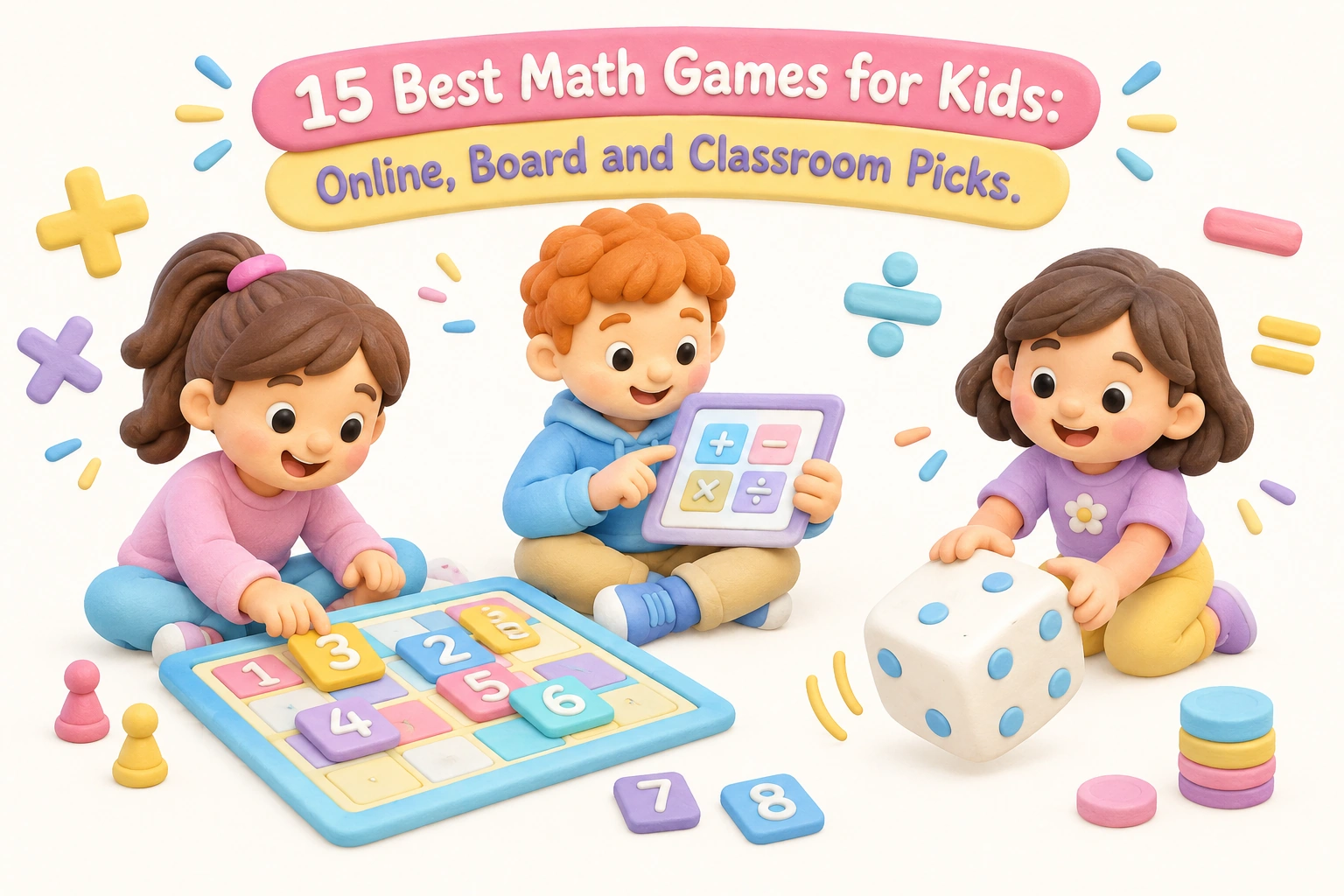
Math games for kids can do something worksheets rarely manage: make practice feel worth showing up for. Research published in peer-reviewed journals, including work cited in Frontiers in Psychology on game-based learning and math motivation, consistently finds that playful, low-stakes practice environments can reduce math anxiety, build math fact fluency, and sustain engagement longer than drill-based approaches alone. This guide covers 15 carefully selected picks — online platforms, board games, and classroom-ready activities — organized by category, with honest notes on age-appropriateness, skills covered, cost, and what the evidence actually supports.
Key Takeaways
- Game-based learning can support number sense, math fact fluency, and strategic thinking when games are well-matched to a child’s current grade-level math skills.
- Online, board, and screen-free math games each serve different learning contexts; the best choice depends on the child’s age, learning style, and available resources.
- Free math games vary widely in quality, ad exposure, and data practices — checking privacy policies and login requirements matters before sharing them with children.
- Caregiver or teacher involvement consistently improves outcomes; games work best as a complement to instruction, not a replacement for it.
- Reluctant math learners often respond well to cooperative or low-competition formats before moving to head-to-head or timed games.
Why Math Games Support Learning: What the Research Suggests
Game-based learning (GBL) in mathematics has been studied across a range of age groups and settings. A systematic review referenced in PMC/NCBI found that structured math board games — particularly those involving number lines and counting — were associated with measurable gains in number sense and counting accuracy among young children. Researchers Ramani and Siegler have specifically examined how linear number board games help children develop a more accurate mental number line, which underpins later arithmetic understanding. Importantly, these gains appear strongest when an adult plays alongside the child, asking questions and narrating moves rather than simply supervising.
Interactive math games in digital environments show a more mixed picture. Engagement tends to be high, but learning transfer — the ability to apply skills in new contexts — depends heavily on whether the game requires genuine mathematical reasoning or simply rewards fast clicking. Parents and teachers evaluating any math game, online or physical, should ask whether the child must actually solve a problem to progress, or whether guessing and retrying is equally effective. Games that require genuine problem-solving before advancing tend to produce more durable skill gains.
Math anxiety is a real barrier for many children, and playful formats can lower the emotional stakes of making errors. When a wrong answer means losing a card rather than a red mark on a test, children are more willing to attempt challenging problems. This is particularly relevant for reluctant math learners, who may disengage from formal practice but remain willing to play one more round of a well-designed game.
Best Online Math Games for Kids
Online math games range from fully adaptive learning platforms with progress tracking and curriculum-aligned content to simple browser-based activities requiring no login. The table below summarizes key features for the most widely used options.
| Platform | Age / Grade Range | Key Skills | Free vs. Paid | Login Required | Adaptive Learning |
|---|---|---|---|---|---|
| Prodigy Math | Grades 1–8 | Full curriculum: addition through algebra readiness | Free (paid parent/teacher tier) | Yes | Yes |
| Khan Academy Kids | Ages 2–8 | Counting, number bonds, early addition | Free | Optional | Partial |
| SplashLearn | Pre-K–Grade 5 | Number sense, place value, fractions, geometry | Free (limited); paid for full access | Yes | Yes |
| Math Playground | Grades 1–6 | Mental math, word problems, logic | Free | No | No |
| Arcademics | Grades K–8 | Math fact fluency, multiplication, division | Free (ads); paid ad-free version | No (basic) | No |
| ST Math | Grades K–8 | Visual-spatial reasoning, deep conceptual math | School license (some free access) | Yes | Yes |
| Zearn | Grades K–5 | Curriculum-aligned, conceptual understanding | Free for students | Yes | Yes |
| DragonBox | Ages 4–13 | Algebra readiness, number sense | Paid app | No | Partial |
Prodigy Math
Prodigy Math is a role-playing game in which children answer curriculum-aligned math questions to battle creatures and progress through a fantasy world. The free tier covers the full math curriculum from grades 1 through 8, making it one of the most comprehensive free math games available. The paid parent and teacher tiers unlock progress tracking, detailed reports, and the ability to assign specific skills. One honest limitation: the game’s reward structure is heavily tied to in-game items and character upgrades, which can shift a child’s motivation toward collecting rather than learning. Parental involvement in reviewing progress reports helps keep the focus on grade-level math skills rather than game progression alone.
Khan Academy Kids
Khan Academy Kids is a well-regarded free platform for children aged 2 to 8, covering early counting, number bonds, shapes, and foundational addition. It requires no paid subscription and collects minimal personal data, making it a strong choice for families concerned about privacy. The platform is not a multiplayer math game, so it works best for independent or co-viewing sessions with a caregiver. Its adaptive learning features are more limited than dedicated math platforms, but its breadth of early childhood content and zero cost make it a practical starting point for Pre-K and kindergarten families.
Math Playground and Arcademics
Math Playground offers a large library of browser-based games covering mental math, word problems, and logical thinking for grades 1 through 6, with no login required and no account creation needed. This makes it genuinely accessible for classroom use on shared devices. Arcademics focuses specifically on math fact fluency through fast-paced multiplayer math games, including racing formats for addition, subtraction, multiplication, and division. The free version of Arcademics includes advertisements; a paid school or family subscription removes ads and adds progress tracking. Both platforms are best used for fluency practice rather than conceptual instruction.
ST Math and Zearn
ST Math uses visual-spatial puzzles to teach mathematical concepts without relying on language, which can be particularly effective for visual learners and English language learners. It is primarily distributed through school licenses, though some free access is available. Zearn is a curriculum-aligned platform built around the widely used Eureka Math and EngageNY curricula, offering structured lessons with embedded games and manipulative-style digital tools. Both platforms are designed to complement classroom instruction rather than replace it, and both provide teachers with meaningful progress tracking data.
Best Math Board Games for Kids
Screen-free math games offer something digital platforms cannot easily replicate: physical handling of pieces, face-to-face social interaction, and the kind of slow, deliberate strategic thinking that comes from waiting for your turn. Research on math manipulatives and hands-on math learning consistently supports the value of physical engagement with mathematical objects, particularly for younger children developing number sense and spatial reasoning.
| Game | Age Range | Players | Key Skills | Approx. Price |
|---|---|---|---|---|
| Prime Climb | Ages 10+ | 2–4 | Multiplication, division, prime factorization | $30–$40 |
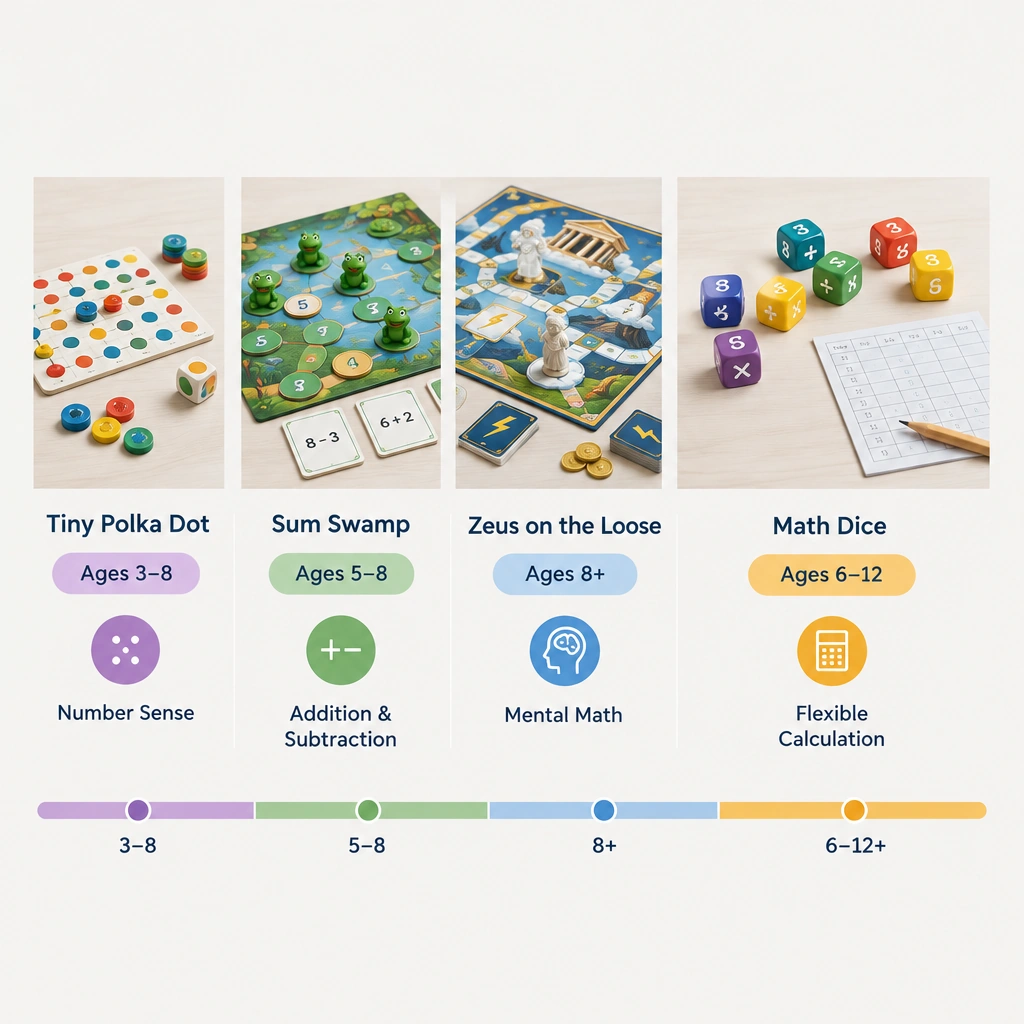
| Sum Swamp | Ages 5–8 | 2–4 | Addition, subtraction, number recognition | $20–$28 |
| Tiny Polka Dot | Ages 3–8 | 1–4 | Counting, number sense, early addition | $25–$30 |
| Math Dice Jr. | Ages 6+ | 2–5 | Addition, mental math | $10–$15 |
| Zeus on the Loose | Ages 8+ | 2–5 | Mental math, addition to 100 | $12–$18 |
| Proof! | Ages 9+ | 2–6 | Multiplication, division, fractions, decimals | $20–$25 |
| Shut the Box | Ages 6+ | 1–4 | Addition, subtraction, number combinations | $15–$25 |
| 24 Game | Ages 8+ | 1–4 | All four operations, order of operations | $10–$20 |
Prime Climb (Ages 10+)
Prime Climb, published by Math for Love, is a beautifully designed board game built around multiplication, division, and prime factorization. The color-coded number system on the board makes the structure of numbers visually intuitive — children can see at a glance which numbers share factors. It is genuinely engaging for upper elementary and middle school students, but it requires solid multiplication fluency before it becomes fun rather than frustrating. This is an important prerequisite note: a child who is still building times table knowledge will struggle to enjoy Prime Climb and may need a simpler game first.
Tiny Polka Dot and Sum Swamp (Ages 3–8)
Tiny Polka Dot, also from Math for Love, is one of the most developmentally appropriate math board games for young children. Its cards use multiple representations of numbers — dots, numerals, ten-frames, and finger patterns — which supports the kind of flexible number sense that underpins later arithmetic. Sum Swamp is a straightforward path game using dice and simple addition and subtraction, well-suited to children in early primary who are building confidence with basic operations. Both games work well as cooperative or low-competition formats, which is particularly helpful for reluctant math learners who find head-to-head competition discouraging.
Zeus on the Loose and Proof! (Ages 8–12)
Zeus on the Loose is a fast-paced card game in which players add numbers to a running total, trying to land exactly on multiples of ten to steal Zeus. It builds mental math speed and number flexibility in a genuinely playful format. Proof! is a set-collection card game requiring players to find equations using any combination of operations — addition, subtraction, multiplication, division, fractions, and decimals — making it one of the most mathematically rich card games available for upper elementary students. Both games are compact, inexpensive, and easy to learn, making them practical for families and classrooms alike.
Best Classroom Math Games
Classroom-ready math games need to work with limited setup time, variable group sizes, and the noise and movement constraints of a real classroom. The most effective classroom math games are those that keep all students active simultaneously, rather than having most children wait while one student takes a turn.
Multiplication Bingo
Multiplication Bingo is a classroom-ready game requiring only printed or hand-drawn bingo cards filled with products, and a caller reading out multiplication expressions. Every student is active simultaneously, and the teacher can target specific times tables by selecting which expressions to call. It is low-prep, easily differentiated by adjusting the number range, and works well for grades 3 through 5 as a fluency warm-up. A useful variation for mixed-ability classrooms is to allow students to use a multiplication chart until they feel confident enough to work from memory.
Addition War (Card Game)
Addition War uses a standard deck of playing cards with face cards removed. Each player flips two cards and adds them together; the higher sum wins all four cards. The game requires no preparation, no materials beyond a deck of cards, and can be played in pairs simultaneously across a whole classroom. It is appropriate for grades 1 through 3 for addition practice, and can be adapted for multiplication by multiplying the two flipped cards instead. This makes it one of the most versatile and genuinely hands-on math games available to teachers with no budget.
Math Whiteboard Race
Math Whiteboard Race divides the class into two or more teams, with one student from each team at the board simultaneously. The teacher calls a problem — a mental math question, a word problem, or a place value challenge — and the first student to write the correct answer scores a point for their team. This format keeps energy high and gives the teacher real-time formative assessment data. It works best when problems are carefully matched to current grade-level math skills, and when the teacher rotates students quickly to prevent any one child from dominating or feeling exposed.
Number Line Jump
Number Line Jump uses a large number line taped or chalked on the floor. Students physically jump along the line to solve addition, subtraction, or skip-counting problems called out by the teacher. The physical movement supports kinesthetic learners and makes the abstract concept of a number line concrete and memorable. Research on embodied cognition suggests that connecting physical movement to mathematical concepts can support understanding, particularly for children in the early primary years. This activity works well outdoors or in a gymnasium when classroom space is limited.
MathTug (Smartboard Multiplayer)
MathTug is a free, browser-based multiplayer math game designed specifically for classroom use on a smartboard or interactive whiteboard. Students compete in real time on math fact fluency challenges, with the whole class visible on the shared screen. It requires no login and no account creation, making it genuinely classroom-ready without administrative overhead. MathTug is best used as a short warm-up or end-of-lesson activity rather than a primary instructional tool, and it works across a wide grade range depending on the skill level selected.
Free vs. Paid Math Games: What the Difference Actually Means
The free vs. paid distinction in online math games is often less straightforward than it appears. Many platforms offer a free tier that covers the core game experience but restricts access to progress tracking, parent dashboards, ad-free play, or the ability to assign specific skills. Understanding what the paid tier actually adds helps families and teachers make informed decisions rather than assuming free always means limited or paid always means better.
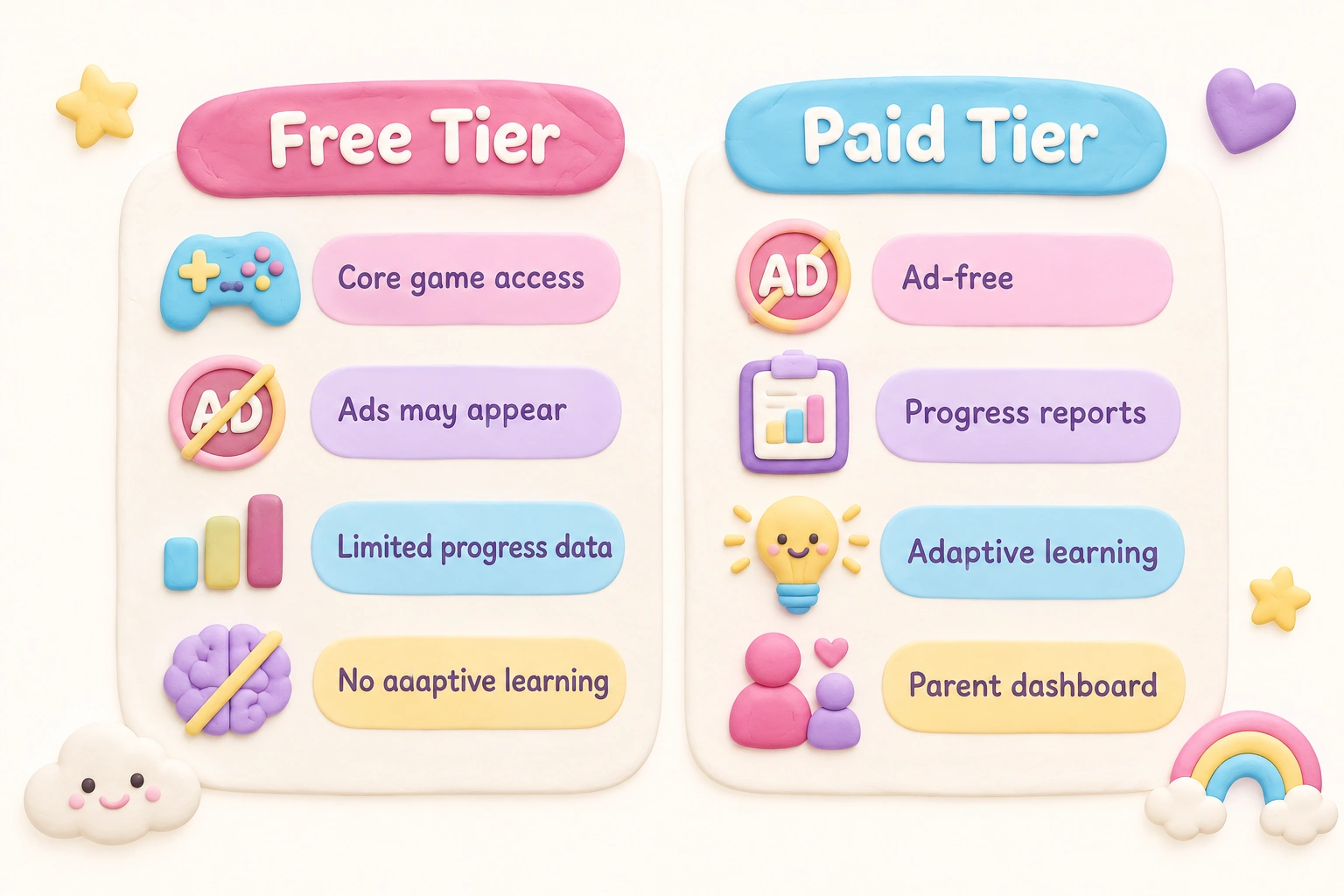
- Progress tracking and reports: Most free tiers do not include detailed progress reports. Paid tiers on platforms like Prodigy, SplashLearn, and IXL provide skill-by-skill breakdowns that are genuinely useful for identifying gaps.
- Ad-free experience: Free versions of Arcademics and some other platforms include advertisements. For younger children especially, ads can be distracting and may expose children to content unrelated to math learning.
- Adaptive learning: True adaptive learning — where the platform adjusts difficulty based on demonstrated performance — is typically a paid feature. Free tiers often offer a fixed sequence of activities rather than personalized pathways.
- Data and privacy: Some free platforms collect user data to fund their free tier through advertising or data partnerships. Before creating an account for a child, reviewing the platform’s privacy policy and checking whether it complies with COPPA (for US families) or equivalent local regulations is worthwhile.
- No login required options: Math Playground, MathTug, and Hooda Math offer substantial free content with no login required, making them practical for classroom use on shared devices where account management is impractical.
Math Games by Age and Grade Level
Matching a math game to a child’s current developmental stage and grade-level math skills is the single most important factor in whether the game will be engaging and educationally useful. A game that is too easy produces boredom; one that is too difficult produces frustration and can reinforce math anxiety rather than reducing it.
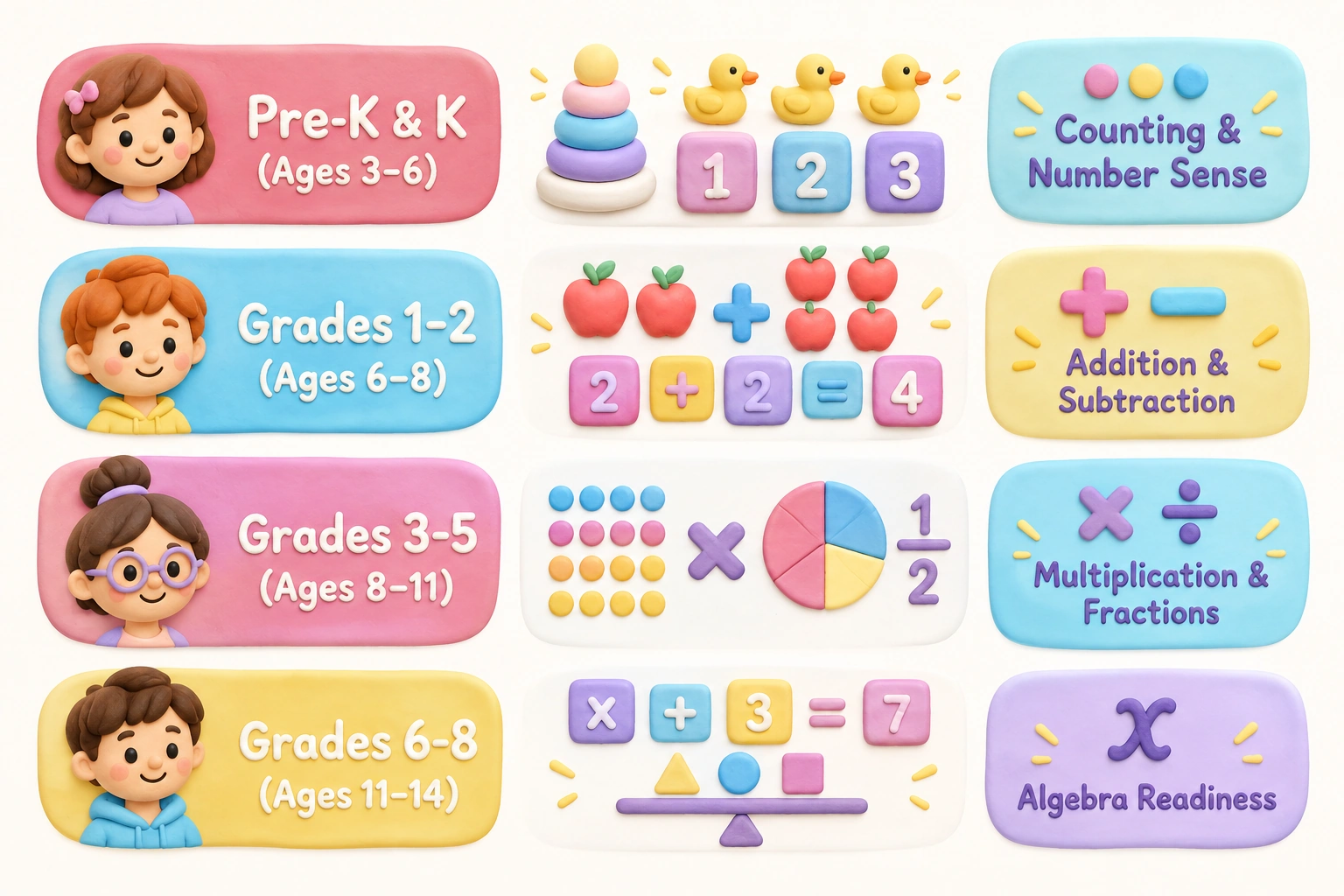
- Pre-K and Kindergarten (Ages 3–6): Focus on counting, number recognition, and early number sense. Best picks: Tiny Polka Dot, Khan Academy Kids, Number Line Jump. Avoid timed or competitive formats at this stage.
- Grades 1–2 (Ages 6–8): Addition and subtraction fluency, number bonds, place value. Best picks: Sum Swamp, Addition War, Math Dice Jr., SplashLearn, Zearn. Cooperative formats work well alongside simple competitive games.
- Grades 3–5 (Ages 8–11): Multiplication tables, division, fractions, decimals, word problems. Best picks: Prodigy Math, Multiplication Bingo, Zeus on the Loose, Proof!, 24 Game, Arcademics. Children at this stage can handle more competitive formats and benefit from timed fluency practice.
- Grades 6–8 (Ages 11–14): Prime factorization, algebra readiness, geometry, order of operations. Best picks: Prime Climb, Desmos Classroom activities, Prodigy Math (upper grades), 24 Game (advanced). Middle school students often respond well to strategy-heavy games and real-world problem contexts.
Choosing the Right Math Game for Your Child or Classroom
The most effective math game is the one a child will actually play repeatedly. Novelty drives initial engagement, but a game needs genuine mathematical depth to sustain interest and produce skill gains over time. When evaluating any math game — online, board, or classroom activity — the following questions are worth considering.
- Does the child need to solve a real math problem to progress, or can they succeed by guessing and retrying?
- Is the game matched to the child’s current skill level, or does it require prerequisite knowledge the child has not yet developed?
- For online games: does the platform collect personal data, display advertisements, or require an account? Is it ad-free and privacy-compliant?
- For board games: how long does a typical session take, and is that realistic for the child’s attention span and the available time?
- For classroom games: can all students be active simultaneously, or do most children wait while one student plays?
- Does the game support the specific skill the child needs to practice — math fact fluency, number sense, strategic thinking, or conceptual understanding — or does it cover skills the child has already mastered?
Caregiver involvement consistently improves outcomes across all game types. Playing alongside a child, asking questions about their reasoning, and celebrating effort rather than speed are practical strategies that research on playful learning supports across age groups.
Frequently Asked Questions
Are online math games as effective as worksheets for building math skills?
Online math games and worksheets serve different purposes. Worksheets are efficient for structured practice of a specific skill in a quiet, focused setting. Online math games tend to produce higher engagement and lower math anxiety, which can make children more willing to practice for longer. The evidence suggests that well-designed interactive math games can support math fact fluency and number sense comparably to worksheet practice, but neither format replaces quality instruction. The most effective approach typically combines both, with games used for motivated practice and worksheets for targeted skill consolidation.
What are the best free math games that require no login?
Math Playground, MathTug, and Hooda Math offer substantial free content with no login required. Arcademics allows basic multiplayer play without an account, though the free version includes advertisements. For board and card games, Addition War with a standard deck of cards and Shut the Box with dice require no digital access at all and cost very little.
How do I know if a math game is appropriate for my child’s grade level?
Most reputable math games list an age range or grade range on the packaging or platform. More useful than the stated range is checking whether the game requires skills your child has already developed. A game requiring multiplication fluency will not be enjoyable for a child still building times table knowledge, even if the stated age range technically includes your child. Starting slightly below the stated level and moving up as confidence grows tends to produce better outcomes than starting at the top of the range.
Are math board games better than online math games?
Neither format is universally better. Math board games offer face-to-face social interaction, physical handling of pieces, and screen-free engagement, which many families and teachers value. Online math games offer adaptive learning, progress tracking, and accessibility on any device. The best choice depends on the child’s learning style, the available time and resources, and the specific skill being practiced. Many families find that a combination — online games for independent practice and board games for family or classroom play — works better than relying on either format alone.
Can math games help children who have math anxiety?
Math games can help reduce math anxiety by lowering the emotional stakes of making errors and creating a positive association with mathematical thinking. Cooperative formats, where children work together rather than competing, are particularly effective for anxious learners. Timed or highly competitive games may increase anxiety in some children, so it is worth observing how a child responds and adjusting the format accordingly. If math anxiety is significantly affecting a child’s school performance or wellbeing, consulting a teacher or educational psychologist is advisable alongside any game-based strategies.
What math games work well for homeschool families?
Homeschool families benefit from games that work with small groups or a single child. Zearn and Khan Academy Kids are strong free online options with curriculum-aligned content. For hands-on math, Tiny Polka Dot, Math Dice Jr., and Shut the Box work well with one or two players. Prime Climb and Proof! are excellent for older children and can involve parents as active players, which research suggests improves learning outcomes compared to independent play.
Finding the Right Math Game for Your Child’s Stage and Style
No single math game works equally well for every child, every classroom, or every family. The 15 picks in this guide span a wide range of ages, skills, formats, and budgets precisely because the right choice depends on the individual child’s current grade-level math skills, learning style, and relationship with mathematics. A reluctant math learner may need a cooperative board game before a competitive online platform. A child who has already developed strong math fact fluency may be ready for the strategic thinking demands of Prime Climb or the 24 Game. A classroom teacher with no budget and shared devices will find different value in MathTug or Addition War than a family with a tablet subscription.
The most important practical step is to start with a game that matches what the child can already do, then gradually increase the challenge as confidence grows. Pairing any game — online or physical — with an engaged adult who asks questions, celebrates reasoning, and plays alongside the child will consistently produce better outcomes than unsupervised independent play. Math games are a genuinely useful tool for building mathematical confidence and fluency, but they work best as part of a broader learning environment that includes quality instruction, varied practice, and plenty of encouragement.

Take a short quiz to find out what your everyday choices say about your parenting style
When your child is curious about something new, what’s your instinct?
Take a short quiz to find out what your everyday choices say about your parenting style
“Can I download this app?” What happens next?
Take a short quiz to find out what your everyday choices say about your parenting style
When it comes to rules at home, which sounds most like you?
Take a short quiz to find out what your everyday choices say about your parenting style
If you could give your child one life skill today, what would you pick?
Take a short quiz to find out what your everyday choices say about your parenting style
Your child gets to choose what to watch. What would your ideal setup look like?
Take a short quiz to find out what your everyday choices say about your parenting style
Pick your parenting superpower ✨