25 Best Games for Kids: Online, Board and Active Picks

 Discover a Free Education Video App for Kids
Pastory uses AI to personalize educational video content based on your child’s interests and personality. Safe, engaging, and built for curious young minds. Sign up now to stay updated and enjoy early access with a free trial
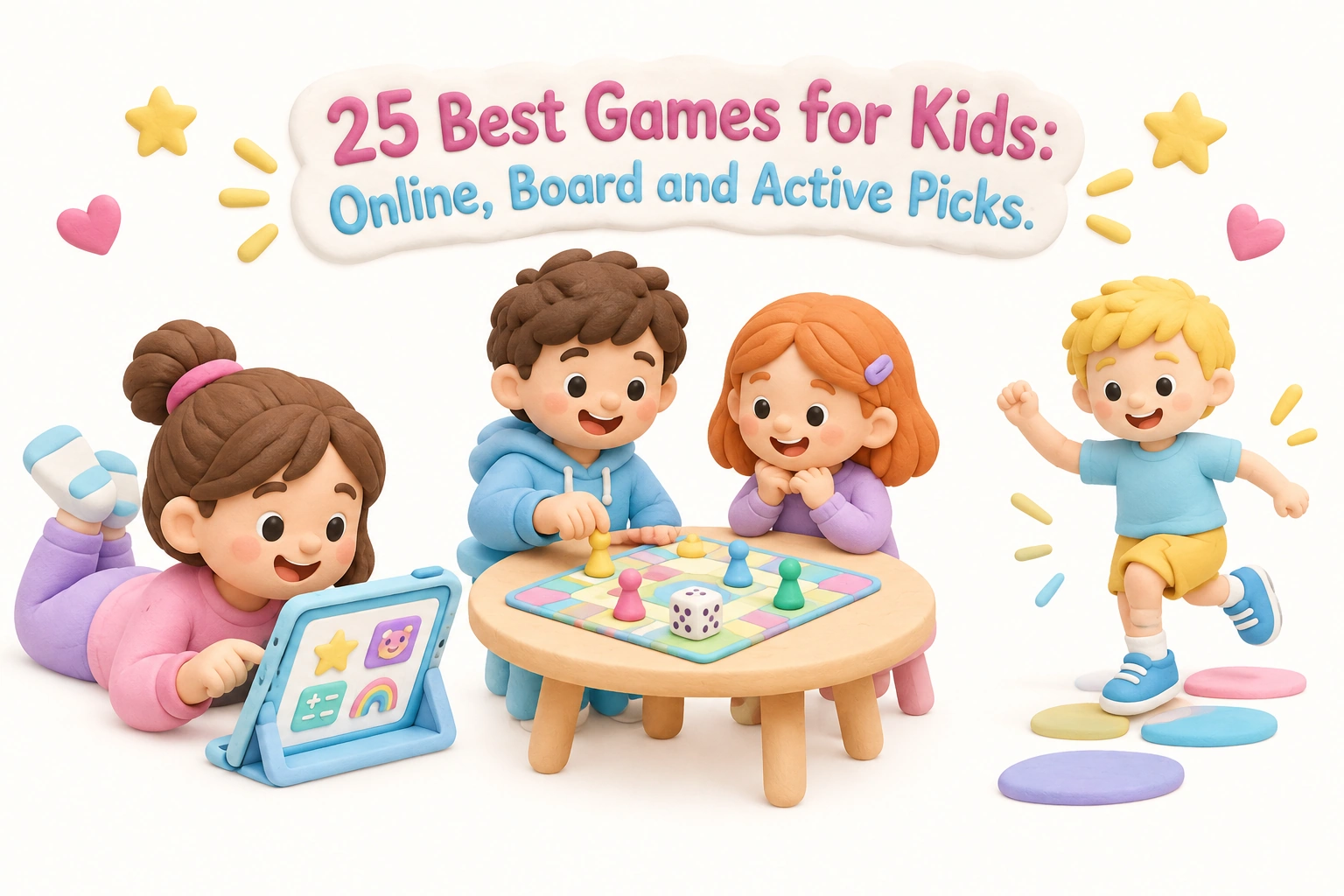
Choosing the right games for kids involves more than picking whatever looks fun on a shelf or a screen. The best picks support genuine developmental goals — building problem-solving skills, encouraging cooperative play, developing gross motor skills, or simply giving children a healthy outlet for energy and imagination. This guide covers 25 carefully selected games across three categories: online, board, and active. Each pick includes age-range guidance, developmental context, and practical notes to help parents and caregivers make informed choices.
Key Takeaways
- Age-appropriate games across all three categories — online, board, and active — can meaningfully support cognitive, social, and physical development when chosen thoughtfully.
- Cooperative games are particularly valuable for children who struggle with losing, as they shift the focus from competition to shared problem-solving.
- Free browser games can be safe and educational, but parents should check for ad exposure, chat features, and whether the platform requires sign-up before allowing independent use.
- Active games, including those requiring no equipment, support gross motor skills and emotional regulation alongside the obvious physical benefits.
- A quick-reference table at the end of this article maps all 25 picks by category, age range, number of players, and indoor or outdoor suitability.
Best Online Games for Kids
Safe online games for kids can offer genuine educational value when they are age-appropriate, low in advertising, and designed with learning goals in mind. The distinction between curated educational platforms and open-ended entertainment sites matters considerably: platforms built around curriculum goals tend to support skills like counting, reading, and pattern recognition more reliably than general gaming sites. Parents should also consider screen time balance — the American Academy of Pediatrics recommends consistent limits and co-engagement for younger children, particularly under age six. For older children, the quality and purpose of screen time matters as much as the total duration.
1. ABCya (Ages 2–13)
ABCya is a browser-based educational platform offering hundreds of games organized by grade level. Games cover literacy, maths, strategy, and creativity. It requires no download and no sign-up for most content, making it easy to access. The free version includes ads, so parental supervision during use is advisable for younger children. Builds: literacy, numeracy, pattern recognition.
2. PBS Kids Games (Ages 2–8)
PBS Kids Games is one of the most consistently kid-friendly and ad-light free browser game collections available. Games are tied to beloved characters from shows like Curious George and Daniel Tiger, which supports engagement. Content is editorially curated rather than algorithm-driven, which means children are less likely to encounter inappropriate material. Builds: early literacy, emotional vocabulary, curiosity.
3. Khan Academy Kids (Ages 2–8)
Khan Academy Kids is a free, no-advertisement app and browser platform offering structured learning activities in reading, maths, social-emotional skills, and creative expression. It adapts to the child’s progress, offering a form of personalized learning that adjusts difficulty based on performance. It is widely regarded as one of the most educationally rigorous free platforms for young children. Builds: early reading, maths foundations, emotional intelligence.
4. Prodigy Math (Ages 6–13)
Prodigy Math wraps curriculum-aligned maths practice inside a role-playing game format. Children answer maths questions to progress through battles and adventures, which can sustain engagement longer than traditional worksheets. The free version is substantial, though a paid membership unlocks additional content. Parents can monitor progress through a dashboard. Builds: arithmetic, problem-solving skills, persistence.
5. Toca Life World (Ages 4–9)
Toca Life World is a sandbox-style digital play environment where children create stories, design characters, and explore open-ended scenarios. It contains no advertising and no social features, making it one of the safer independent-use options for younger children. It supports imaginative play rather than structured learning, which has its own developmental value. Builds: creativity, narrative thinking, imaginative play.
6. Hooda Math (Ages 6–14)
Hooda Math offers a large library of free browser-based maths games covering topics from basic arithmetic to geometry and logic puzzles. It requires no sign-up and no download. The interface is straightforward, though the site does carry some advertising, so parental awareness is recommended. Builds: mathematical reasoning, logic, critical thinking.
7. National Geographic Kids Games (Ages 6–12)
National Geographic Kids offers free browser games focused on animals, geography, science, and environmental topics. The content is editorially produced and tied to factual learning, making it a strong choice for children with interests in nature and science. Games are generally low-pressure and exploratory in format. Builds: geography skills, scientific curiosity, general knowledge.
8. Starfall (Ages 3–8)
Starfall is a long-established educational platform focused on early reading and phonics. It uses interactive stories, songs, and games to support letter recognition, blending, and reading fluency. The free version covers foundational phonics content. It is particularly well-suited for preschoolers and early readers. Builds: phonics, early reading, language development.
9. Math Playground (Ages 5–12)
Math Playground offers a broad range of maths games, logic puzzles, and word problems organized by grade level. Many games are genuinely challenging and reward strategic thinking rather than simple repetition. The platform is free to use in a browser with no download needed. Builds: mathematical reasoning, spatial reasoning, critical thinking.
A practical note on screen time for online games: even well-designed educational platforms benefit from time limits and occasional co-play with a caregiver. Discussing what a child is doing on screen — asking questions, celebrating progress — tends to deepen the learning value of any digital game.
Best Board Games for Kids
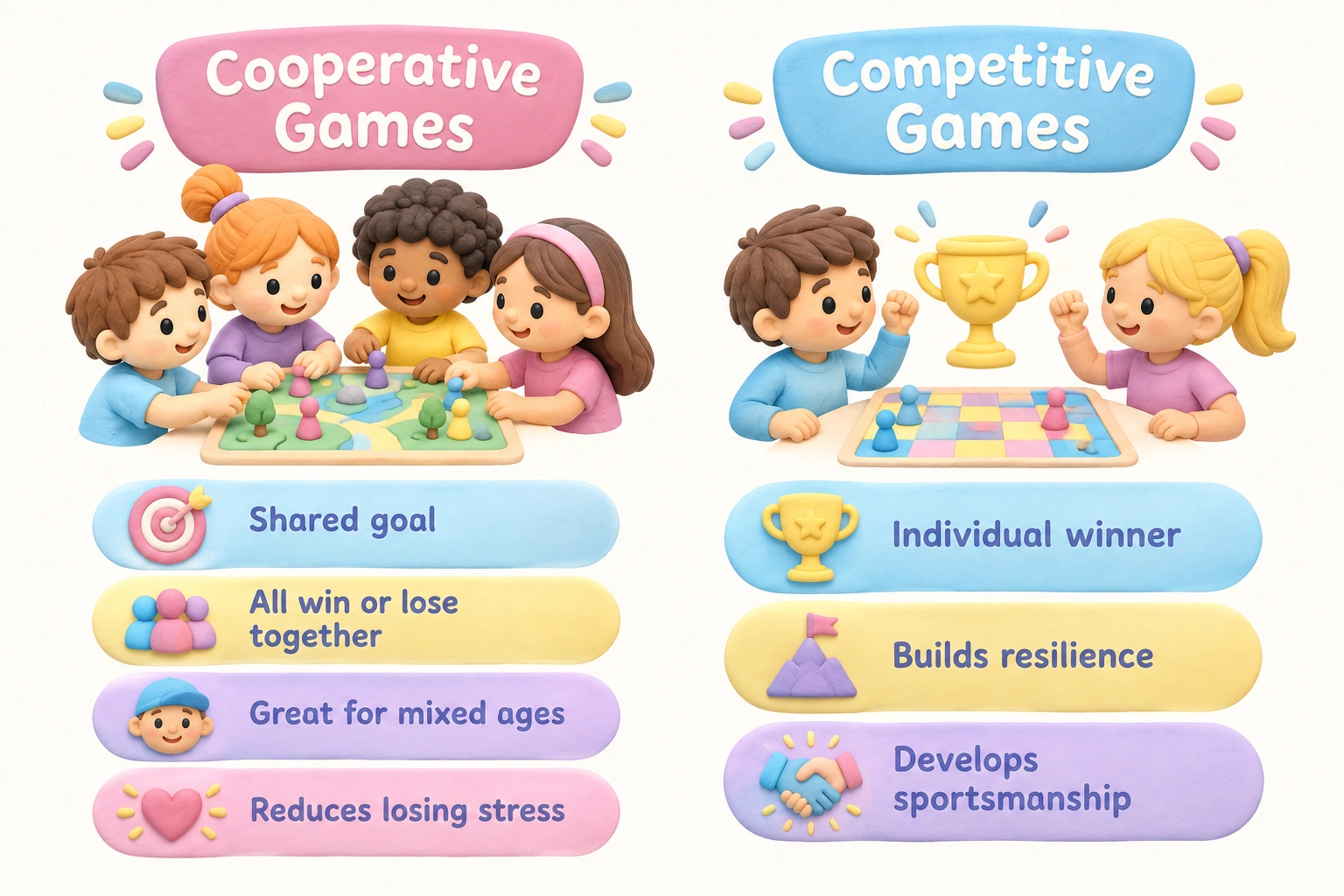
Board games for kids offer something digital games rarely can: face-to-face interaction, physical handling of pieces, and the social experience of sitting together at a table. Classic board games have endured for good reason — they teach turn-taking, patience, and sportsmanship in a tangible, low-stakes environment. Newer designs have expanded the category considerably, with cooperative board games, strategy games for kids, and beautifully illustrated tile games now widely available. When selecting a board game, consider the number of players in your household, the typical session length your child can sustain, and whether a cooperative or competitive format suits their temperament.
10. Candy Land (Ages 3–6)
Candy Land is one of the most accessible classic board games for toddlers and preschoolers. It requires no reading and no complex decisions — children simply draw cards and move their piece. This simplicity makes it ideal for introducing the concept of turn-taking and following rules. Session length is typically 15–20 minutes. Builds: turn-taking, colour recognition, patience. Players: 2–4. Cooperative or competitive: competitive.
11. Hoot Owl Hoot! (Ages 4+)
Hoot Owl Hoot! is a cooperative board game in which players work together to guide owls back to their nest before sunrise. Because all players win or lose together, it removes the sting of individual defeat and encourages teamwork and collaborative decision-making. It is an excellent first cooperative game for preschoolers. Builds: cooperation, colour matching, strategic thinking. Players: 2–4. Cooperative or competitive: fully cooperative.
12. Outfoxed! (Ages 5+)
Outfoxed! is a cooperative deduction game where players work as a team to identify which fox stole a pot pie before the culprit escapes. It introduces logical reasoning and process-of-elimination thinking in a format accessible to young children. The cooperative structure makes it particularly suitable for mixed-age sibling groups. Builds: deductive reasoning, teamwork, critical thinking. Players: 2–4. Cooperative or competitive: fully cooperative.
13. Rhino Hero (Ages 5+)
Rhino Hero is a fast-paced stacking card game in which players build a wobbly skyscraper and try not to topple it. It develops fine motor skills and spatial reasoning while keeping sessions short — typically 10–15 minutes. The compact format makes it easy to travel with. Builds: fine motor skills, spatial reasoning, patience. Players: 2–5. Cooperative or competitive: competitive.
14. Zingo! (Ages 4–8)
Zingo! is a fast-paced matching game similar to bingo, using picture and word tiles. It supports early literacy and vocabulary development while keeping the pace lively enough to hold young children’s attention. The sliding tile dispenser adds a satisfying physical element. Builds: vocabulary, word recognition, attention span. Players: 2–6. Cooperative or competitive: competitive.
15. Ticket to Ride: First Journey (Ages 6+)
Ticket to Ride: First Journey is a simplified version of the popular strategy game, designed specifically for younger players. Children collect train cards and claim routes across a map, introducing basic geography and route-planning thinking. It plays in around 30 minutes and scales well for family game night with mixed ages. Builds: geography skills, strategic planning, turn-taking. Players: 2–4. Cooperative or competitive: competitive.
16. Kingdomino (Ages 7+)
Kingdomino is a tile-drafting game in which players build a kingdom by selecting and placing domino-style landscape tiles. It introduces spatial reasoning and simple scoring strategy in a visually appealing format. Games last around 15–20 minutes, giving it strong replay value for family game nights. Builds: spatial reasoning, strategic thinking, pattern recognition. Players: 2–4. Cooperative or competitive: competitive.
17. Blokus (Ages 7+)
Blokus is a strategy game in which players place geometric pieces on a grid, trying to claim as much territory as possible while blocking opponents. It is one of the most effective games for developing spatial reasoning and forward-planning skills in school-age children. The rules are easy to learn but the strategy deepens with experience. Builds: spatial reasoning, strategic thinking, geometry awareness. Players: 2–4. Cooperative or competitive: competitive.
18. Catan Junior (Ages 6+)
Catan Junior adapts the classic resource-management game for younger players, using pirates and islands instead of settlements. Children collect resources, trade, and build — introducing basic economic thinking and negotiation in an age-appropriate format. It bridges the gap between simple children’s games and more complex family strategy games. Builds: resource management, negotiation, strategic planning. Players: 2–4. Cooperative or competitive: competitive.
Best Active Games for Kids
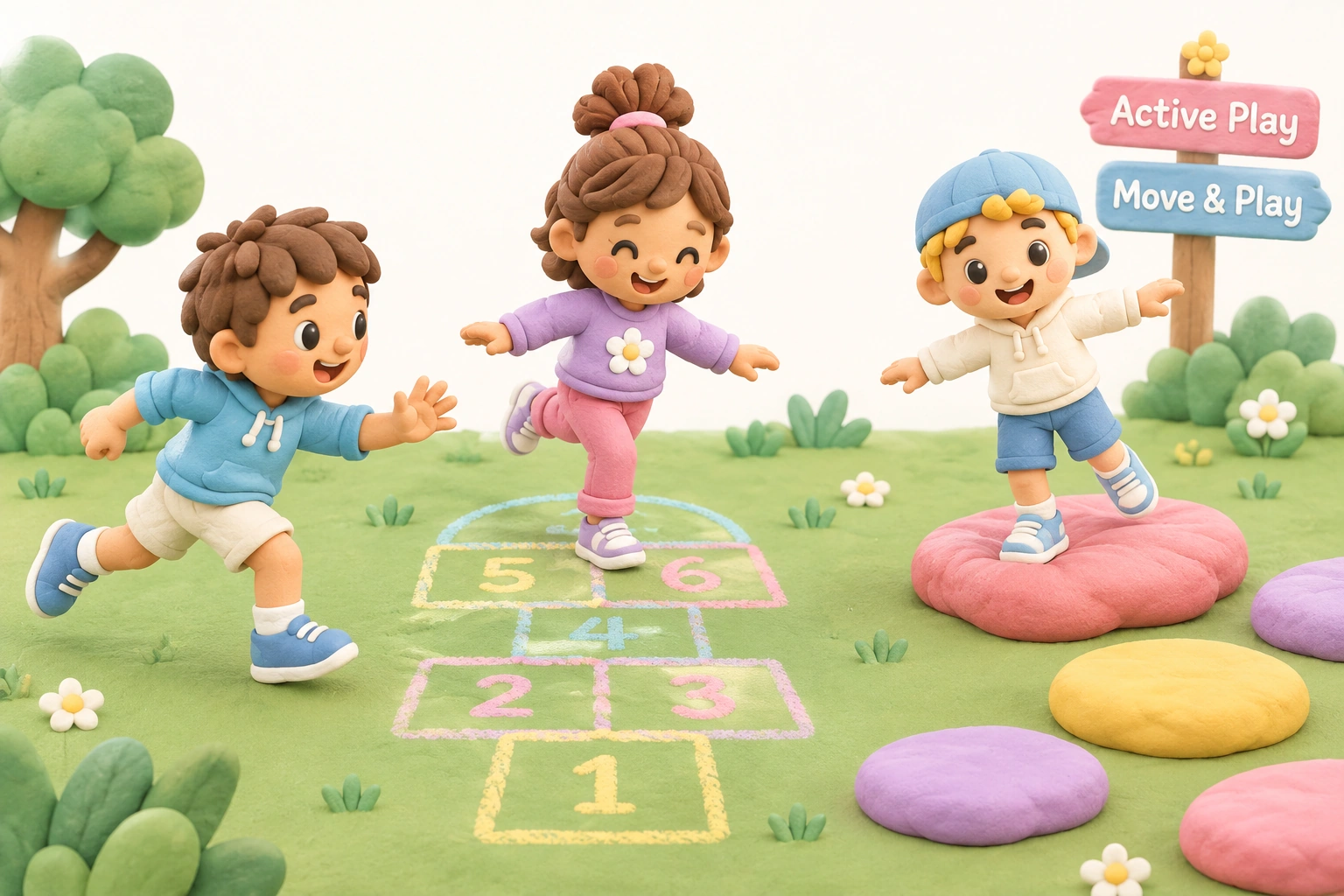
Active play is essential for children’s physical and cognitive development. Gross motor skills, coordination, emotional regulation, and social skills all benefit from regular movement-based play. Importantly, many of the most effective active games for kids require no equipment at all, making them accessible indoors and outdoors alike. The games below include both classic outdoor games and indoor active options for rainy days or limited spaces — a combination that is often missing from standard game roundups.
19. Freeze Tag (Ages 4+, No Equipment)
Freeze Tag is a timeless outdoor game in which one player tags others to freeze them in place, while unfrozen players can rescue their teammates. It combines running, strategy, and social cooperation in a format that works for groups of any size. It can be played indoors in a large room with modified movement rules. Builds: gross motor skills, teamwork, spatial awareness. Indoor or outdoor: both.
20. Simon Says (Ages 3+, No Equipment)
Simon Says is a classic listening and movement game that develops attention, impulse control, and body awareness. It requires no equipment and works equally well indoors or outdoors. For younger children, it also supports following multi-step instructions, which is an important early executive function skill. Builds: listening skills, impulse control, body awareness. Indoor or outdoor: both.
21. The Floor Is Lava (Ages 4+, Minimal Equipment)
The Floor Is Lava is an imaginative movement game in which children must navigate a room without touching the floor, using cushions, furniture, or designated safe zones. It develops gross motor skills, balance, and creative problem-solving simultaneously. Indoors, it requires only household items; outdoors, it can be adapted with chalk-marked zones. Builds: gross motor skills, balance, creative thinking. Indoor or outdoor: both.
22. Hopscotch (Ages 4–10)
Hopscotch is a classic backyard game that develops balance, coordination, and counting skills. All it requires is chalk and a flat surface. It can be adapted for different ages by changing the grid complexity or adding number challenges. It is a reliable recess game that works for mixed-age groups. Builds: balance, coordination, counting. Indoor or outdoor: outdoor primarily.
23. Scavenger Hunt (Ages 4+, Adaptable)
A scavenger hunt can be tailored to almost any age, environment, or learning goal. Indoors, it might involve finding household objects by colour or shape; outdoors, it can incorporate nature items, clues, or map-reading. Scavenger hunts develop observation skills, reading comprehension (for older children), and collaborative problem-solving when played in teams. Builds: observation, problem-solving skills, teamwork. Indoor or outdoor: both.
24. Obstacle Course (Ages 3+, Adaptable)
Setting up a simple obstacle course — using cushions, hula hoops, tape lines, or garden furniture — gives children a structured physical challenge that builds gross motor skills, coordination, and persistence. Courses can be timed for older children to add a competitive element, or completed cooperatively for younger groups. The setup itself can be a creative activity. Builds: gross motor skills, coordination, persistence. Indoor or outdoor: both.
25. Throw Throw Burrito (Ages 7+)
Throw Throw Burrito is a fast-paced card-and-dodgeball hybrid game in which players collect matching cards while simultaneously dodging foam burritos thrown by opponents. It combines the structure of a card game with active physical play, making it an excellent bridge between board game night and active play. It works best in a medium-sized indoor space. Builds: hand-eye coordination, quick decision-making, gross motor skills. Players: 2–6. Indoor or outdoor: indoor primarily.
Quick-Reference Guide: All 25 Games at a Glance
The table below maps each of the 25 picks by category, recommended age range, number of players, and whether the game suits indoor or outdoor play. Use it to quickly identify options that fit your child’s age, your available space, and the number of players in your group.
| Game | Category | Age Range | Players | Indoor / Outdoor |
|---|---|---|---|---|
| ABCya | Online | 2–13 | 1 | Indoor |
| PBS Kids Games | Online | 2–8 | 1 | Indoor |
| Khan Academy Kids | Online | 2–8 | 1 | Indoor |
| Prodigy Math | Online | 6–13 | 1 | Indoor |
| Toca Life World | Online | 4–9 | 1 | Indoor |
| Hooda Math | Online | 6–14 | 1 | Indoor |
| National Geographic Kids | Online | 6–12 | 1 | Indoor |
| Starfall | Online | 3–8 | 1 | Indoor |
| Math Playground | Online | 5–12 | 1 | Indoor |
| Candy Land | Board | 3–6 | 2–4 | Indoor |
| Hoot Owl Hoot! | Board | 4+ | 2–4 | Indoor |
| Outfoxed! | Board | 5+ | 2–4 | Indoor |
| Rhino Hero | Board | 5+ | 2–5 | Indoor |
| Zingo! | Board | 4–8 | 2–6 | Indoor |
| Ticket to Ride: First Journey | Board | 6+ | 2–4 | Indoor |
| Kingdomino | Board | 7+ | 2–4 | Indoor |
| Blokus | Board | 7+ | 2–4 | Indoor |
| Catan Junior | Board | 6+ | 2–4 | Indoor |
| Freeze Tag | Active | 4+ | 3+ | Both |
| Simon Says | Active | 3+ | 2+ | Both |
| The Floor Is Lava | Active | 4+ | 2+ | Both |
| Hopscotch | Active | 4–10 | 1+ | Outdoor |
| Scavenger Hunt | Active | 4+ | 2+ | Both |
| Obstacle Course | Active | 3+ | 1+ | Both |
| Throw Throw Burrito | Active | 7+ | 2–6 | Indoor |
How to Choose the Right Game for Your Child
Selecting age-appropriate games is less about finding the most popular title and more about matching a game’s demands to your child’s current developmental stage. A game that is too simple will bore an older child quickly; one that is too complex will frustrate a younger one. The following considerations can help narrow the field.
Consider temperament and social style. Children who are sensitive to losing often thrive with cooperative games, where the group wins or loses together. Competitive games are fine for children who handle setbacks well, but introducing cooperative play alongside competitive options can help build emotional resilience over time.
Think about session length. Toddlers and preschoolers typically sustain focused play for 10–20 minutes. School-age children can manage 30–45 minutes. Tweens and older children can engage with longer strategy games. Choosing a game with a session length that matches your child’s attention span reduces frustration for everyone at the table.
Account for mixed-age groups. When siblings of different ages play together, cooperative games tend to work best because they remove the advantage gap between older and younger players. Games like Outfoxed! and Hoot Owl Hoot! are particularly well-suited to mixed-age family play. For online games, platforms like Khan Academy Kids and ABCya offer grade-level filtering that allows each child to play at their own level independently.
Balance screen time thoughtfully. For families incorporating online games, it helps to treat digital game time as one component of a broader play diet rather than the default option. Rotating between online, board, and active games across the week supports a wider range of developmental skills and reduces the risk of over-reliance on screens for entertainment.
Online Game Safety: What Parents Should Check
Not all free browser games are equally safe. Before allowing independent use of any online platform, parents are encouraged to check several practical factors. First, does the site require account creation or personal information? Platforms like PBS Kids and Starfall do not require sign-up, which reduces data exposure for young children. Second, does the free version carry advertising? Sites with ads — even educational ones — can expose children to content unrelated to the game. Third, does the platform include chat or social features? Multiplayer games with open chat carry risks that are not present in single-player educational games. Finally, consider whether the platform’s content is editorially curated or algorithmically generated. Curated platforms tend to maintain more consistent quality and age-appropriateness than those driven purely by engagement metrics.
Developmental Benefits by Game Category
Each of the three game categories in this guide supports a distinct but overlapping set of developmental skills. Understanding these differences can help parents choose games that complement what their child is working on at a given stage.
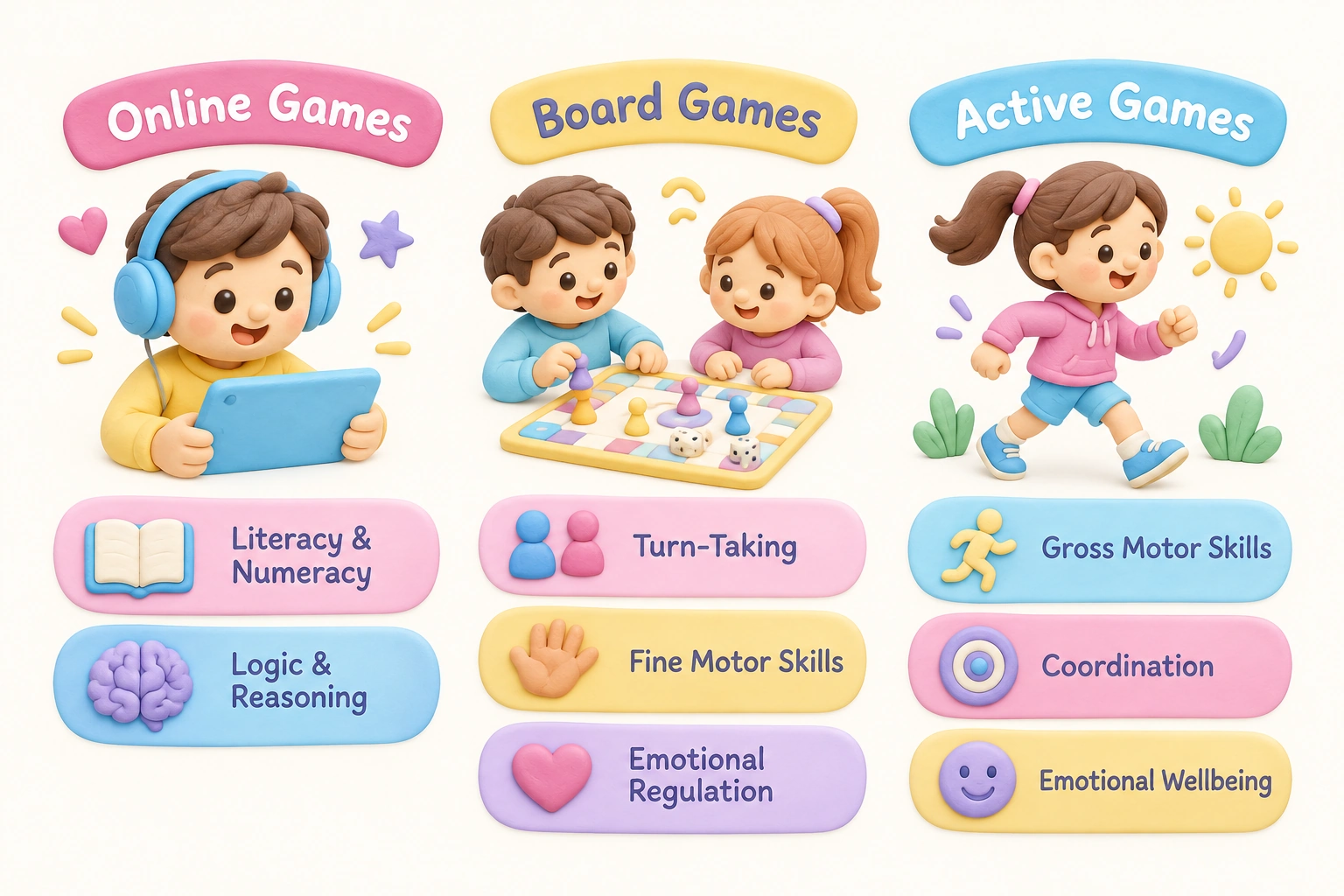
Online educational games can support cognitive skills including numeracy, literacy, pattern recognition, and logical reasoning when the platform is well-designed. The interactive format may help sustain attention for children who find passive learning less engaging. However, outcomes vary considerably by platform quality, session length, and whether a caregiver is involved in the experience.
Board games offer unique social and emotional developmental benefits that digital games rarely replicate. Turn-taking, reading facial expressions, managing disappointment, and celebrating others’ success are all practised naturally during a board game session. Strategy games for kids additionally develop planning, spatial reasoning, and flexible thinking. The physical handling of game pieces also supports fine motor development in younger children.
Active games support gross motor skills, cardiovascular health, and body awareness most directly. Beyond the physical benefits, movement-based play also supports emotional regulation — physical activity is consistently associated with improved mood and reduced anxiety in children across a wide age range. Many active games also develop social skills through negotiation, rule-following, and cooperative problem-solving.
Frequently Asked Questions
What age are board games appropriate for?
Most children are ready for simple board games with basic rules — such as Candy Land or Hoot Owl Hoot! — from around age three or four. Games requiring reading, strategy, or longer attention spans are generally better suited to children aged six and above. Always check the manufacturer’s age recommendation and consider your individual child’s developmental stage alongside it.
Are free online games safe for kids?
Many free online games are safe and educationally valuable, but safety varies significantly by platform. Look for platforms that do not require personal information, carry minimal advertising, and do not include open chat features. Editorially curated platforms like PBS Kids and Khan Academy Kids are among the most consistently safe options for younger children. Parental supervision during initial use is always advisable.
How much screen time is appropriate for children playing online games?
The American Academy of Pediatrics recommends avoiding screen time other than video calls for children under 18–24 months, limiting use to one hour per day of high-quality content for children aged two to five, and applying consistent limits with attention to content quality for children aged six and older. Online games — even educational ones — count toward daily screen time totals. Balancing digital game time with board games and active play supports a healthier overall play diet.
What are cooperative games and why are they recommended?
Cooperative games are games in which all players work together toward a shared goal rather than competing against each other. They are particularly recommended for younger children, children who find losing distressing, and mixed-age groups where skill gaps between players might otherwise make competition feel unfair. Examples in this guide include Hoot Owl Hoot! and Outfoxed!
Can active games be played indoors?
Yes. Many active games work well indoors with minor adaptations. Simon Says, The Floor Is Lava, Freeze Tag (with walking instead of running), and obstacle courses built from household items all work in living rooms or hallways. Indoor active play is particularly useful on rainy days or in households without access to outdoor space.
How do I choose between a competitive and a cooperative game?
Consider your child’s temperament and the group dynamic. Cooperative games tend to work better for younger children, children who are sensitive to losing, and mixed-age sibling groups. Competitive games can be excellent for developing resilience and sportsmanship in children who handle setbacks reasonably well. Many families benefit from having both types available and rotating between them.
Do online educational games actually help children learn?
Well-designed educational games can support skill development in areas like literacy, numeracy, and logical reasoning, particularly when they align with curriculum goals and are used consistently. However, outcomes vary by child, platform quality, session length, and caregiver involvement. Online games are most effective as one component of a broader learning environment rather than a standalone educational solution.
Finding the Right Mix of Games for Your Family
The most effective approach to games for kids is rarely about finding a single perfect option — it is about building a varied play diet that includes digital, tabletop, and physical experiences. Online games can offer accessible, low-cost educational value when chosen carefully and used within sensible screen time limits. Board games bring the irreplaceable social experience of playing face-to-face, developing turn-taking, emotional regulation, and strategic thinking in ways that screens cannot fully replicate. Active games — many of which require no equipment at all — support physical development and emotional wellbeing alongside the obvious fun of movement.
When selecting games, prioritize age-appropriateness, your child’s individual temperament, and the developmental skills you most want to support at their current stage. Rotate between categories across the week, involve yourself in play when possible, and treat game time — whether on a screen, at a table, or in the backyard — as a genuine opportunity for connection and growth. The 25 picks in this guide are a starting point; the best game for your child is ultimately the one they will engage with enthusiastically and return to with genuine interest.

Take a short quiz to find out what your everyday choices say about your parenting style
When your child is curious about something new, what’s your instinct?
Take a short quiz to find out what your everyday choices say about your parenting style
“Can I download this app?” What happens next?
Take a short quiz to find out what your everyday choices say about your parenting style
When it comes to rules at home, which sounds most like you?
Take a short quiz to find out what your everyday choices say about your parenting style
If you could give your child one life skill today, what would you pick?
Take a short quiz to find out what your everyday choices say about your parenting style
Your child gets to choose what to watch. What would your ideal setup look like?
Take a short quiz to find out what your everyday choices say about your parenting style
Pick your parenting superpower ✨