
6 Hands-On Activities for Teaching Place Value to Kids

 Discover a Free Education Video App for Kids
Pastory uses AI to personalize educational video content based on your child’s interests and personality. Safe, engaging, and built for curious young minds. Sign up now to stay updated and enjoy early access with a free trial
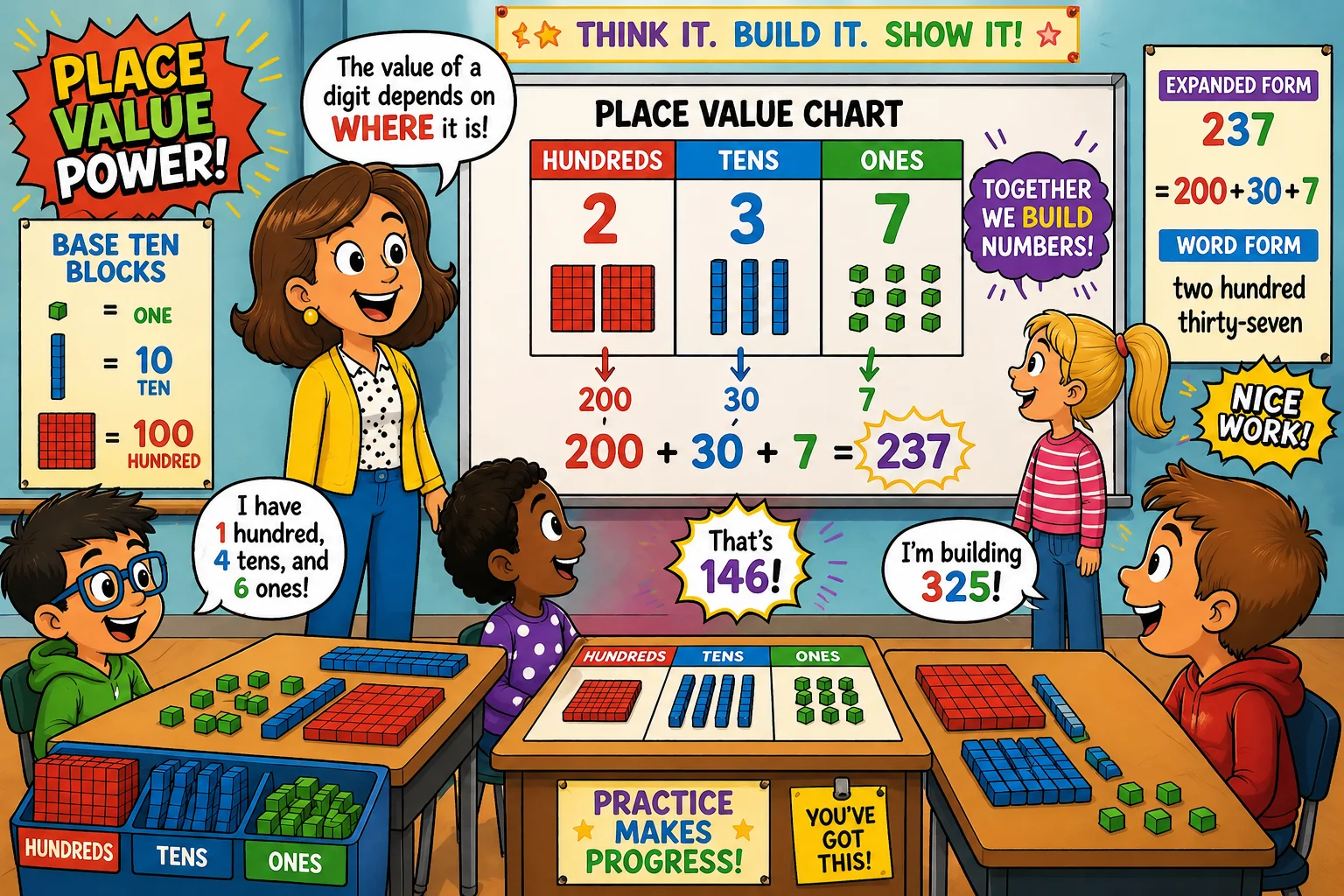
Learning how to teach place value effectively gives children the foundation they need for nearly every math skill that follows. When students understand that a digit’s position determines its worth, addition, subtraction, and mental math all become more manageable. This guide covers what place value is, when to introduce it by grade level, a structured nine-step teaching sequence, and six hands-on activities suited for the classroom or home.
You will also find quick daily routines that reinforce the concept in five minutes or less, plus a look at the most common mistakes students make and how to address them early.
Key Takeaways
- Place value is a core early math concept that supports addition, subtraction, multiplication, and number sense.
- Teaching readiness begins in kindergarten and builds progressively through third grade and beyond.
- A nine-step systematic sequence helps introduce place value in a clear, structured order.
- Six hands-on activities — including Place Value Bingo, Roll and Write, and Build, Draw, Write — make practice engaging and concrete.
- Short daily routines and early correction of common mistakes help students build lasting understanding.
What Is Place Value
Place value is the principle that a digit’s worth depends on its position within a number. In the number 45, the digit 4 does not simply mean “four” — it means four tens, or 40. The digit 5 means five ones. Understanding this distinction is what separates children who can work flexibly with numbers from those who are simply memorizing procedures.
This positional system is the foundation for regrouping, comparing multi-digit numbers, working with decimals, and eventually mastering multiplication and division. Without a solid grasp of how digit position works, children tend to treat numerals as isolated symbols rather than parts of a structured system — which leads to persistent errors throughout their math education.
Place Value vs. Digit Value
A common point of confusion is the difference between a digit and its positional worth. A digit is simply a symbol — one of the numerals 0 through 9. The concept of place value is the power that position gives that symbol within a number. The digit 3 on its own means three. But with positional notation, 3 in the tens place means thirty — not three. Helping students understand this distinction early prevents a wide range of errors later.
The Base-10 System: Where It Comes From
The place value system used in everyday math is a base-10 system, meaning numbers are organized in groups of ten. Each column is worth ten times the place to its right. This structure likely developed from the fact that humans have ten fingers — making groups of ten a natural counting unit. Understanding why the system is built around tens helps children see the logic behind the place value chart rather than treating it as an arbitrary rule.
The base 10 structure also explains why each digit in one place represents ten times more than the same digit one column to the right. A 4 in the ones place equals 4. A 4 in the tens place equals 40. The position of a digit in the number determines its value — and grasping that principle is the key to everything that follows.
Place Value Chart Basics
A place value chart organizes digits into labeled columns: ones, tens, hundreds, thousands, and beyond. To read a number using this chart, start from the left (the highest column) and move right. In the number 362, the digit 3 is in the hundreds place and represents 300; the 6 is in the tens column and represents 60; and the 2 is in the ones place and represents 2. This visual layout helps students see the value of each digit at a glance, rather than treating a three-digit number as a single undivided whole.
Why Place Value Matters for Young Learners
Investing time in this concept pays off across a child’s entire math education. Place value lays the groundwork for addition and subtraction with regrouping, prepares students for multiplication and division, and supports understanding of decimals and fractions. In everyday life, the concept shows up in handling money — dimes represent tens and pennies represent ones — giving it immediate, practical relevance.
How It Enables Mental Math
Without an understanding of digit position, children rely on counting by ones for every calculation. With it, they can break numbers apart and work with them efficiently. A student who understands place value works can solve 27 + 10 instantly by recognizing that adding one ten increases the tens digit from 2 to 3, giving 37 — no counting required.
How It Prevents Common Math Errors
Many of the most persistent early math errors stem directly from weak positional reasoning. Students write 45 as “405,” confuse the tens and ones columns, or add digits across positions as if they carry equal weight. Research in mathematics education consistently identifies these misconceptions as a root cause of difficulty with multi-digit operations. Catching and correcting them early saves significant instructional time later.
How It Builds Number Sense
Number sense — the ability to work flexibly and intuitively with numbers — depends heavily on students’ understanding of place value. When students grasp that 47 is close to 50 because it contains 4 tens, they can estimate, compare, and round with confidence. This kind of flexible thinking is what allows children to approach problems from multiple angles rather than relying on a single memorized method.
When to Start Teaching Place Value
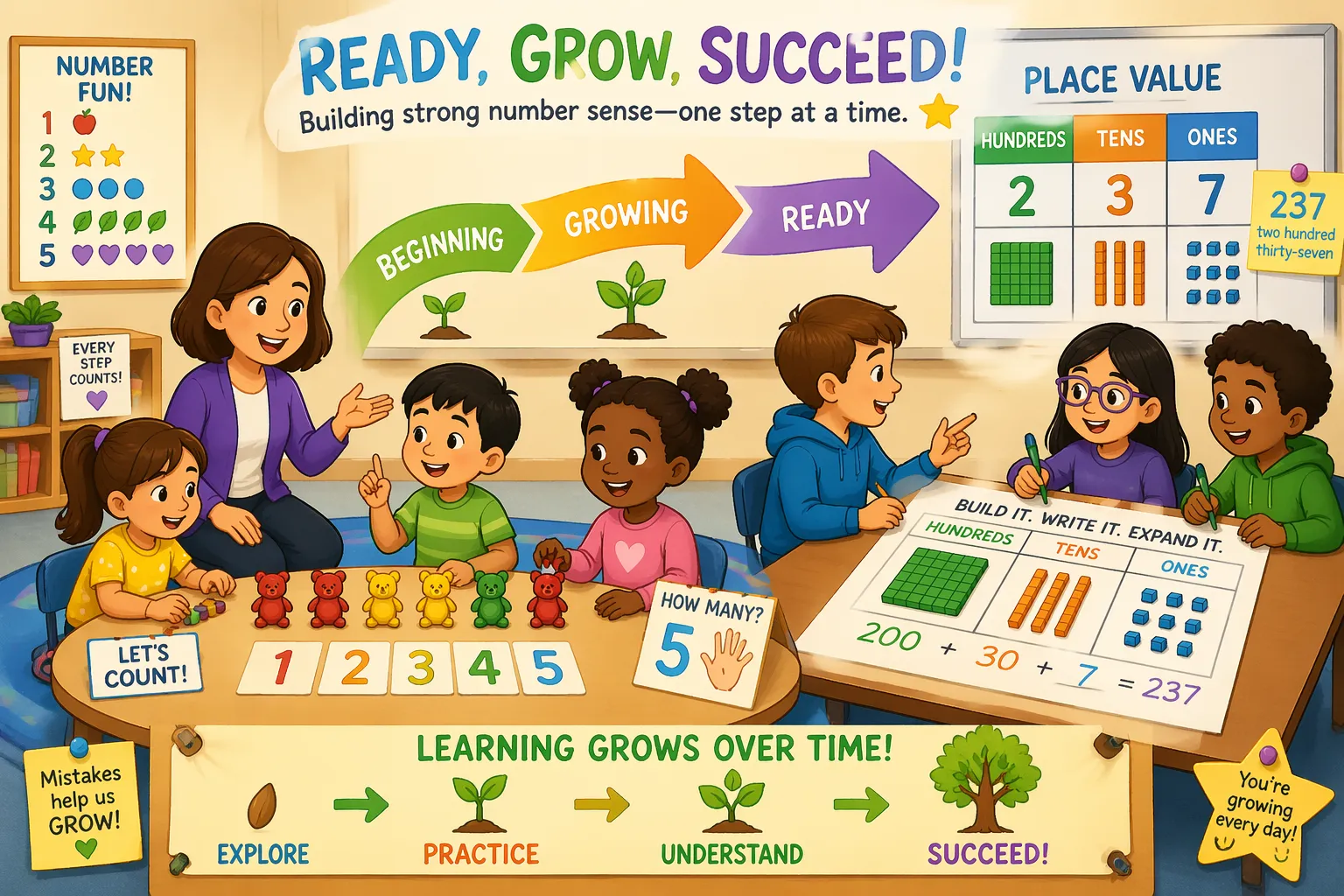
Formal instruction typically begins in 1st grade, but readiness depends on foundational skills rather than age alone. Before structured lessons begin, children should be able to count reliably to 20, recognize single digits, and group small collections of objects. Starting too early — before these skills are secure — tends to create confusion rather than understanding.
Tips for teaching across grade levels always start with the same principle: meet students where they are, not where the curriculum assumes they should be.
Kindergarten Readiness
Kindergarten is not the time for formal positional instruction, but it is the time to build the pre-skills that make it possible. Counting by tens to 100, making groups of ten objects, and recognizing that ten ones equal 1 ten are the key foundations. These pre-grouping activities prepare students to learn about place value when direct instruction begins in first grade.
First-Grade Milestones
To teach place value in first grade effectively, start with teen numbers. Students are ready to learn that 14 means one group of ten and four leftover ones — in other words, 1 ten and 2 ones isn’t the same as 12 ones rearranged randomly, but a structured quantity. First graders work with a place value chart up to 99, compare two-digit numbers, and begin using positional language. By the end of the year, most students will compose two-digit numbers confidently using tens and ones.
Second-Grade Expansion
In 2nd grade, the concept extends to the hundreds place and represents a significant leap in numerical thinking. Students learn to represent numbers in standard form (365), expanded form (300 + 60 + 5), and word form. Skip counting by 5s, 10s, and 100s reinforces positional patterns. By the end of second grade, students should be fluent with three-digit numbers and understand how each column relates to the next.
Third Grade and Beyond
By 3rd grade, students are applying their knowledge of place value to multi-digit multiplication, rounding, and more complex addition and subtraction. In grade 5, the system extends into decimals — tenths, hundredths — where understanding digit position becomes even more critical. The thousands place appears regularly in 3rd and 4th grade work, and by grade 5, students are expected to reason fluently about numbers into the millions. Common core math standards map this progression clearly across grade levels, giving educators a reliable framework for sequencing instruction.
9 Easy Steps to Teach Place Value Systematically
Effective instruction follows a clear progression from concrete, hands-on experience to abstract symbolic understanding. Moving through this sequence too quickly is one of the most common instructional mistakes. Use formative assessment after each step to confirm mastery before moving on.
- Count by groups (skip counting) — Begin with skip counting by 10s to 100, then by 5s and 2s. Use number lines and body movements to connect rhythm to numerical structure.
- Bundle straws or popsicle sticks — Count individual sticks to ten, then bundle them with a rubber band. Introduce “one ten” as a single unit. Repeat until students can build bundles of 100.
- Introduce a place value mat with base-ten blocks — A place value mat is the most versatile manipulative for early positional instruction. Place rods and unit cubes on the correct columns to build numbers from 1 to 99. Using base ten blocks at this stage gives students a physical experience of what tens and ones actually look like.
- Read numbers from the chart — Show a number like 54. Point to the tens column: “5 tens = 50.” Point to the ones column: “4 ones = 4.” Combine: “fifty-four.” Practice this daily.
- Write numbers in expanded form — Convert 73 into 70 + 3, then into (7 × 10) + (3 × 1). Gradually remove the visual support of the blocks as students build confidence.
- Compare numbers using digit position — Teach greater than, less than, and equal to by comparing the tens digit first, then the ones digit only when tens are equal. The classic “alligator mouth” analogy helps young learners remember which direction the symbol points.
- Add and subtract 10 or 100 mentally — Practice problems like “10 more than 38 is ___” by changing only the tens digit. This builds fluency without counting from one.
- Introduce regrouping (trading) — Show that 10 ones can be traded for 1 ten, and 10 tens for 1 hundred, using physical base-ten blocks. This is the concrete foundation for carrying and borrowing.
- Apply the concept to word problems — Present problems like “I have 4 tens and 7 ones. How many?” Connect positional reasoning to money and measurement to ground abstract thinking in real-world contexts.
Hands-On Activities for Classroom or Home
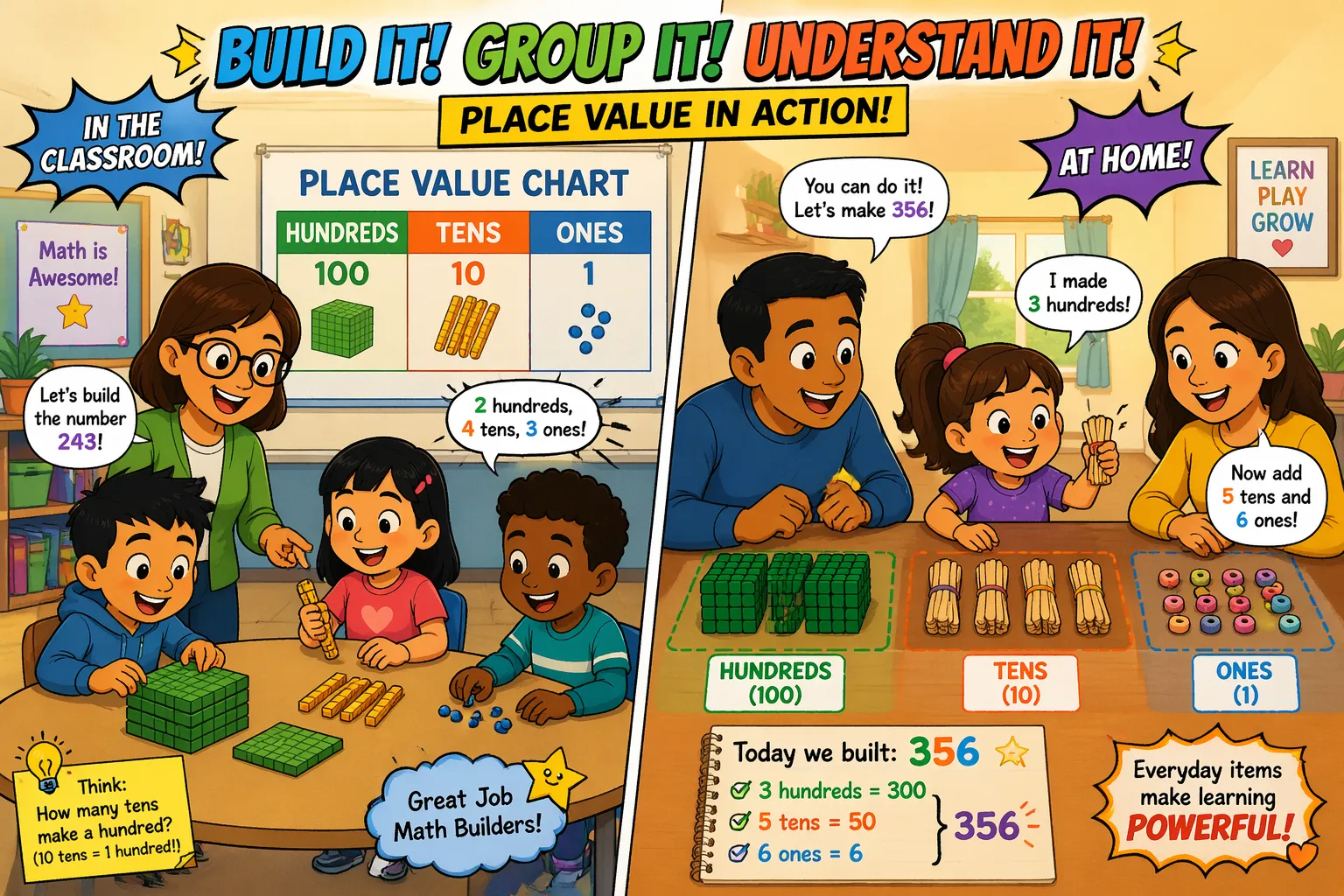
Concrete activities are essential for helping students visualize positional notation before they work with abstract symbols. The following require minimal preparation and work well in learning centers, small groups, or whole-class review.
Base-10 Block Building Challenge
Give students a two- or three-digit number and ask them to represent the number using base-ten blocks (rods for tens, unit cubes for ones). After building, they draw what they made and write the expanded form. This activity helps students grasp the relationship between physical groups and written notation in a way that worksheets alone cannot achieve. Rotating through different numbers gives repeated, varied practice without the activity becoming repetitive.
Place Value Bingo
Create bingo cards filled with two-digit numbers. Instead of calling the number directly, describe its positional components — “4 tens and 8 ones” — and students search their card for 48. This activity reinforces the connection between positional language and standard form while keeping engagement high. It also helps with identifying place efficiently under mild time pressure, which builds automaticity.
Place Value War Card Game
Each player draws two digit cards and arranges them to make the largest possible two-digit number. Players compare, and the higher number wins the round. This game naturally prompts students to think carefully about which digit belongs in the tens column — building strategic positional thinking through play.
Roll and Write
Students roll two dice, assign the higher result to the tens column and the lower to the ones column, then write the number, draw base-ten blocks, and write the expanded form. Add a third die to extend the activity to three-digit numbers for second graders. This low-prep activity is one of the most effective ways to allow students to practice place value skills repeatedly in a short time.
Showing the Value With Cards
Give students digit cards and a labeled mat. Call out a number and ask students to place the correct cards in the right columns, showing the value of each position explicitly. Students fill in the blanks on a recording sheet after each round. This works particularly well as a center activity, where students to explore the concept independently and students to share their reasoning with a partner.
Build, Draw, Write
Students will compose a number three ways: build it with blocks, draw it as a quick sketch of rods and cubes, and write it in expanded form. This three-step sequence helps students master all representations of a number rather than relying on just one format. It provides students with multiple entry points to the same concept — which research on early numeracy suggests improves retention significantly.
Daily Routines That Reinforce the Concept (5 Minutes)
Consistent, brief routines build the automaticity students need to use positional reasoning fluently. A five-minute warm-up at the start of each math lesson is enough to reinforce skills without taking significant instructional time.
Effective components of a daily number routine include:
- Number of the Day sheet: Display one number and ask students to write it, draw it with base-ten blocks, write it in expanded form, and find 10 more and 10 less.
- Call-out drill: The teacher says a number aloud and the class responds with its positional components. “48.” “4 tens, 8 ones.” “10 more?” “58.” No materials needed.
- Error correction: Show a student-style mistake and ask the class to diagnose and fix it. Builds both conceptual understanding and mathematical discourse.
Common Mistakes and How to Fix Them
Understanding where students go wrong helps educators intervene quickly and effectively. The most frequent errors follow predictable patterns.
Writing “three hundred four” as 3004: Students making this error treat each word as a separate number rather than understanding the positional system as a whole. Fix this by returning to the chart, filling in each column individually, and emphasizing that “no tens” means a zero must hold that column — giving 304, not 3004.
Confusing the tens and hundreds columns: Color-coded place value mats help enormously. Assign a consistent color to each column and use those same colors when writing numbers. Regular drilling — “Which digit is in the tens column? Which is in the hundreds?” — builds automaticity.
Adding tens to ones directly (e.g., 24 + 10 = 214): This error suggests the student does not yet see a two-digit number as a composed unit. Return to base-ten blocks: physically add one ten rod to a model of 24 and show that the result is 3 rods and 4 units — 34, not 214.
Frequently Asked Questions
How do you explain place value to a 6-year-old?
Use concrete, familiar objects. One effective approach is the “cookie tray” method: a full tray holds 10 cookies (one ten), and loose cookies are ones. Ask the child to show 23 using trays and cookies — 2 full trays and 3 loose ones. Tangible materials make the abstract idea immediately accessible.
What is the best place value to use as a first manipulative?
Base-ten blocks are the most widely recommended starting point. They are proportional — a ten rod is literally ten times longer than a unit cube — which means students can see and feel the difference between columns, not just label them. The place value mat keeps the blocks organized and reinforces the left-to-right structure of the number system.
What order should the concepts be taught?
A research-supported sequence moves from concrete to abstract:
- Counting by tens and skip counting
- Bundling physical objects into groups of tens
- Building numbers on a place value mat using base-ten blocks
- Writing in expanded form and identifying place for each digit
- Comparing numbers by digit position
- Regrouping and trading
Skipping steps tends to produce surface-level understanding that breaks down under more complex tasks. The hundreds place and represents the biggest conceptual leap for most young learners — give it extra time.
How long does it take to develop strong place value skills?
In first grade, most students need three to four months of consistent instruction and daily practice to become fluent with two-digit numbers. In second grade, extending to three-digit numbers typically takes two to three months. Students who encounter these ideas through daily routines alongside structured lessons consolidate their understanding significantly faster — and are far better prepared when the concept reappears at a higher grade level.

Take a short quiz to find out what your everyday choices say about your parenting style
When your child is curious about something new, what’s your instinct?
Take a short quiz to find out what your everyday choices say about your parenting style
“Can I download this app?” What happens next?
Take a short quiz to find out what your everyday choices say about your parenting style
When it comes to rules at home, which sounds most like you?
Take a short quiz to find out what your everyday choices say about your parenting style
If you could give your child one life skill today, what would you pick?
Take a short quiz to find out what your everyday choices say about your parenting style
Your child gets to choose what to watch. What would your ideal setup look like?
Take a short quiz to find out what your everyday choices say about your parenting style
Pick your parenting superpower ✨



