

The journey through the UK education system is structured and progressive, culminating in a period of intense specialization and preparation for life beyond school. If your child is approaching the sixth form—the two years covering Year 12 and Year 13—you’re likely seeking detailed, authoritative information about the academic pathways ahead. This article provides a comprehensive guide to what students learn in Year 12, marking the first half of Key Stage 5. This crucial stage is where pupils move away from the broader National Curriculum of previous years and commit to specific academic or vocational streams.
Year 12 offers a significant shift in focus, providing students with the opportunity to pursue subjects they are truly passionate about, leading to globally recognized qualification options. We’ll explore the main academic routes, including A-levels, the International Baccalaureate (IB), and various BTEC and vocational programmes, outlining how this secondary school phase prepares pupils for university, apprenticeships, or the professional world. Understanding these structures is key to supporting your young adult as they transition to higher education or career pathways.
Overview of Year 12 Study in Secondary School
Year 12 represents a pivotal transition point for pupils, setting the trajectory for their future academic and professional lives. After the comprehensive, compulsory structure of Key Stage 4 (which culminates in GCSEs in year 11), Year 12 introduces a greater degree of independence and academic specialization.
The primary purpose of Year 12 is to provide deep, sustained study in a select few subjects. This not only builds the foundational knowledge required for higher education but also cultivates the critical thinking and analytical skills essential for success. Academic expectations are significantly higher than in earlier school years. Students are expected to manage a heavier workload, conduct independent research, and engage with complex, theoretical concepts. This increased rigor is directly linked to Key Stage 5, which is designed to bridge the gap between secondary school education and university-level study.
Key Stage 5 Position in Education Pathway
Key Stage 5 is the final stage of compulsory education in England, typically covering the two years following GCSEs—specifically, year 12 and year 13.
- Progression from KS4: The transition from the broad, mandatory curriculum of Key Stage 4 (ages 14–16) to Key Stage 5 (ages 16–18) is marked by specialization. Students typically narrow their focus from 9–12 GCSE subjects to just three or four A-level subjects, or the balanced structure of the IB Diploma.
- Curriculum Flexibility: While the English National Curriculum defines the core structure, Key Stage 5 offers the greatest curriculum flexibility. Schools and sixth form colleges tailor their offerings based on student demand and faculty expertise, providing a diverse range of A-level, BTEC, and other vocational options.
Year 12 Academic Goals
The goals set in Year 12 are ambitious, focusing on depth, skill acquisition, and future planning.
| Academic Goal | Description | Key Skill Development |
| Subject Depth | Achieving an advanced, university-level mastery of chosen subjects. | Advanced research, complex problem-solving, theoretical application. |
| Exam Preparation | Building the systematic knowledge and exam technique for the final year 13 qualification exams. | Essay writing, time management, effective revision strategies. |
| Skills Development | Cultivating independent learning, critical evaluation, and analytical reasoning. | Autonomy, resilience, high-level communication. |
| University Planning | Researching degree courses, attending open days, and preparing the foundation for UCAS planning. | Career planning, decision-making, self-assessment. |
Year 12 Pathway Options
Students in Year 12 can choose from several distinct academic pathways, each tailored to different learning styles and career aspirations.
- A-level Route: The most traditional and common route. Students usually study three to four A-level subjects. The grading is based almost entirely on final exams in Year 13. This path is highly valued by UK universities and for specific science or humanities degrees.
- International Baccalaureate (IB) Diploma: A globally recognized, comprehensive two-year programme. Students study six subjects (three at Higher Level/HL, three at Standard Level/SL), alongside the core components: Theory of Knowledge (TOK), the Extended Essay, and Creativity, Activity, Service (CAS).
- BTEC and Vocational Programmes: These are more practically oriented qualifications, such as a BTEC National Diploma in Health and Social Care or Applied Science. Assessment is often a mix of coursework, practical assignments, and exams, providing a direct route to employment or specific university courses.
- Mixed Programmes: Some schools and colleges offer the flexibility for students to combine an A-level with a vocational course, such as two A-levels alongside a BTEC Subsidiary Diploma, to create a bespoke study plan.
Contents of Year 12 Curriculum
The Year 12 curriculum is determined by the pathway chosen. For those pursuing A-levels or the IB, the content represents a significant expansion and deepening of topics first introduced at the GCSE level in Key Stage 4.
A Level Subjects
The first year of A-levels is often referred to as the AS year (though the formal AS qualification is now separate in England). Students begin the two-year curriculum, focusing intensely on the content that will be examined at the end of Year 13.
Structure: Content is delivered at a highly academic level. The focus is on theoretical understanding, research methodology, and applying complex ideas.
Typical Subjects:
- Maths and Science: Core subjects like Maths, Further Maths, Biology, Chemistry, and Physics are popular, requiring exceptional analytical skills.
- Humanities and Social Sciences: Subjects like History, Geography, Psychology, and Sociology demand high-level essay writing and critical evaluation.
- Arts and Vocational: Art, Drama, Music, Computer Science, and Business Studies blend theoretical knowledge with practical and project-based assessment.
- Foreign Languages: Foreign languages like French, Spanish, and German continue to build on the GCSE foundation, focusing on advanced translation, literature, and cultural study.
IB Subjects
For students on the IB Diploma, Year 12 is integrated into the two-year programme and involves balancing six subjects with the core elements.
- Higher Level (HL) / Standard Level (SL) Subjects: Students begin the in-depth study of their six subjects. HL subjects require a greater depth of knowledge and more class hours than SL subjects.
- Theory of Knowledge (TOK): A compulsory element, TOK encourages critical reflection on the nature of knowledge across various disciplines.
- Creativity, Activity, Service (CAS): Students engage in personal projects outside the classroom, fostering personal and interpersonal development.
- Extended Essay: Students begin the process of researching and writing a 4,000-word essay on a topic of their choice, which is a key preparation for university research.
BTEC and Applied General Courses
BTEC (Business and Technology Education Council) qualifications provide a practical, career-focused alternative to A-levels or the IB.
- Practical Learning: The learning is contextualized, often involving real-world case studies and vocational skills training.
- Assessment: Assessment is continuous, with much of the final grade based on assignments, projects, and practical tasks completed over Years 12 and 13. This structure suits students who perform better under continuous assessment than high-stakes final exams.
Sectors: Popular sectors include:
- Sport and Leisure
- Health and Social Care
- Information Technology (IT)
- Applied Science
Subject Faculties and Study Maps
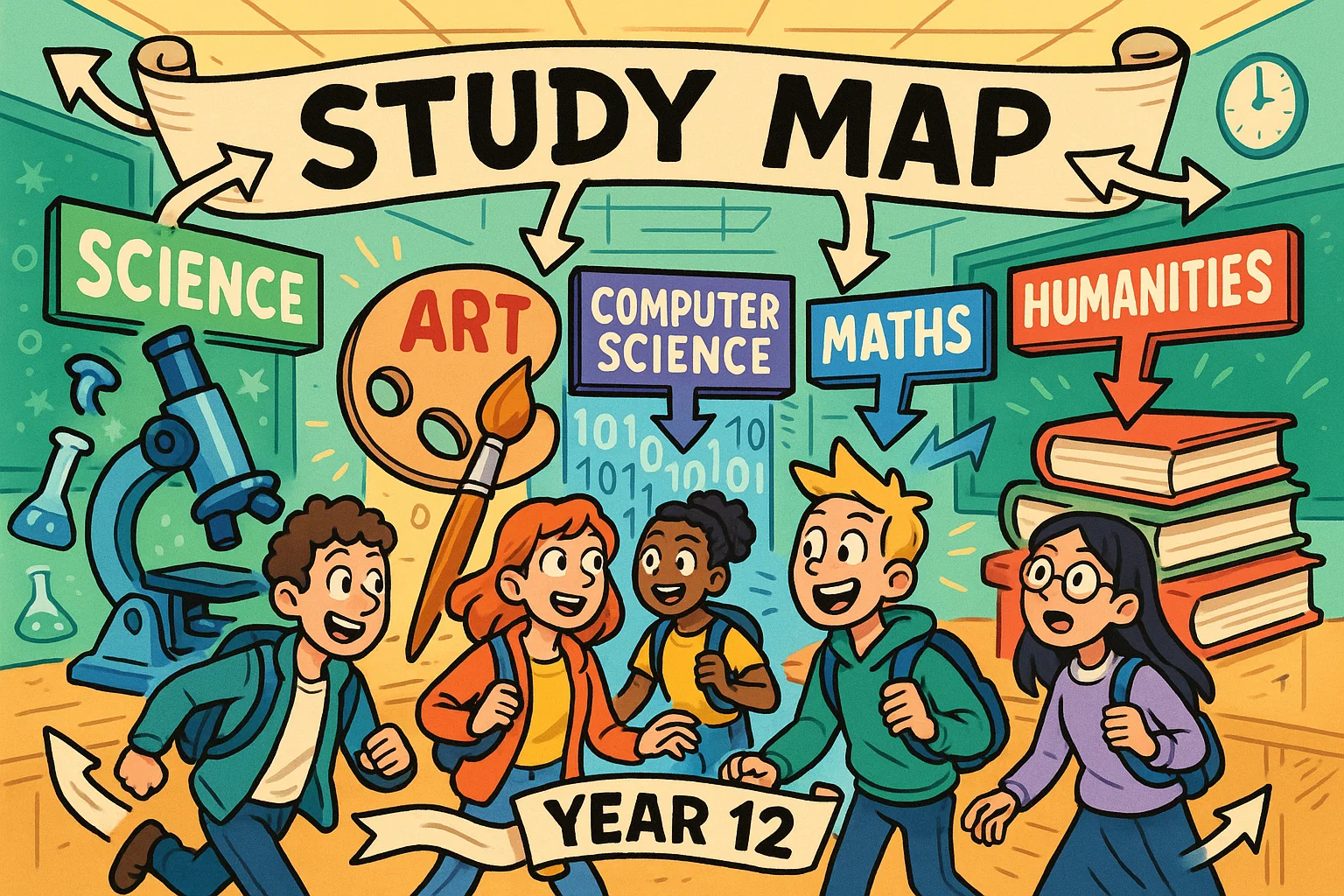
Leading senior schools and sixth form colleges structure their Year 12 provision around distinct subject faculties. The following provides a snapshot of the intense academic content a pupil encounters in the first key stage of the sixth form.
English Faculty
The English faculty focuses on advanced literary analysis, moving far beyond the foundational English language and reading skills developed in primary school and early secondary level.
Core Focuses:
- Literature Analysis: Deep-diving into set texts (e.g., Shakespeare, Modern Drama, Poetry) and exploring contextual, critical, and theoretical perspectives.
- Comparative Writing: Developing sophisticated arguments that compare and contrast literary works.
- Critical Skills: Engaging with literary criticism and forming independent, well-supported interpretations.
Mathematics Faculty
Maths at A-level is a significant jump from GCSE maths and science and is often the qualification required for a wide range of university degrees.
| A-level Math | A-level Further Math (Optional) |
| Pure Math: Advanced algebra, calculus (differentiation and integration), trigonometry, logarithms. | Further Pure: Complex numbers, matrices, further calculus techniques. |
| Statistics: Probability distributions, hypothesis testing, data analysis. | Further Statistics: Advanced probability, statistical modelling. |
| Mechanics: Forces, motion, vectors, and Newton’s laws of motion. | Further Mechanics: Momentum, work, energy, oscillations. |
Science Faculty
Biology, Chemistry, and Physics form the bedrock of the Science Faculty, requiring both theoretical mastery and practical competency.
- Biology: Focuses on biological molecules, cell structure, genetics, ecology, and human physiology. Requires significant memorization and understanding of complex systems.
- Chemistry: Covers physical, organic, and inorganic chemistry, including atomic structure, thermodynamics, reaction kinetics, and advanced synthesis techniques.
- Physics: Deals with fundamental concepts such as waves, electricity, mechanics, quantum phenomena, and cosmology. Heavy emphasis on problem-solving and mathematical application.
Social Science Faculty
These subjects help students understand human behaviour, social structures, and political systems, developing strong analytical and essay-writing capabilities.
- Psychology: In Year 12, students typically cover approaches (e.g., cognitive, biological), psychopathology, and research methods. Case studies and interpreting statistical data are key.
- Sociology: Focuses on key social structures (e.g., family, education, crime) and major theoretical perspectives (e.g., Functionalism, Marxism).
- Criminology (Applied General): Often assessed via coursework, this examines crime patterns, policy, and the criminal justice system.
Business, IT & Computer Science Faculty
These programmes are designed to prepare students for the demands of the modern, data-driven economy.
- Business Studies / Economics: Covers markets, economic models, finance, accounting, and strategic management.
- Computer Science: Moves beyond basic coding to cover computational thinking, programming, algorithms, data structures, and the theoretical aspects of computation.
- IT (BTEC): Focuses on practical skills in areas like networking, software development, and data management.
Expressive Arts Faculty
Art, Drama, and Music pathways allow for creative expression, critical appreciation, and practical skill development, often using a project-based approach.
- Project-Based Assessment: A significant portion of the qualification is based on practical portfolios, performance, and creative development, contrasting with the exam-heavy nature of traditional A-levels.
Year 12 Key Stages Reference
Understanding where Year 12 fits within the entire UK school system is essential for appreciating the level of academic intensity and independence expected. The school curriculum is split into four compulsory key stages, with Key Stage 5 being the final, optional stage (ages 16-18).
| Key Stage | Year Group(s) | Typical Age Range | Core Focus |
| Key Stage 1 | Years 1 and 2 | Ages 5 to 7 | Literacy (including English reading), numeracy, and basic knowledge. Culminates with national tests in English reading and teacher assessments at age 7. |
| Key Stage 2 | Years 3–6 | Ages 7 to 11 | Broader curriculum, preparation for secondary school. Ends with SATS (Standard Assessment Tests) at the end of primary school. |
| Key Stage 3 | Years 7–9 | Ages 11 to 14 | Exploration of a wide range of subjects, including introductory foreign languages and advanced maths and science. First three years of secondary schooling. |
| Key Stage 4 | Years 10 and 11 | Ages 14 to 16 | GCSE preparation, with core compulsory subjects like English language, math, and science. Ends with GCSE exams. |
| Key Stage 5 | Years 12 and 13 | Ages 16 to 18 | Specialization (A-level, IB, BTEC), preparation for university or career. |
Key Stage 4 Link to Year 12
The move from GCSE to Year 12 is significant. GCSE performance, particularly in core subjects like English Language, English Literature, and Maths, directly dictates which Year 12 courses a student can pursue. A strong foundation from Key Stage 4 is non-negotiable for success in the highly specialized Key Stage 5 curriculum. For example, entry to A-level Maths typically requires a Grade 7 or higher at GCSE.
Key Stage 5 Focus
The twin focus of Key Stage 5 is depth and specialization.
- Depth: Students are expected to read widely, debate complex theories, and apply knowledge creatively, mirroring university study.
- Exam Preparation for Year 13: While Year 12 builds the knowledge base, it is also a vital year for developing the study habits, revision techniques, and understanding of exam demands that will determine the final qualification grades in Year 13.
Post-16 Study Path Choices
Year 12 is the year when choices truly begin to shape a student’s future. The subjects studied heavily influence the options for higher education.
- University: Specific A-level or IB subjects are non-negotiable entry requirements for many degree courses (e.g., Chemistry A-level for Chemical Engineering).
- Vocational Routes: BTEC and Applied General qualifications often lead directly into Higher National Diplomas (HNDs) or employment in specific sectors.
- Apprenticeships: Many higher-level apprenticeships require strong academic grades from Year 12 and Year 13.
University Preparation in Year 12
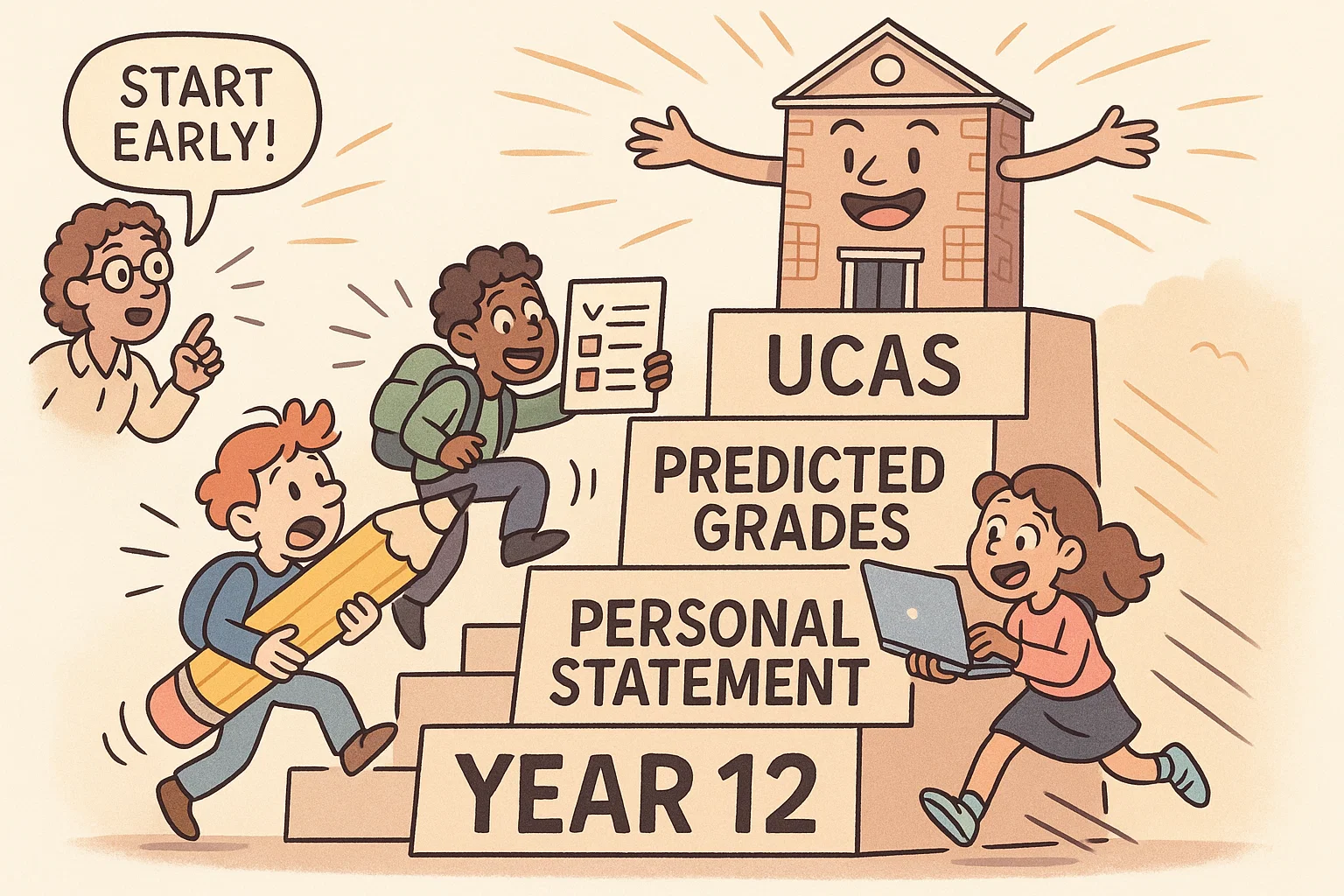
For the majority of pupils, Year 12 is the most active period for researching and planning their university applications.
UCAS Planning
The Universities and Colleges Admissions Service (UCAS) manages the central application system for UK universities. Year 12 is the critical period for planning:
- Predicted Grades: Teachers use Year 12 performance, including internal exams, to form predicted grades for A-levels or IB. These grades are submitted to UCAS and are the basis upon which universities make offers.
- Personal Statement Drafting: Students must begin drafting their personal statement, a core component of the UCAS application. This is a chance for them to showcase their subject passion, extracurricular involvement, and readiness for higher education.
- Research and Visits: Attending university open days and undertaking subject-specific reading (super-curricular activities) in Year 12 are essential for making informed choices and demonstrating commitment.
Subject-Specific Requirements
The choice of subjects in Year 12 is often dictated by the desire to meet specific university entrance criteria.
- STEM Courses (Science, Technology, Engineering, Math): Require specific A-levels (e.g., Physics and Math for Engineering).
- Medicine / Veterinary Science: Require specific science A-levels (Biology and Chemistry) and significant work experience, which must be secured during Year 12.
- Law / Humanities / Arts: Often accept a wide range of essay-based subjects but may value specific subjects like History or English Language and Literature.
Foundation and Pathway Routes
For some pupils, or those whose Year 12 performance doesn’t meet the competitive entry grades, alternative routes are available.
- Foundation Years: A one-year course preceding a three-year undergraduate degree, often used for students who don’t have the required subjects or grades.
- Pathway Courses: Courses offered by private educational providers or sixth form colleges that guarantee entry to a partner university upon successful completion.
Assessments in Year 12
Assessment in Year 12 serves a dual purpose: to measure current understanding and to provide the data necessary to accurately determine predicted grades for university applications.
Internal Exams and Progress Checks
The internal examination schedule in Year 12 is rigorous:
- Mid-Year Exams: Often held early in the spring term, these cover the first term’s content.
- End-of-Year Exams (Mocks): The most significant assessment, often held in the summer term, mimicking the full structure and timing of the final Year 13 exams. They cover the entirety of the Year 12 curriculum and are crucial for predicted grade formation.
- Progress Tests: Regular, informal assessments used by teachers to check knowledge retention and identify areas for intervention.
Coursework and Practical Assessments
For many courses, the grade is not solely determined by final exams.
- Coursework: Subjects like English Language and History often contain a coursework component (Non-Exam Assessment or NEA) that is started in Year 12 and counts towards the final A-level grade.
- Practical Assessments: In maths and science A-levels, practical skills are assessed through a mandatory set of experiments. For sciences, the Practical Endorsement is a separate pass/fail qualification based on competence demonstrated across years 12 and 13.
Predicted Grade Formation
This process, typically occurring towards the end of Year 12, requires professional judgment and is taken with great seriousness by schools.
Explore the Topic

For families and pupils investigating the landscape of post-GCSE study, understanding the foundational differences between the various academic routes is critical.
GCSE Programme Connection
The performance in the GCSE programme is the passport to Key Stage 5.
- For instance, a pupil who achieved excellent results in years 10 and 11 in essay-based subjects may be best suited for A-levels in Humanities. Conversely, a strong aptitude in Health and Social Care may better align with the practical approach of a BTEC.
A Level Study Insights
A-levels require a significant shift in learning approach. Unlike GCSEs where content volume is high, A-levels require deep conceptual understanding and synthesis. There’s less spoon-feeding; the onus is on the pupil to manage their time and conduct substantial reading beyond the taught school curriculum. This is where independent learning, first fostered in junior school, must fully mature.
International Baccalaureate Route
The IB Diploma promotes a holistic approach, requiring a balance of sciences, humanities, foreign languages, and arts. The compulsory core components (TOK, EE, CAS) are designed to produce well-rounded students for higher education who are globally aware and critical thinkers. The IB is popular in independent schools and is an excellent qualification for entry to universities worldwide.
Services and Information
When considering Year 12 options, especially for international students or those considering private schools, specific support services may be relevant.
School Placement Advice
Choosing the right environment for Key Stage 5 is paramount. Options include:
- State Sixth Form: Generally attached to a secondary school, offering a familiar environment.
- Sixth Form College: Specialized institutions, often offering a wider range of courses and a more independent learning atmosphere.
- Independent Schools / Senior School: Private schools that often offer both A-levels and the IB, typically with smaller class sizes and extensive extracurricular programmes.
Guardianship Services
For students from overseas studying in the UK school system, professional guardianship services provide essential pastoral care and support, particularly for those whose parents reside outside of the UK. This is crucial for compliance with UK visa regulations and ensuring the student has local, reliable support throughout years 12 and 13.
Government Activity
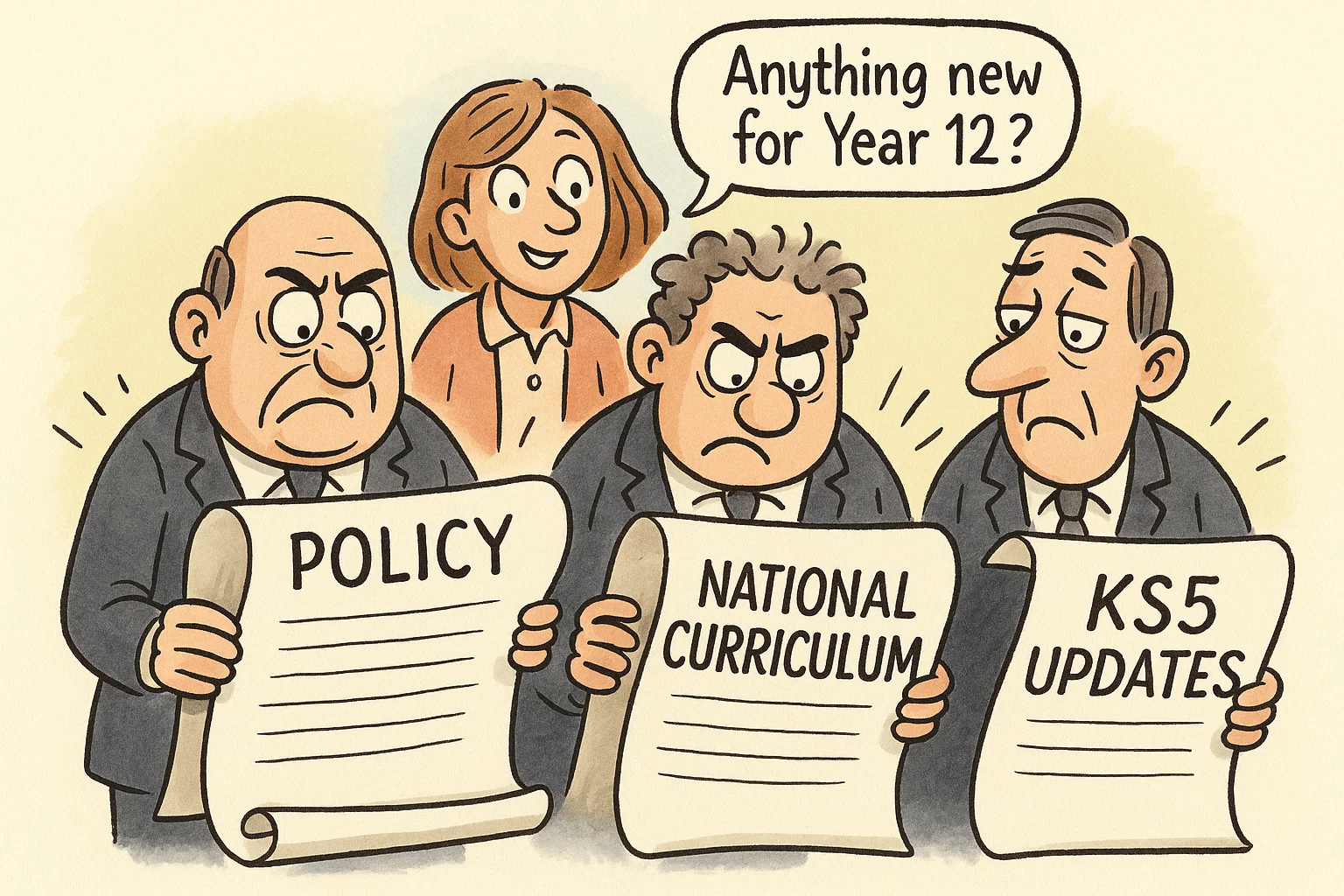
The framework for Key Stage 5 is set by government bodies, ensuring a consistent standard across all schools that follow the national curriculum, including state and many independent schools in England (with devolved administrations in Scotland, Wales, and Northern Ireland having their own systems).
Curriculum Regulations
The Department for Education (DfE) sets the overall standards for the curriculum. Qualifications are regulated by the Office of Qualifications and Examinations Regulation (Ofqual).
- Ofqual: Ensures that all qualifications, including A-levels, GCSEs, and many vocational awards like BTEC, are robust and comparable in terms of difficulty and academic rigor.
Education Policy Updates
Changes in education policy can impact the Year 12 experience. For instance, recent policy has focused on reforming the content of A-levels to make them more rigorous and linear, meaning most assessment occurs at the end of year 13, reinforcing the importance of sustained, deep learning throughout Year 12.