

The transition into Year 3 marks a significant milestone in your child’s educational journey. Typically for pupils aged 7 to 8, this school year is not just about moving up a grade; it represents the crucial leap from Key Stage 1 (KS1) infant education into the Key Stage 2 (KS2) junior phase of primary school. It’s where the foundations of early learning solidify into deeper, more complex subject knowledge across the national curriculum. For many children, this also involves a physical move to a new Junior School setting, bringing fresh challenges and opportunities for independence.
Understanding what is covered in the Year 3 curriculum is essential for parents who want to provide effective support at home. This comprehensive guide, informed by the English national curriculum and best practices in child development, is designed to clearly outline the academic programme for Year 3. You’ll find out what to expect in terms of English skills, maths and science learning, and the broader, balanced curriculum that shapes their longer-term success across primary and secondary schooling. The aim is to demystify the learning goals and empower you to confidently champion your child’s academic growth throughout the year.
Navigation Menu: What Your Year 3 Pupil Will Learn
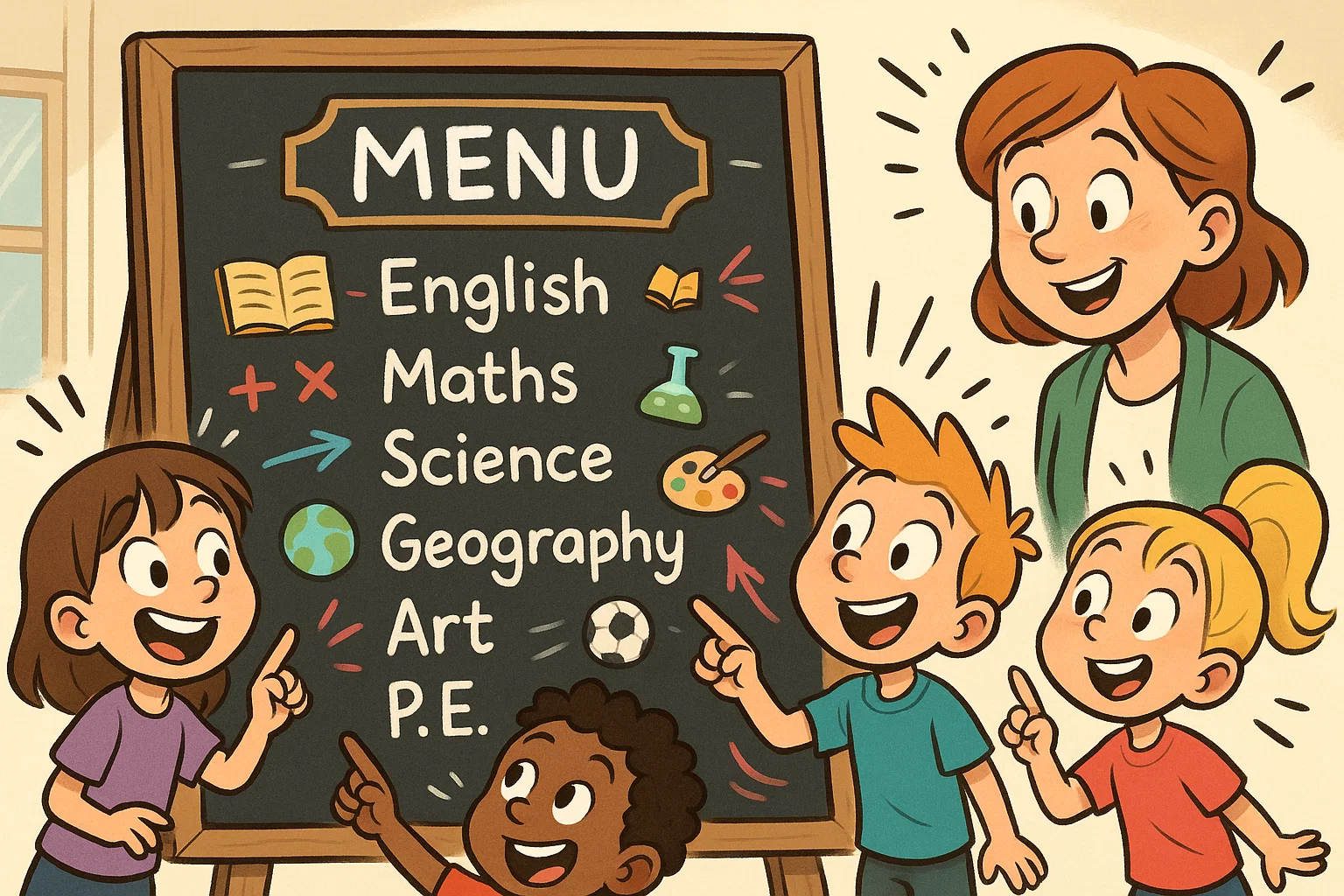
As your child embarks on the first year of Key Stage 2, the complexity and depth of their learning will noticeably increase. This guide is structured to allow for quick navigation, ensuring you can easily pinpoint the specific subject information you need, similar to finding guidance on a government website.
| Section Title | Focus Area | Key Takeaway |
| Key Stage Placement | Understanding the transition from KS1 to KS2. | Year 3 bridges basic skills with more advanced learning. |
| Year 3 English Overview | Reading, writing, grammar, and spoken and written skills. | Emphasis shifts to comprehension and structured writing. |
| Year 3 Maths Curriculum | Number and place value, multiplication, fractions, and geometry. | Formal written methods and the 3, 4, and 8 times tables are introduced. |
| Year 3 Science Curriculum | Biology, chemistry, and physics topics. | Greater focus on working scientifically and forming conclusions. |
| Year 3 Foundation Subjects | History, Geography, Art, DT, Computing, and PSHE. | The broad and balanced curriculum expands their cultural capital. |
| Year 3 Assessments | Teacher assessments and end of year expectations. | Ongoing monitoring replaces the formal Year 2 SATs. |
| School Support Resources | Home learning support and external tools. | Practical steps to help your learner master new concepts. |
Search
Parents frequently search for specific Year 3 topics to understand homework or address learning gaps. If you’re looking for details on a particular area, such as the multiplication tables expected, or the shift in spelling strategies, this comprehensive breakdown will serve as a quick reference point. We detail the specific subject content to ensure you learn what’s necessary for effective home support.
Contents Overview
The curriculum for Year 3 is designed to significantly increase the intellectual challenge for the pupil. The key segments we’ll explore include:
- Core Subjects: In-depth coverage of English, math, and science.
- Curriculum Areas: A look at the foundation subjects like History, Geography, and Design and Technology.
- Learning Goals: Clear expectations for what children should achieve by the end of year.
- School Support: Practical advice on how you can work with the school year team to support your child.
Key Stage Placement: Stepping into Key Stage 2
Year 3 is the entry point for Key Stage 2 (KS2), which encompasses Years 3, 4, 5, and 6. This stage is often viewed as the ‘junior’ phase of primary school, where the focus moves from developing basic literacy and numeracy to applying these skills with increasing independence and complexity. The KS2 framework is designed to deepen subject knowledge and prepare children for the rigours of secondary school.
Early Years Foundation Stage Recap (EYFS)
Before a child reaches Year 3, they navigate the Early Years Foundation Stage (EYFS) and Key Stage 1 (KS1). The journey began in Reception, where they developed foundational skills like basic number recognition, phonological awareness, and social interaction.
- EYFS Goals: Personal, social, and emotional development; physical development; communication and language; literacy and mathematical development; understanding the world; and expressive arts and design.
Key Stage 1 Skills Carryover
By the end of Year 2, Year 3 pupils have typically mastered the fundamental key stage 1 competencies that Year 3 will now expand upon. The curriculum assumes a secure grasp of the following:
| KS1 Skill | Year 3 KS2 Expansion |
| Basic Phonics and word decoding. | Shift to fluent reading, deep comprehension, and spelling patterns (prefixes/suffixes). |
| Addition/Subtraction facts to 20, 2, 5, 10 times tables. | Introduction of 3-digit number calculations, formal written methods, and the 3, 4, 8 times tables. |
| Simple sentence structure, capital letters, and full stops. | Writing structured paragraphs, using a wider vocabulary, and introducing more complex punctuation (e.g., inverted commas). |
| Simple scientific enquiry (e.g., observing and grouping materials). | Designing fair tests, making systematic observations, and drawing conclusions using scientific terminology. |
Key Stage 2 Framework
The Key Stage 2 framework is significantly different from KS1 as it introduces greater subject specialisation and more advanced terminology. Its purpose is to ensure all pupils graduate primary school ready for the years of secondary education.
- Deeper Literacy: Moving from learning to read, to reading to learn. This involves engaging with a wider range of fiction and non-fiction texts, including poetry and play scripts, and developing strong analytical and inferential comprehension.
- Expanding Maths Complexity: Fluency and mastery of the four operations (addition, subtraction, multiplication, and division) are a strong focus, along with initial concepts of fraction and geometry.
- Broader Scientific Knowledge: Learning moves from observation to explaining everyday phenomena using appropriate scientific models.
Year 3 English Overview: Building Literacy Fluency
The Year 3 curriculum for English is designed to build on the English skills acquired across KS1, aiming for a strong command of the spoken and written word. The overarching goal is for the child to become a confident, fluent reader and a structured, accurate writer.
Reading
The expectation in Year 3 is a transition to reading longer chapter books and engaging with a wider range of fiction and non-fiction genres. The shift is from decoding words to deep comprehension.
- Fluency: Reading aloud with expression, pace, and attention to punctuation.
- Comprehension: Drawing inferences about characters’ feelings and motives, justifying these with textual evidence, and predicting what might happen.
- Vocabulary: Increasing familiarity with varied vocabulary and using a dictionary to check the meaning of unfamiliar words.
Writing
Writing in Year 3 moves beyond simple recounts to structured compositions. The pupil should be able to organise their writing into clear paragraphs, each focusing on a single idea or event.
| Writing Goal | Example |
| Paragraphs | Grouping sentences about a setting, a character’s thoughts, or a sequence of actions. |
| Narrative Structure | Creating engaging settings, developing believable characters, and structuring a clear plot. |
| Non-Fiction | Writing reports, instructions, and explanations using the correct formal language and structure. |
| Handwriting | Using the diagonal and horizontal strokes needed to join letters and maintain legible, fluent script. |
Grammar and Vocabulary
Grammar and vocabulary instruction becomes more explicit. Year 3 pupils will encounter and be expected to use a range of new grammatical terms, contributing to more sophisticated spoken and written English language.
New Grammatical Terminology
- Conjunctions: Using words like when, before, after, while, so, and because to link clauses and create complex sentences.
- Adverbs: Understanding adverbs of time (e.g., then, next) and adverbs of manner (e.g., slowly, carefully).
- Prefixes/Suffixes: Understanding how these change the meaning of root words (e.g., unhappy, happiness). This is key to improved spelling and vocabulary.
Punctuation: Correct use of inverted commas to mark direct speech and the use of the possessive apostrophe for both singular and plural nouns (e.g., the girl’s book, the children’s toys).
Spoken English
Developing strong speaking and listening skills is a compulsory part of the curriculum. This involves more than just talking; it requires attentive listening and clear articulation of ideas.
- Classroom Discussion: Articulating and justifying answers and opinions in group work and whole-class conversations.
- Presentations: Giving well-structured descriptions, explanations, and narratives to different audiences.
- Group Work: Collaborating effectively, maintaining attention, and building on the contributions of others.
Year 3 Maths Curriculum: Developing Calculation Mastery
The Year 3 Maths curriculum is a pivotal year for establishing fluency with the four operations and setting the groundwork for more advanced Key Stage 2 mathematics. The national curriculum mandates a significant step up, introducing formal written methods for the first time. The focus, as per the KS2 framework, is on a deeper mastery of core concepts.
Number and Place Value
Pupils move beyond 2-digit numbers to work confidently with numbers up to 1,000.
- 3-Digit Numbers: Identifying the place value of each digit (hundreds, tens, ones).
- Comparing and Ordering: Using the <, >, and = symbols to compare numbers.
- Rounding: Calculating the nearest 10 or 100.
Addition and Subtraction
This is where children are introduced to the formal written methods of column addition and subtraction for numbers up to three digits.
- Written Methods: Adding and subtracting numbers using the standard columnar method, including exchange (regrouping).
- Mental Maths Strategies: Practicing mental calculations, such as adding or subtracting multiples of 10 or 100 to a 3-digit number.
- Estimation and Inverse Operations: Estimating answers and using the inverse relationship between addition and subtraction to check accuracy.
Multiplication and Division
Year 3 places a heavy emphasis on learning and recalling times tables.
- Times Tables: Mastering the 3, 4, and 8 times tables (and the corresponding division facts), building on the 2, 5, and 10 tables learned in KS1.
- Problem Solving: Solving problems involving scaling (e.g., three times as many) and correspondence (e.g., several objects connected to several others).
- Beginning to multiply two-digit numbers by a one-digit number using mental strategies, and later moving towards written methods.
Fractions
Children are formally introduced to the concept of a fraction as part of a whole, a quantity, or a set.
- Unit and Non-Unit Fractions: Recognising, naming, and writing unit fractions (½, ⅓, ¼) and non-unit fractions such as 2/3 and 3/4.
- Equivalent Fractions: Recognising and showing equivalent fractions with small denominators (for example, ½ is the same as 2/4).
- Number Line: Locating and representing fractions on a number line.
Measurement
A wide range of measurement concepts are covered, building practical skills alongside mathematical knowledge.
- Length, Mass, Capacity: Measuring, comparing, adding, and subtracting standard units (m/cm/mm, kg/g, l/ml).
- Perimeter: Calculate the perimeter of simple 2-D shapes.
- Time: Telling and writing the time from an analogue clock, including Roman numerals and introducing the 24-hour format. They also learn the number of seconds in a minute, and the number of days in each month.
- Money: Adding and subtracting amounts of money to give change.
Geometry
The focus in geometry shifts from simple shape recognition to understanding the properties of shapes and lines.
- 2D/3D Shapes: Drawing 2-D shapes and making 3-D shapes from models, and describing their properties (faces, edges, vertices).
- Angles Basics: Recognising angles as a property of shape or a description of a turn, and identifying right angles.
- Lines: Identifying horizontal and vertical lines and pairs of perpendicular and parallel lines.
Statistics
Year 3 is the introduction to interpreting and presenting data in a formal way.
- Data Representation: Interpreting and presenting data using bar charts, pictograms, and tables.
- Problem Solving: Solving one-step and two-step problems using data presented in scaled bar charts, pictograms, and tables (e.g., ‘How many more?’ and ‘How many fewer?’).
Year 3 Science Curriculum: Broadening the Scientific View
The Year 3 Science curriculum encourages the pupil to broaden their scientific view of the world through exploration, discussion, and practical scientific enquiry. The goal is to move towards making systematic observations and drawing simple, justifiable conclusions.
Biology
- Plants: Identifying and describing the functions of different types of plant parts (roots, stems, leaves, flowers, seeds) and understanding what plants need to grow and thrive (air, light, water, nutrients).
- Animals (Including Humans): Focusing on nutrition, and the functions of the human skeleton and muscles. Pupils learn why different types of food are important for health and how the skeletal and muscular systems enable movement.
Chemistry
- Rocks: Comparing and contrasting different types of rock based on their appearance and simple physical properties.
- Soils: Learning about the formation of soil from rocks and dead organic matter.
- Fossils: Understanding how fossils are formed.
Physics
- Forces and Magnets: Investigating pushes and pulls as forces, and discovering that magnets have two poles and that different types of magnets attract or repel each other. They identify magnetic materials.
- Light and Shadows: Recognising that light is needed to see and that dark is the absence of light. They explore how shadows are formed when an opaque object blocks light, and how the size of shadows changes depending on the position of the light source.
Year 3 Foundation Subjects: The Broad and Balanced Curriculum
While English, math, and science are the core subjects, the broad and balanced curriculum of Year 3 ensures a rounded education, introducing specific subject knowledge that will be built upon throughout KS2 and into secondary school.
History
The focus is typically on British history beyond living memory and the achievements of early civilisations.
- Prehistoric Britain: Studying the Stone Age, Bronze Age, and Iron Age.
- Early Civilisations: Often covering Ancient Egypt or the Greeks, looking at major societal features.
Geography
Pupils expand their understanding of the world, moving from local to regional and global contexts.
- Maps and Directions: Using maps, atlases, globes, and digital mapping to locate places. Using the eight points of the compass to describe direction.
- Physical Features: Identifying and describing key physical features, such as rivers, mountains, and coasts.
- UK Regions: Studying a region of the United Kingdom and comparing it to a region in a contrasting country.
Art and Design
Developing skills in various media and learning about influential artists.
- Techniques: Improving their sketching and drawing skills, and experimenting with colour mixing and painting techniques.
- Artists: Studying the work of famous artists, architects, and designers to inform their own work.
Design and Technology (DT)
Applying practical skills to design and make products for a purpose.
- Product Planning: Generating, developing, and communicating their ideas through drawing and talking.
- Structures: Exploring how structures can be made stronger and more stable.
- Mechanisms: Using simple mechanisms like levers, sliders, wheels, and axles in their designs.
Computing
Learning to use technology purposefully to create, store, manipulate, and retrieve digital content.
- Basic Coding: Designing and writing simple programmes and explaining what their code does.
- Data: Organising, storing, and retrieving data in various digital formats.
- Digital Safety: Understanding the importance of staying safe online.
Physical Education (PE)
Developing fundamental movement skills and encouraging teamwork.
- Skills: Running, jumping, throwing, and catching in isolation and combination.
- Games: Participating in competitive team games (e.g., netball, football) and applying basic principles suitable for attacking and defending.
Music
Learning to sing, play instruments, and appreciate different types of music.
- Singing and Rhythm: Using voices expressively and creatively by singing songs and speaking chants and rhymes.
- Instruments: Playing tuned and untuned musical instruments with increasing control.
PSHE (Personal, Social, Health and Economic Education) and RSE (Relationships and Sex Education)
These subjects are crucial for a child’s well-being and development, covering areas that help them navigate social and emotional challenges. Schools follow the national curriculum for relationships and sex education (RSE), which is compulsory in primary and secondary schools.
- Emotional Literacy: Recognising and managing their feelings and understanding how their behaviour affects others.
- Personal Safety: Learning about personal boundaries, keeping safe, and knowing who to turn to for help.
- Friendships: Understanding and respecting different types of families and friendships.
Year 3 Assessments: Tracking Progress and Mastery
Unlike the formal Key Stage 1 SATs taken in Year 2, the Year 3 pupil does not face mandatory national exams. Assessment at this stage is primarily ongoing and formative, conducted by the class teacher to ensure each learner is on track to master the national curriculum goals and is prepared for the Year 4 Multiplication Tables Check and the end of KS2 SATs in Year 6.
Classroom Monitoring
Teachers continuously assess progress throughout the year using a variety of methods. This constant feedback loop is essential for identifying and addressing any learning gaps early.
- Formative Checks: Daily or weekly tasks, observations during group work, and verbal questioning to gauge understanding of specific concepts.
- Progress Tracking: Using internal school systems to record attainment against the curriculum objectives for English, maths and science.
- Feedback: Providing targeted feedback to pupils on how to improve their work, focusing on moving their learning forward.
End-of-Year Assessments
While not nationally standardised, most schools conduct internal end-of-year tests to formally measure a child’s progress.
- Non-Standardised Tests: These are internal exams often purchased from external providers (like those used for KS2 preparation) to benchmark performance against national averages and track progress over time.
- Teacher Judgement: Teachers compile a holistic view of the child’s performance in reading and writing, math, and science based on their daily work, projects, and internal tests.
National Curriculum Benchmarks
The official UK government guidance sets clear learning goals that Year 3 pupils are expected to have achieved by the time they start Year 4. These benchmarks indicate a child has a ‘secure’ grasp of the curriculum for their age.
- English: Confidently using basic grammar and vocabulary elements (like expanded noun phrases, conjunctions) and organising writing into clear paragraphs.
- Math: Accurately calculating addition and subtraction of 3-digit numbers using formal written methods, and recalling the 3, 4, and 8 times tables.
- Science: Demonstrating an ability to plan simple investigations, make accurate observations, and use some scientific terminology.
School Support Resources: Helping Your Learner Master KS2
Supporting your child at home is highly correlated with their success in the Year 3 curriculum. The partnership between home and school is vital for helping a pupil build confidence and master the different types of academic challenges they face in Key Stage 2.
Free Checklists
Many educational organisations offer free, printable checklists that break down the KS2 English and Maths objectives into manageable steps.
- Purpose: These resources allow parents to easily see the specific skills a child is working on (e.g., using a fronted adverbial in English language; identifying equivalent fractions in math) and find targeted support materials.
Activity Books
Practice resources, such as activity books, can offer structured practice that complements the school’s teaching and helps solidify understanding.
- Reading and Writing: Workbooks focusing on comprehension strategies, grammar, and punctuation can reinforce classroom lessons.
- Maths: Practice books that offer additional problems for multiplication and division, mental arithmetic, and the formal written methods.
Subject Packs and Digital Tools
Schools often use or recommend digital tools that make learning fun and accessible.
- Digital Learning: Apps and online programmes (like those for math fact fluency) can provide engaging, personalised learning outside of class time.
- Revision Guides: Simple, colourful guides can help pupils revisit key scientific terminology or historical facts in preparation for an end-of-year assessment.
Explore the Topic: A Wider Look at the KS2 Journey
Year 3 is merely the first chapter of Key Stage 2. For parents planning ahead, it is useful to contextualise this year’s learning within the broader primary and secondary schools landscape.
KS2 Subjects
The Key Stage 2 journey is a continuous cycle of building knowledge and complexity. The core subjects—English, maths, and science—continue to take up the largest portion of the timetable, with skills becoming increasingly interconnected across subjects. For instance, the grammar skills learned in English are vital for clearly recording scientific observations.
- Interconnected Learning: The curriculum is designed so that knowledge in one area supports another. For example, learning about Ancient Egypt in History might be linked to reading non-fiction texts or writing creatively in English.
Transition to Year 4
The skills learned and mastered in Year 3 directly prepare the child for the challenges of Year 4, which introduces the Multiplication Tables Check (MTC) and further complexity in English language arts.
- Multiplication Tables: The most crucial preparation for Year 4 is the secure recall of the 3, 4, and 8 times tables, ready to build towards full tables up to 12 × 12 by Year 4, especially the 6, 7, 9, 11, and 12 tables.
- Increased Writing Expectation: Children are expected to write in longer forms and use a more sophisticated vocabulary and rhetorical devices.
- Scientific Enquiry: Moving from teacher-led investigations to more independent planning of fair tests.
The information above provides a clear and authoritative overview of what you can expect in Year 3. By understanding the goals and the scaffolding from Key Stage 1 to Key Stage 2, you are well-equipped to support your child’s success.