

The transition from primary school (Year 6) to secondary school (Year 7) is a significant milestone for any child. It marks the start of Key Stage 3 (KS3), an exciting educational phase where your child, now a Year 7 student, will encounter a much broader and deeper curriculum. This comprehensive guide is designed to give you a full overview of the Year 7 curriculum in the UK, detailing the subjects your child will study in Year 7, the assessment methods used, the key skills they will develop, and, most importantly, how you can support their learning journey at home. Understanding this programme of study will empower you to help your pupil thrive during this crucial period of academic and personal growth.
This period of education is where students move beyond the foundations built in primary school and begin to specialize in individual subjects taught by specialist teachers. The core aim is to broaden horizons, deepen knowledge and understanding, and equip students with the essential academic and life skills needed to progress confidently towards Key Stage 4 (KS4) and their GCSEs.
Key Stage 3 Overview
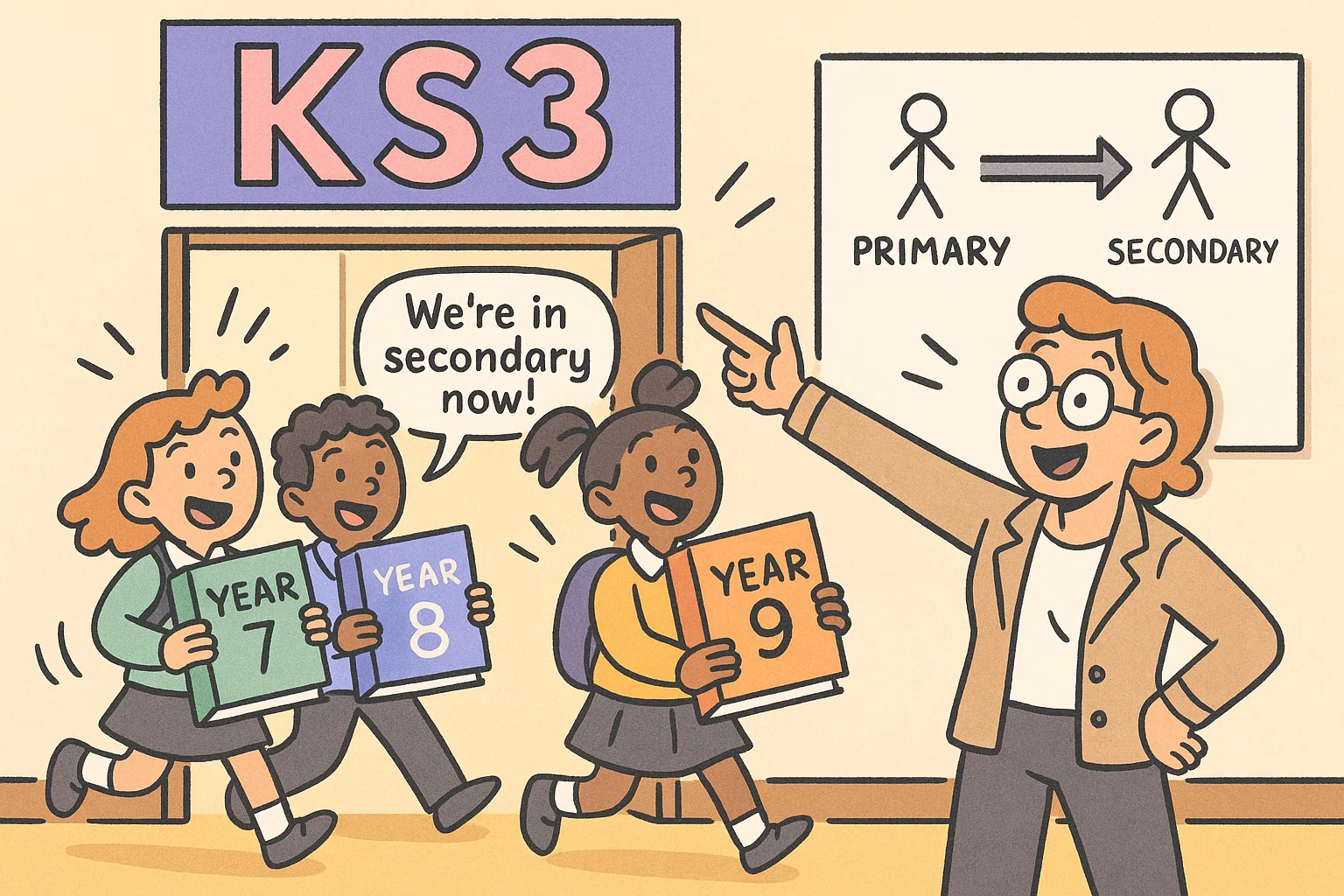
Key Stage 3 (KS3) spans three academic years: Year 7, Year 8 and Year 9. It generally covers the ages of 11 to 14. Year 7 is the entry point, the first of the three years that make up this phase of the National Curriculum.
KS3 Curriculum Structure
The curriculum is designed to be broad and balanced, ensuring all students will study a wide array of disciplines. All state-funded schools in England follow the National Curriculum, which mandates a set of compulsory subjects. While academies and free schools have some flexibility, they must still provide a high-quality education covering the core areas.
Core Subjects:
- English
- Maths (Mathematics)
- Science (often taught as a combined subject initially)
Foundation Subjects:
- Art and Design
- Citizenship
- Computing
- Design and Technology (Product Design is a common element)
- Geography
- History
- Modern Foreign Languages (MFL)
- Music
- Physical Education (PE)
In addition to these, all schools must provide religious education (RE), which generally follows an agreed syllabus, and Relationships and Sex Education (RSE), ensuring a holistic programme of study. Students will typically rotate through various subjects on a complex timetable, a major change from the primary school model.
KS3 Learning Goals
The primary goal of the KS3 curriculum is to build upon the foundations established in Year 6 and prepare students for the demands of GCSE study in Key Stage 4. Throughout Year 7, students are encouraged to develop their understanding of key concepts and refine essential academic skills.
| Key Skill Focus | Year 7 Development | Application in Subjects |
| Literacy & Oracy | Developing more advanced reading and writing skills, refining sentence structures, and developing effective speaking and listening techniques. | English, History, Science (report writing). |
| Numeracy & Fluency | Applying mathematical principles, securing fluency in arithmetic, and introducing basic algebra and problem solving. | Math, Science, Design and Technology. |
| Enquiry & Analysis | Learning to research, evaluate sources, ask challenging questions, and analyse information critically. | History, Geography, Science, Art. |
| Practical & Creative | Safe use of tools and equipment, prototyping, drawing, and performance skills. | Design and Technology, Art, Drama, Music, PE. |
Year 7 Transition
Moving from primary school, where they were among the oldest pupils and often stayed in one classroom with one main teacher, to secondary school can be challenging. Schools work hard to smooth this process, helping the new year group acclimatise to a larger environment with multiple teachers and subjects.
- Induction Days: Most secondary schools offer orientation or induction days for Year 7 learners in the summer term of Year 6. This allows them to explore the campus, meet some key staff and peers, and practice navigating around the school.
- Baseline Tests: Early in Year 7, many schools administer baseline tests in English and math. These are not high-stakes exams but are designed to assess each pupil’s level of attainment as they enter the school, helping teachers tailor the programme to individual needs.
- Form Groups: Students are typically assigned to a tutor or form group for daily registration and pastoral care. This single point of contact is vital for emotional and social well-being.
Year 7 Maths
Year 7 maths is a crucial step, representing the first year of secondary-level mathematics where the subject begins to divide into distinct strands. The goal is to build secure fluency with number operations while introducing more abstract and formal mathematical ideas, most notably algebra. Students will learn to transition from the practical, concrete math of primary school to a more conceptual understanding, focusing heavily on problem solving.
Number and Place Value
Students learn to extend their understanding of the number system. This includes:
- Working with integers (positive and negative whole numbers), including ordering and comparing.
- Deepening their understanding of decimals and place value, particularly in calculating and rounding.
- Being introduced to key concepts like powers, roots, prime numbers, factors, and multiples.
Arithmetic Operations (ASMD)
A core focus is on ensuring fluency in the four basic operations (addition, subtraction, multiplication, division) across different types of numbers.
- Mastering operations with whole numbers and decimals.
- Introducing the arithmetic of negative numbers, such as calculating
-4 + (-6) = -10
. - Securing the correct order of operations (BIDMAS/BODMAS).
Fractions and Percentages
Building on Year 6, students will study all key operations with fractions.
- Comparing, simplifying, and finding equivalent fractions.
- Adding, subtracting, multiplying, and dividing fractions, including mixed numbers.
- Converting between fractions, decimals, and percentages. Students will also apply this knowledge to practical, real-life percentage tasks, such as finding a percentage of an amount.
Ratio and Proportion
This marks the formal introduction to the concepts of ratio and proportion.
- Understanding and simplifying simple ratios.
- Applying scaling and simple direct proportion to recipes, maps and conversions.
- Solving practical problems involving sharing amounts in a given ratio.
Algebra Basics
This is often a new and exciting, yet potentially challenging, area for Year 7 learners. They learn how to use formal algebraic notation.
- Introducing the idea of a variable and writing algebraic expressions (e.g., 3x + 5).
- Substitution of values into expressions and simple formulas.
- Solving simple linear equations, typically of the form ax±b=c.
- Investigating number sequences and finding the rule for the nth term.
Geometry and Measure
In geometry, students also solidify their spatial reasoning.
- Working with angles, including calculating missing angles on a straight line, around a point, and vertically opposite angles.
- Investigating the properties of 2D shapes (triangles, quadrilaterals) and 3D shapes (cubes, prisms).
- Calculating the area and perimeter of rectangles, triangles, and compound shapes.
- Learning to use measuring units and performing conversions (e.g., metres to kilometres).
Probability
Probability is introduced as a way to quantify chance.
- Using appropriate language to describe chance (impossible, unlikely, likely, certain).
- Carrying out simple probability experiments and recording outcomes clearly.
- Calculating simple theoretical probability as a fraction, decimal, or percentage.
Statistics
Students complete work on collecting, representing, and interpreting data.
- Reviewing different methods of data collection.
- Constructing and interpreting frequency tables, bar charts, and line graphs.
- Calculating and interpreting measures of central tendency: mean, median, mode, and range (the averages).
Year 7 English
The English curriculum, which is designed to enhance reading and writing skills, focuses on equipping students with the literacy necessary for all other subjects. Year 7 students learn to appreciate a diverse literary heritage, including works by writers from different cultures and historical periods.
Reading Skills
The emphasis shifts to critical and analytical reading.
- Fiction and Poetry: Students read and analyse a wide range of texts, often including an introduction to Shakespeare (e.g., The Tempest or A Midsummer Night’s Dream) and classic texts like Dickens. They explore characterisation, setting, plot, and literary devices.
- Non-Fiction: Students learn to dissect the purpose and audience of non-fiction texts (e.g., articles, speeches, arguments), focusing on rhetorical devices and bias.
- Inference and interpretation: They are expected to infer and deduce meaning, using textual evidence to support their points—a key skill for GCSE success.
Writing Skills
Students complete tasks designed to make them versatile and precise writers.
- Narrative Writing: Developing vivid description and coherent story structures, often linked to the fiction they are reading.
- Essays and Arguments: Learning to structure a formal essay, present a viewpoint convincingly, and use topic sentences effectively.
- Grammar and Punctuation: Consolidating and extending knowledge of complex punctuation (colons, semi-colons, dashes) and complex sentence building, including using a variety of clauses.
Speaking and Listening
Oracy remains a critical component of the programme of study.
- Class Discussions: Engaging in thoughtful debate, listening actively, and articulating complex ideas clearly.
- Presentations: Preparing and delivering formal and informal speeches, which builds confidence and the ability to adapt language to suit purpose and audience.
- Group Work: Collaborating effectively, taking on different roles, and practising effective communication.
Year 7 Science
In Year 7, science is usually taught as a combined subject, but students have separate blocks covering the three core disciplines: Biology, Chemistry, and Physics. The curriculum is designed to encourage scientific enquiry, experimentation, and the application of mathematical skills to scientific data. Students have the opportunity to develop practical lab skills, with an emphasis on safety.
Biology Topics
Biology focuses on the study of living organisms.
- Cells: Introduction to animal and plant cells, their basic structure, and function.
- Body Systems: Basic overview of human body systems, such as the skeletal, circulatory, and digestive systems.
- Ecosystems: Learning about different habitats, food chains, interdependence, and basic ecology concepts.
- Basic Health: Concepts related to nutrition, diet, and disease prevention.
Chemistry Topics
Chemistry introduces the fundamental building blocks of matter.
- Particles: The particle model of matter (solids, liquids, gases) and changes of state.
- Elements, Mixtures, and Compounds: Distinguishing between pure substances and mixtures, and learning about the basic arrangement of the periodic table.
- Reactions: Introduction to simple chemical reactions, including observable changes like colour change and gas production.
- Lab Safety: Crucial instruction on the safe handling of chemicals and tools and equipment.
Physics Topics
Physics explores forces, energy, and the physical world.
- Forces: Introduction to forces (gravity, friction, air resistance) and their effects on motion.
- Energy: Different forms of energy (kinetic, potential, thermal) and the concept of energy transfer.
- Electricity Basics: Simple circuits, components, and the flow of current.
- Scientific Measurement: Accurate use of measuring instruments and understanding units.
Year 7 Humanities
The humanities subjects—Geography, History, and Religious Education—are vital for building cultural capital, critical thinking, and an understanding of the world.
Geography
The geography programme of study aims to transition students from local studies to global issues. Students who learn geography develop essential map skills and spatial awareness.
- Maps and Globes: Mastering scale, grid references, compass directions, and Ordnance Survey (OS) maps.
- Physical Geography Basics: Students will learn about different landforms, the water cycle, weather, and climate.
- Human Geography: Introducing concepts like population distribution, settlement, and land use.
- Global Issues: Elementary discussions on climate change, sustainability, and resource management, promoting enquiry.
History
Students explore key historical periods and develop the skills of a historian.
- Medieval England: A major focus is often on Medieval England, exploring topics like the Norman Conquest, the Feudal System, the Black Death, and the role of the Church.
- Key Historical Skills: Learning to distinguish between primary and secondary sources, evaluate historical evidence, understand chronology (timelines), and identify cause and consequence.
- Early Modern Periods: Some schools may introduce topics like the Tudors or Stuarts towards the end of year 7.
Philosophy and Ethics (RE/R.E.)
RE in secondary school moves beyond simply learning about religions to engaging in deeper philosophical and ethical debates.
- Beliefs: Students will study the core beliefs and practices of major world religions and non-religious worldviews.
- Moral Discussions: Students also have the opportunity to participate in critical discussions about ethical issues, such as environmental responsibility, fair trade, or wealth distribution, using an agreed syllabus.
- Critical Thinking: Encouraging pupils to articulate their own opinions respectfully and support their arguments with reason and evidence.
Year 7 Creative Subjects
Creative disciplines are essential for holistic development, supporting self-expression, innovative problem solving, and manual dexterity.
Art
Art and Design introduces students to formal artistic techniques and concepts.
- Drawing and Painting: Developing observational key skills and control over different media.
- Colour Theory: Understanding the colour wheel, primary, secondary, and tertiary colours, and the effects of tone and shade.
- Visual Elements of Art: Learning about line, shape, form, texture, and space.
- Evaluation: Critically examining and responding to the work of different artists.
Design and Technology (D&T)
D&T teaches students to design and make functional products, often rotating through specialist areas.
- Product Design Basics: The iterative design process: research, idea generation, prototyping, testing, and evaluation.
- Materials and Tools: Safely using hand tools and equipment to work with wood, plastic, and metal.
- Subareas: Students typically rotate through units in Food Technology (basic cooking skills and nutrition), Textiles (simple sewing and material properties), and Product Design (resistant materials).
Drama
Drama is a powerful tool for confidence, empathy, and communication.
- Improvisation: Quick-thinking and spontaneous performance to develop character and narrative.
- Script Work: Analysing and performing short scripted scenes, focusing on vocal projection and stage presence.
- Confidence building: Using drama games and exercises to encourage teamwork and self-assurance.
Music
Music develops theoretical understanding and practical performance.
- Notation and Rhythm: Reading and writing basic musical notation.
- Instruments: Students are also introduced to key instruments, such as the keyboard, ukulele, or percussion, and learn how to use them.
- Group Performance: Collaborating in an ensemble, which enhances listening and timing skills.
Year 7 Modern Foreign Languages (MFL)
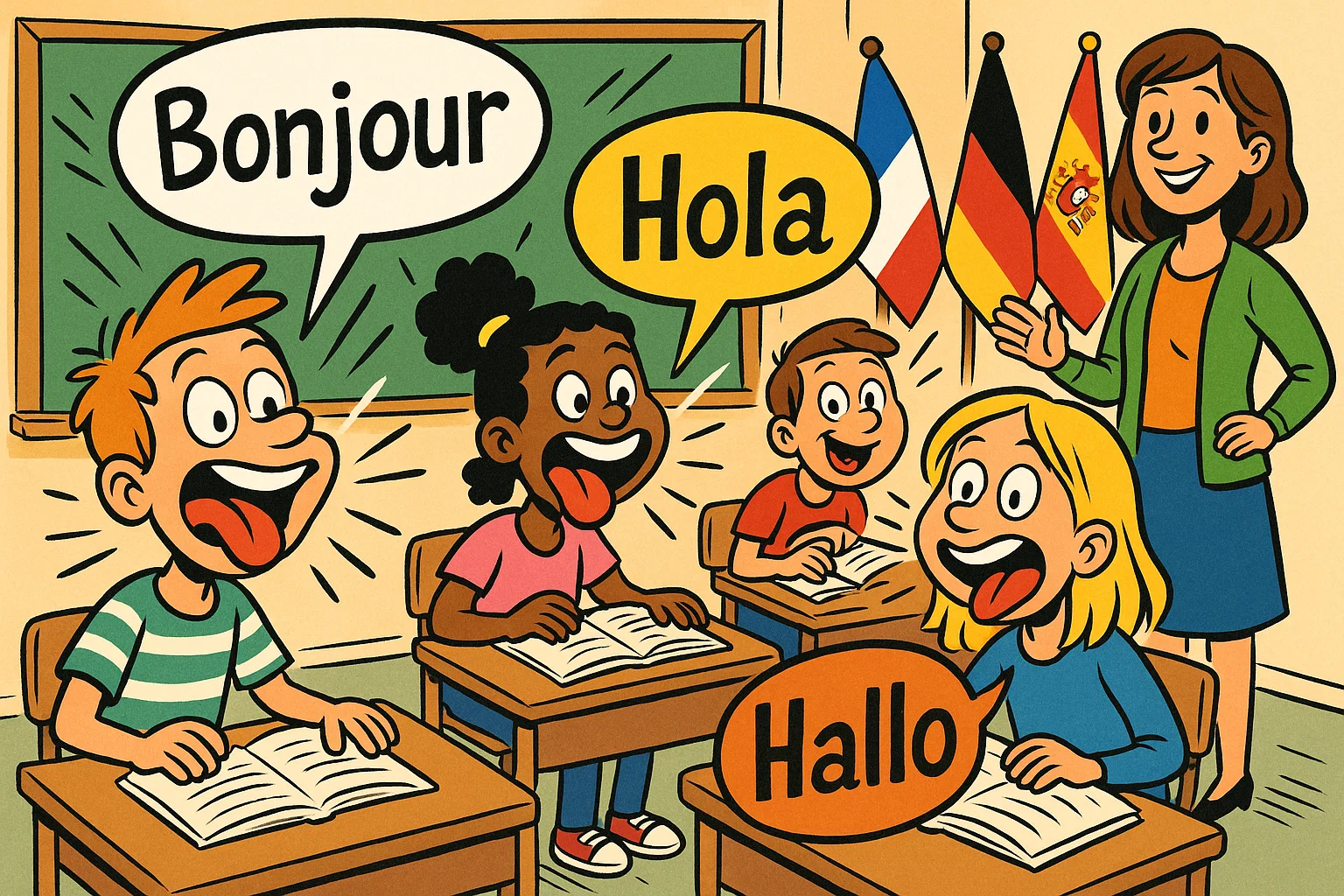
Cartoon Year 7 MFL classroom with students learning new languages through speech bubbles.
In Year 7, students begin their study of a Modern Foreign Language (MFL), typically French, Spanish, or German. The focus is on building foundation language fluency and cultural awareness.
Vocabulary Themes
The initial focus is on practical, high-frequency vocabulary.
- Self and Family
- School and Daily Routine
- Hobbies and Interests
- Food and Drink
Grammar Basics
A more formal approach to grammar begins, which also supports reading and writing development in English.
- Introduction to verbs and basic tenses (often the present tense).
- Understanding gendered nouns and simple sentence structure.
Speaking and Listening
The goal is communication and confidence. Students also practice their speaking and listening through:
- Role-playing simple conversations and dialogues.
- Learning correct pronunciation.
- Translating simple texts from and into the target language.
Year 7 Computing
The computing programme moves significantly beyond the basic ICT skills of primary school, focusing on computational thinking and digital citizenship.
Coding Basics
Students learn the fundamentals of programming.
- Simple Programming Concepts: Understanding algorithms, sequencing, loops, and conditional logic.
- Block-Based or Text-Based Tasks: Often starting with visual, block-based languages (like Scratch) before moving to basic text-based coding (like Python).
Digital Safety
A critical area, given the increasing digital presence in children’s lives.
- Online Safety and Privacy: Understanding cyberbullying, digital footprints, and the importance of protecting personal information.
- Responsible Behaviour: Discussing the legal and ethical implications of using digital content.
ICT Skills
Consolidating practical IT literacy.
- Working effectively with documents and spreadsheets.
- Creating clear, well-structured presentations and using basic data-handling tools.
Year 7 Physical Education (PE)

PE contributes to physical, mental, and social health. The programme of study aims to build fitness, teamwork, and the key skills of various sports.
Team Sports
Students are introduced to a range of competitive and non-competitive team sports.
- Football, Basketball, Netball, and Rugby (often Tag Rugby).
- Focus is on strategy, spatial awareness, communication, and sportsmanship.
Individual Activities
Activities that foster personal fitness and skill mastery.
- Gymnastics and trampolining.
- Athletics (running, jumping, throwing events).
- Swimming (where facilities allow).
Health Education
PE lessons are often linked with health and well-being.
- Basic understanding of a healthy lifestyle.
- Introduction to basic nutrition and the importance of regular physical activity.
Year 7 Assessment
In KS3, formal exams are less frequent than at GCSE, but assessment is continuous and provides vital feedback. Progress is tracked to ensure students are ready for the challenges of Year 8 and Year 9.
Baseline Tests
These tests are typically administered in the first few weeks of Year 7 to ascertain the precise level of a student’s knowledge and understanding in subjects like English and math following their Year 6 experience. They help the school set appropriate targets and teaching groups.
Formative Assessment
This is the ongoing process that drives daily learning.
- Ongoing Feedback: Detailed, constructive feedback from teachers on classwork and homework.
- Class Participation: Assessing the pupil’s engagement in discussion and their ability to articulate ideas (speaking and listening).
- Homework Review: Checking for understanding of the key concepts being taught.
Summative Assessment
These are evaluations of learning at the end of year or at the end of unit.
- End-of-Unit Tests: Short tests to check mastery of specific topics (e.g., an algebra unit test).
- End-of-Year Tests: Comprehensive exams given in the summer term to gauge overall progress throughout Year 7.
- Reports and Attainment Grades: Parents receive regular reports detailing their child’s current attainment, effort, and progress towards their end of key stage 3 targets.
Support at Home
As a parent, your support is invaluable. The move to secondary school requires your child to become more independent and organised. Encourage open dialogue about the subjects they study and any challenges they face.
Maths Support at Home
- Practice Tasks: Encourage regular, short practice sessions, perhaps using online resources or homework provided by the school to build fluency.
- Building Confidence: Never express the idea that math is inherently difficult. Focus on effort and understanding over rote memorisation. Celebrate small wins, especially with complex topics like algebra or problem solving.
- Recommended Tools: Ensure your child has a scientific calculator and learns how to use it correctly, but encourage mental mathematical work first.
Reading Support
The single most important thing you can do is encourage reading.
- Encouraging Reading Routines: Allocate 20-30 minutes of quiet, device-free reading time each day. It doesn’t have to be Shakespeare; high-quality fiction, non-fiction, graphic novels, and even complex articles are all beneficial.
- Discussing Books: Ask open-ended questions about what they are reading: “Why do you think the character made that decision?” or “What techniques did the author use to build suspense?” This enhances their analytical and comprehension skills.
Study Habits
Good organisation is key for thriving in Year 7.
- Planning Homework Time: Help them establish a fixed routine for completing homework, avoiding last-minute stress. They now have homework from multiple teachers, requiring better time management.
- Managing Workload: Use a large wall calendar or a digital planner to track deadlines and extra-curricular commitments around the school.
- Revision Tips: Introduce simple revision techniques for end of year exams, like making flashcards for key concepts or summarizing notes after each lesson to consolidate knowledge and understanding throughout Year 7.
By actively engaging with the Year 7 curriculum and providing a supportive, organised home environment, you are giving your child the best opportunity to work towards a successful and confident end to Key Stage 3.