

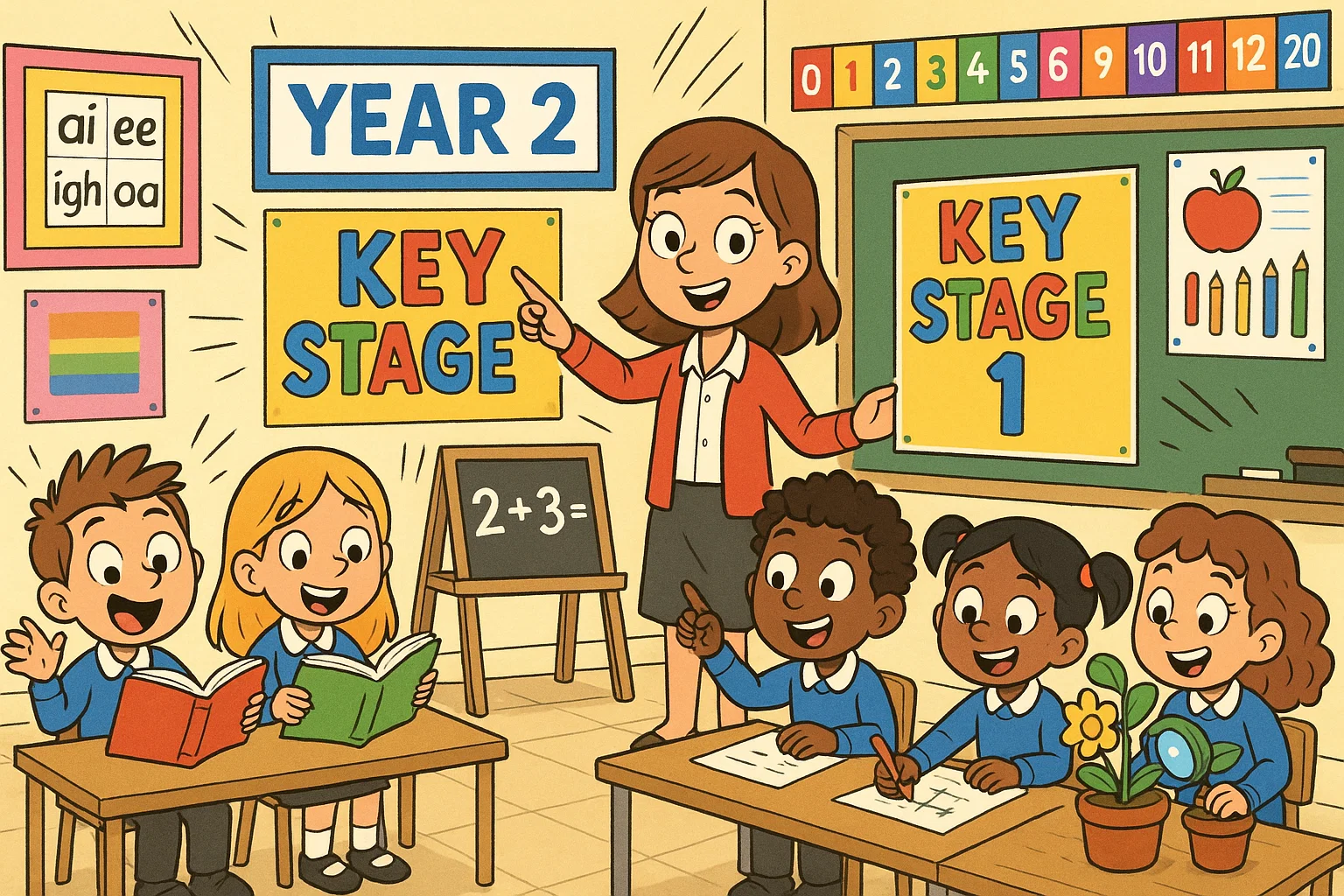
Year 2 is a pivotal time in a child’s primary school journey in England. At this stage, typically for children aged 6–7, pupils consolidate the foundational skills they built in Year 1 and prepare for the transition to Key Stage 2 (KS2). This is the year when foundational reading, writing, and math concepts become fluent, providing the essential building blocks for future learning across the entire national curriculum for England.
Understanding what your child can expect in Year 2—from core subjects to key end-of-year assessments—is the best way to support their growth. This guide breaks down the curriculum, the expected milestones, and how teachers assess progress as your child completes the final year of Key Stage 1 (KS1).
Key Stage 1 Overview

Key Stage 1 covers the first two years of formal schooling: Year 1 and Year 2. As the final year of this stage, Year 2 is where children are expected to reach the government’s expected standard of attainment in the core subjects. The focus shifts from the play-based learning of the Early Years Foundation Stage (EYFS) to more structured academic work, encouraging pupils to develop greater independence as learners.
- Final Year of KS1: Year 2 marks the end of the initial, crucial stage of primary education and preparation for later schooling.
- Academic Milestones: By the end of this year, children should be fluent readers, able to write short narratives, and confident in basic arithmetic and place value up to 100.
- Broader Education System Context: The attainment demonstrated in Year 2 serves as a baseline for measuring your child’s progress as they move into the junior school phase of Key Stage 2.
KS1 Subjects
The compulsory subjects taught in Key Stage 1 ensure pupils receive a broad and balanced curriculum. While all subjects are important, a strong emphasis is placed on English reading, Maths, and Science.
| Subject Category | Compulsory KS1 Subjects | Focus in Year 2 |
| Core Subjects | English, Maths, Science | Reading fluency, place value and number work up to 100, materials and living things. |
| Foundation Subjects | Art and Design, Computing, Design and Technology (D&T), Geography, History, Music, Physical Education (PE) | Developing technical skills, understanding basic chronology and location, practical application. |
| Statutory Subjects | Religious Education (RE), Relationships and Health Education | Understanding different cultures, health, and personal relationships. |
KS1 Learning Goals
The goals set out in the national curriculum for Year 2 represent significant skill progression from Year 1. Teachers are working to ensure every pupil meets these standards, which are outlined in depth in official documents.
- Literacy: Moving beyond basic phonics to read common exception words by sight, improving punctuation use (including commas and apostrophes), and writing coherent, longer texts.
- Maths: Mastering the basics of addition and subtraction facts to 20, knowing the 2, 5, and 10 times tables, and working with fractions (½, ¼, ¾).
- Science: Developing skills in observation, prediction, and simple data recording while exploring core topics like living things and materials.
KS1 Assessments
The Year 2 assessments, often referred to as SATs (Standard Assessment Tests), are a key component of the end of year 2 process. It is important to remember that these tests are a tool for the school and teachers, not a high-stress, pass/fail examination for the child.
The final teacher assessments in English and teacher assessments in maths are based on a combination of the test results and a pupil’s work throughout the year.
Year 2 Daily School Experience
A typical school day for a Year 2 child involves a good balance of core academic work, creative foundation subjects, and opportunities for social development. The timetable is more structured than in Reception, but still features movement and varied activities to keep children engaged and motivated to learn.
Classroom Activities
Classroom activities in Year 2 are designed to reinforce core knowledge through practical and collaborative methods.
- Literacy & Phonics: Daily dedicated sessions focus on phonics reinforcement, followed by guided English reading and creative writing sessions. Many schools use reading groups based on ability to target specific needs.
- Maths Practice: Activities include hands-on problem-solving using manipulatives (like counters or blocks), mental maths practice, and recorded work, often following a mastery approach that ensures deeper understanding.
- Projects: Collaborative projects integrate subjects like History or Science, encouraging teamwork and developing early investigative or observation skills.
Skill Development
The emphasis in Year 2 is on consolidating the basic mechanics of learning to achieve fluency:
- Reading Fluency and Stamina: The goal is for a child to read effortlessly so they can focus on comprehension, transitioning from ‘learning to read’ to ‘reading to learn.’
- Writing Stamina: Developing the ability to write a full page or more, sequencing sentences effectively to form short narratives and reports.
- Mental Maths: Quick recall of number facts and basic tables is prioritised to enable more complex calculation later.
Social Growth
Alongside academics, the Year 2 child is expected to demonstrate significant social and emotional growth. This includes:
- Increased Independence: Taking responsibility for belongings, homework, and following multi-step instructions without constant teacher supervision.
- Teamwork and Collaboration: Working effectively in small groups, sharing ideas, and managing minor disagreements respectfully.
- Positive Behaviour: Understanding and consistently applying school rules and being a role model for younger pupils.
Year 2 Literacy Skills
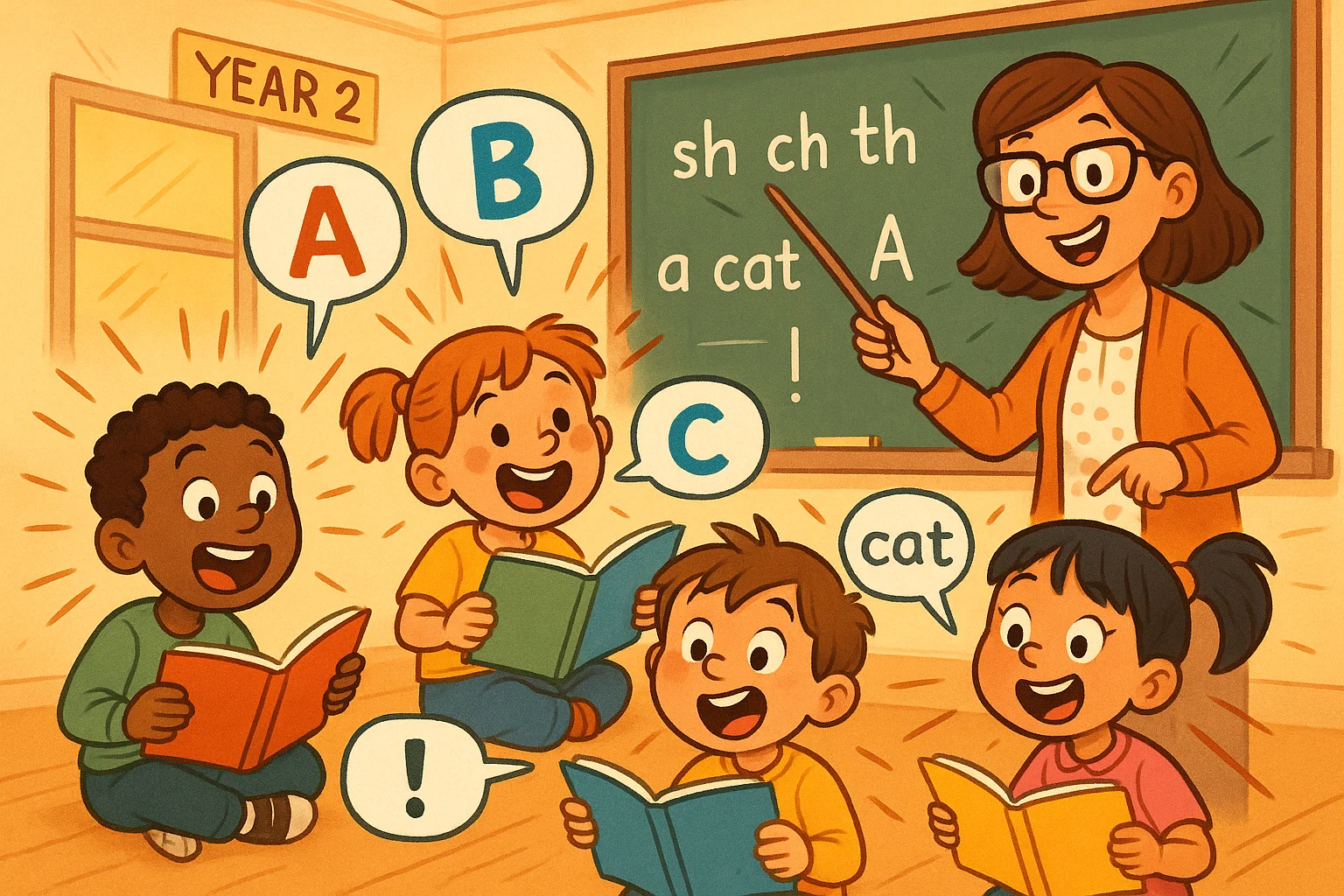
Literacy in Year 2 is the engine of all future learning. The National Curriculum for England has clear expectations for reading and writing, ensuring pupils have a strong command of the language.
Reading Skills
- Fluency: Reading accurately and at a good pace (e.g., around 90 words per minute is a strong target).
- Comprehension: Understanding the main points of a text, retrieving information, and making inferences about characters’ feelings or events.
- Vocabulary Growth: Encountering and discussing a wider range of words across fiction and non-fiction, linking new meanings to known ones.
Grammar
The grammar requirements in Year 2 are a significant step up, focusing on the building blocks of sophisticated sentences:
| Grammar/Punctuation Concept | Examples of Application |
| Punctuation | Correct use of full stops, capital letters, question marks (?), exclamation marks (!), and beginning to use commas in lists and apostrophes for contraction (e.g., it’s). |
| Sentence Types | Identifying and using statements, questions, commands, and exclamations. |
| Tenses | Consistent and correct use of past and present tense (e.g., I walked vs. I walk). |
| Expanded Noun Phrases | Adding detail to nouns (e.g., The enormous, hungry monster instead of The monster). |
| Conjunctions | Using coordinating (and, but, or) and subordinating (when, if, because, that) conjunctions to join clauses. |
Writing Skills
Year 2 writing moves from simple sentences to structured composition. Pupils are expected to:
- Compose and Sequence: Plan or say sentences aloud before writing, then sequence them to form a cohesive short narrative or non-fiction piece.
- Handwriting Fluency: Form letters correctly, with consistent size and orientation, and begin to join some letters neatly.
- Editing: Check their own work for basic errors in spelling and punctuation before presenting the final piece.
Year 2 Maths Skills
The Year 2 math curriculum is highly focused on developing a strong sense of number and place value, building a foundation for Key Stage 2 topics like long multiplication and division in later year groups and key stages.
Number Work
- Place Value to 100: Recognising the value of each digit in a two-digit number (e.g., 47 is 4 tens and 7 ones).
- Addition and Subtraction: Fluently recalling and applying number facts to 20, and using concrete objects, pictorial representations, and mental methods to solve problems involving two-digit numbers and ones, or two-digit numbers and tens.
- Problem-Solving: Applying number knowledge to word problems, using place value to solve simple challenges.
Times Tables
The formal introduction to multiplication begins in Year 2.
- Pupils should recall and use multiplication and division facts for the 2, 5, and 10 times tables.
- This learning is supported through arrays (visual grids), repeated addition, and grouping.
Measurements and Shapes
Children expand their understanding of the world by learning to use standard units.
- Measurement: Comparing and ordering lengths (cm/m), mass (g/kg), capacity (ml/l), and temperature (C).
- Time: Telling the time to the nearest 5 minutes, including quarter past and quarter to.
- Shapes and Data: Identifying properties of 2D shapes (sides, vertices) and 3D shapes (faces, edges, vertices), and interpreting simple pictograms, tally charts, and tables.
Year 2 Science Topics
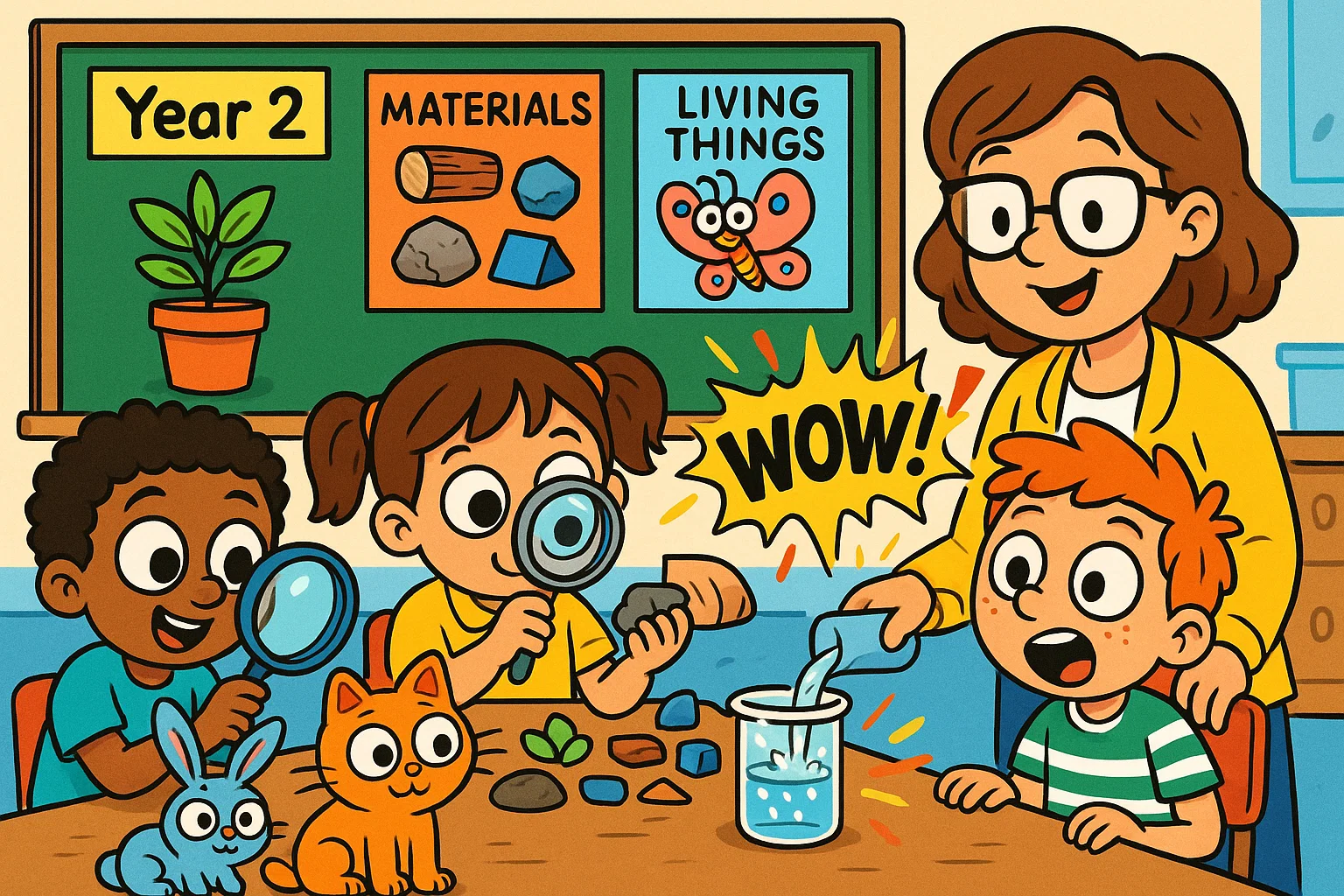
Science in Year 2 is about hands-on exploration, observation, and developing a sense of curiosity. The key scientific skills revolve around setting up simple comparative tests and recording results.
Living Things
- Habitats: Exploring different local habitats and understanding how animals are suited to them.
- Basic Needs: Discussing the essential needs of animals (including humans) for survival (water, food, air, shelter).
Materials
- Properties: Observing and describing the uses of everyday materials based on their properties (e.g., glass is transparent, wood is strong).
- Grouping and Sorting: Sorting materials into groups based on observable properties, such as being waterproof or flexible.
Plants
- Plant Growth: Observing how plants grow from seeds or bulbs.
- Seasonal Changes: Noticing and recording the changes to plants and animals across the four seasons.
Year 2 SATs and Assessment
The Key Stage 1 SATs are statutory national curriculum tests that take place in the final term of Year 2. However, since 2024, these tests have become optional for schools to administer. The key outcome remains the Teacher Assessment based on evidence across the entire year.
KS1 SATs Format
If a school chooses to administer them, the tests cover:
- English Reading: Usually two papers testing reading accuracy and comprehension.
- Grammar, Punctuation and Spelling (GPS): A separate paper to assess knowledge of punctuation and basic grammar rules.
- Maths: Two papers—one for arithmetic (straightforward calculations) and one for reasoning (word problems and applying knowledge).
Teacher Assessment
The most important outcome for parents is the Teacher Assessment. Teachers use the SATs results as one part of the overall picture. They draw on evidence from daily classwork, recorded observations, and formal assessments throughout the year to determine if a child is working towards the expected standard (WTS), at the expected standard (EXS), or at greater depth (GDS).
Parent Support for Year 2

Your support at home is vital for reinforcing the learning happening in Year 2.
Reading Support
- Daily Reading: Commit to reading with your child every day, even for just 10 minutes.
- Discussing Stories: Move beyond just decoding the words. Ask comprehension questions: “Why did the character do that?” or “What do you think will happen next?”
- Explore Non-Fiction: Don’t limit reading to stories; explore topic books, instructions, and even recipes to develop real-world reading skills.
Real-Life Maths
- Money and Change: Play a game of shops, letting your child choose coins and calculate change.
- Telling Time: Encourage them to read the time on an analogue clock to the nearest five minutes.
- Cooking and Measurement: Use cooking to practice measuring ingredients (weight and capacity) and fractions.
Building Independence
- Routines: Establish consistent, calm routines for homework, organising their school bag, and preparing for the next day.
- Responsibility: Give them small responsibilities around the house that build confidence and follow-through. For example, “You are in charge of putting your reading book back in your bag.”
Explore the Topic
As your child completes Key Stage 1, it’s a natural time to look ahead or reflect on their starting points.
EYFS Recap
The EYFS (Early Years Foundation Stage) in the Reception year laid the crucial foundation, focusing on starting points in language and early literacy and numeracy skills. Year 1 and 2 built directly on this foundation, moving to formal application of these skills within the Key Stage 1 curriculum.
Key Stage 2 Preview
The move to Key Stage 2 (Years 3, 4, 5, and 6) brings a greater focus on academic depth, broader subjects, and increasing independence in learning. In Year 3, children will begin to tackle more complex long-form calculations in maths, and their writing will become longer and more detailed. The next major examination will be the Key Stage 2 SATs at the end of Year 6.
Search Tools
For official, authoritative guidance on the UK school system and the national curriculum, always check resources from GOV.UK. Educational publishers like Oxford Owl also offer excellent, free resources aligned with Key Stage 1 and 2 expectations.
Support and Services
If you have concerns about your child’s progress in Year 2, remember that support is available both through the school and external resources.
Tutoring Support
Some parents choose tutoring support for a focused boost in a specific area, particularly English reading or maths, to ensure the pupil is confidently meeting the expected standard before entering Key Stage 2. Look for tutors or catch-up programmes with experience in the KS1 curriculum.
School Support Links
Your child’s primary school offers pastoral and academic support, including:
- SEN (Special Educational Needs) Support
- Small group interventions (e.g., targeted reading or phonics groups)
- Communication with the class teacher is the first and most important step to understanding your child’s progress.
Would you like me to find some useful online resources for practicing Year 2 reading comprehension, or would you prefer a summary of the Key Stage 2 (Year 3) curriculum?