

Year 5 marks a crucial, exciting stage in a pupil’s academic journey within the UK school system. Typically catering to children aged 9 to 10, it’s the third year of Key Stage 2 (KS2) in primary school. This year consolidates the foundational knowledge acquired in earlier years while introducing more complex concepts across all subjects. It also lays essential groundwork for the end-of-Key-Stage 2 SATs in Year 6 and the eventual transition to secondary school.
The curriculum is rigorous yet broad, ensuring a well-rounded education. While state-funded primary schools in England must follow the National Curriculum, independent schools (or prep schools) and international schools following a British programme often have the freedom to enhance and extend the curriculum, potentially adding subjects like additional languages or increasing the depth of their maths and science provision. Regardless of the setting, Year 5 is a year of growing independence and intellectual maturity, encouraging pupils to develop stronger critical-thinking skills and become more organised, independent learners.
Key Stage 2 Structure for Year 5
Year 5 sits in the Upper Key Stage 2 bracket (Years 5 and 6). The overall goal is to ensure every pupil leaves primary school ready for the demands of secondary education, possessing high literacy and numeracy levels. The school year runs from September to July, and the daily structure balances core academic work with foundation subjects.
- Timeline: Age 9 to 10 years old.
- Curriculum Focus: Consolidating prior learning and deepening knowledge and skills across all compulsory subjects.
- Goals: Building resilience, independence, and deeper subject-specific understanding, particularly in English and maths.
KS2 Subjects Overview
The National Curriculum dictates a balanced curriculum in state schools. While the core focus remains on maths and science alongside English reading, grammar, spelling, and punctuation, other subjects are essential for holistic development.
| Subject Category | Mandatory Subjects in KS2 | Year 5 Focus/Delivery |
| Core | English, Math, Science | Daily intensive lesson plans focusing on complex skills. |
| Foundation | History, Geography, Art & Design, Design & Technology, Computing, Music, Physical Education, Languages (statutory in KS2 for maintained schools; often expanded in prep schools), Religious Education. | Taught throughout the year to build cultural and practical knowledge. |
Year 5 Academic Goals
The core learning targets for this school year are highly ambitious, marking a significant step up from Year 4. They directly influence the teacher’s planning and progression.
- Mathematics: Applying written methods for multi-digit calculations; mastering complex fractions and decimals; exploring early algebraic thinking, such as using symbols and recognising number patterns.
- Literacy: Comprehending and analysing longer, more complex texts; using sophisticated grammar and punctuation in extended creative writing.
- Science: Conducting simple experiments, controlling variables, and recording data accurately.
Assessments in KS2
In Year 5, formal external exams are not statutory. However, schools conduct regular assessments to track progress and inform teaching.
- Informal Classroom Assessments: Daily checks, marking of classwork and tasks, and verbal questioning are constant forms of progress tracking.
- Progress Tracking: Teachers use diagnostic tests and end of year assessments to measure student attainment against the national expected standard.
- Preparation for Year 6 SATs: While not the main focus, many concepts taught in Year 5, especially in tests in maths and English language (SPaG), are direct precursors to the Year 6 SATs. This preparation helps to build confidence and reduce anxiety later on.
Year 5 Mathematics
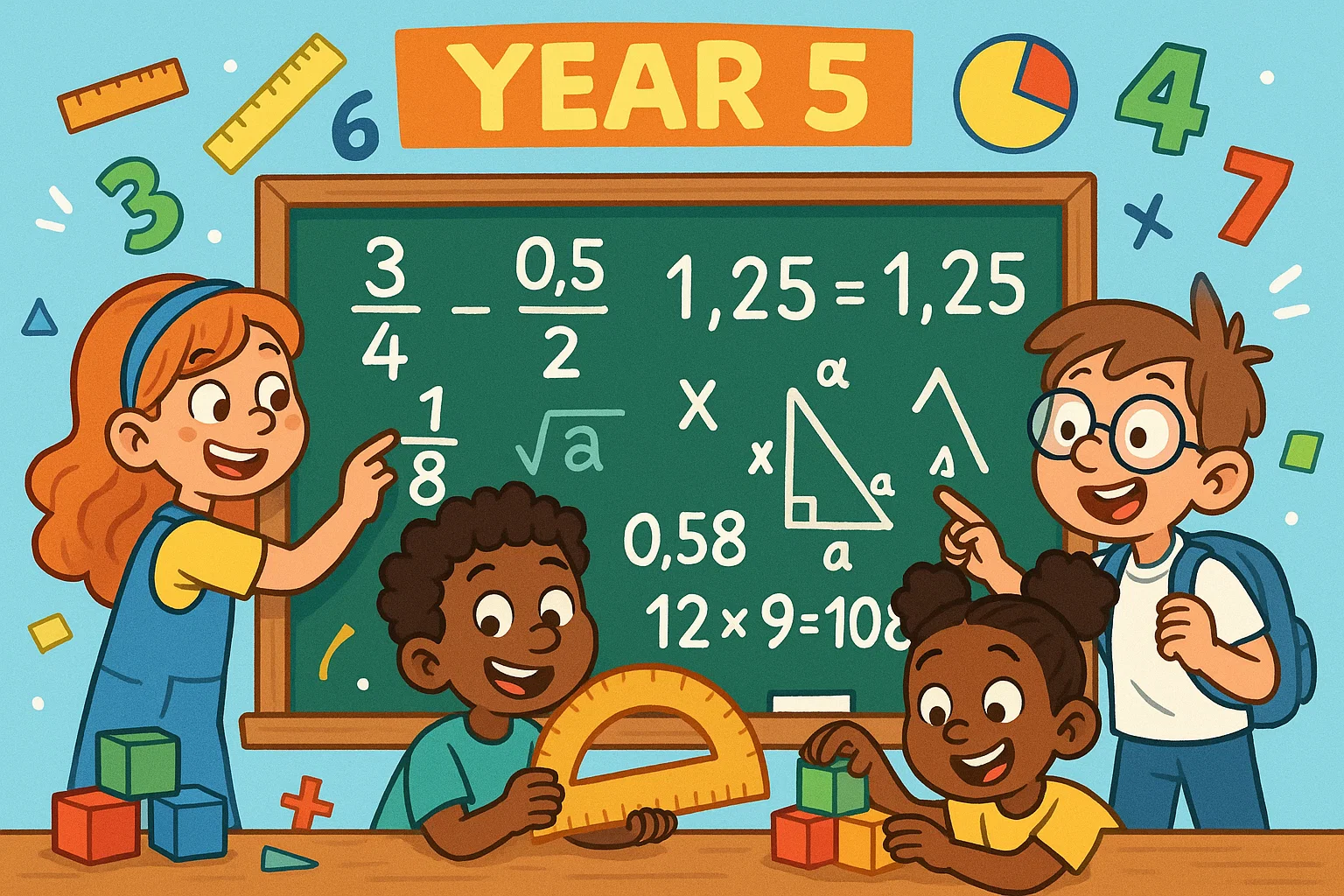
Year 5 mathematics classroom with students working on fractions, geometry and multiplication.
The Year 5 math curriculum demands a strong grasp of number, calculations, and the introduction of increasingly abstract concepts. This year focuses heavily on developing robust problem-solving and reasoning skills.
Fractions, Decimals, Percentages
This area requires pupils to compare, convert, and calculate using these number forms, linking them directly to one another.
- Conversions: Converting improper fractions to mixed numbers and vice versa.
- Calculations: Adding and subtracting fractions with different denominators.
- Equivalents: Recognising that fractions, decimals, and percentages are different representations of the same value.
Multiplication and Division Mastery
Pupils move beyond basic operations towards confidence with more complex written methods.
- Multi-Digit Multiplication: Multiplying numbers of up to four digits by a one- or two-digit number using the formal written method.
- Long Division: Dividing numbers of up to four digits by a one-digit number and interpreting remainders appropriately.
- Number Properties: Identifying factors, common factors, multiples, and prime numbers, preparing the groundwork for algebra.
Geometry and Measurement
The focus shifts from simple recognition to measurement and calculation.
- Angles: Measuring, drawing, and calculating angles, including angles on a straight line and around a point.
- Area and Perimeter: Calculating the perimeter of composite rectilinear shapes and finding the area of different shapes.
- Volume Basics: Beginning to understand and calculate volume by counting unit cubes. Practical activities with unit cubes or simple measuring tasks are commonly included.
Data Handling
Pupils learn to collect, interpret, and present data using more sophisticated methods.
- Graphs and Tables: Reading and interpreting line graphs, tables, and timetables.
- Basic Statistics: Calculating and interpreting the mean average of a set of discrete data.
Year 5 English Skills
The English language curriculum places a heavy emphasis on broadening literacy skills, vocabulary, and the technical aspects of writing.
Reading Analysis Skills
Children transition from simple comprehension to critical analysis.
- Longer Texts: Working with increasingly longer texts, including classic fiction, myths, legends, and non-fiction reports.
- Themes and Characters: Identifying and discussing themes, motives, causes and effects, justifying inferences with evidence from the text.
- Vocabulary: Using a dictionary effectively to confirm word meanings and improve their own vocabulary.
Writing Composition
The focus moves to structuring and manipulating text for different purposes.
- Paragraph Structure: Organising ideas into cohesive paragraphs and using a range of cohesive devices (e.g., adverbials like ‘meanwhile,’ ‘therefore’).
- Narrative Skills: Developing story settings, characters, and plots, using descriptive detail to show rather than tell the action and emotion.
- Persuasive Writing and Report Writing: Producing non-fiction texts that clearly state a point of view (persuasive) or present factual information in a structured way (report writing).
Grammar and Vocabulary
Grammar requirements are significant, laying the foundation for English language studies in secondary school.
| Grammar/Punctuation Concept | Year 5 Focus |
| Punctuation | Using commas, dashes or brackets to indicate parenthesis; using hyphens to avoid ambiguity; using speech marks accurately. |
| Verb Tenses | Using and understanding the difference between the active and passive voice. |
| Sentence Structure | Using relative clauses (starting with who, which, where, when, whose, that). |
Spoken Language
Developing clear, articulate communication skills is a vital part of the curriculum.
- Presentations and Debates: Participating in structured discussions and giving formal presentations, using notes appropriately to support their delivery.
- Classroom Communication: Learning to respectfully listen to, challenge, and build upon the ideas of others.
Year 5 Science Topics
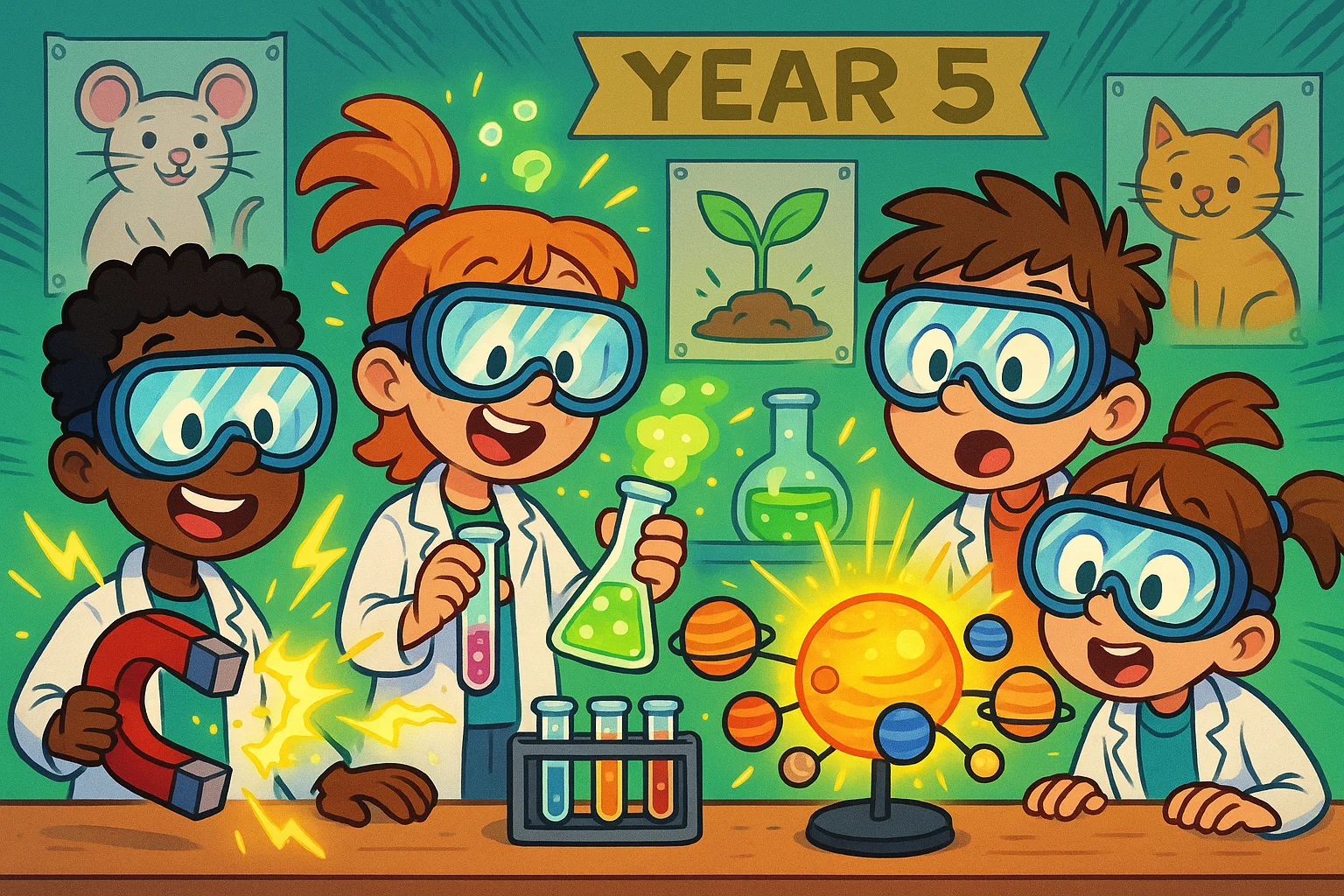
The Year 5 science programme encourages a hands-on approach, developing knowledge and skills through inquiry. Pupils learn to work scientifically by asking questions, planning fair tests, taking measurements, and drawing conclusions.
Life Cycles and Reproduction
Students explore the continuity of life across different organisms.
- Plant Life Cycles: Describing the life cycle of a flowering plant, including pollination, seed dispersal, and reproduction.
- Animal Life Cycles: Understanding the life cycles of mammals, amphibians, insects, and birds.
Forces and Motion
This topic introduces fundamental concepts of physics through practical interactive exploration.
- Forces: Exploring air resistance, water resistance, and friction.
- Gravity: Understanding the concept of gravity and its effect on objects.
- Experiments: Designing and carrying out investigations to explore how surface area affects air resistance (e.g., parachute experiments).
Properties of Materials
Pupils continue to explore the physical and chemical properties of different materials.
- Testing Materials: Conducting fair tests in maths and science to measure properties like hardness, solubility, and thermal insulation.
- Changes: Understanding reversible and irreversible changes, such as dissolving, mixing, and burning.
Earth and Space
The curriculum moves beyond Earth to the wider solar system.
- Planets and Orbits: Describing the movement of the Earth and other planets relative to the Sun and understanding that the Earth rotates on its axis.
- Seasons: Explaining how the tilt of the Earth causes seasons.
- Modelling: Creating models of the solar system or using digital tools to visualise orbits.
Year 5 Humanities
The geography and history subject areas expand the pupil’s understanding of the world, both past and present.
British History Themes
Year 5 typically delves into later periods of British history, connecting them to modern society.
Topics: Common areas include:
- Anglo-Saxons and Vikings: Settlement, culture, and conflict.
- Tudors/Stuarts: Often taught in Year 5 or Year 6, depending on the school curriculum structure.
Geography and World Studies
Students develop a global perspective, mastering map work and physical geography.
- Climate and Biomes: Studying different global regions, including comparing the physical geography of a UK region with a region in North or South America.
- Maps and Globes: Developing confident use of scale, map symbols and grid references.
Local Fieldwork Projects
Outdoor tasks are key for applying geography skills practically.
- Map Skills: Creating their own simple maps of the primary school grounds or local area.
- Environment Exploration: Observing and recording land use, traffic, or environmental quality in a local study.
Year 5 Technology and Digital Skills
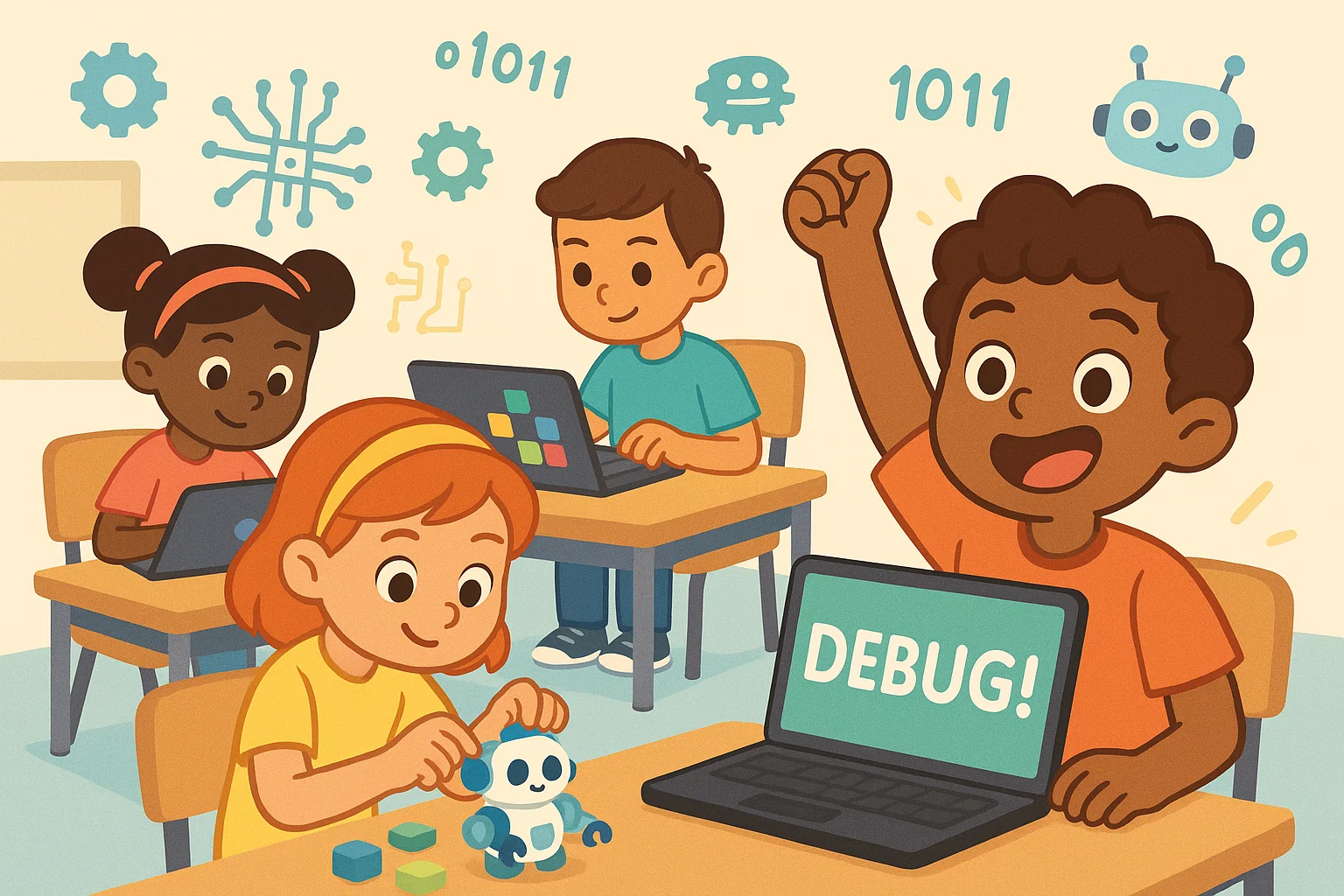
Computing in Year 5 focuses on developing computational thinking and crucial digital literacy skills for the modern age.
Coding and Programming Basics
Students move from simple instructions to structured programming.
- Block-Based Coding: Using platforms like Scratch to create programs that involve algorithms, sequence, selection, and repetition (loops).
- Debugging: Identifying and fixing errors (debugging) in their own and others’ code.
Digital Literacy
This includes learning how to use technology responsibly and safely.
- Safe Internet Use: Understanding online etiquette and knowing how to report inappropriate content or contact.
- Research Accuracy: Developing skills to evaluate the reliability of sources found online.
Multimedia Projects
Applying digital skills to creative interactive tasks.
- Digital Storytelling: Creating short films or animated stories.
- Presentations: Creating effective digital presentations using simple productivity tools.
Year 5 Creative Subjects
Arts, music, and drama are integral to a broad and balanced curriculum, fostering creativity and self-expression.
Visual Art Techniques
Art lessons expand technical proficiency and critical appreciation.
- Sketching and Painting: Experimenting with various media, including charcoal, pastels, and different types of paint, with increasing focus on perspective and shading.
- Colour Theory: Understanding primary, secondary, and tertiary colours, and how to mix and use them effectively.
Music and Performance
The programme includes both creation and appreciation of music.
- Instruments: Learning to play simple melodic patterns on instruments like the recorder or glockenspiel.
- Performance: Participating in group singing and simple rhythmic activities.
Drama and Creativity
Drama builds social skills and confidence.
- Roleplay and Short Plays: Developing characters and plots through roleplay and improvisation.
- Reading Scripts: Working with simple scripts and understanding stage directions.
Year 5 Physical Education
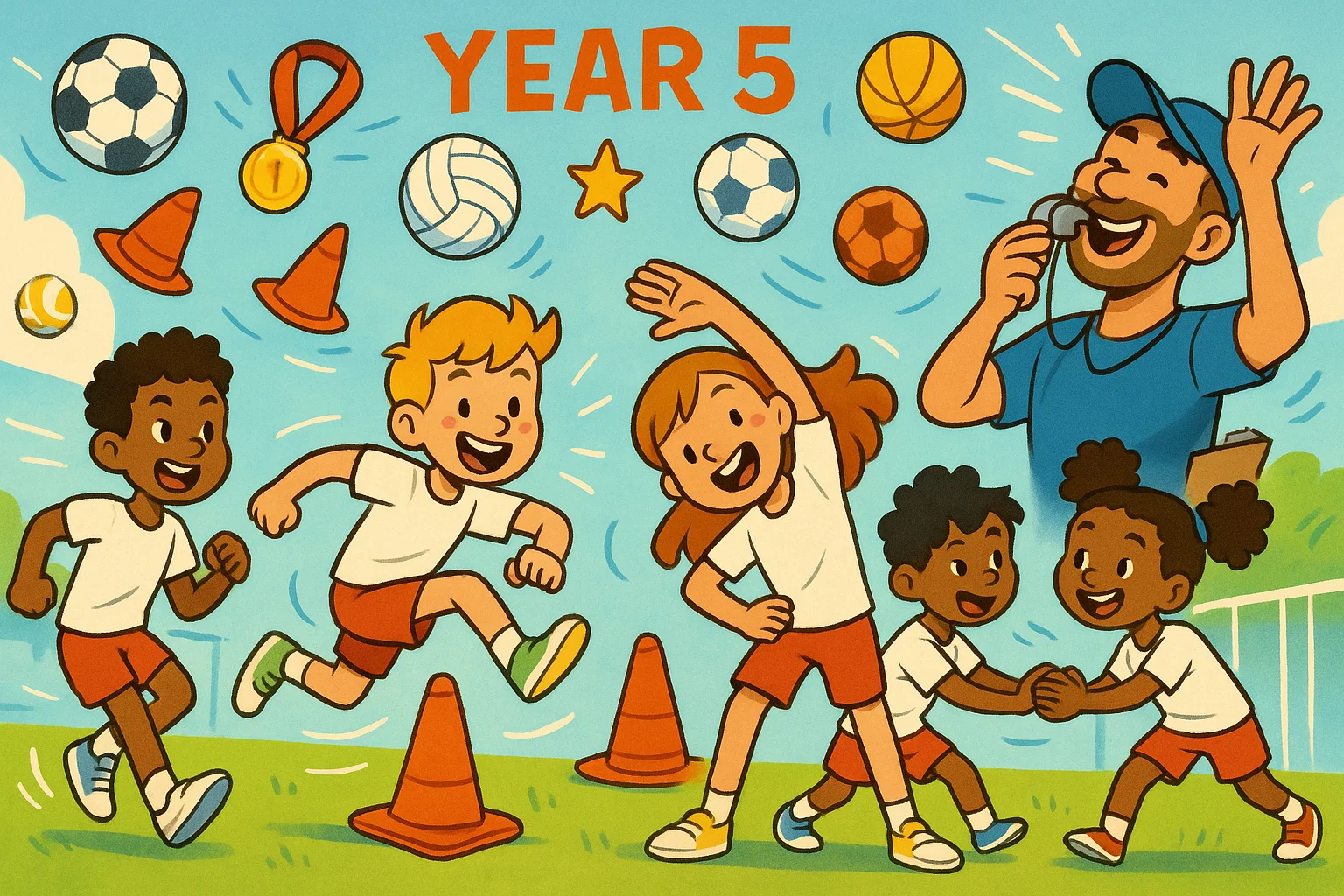
PE goals focus on physical development, coordination, and the ability to work as a team.
Core Sports Skills
Drills are used to enhance specific movement skills.
- Coordination Drills: Developing agility, balance, and coordination through gymnastics and simple athletics events.
- Football and Netball: Practising the specific skills and rules of these popular team games.
Health and Fitness
Understanding the importance of a healthy lifestyle.
- Stamina and Strength: Participating in activities designed to improve cardiovascular fitness.
- Healthy Lifestyle: Learning about the basics of nutrition and the importance of warm-ups and cool-downs.
Team Games
This aspect teaches vital social and emotional lessons.
- Collaboration and Strategy: Developing tactics and working together effectively to achieve a common goal.
- Sportsmanship: Learning to compete respectfully, celebrating success, and handling defeat graciously.
Year 5 Life Skills and PSHE
Personal, Social, Health, and Economic (PSHE) education is fundamental for holistic pupil development, preparing them for secondary school and beyond.
Personal Growth and Confidence
- Resilience: Discussing strategies for managing challenges and bouncing back from setbacks.
- Friendships: Exploring the dynamics of complex social situations and resolving conflicts respectfully.
Health and Safety Topics
- Emotional Wellbeing: Identifying and managing different emotions; understanding the importance of asking for help.
- Safety Rules: Revisiting and applying basic safety rules in different situations.
Citizenship and Values
- Responsibility: Understanding personal and community responsibility.
- Digital Citizenship: Discussing the importance of respect and appropriate behaviour online.
School Types Offering Year 5
The academic environment for Year 5 (grade 5) can vary significantly across the UK school system.
State Primary Schools
- Curriculum Standards: Must follow the National Curriculum and its associated curriculum standards, ensuring a baseline of consistent education.
- Environment: Typically a mixed-ability, inclusive classroom environment with a focus on preparing children for the KS2 SATs in Year 6.
Independent and Boarding Schools
These private schools, often called prep schools (ages 7 to 11 or 13), use the National Curriculum as a base but often go further.
- Curriculum Expansion: May introduce or accelerate second language learning (e.g., French or Spanish), expand arts provision, or increase time spent on maths and science beyond state requirements.
- Focus: Preparation for 11+ or 13+ entrance exams for senior school entry, leading to an academically challenging, faster-paced environment.
International Schools Following British Curriculum
Global schools often follow British-styled programmes like Cambridge Primary or Pearson Edexcel.
- Stage 5: Year 5 is equivalent to Primary Stage 5 in many international frameworks.
- Teaching: The syllabus is similar to the UK National Curriculum but with a global context, providing an overview of British knowledge and skills requirements internationally.
Primary Stage 5 in British Curriculum
For international students, Primary Stage 5 is the formal name for the year 5 academic level.
Subject Structure in Stage 5
- Similarities: The subject structure mirrors the UK National Curriculum, focusing on English reading, writing, math, and science. The syllabus often allows for more cultural adaptations.
Entry Requirements for Online Programmes
Online British schools offer flexible learning for Primary Stage 5.
- Admissions: Typically based on the child’s age (10 and 11 years old) and a review of previous school year reports or a basic diagnostic assessment.
Fees and Study Format
- Study Format: Classes are often delivered via interactive digital classroom environments, with access to online materials, worksheets and recorded lessons.
Year 5 Parent Support Guide
Your role as a parent is to encourage, not pressure, your child during this transitional year.
Homework Expectations
- Volume: Expect a noticeable increase in homework volume and complexity compared to Year 4. This is intentional to build the stamina needed for secondary school.
- Parental Help: Encourage independence, but be available to discuss concepts, especially in problem-solving math exercises or creative writing tasks. Don’t simply provide the answers.
Progress Tracking
- School Reports: Focus on areas for growth as much as achievement. A strong report will detail specific knowledge and skills your pupil needs to consolidate.
- Performance Indicators: Look for consistent performance throughout the year in specific subject areas like grammar and tests in maths.
Resources for Home Learning
- Reading: Encourage reading a wide range of genres; use a physical dictionary to look up new vocabulary.
- Mathematics Tools: Use online interactive math games to practise fluency in times tables and early algebraic reasoning.
- Science Kits: Simple, safe science kits can encourage a love for practical experimentation at home.
FAQs about Year 5 Learning
Key Subjects in Year 5
The key subjects are English language, math, and science, which form the core of the KS2 curriculum. Geography and history are essential foundation subjects that provide broad cultural knowledge.
Difficulty Level of Year 5
Year 5 is often cited as the biggest academic jump in Key Stage 2. The difficulty level increases due to the introduction of advanced concepts (like long division, complex fractions, and relative clauses) and the greater expectations for independence in learning and organisation.
How Schools Support Different Learners
Schools use a variety of strategies to ensure all pupils succeed:
- SEND Support: Individualised lesson plans, small group work with teaching assistants, and adapted classwork and tasks.
- Stretch Challenges: Providing more complex problem-solving tasks in maths and science for high-achieving pupils.
- Small Group Work: Targeted support or enrichment for specific subject areas.
Year 5 Homeschooling Programmes
Families that choose Year 5 homeschooling programmes typically follow the National Curriculum or a commercial syllabus aligned with British standards. They use a range of educational resources to cover every subject and are responsible for all assessment and progress tracking.