

The final stretch of secondary school is here! Year 11 marks the culmination of the two-year journey through the GCSE curriculum and Key Stage 4 education in the UK. This pivotal academic year (typically for students aged 15 to 16) is where all the hard work, from mastering core concepts in Year 10 to refining advanced skills and knowledge, is put to the test. It’s a challenging, rewarding, and often stressful period—but with the right approach and support, it is absolutely manageable.
This guide provides a complete, authoritative overview of what Year 11 students learn, how the GCSE course is structured, the critical steps for successful exam preparation, and the essential resources available. We’ll walk you through the compulsory core subjects like English Language, English Literature, and Maths, the breadth of optional choices, and the crucial transition to sixth form or other post-16 pathways. Our goal is to empower both students and parents with the knowledge and skills necessary to navigate this crucial year with confidence.
Contents: Navigating Your Final Year
This section outlines the structure of this full guide, providing a quick road map to the information you need. Readers can quickly navigate to detailed sections on Year 11 subjects, essential exam techniques, post-16 options choices, and vital support resources.
Navigation Map
This simple map format helps you quickly find the sections relevant to your most pressing questions about the current year 11 curriculum:
- Key Queries Year 11: Quick answers to immediate questions.
- Key Stage 4: Understanding the context of the entire secondary school phase.
- Year 11 Curriculum Overview: The big picture of compulsory and optional subjects.
- GCSE Subjects in Year 11: Detailed subject-by-subject breakdowns.
- Options Choices in Year 11: How GCSE choices impact future pathways.
- Year 11 Exam Preparation: Strategies for successful revision.
- What Happens in Year 11: School life, deadlines, and the post-exam period.
- Year 11 Support and Resources: Tools and services to help you thrive.
- Explore the Topic: Connecting KS4 to earlier and later educational stages.
- FAQs Year 11 UK: Answers to common questions about the final year.
Key Queries Year 11
This section answers the immediate, fundamental questions often asked by students and parents at the start of the GCSE year 11 period:
- What subjects are compulsory? English Language, English Literature, Maths, and Science (either Combined Science or three separate sciences).
- What are GCSEs? General Certificate of Secondary Education—the main qualification taken at the end of year 11 that determines post-16 choices.
- Which exam boards are used? The main boards in the UK are AQA, Edexcel (Pearson Edexcel), and OCR (Oxford, Cambridge and RSA Examinations). Schools choose their board, and it’s essential to know which one your school uses for your subjects.
- How should I prepare for GCSEs? Effective preparation involves a combination of consistent learning, active revision techniques, completing homework, and, critically, practicing past papers.
Key Stage 4: The Context of the GCSE Journey
Key Stage 4 (KS4) covers the last two years of compulsory secondary education in England, Wales, and Northern Ireland. It typically runs from the start of year 10 to the end of year 11, covering the ages of 14 to 16. This stage is fundamentally dedicated to the study and examination of GCSE qualifications.
Year 11 Place in KS4
Year 11 is the final year of KS4 and is the most significant phase. Students transition from learning new content to consolidating, revising, and sitting the high-stakes final gcses examinations. The entire gcse course culminates here, with the majority of external assessment taking place in the summer term. Students in year 11 often find the increase in focused study time and independent learning necessary to meet the demands of the syllabus.
Core KS4 Goals
The learning aims within KS4 are designed to equip students with the skills necessary for success in their next steps. The core goals include:
- Mastery of Core Subjects: Ensuring a strong foundation in English, Maths, and Science.
- Exam Readiness: Developing essential exam techniques, time management, and the ability to recall and apply knowledge and understanding under pressure.
- Development of Analytical and Practical Skills: Encouraging critical thinking, problem-solving, and practical application of learning, particularly in vocational or science subjects.
KS4 Assessments
While assessments are continuous throughout year 10 and 11, the most important evaluations in Year 11 are the terminal assessments.
- GCSE Exams: The primary assessment method for most subjects, taken in the May/June examination period. The gcse grade (on the 9-1 scale) achieved in these subjects determines entry into sixth form or college.
- Coursework and Practical Assessments: Some subjects, particularly in the Arts, Design Technology, and Physical Education, have Non-Exam Assessment (NEA) or controlled assessments completed over the two years that contribute to the final grade.
- Mock Exams: Crucial internal assessments that simulate the real GCSE experience, often held in the Autumn and Spring terms to gauge progress and inform revision strategies.
Year 11 Curriculum Overview
The Year 11 curriculum in UK schools is structured to ensure a broad and balanced education while specializing in subjects chosen for their GCSE qualifications. It is rooted in the national curriculum for key stage 4.
Core Subjects
The core compulsory subjects are the bedrock of the secondary education system and are vital for future educational and career progression.
- English Language & English Literature: Count as two separate GCSEs. They are fundamental for developing communication and analytical skills.
- Mathematics: A well-rounded mathematical education is mandatory, focusing on problem-solving across Number, Algebra, Geometry, and Statistics.
- Science: Students typically take either Combined Science (worth two GCSEs) or the three Separate Sciences (Biology, Chemistry, and Physics, worth three GCSEs).
- Non-GCSE Core: Physical Education (PE) and PSHE, which includes Relationships and Sex Education (RSE)
Optional Subjects
Students carry forward their optional choices made in year 9 or year 10. These subjects allow students to tailor their education to their interests and career paths. Typical options fall into the following pillars, which relate to the English Baccalaureate (EBacc) measure:
| Pillar | Example Subjects | GCSE Count |
| Humanities | Geography, History, Religious Studies | 1 |
| Languages | French, Spanish, German (students are encouraged to study a language) | 1 |
| Creative/Tech | Art, Drama, Music, Computer Science, Design Technology | 1-2 |
| Vocational | Business Studies, Health & Social Care, Enterprise | 1 (or equivalent) |
Curriculum Variations Across Schools
While the core curriculum remains consistent across England due to the National Curriculum, the specifics can vary:
- Academy and Independent Schools: While they mostly follow the GCSE model, some may offer IGCSE (International GCSE) qualifications, particularly in subjects like English, Maths, and Sciences.
- School-Directed Courses (SDC): Schools may allocate curriculum time to areas such as Careers Education, Citizenship, and targeted independent learning, beyond the formal GCSE structure.
- Exam Board Choice: A school’s choice of exam board (AQA, Edexcel, OCR) influences the specific texts, question styles, and assessment structure, though the core knowledge and skills tested are the same.
GCSE Subjects in Year 11: A Deep Dive
In Year 11, the focus shifts from initial content acquisition to application, analysis, and intensive revision across all subjects.
English Language
The GCSE English Language course is designed to prepare students for the demands of the real world and further study.
- Reading Skills: Analysis of unseen texts from the 19th, 20th, and 21st centuries. Students must identify explicit and implicit information and analyze how writers use language and structure to achieve effects.
- Writing Tasks: Students must demonstrate the ability to write effectively and coherently for different purposes and audiences (e.g., narrative, descriptive, persuasive articles, speeches), with an emphasis on accurate spelling, punctuation, and grammar.
- Speaking and Listening: Assessed separately (often Pass, Merit, Distinction) and does not contribute to the final gcse grade, but is a mandatory component.
English Literature
GCSE English Literature requires the in-depth study of set texts, which varies by exam board but typically includes:
- Shakespeare Play: Often Macbeth or Romeo and Juliet.
- 19th-Century Novel: Such as A Christmas Carol or Jekyll and Hyde.
- Modern Text: A play (e.g., An Inspector Calls) or prose fiction.
- Poetry: An anthology of themed poems (e.g., Power and Conflict) and an unseen poetry section. All literature exams are usually closed-book, meaning students must recall key quotations and plot points.
Mathematics
The Maths syllabus is broad and covers essential domains at either Foundation (grades 1-5) or Higher (grades 4-9) tier. The goal is a well-rounded mathematical education.
| Domain | Key Year 11 Focus Areas |
| Number | Standard form, upper and lower bounds, surds, and advanced arithmetic. |
| Algebra | Solving quadratic and simultaneous equations (including graphical), algebraic fractions, function notation, and geometric arguments. |
| Ratio & Proportion | Direct and inverse proportion, compound measures, and geometric similarity. |
| Geometry | Pythagoras’ theorem and trigonometry (SOHCAHTOA), circle theorems, and vectors. |
| Statistics | Data representation (histograms), measures of central tendency, and probability. |
Assessment typically involves three papers: one non-calculator paper and two calculator papers.
Science (Combined or Separate)
Students either complete Combined Science (two GCSEs) or the three Separate Sciences (Biology, Chemistry, Physics—three GCSEs).
- Biology: Focuses on systems like the human body (e.g., body systems, health issues and related societal impacts), ecology, and genetics.
- Chemistry: Covers atomic structure, bonding, quantitative chemistry, and organic chemistry.
- Physics: Includes forces, electricity, waves, and particle physics.
All courses incorporate compulsory practical assessments that are tested within the written exams, demanding strong knowledge and understanding of scientific methodologies.
Humanities
These subjects develop students’ analytical, research, and essay-writing skills and knowledge.
- Geography: Core topics often include global hazards, urban issues, human and physical geography interactions, and fieldwork skills.
- History: Modules commonly cover topics like Crime and Punishment through time, Cold War, or conflict in the Middle East.
Modern Foreign Languages
To study a language is a core component of the English Baccalaureate. The GCSE course assesses four main skills:
- Listening
- Reading
- Writing (includes translating sentences)
- Speaking (often an individual or small group assessment with the teacher, recorded and submitted to the exam board).
Arts and Creative Subjects
GCSE Arts (Art & Design, Drama, Music, Photography) and Design Technology place significant weight on coursework and practical performance.
- Coursework Weight: Often accounts for 60% of the final gcse grade in subjects like Art, requiring the creation of a portfolio across year 10 and 11.
- Exams: The remaining portion is typically an external practical examination or a written paper testing critical analysis or theory.
Physical Education
GCSE Physical Education is a challenging blend of practical skills and theory.
- Theory: Covers anatomy, physiology, psychological factors affecting performance, and health and economic implications of lifestyle choices (e.g., body systems, data analysis, and well-being).
- Practical Performance: Requires assessment in three different sports/activities, often filmed and moderated externally.
Religious Studies
The Religious Studies GCSE can be taken as a full or short course. It focuses on ethical debates and comparative religion.
- Themes: Typically covers philosophical and ethical themes (e.g., peace and conflict, human rights).
- Comparative Religion: Requires detailed knowledge of the beliefs and practices of two or more religions.
Options Choices in Year 11: Planning Your Future Path
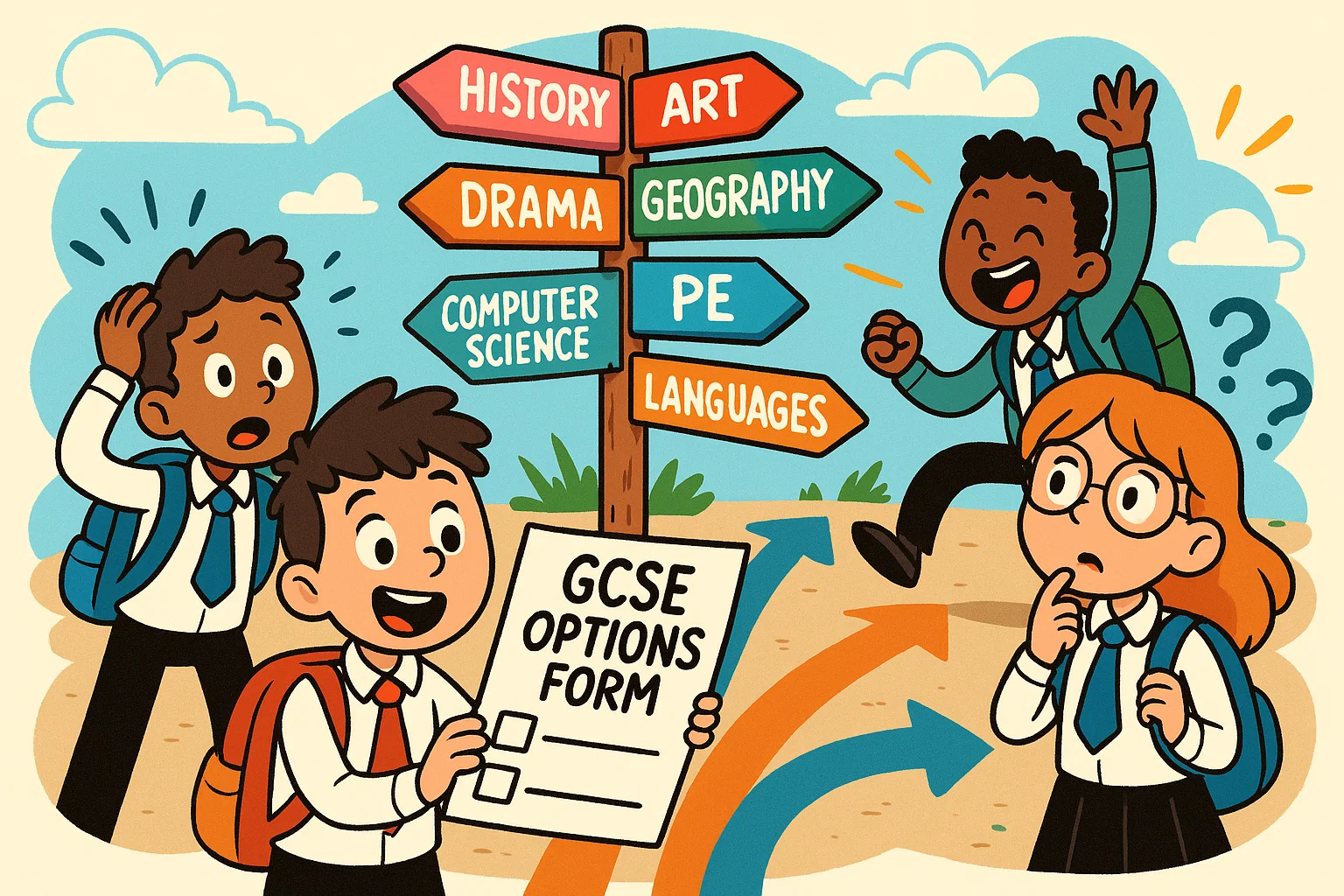
Although the initial subject selections were made in Year 9 or Year 10, Year 11 is the point where students make the concrete decisions about their future, as their GCSE results will open or close doors to post-16 opportunities.
Subject Selection Strategy
The best strategy for students in year 11 is to choose subjects not just based on enjoyment, but on how they align with their long-term education or career goals.
- Strengths & Ambitions: Encourage students to identify subjects where they consistently achieve a high gcse grade and which are pre-requisites for their next steps. For example, aspiring engineers need strong Maths and Physics grades.
- The EBacc: Students are strongly encouraged to achieve the English Baccalaureate (EBacc), which requires a GCSE in English Language, English Literature, Maths, Science, a Humanities subject (History or Geography), and a language. Data suggests students who achieve the EBacc have better post-16 progression.
- Tutor & Teacher Advice: The support from teachers and form tutors is invaluable here. They can offer an objective perspective on a student’s potential in a subject.
Entry Requirements for Sixth Form
One of the most immediate concerns for Year 11 students is securing a place in their preferred sixth form or college.
- General Entry: Most post-16 institutions require a minimum number of passes (Grade 4 or 5) across all GCSEs, including GCSE English and Maths.
- A-Level/BTEC Requirements: Individual A-Level or BTEC courses will have specific gcse grade requirements, often a Grade 6 or 7 in the related subject. For example, a student may need a Grade 7 in GCSE Maths to study Maths or Further Maths at A-Level.
| Post-16 Option | Typical General Requirements | Typical Subject-Specific Requirement |
| A-Levels | Minimum five Grade 4s/5s including English & Maths. | Grade 6 or 7 in the specific subject (e.g., Grade 7 in GCSE Math to study a language at A-Level). |
| Level 3 BTECs | Minimum five Grade 4s, including English and/or Maths. | Grade 4 or Merit in a relevant GCSE or vocational qualification. |
| Apprenticeships | Varies, but often Grade 4 in English and Maths. | Relevant GCSEs or vocational qualifications to the trade/sector. |
Year 11 Exam Preparation: Strategies for Success
Effective exam preparation in the final year is about more than just reading notes; it’s about active learning, strategic revision, and building confidence.
Mock Exams Role
Mock exams are a critical rehearsal for the real thing. Held throughout the year, they serve several functions:
- Progress Check: They help students and teachers gauge their current knowledge and understanding and predict their final gcse grade potential.
- Gap Identification: Results highlight areas that require more revision—the ‘knowledge gaps’—allowing for focused study.
- Exam Practice: They provide vital practice in adhering to the time constraints and following the instructions of the official past paper formats.
Revision Techniques
To prepare for their GCSE, students need to employ active revision techniques, moving beyond simply highlighting notes (passive).
- Active Recall (Knowledge Quizzing): The act of retrieving information from memory, such as using flashcards (term on one side, definition on the other) or ‘look, cover, write, check’.
- Spaced Repetition: Revisiting topics in increasing time intervals to solidify memory. This is proven to be one of the most effective ways to make knowledge stick long-term.
- Practicing Past Papers: This is the ultimate form of active revision. Students should complete full past paper exams under timed conditions, using the exam board’s mark scheme to understand how points are awarded and refine their exam techniques.
- Manage time effectively: Creating a realistic and structured revision timetable that includes breaks and downtime is key to maintaining a balanced routine and avoiding burnout in this crucial year.
Exam Boards Differences
Students must be thoroughly familiar with their specific exam board—AQA, Edexcel, or OCR—as they influence the presentation and style of questions. While all boards follow the same national curriculum for content, there are differences:
- Question Style: Edexcel is often known for more multi-step problem-solving questions in Maths, while AQA can be more structured and straightforward. OCR is sometimes lauded for its rigorous assessments that test deep application of knowledge and understanding.
- Paper Structure: The number of marks per paper and the order of non-calculator vs. calculator papers can vary, making it essential to practicing past papers specific to the correct board.
What Happens in Year 11: School Life and Transitions
School life in Year 11 is distinctly different from Key Stage 3 (year 9) or even Year 10 due to the intense focus on examination results and future planning.
Weekly Timetable
A typical Year 11 timetable will be heavily weighted toward the GCSE subjects.
| Component | Approximate Weekly Hours (Example) | Description |
| Core Subjects (English, Maths, Science) | 12-15 hours | Focused time on content consolidation and past paper practice. |
| Optional Subjects (e.g., Geography, Art) | 8-10 hours | Continued development of final coursework and core topic revision. |
| Non-GCSE (PE, PSHE, Form Time) | 2-3 hours | Essential time for personal growth, well-being, and career guidance. |
| Supervised Revision/Study | 2-4 hours | Dedicated time for individual or small-group revision with support from teachers. |
Coursework and Practical Tasks
The beginning of Year 11 is often characterized by the final push for coursework submission. For subjects with a significant Non-Exam Assessment (NEA) component (e.g., Design Technology, Art, or Drama), meeting the specified deadlines is paramount as this work can account for up to 60% of the final gcse grade. A failure to submit on time can lead to a significant impact on the overall result.
Post-Exam Period
The period following the final May/June exams can feel strange. This time, before the official end of year 11, is crucial for the transition to post-16 life. Activities often include:
- Taster Days: Opportunities to attend sixth form or college to experience A-Level or BTEC teaching styles.
- Career Guidance: Focused sessions on CV writing, interview skills, and exploring different future educational and career paths.
- Work Experience: Short, meaningful placements that allow students to explore areas of interest and apply skills and knowledge in real-world settings.
- Preparation for Sixth Form: Reading lists, introductory tasks, and bridging work for their chosen post-16 courses to ensure a smooth transition.
Year 11 Support and Resources
Students and parents should leverage the wealth of resources available to help them maintain a balanced approach and succeed.
Online Learning Tools
The modern student benefits from a huge range of high-quality online tools:
- BBC Bitesize: An excellent, free resource covering all major GCSE specifications with revision notes, video clips, and quizzes.
- Exam Board Websites: The official AQA, Edexcel, and OCR websites contain all the official specifications, mark schemes, and past paper archives—the gold standard for revision.
- Tutor Platforms: Online platforms can provide targeted, subject-specific support from an experienced tutor to address particular learning gaps.
School Support Services
Support from teachers and pastoral staff is the most reliable resource.
- Teachers: Offer subject-specific clinics, after-school revision sessions, and personalized feedback on homework and mock exams.
- Pastoral and PSHE: Dedicated time for PSHE and form time focuses on well-being, stress management, and making informed decisions about their future, ensuring students have the emotional resilience needed.
- SEN Support: Students with Special Educational Needs (SEN) or temporary barriers (e.g., injuries) can access tailored support and possible exam access arrangements (e.g., extra time, rest breaks).
Useful Links
- National Curriculum Pages: For detailed subject specifications, searchable via GOV.UK.
- Exam Board Specifications: Essential documents detailing exactly what content will be assessed for each subject.
Explore the Topic
Succeeding in Year 11 is about seeing it as part of a larger educational journey.
Guides for KS3–KS5
Understanding the progression from Key Stage 3 (year 9) through KS4 (year 10 and 11) to KS5 (post-16, including sixth form) provides vital context. Year 11 builds directly on the foundational skills and knowledge acquired during KS3 and is designed to prepare students for the academic rigour of A-Levels, BTECs, or apprenticeships.
Subject-Specific Guides
For detailed roadmaps for each GCSE subject, look for guides provided by the major exam boards. These resources break down the syllabus into manageable chunks, helping students and tutors plan a structured revision timeline.
Further Education Pathways
The results achieved at the end of year 11 are the currency for post-16 choices:
- A-Levels: Academic qualifications, typically studied over two years, typically required for university entry.
- BTECs and T-Levels: Technical and vocational qualifications offering a practical route to higher education or skilled employment.
- Apprenticeships: Combining work with study, a direct path into a career while earning a wage.