


Have you ever wondered why the Earth feels solid beneath your feet, yet mountains continue to grow and volcanoes occasionally roar to life? To a child, the ground seems like a permanent, unmoving giant. However, underneath our houses and parks, the world is actually a giant, slow-motion puzzle. Teaching complex earth science concepts like the theory of plate tectonics can feel daunting, but the best way to bridge the gap between abstract geological theories and a child’s curiosity is through hands-on play.
This science experiment is designed for budding geologists aged 6 to 12. By using tactile models—often involving edible treats—we can transform a dense lesson into an unforgettable afternoon of discovery. Our goal is to visualize how the Earth’s crust is broken into several segments that move over the mantle, creating the world as we know it. Whether you are a parent looking for a rainy-day activity or a teacher seeking a worksheet alternative, these science activities provide a “front-row seat” to the movement of tectonic plates.
Tectonic Plate Theory Basics
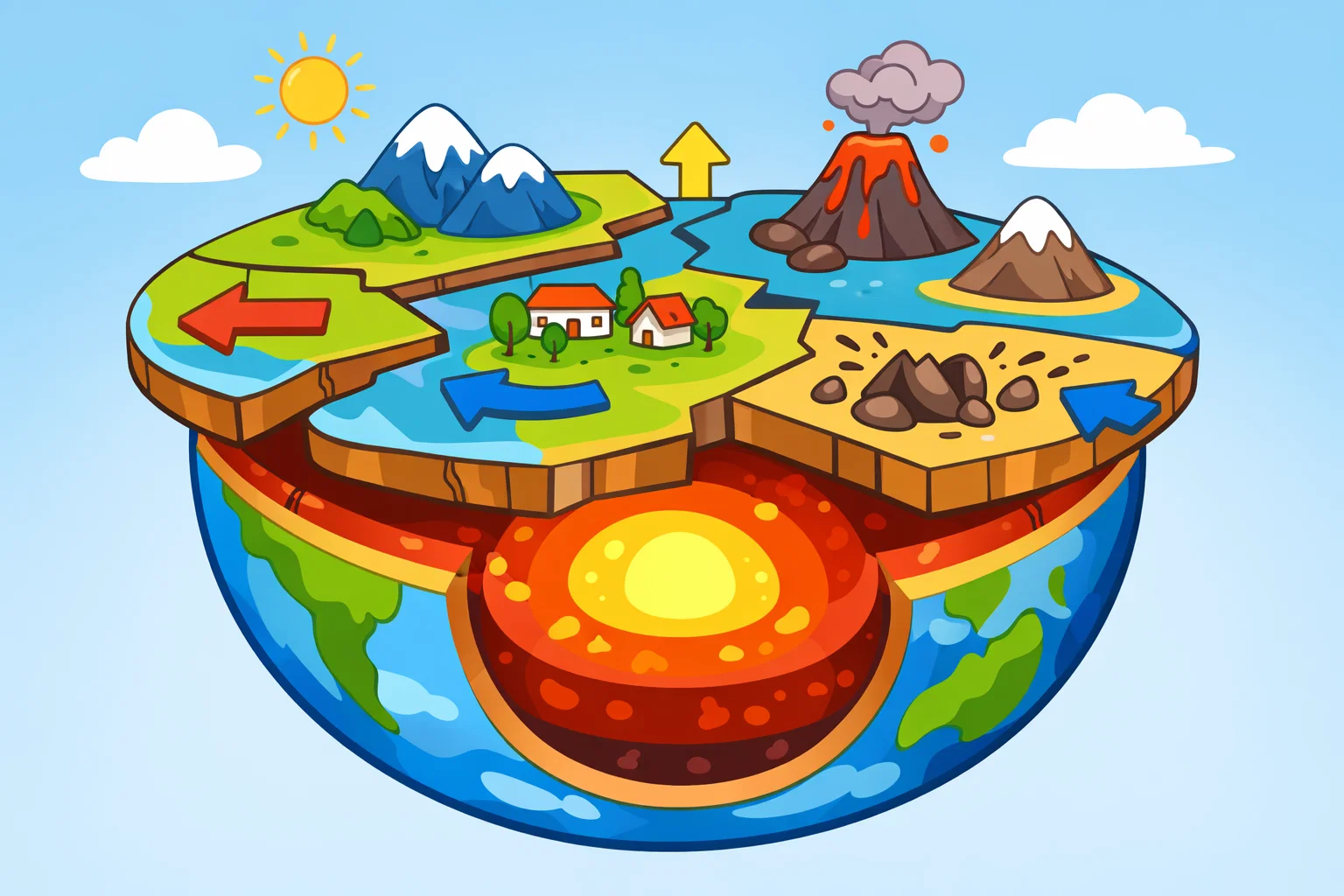
Understanding the Earth’s behavior requires us to look deep beneath the surface. For a long time, people believed the continents were fixed in place, but modern science has revealed a planet that is vibrant, shifting, and restless. This section covers the fundamental principles that explain why our world looks the way it does.
Earth’s crust and moving plates
The outermost layer of our planet is called the crust. This isn’t just one continuous skin; it is made of several large and small sections. These massive slabs sit on top of the semi-fluid asthenosphere, a part of the upper mantle.
In 1912, a scientist named Alfred Wegener noticed that the continents looked like they could fit together like puzzle pieces. He proposed that they were once a single supercontinent. While he didn’t know exactly how they moved at the time, we now know it’s because the earth’s interior is constantly moving. Because the layer beneath is incredibly hot, the molten rock inside moves in circles called convection currents. This process acts like a conveyor belt, causing these massive geological segments to shift slowly over long periods of time.
Effects of Plate Movement on the Earth’s Surface
When these massive slabs of solid rock interact, they don’t do so quietly. The energy released at the boundaries of these segments is responsible for the most dramatic features of our landscape. Depending on how two plates meet, different events occur:
- Mountain ranges form when landmasses collide, the pressure forces the earth upward.
- Volcanoes: When sections pull apart or one slides under another, allowing magma to escape to the surface.
- Earthquakes: When the edges of these massive blocks grind past each other and suddenly “slip,” releasing waves of energy.
Why models help explain plate motion
Young learners often struggle with “deep time”—the idea that things happen over millions of years. Hands-on science experiments for kids use physical objects to speed up this process and make the invisible visible.
- Visual Learning: Seeing ‘new crust’ form in a bowl of whipped cream makes the concept of seafloor spreading stick far better than a textbook diagram.
- Tactile Engagement: Breaking a graham cracker to represent a destructive plate boundary provides a sensory memory of how rocks snap under pressure.
- Cause and Effect: Kids can see exactly why a trench forms when one piece is denser than another, allowing them to predict future geological changes.
Types of Tectonic Plate Boundaries
Geologists categorize the meeting points of tectonic plates into three main types. Each type of interaction creates a specific set of “symptoms”—from deep ocean valleys to massive mountain peaks. By understanding these boundaries, kids can look at a map and predict where the next big volcano might appear.
Divergent plate boundary model
At divergent boundaries, the plates of the Earth’s crust are moving apart. Imagine the Earth’s shell stretching until it tears. As they separate, melted rock (magma) rises from the mantle to fill the gap, cooling to create a new crust. This most often happens on the ocean floor, a process known as seafloor spreading. In our model, we can show this by pulling two materials apart and watching the “magma” rise between the oceanic segments, forming an undersea ridge like the Mid-Atlantic Ridge.
Convergent plate boundary model
A convergent plate boundary is where the action gets intense and often “destructive.” When a thin oceanic crust meets a thick continental crust, the thinner one is pushed down into the mantle in a subduction zone. This creates deep ocean trenches. If two pieces of continental land hit each other, they don’t sink; instead, they crumple and are forced upward. This is exactly how a mountain range like the Himalayas is born—it’s a slow-motion car crash of continents!
Transform plate boundary model
At a transform zone, the slabs aren’t crashing or fleeing; they are side-swiping. However, rocks are jagged, so they don’t slide smoothly. They get stuck and “lock” together. Tension builds up over years until—SNAP—the earth jerks forward. This type of tectonic motion is a major cause of earthquakes. The San Andreas Fault in California is the most famous example of this “sideways” grind.
Hands-On Tectonic Plates Model Activities
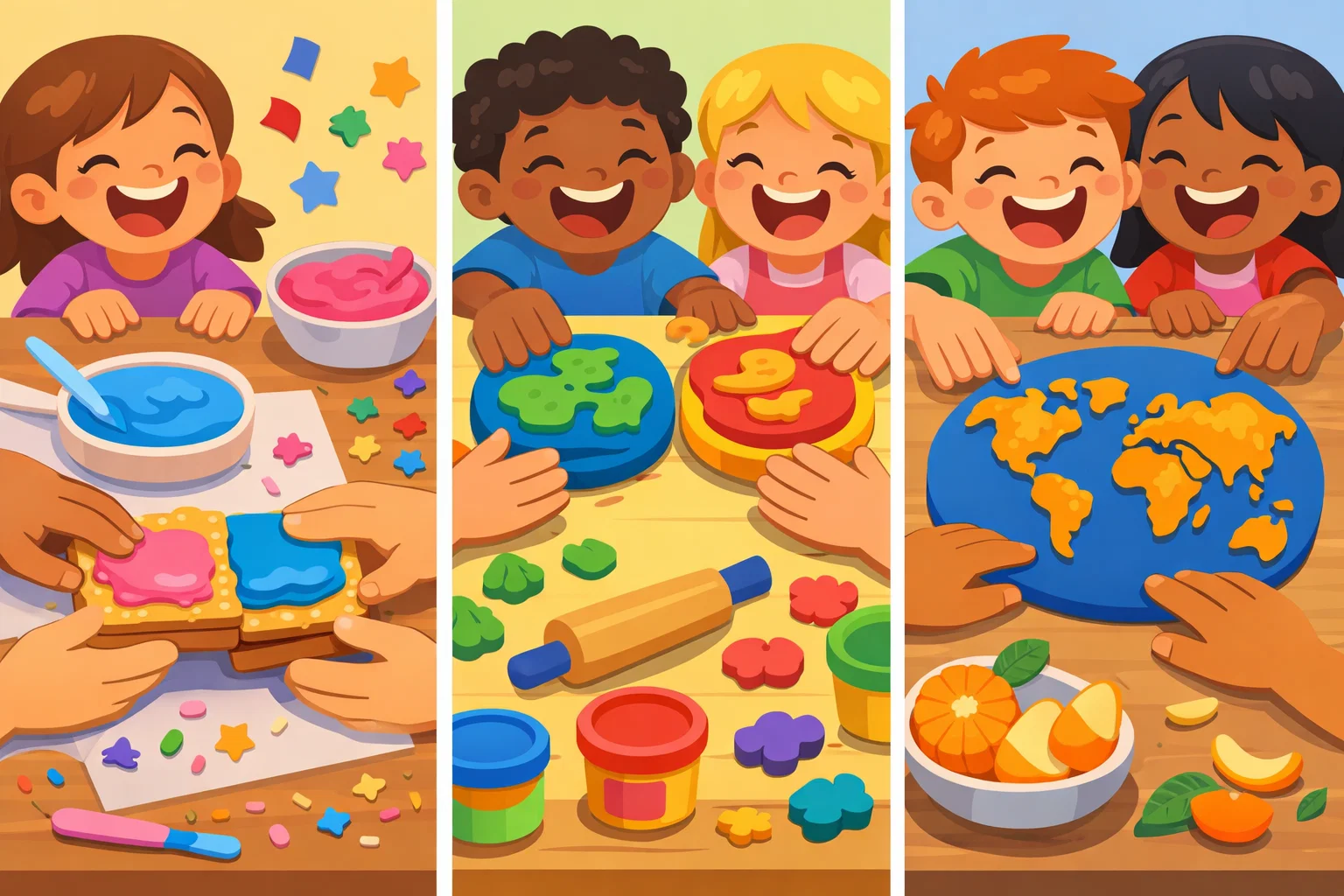
Turning theory into practice is where the real learning happens. These activities are designed to be mess-friendly and highly engaging, using everyday items to represent the massive forces of our planet.
Edible tectonic plates model experiment
This is the gold standard of edible science because it perfectly mimics the textures of the Earth.
- The “Mantle”: Use a layer of whipped cream, frosting, or even peanut butter on a flat plate. This represents the gooey, semi-liquid layer.
- The “Plates”: Use graham crackers to represent the continental crust (thicker and less dense) and fruit leather for the oceanic parts (thin and denser).
- The Experiment: Place your pieces on the “mantle” and simulate the three movements. You’ll see the “magma” ooze up during divergence and the crackers crumble during collision. It’s a delicious way to visualize geology.
Orange peel tectonic plates model
The Earth is a sphere, which makes a round orange the perfect 3D model.
- Carefully peel an orange, trying to keep the pieces large and intact.
- The peel represents the earth’s crust, and the fruit inside is the mantle beneath the crust.
- Have your child try to rearrange the pieces back on the orange using toothpicks to hold them.
- Notice the gaps and overlaps—this mimics how the lithospheric blocks cover the globe like a giant, cracked puzzle. It helps kids realize that when one section moves, it affects all the others.
Playdough tectonic plates model
For a non-edible version, playdough is excellent for showing mountain building and layers.
- Layer two or three different colors of dough to represent different rock strata.
- Place the layers on a flat surface and push them together from opposite sides.
- You will see the material fold upward and “buckle,” perfectly illustrating how mountains are formed through immense pressure. You can also use a knife to cut a “fault line” and show how the layers shift during an earthquake.
Materials Needed for Plate Tectonics Experiment
To ensure a successful science activity session, gather your supplies beforehand. Having everything ready prevents the “wait time” that can lead to lost interest.
Household materials list
Most of these items are already in your pantry.
- Graham crackers (2-4 sheets) for the rigid blocks.
- A tub of cool whip, frosting, or peanut butter for the mantle.
- A flat tray or large plate to contain the mess.
- Fruit leather or thin chocolate for the undersea sections.
- A small cup of water (used to soften the cracker edges for subduction).
Classroom-safe alternatives
If you are working in a school or have food allergies, these materials work just as well:
- Sponges: Excellent for showing compression and tectonic force; they bounce back, showing how some rocks store energy.
- Cardboard: Use corrugated pieces to represent the rigid lithosphere.
- Shaving Cream: A messier but very effective substitute for the semi-liquid interior. It’s easy to clean up and very “reactive.”
Optional tools for demonstration
Enhance the lesson with these visual aids:
- Printable maps of the major world segments so kids can name their pieces (e.g., “The Pacific Block”).
- A worksheet to record observations during the science experiment (What did you see? What did you feel?).
- Small labels or toothpicks to mark the names of the boundaries (Divergent, Convergent, Transform).
Step-by-Step Instructions for Model Experiment

Let’s walk through the edible plate tectonics model. This process follows the scientific method, encouraging kids to observe first and conclude later.
1. Preparing tectonic plate pieces
Begin by spreading a thick layer (about 1 inch) of whipped cream onto your tray. This represents the asthenosphere—the hot, weak upper part of the mantle that allows the lithospheric sections to slide. Break your graham crackers into two large rectangles. If you’re using fruit leather for the oceanic part, cut it into a smaller, thinner strip.
2. Simulating plate movement
- Divergent: Place two crackers side-by-side on the cream. Slowly move away from each other. Observe how the “magma” (cream) fills the rift, just like at the Mid-Atlantic Ridge.
- Convergent: Dip the end of one cracker in water for 5 seconds to soften it. Push it against a dry cracker. The wet one should slide under (subduction) or the two will crumble together to form a ridge.
- Transform: Place two dry crackers side-by-side and make the plates slide past each other horizontally. Notice how they catch and then move in a “jerky” fashion, which causes earthquakes.
3. Observing results and changes
Encourage your “mini-scientists” to look closely at the edges of their crackers. Are they breaking? Is the “mantle” oozing out? Ask: “What happens when the plates move towards each other?” or “Why did the wet cracker go underneath?” This is where the scientific theory becomes a visible, tangible reality.
Plate Boundary Examples Using Models
Connecting the model to the real world helps children understand the scale of these events. The Earth is a giant laboratory, and our kitchen model is just a small window into its power.
Mountain building example
When we push our continental crust (graham crackers) together without softening them, they buckle. This represents the “folding” of solid rock. The Himalayan Mountains, including Mount Everest, were formed this way when the Indian landmass crashed into the Eurasian one. It is a process that has been happening for millions of years and continues today!
Rift and seafloor spreading example
When you pull your crackers apart, the gap reveals the mantle underneath. In the real world, this happens at the Mid-Atlantic Ridge. As the ocean floor pulls apart, melted rock cools and becomes a new crust. The Atlantic Ocean is actually getting a few centimeters wider every year!
Earthquake motion example
The “stick-slip” motion you feel when sliding crackers past each other is exactly what happens at the San Andreas Fault in California. Because the rocks are jagged, they don’t slide smoothly. They build up energy for decades until they suddenly release it, causing earthquakes (and indirectly influencing volcanic activity in some regions).
Science Explanation Behind Model Experiment
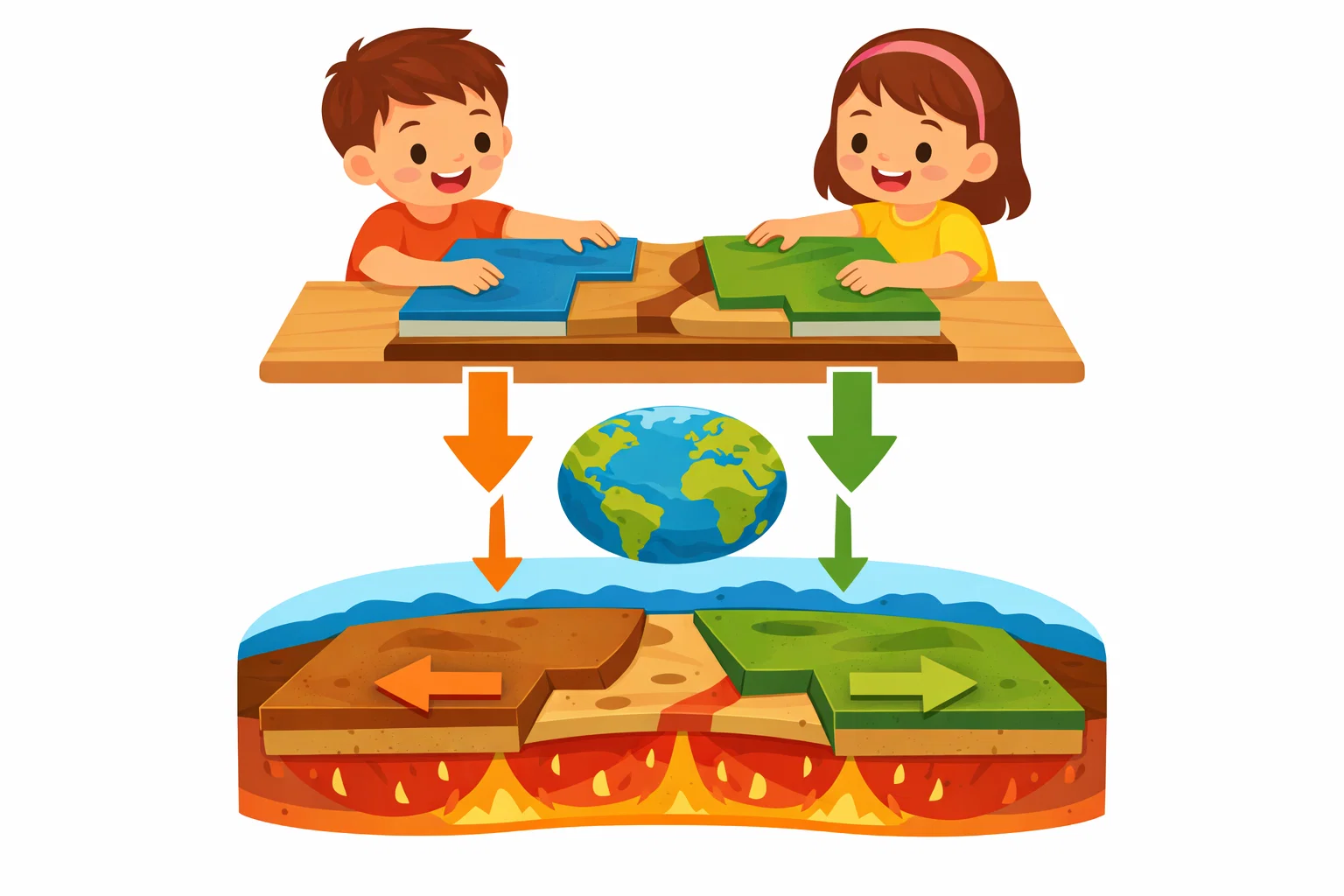
Why does this work? It’s all about physics and heat. The Earth’s interior is a high-pressure environment that behaves differently than the world we see on top.
How model matches real plate motion
While graham crackers aren’t solid rock, their brittleness mimics the earth’s outer shell. The whipped cream acts like the semi-liquid layer—it’s solid enough to hold the weight above but fluid enough to allow tectonic motion. The water we use to soften the crackers mimics how heat and pressure make rocks more “plastic” or flexible deep underground.
Limitations of simple models
It is important to clarify a few things for kids to maintain geological accuracy:
- Speed: The model happens in seconds; the real Earth takes millions of years.
- Heat: Our model is cold, but the real earth’s mantle is scorching hot due to radioactive decay in the core.
- Scale: The Earth’s blocks are miles thick, whereas our crackers are just millimeters.
Vocabulary terms for kids
- Lithosphere: The rigid outer part of the earth, consisting of the crust and upper mantle.
- Subduction: The downward movement of one tectonic plate beneath another.
- Trench: A long, narrow, deep depression in the ocean floor.
Extra Challenges and Experiment Variations
Once the basic concepts are mastered, it’s time to experiment with variables. This is where true scientific inquiry begins.
Changing materials for different results
What happens if you use edible materials with different textures? Try using a fruit roll-up as an oceanic section and a graham cracker as a continental block. Because the fruit leather is denser, it will almost always undergo subduction. This teaches kids about density and why the ocean floor is usually recycled back into the Earth while continents stay on top.
Combining volcano or earthquake models
Try placing a small “mountain” of whipped cream over a divergent boundary. As you pull the crackers apart, watch the “volcano” collapse or grow. You can also place small LEGO houses on your crackers and see which type of movement (divergent, convergent, or transform) causes the most “damage” to the structures.
Predicting outcomes before movement
Before you move the pieces, ask your child to make a hypothesis. “If I push these two pieces together as hard as I can, what will happen to the middle?” Encouraging them to predict outcomes before the science activities start builds critical thinking skills used by real geologists.
Free Exploration and Open-Ended Play
Science shouldn’t always be scripted. Allowing for free play allows children to discover “happy accidents” in their models that might lead to deeper questions.
Letting kids design own plate models
After following the instructions, give the kids extra materials like marshmallows or gummy worms. Let them see if they can build a volcano or a bridge that survives an “earthquake.” They might find that some materials represent the earth’s crust better than others.
Asking observation questions
To guide the discussion, try these prompts:
- “Why do you think the oceanic crust usually sinks?”
- “What happens to the magma when it reaches the surface?”
- “If we look at a map, where else might we see mountains forming?”
- “Can you find where we live on a tectonic map? Are we near a boundary?”
Learning Extensions and Book Connections
Combining a science experiment with literature creates a “full-brain” learning experience. Here are some ways to keep the momentum going.
Children’s Books About Plate Tectonics
- The Magic School Bus On the Ocean Floor by Joanna Cole: A fantastic look at the undersea world.
- Earth: Feeling the Heat by Brenda Walpole: Focuses on the heat that drives tectonic motion.
- National Geographic Kids: Everything Rocks and Minerals: Great for identifying the solid rock types found at boundaries.
Reading and science integration ideas
After the experiment, have your child draw a “comic strip” of a tectonic block’s journey over millions of years. This combines literacy with the earth science they just practiced. You can also try an edible rock cycle activity later to show how rocks change from one type to another.
More Earth Science Experiments for Kids
If your child is now a fan of geology, there are many other related projects to explore the layers of the earth and its history.
Rock cycle model activities
Explore how heat and pressure turn sedimentary rocks into metamorphic ones using Starburst candies. Melt them slightly to show how melted rock cools into igneous formations.
Volcano and earthquake demonstrations
Build a classic baking soda volcano to show what happens when magma escapes through the crust. Alternatively, build an “earthquake shake table” out of cardboard and rubber bands to test building stability.
Geography and Earth layers projects
Create a “Playdough Earth” with a core, mantle, and crust to show the scale of the different layers. Use a printable chart to label the depths and temperatures of each section.