

Helping a child master the intricacies of written language is a journey that moves far beyond the traditional Friday morning assessment. For many students, a simple list of words can feel overwhelming or tedious if the only strategy offered is “look, cover, write, check.” Many educators and parents notice that the most effective way to improve literacy is one that engages multiple senses—combining sight, sound, and touch to help the brain encode spelling patterns more deeply.
Whether you are a teacher looking for fresh ideas for teaching or a parent trying to make spelling practice more enjoyable at home, the goal is the same: to move from rote memorization to true mastery. Fun spelling activities can help reduce anxiety often associated with spelling mistakes and instead foster a sense of curiosity about how English words are built. This guide explores a wide range of hands-on spelling activities, digital tools, and movement-based games designed to help children spell words correctly and with confidence.
Spelling Activity Ideas
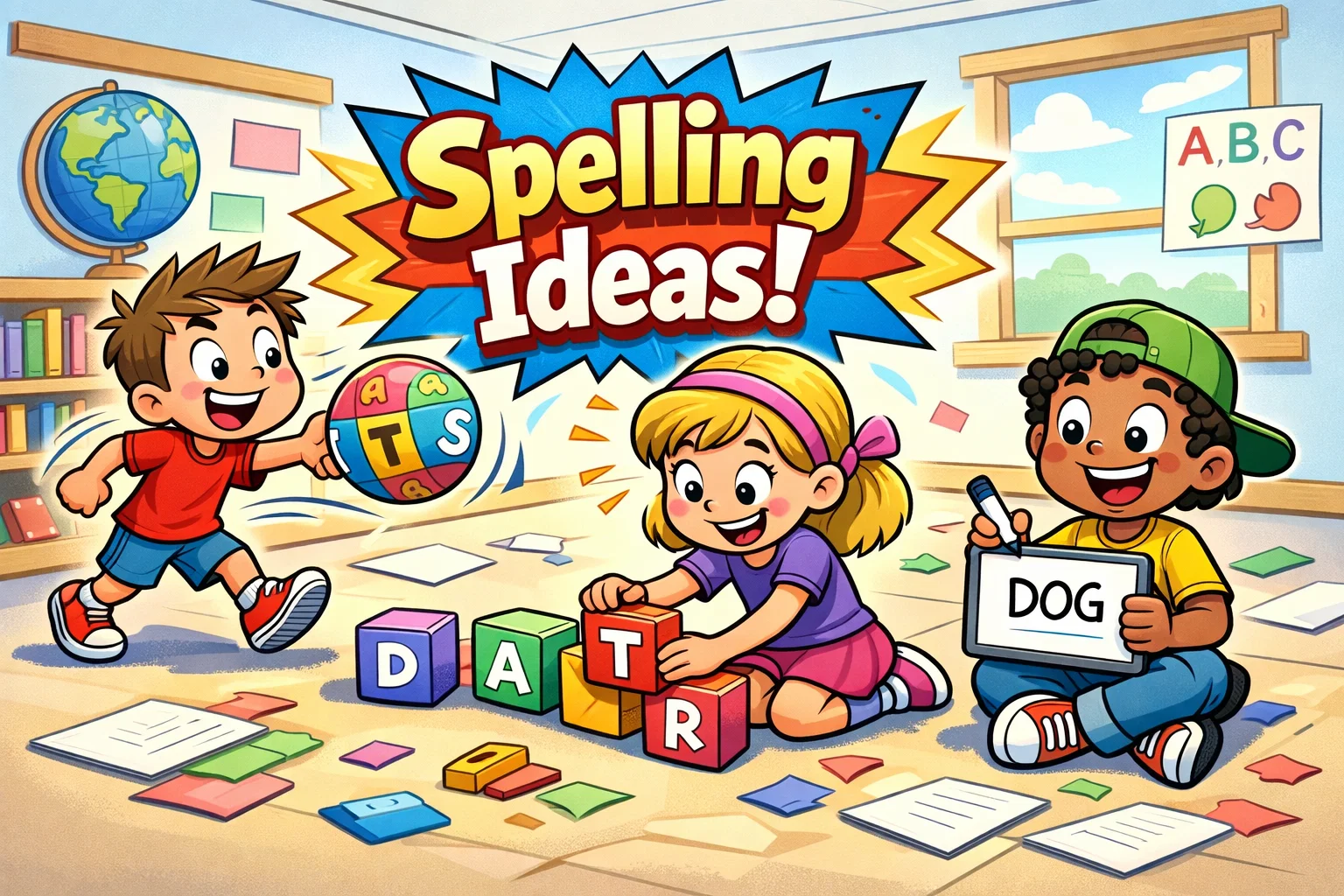
When we make learning interactive, children are more likely to stay focused. Diversifying your vocabulary training ensures that you reach visual, auditory, and kinesthetic learners alike. Instead of just asking a child to write each word ten times, try these engaging methods to improve their orthography.
Wordketball
This is a high-energy spelling game perfect for the classroom or a driveway. Students are divided into teams. To earn a “shot” at the hoop (or a laundry basket), a student must provide the correct spelling of a term. If they get the specific spelling right, they take a shot for extra points. This builds teamwork and associates academic work with physical achievement.
Vocab Bingo
A classic for a reason! Create bingo cards using a child’s spelling list. The teacher or parent calls out a definition or a phonics clue (e.g., “This word has a silent ‘e’ at the end”), and the child must identify and mark the word aloud. This encourages them to recognize different letter arrangements visually without feeling like they are back in a lecture.
Celebrity heads with words
In this version of the popular guessing game, a student wears a headband with a sight word attached to it. They must ask their peers questions to figure out which term is on their head. Questions might include, “Does my word start with a consonant?” or “Does it have five letters?” This encourages children to think about the anatomy of a term rather than just memorizing it.
Roll, say and add
Using a pair of dice, children roll to determine how they will tackle their practice spelling. Each number corresponds to a task:
- Read the word aloud.
- Write each letter in a different color.
- Use alphabet blocks to build it.
- Write the word with your non-dominant hand.
- Identify the individual sounds in the word.
- Add one letter at a time until the word is complete.
Word work grids
Word work grids are a versatile worksheet alternative. A grid might ask a student to “Trace it, Build it, Write it, and Draw it.” By making spelling a multi-step process, the child processes the entry through different cognitive channels, which is much more effective than simple repetition.
Hands-on spelling activities
Tactile learners often struggle with the abstract nature of literacy. Hands-on spelling activities are known to significantly improve memory retention by creating “muscle memory” for language.
- Clay or playdough letters: Rolling out clay to form words helps children feel the curves and lines of each consonant and vowel. This tactile feedback is essential for younger learners.
- Magnetic letters: Using magnets on a fridge allows kids to create words and easily swap out components to see how changing one letter at a time creates a new entry (e.g., cat to bat).
- ABC pasta noodles: For a fun and effective sensory experience, have children glue pasta or beads with letters onto cardstock. This turns a dry task into an art project.
- Jump rope: For every jump, the child says one letter of the term. This rhythmic physical task connects movement with the learning process.
- Spelling word shapes: Have children draw a “box” around their vocabulary. Tall letters like ‘t’ get tall boxes; letters with tails like ‘g’ get boxes that dip down. This helps them visualize the unique “silhouette” of certain words.
Multisensory spelling activities
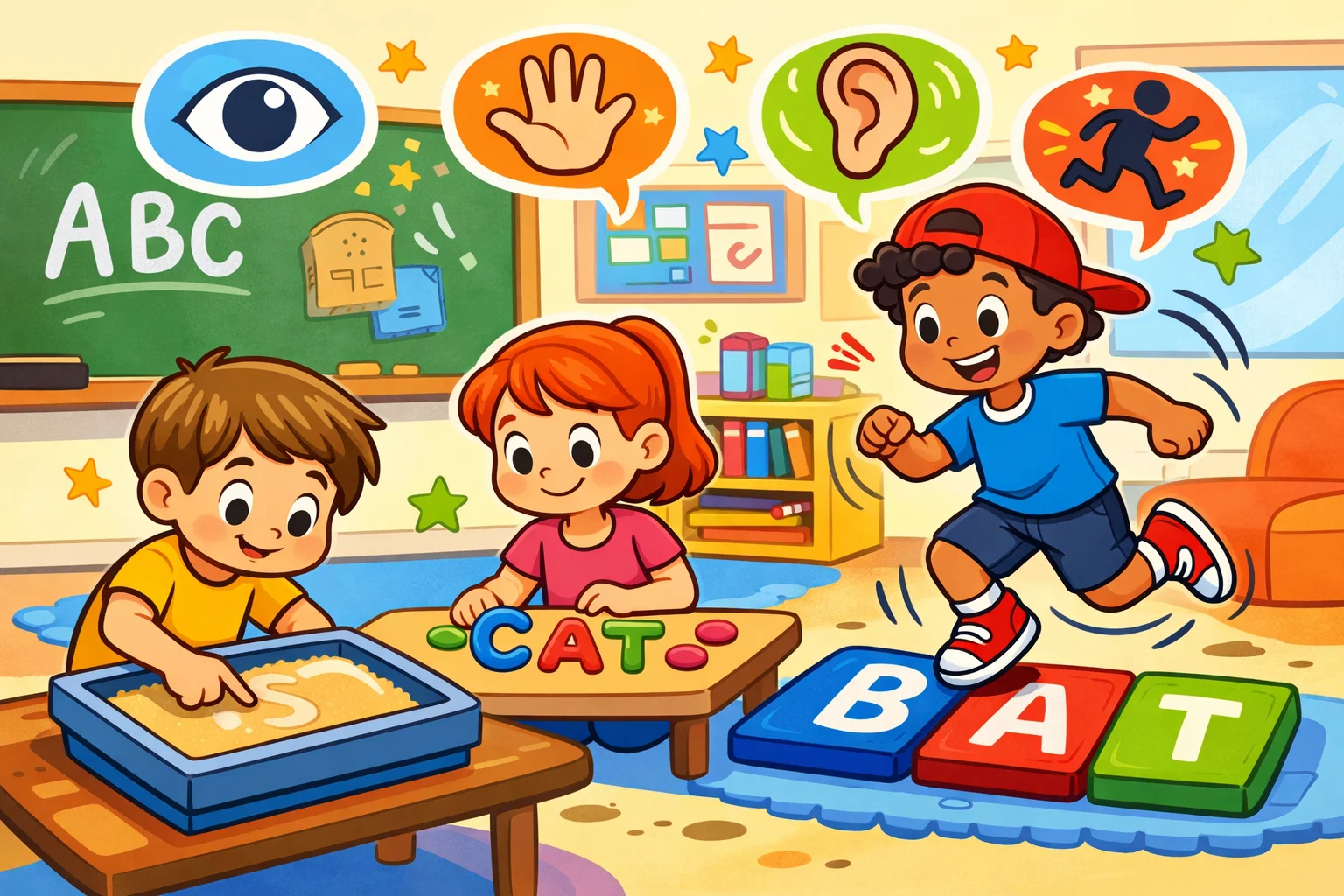
Multisensory techniques are a cornerstone of spelling support for struggling learners, particularly those with dyslexia. These activities and games ensure that the brain receives information through multiple “entry points,” making it harder for the information to be forgotten.
| Activity | Sensory Focus | Goal |
| Rainbow writing | Visual | Using different colors to highlight specific letter sequences. |
| Air spelling | Kinesthetic | Using large arm movements to write letters in the air. |
| Back tracing | Tactile | Tracing letters on a partner’s back to feel the individual sounds in words. |
| Bubble wrap pop | Tactile/Auditory | Popping a bubble for every sound at a time as they go through the list. |
| Sticky note | Visual/Tactile | Moving letters around to reach the proper result physically. |
Rainbow writing
This method involves using a different colored crayon for each letter or for the entire word multiple times. By the end, the word looks like a rainbow. This visual repetition helps the brain recognize the sequence of the alphabet more clearly.
Air spelling
Instead of a pencil, children use their “skywriter” finger. By using the whole arm to write each letter, they engage gross motor skills. This is particularly helpful for children who find fine motor tasks like writing on paper frustrating.
Back tracing
This is a wonderful partner activity. One child “writes” a term from the child spelling list on the other’s back. The receiver must guess the word. It builds a strong tactile connection to the letter shapes.
Spelling games for classroom
Group dynamics can turn a dull assessment into a collaborative and fun spelling session. Competitive elements, when managed well, can spark a great deal of enthusiasm.
Spelling bingo
Teachers can provide a list of spelling words and blank grids. Students fill their own grids, which helps them write each word at least once before the game even begins. This “pre-study” is a sneaky way to get extra practice in.
Memory match
Create cards where one card has the term and the other has a picture or a definition. Students must match them to build literacy and vocabulary simultaneously. This is excellent for learning spelling patterns in context.
Hot potato
Students sit in a circle and pass an object. When the music stops, the person holding the “potato” must spell the word aloud. To make it more challenging, each student in the circle can contribute one letter at a time until the term is complete.
Spelling headbands
Similar to Celebrity Heads, this is a guessing activity where the goal is to identify the term based on clues about its rules or phonics sounds. It encourages deductive reasoning and linguistic analysis.
Tic tac toe
To claim a square, a student must name the letters of a term from their child’s spelling list without error. If they miss a letter, the square remains open for the next player. This high-stakes (but fun) format keeps everyone on their toes.
Homeschool spelling activities
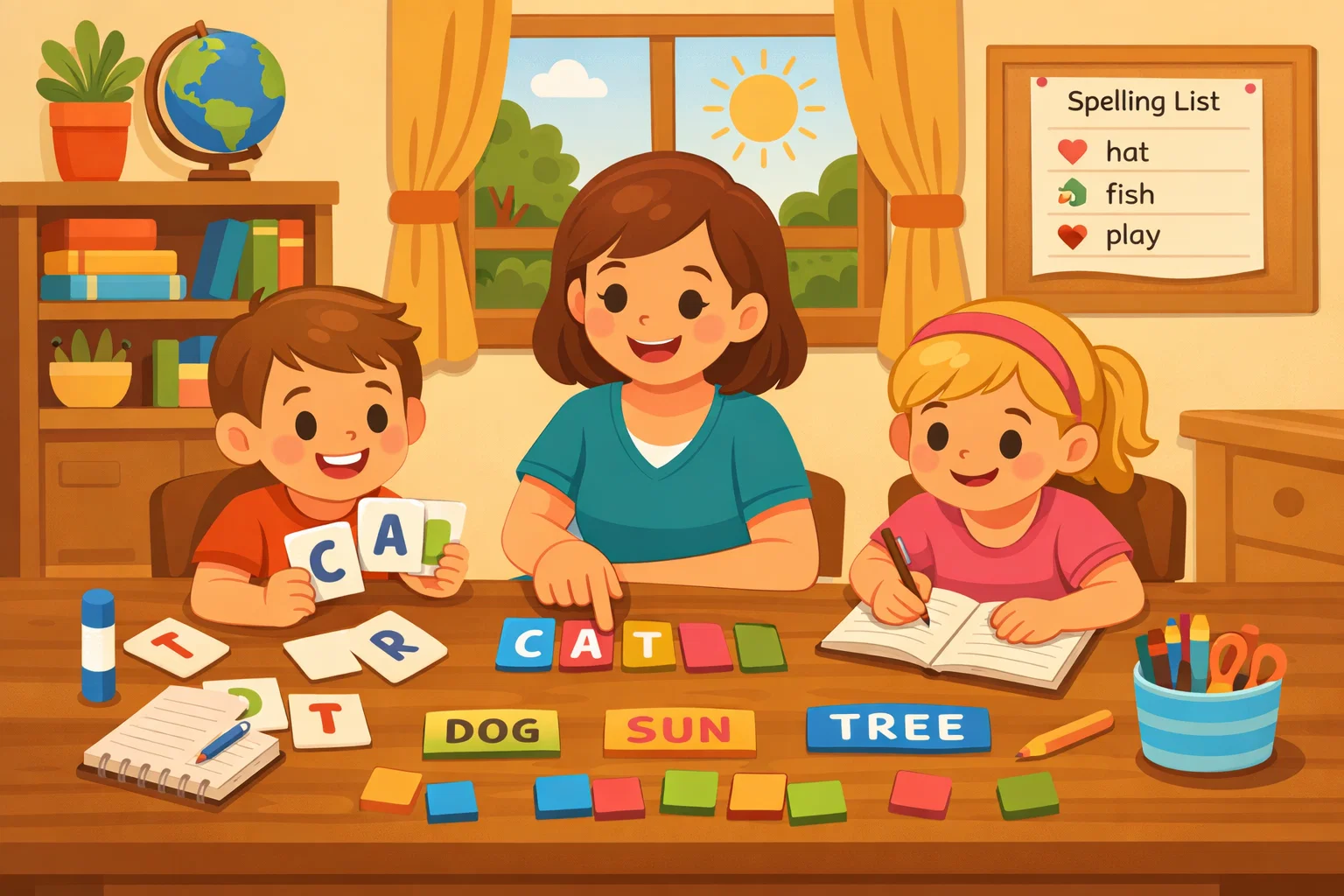
For parents managing literacy routines at home, the environment offers unique opportunities for “active” learning that a classroom might not. You can turn your entire living space into a laboratory for literacy.
Lily pad letters involve placing paper “lily pads” with letters on the floor. The child must hop to the correct letters to spell out words. If you have stairs, Stair steps spelling is a great way to help them remember—write one letter per step as they climb. This connects the ascending motion with the progression of the word.
Spelling ball is another favorite; toss a ball back and forth, saying one letter each time you catch it. This keeps the learning process light and prevents the “boredom” that often comes with a standard worksheet. Finally, Scrambled spelling involves taking a list of words, cutting the letters apart, and having the child rearrange them to form words correctly. This helps them see that terms are just puzzles waiting to be solved.
Spelling worksheets and printables
While digital and tactile play is vital, there is still a place for paper-based spelling activities to make sure children can handle written assessments. The key is to make these printables interactive.
- Spelling activity task cards: Small cards with prompts like “Write your words in ‘Pyramid’ style” or “Write your words using only vowels.” These are great for independent work.
- Laminated spelling sheets: Use dry-erase markers so kids can practice and erase errors without the frustration of messy eraser marks.
- Word grids: These help children categorize vocabulary by specific sequences (e.g., words ending in -tion vs -sion).
- Spelling puzzles: Word search puzzles, crosswords, and letter scrambles are excellent for helping kids scan for the right version in a sea of letters. They train the eye to see the word correctly among distractions.
Spelling challenges
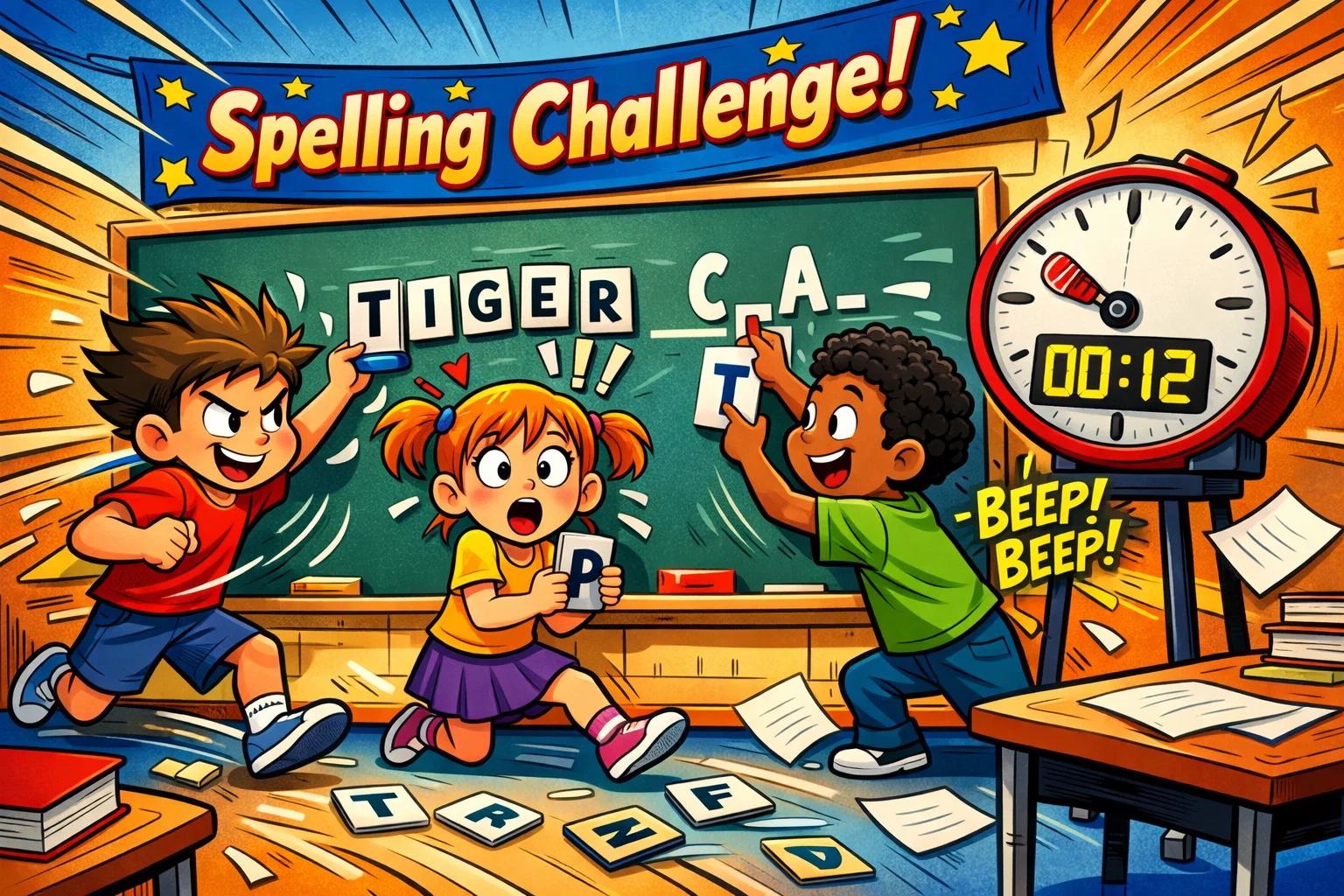
For kids who find their list of spelling words too easy, try these engaging activities to stretch their brains and prevent plateaus:
- Add-on story spelling: The child must take five items from their list and incorporate them into a short, silly story. This proves they know how to use the word correctly in a sentence.
- Spelling pyramid: This is a visual way to build a term. Write the first letter, then the first two on the line below, then the first three, until the entry forms a triangle. It emphasizes the sequence of the alphabet.
- Role-reversal spelling test: Let the child be the teacher. They give you the test, and you might even purposely make a mistake. Can they catch the different spelling you used?
- Word hunt games: Give them a list of spelling terms and ask them to find those words in a newspaper or a favorite book. This sharpens their “visual search” skills.
Digital spelling games
In the modern age, using a computer or tablet is a natural way to support literacy. Many online spelling platforms offer free spelling activities that adapt to a child’s spelling level in real-time.
- Online spelling games for kids: Websites provide a game format for almost any vocabulary set. These often use colorful animations and sound effects to keep engagement high.
- Typing spelling words: Learning to type helps children recognize English words through keyboard patterns. This “muscle memory” of the fingers is a powerful tool for literacy.
- Interactive spelling quizzes: These provide instant feedback, helping kids learn from spelling mistakes immediately rather than waiting days for a graded paper.
Spelling benefits
Why do we put so much effort into learning spelling patterns? It isn’t just about passing the next exam; it’s about building a foundation for all future communication.
Memory retention
The discipline of memorizing rules and letter sequences helps improve memory skills. It teaches the brain how to categorize and store complex information.
Phonics and sound patterns
Accurate writing reinforces the relationship between letters and individual sounds in words, which is the foundation of reading. A child who can correctly construct words can usually decode them while reading.
Writing confidence
When a child doesn’t have to stop to think about how words are spelled, their creative thoughts flow more freely. Accuracy leads to fluency, and fluency leads to a love of writing.
Focus and attention
Precise tasks like writing each letter carefully or finding a term in a word search puzzle improve a child’s ability to concentrate on details. It trains the eye to be observant.
Spelling challenges
Many children face hurdles when they learn to spell. Understanding these challenges is the first step to overcoming them.
- Sound-based spelling errors: These occur when a child uses phonics too literally (e.g., “phone” becomes “fone”). This is a natural part of the learning process but needs guidance.
- Sight word confusion: Small, common terms like “they,” “said,” or “was” often don’t follow standard rules. These are often called “heart words” because they must be learned by heart.
- Proper noun mistakes: Forgetting to capitalize names or places is a frequent error.
- Repeated spelling errors: These “fossilized” mistakes happen when a child has practiced a term in their head but with the wrong letters for too long.
Spelling support for struggling learners
If a child is having a hard time, the worst thing we can do is increase the pressure. Instead, we should change our approach to spelling.
Multisensory learning strategies
As mentioned earlier, using hands-on spelling activities like clay or air writing is non-negotiable for students who struggle with traditional methods. These activities make the abstract concrete.
Confidence-building methods
Use low-stakes spelling games for kids to build their self-esteem. When a child feels they can “win” at a literacy activity, they are much more likely to keep trying when the list of words gets harder.
Home practice routines
Consistency is more important than duration. Ten minutes of spelling at home using fun spelling activities is much more effective than an hour of frustrated crying over a worksheet.
By focusing on fun and effective ways to engage with the alphabet, you turn a chore into a challenge. Whether you’re using beads with letters, online spelling tools, or just a ball in the backyard, you are giving your child the tools they need to succeed in a literate world.