

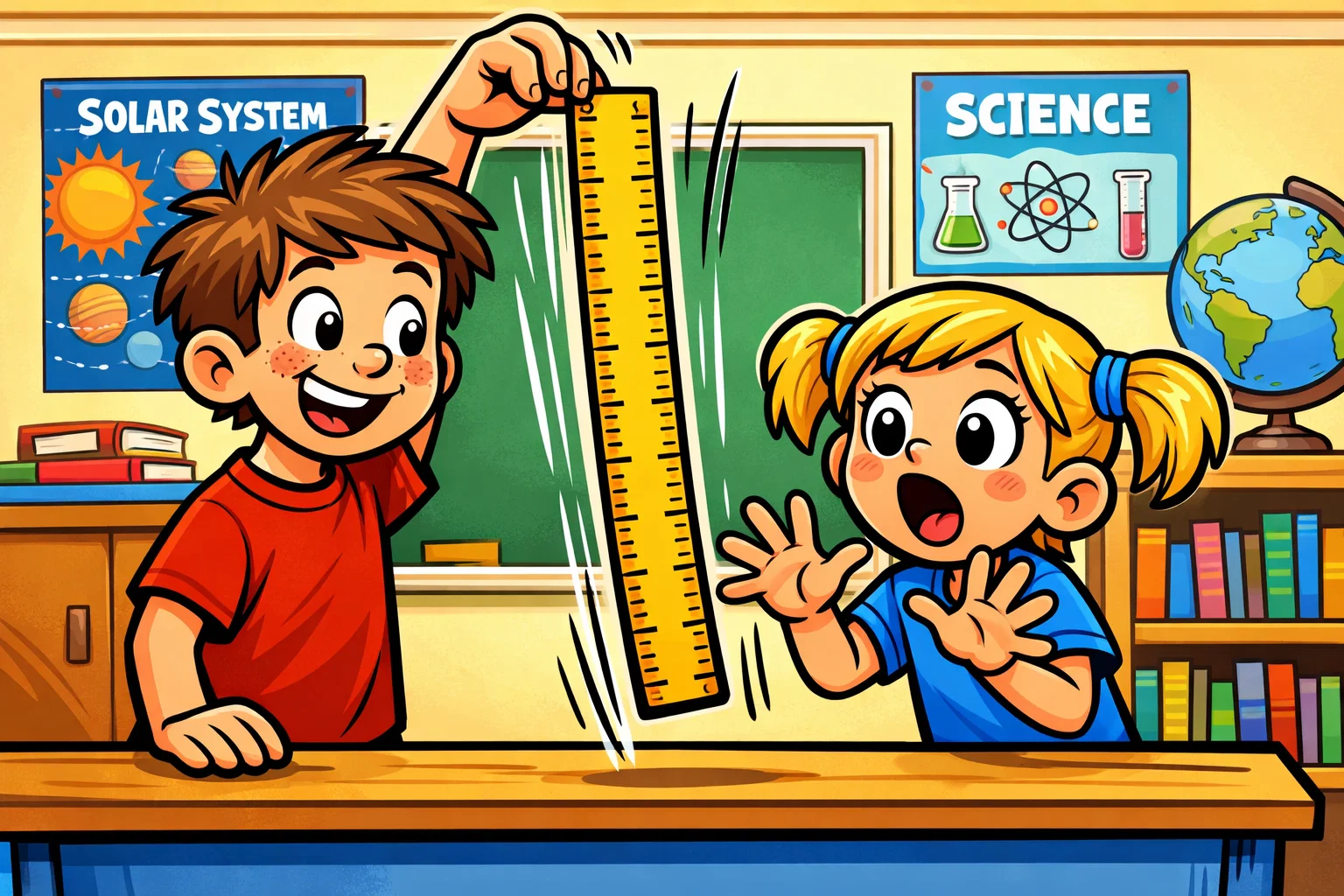
Have you ever wondered why some people are “lightning fast” at catching a ball while others seem to have a bit of a delay? It all comes down to reaction time, a fascinating intersection of biology and physics. The ruler drop reaction time experiment is one of the most popular STEM (Science, Technology, Engineering, and Mathematics) activities because it requires almost no equipment – just a simple ruler – and provides immediate, measurable results.
This experiment is a staple in classrooms and homes alike because it transforms a complex biological process into a fun, hands-on game. Whether you are a teacher looking for a science fair project or a parent wanting to engage your child in a “brainy” afternoon activity, the ruler drop is perfect for children aged 6 and up. It offers a tangible way to test your reaction time and understand how our bodies communicate with the world around us.
Reaction Time Basics
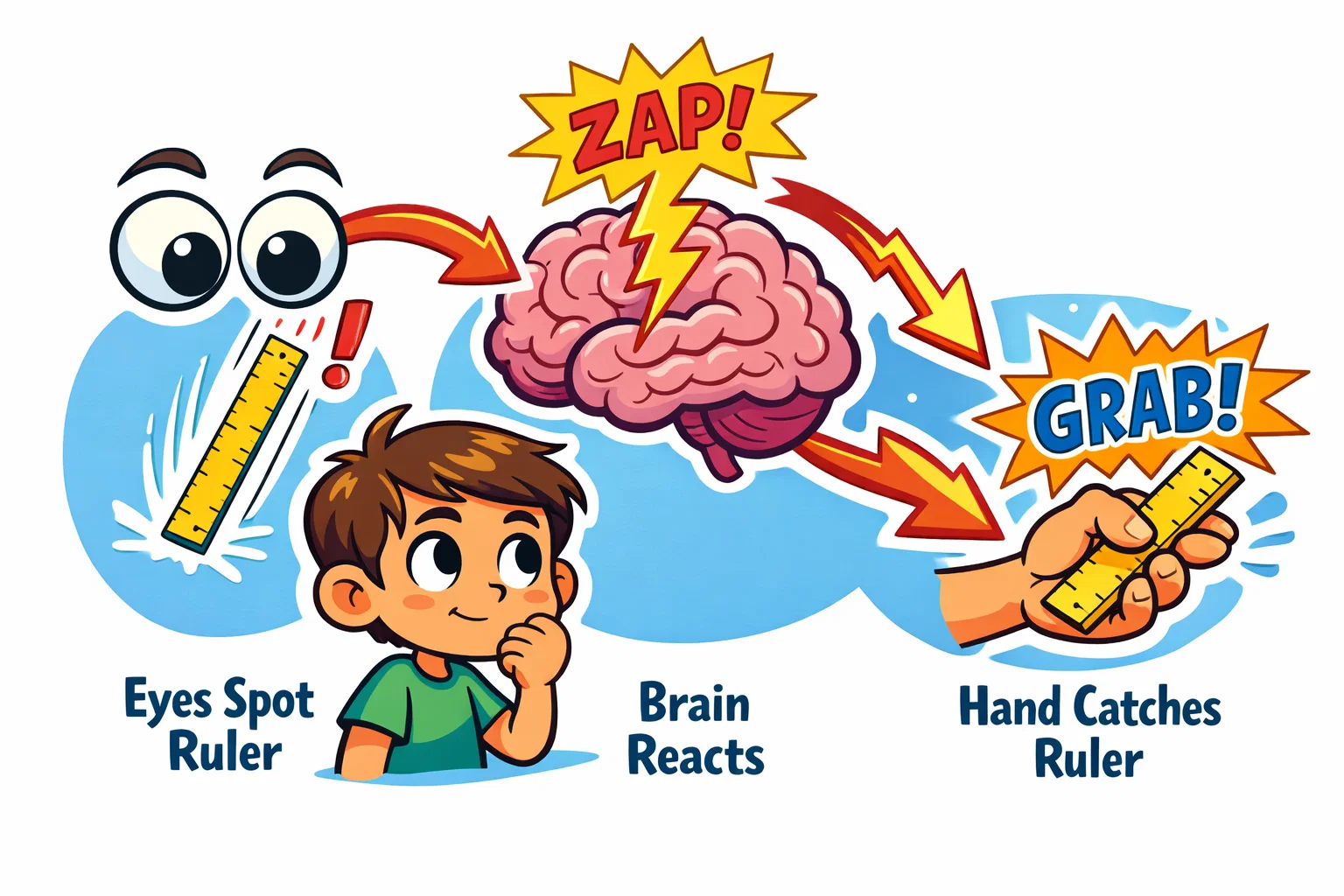
At its core, reaction time is the time it takes for a person to respond to something they see, hear, or feel. In a fast-moving world, our ability to react is what keeps us safe, whether we are dodging a puddle or catching a falling glass.
Reaction Time Definition for Kids
In simple terms, reaction time is the gap between a stimulus (the “trigger”) and your response (the action). Imagine you are playing tag; the moment you see a friend’s hand reaching for your shoulder, your brain signals “Run!” The tiny slice of time between seeing the hand and your legs moving is your reaction time. It’s like a loading bar in a video game – some bars load faster than others!
Sensory Signals and Brain Pathways
During a ruler drop experiment, your body follows a specific neural pathway. First, your eyes see the falling ruler. This visual information is converted into electrical signals that the nerve cells send to the brain. The brain processes this information in the visual cortex and decides to act. It then sends a message down the spinal cord to the muscle groups in your hand, telling your thumb and index finger to close together.
Reaction Time vs. Reflex Response
It is common to hear people say, “Wow, great reflexes!” when someone catches a falling ruler. However, there is a scientific difference:
- Simple reflex: These are automatic and controlled by the spinal cord. If you touch a hot stove, your hand pulls away before your brain consciously feels the heat. It doesn’t require conscious thought.
- Reaction: This involves the brain. You have to see the ruler, process that it is falling, and decide to catch it. Because the brain is involved, reactions are slightly slower than reflexes.
Sensory Systems Involved in Ruler Drop Test
To successfully catch the ruler, several systems must work together in harmony.
Visual Sensory Processing
Your eyesight is the “scout” of this mission. The moment the ruler is dropped, your eyes detect the motion. This experiment is a great way to show how our visual information triggers physical movement. If the room is too dark, or if you aren’t paying attention, the “scout” can’t do its job, and your response time will slow down.
Nervous System Role
The nervous system acts like a high-speed communication network. Sensory neurons carry the “it’s falling!” message to the brain, and motor neurons carry the “catch it!” message back to the thumb. Even though these signals to your muscles can travel at speeds of up to about 100 meters per second, the whole process still takes a fraction of a second.
Hand–Eye Coordination
This is the “teamwork” between your vision and your motor skills. Hand-eye coordination is what allows your thumb and index to meet at exactly the right measurement on the ruler.
Experiment Objectives
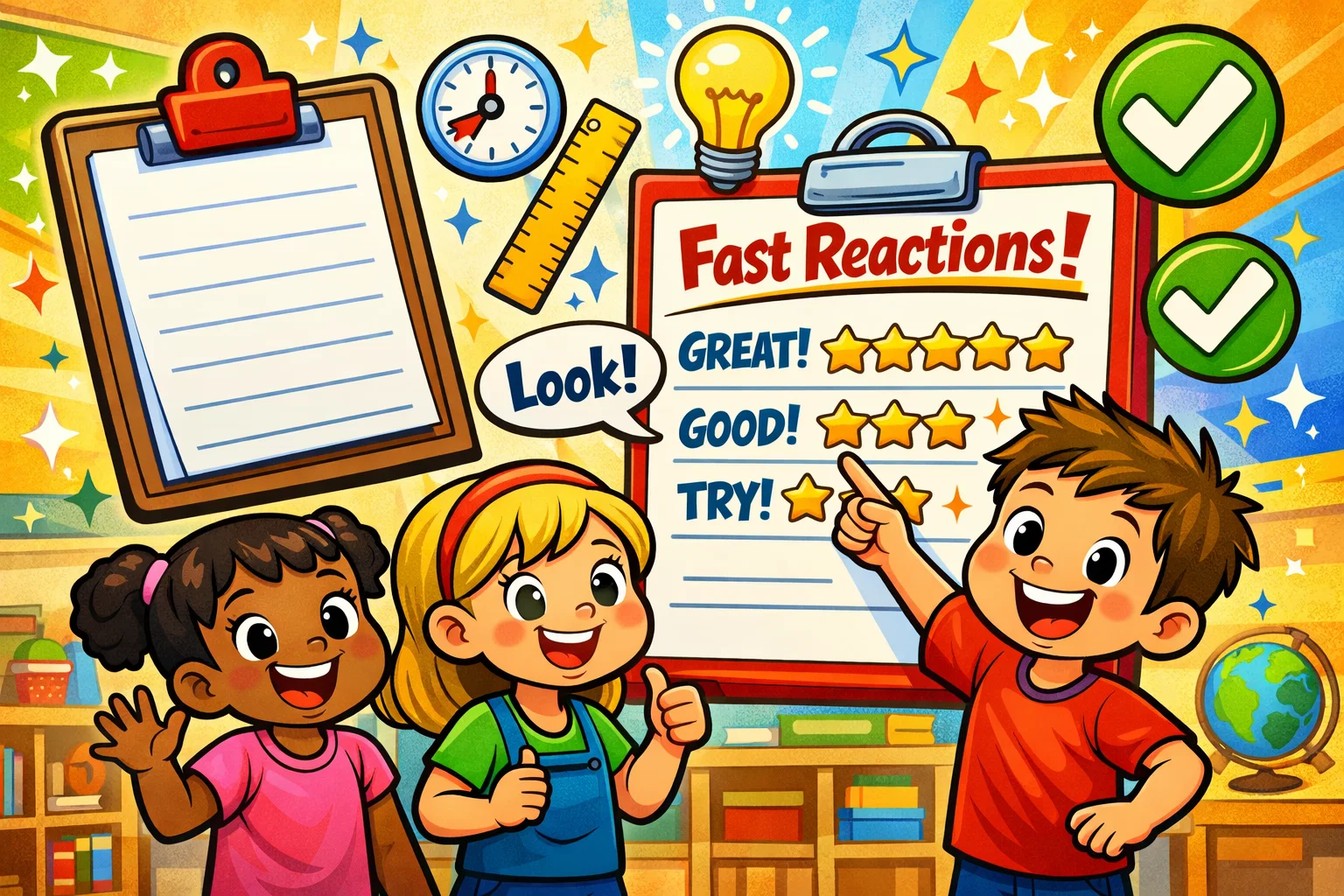
Why do we do this simple test? It’s more than just a game; it’s a science project that teaches real-world skills.
- Measuring Sensory Reaction Speed: We use the centimeter markings to estimate how quickly the brain processes information.
- Comparing Individual Reaction Results: It’s a great way to see how different people compare. Does a 12-year-old react faster than a 6-year-old?
- Introducing Scientific Observation: Kids learn to repeat the experiment, record data, and look for patterns, which are the building blocks of the scientific method.
Materials Needed
One of the best parts of the ruler drop test is how little you need to get started:
| Item | Description |
| Ruler | A 30 cm (12-inch) ruler with clear centimeter markings. |
| Worksheet | A paper or printable worksheet to record your trials. |
| Partner | One person to hold the ruler and one to catch it. |
| Table | To rest your forearm for consistency. |
Note: A wooden or plastic ruler works best. Avoid flexible “bendy” rulers as they can wobble while the ruler is falling, making it harder to get an accurate measurement.
Experiment Setup
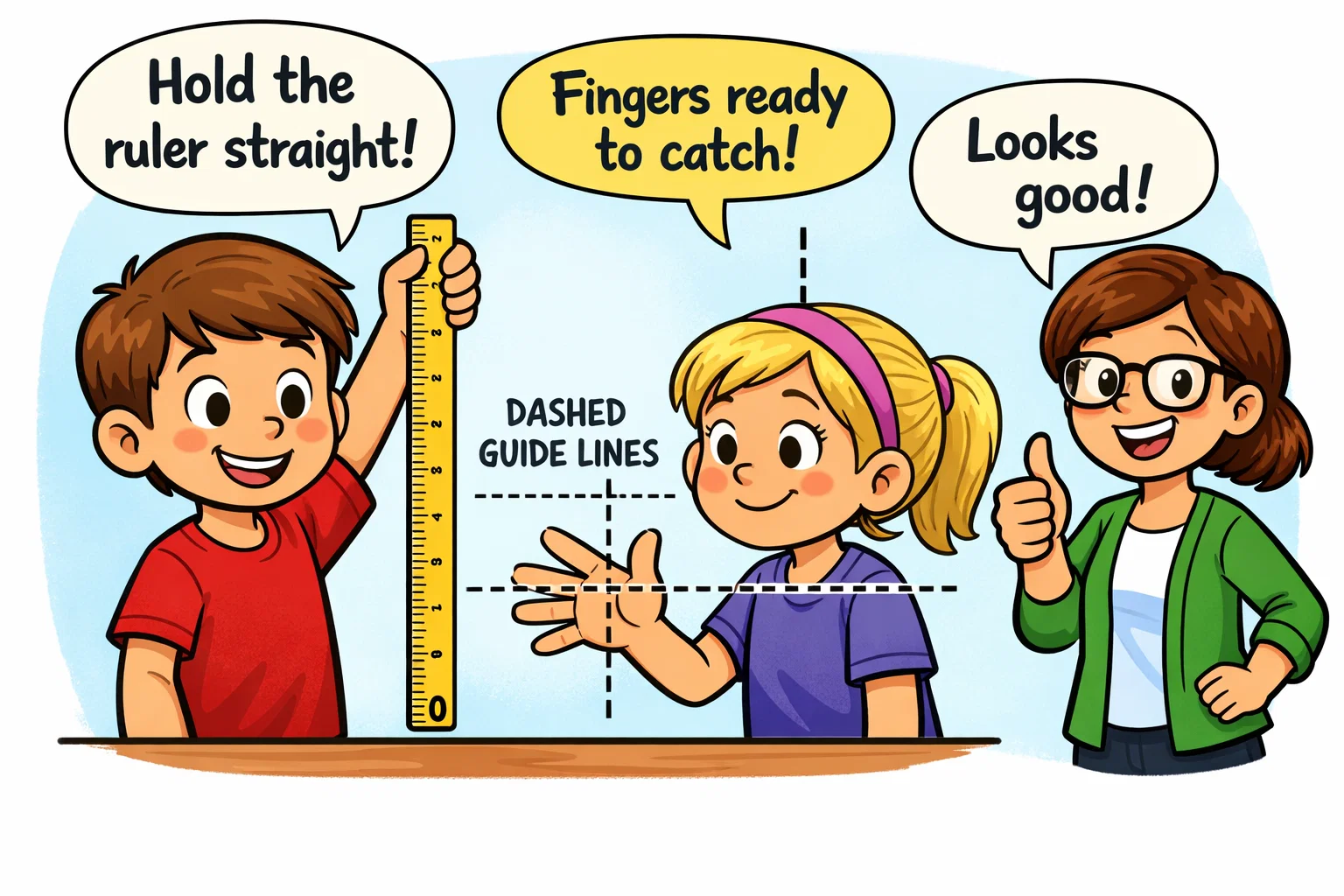
To ensure your science fair project yields accurate results, you need a controlled setup.
- Participant Positioning: The catcher sits at a table, resting their forearm on the edge of the table. This keeps the arm steady so only the thumb and finger do the work.
- Ruler Starting Position: The partner holds the ruler vertically. The bottom of the ruler (the 0 cm mark) should be exactly between the catcher’s thumb and index finger.
- Safety Considerations: Ensure there is enough space and supervision for younger children so no one gets poked in the eye with the falling ruler.
Step-by-Step Instructions
Ready to test your reaction time? Follow these steps:
Ruler Drop Procedure
The “dropper” holds the top of the ruler. The “catcher” places their thumb and index finger on either side of the 0 cm mark without touching the ruler. Without any warning or countdown, the dropper must release the ruler.
Measuring Catch Distance
Once you catch a falling ruler, look at the measurement where the top of your thumb touches the ruler. If you caught it at 10 cm, record that number!
Repeating Trials
Never rely on just one drop! To get a true sense of your reaction time, you should repeat the experiment at least 5 to 10 times. This helps account for “lucky” catches or times when you were distracted.
Reaction Time Calculation
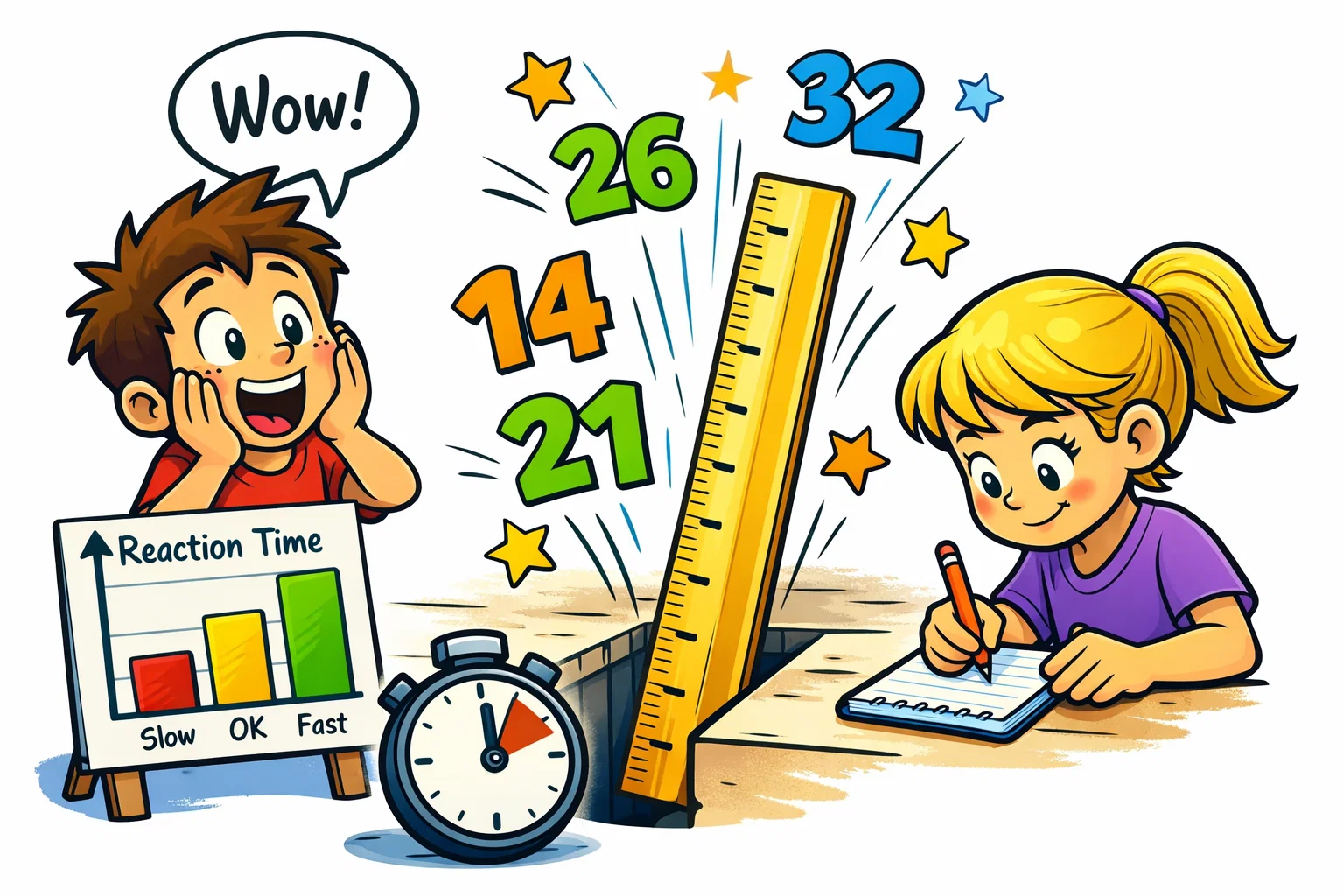
So, how do you turn centimeters into seconds? Because gravity pulls objects down at a constant rate, we can calculate time based on distance.
Distance-to-Time Table
Most schools use a printable conversion chart like the one below:
| Distance (cm) | Time (seconds) |
| 5 cm | 0.10 s |
| 10 cm | 0.14 s |
| 15 cm | 0.17 s |
| 20 cm | 0.20 s |
| 25 cm | 0.23 s |
| 30 cm | 0.25 s |
Simple Formula Explanation
For older students, the physics formula used is:
t = √(2d / g)
where:
t — time (seconds)
d — distance fallen (meters)
g — acceleration due to gravity (9.8 m/s²)
This formula shows the time it takes for an object to fall a given distance under gravity.
Average Reaction Time Results
To find your average reaction time, add up all your trial times and divide by the number of trials.
Example: (0.20 + 0.18 + 0.22) ÷ 3 = 0.20 seconds
Scientific Method Application
Question and Hypothesis Formation
Ask: “Does my dominant hand react faster than my non-dominant hand?” Your hypothesis might be: “I think my right hand will be faster because I use it more.”
Controlled Variables
In order to catch the ruler fairly, keep things the same:
- Same ruler.
- Same distance between thumb and index.
- No “counting down” before the ruler is dropped.
Data Collection and Analysis
Record your results on a worksheet. Look for trends – did you get faster as you practiced? This improvement is often linked to muscle memory.
Key Questions for Kids
- What Affects Reaction Time? Does being tired or having background noise make you slower?
- Can Reaction Time Improve? Yes! Through neural plasticity, the brain processes information more efficiently with practice.
- Differences Between Participants: Why might a tall person or an athlete have different results?
Experiment Extensions
Dominant vs. Non-Dominant Hand Test
Usually, the dominant hand is the quickest. Why? Because the neural pathway to that hand is “well-traveled” and stronger.
Visual vs. Audio Signal Variation
Try having the catcher close their eyes. The dropper says “Go!” at the exact moment the ruler is released. You might find that humans react faster to sound than to sight!
Distraction Impact Test
Try the ruler drop while the catcher is answering math problems or listening to loud music. You will see how distraction significantly affects reaction speed.
Printable Worksheets and Tables
Reaction Time Recording Sheet
Create a simple table with columns for: Trial Number, Distance (cm), and Time (ms or seconds).
Experiment Reflection Sheet
Include questions like:
- “What was your fastest catch?”
- “What happened when you were distracted?”
- “How did your brain receive the signal to move?”
Classroom and Home Use
STEM Lesson Integration
This experiment aligns perfectly with biology units on the nervous system or physics units on gravity. It’s a low-cost way to bring science to life.
Group Activity Format
In a classroom, pair students up. One acts as the “scientist” (recording data) while the other is the “test subject.”
At-Home Science Activity
Parents, this is a great “rainy day” activity. It’s competitive, educational, and requires zero cleanup!
Common Mistakes and Tips
- Anticipation Errors: If the catcher starts moving before the ruler is dropped, the trial is void. The drop must be a surprise!
- Reading Measurement Incorrectly: Always measure from the top of the thumb.
- Trial Consistency: Make sure the finger and thumb are always the same distance apart (about 2 cm) at the start.
Related Sensory Science Activities
- Brain Reaction Games: Try “Red Light, Green Light” to test whole-body response time.
- Reflex and Sensory Experiments: Test the “knee-jerk” reflex to see how it differs from a conscious reaction.
- Coordination Skill Challenges: Try juggling or balancing a ruler vertically on one finger to improve motor skills.
Educational Value Summary
The ruler drop reaction time experiment involves more than just a falling ruler. It is a window into how our sensory systems and brain work together.
Skills Developed
- Analytical: Calculating averages and reading measurements.
- Cognitive: Recognizing the neural pathway and stimulus.
- Motor: Enhancing hand-eye coordination and fine motor control.
Why It Works
It works because it is simple, measurable, and engaging. It takes the invisible world of neurons and signals and makes it something you can hold in your hand.