

Nine years old – what a fantastic age! Your child is starting to experiment with more abstract thinking, moving past simple, concrete facts and diving into the exciting world of logic, deduction, and clever wordplay. This is the perfect time to introduce them to tricky riddles and brain teasers that not only keep them busy and entertained but also actively sharpen their minds. A great riddle acts like a mental workout, helping them build the problem-solving skills they’ll need for school and beyond.
This carefully curated collection of riddles for kids is designed specifically for the curious, developing mind of a 9-year-old. We’ve compiled the best riddles for kids – a mix of funny riddles for a good laugh, hard riddles to truly stump them, and clever puzzles that boost their critical thinking. Get ready to watch your child’s face light up with pride when they crack a complex clue, or erupt in giggles at a silly pun. Let’s get their imagination engaged and their thinking challenged!
Benefits of Riddles for 9 Year Olds
At nine, children are typically in the stage of development that Swiss psychologist Jean Piaget called “Concrete Operational.” This means they’re excellent at organizing, classifying, and using logic to solve physical and mathematical problems. Riddles specifically designed for this age group help broaden their logical abilities beyond concrete facts, offering robust benefits across cognitive, linguistic, and social domains.
Critical Thinking Skills
Riddles are one of the most effective and playful ways to develop critical thinking skills. To successfully solve a tricky riddle, a child must do more than just recall a fact; they must engage in a process of elimination, weigh multiple interpretations of the same word (a phenomenon known as semantic ambiguity), and apply logic.
- Logic and Deduction: Many great riddles, especially hard riddles, are structured like mini-mysteries. They require the child to use clues, eliminate possibilities, and deduce the non-obvious answer. For example, a riddle might describe something that has four legs but can’t walk, forcing the child to consider a chair or a table, rather than an animal. The cognitive process of solving riddles builds a strong foundation for future academic subjects like mathematics and science. Research indicates that children who effectively comprehend and appreciate riddles show stronger cognitive skills and greater reasoning ability. For instance, one study of 4- to 11-year-olds found a clear link between riddle-comprehension and advanced cognitive processing.
- Problem-Solving and Decision Making: One experimental study showed that using riddles in classroom settings contributed to children’s improvements in working memory and attention – two core elements of executive function. This continuous process of trying to solve a problem-solving task and receiving immediate feedback helps them refine their strategies and make smarter decisions under pressure.
Vocabulary Development
The linguistic structure of a riddle is often its secret weapon. Riddles rely heavily on wordplay, metaphors, and descriptions that use common words in unusual or abstract ways.
- Expanding Language Skills: Riddles introduce children to nuanced and rich vocabulary. For instance, a riddle about rain might use words like “patter,” “drench,” or “mist,” subtly adding new language to their lexicon.
- Understanding Semantic Ambiguity: Riddles frequently play on double meanings, forcing the child to recognize that a word can refer to both a physical object and an abstract concept (e.g., a “key” that opens a lock versus a “key” on a keyboard). This ability to understand multiple meanings is crucial for reading comprehension and effective communication as they get older.
Confidence and Teamwork
The feeling of pride when a child figures out a particularly challenging brain teaser for kids is incredibly motivating.
- Boosting Self-Esteem: When kids of all ages successfully engage in solving riddles, especially a hard riddle, they experience a significant confidence boost. This sense of accomplishment encourages them to take on more complex challenges in other areas of their lives.
- Fostering Social Bonds: Riddles are a great way to get kids busy and interacting. When children work together to solve a puzzle, they naturally practice teamwork, communication, and patience. They learn to share ideas, listen to different perspectives, and celebrate group success, which strengthens their peer relationships – a major developmental milestone at age nine.
How to Choose Riddles for 9 Year Olds
Selecting the right riddles is an art. Too easy, and they’ll lose interest; too hard, and they’ll get frustrated. The best selection for this age group acts as a mental staircase, guiding them from simple, pun-based jokes to sophisticated logic puzzles.
Balance of Funny and Smart
A great mix keeps the engagement level high.
- Humor as an Entry Point: Funny riddles are excellent for warming up the brain. They create a positive, low-stress environment for thinking. When a riddle makes them laugh, they’re more willing to try the next, more complex one. The goal is to start with a joke-like question – like, “What has a mouth but never talks?” – and then transition to a puzzle that demands genuine logical effort.
- Mind-Stretching Challenges: Once they’re engaged, introduce riddles that require true lateral thinking and deduction. A successful strategy is to mix one funny riddle with two clever tricky riddles to keep them on their toes.
Suitable Difficulty Levels
For a 9-year-old, a well-balanced mix of difficulty ensures that every child can find success and feel appropriately challenged.
| Difficulty Level | Characteristics | Example Riddle Type | Cognitive Focus |
| Easy Riddles | Based on simple puns or familiar objects; the answer is often found in the wordplay itself. Ideal for quick wins. | What has to be broken before you can use it? (An Egg) | Vocabulary, Quick Recall |
| Medium Riddles | Requires a small logical step or a moment of “thinking outside the box”; involves double meanings. | I have cities but no houses, mountains but no trees, and water but no fish. What am I? (A Map) | Deduction, Semantic Ambiguity |
| Hard Riddles | Brain teasers that demand multiple steps of logic, lateral thinking, or breaking a core assumption. Great for boosting problem-solving skills. | What is full of holes but can still hold water? (A Sponge) | Lateral Thinking, Assumption Breaking |
School-Friendly Themes
Choosing themes that align with a child’s current interests and school subjects enhances the learning transfer.
- Science and Nature: Riddles about rain, animals (like animal riddles for kids), space, or seasons naturally complement their science curriculum.
- Math and Logic: Math riddles for kids and puzzles focused on sequences or shapes directly reinforce classroom learning in a fun, non-threatening way.
- Everyday Life: Riddles about common objects, such as a deck of cards or a one-story house, relate directly to their world, making the problem-solving process feel tangible and relevant.
Funny Riddles for 9 Year Old Kids
Laughter is a powerful cognitive primer. These funny riddles for kids are designed to surprise and delight, providing the mental “reset” needed between hard riddles and brain teasers.
Short Funny Riddles
Quick one-liners that are perfect for sharing at recess or with friends. They’re a fun way to get kids thinking instantly.
- Why did the cookie go to the doctor? (Because it felt crumbly!)
- What is full of holes but still holds water? (A sponge.)
- What has to be broken before you can use it? (An egg.)
- What has an eye but cannot see? (A needle.)
- What kind of room has no doors or windows? (A mushroom.)
- What question can you never answer yes to? (Are you asleep yet?)
- What goes up but never comes down? (Your age.)
- I have four legs, but I never run. What am I? (A table.)
- I have a mouth but never talks, and a bed but never sleeps. What am I? (A river.)
- What can you catch, but not throw? (A cold.)
Silly and Playful
More absurd questions that tap into the 9-year-old’s growing sense of sophisticated, often pun-heavy, humor.
- A man forgot to bring an umbrella. His clothes were soaked, and his head was wet. Where was he? (In the shower.)
- What is heavier, a pound of feathers or a pound of rocks? (Neither, they both weigh a pound!)
- What has to eat to live, but is killed if it drinks? (Fire.)
- What has many teeth but cannot bite? (A comb.)
Trick Questions
These are the riddles that make a child think they know the answer, only to deliver a surprising and often hilarious twist.
- You are running a race and you pass the person in second place. What place did you finish in? (Second place.)
- A man was walking in the rain in the middle of nowhere. He was wearing no coat and carrying no umbrella. His clothes were soaked, but not a single hair on his head was wet. How is this possible? (He was bald.)
- A farmer has 17 sheep, and all but 9 die. How many are left? (9.)
- A woman has six daughters and each of her daughters has a brother. How many children does she have in total? (Seven, six daughters and one son.)
- I’m light as a feather, yet the strongest person can’t hold me for five minutes. What am I? (Breath.)
Hard Riddles for Strong Thinkers
These tricky riddles are for the 9-year-olds who love a true challenge. They require lateral thinking, attention to detail, and the ability to question their initial assumptions. These are excellent for building robust problem-solving strategies.
Guess the Object
Riddles that describe an object metaphorically, forcing the child to deduce the identity from the non-literal clues.
- I have cities with no buildings, forests with no trees, and water with no fish. What am I? (A map.)
- What has a bed but never sleeps, a mouth but never talks, and can run but never walks? (A river.)
- I have keys, but open no locks. I have a space, but no room. You can enter, but can’t go inside. What am I? (A keyboard.)
- What belongs to you, but everyone else uses it more often? (Your name.)
- I am taken from a mine and shut up in a wooden case, from which I am never released, and used by almost everybody. What am I? (Pencil lead or graphite.)
- What can fly without wings or a tail? (Time.)
Brain Teasers
These are puzzles that require one or two steps of logical analysis to crack. They help get their brains working on a higher level.
- You are running a race. If you pass the person in the very last place, what place are you in? (You can’t pass the last person.)
- A bus driver went the wrong way down a one-way street, passed a “Stop” sign without stopping, and was speeding. Yet, he didn’t break any traffic laws. How is this possible? (He was walking, not driving; he was the bus driver off-duty.)
- A man lives in a one-story house made of red bricks. Everything inside is red: the walls, the furniture, the carpet, the food, even the cat. What color are the stairs? (There are no stairs, it’s a one-story house.)
- If you have two fathers and one father is your dad, who is the other father? (Your grandfather.)
- What is always in front of you but can’t be seen? (The future.)
Multi-Clue Puzzles
Longer-form riddles that require the child to manage more information and remember all the clues.
- What can be cracked, made, told, and played? (A joke.)
- A poor man lives in a red house. A rich man lives in a blue house. Where do all the great thinkers live? (The library.)
- Two fathers and 2 sons went fishing. They each caught one fish, but only three fish were caught in total. How is this possible? (There were only three people: a grandfather, his son, and his grandson.)
- What is the one thing that all smart people will inevitably ask? (Why?)
Animal Riddles
Animal riddles for kids are always a hit. These blend fun facts about creatures with clever wordplay, making them both entertaining and educational. They are a fun way to learn biology and characteristics.
Pets and Familiar Animals
Riddles about the animals kids see and interact with every day.
- I have a long, shaggy mane and a loud roar, but I’m a big softy when I come home. What am I? (A pet dog – a playful interpretation.)
- I purr when I’m happy and hiss when I’m mad. I have sharp claws but keep them hidden. What am I? (A cat.)
- I give milk and have four stomachs, but I only have four legs to walk. What am I? (A cow.)
- I am very fast and run but never walk. I help you in the race. What am I? (A horse.)
- I start as a tiny egg, turn into a squiggly eater, and then fly without wings. What am I? (A butterfly.)
Zoo and Jungle Animals
Slightly harder animal facts that kids love.
- I live in a tree, I love to swing, and I often use a very long mouth but never talk. What am I? (A monkey.)
- I have the longest neck, but I don’t wear a collar. I eat leaves from the tallest trees. What am I? (A giraffe.)
- I have stripes, am a big cat, and can stump any other animal in a jungle fight. What am I? (A tiger.)
- I have a long trunk, but no luggage. I’m the biggest land animal. What am I? (An elephant.)
Sea Creatures
Include ocean-themed riddles for variety.
- I don’t have lungs, but I need air to breathe. I jump in and out of the ocean water. What am I? (A dolphin.)
- I have eight arms, but only use two to swim. I can squirt ink when afraid. What am I? (An octopus.)
- I am a very slow traveler on the bottom of the ocean. I have a shell, but it’s not for hiding. What am I? (A sea turtle.)
Math Riddles
Math riddles for kids are excellent because they merge the abstract rules of mathematics with the fun of word problems. These are some of the awesome riddles for kids that build numeric logic.
Quick Numbers Puzzles
Short math problems with a twist that help get their brains working.
- What number increases its value by 12 when you turn it upside down? (86 becomes 98.)
- I am an odd number. Take away one letter and I become even. What number am I? (Seven; take away ‘s’ and it becomes ‘even’.)
- What two numbers multiply to 8 but add up to 9? (8 and 1)
- You’re running a race and you finish the race ahead of everyone else. What place did you finish in? (First place.)
Geometry and Shapes
Engaging geometry concepts and everyday objects.
- What has one face and two hands, but no arms or legs? (A clock.)
- I have no beginning and no end. What shape am I? (A circle.)
- I have a mouth but never speak. I’m long and thin. I’m made of wood, and you can draw a straight line with me. What am I? (A pencil.)
Word-Based Math Riddles
Language puzzles with numeric logic.
- How can you add eight 8s to get the number 1,000? (888 + 88 + 8 + 8 + 8 = 1,000.)
- I am a 3-digit number. My tens digit is 4 times greater than my ones digit. My hundreds digit is 3 less than my tens digit. What number am I? (141.)
- If you’re running a race and suddenly pass the person who came in fourth, what place are you in now? (Fourth place.)
- A half-eaten apple is in the basket that’s on the table. How many children took a bite? (One child – the apple is half-eaten, not half-bitten.)
Food Riddles
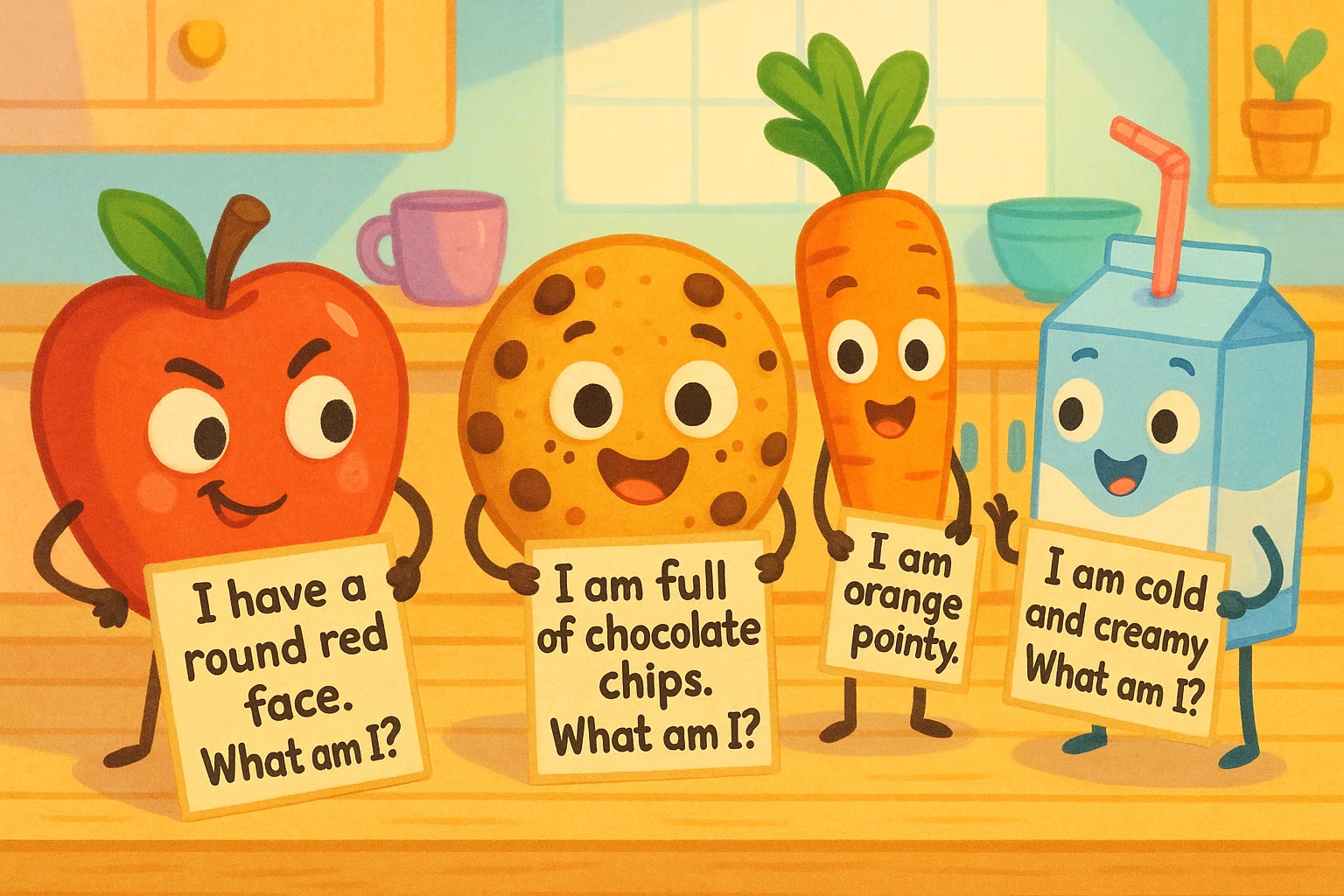
Playful riddles about snacks, fruits, veggies and favorite meals.
Everyday Fridge Items
Easy riddles that preschoolers also know, but with a clever twist for kids of all ages.
- I have layers, but I’m not clothing. I make you cry, but I don’t hurt you. What am I? (An onion.)
- I am yellow and you peel me to eat. If I’m sick, I’m not peeling well. What am I? (A banana.)
- I am green, crunchy, and often found with creamy dip. I am also the name of a US state. What am I? (Celery.)
Restaurant Foods and Sweets
Fun options tied to treats kids love.
- I have a crown, but I am not a king. I am a fruit that is often served with ham. What am I? (A pineapple.)
- What kind of cheese is made backward? (Edam.)
- I have no voice, but I can make a statement. I can be hot or cold and am found in a bowl. What am I? (Soup.)
Healthy Foods
Add some educational nutrition content through playful description.
- I’m a fruit that looks like a little star when you cut me horizontally. What am I? (A carambola or star fruit.)
- I am small, green, and round. I grow on a vine and come in a bunch. What am I? (A grape.)
- I’m a red fruit that is loved by doctors who claim one a day keeps them away. What am I? (An apple.)
Object Riddles
Common household objects that kids can guess from clues, helping to boost observation skills.
School Supplies
Classroom-friendly riddles to get kids busy with a mental break.
- I have a spine, but no bones. I have pages, but no voice. What am I? (A book.)
- I can be long or short, and I must be replaced once I pass the person who owns me. What am I? (A pencil.)
- I get sharper the more I’m used, and I hold the power of the written word. What am I? (A pencil.)
Gadgets and Toys
Modern objects relevant to children’s lives.
- I am flat and rectangular, I can run lots of apps, and I get kids thinking with games and education. What am I? (A tablet or a computer.)
- What has keys but can’t open locks? (A keyboard.)
Everyday Household Items
Items everyone has seen, but few people truly stop to describe.
- I have an ear but cannot hear. What am I? (A cup or a mug.)
- What is always coming, but never arrives? (Tomorrow.)
- What gets wetter and wetter the more it dries? (A towel.)
- What is the biggest thing you can hold in your hand? (Your breath.)
Nature Riddles
Introduce environmental themes through playful puzzles.
Weather Riddles
Sun, rain, storm, cloud topics.
- I come down, but I never go up. I am wet, and I quench the thirst of the Earth. What am I? (Rain.)
- I have no voice, but I cry, and I have no wings, but I fly without wings away. What am I? (A cloud.)
- I am beautiful and have seven colors, but I only appear after it rains. What am I? (A rainbow.)
Plants and Trees
Beginner-friendly biology concepts for kids of all ages.
- I have a thick skin and a green body. I can survive without water in the desert for a long time. What am I? (A cactus.)
- I have rings, but no fingers. I have a heart, but I do not beat. What am I? (A tree.)
Earth and Seasons
Expand to geology and seasonal changes.
- I have no lungs, but I need air to live, and I have no legs, but I run but never walk. What am I? (A fire.)
- What is in the winter sky that makes everything sparkle? (Frost.)
Holiday Riddles
Make seasonal celebrations fun riddles with themed content.
Halloween Riddles
Slightly spooky but kid-safe puzzles.
- I have a neck but no head. I wear a pointy hat and am often carved. What am I? (A pumpkin.)
- I have four legs and carry my owner on my back, but I am not an animal. What am I? (A broomstick.)
- I am white, cold, and a little spooky, but I can’t hurt you. What am I? (A ghost.)
Christmas Riddles
Include Santa, gifts, and snow themes.
- I am a circle that’s not quite a ring, and I hang on your door to make the carols sing. What am I? (A wreath.)
- I am a tiny box, but I contain a match. I give light but I’m not the sun. What am I? (A box of Christmas lights.)
- What do you call an elf who runs away? (A rebel without a Claus.)
Birthday Riddles
Fun ideas for party games.
- I get bigger the more you take away from me. What am I? (A hole, as in a hole in the ground.)
- I have many points and come at the end of a big party. What am I? (Birthday candles.)
Technology Riddles
Modern-life riddles aligned with kids’ growing tech curiosity, crucial for future problem-solving.
Gadgets for Kids
Tablets, headphones and everyday tech.
- I have a screen, but I’m not a TV. I have a keyboard, but I’m not a piano. What am I? (A tablet or a computer.)
- I have two ears but cannot hear. I help you listen to music or talk to a friend. What am I? (Headphones.)
Digital Life Puzzles
Safe internet themed riddles that get kids thinking about their digital world.
- I have a long tail, but I’m not a comet. I deliver messages instantly, but I’m not a letter. What am I? (Email.)
- I have a key, but I don’t open a door. I protect your private information. What am I? (A password.)
Logic from Computing
Abstract thinking inspired by computers.
- What is the best kind of computer to sing with? (A Dell.)
- What has an F and a T but is not true? (The word ‘False’.)
Logic Riddles
Focus on puzzles that teach reasoning patterns and using logic. These are the best for building deep problem-solving skills.
Step-by-Step Deduction
Riddles that require using clues in order.
- A father and son are in a car accident. The father is killed, and the son is rushed to the hospital. The surgeon says, “I can’t operate on this boy, he’s my son.” How is this possible? (The surgeon is the boy’s mother.)
- A rooster is sitting on a roof of a barn. If the wind is blowing west, and the rooster laid an egg, which way will the egg roll? (Roosters don’t lay eggs.)
- I have a thousand faces, but only one coat. What am I? (A deck of cards.)
Pattern Recognition
Sequences and associations that help get their brains working.
- What is next in this sequence: J, F, M, A, M, J, J, A, S, O, N, ___? (D—The first letter of the months of the year: January, February, March, etc. The next is December.)
- I am the letter after love riddles, but before math. What am I? (M, the letter ‘M’ in the alphabet.)
Lateral Thinking
Non-obvious solutions that truly stump even adults.
- A person forgot to bring an umbrella and yet his head and face were not wet, but his clothes were soaked. How is this possible? (He was bald.)
- What word is written incorrectly in every dictionary? (The word “incorrectly.”)
- There is a blue house, a red house, and a kerosene lamp. If the blue house is made of blue bricks and the red house is made of red bricks, what is the kerosene lamp made of? (Glass and metal, or the materials of a lamp, not bricks.)
Fresh Riddles for School Year 2025
Seasonal and trending riddles to refresh reading engagement.
Back to School Riddles
Great for first week activities to get kids busy.
- I have a black face, I show you the time, but I only talk when my battery is charged. What am I? (A digital watch/phone.)
- I have a lot of numbers, but I can’t count. I help you call a friend. What am I? (A telephone keypad.)
Seasonal Fun
New riddles for fall, winter, spring.
- I am a star, but I don’t twinkle. I melt away, but I’m not ice cream. What am I? (A snowflake.)
- I arrive with a chill, have bright colors, and make the leaves fall. What season am I? (Fall/Autumn.)
How Kids Can Create Their Own Riddles
Motivate children to be creative and write their own puzzles, the ultimate form of problem-solving.
Start with the Answer
Describe the recommended method: always start with the answer – the object you want to be guessed. This is the foundation of a good riddle.
- Select an object: Pick something tangible, like a cloud, a table, or a clock.
- Brainstorm its characteristics: List its literal features (four legs, made of wood, etc.) and its figurative actions (it “runs” but never walks). For example, for a clock, list: it has hands, a face, it tells time, it never moves.
Add Clues Gradually
Tips for making clues fun yet fair, focusing on metaphor.
- Step 1: The Misleading Clue (The Trick): Start with a clue that sounds like it’s describing something else entirely. “I have a mouth but cannot speak.”
- Step 2: The Descriptive Clue (The Detail): Add a clearer, literal detail. “I am used for food.”
- Step 3: The Final Clue (The Reveal): Give the most specific, yet still non-obvious, clue. “I have a bowl.” (Answer: A spoon).
Trick vs Fair Play
Teach balance between a clever tricky riddle and one that is too confusing.
- Clever: A riddle that has a double meaning for a common word (like “bed” for a river bottom) is clever.
- Too Confusing: A puzzle that requires obscure knowledge or a solution based on a misspelling is unfair and frustrating. The best riddles feel challenging but solvable using logic.