

As children step into the marvelous age of seven, their cognitive abilities are rapidly expanding. They are moving past purely concrete thinking and starting to dabble in the exciting world of abstract thought, which makes this the perfect time to introduce them to the magic of riddles for kids. A great riddle isn’t just a fun way to entertain; it’s a powerful tool that helps with brain teasers and boosts their capacity for language, focus, and lateral thinking. Introducing easy riddles for kids now can lay a strong foundation for future learning.
This collection provides a dozen unique, kid-friendly puzzles designed specifically to match the developing intellect of a seven-year-old. You’ll find everything from easy riddles perfect for warming up little minds to tricky riddles for kids that will genuinely stump them (and maybe you!). They are sorted by themes and difficulty, ensuring that whether you’re on a road trip or just looking for a new family game, you have the right challenge to get their brains working and boost their problem-solving skills. Get ready to dive into the world of awesome riddles for kids they will love!
What Riddles Are
In the simplest terms, a riddle is a statement or question that poses a puzzle and requires cleverness to solve. They are short mental workouts that combine logic, imagination, and often a dash of humor or pun. Unlike a simple trivia question, a riddle’s answer isn’t directly stated; it’s hidden within the clues.
Think of the structure like this: A description is given, often phrased as “What am I?” or “I have this, but I do that.” The descriptive clues are frequently misleading or metaphorical, forcing the reader to think outside the box. For example, a common riddle structure is: I have cities, but no houses. I have mountains, but no trees. I have water, but no fish. What am I? (A map.) This demonstrates how riddles encourage looking beyond the literal meaning of words to discover the concealed meaning.
How Riddles Help Kids Learn
Understanding how riddles help children learn is vital for parents. When a child attempts to solve a riddle, they are engaging in a complex series of mental steps:
- Decoding the Clues: They must first understand the literal meaning of each sentence.
- Connecting the Dots: They synthesize the individual clues into a single, cohesive concept.
- Lateral Thinking: They must consider multiple potential answers, rejecting the obvious and embracing the unexpected.
- Vocabulary Growth: They are exposed to new words and phrases in a context that requires them to apply the meaning immediately.
This repeated practice in mental agility not only improves their logic but also boosts their working memory—an essential component for success in school and beyond. Studies suggest that children who regularly engage in such cognitive tasks show marked improvement in non-verbal reasoning scores, which is crucial for overall academic success.
Safe Entertainment for Children
In an age dominated by screens, finding engaging, wholesome, and accessible entertainment can be a challenge. Riddles are a great way to fill the gap. They are entirely screen-free and can be enjoyed anywhere—at home, during a quiet time in the bedroom, waiting at the doctor’s office, or as part of a family game night.
Riddles make a wonderful tool for teachers, too. They serve as excellent five-minute warm-ups that encourage students to refocus and transition from recess to learning. For parents, a collection of fun riddles for kids offers a fantastic way to connect with your children, share a laugh, and enjoy high-quality interactive time without relying on digital devices. They are a superb investment in quality time.
Easy Riddles for 7 Year Olds
This group of easy riddles is perfect for starting your riddle journey. They build confidence and are excellent for quick, satisfying moments of success. They often rely on simple, direct wordplay or common objects and ideas. This section is great for a warm-up or a classroom activity.
Short Riddles
These snappy puzzles are designed to let kids solve them quickly, giving them an instant boost of achievement.
| Clue | Answer |
| What has an eye but cannot see? | (A needle) |
| What is full of holes but still holds water? | (A sponge) |
| I have a deck, but I can’t play a single card game. What am I? | (A ship) |
| What has one head, one foot, and four legs? | (A bed) |
| What has to be broken before you can use it? | (An egg) |
Beginner Logic Riddles
These fun puzzles encourage the development of clear, sequential thinking.
- I go up and down, but I never move. What am I? (A set of stairs)
- I am an odd number. Take away one letter, and I become even. What number am I? (Seven)
- What has keys but can’t open doors? (A piano)
- What is always in front of you but can’t be seen? (The future)
- What can you catch, but not throw? (A cold)
Riddles with Simple Wordplay
These playful language jokes are suitable for the early reading level of a seven-year-old.
- What is a pirate’s favorite letter? (Arr!)
- What kind of tree can you carry in your hand? (A palm tree)
- What time is it when an elephant sits on a fence? (Time to fix the fence!)
- What do you call a sleeping bull? (A bulldozer)
- What has no voice but tells you a lot? (A book)
Funny Riddles for 7 Year Olds
Humor is a fantastic motivator. Funny riddles keep kids busy and motivated to learn, transforming what could be a cognitive chore into a source of pure joy. Seven-year-olds are at an age where they truly appreciate a good pun and silly logic, which is why these are often their favorites.
Silly Riddles
These are laugh-out-loud ideas that many children will quickly memorize and share with their friends.
- Why did the cookie go to the hospital? (Because it felt crumbly.)
- What has teeth but can’t eat? (A comb.)
- What do you call a sad strawberry? (A blueberry.)
- What do you call a fish with no eyes? (Fsh.)
- Why can’t a bicycle stand up by itself? (Because it is two-tired.)
Jokes with Answers as Riddles
These encourage children to share and memorize them. Sharing jokes and riddles helps with social development and memorization.
- I have two backs and one stomach. I am always tired. What am I? (A pair of scissors.)
- What do you call a bear with no teeth? (A gummy bear.)
- I have an umbrella, but I still get wet in the rain. Why? (I forgot to open it.)
- What kind of room has no windows and no doors? (A mushroom.)
- Where does a pencil go on vacation? (Pencil-vania.)
Challenging Riddles for 7 Year Olds
These are the tricky riddles—the ones that truly stump little minds and force them to use all their budding cognitive power. This is a higher difficulty level. For these more difficult puzzles, adults should offer support and encouragement, reminding the child that the goal is fun, not frustration. Solving riddles at this level is a true triumph!
Longer Story Riddles
These require multi-step thinking and memory practice to keep track of all the clues.
- I am taken from a mine and shut up in a wooden case, from which I am never released, and yet I am used by almost everybody. What am I? (Pencil lead/graphite.)
- A man was walking down an empty road when a sudden downpour started. He had no coat, no hat, and no umbrella, yet his hair didn’t get wet. How is this possible? (He was bald.)
- A police officer saw a truck driver ignore a stop sign, speed in a 40 mph zone, and drive down a one-way street the wrong way. The officer did nothing. Why? (The truck driver was walking.)
Hard Word Riddles
These encourage decoding clues and hints hidden within the language itself, making them excellent clever riddles.
- What word is always spelled incorrectly? (Incorrectly)
- What has to be broken to be used, but is never repaired? (A secret)
- The more you take, the more you leave behind. What are they? (Footsteps)
- I can be cracked, made, told, and played. What am I? (A joke)
- I have cities, but no houses; forest, but no trees; and water, but no fish. What am I? (A map)
Math Riddles for 7 Year Olds
Connecting riddles with early math skills makes learning feel like a playful challenge. These focus on basic numbers, shapes, and patterns, helping to get their brains working on school topics in a fun way.
Counting Puzzles
Using real situations, like objects they are familiar with, makes the math relevant. This is an excellent way to boost problem-solving skills in a practical context.
- If a rooster lays an egg on the roof of a barn, which way will it roll? (Roosters don’t lay eggs.)
- If you have ten sweets and you eat seven, how many do you have left? (Ten, you still have the wrappers!)
- What number do you get when you multiply all of the numbers on a phone dial? (Zero)
School Math Puzzles
These make solving riddles feel like a playful activity that reinforces school topics.
- I am between four and six, and I am the number of sides on a square. What number am I? (Five)
- What number stays the same no matter how many times you turn it upside down? (8)
Animal Riddles for 7 Year Olds
Animal themes are universally popular and incredibly relatable for kids of all ages. They allow for playful use of biological facts and characteristics, which kids love.
Farm Animals
Introduce characteristics of animals children often know from books or visits.
- I give milk and say “Moo.” What am I? (A cow)
- I wake up everyone on the farm with my morning calls. What am I? (A rooster)
- I have wool, and I say, “Baa.” What am I? (A sheep)
Wild Animals
These use nature facts and interesting characteristics to create good clues.
- I have a long neck, and I eat leaves high up in the trees. What am I? (A giraffe)
- I sleep all winter, but I am not in a bedroom. I love honey. What am I? (A bear)
- I live in the forest and my stripes make me look like a prisoner. What am I? (A tiger)
Nature Riddles for Kids
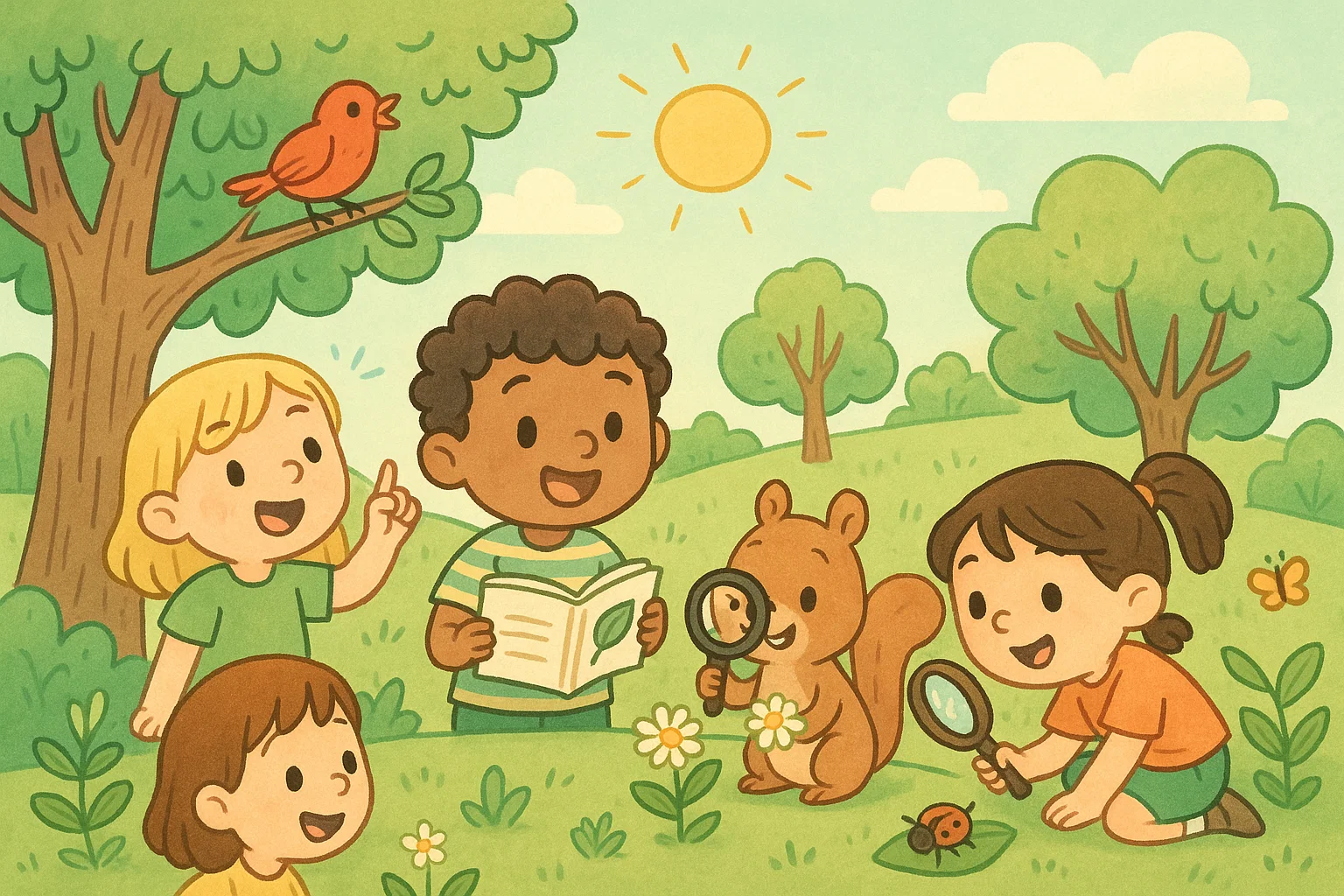
Nature riddles are fantastic for encouraging curiosity about the outside world, from the sky above to the earth below. They tie into science and environmental learning.
Weather Riddles
These involve elements like the sun, rain, and clouds.
- I am white and fluffy, and I move across the sky, but I never fall to the ground. What am I? (A cloud)
- I have a top that looks like an umbrella. What am I? (A mushroom)
- I come down hard and fast, making big puddles, but I am not snow. What am I? (Rain)
Plants and Trees
Include simple logic about familiar nature objects.
- I wear a coat in the winter and a dress in the summer. I drop my leaves in the fall. What am I? (A tree)
- I have a large crown, but I am not a king. I provide shade but have no hands. What am I? (A forest tree)
Seasonal Riddles for Kids
Describing riddles themed for holidays and calendar seasons makes them perfect for year-round family fun and classroom engagement.
Halloween Riddles
Share friendly spooky ideas that are fun, not frightening.
- I am tall and white, and I always go trick-or-treating in my own home. What am I? (A ghost)
- I love to fly at night and hang upside down. What am I? (A bat)
Christmas Riddles
Use festive, joyful themes.
- I have many needles but never sew. I get dressed up once a year. What am I? (A Christmas tree)
- I travel all around the world in one night and bring toys to good children. Who am I? (Santa Claus)
Summer Break Riddles
Include travel, beach, and fun activities, great for a road trip.
- I help you float in the water, but I am not a boat. I am often bright yellow. What am I? (A swim ring)
- I am sweet and cold, and I melt in the heat. Kids love me in the summer. What am I? (Ice cream)
Word Riddles for 7 Year Olds
These are crucial for vocabulary development and improving reasoning by focusing on the mechanics of language. They are excellent clever riddles.
“What Am I” Riddles
Provide clues leading to objects or animals.
- I have a tongue, but cannot speak. I help you walk a mile. What am I? (A shoe)
- You use me to open a door, but I am not a hand. I can pick a lock. What am I? (A key)
- I am filled with air, but I am not alive. I go flat when I get a pun-cture. What am I? (A tire)
Homophones and Word Tricks
Keep language playful but age-appropriate to teach kids about words that sound alike but have different meanings.
- What has an eye but can’t see, and a needle but can’t sew? (A hurricane)
- What two words, when combined, hold the most letters? (The post office)
Benefits of Riddles for Children
This activity is a powerhouse for development.
| Benefit Category | Cognitive Skill Development | Practical Application |
| Logic and Reasoning | Deductive reasoning, identifying patterns | Boost problem-solving skills in school |
| Language Skills | Vocabulary expansion, understanding context and metaphor | Improved reading comprehension |
| Memory | Working memory (holding clues in mind) | Enhanced focus and concentration |
| Social-Emotional | Patience, collaboration (in family game setting) | Confidence in tackling tough problems |
Learning Through Play
When kids are having fun, they are more engaged and often progress faster. Solving riddles transforms tedious cognitive exercises into exciting games. They foster creativity and the ability to think flexibly, often called “thinking outside the box.” Play is the work of childhood and riddles are a great way to make that work highly productive.
Confidence Building
Successfully figuring out a tricky riddle gives a child a powerful sense of accomplishment. This small success builds the confidence to try harder tasks, not just in play, but in school assignments as well. The simple act of saying, “I can solve this brain teaser!” is invaluable to a child’s self-esteem.
Tips for Helping Kids Solve Riddles
Provide adult guidance without giving answers too fast. Offer hints and encourage teamwork.
Step by Step Clue Search
Advise your child to take a moment and identify the most important words in the riddle.
- What are the verbs? (e.g., “I talk,” “I fly”)
- What are the specific objects mentioned? (e.g., a lock, a deck of cards, an umbrella)
- Which clues contradict each other? (These are often the key to the answer, like having “cities but no houses.”) Encourage them to be little detectives!
Think in Pictures
Encourage visual imagination. Ask them to draw the scene the riddle describes. Often, when the clues are mapped out visually, the non-literal answer becomes clear. This helps them bridge the gap between abstract language and concrete imagery.
How Kids Can Create Riddles
Motivate children to be inventors of their own puzzles. This is the highest form of mastery.
Start from Answer
The simplest way for a child to begin writing their own awesome riddles for kids is to choose an object they love—a favorite toy, a pet, or a common bedroom object. For example, choose “A shoe.”
Collect Clues
Guide them to choose fun and surprising facts about the object.
- Fact 1 (Literal): It has laces.
- Fact 2 (Tricky): It has a tongue, but can’t taste.
- Fact 3 (Action): It takes me on a walk.
- Final Question: What am I?
Test on Friends
Suggest sharing the newly created clever riddles at school or home. This provides valuable social practice, as they learn to present their ideas clearly and handle feedback. Being able to stump their friends with their own creations is highly motivating!
More Brain Games for Kids
Offer related learning games like trivia, puzzles, and logic challenges.
School-Friendly Group Games
Mention activities teachers can use in class to get their brains working.
- “Twenty Questions”: A classic logic game that requires systematic questioning to narrow down an answer.
- Logic Puzzles (Non-Verbal): Sudoku for kids, simple grid logic puzzles, and sequence pattern matching.
- Charades/Pantomime: Excellent for non-verbal communication and creativity.
Screen-Free Games at Home
Give ideas for parents seeking quality time and great ways to keep kids busy.
- Building Challenges: Using LEGOs or blocks to complete a specific, abstract building task (e.g., “Build a machine that catches the rain”).
- Board Games: Strategy games like Checkers, Battleship, or deck of cards games that require planning.
- Storytelling Chains: One person starts a story with one sentence, and the next person adds a sentence, focusing on imagination and narrative structure.