

As children enter kindergarten, cognitive flexibility, vocabulary range, and listening comprehension begin to expand at a rapid pace. Play remains the most effective learning mechanism at this stage, especially when activities combine curiosity, structure, and immediate feedback. Riddles for 5 year olds with answers provide exactly that balance. Each short brain teaser presents a manageable challenge followed by clear resolution, reinforcing both confidence and analytical thinking.
Well-designed riddles introduce descriptive language, logical sequencing, and inferential reasoning in a format that feels like a game. A simple question paired with an answer encourages prediction, comparison, and memory recall without academic pressure. Regular exposure to age-appropriate riddles strengthens early literacy foundations, supports attention development, and turns everyday moments into structured learning opportunities that remain enjoyable and memorable.
Easy Riddles for 5 Year Olds
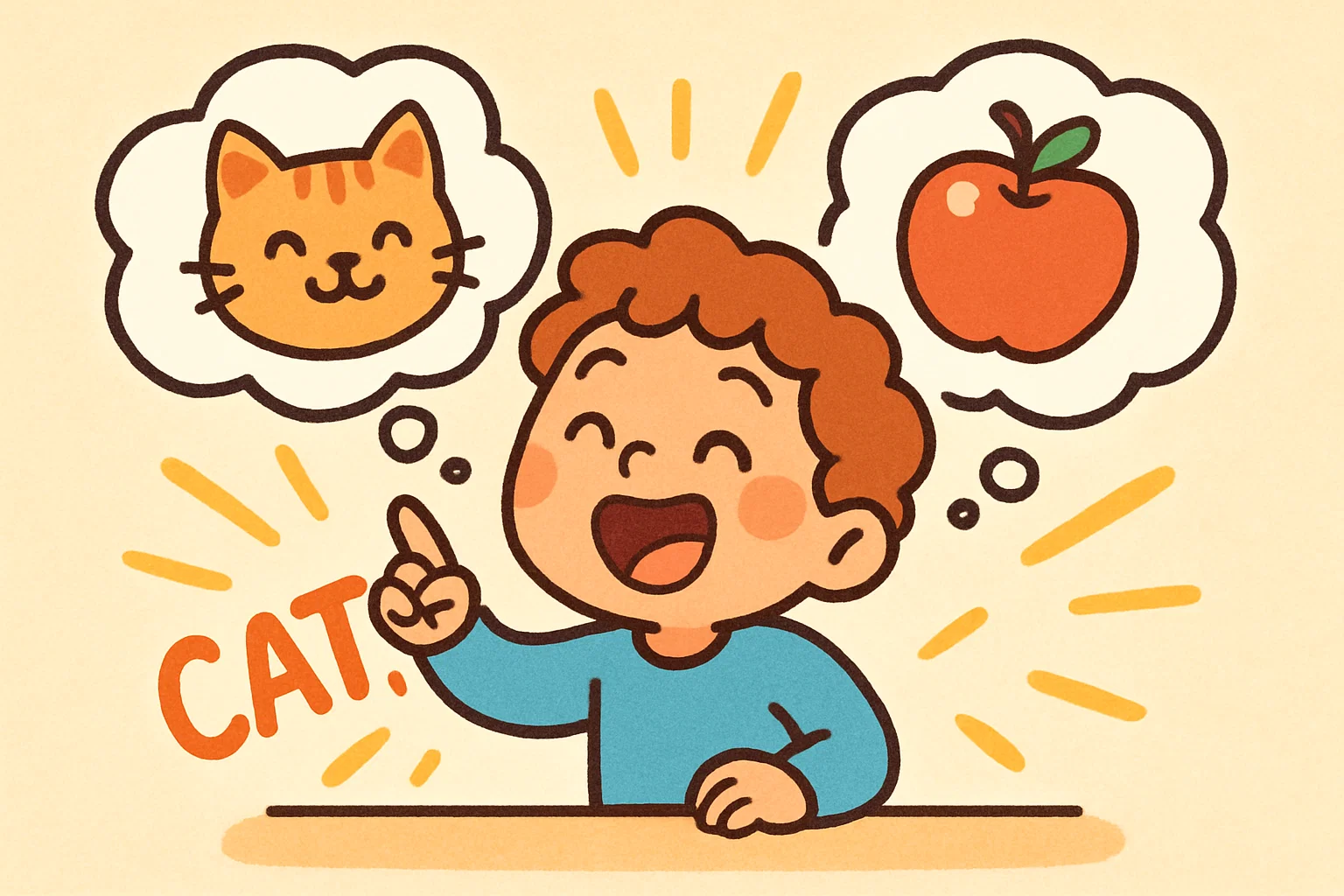
Five-year-olds thrive on familiarity. The best easy riddles for this age group focus on everyday objects, common animals, or simple concepts they encounter daily. They serve as a fantastic warm-up, requiring simple logic but encouraging them to listen closely to the clues.
Short with simple answers
These quick riddles are excellent for building confidence. Their brevity makes them easy to remember and quick to solve.
- I am round and you eat me. What am I? (An apple)
- I have four legs, but can’t walk. What am I? (A table)
- You use me to open a door. What am I? (A key)
- I can be big or small, and I fly. What am I? (A balloon)
- What is always in front of you but can’t be seen? (The future)
“What am I” riddles for young kids
The “What am I” format helps children focus on sensory clues—what something looks like, feels like, or what it does. This strengthens their ability to connect descriptions to objects, a crucial pre-literacy skill.
| Clues | Answer |
| I am yellow and you peel me. Monkeys love to eat me. What am I? | A banana |
| I am white and cold. I fall from the sky in winter. What am I? | Snow |
| I have a face and hands, but I don’t have lungs or a mouth. What am I? | A clock |
| I get wet when drying. What am I? | A towel |
| I am a hole in the ground filled with water, and you can swim in me. What am I? | A swimming pool |
Everyday objects
Using household items makes the abstract process of solving riddles concrete. These items are right there, ready for a child to touch and examine if they get stuck.
- I have a tongue but cannot talk. I have a sole but can’t walk. What am I? (A shoe)
- I have a bed but never sleep. I run all day and night. What am I? (A river)
- You carry me to school, and I hold your books and lunch. What am I? (A backpack)
- I am used to cleaning your teeth. What am I? (A toothbrush)
- I melt when it gets hot outside. I come in many flavors. What am I? (Ice cream)
Funny
Humor is a powerful learning tool. Funny riddles for kids leverage the element of surprise and playful wordplay to encourage memory retention and engagement. The sillier the outcome, the more likely a 5-year-old will ask to hear it again!
Animal jokes
Animals are a constant source of fascination. Adding a funny twist to their characteristics makes these animal riddles even better.
- What has four legs and a tail, barks when it’s happy, and chases the mailman? (A dog)
- Why did the chicken cross the playground? (To get to the other slide!)
- I moo all day and make the milk you drink. What am I? (A cow)
- What do you call a sleeping bull? (A bulldozer)
- I’m striped like a zebra but can climb trees and run fast. What am I? (A tiger)
Food and snacks
Food always gets kids excited! These food riddles encourage kids to think about the properties of what they eat.
- What has to be broken before you can use it? (An egg)
- I’m red, I’m round, and I grow on a tree. I keep the doctor away. What am I? (An apple)
- I am sticky, sweet, and made by bees. What am I? (Honey)
- I have layers but am not a shirt. If you peel me, you might cry. What am I? (An onion)
- What has a neck but no head, and wears a cap? (A bottle)
School and toy themed jokes
Relating riddles to a child’s immediate environment, like their school or playtime, makes the content instantly relatable and encourages them to use contextual memory.
- I have an eraser on my head, and I help you write. What am I? (A pencil)
- I have keys but open no doors. I have a space but no room. You can enter but can’t go outside. What am I? (A keyboard)
- I come in a box, I have 51 friends, and we are used for many card games for kids. What am I? (A deck of cards)
- What has one eye but cannot see? (A needle)
- I can be rolled, thrown, and bounced, and I help you play sports. What am I? (A ball)
Animal Riddles for 5 Year Olds
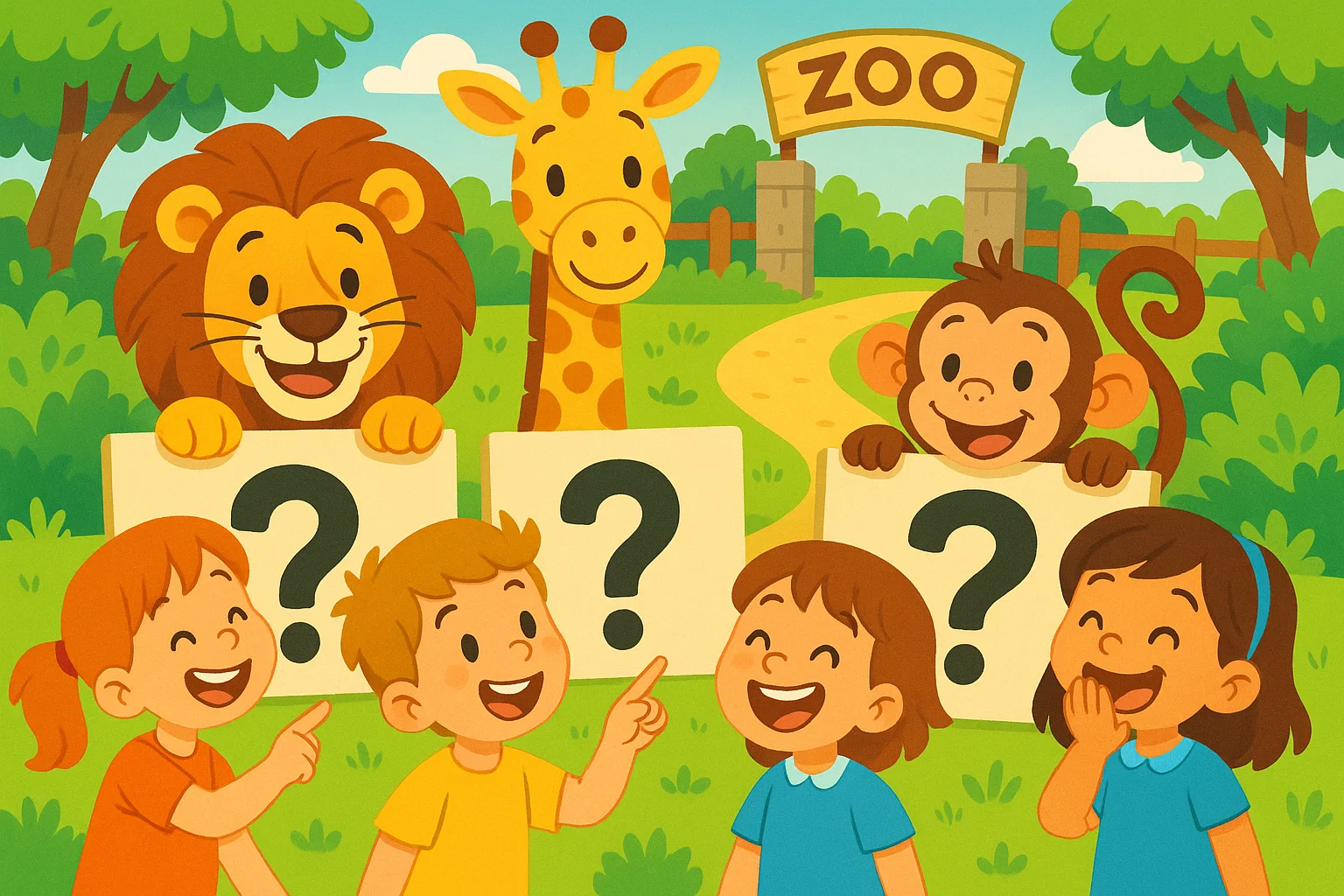
Animal riddles are fundamental for this age. They allow children to demonstrate their knowledge of the natural world, linking sounds, movements, and habitats to the correct animal. This is a core part of early science education.
Farm animals
Farm animals are great because most children have learned their sounds and names early on.
| Riddle | Answer |
| I say “oink” and love the mud. I live in a sty. What am I? | A pig |
| I wear a wool coat and say “baa.” What am I? | A sheep |
| I am tall, have a long mane, and I run fast. I say “neigh.” What am I? | A horse |
| I wake up the farmer in the morning with a “cock-a-doodle-doo.” What am I? | A rooster |
Zoo animals
Zoo animals introduce concepts of size, strength, and unique features, expanding a child’s vocabulary.
- I am huge and gray, with a long trunk. I like peanuts. What am I? (An elephant)
- I have a very long neck and eat leaves high up in the trees. What am I? (A giraffe)
- I roar, and I am called the king of the jungle. What am I? (A lion)
- I hang upside down and love to swing. What am I? (A monkey)
- I am slow, carry my house on my back, and can hide inside it. What am I? (A turtle)
Pets and friendly creatures
These riddles are the most personal, as they relate to creatures children might have as a pet or see in their backyard.
- I meow and purr and chase mice. You often pet me. What am I? (A cat)
- I swim in a bowl and have bright fins. I can’t talk. What am I? (A fish)
- I am tiny and buzz, and I make sweet honey. What am I? (A bee)
- I fly without wings and cry without eyes. What am I? (A cloud)
Seasonal Riddles for 5 Year Olds
Connecting riddles to the seasons helps children observe and appreciate the world around them, linking concepts like weather and outdoor activities to specific times of the year.
Summer
- I am hot and bright, and I make shadows on the ground. What am I? (The sun)
- I am cold, sweet, and melt quickly on a hot day. What am I? (An ice cream cone)
- You use me to build castles at the beach. What am I? (Sand)
- I keep you safe from the sun when you hold me over your head. What am I? (An umbrella)
Winter
- You roll me into three big balls, and I have a carrot nose. What am I? (A snowman)
- You wear me on your hands to keep them warm. I come in a pair. What am I? (Gloves or mittens)
- I am a warm drink you sip when you come in from the cold. What am I? (Hot chocolate)
- I fall from the sky in winter, and every piece is different. What am I? (A snowflake)
Spring and fall
- I come out after the rain and help flowers grow. What am I? (The sun)
- I am yellow, red, and brown, and I fall off trees in autumn. What am I? (Leaves)
- You need me to jump in puddles. I go on your feet. What am I? (Rain boots)
- I grow in the spring, I’m often colorful, and I smell sweet. What am I? (A flower)
Holiday Riddles for 5 Year Olds

Holiday-themed riddles build excitement and anticipation for special events. They reinforce cultural knowledge and traditions in a playful format.
Halloween
- I am round and orange, and I have a carved smile. What am I? (A pumpkin)
- I am a white, friendly figure that says “Boo!” What am I? (A ghost)
- I’m sweet and delicious, and you get a lot of me on Halloween night. What am I? (Candy)
Christmas
- I fly in a sleigh with reindeer and bring presents. What am I? (Santa Claus)
- I am green and tall, and you hang ornaments on me. What am I? (A Christmas tree)
- I am wrapped up with paper and a bow. You open me on Christmas morning. What am I? (A present)
Easter
- I hide in the grass, and I deliver chocolate treats. What am I? (The Easter Bunny)
- I am usually hard-boiled and painted bright colors. What am I? (An Easter egg)
- I am a fuzzy, small bird that hatches out of a shell. What am I? (A chick)
Learning Riddles for 5 Year Olds
This category focuses on early academic concepts, transforming lessons in math, color theory, and nature into engaging brain teasers. This is where riddles play a direct role in school readiness.
Simple counting
These riddles introduce the concept of basic arithmetic and number sense.
- I have one more than one. What number am I? (Two)
- If you have three cookies and eat one, how many are left? (Two)
- What number do you reach when you count all your fingers on one hand? (Five)
Colors and shapes
Children learn to identify and describe attributes using adjectives like “round,” “red,” or “square.”
- I am a shape with no sides, and I am perfectly round. What shape am I? (A circle)
- I am a primary color, the color of the sun and bananas. What color am I? (Yellow)
- I am a shape with four equal sides. What shape am I? (A square)
Nature
- I am big and blue, and I hang over your head all day. What am I? (The sky)
- I am green and tall, and I give you shade. What am I? (A tree)
- I come down when it’s cloudy and make puddles. What am I? (Rain)
Challenging Riddles for 5 Year Olds
Once a child has mastered the easy riddles, it’s time to introduce tricky riddles for kids. These gently encourage critical thinking skills and demonstrate that sometimes the most obvious answer is not the correct one, focusing on hidden meaning and nuance.
Tricky but solvable
- What has an eye but cannot see? (A needle)
- What is light as a feather, but even the strongest person cannot hold it for five minutes? (Their breath)
- What has to be broken before you can use it? (An egg)
- I have cities with no buildings, forests with no trees, and water with no fish. What am I? (A map)
- What has many teeth but cannot eat? (A comb)
With a twist
These clever riddles often rely on wordplay and simple puns, giving children a funny and surprising answer.
- A farmer has 17 sheep, and all but 9 die. How many are left? (9)
- Imagine you are in a one-story house. Everything is yellow: the walls, the furniture, the doors. What color are the stairs? (There are no stairs in a one-story house)
- A rooster laid an egg on the top of a barn. Which way did it roll? (Roosters don’t lay eggs)
- What is in a red house, made of wood, and always gets wet? (A tongue)
Riddle Games for 5 Year Olds
Riddles are a great way to transition from individual fun to interactive play, promoting social skills like turn-taking and teamwork.
Classroom activities
- Circle Time Guessing: An adult or child reads a short brain teaser aloud while the group listens carefully. The first participant to raise a hand and respond correctly chooses the next prompt. This format strengthens attention, listening discipline, and quick recall.
- Team Guessing Games: Divide the class into two small groups and present a thinking question for discussion. Each team quietly agrees on a solution and writes it on a whiteboard. The first group to show the correct response earns a point, promoting cooperation and shared reasoning.
- Matching Activity: Prepare cards with short riddles on one side and solutions on the reverse. Children pair each clue with the correct answer as a structured sorting exercise. This hands-on approach supports logical association and memory development.
Birthday party games
- Treasure Hunt Game: Each clue directs children to the next location based on the correct answer. For instance, if the prompt describes something cold, sweet, and stored in the freezer, the correct response guides participants to that spot to discover the following task. This format keeps children physically active while strengthening logical sequencing.
- Small Reward Challenge: Offer a sticker or symbolic prize to the participant who successfully solves the most complex brain teasers during the celebration. Recognition of effort reinforces analytical thinking and motivates continued engagement.
Family bonding riddles
- Bedtime Activity: Add one or two short riddles to the evening routine before story time. A brief thinking task helps shift attention from active play to calm reflection while still engaging reasoning skills.
- Travel Game: During long car rides, present a brain teaser in parts, revealing clues gradually. This segmented approach builds anticipation and supports sequential processing, similar to a verbal observation game.
- Dinner Table Challenge: Invite each family member to share a favorite question or create a new one to discuss together. A printed list of riddles can also serve as conversation prompts, encouraging thoughtful dialogue and shared problem-solving.
Benefits of Riddles for 5 Year Olds
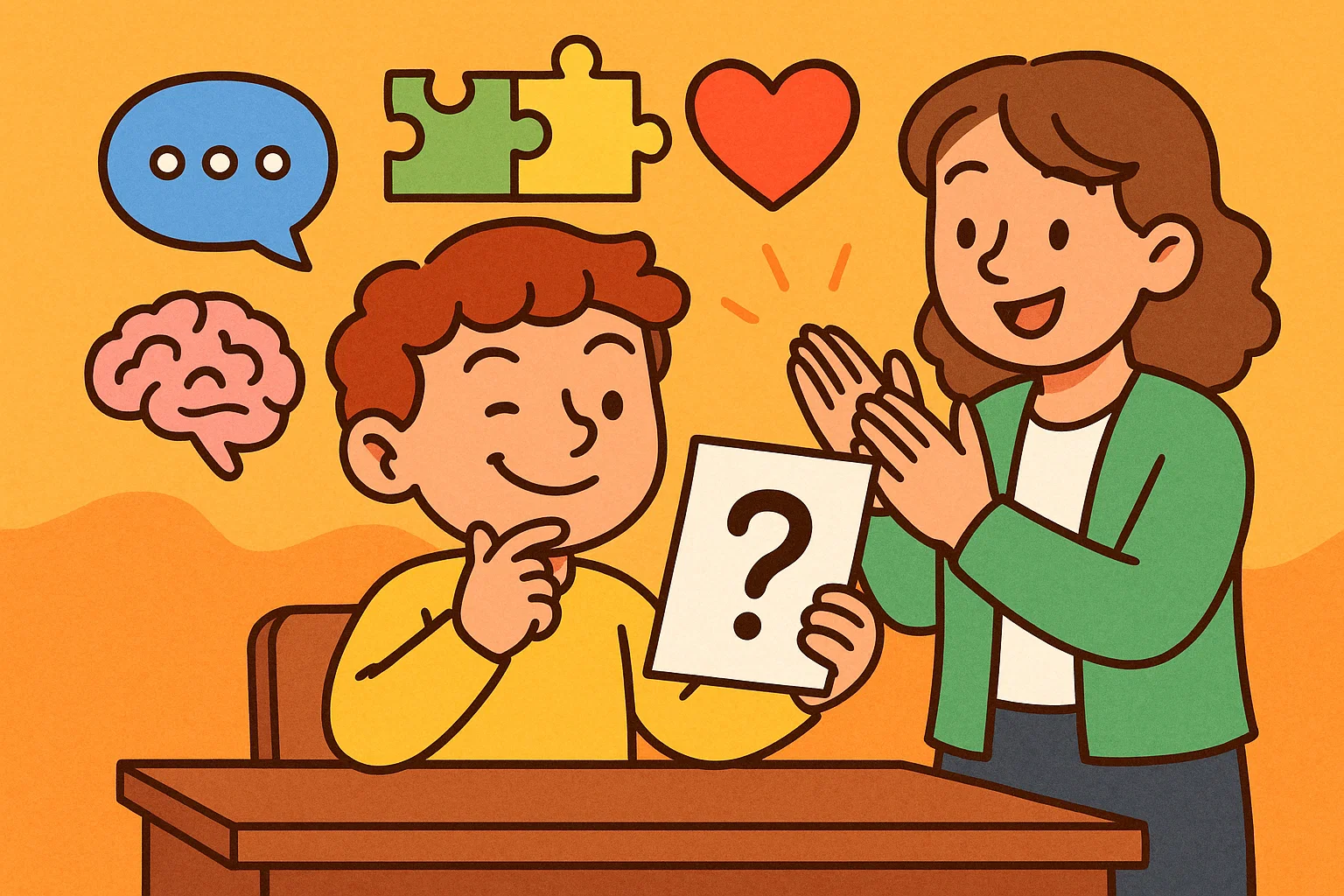
The value of riddles extends far beyond simple entertainment. Riddles are a great way to foster foundational cognitive, linguistic, and social-emotional growth, backed by studies in early childhood education.
How riddles support language skills
- Vocabulary Expansion: Riddles naturally introduce new adjectives, nouns, and verbs. When a child hears a riddle like, “I am made of leather and have laces,” they learn or reinforce the words leather and laces.
- Articulating Complex Ideas: To correctly answer a riddle, a child must synthesize multiple descriptive clues. This requires kids to practice their communication and articulation as they justify their answer.
- Understanding Wordplay and Hidden Meaning: Riddles can also be mini-lessons in figurative language. They teach children that words can have double meanings or be used deceptively for fun, building a sensitivity to nuance that is critical for reading comprehension.
How riddles develop thinking skills
- Logic and Reasoning: Solving riddles involves deductive reasoning. Children must eliminate possibilities based on the clues, moving from general to specific. This is the essence of critical thinking skills.
- Attention and Focus: The sequential nature of riddles—one clue after another—forces children to maintain focus and listen carefully to the whole sequence, enhancing their memory and attention span.
- Boosting Problem-Solving Skills: The core challenge of a riddle is finding a solution to a presented problem. Regularly engaging with brain teasers strengthens the neural pathways associated with problem-solving. Studies suggest that this type of play supports early analytical skills.
Social and emotional benefits
- Building Confidence: Successfully solving a tricky riddle gives a 5-year-old a powerful sense of accomplishment, boosting confidence and self-esteem.
- Humor and Resilience: The playful nature of funny riddles and puns introduces children to low-stakes humor. They learn to laugh at surprising answers and not take themselves too seriously if they get one wrong, fostering emotional resilience.
- Teamwork and Empathy: When playing in a group, children learn to take turns, listen to others’ ideas, and negotiate a common answer, developing early teamwork and empathy skills.
How to Make Simple Riddles with Your Child
The ultimate step in mastering riddles is moving from being a solver to being a creator. This process is highly recommended for parents and teachers, as it is a fantastic way to help kids understand how descriptive language works. Kids can help create every clue.
Start with the answer
The key to an effective riddle is working backward. Pick an object the child knows extremely well.
- Example Answer: A cat.
Help brainstorm clues together
Guide your child to describe the object using its defining characteristics. Try to use three different types of sensory clues:
- Sight/Color: “It is often black, white, or orange.”
- Sound: “It makes a ‘meow’ sound.”
- Action/Location: “It likes to chase a laser dot and take naps on the couch.”
Guide kids to test their riddles
The real fun is in the test! Have your child try out their new riddle on a family member or friend. If the person guesses too quickly, the riddle might be too easy, and you can add a tricky clue. If they can’t guess at all, it might be too hard, and you can adjust to a simpler clue. This helps them understand the concept of a “good” riddle that balances challenge with solvability.
Looking for More Fun Learning Activities?
If your child loves these riddles, they are ready for more engaging, play-based learning!
More preschool puzzles and games
Explore our other resources on brain teasers and games for kids that build similar logic and memory skills, such as pattern matching games and simple geometry puzzles. These activities further enhance critical thinking skills.
Free learning printables
Download our free list of riddles and accompanying worksheets designed to help children visualize the objects and concepts. These free learning printables are a great way to keep the fun going and continue to keep kids busy with meaningful, educational content.