

For a 13-year-old, the world is rapidly expanding, and their brains are primed for complex logic challenges. This age, where they often feel too old for simple games but still crave fun and discovery, is the ideal time to use riddles to sharpen their critical thinking skills and ignite their creativity. Riddles aren’t just games – they’re powerful tools that help kids think critically and creatively, bridging the gap between imaginative play and structured learning in a fun, engaging way.
Our updated 2025 selection offers a wide range of puzzles – from funny riddles that lead to laughter to hard riddles that really stump even the cleverest minds. They’re organized into themes like logic, math, animals, and technology to keep things fresh and engaging. Ready to dive in and get those brains working? Scroll down to explore the best list of riddles to challenge your teen!
What Are Riddles and Why Teens Love Them
A riddle is essentially a question or statement intentionally phrased to require clever thinking for its answer. They are like short, literary puzzles, often relying on double meanings or metaphorical language to describe an object, concept, or idea without naming it directly. For a teen turning 13, cognitive development moves into the formal operational stage, meaning they can now tackle more complex, abstract ideas. This is why a good enigma or tricky riddle that requires them to look beyond the literal meaning is so satisfying at this age. They help teens think critically and creatively, making them a perfect way for families to spend quality time solving riddles together.
Mental Benefits of Solving Riddles
Engaging with riddles for teens offers significant cognitive advantages that can directly impact their success in subjects like math and science. They force the brain to make non-obvious connections, which is key to improving overall mental agility.
- Logic and Reasoning: Riddles demand problem-solving using structured logic. When trying to figure out a hard riddle, a teen must analyze the clues, dismiss the red herrings, and deduce the correct answer. This process strengthens the neural pathways associated with deductive reasoning.
- Memory and Attention: Remembering the subtle clues and connecting them to the description helps improve working memory. The focused attention required to crack a particularly complex riddle boosts concentration skills.
- Vocabulary Improvement: Riddles often use figurative language to describe objects with varied, imaginative language, exposing teens to new words and phrases. This helps them understand words in new contexts and improves reading comprehension.
How Riddles Encourage Creative Thinking
Riddles are like mini-workouts for the imagination. They require a flexible mind that can view a single object from multiple perspectives – a skill essential for innovation and problem-solving in life.
- Imagination: To solve an animal riddle, for example, a teen has to imagine the animal’s characteristics as described by the clues, even if the clues are metaphorical (“I have a horn but don’t have lungs”). This stretches the imagination.
- Flexible Reasoning: A tricky riddle often hides a surprisingly simple answer beneath clever wording, but the clue presentation makes it seem complex. This teaches the teen to shift their focus from the abstract to the literal, or vice versa, forcing them to think creatively. For example, “What is full of holes but still holds water?” (A sponge).
How to Use Riddles in Everyday Life
Integrating fun riddles into daily routines makes learning effortless and engaging. You can use riddles to transition between activities, reduce screen time, and foster family bonding.
- Car Rides: Instead of relying on passive entertainment, start a riddle chain. One person tells a riddle, and the others try to solve it. This is a great way to improve listening and quick thinking.
- Family Dinners: Challenge kids to share a riddle before they get dessert or to open up a topic for conversation. “Can anyone solve this food riddle?” can be a fun prompt.
- School Breaks: Teens can use silly riddles to share with friends during lunch or breaks. This can enhance social interaction and peer bonding.
- Bedtime: A few relaxing, thought-provoking riddles can also be a great wind-down activity before sleep, helping kids relax while still keeping their brains gently engaged.
Fun Riddles for 13 Year Olds
These are light and funny brain teasers that are perfect for teens. They provide a quick, satisfying win that encourages them to try a harder challenge next.
Short Funny Riddles
These are quick hits – perfect for text messages or starting a conversation.
- What has hair on his head but never sleeps? (A bed)
- What question can you never answer yes to? (Are you asleep yet?)
- I follow you all day, but when the sun goes down, I’m gone. What am I? (A shadow)
- What has an eye but cannot see? (A needle)
- What can you catch, but not throw? (A cold)
- What is always in front of you but can’t be seen? (The future)
- What has to be broken before you can use it? (An egg)
- What is light as a feather, but even the strongest person can’t hold it for five minutes? (Their breath)
Trick Questions for Teens
These tricky riddles rely on misdirection and often have an obvious answer hidden behind complicated-sounding clues.
- What is full of keys but can’t go inside any house? (A piano)
- What belongs to you, but other people use riddles to describe it more than you do? (Your name)
- What has one head, one foot, and four legs, but can’t walk? (A bed)
- I have cities, but no houses; forests, but no trees; and water, but no fish. What am I? (A map)
- What is always coming, but never arrives? (Tomorrow)
- What has many hearts but no other organs? (A deck of cards)
- What has a neck but no head? (A bottle or a shirt)
Silly Riddles to Share With Friends
These are designed to be silly and social, often relying on puns or wordplay that appeal to the teenage sense of humor.
- What do you call a fake noodle? (An impasta)
- Why did the bicycle fall over? (Because it was two-tired)
- I am a bird, and I can come out at night without being called. What am I? (An owl)
- What do you call a pig that knows karate? (A pork chop)
- Why did the student eat his homework? (Because the teacher told him it was a piece of cake)
- What has a bark but can never bite? (A tree)
- What do you get when you cross a snowman with a vampire? (Frostbite)
Hard Riddles for 13 Year Olds
This section is designed to challenge kids and stump even the most confident thinkers. These riddles require the use of advanced problem-solving skills and deeper critical thinking skills.
Logic Riddles
These puzzles are the epitome of logic riddles, focusing on reasoning and critical thinking.
- I can be broken, but I’m never held. I can be given, but never taken. What am I? (A promise)
- A man is stuck on an island. He only has a box of matches. The only things around him are wood, grass, and a tank of gas. How does he light his fire? (He lights a match)
- What has a mouth but never speaks? (A river)
- What has no voice, but can tell you a story? (A book)
- What is greater than God, more evil than the devil, the poor have it, the rich need it, and if you eat it, you’ll die? (Nothing)
- What has an endless supply of energy but can’t go inside a battery? (The sun)
- I have four legs, but can’t go for a walk. I have a surface, but you can’t go inside of me. What am I? (A table)
Brain Teasers With Multiple Steps
These are multi-layered tricky riddles that require significant deduction and sustained attention to detail. Solving riddles like these strengthens problem-solving.
- A father’s son is sitting in a chair. The son is my son’s father. Who is the person talking? (The mother/daughter-in-law)
- I am a word that, if you take away my first letter, I still sound the same. Take away my second letter, and I still sound the same. What word am I? (Queue)
- What five-letter word becomes shorter when you add two letters to it? (Short, adding ‘er’ makes it shorter)
- I am taken from a mine and shut up in a wooden case, from which I am never released, and yet I am used by almost every person. What am I? (Pencil lead/Graphite)
- I have no life, but I can die. What am I? (A battery)
- What is always thirsty but never drinks? (A fire)
Classic Hard Riddles With Modern Twist
Riddles can also be timeless, but a modern spin helps them connect with teens. These are the best riddles for this category.
- I am alive without breath, cold without a body, never thirsty but always drinking. What am I? (A fish)
- What has an ear but cannot hear? (A corn cob)
- What is as big as an elephant but weighs nothing? (An elephant’s shadow)
- What is always running but never leaves the house? (A tap/faucet)
- What is always in motion but never goes anywhere? (A clock’s hands)
- What is always behind you but you can’t go inside it? (The past)
- What happens once in a minute, twice in a moment, but never in a thousand years? (The letter M)
Math Riddles for 13 Year Olds
These puzzles combine mathematical problem-solving with the fun of a riddle, making them an excellent way to prepare for subjects like math.
Easy Math Puzzles
Simple numerical logic that uses patterns or basic arithmetic.
- I am an odd number, but if you take away a letter, I become even. What number am I? (Seven)
- If you multiply me by any other number, the answer will always be the same. What number am I? (Zero)
- A rooster lays an egg on a roof. Which way does the egg roll? (Roosters don’t lay eggs)
- Two fathers and two sons go fishing. Each catches one fish. They bring home three fish. How is this possible? (A grandfather, a father, and a son)
- How can you add eight 8’s to get the number 1,000? (888 + 88 + 8 + 8 + 8 = 1000)
Trick Math Questions
These riddles use numbers but the trick is in the wording, not the calculation.
- A baker is 5 feet tall and wears size 10 shoes. What does he weigh? (Flour)
- I have a number. If you take away half of me, zero is left. What number am I? (The number 8, take away the top half leaves 0)
- What is the next number in this sequence: 1, 1, 2, 3, 5, 8, 13, ___? (21, the Fibonacci sequence)
- What number increased by 8 equals 8? (0)
- I am four times as old as my son. In 20 years, I will be twice as old as my son. What are our current ages? (40 and 10)
Geometry and Logic Riddles
These involve shapes, sequences, and spatial reasoning, essential skills for critical thinking.
- I have one face and I can come alive when you push my button. I count time, but I don’t have lungs to breathe. What am I? (A digital clock)
- I have a large mouth and a huge belly, but I can’t go inside the closet. I am a great square and love to consume everything. What am I? (A dump truck/recycling container)
- You have a 3-liter jug and a 5-liter jug. How can you measure exactly 4 liters of water? (Fill the 5-L, pour into 3-L (leaving 2-L in 5-L jug). Empty 3-L jug. Pour the 2-L into 3-L jug. Fill 5-L jug again. Pour from 5-L into 3-L jug (which has 2-L) until it’s full. This leaves 4-L in the 5-L jug.)
- What geometric shape is always telling the truth? (A right angle)
Funny Riddles for Teens
Laughter is a powerful learning tool. These funny riddles use witty, pun-based humor – a great way for teens to bond and laugh together.
Everyday Life Jokes in Riddle Form
Using familiar teen experiences like school or technology makes the riddles relatable.
- I have a thousand words, but I can’t go inside a book. I am the only thing you can’t go without when I come alive with a text. What am I? (A smartphone)
- What is brown and sticky? (A stick)
- Why did the math book look sad? (Because it had too many problems)
- What has keys but can’t open doors? (A keyboard)
- What is an astronaut’s favorite part of a computer? (The space bar)
- I have a lot of money, but I don’t have lungs to breathe. I go inside a pocket, but I can’t go inside a wallet. What am I? (A gold coin)
Witty Riddles With Wordplay
These riddles use double meanings to make them think twice.
- What has an ear but cannot hear? (A corn cob)
- What is the fastest way to cool a pizza? (The “pizz” is silent, so it’s “za”)
- What has a bed but never sleeps? (A river)
- I go inside and out, I have a mouth but never speak, and I have a body but never move. What am I? (A bay or inlet)
- What is something you can keep all day without being stolen? (Your word/a promise)
- What word is spelled incorrectly in every dictionary? (Incorrectly)
Clean Jokes for School or Family Time
Safe and fun riddles for kids that can be shared in any setting.
- What kind of building has the most stories? (A library)
- What do you call a lazy kangaroo? (Pouch potato)
- Why did the scarecrow win an award? (Because he was outstanding in his field)
- What runs around a house but never moves? (A fence)
- What has cities, but no houses; forests, but no trees; and water, but no fish? (A map)
- What has to do with an ocean but is not the sea? (An oyster/shell)
Animal Riddles for 13 Year Olds
Animal riddles are a great way to learn about nature while still having fun. They require teens to think creatively about creature characteristics.
Zoo and Jungle Riddles
Riddles can also include fun facts about exotic animals.
- I am tall and have a very long neck. I have spots, but I can’t go inside a building unless it’s very tall. What am I? (A giraffe)
- I am a great swimmer and don’t have lungs like you, but I am a mammal and can communicate by jumping. What am I? (A dolphin)
- I roar, but I don’t have lungs. I am the king of the jungle. What am I? (A lion)
- I swing in trees and love bananas. I can come alive when I see a peanut. What am I? (A monkey)
- I am the largest land animal, I have a trunk, and my ears are huge. What am I? (An elephant)
Pets and Farm Animal Riddles
These are relatable and often easier to visualize.
- I wag my tail when I’m happy and sometimes fetch. I go inside your house, but I can’t go on the furniture. What am I? (A dog)
- I purr and climb. I have nine lives and love to nap. What am I? (A cat)
- I give milk and go inside a barn. I chew my cud and don’t have lungs that you see. What am I? (A cow)
- I am small and run on a wheel. I go inside a cage. What am I? (A hamster/mouse)
Ocean Creature Riddles
Focusing on marine life and their unique traits.
- I have many arms, but can’t go inside clothes. I squirt ink when I am scared. What am I? (An octopus)
- I move sideways and have two big pincers. I go inside the sand. What am I? (A crab)
- I am toothy and scary, but I don’t have lungs like a human. I rule the ocean depths. What am I? (A shark)
Food Riddles for 13 Year Olds
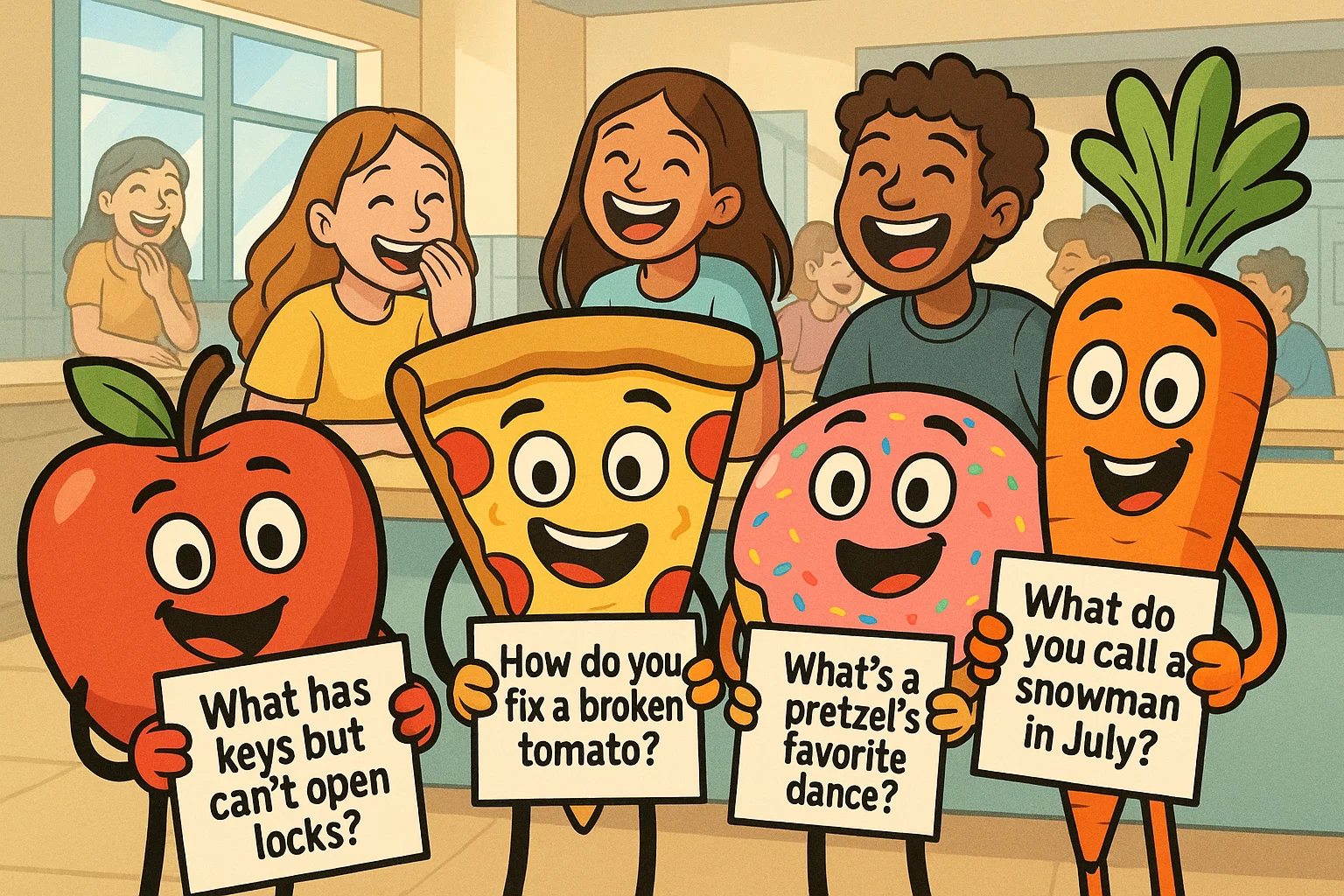
These food riddles are playful and connect to everyday experiences in the kitchen and at the dining table.
Sweet and Dessert Riddles
These focus on sugary treats and their characteristics.
- I am cold and come in many flavors. I melt if you leave me out. What am I? (Ice cream)
- I am a circle of baked dough, often covered in frosting and sprinkles. What am I? (A donut)
- I am a bar of dark sweetness. You melt me to make a fondue. What am I? (Chocolate)
Fruit and Vegetable Riddles
Fun ways to teach healthy eating in a riddle format.
- I am red and crunchy. I keep the doctor away. What am I? (An apple)
- I am green and bumpy and loved by rabbits. I come alive in spring. What am I? (A carrot)
- I have a crown but am not royalty. I am sweet and spiky. What am I? (A pineapple)
Everyday Meal Riddles
Riddles about common staples and meals.
- I am sliced and used to make sandwiches. I am a staple of the kitchen. What am I? (Bread)
- I am hot and cheesy, cut into slices. I go inside a box for delivery. What am I? (Pizza)
- I am round and yellow. I don’t have lungs or a mouth, but I go inside an omelet. What am I? (An egg)
Science and Nature Riddles
Riddles can also be educational, using scientific concepts to spark curiosity and help get their brains working.
Space and Planet Riddles
These encourage thoughts about the vastness of the universe.
- I have rings but no fingers. I am a gas giant. What am I? (Saturn)
- I shine brightly, but I am not the sun. I come out at night without being called. What am I? (A star)
- I have a long tail, but I am not an animal. I travel through space. What am I? (A comet)
Earth and Weather Riddles
Focusing on geography and atmospheric phenomena.
- I start as rain, but I go inside to fill the oceans. I flow but don’t have lungs. What am I? (A river)
- I am white and fluffy, but I am not a sheep. I pour water but don’t have lungs. What am I? (A cloud)
- I am the outer layer of Earth, but I am not a skin. I can’t go inside the core. What am I? (The crust)
Scientific Object Riddles
Concepts from physics and chemistry in a challenging format.
- I attract metal, but I am not a person. I have two poles. What am I? (A magnet)
- I am the smallest part of matter, but I can’t go inside a tiny box. I go inside everything. What am I? (An atom)
- I flow but am not water. I light up your house. What am I? (Electricity)
Technology Riddles for Teens
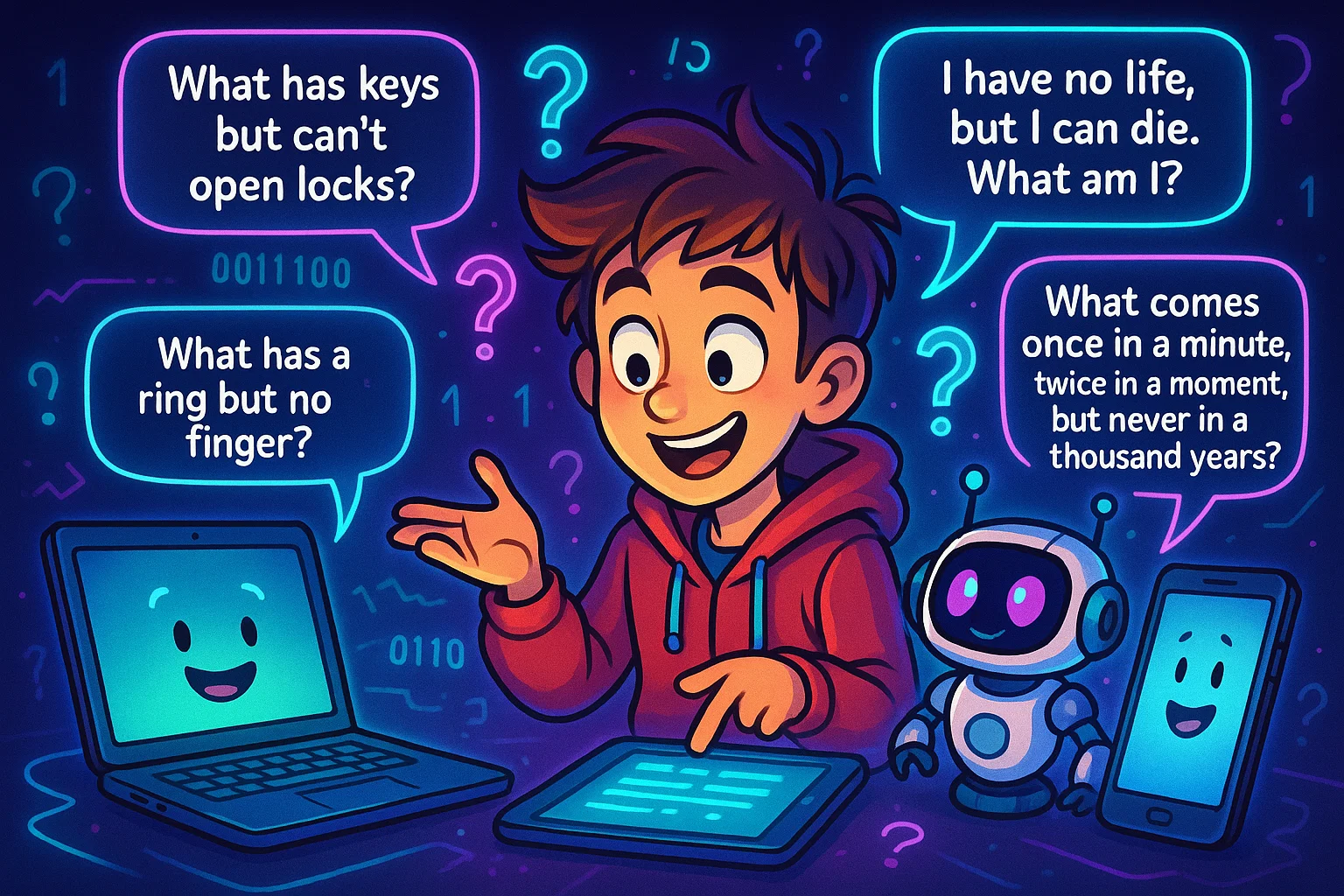
Riddles for teens often relate well to the digital world, blending humor with modern life.
Computer and Internet Riddles
These use modern digital terms to help kids think about technology.
- I have a lot of keys, but I can’t go inside the lock. I help you write. What am I? (A keyboard)
- I come alive with a click, but I don’t have lungs to breathe. I take you to new places instantly. What am I? (A hyperlink/URL)
- I have a big memory, but I don’t have a brain. I go inside your computer. What am I? (Hard drive/Storage)
- I am a network, but I can’t go on the road. I connect your devices. What am I? (Wi-Fi)
Gaming Riddles
Fun for those who spend time in virtual worlds.
- I am a world you can go inside, but I am not a room. I have levels and bosses. What am I? (A video game)
- I am a handheld device, but I don’t have lungs. I come alive with a tap. What am I? (A console/gaming handheld)
- I am your avatar, but I don’t have hair on his head in real life. I represent you in a virtual world. What am I? (A game character)
Logic-Based Digital Puzzles
Hard riddles about the abstract concepts of technology.
- I am all code, but I can come alive and talk to you. I am smart, but I don’t have a brain. What am I? (AI/Chatbot)
- What is always growing in value and size, yet you can keep it all day without it being stolen? (Data/Knowledge)
Holiday and Seasonal Riddles
Adding a seasonal or topical twist makes riddles great for parties and family gatherings.
Halloween Riddles
Funny riddles that are spooky but safe for teens.
- I am wrapped up, but I don’t have lungs. I am a monster, but I don’t have hair on his head. What am I? (A mummy)
- I fly at night and hang upside down. What am I? (A bat)
Christmas and Winter Riddles
Celebrating the cold and gift-giving season.
- I melt when I am warm and make the world white. I can’t go inside the house. What am I? (Snow)
- I am full of gifts, but I am not a store. I go inside your house under a tree. What am I? (Santa’s sack/Stocking)
Summer Vacation Riddles
Focusing on fun and relaxation.
- I am warm and bright, but I can’t go inside the ocean. I help you tan. What am I? (The sun)
- I am a big stretch of sand, but I can’t go inside your pocket. People relax on me. What am I? (The beach)
Riddles About Objects and Everyday Things
These best riddles encourage kids to think creatively about the mundane objects surrounding them.
Household Object Riddles
Making teens look twice at familiar items.
- I have hands, but I can’t clap. I tell you the time. What am I? (A clock)
- I have a big mouth but never speak. I go inside your bathroom. What am I? (A sink)
School Supply Riddles
Relatable to their daily school experience.
- I have pages but I don’t have lungs. I go inside a backpack. What am I? (A book)
- I have ink but I can’t go inside a pool. I help you write. What am I? (A pen)
Transportation and City Riddles
Focusing on the larger world outside their home.
- I have many windows, but I am not a house. I move people around. What am I? (A bus/train)
- I have streets, but I can’t go anywhere. I have many tall structures. What am I? (A city)
Create Your Own Riddles
One of the most powerful ways to strengthen critical thinking skills is to move from solving to creating. Encouraging teens to create their own riddles is a great exercise in problem-solving and creative expression.
Start With the Answer
The easiest way to begin is to pick an object first. For example, let’s pick a cloud.
- Brainstorm: What are its qualities? (White, fluffy, floats, gives rain, moves, changes shape, doesn’t have lungs).
Think Like Your Object
Next, describe the object using metaphorical or abstract terms. How would a cloud describe itself without saying its name?
- “I am white and high, but I am not a flag.”
- “I have water, but I can’t go inside a cup.”
Add a Clever Twist
The final step is to make the riddle tricky by adding a misleading clue or a double meaning. This is where you challenge kids to be clever.
- Example: “I am fluffy and white, I don’t have lungs to breathe, but I pour water on the world when I cry.” (A cloud)
Benefits of Riddles for Teenagers
The value of solving riddles goes far beyond simple entertainment. When teens practice cognitive flexibility through riddles, they build transferable skills for school and life.
Boosts Focus and Memory
- Attention Span: Hard riddles demand sustained focus. To unravel a tricky riddle, the teen must pay close attention to the details and hold them in their working memory while attempting different solutions.
- Cognitive Agility: The constant mental shifting required to interpret clues helps get their brains working quickly and efficiently, a skill valuable for studying and taking exams.
Improves Problem-Solving Skills
- Lateral Thinking: Riddles use language to force thinking outside the box. They teach that the most obvious answer is often a distraction and that complex problems can have simple, elegant solutions. This ability to think creatively is the core of problem-solving.
- Analytical Skills: When trying to stump a peer with a clever riddle, the teen learns to analyze their own word choices and the impact of the phrasing. This analysis is a core problem-solving skill.
Encourages Social Interaction
- Peer Bonding: Sharing funny riddles or a particularly hard riddle is a great way to initiate conversation and friendly competition. It encourages social interaction and collaboration as teens solve a riddle together.
- Verbal Communication: Explaining a complex riddle or its logic improves articulation and clarity – an essential confidence-building skill for teens.
More Brain Games and Logic Challenges
If your teen is a great fan of riddles for teens, there are other activities that can similarly enhance their critical thinking skills and help get their brains working.
Word and Number Puzzles
| Activity | Skill Enhanced | Description |
| Sudoku | Logic, Pattern Recognition | Requires deductive reasoning to place numbers based on established rules. Excellent for problem-solving. |
| Crosswords | Vocabulary, General Knowledge | Boosts word power and knowledge recall. Great for helping kids to think about semantics. |
| Kakuro | Math, Deduction | A cross between Sudoku and crosswords, using numerical sums. Perfect for practicing subjects like math. |
Trivia Quizzes for Teenagers
Quizzes, like riddles, can also be a group activity that tests general knowledge, and turning learning into a social game. Focus on pop culture, history, and science to appeal to their interests.
Memory and Reaction Games
Quick challenges that demand fast processing help get their brains working quickly. Card games like ‘Memory’ or digital logic-based games can improve reaction time and short-term memory, skills that are crucial when facing a tricky riddle or a complex problem in subjects like math.
Remember: The goal is engagement. The best brain riddles are the ones that spark genuine curiosity and encourage your teen to think critically and creatively.