

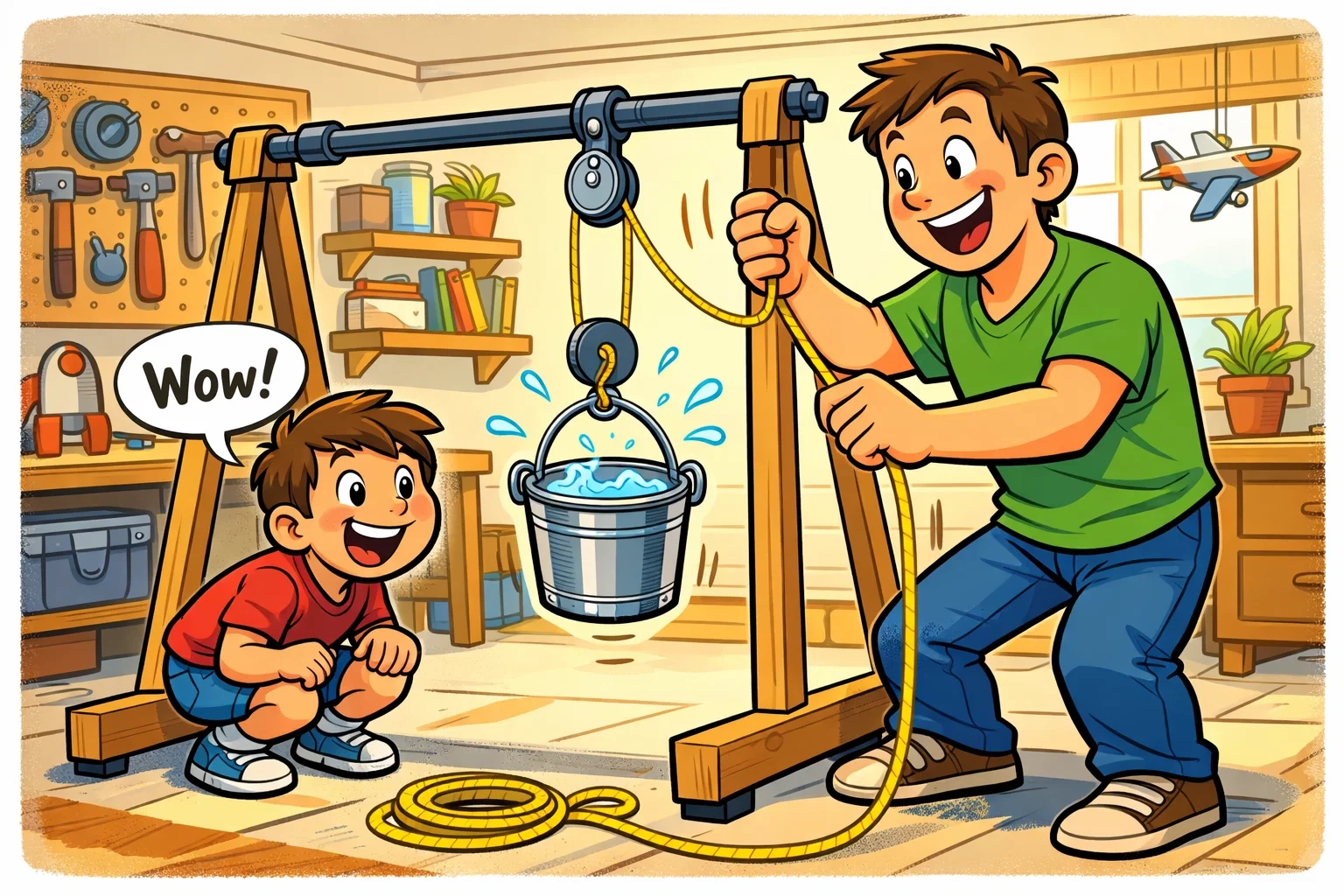
Discovering how to move heavy objects with just a string and a wheel is a moment of scientific magic for children. Pulleys are essential simple machines found everywhere, from construction cranes to school flagpoles.
By building a pulley system at home, young learners can:
- Transform abstract physics into tangible reality.
- Build “problem-solving brain wiring” (as noted by Neil deGrasse Tyson).
- Explore the mechanics that have shaped human civilization.
What Is Pulley?
In science, a pulley is a mechanical device that changes the direction or magnitude of a force to facilitate “work.” In physics, work is defined by a specific relationship:
Work = Force * Distance
The operation of a pulley is governed by key principles:
- Energy Transfer: Energy moves from the user’s muscles, through a cord, and into the load.
- Conservation of Energy: Energy is never created or destroyed, only redirected.
- Force Modification: The system allows for easier lifting by changing how and where force is applied.
Basic Parts of Pulley System
A functional setup requires three main components:
- The Wheel: Also known as a sheave, this is the circular part that rotates. It usually has a groove around its edge to keep the rope in place.
- The Axle: The central rod or pin upon which the wheel rotates. In home setups, this might be a pencil or a wooden skewer.
- The Rope: A flexible cord, twine, or cable that loops over the wheel to transmit force.
How Pulley Systems Redirect Force
The most immediate benefit of using a simple pulley is the ability to change the direction of effort. Typically, lifting a load requires pulling upward, which works against gravity and can be physically taxing. By looping a rope over a fixed support, you can pull downward. This allows you to use your own body weight to help lift the object, making the task feel much more manageable even if the amount of force required remains the same.
Science Behind Mechanical Advantage
Mechanical advantage is the factor by which a machine multiplies the input force. If a system has a mechanical advantage of 2, you only need to provide half the force to lift a specific weight. This concept is a cornerstone of engineering. However, physics dictates a trade-off: to use less force, you must pull the rope over a longer distance. This “Great Trade-off” ensures that the total work remains constant, adhering to the laws of thermodynamics.
Types of Pulley Systems Explained
Understanding the different types of pulleys allows kids to experiment with how force and distance interact. Each configuration offers a unique scientific lesson.
Fixed Pulley: Changing Direction
In a fixed pulley, the axle is anchored to a stationary support, such as a hook or a beam. This system has a mechanical advantage of 1. While it doesn’t reduce the force needed to lift a load, it allows for redirection. A classic example is a flagpole or a clothesline. It is the most intuitive version for younger children to explore first.
Movable Pulley: Reducing Effort
A movable pulley is attached directly to the load itself and moves along the rope. This configuration effectively splits the weight between two segments of the rope. Because each side of the rope supports half the weight, the user only needs to apply half the force. This provides a mechanical advantage of 2. It is a striking demonstration for kids to feel a heavy bucket of toys suddenly become “lighter.”
Compound Pulley: Combining Strength
Commonly referred to as a “block and tackle,” a compound pulley combines both fixed and movable wheels. This setup allows you to change the direction of force while simultaneously magnifying your effort. As more wheels are added, the mechanical advantage increases.
| Pulley Configuration | Mechanical Advantage (MA) | Direction Change | Input Force vs. Load |
| Single Fixed | 1 | Yes | Force = Load |
| Single Movable | 2 | No | Force = 0.5 x Load |
| Compound (2 wheels) | 2 | Yes | Force = 0.5 x Load |
| Complex (N ropes) | N | Yes/No | Force = Load / N |
Essential Supplies for DIY Pulley Projects
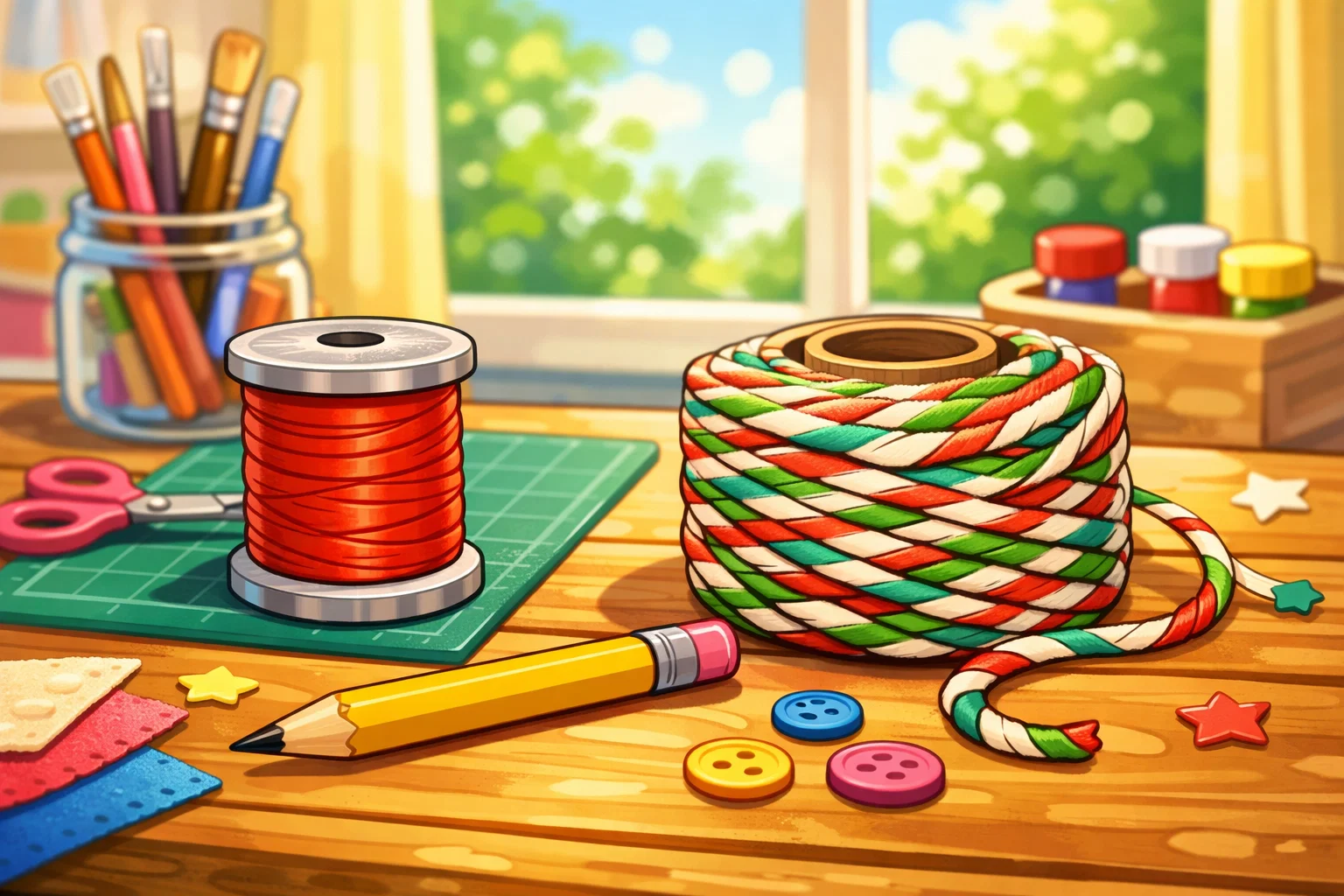
You don’t need a laboratory to explore these machines. Most components are likely already in your kitchen or craft drawer.
Household Items for Pulley Wheels
The best homemade “wheels” are items that have a natural groove or a hollow center. Empty thread spools are the gold standard because they are designed to hold thread and have a perfect axle hole. Other options include:
- Empty toilet paper rolls (with cardboard rims added).
- Plastic bottle caps with a hole poked through the center.
- Rolling pins (for a large-scale fixed pulley).
Best Strings and Ropes for Low Friction
The choice of cord is vital. Avoid stretchy materials like yarn or rubber bands, as the force will go into stretching the material rather than lifting the load. Use inelastic options such as:
- Braided nylon mason line.
- Strong shoelaces.
- Cotton twine.
Creative Load Containers and Baskets
To lift items, you need a “basket.” Small plastic cups, sand buckets, or even a recycled strawberry container work well. Ensure you can tie the string centrally to maintain a stable center of gravity.
How to Make Simple Pulley System: Step-by-Step Guide

Follow these steps to build a reliable setup at home.
Step 1: Prepare Load Basket
Take a small cup and poke two holes near the rim on opposite sides. Thread a short piece of string through these holes to create a handle. Fill the basket with “cargo” like marbles, pebbles, or small toy cars.
Step 2: Assemble Axle and Suspension
Slide your thread spool onto a smooth axle like a pencil or a wooden skewer. Secure the axle horizontally. You can tape the ends of the pencil between two chairs or have a partner hold it steady. Ensure the spool can spin freely with minimal friction.
Step 3: Thread System for Testing
Loop your long piece of string over the spool. Tie one end to the handle of your load basket. Grab the other end and pull. You have just created a fixed pulley!
Pulley Science Experiments for Young Engineers
Once the basic structure is built, it is time to investigate. Educational research emphasizes that hands-on learning is significantly more effective than passive observation. In fact, a major meta-analysis found that failure rates in STEM subjects are 55% higher under traditional lecturing compared to active learning.
Lifting Heavy Objects with Less Force
Try lifting a heavy object by hand first. Then, set up a movable pulley. Ask the child to describe the difference. They may indicate that it feels much easier, which suggests that the mechanical advantage is at work. This is the “superhero” effect of physics.
Measuring Distance vs Effort
Use a ruler or measuring tape. If you want to lift the bucket 10 centimeters using a compound system (MA of 2), how much rope do you have to pull? You will find that you must pull 20 centimeters. This demonstrates the conservation of work: you trade distance for ease of force.
Investigating Friction and Smooth Motion
Friction is the “enemy” of the ideal machine. Try using a rough string vs. a smooth nylon cord. You might observe that the effort required is greater when friction is high. Adding a tiny drop of cooking oil to the axle can demonstrate how lubrication improves efficiency.
Challenging STEM Activities with Pulley Variations
For older children, move beyond the basics into complex engineering.
Build Working Toy Elevator
Construct a tall frame using cardboard boxes. Use a pulley at the top to create a lift that can move “passengers” between different floors of a toy house. This connects the experiment to modern technology and architecture.
Create Tabletop Flagpole Project
Use a long dowel or a wrapping paper tube as the pole. Attach a fixed pulley to the top and a cleat at the bottom. This allows kids to see how pulleys are used for ceremonial and functional height-based tasks.
Design Multi-Wheel Block and Tackle
Challenge your young engineer to use four spools and one long string. Can they lift a very heavy load, like a large bag of flour, using only one finger? This explores the limits of mechanical advantage in a domestic environment.
Real-World Applications of Pulleys
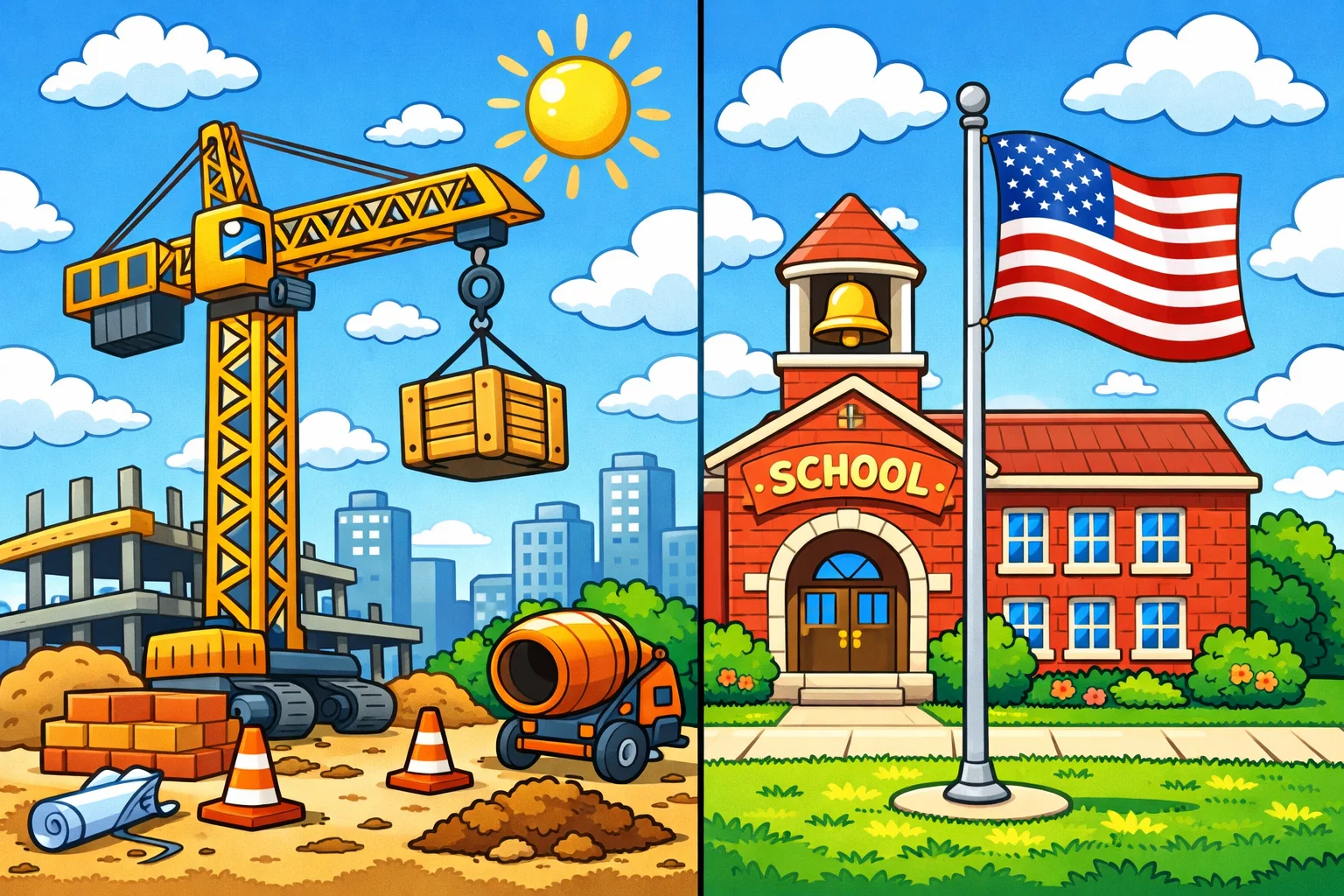
Connecting home projects to the outside world reinforces learning. Pulleys are not just toys; they are essential tools for modern life.
Construction Cranes and Heavy Lifting
Cranes use massive block and tackle systems to lift steel beams. Without these simple machines, the skyscrapers we see today would be impossible to build.
Window Blinds and Home Mechanics
Many household window blinds use a small pulley hidden in the top casing. When you pull the cord down, the blinds move up — a perfect example of force redirection in a confined space.
Elevators and Transportation Technology
Modern elevators rely on complex pulley systems and counterweights. Jan Bernard of Dragon’s Den Curriculum notes that these machines are woven into the very fabric of our culture and history.
Why Hands-On Physics Matters for Child Development
The impact of these experiments extends well beyond test scores. Data from the U.S. Bureau of Labor Statistics suggest that STEM occupations are projected to grow by about 8.1% between 2024 and 2034, nearly three times the rate of non‑STEM jobs, yet many students still leave these pathways due to low engagement.
Building Critical Thinking and Problem-Solving Skills
When the rope slips or the spool sticks, children naturally engage in troubleshooting. They might suggest adding cardboard “rims” to the spool. This iterative process builds “problem-solving brain wiring” that is useful in all areas of life.
Improving Fine Motor Skills through Construction
Tying knots, threading spools, and stabilizing structures require precision. These activities help develop the hand-eye coordination necessary for future technical tasks.
Boosting Confidence with Successful Engineering
Completing a working machine provides a sense of self-efficacy. Students who encounter and fix “fail points” develop higher resilience, a trait that the National Science Teaching Association (NSTA) highlights as vital for academic success.