

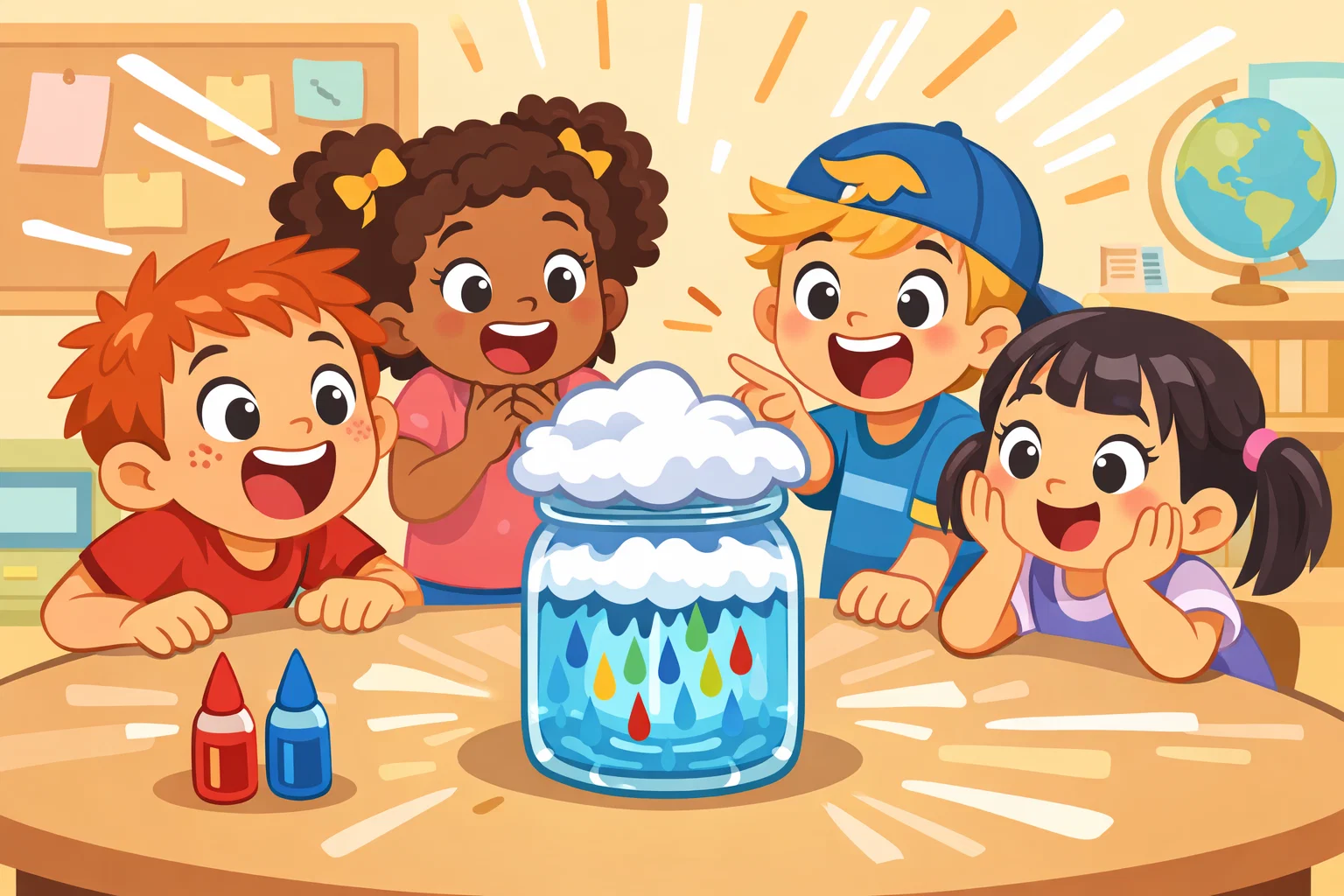
The cloud in a jar experiment is one of the most beloved and visually striking science activities for young learners. It serves as a gateway into the fascinating world of meteorology, allowing children to observe basic atmospheric processes in a controlled, miniature environment. By using a few simple household items, you can transform a kitchen table into a weather laboratory, making otherwise invisible processes like water vapor and condensation visible to the naked eye. Kids are often mesmerized by how the “rain” eventually breaks through the cloud layer, providing a “wow” moment that cements scientific principles more effectively than a textbook ever could.
This jar science experiment is popular in early childhood education and homeschooling because it bridges the gap between abstract concepts and tangible reality. Children don’t just hear about how sky patterns develop; they see a cloud-like formation form right in front of them. It is an ideal weather science project because it is low-cost, high-engagement, and safe for a wide range of ages. Whether you are a parent looking for a weekend science activity or a teacher planning a comprehensive weather unit, this experiment offers a hands-on way to explore the water cycle with ease.
Purpose of Cloud in Jar Experiment
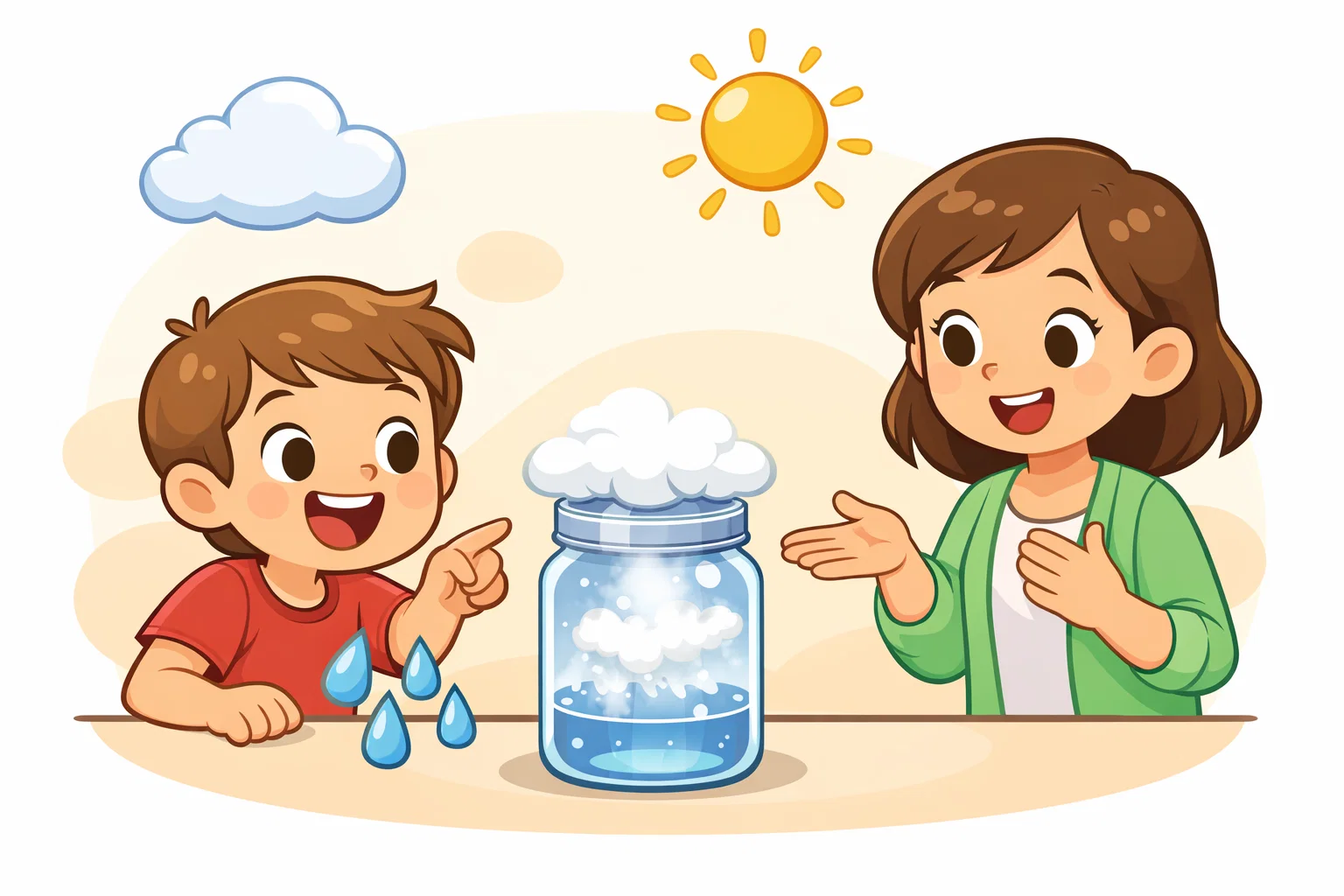
The primary goal of the cloud in a jar science project is to make weather phenomena easier to understand. For a child, the fluffy white shapes above might seem like solid pillows or magical fluff; this experiment grounds those observations in physics. By recreating the weather science experiment at home, kids develop foundational observation and prediction skills. They learn to ask, “What happens if I add more water?” or “Why does the color stay at the top of the jar for a while before falling?” These questions are the building blocks of the scientific method and critical thinking.
Weather concepts demonstration
The experiment is a perfect microcosm of the water cycle. It demonstrates evaporation (represented by the warm water), condensation (the formation of the mist), and precipitation (the “rain” falling through). It helps children understand that clouds are not solid objects but collections of tiny water droplets that eventually become too heavy to stay suspended in the air.
Visual learning benefits
Visual aids are essential for early cognitive development. Learning that combines visual elements with explanation helps children better understand and remember new concepts. The use of vibrant food coloring and the fluffy texture of shaving cream provides a sensory-rich experience. Watching the blue food colouring swirl through the warm water mimics the movement of a real rainstorm, helping kids intuitively grasp basic ideas of saturation and density.
Age groups suitability
One of the best things about this jar activity is its versatility.
- Preschool (Ages 3-5): Focus on the sensory aspect – the “fluffy” texture and the “pretty” rain. It’s a great way to introduce basic vocabulary like rain and water.
- Elementary (Ages 6-10): Students can start tracking the time it takes for the “rain” to fall and discuss the actual science of water vapor in the jar.
- Middle School (Ages 11–13) / Homeschool: Older students can delve into the role of aerosols and particles by using the “smoke” version of the experiment (with adult supervision) to see how moisture needs a surface to cling to.
Materials for Cloud in Jar Experiment
You don’t need a high-tech lab to make a cloud. Most of these items are likely sitting in your pantry or bathroom cabinet right now.
Household materials list
To perform the most common version (the “Rain Cloud in a Jar”), you will need:
- A clear glass jar: A mason jar or any large glass jar works best.
- Warm water: This represents the moist, warm air found near the Earth’s surface.
- Shaving cream: (The foam kind, not the gel) This represents the aerosol structure.
- Food coloring: Blue is classic, but any color works to represent precipitation.
- Pipette or dropper: For controlled “rain” application.
| Material | Purpose in Experiment | Real-World Equivalent |
| Warm Water | Creates moisture | Warm surface water |
| Shaving Cream | Acts as a barrier | Cloud layer holding moisture |
| Food Coloring | Visual “rain” | Heavy precipitation |
| Glass Jar | Containment | The atmosphere |
Safety notes for kids
While this is a simple and easy project, adult supervision is always recommended.
- Glass Handling: Ensure the jar is placed on a stable surface to prevent breakage.
- Non-toxic items: Use standard shaving cream and food-grade coloring.
- Heat Safety: The water should be warm, not boiling, to avoid burns or cracking the glass.
- Cleanup: Keep paper towels nearby, as blue food colouring can stain porous countertops!
Optional learning enhancements
To turn this into a full weather unit study, consider adding:
- A magnifying glass: To look closely at the water droplets forming at the edge of the foam.
- A stopwatch: To time how long the foam layer holds the “rain” before it breaks.
- Science Journal: Have the child draw what they see a cloud doing at different stages of the experiment.
Setup Process for Cloud in Jar Experiment
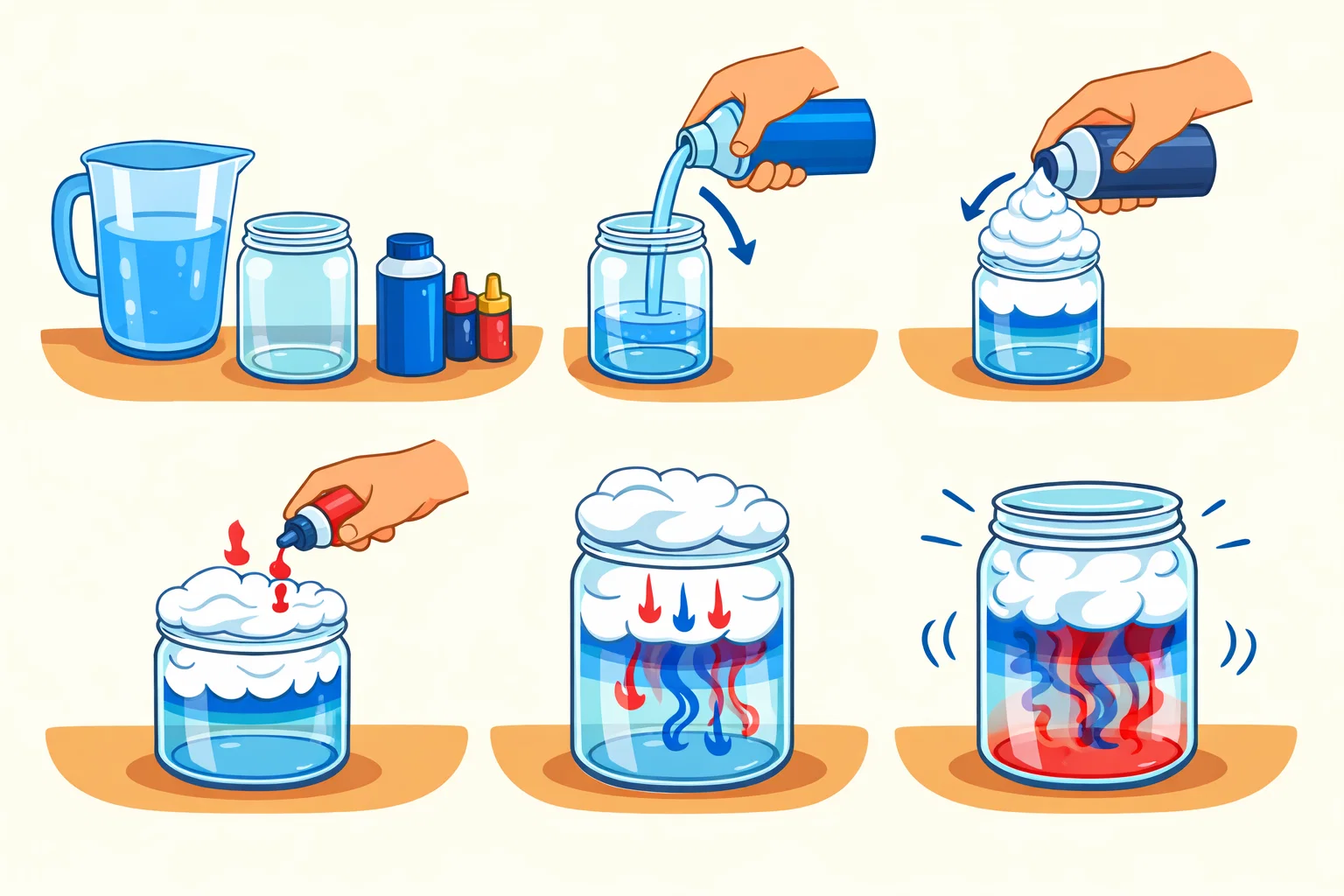
A smooth science experiment starts with a good setup. Preparation prevents frustration and ensures the kids stay focused on the “magic” of science.
Jar preparation
Fill your jar about 3/4 full with warm water. Using warm water is a great way to ensure there is enough humidity within the jar to simulate a moist atmosphere. Make sure the glass is clean so the kids can see the “rain” falling clearly without streaks or smudges.
Cloud layer creation
Squirt a generous layer of shaving cream on top of the jar. You want it to look like a puffy cumulus-like cloud, but don’t overdo it! If the layer is too thick (thicker than about 2–3 cm), the “rain” will take a very long time to break through, which might test the patience of younger participants.
Experiment space setup
Choose a well-lit area, preferably near a window or under a bright kitchen light. This helps the particles and colors stand out. It helps to place the jar on a white tray or a piece of white paper; the contrast makes the falling “rain” much easier to track.
Step-by-Step Cloud in Jar Instructions
Follow these steps to create your own weather model and simulate rain with your little scientists.
Step one: water vapor simulation
Once the warm water is in the jar, explain that this represents the air on a warm day. In the real world, the sun heats the water in our oceans and lakes, causing it to evaporate and rise into the sky as water vapor.
Step two: cloud formation
Add the shaving cream cloud. Explain that as water vapor rises, it cools and condenses. In our jar science experiment, the shaving cream is our model of a condensed moisture layer – a collection of billions of tiny droplets suspended together in the sky.
Step three: rain simulation
Mix some blue food colouring with a small amount of water in a separate cup. Using a pipette, slowly drop the colored water onto the top of the jar. As you add more colored water to the foam layer, the structure becomes saturated.
Step four: observation stage
Watch the bottom of the shaving cream layer. Eventually, the colored water will become too heavy for the foam to hold. It will begin to streak down into the clear warm water below. This is precipitation! Ask the child: “What does it look like? Is the rain falling fast or slow?”
Science Explanation Behind Cloud in Jar Experiment
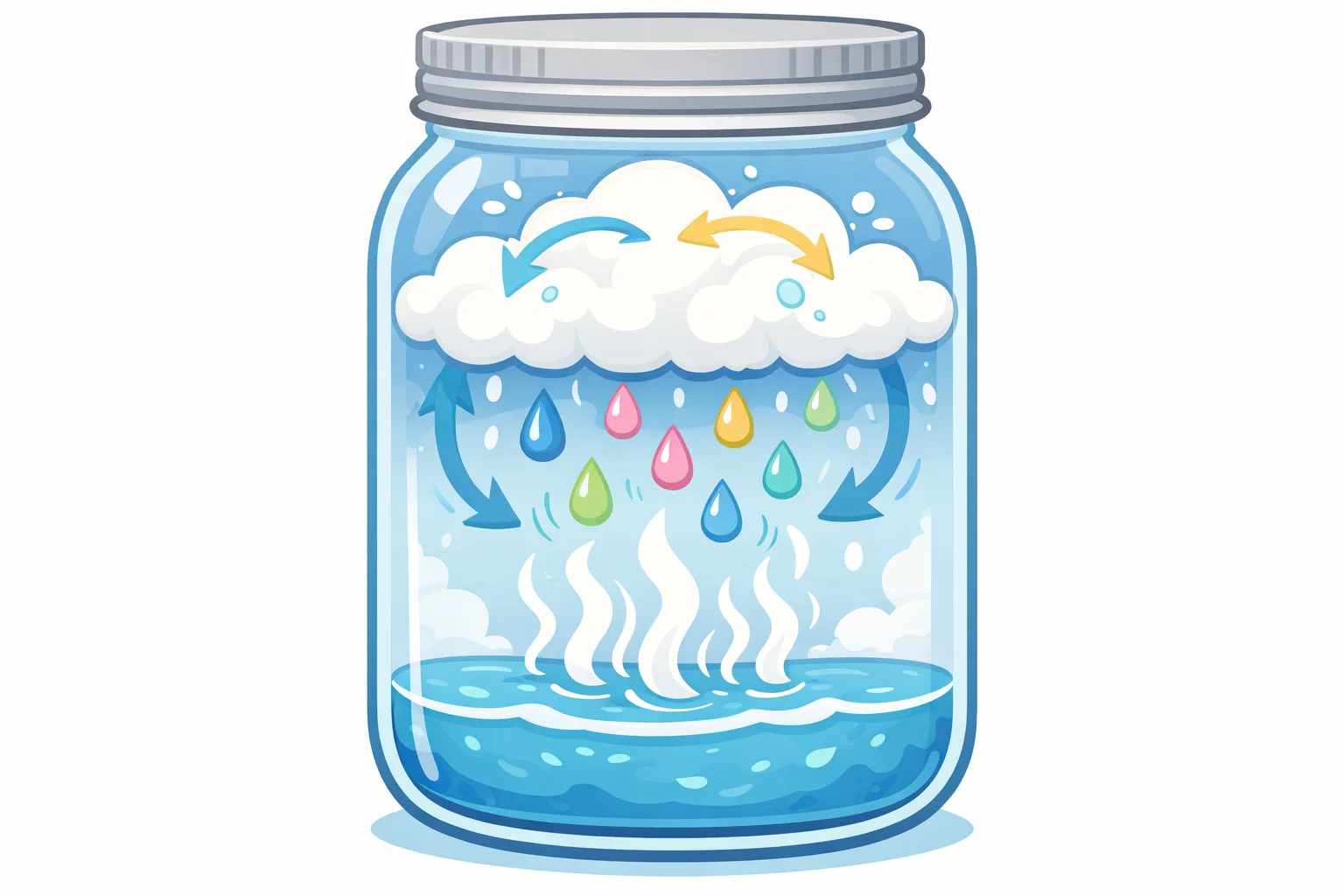
To provide a deeper science activity for older kids, you can introduce the “Aerosol Method.” This version actually creates a visible mist inside the glass.
Condensation process
Clouds form when water vapor (gas) turns back into liquid water droplets. This happens when warm air rises and cools. However, water vapor can’t just turn into a mist on its own – it needs a “seat” to sit on. These “seats” are called condensation nuclei – tiny particles in the air such as dust, pollen, or smoke particles.
Precipitation process
In the shaving cream version, the “rain” falls because of gravity. When the fluffy layer can no longer hold the weight of the “rain” (food coloring), it must release it. In the real world, this is called saturation. When an air mass becomes fully saturated, precipitation can occur.
Real-world weather connection
Explain to the kids that every formation they see in the sky is doing exactly what is happening in the jar. When they see dark, heavy masses, it means those areas are full of condensed water and are getting ready to release precipitation.
Learning Outcomes for Kids
This fun and simple experiment is more than just a distraction; it’s a foundational educational tool.
Observation and prediction skills
Before adding the food coloring, ask: “How many drops do you think it will take before the rain falls?” This encourages them to make a hypothesis. Afterward, they can compare their guess to the actual result.
Cause and effect reasoning
Children learn that their actions (adding water) lead to a specific reaction (rain falling). This is a core concept in logical reasoning. They see that the moisture model has a limit to how much it can hold.
Early STEM engagement
By framing this as “being a scientist,” you build a child’s confidence in STEM (Science, Technology, Engineering, and Math). It makes science feel accessible and cool, rather than intimidating.
Cloud in Jar Experiment Variations
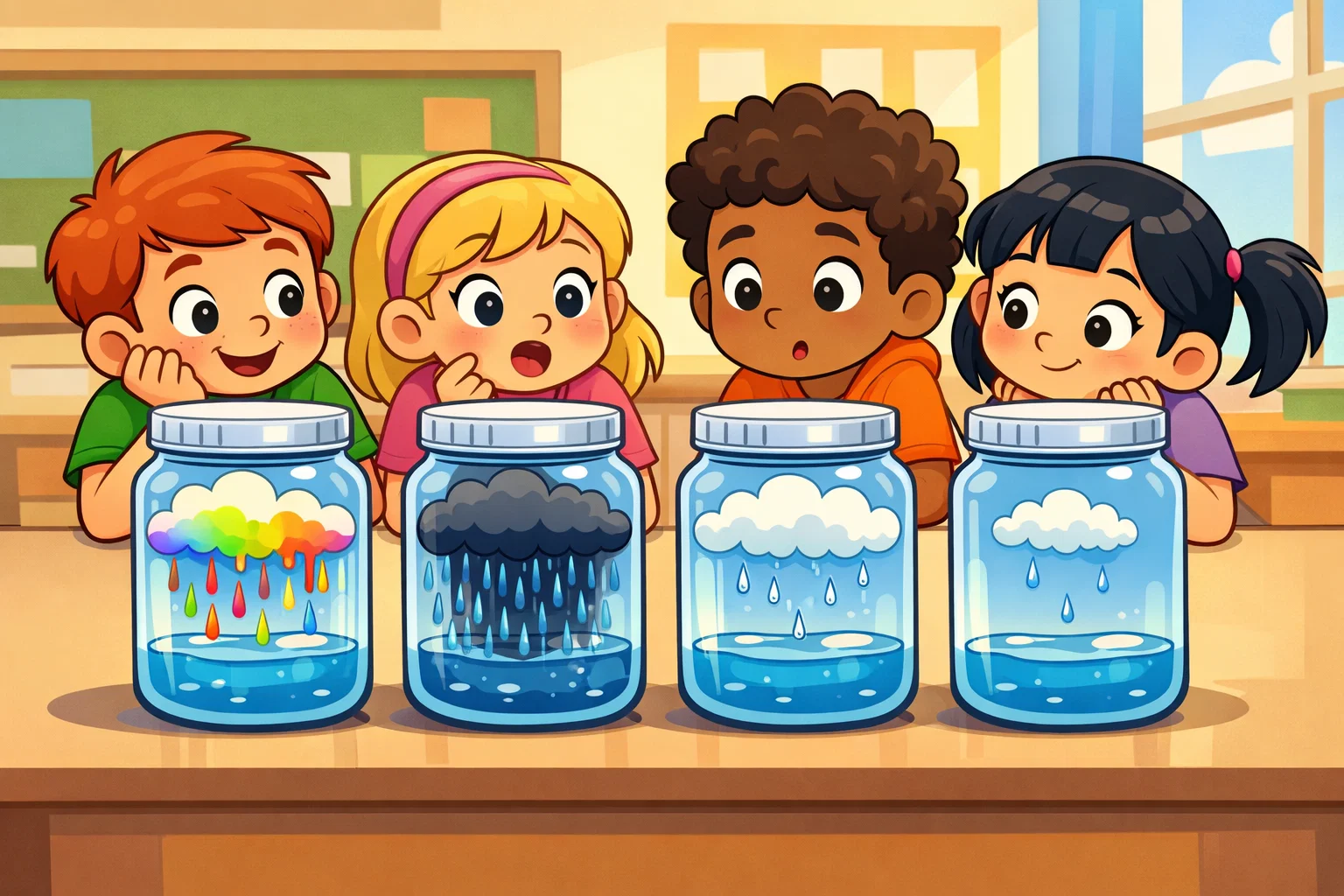
Don’t stop at one jar! Variety is the spice of science.
Color mixing variation
Use different colors of food coloring to represent different types of weather. Yellow and red can symbolically represent heat or dusty conditions while mixing them can show how different air masses interact.
Temperature comparison
Try one jar with ice-cold water and one with warm water. You will notice that the warm water jar produces more “mist” because it creates more water vapor. This is a cool science way to show why sky formations are more common in certain climates.
Group classroom version
In a classroom or at home with multiple kids, give each child their own small container. They can “race” to see whose experiment rains first. This is a great way to discuss variables – did one person use more shaving cream than the other?
Related Weather Science Experiments for Kids
If your little one is hooked on weather activities, try these next:
Rain cycle experiments
The Plastic Bag Garden: Tape a Ziploc bag with a little water inside to a sunny window. You will see evaporation and condensation happen over the course of a day on the plastic surface.
Cloud and atmosphere projects
The Bottle Experiment: Use a 2-liter bottle and a bicycle pump to rapidly change air pressure, which creates an instant, thick mist. This is a more advanced version of the cloud in a jar science project.
Seasonal weather activities
- Making Frost: Use a tin can, ice, and salt to see how moisture creates frost on surfaces.
- Wind Vanes: Use a straw and paper to measure the direction of the “atmosphere.”
Common Mistakes During Cloud in Jar Experiment
Sometimes science doesn’t go as planned! If your jar experiment isn’t working, check these common issues:
Incorrect water temperature
If the water is too cold, you won’t get the “foggy” effect on the glass. If it’s too hot, it might melt the shaving cream too quickly. Aim for “bathwater warm” for the best cloud simulation results.
Excess shaving cream usage
This is the most frequent mistake. A massive mountain of shaving cream looks cool, but the food coloring will just get trapped in the middle, and you’ll be waiting 20 minutes for it to “rain.” Use a thin, even layer for the best results.
Food coloring quantity issues
If you use undiluted food coloring, it might be too heavy and sink too fast. Mixing it with a little bit of water first makes the transition look more like rain and less like a heavy blob falling through the atmospheric model.
Tips for Teaching Cloud in Jar Experiment
Classroom engagement tips
Ask open-ended questions. Instead of saying, “Look at the rain,” ask, “What do you think is happening to the water inside the white foam?” Let the kids lead the discussion.
Home learning adaptation
For a fun and simple home version, let the kids help with the pouring and squirting. It’s a great fine-motor skill activity. A carefully placed jar on the counter allows them to see the “storm” at eye level.
Follow-up discussion ideas
- “Where does the water go after it rains?” (Introduces the concept of runoff and the water cycle).
- “Why are some formations white and some gray?” (Discusses density and light).