

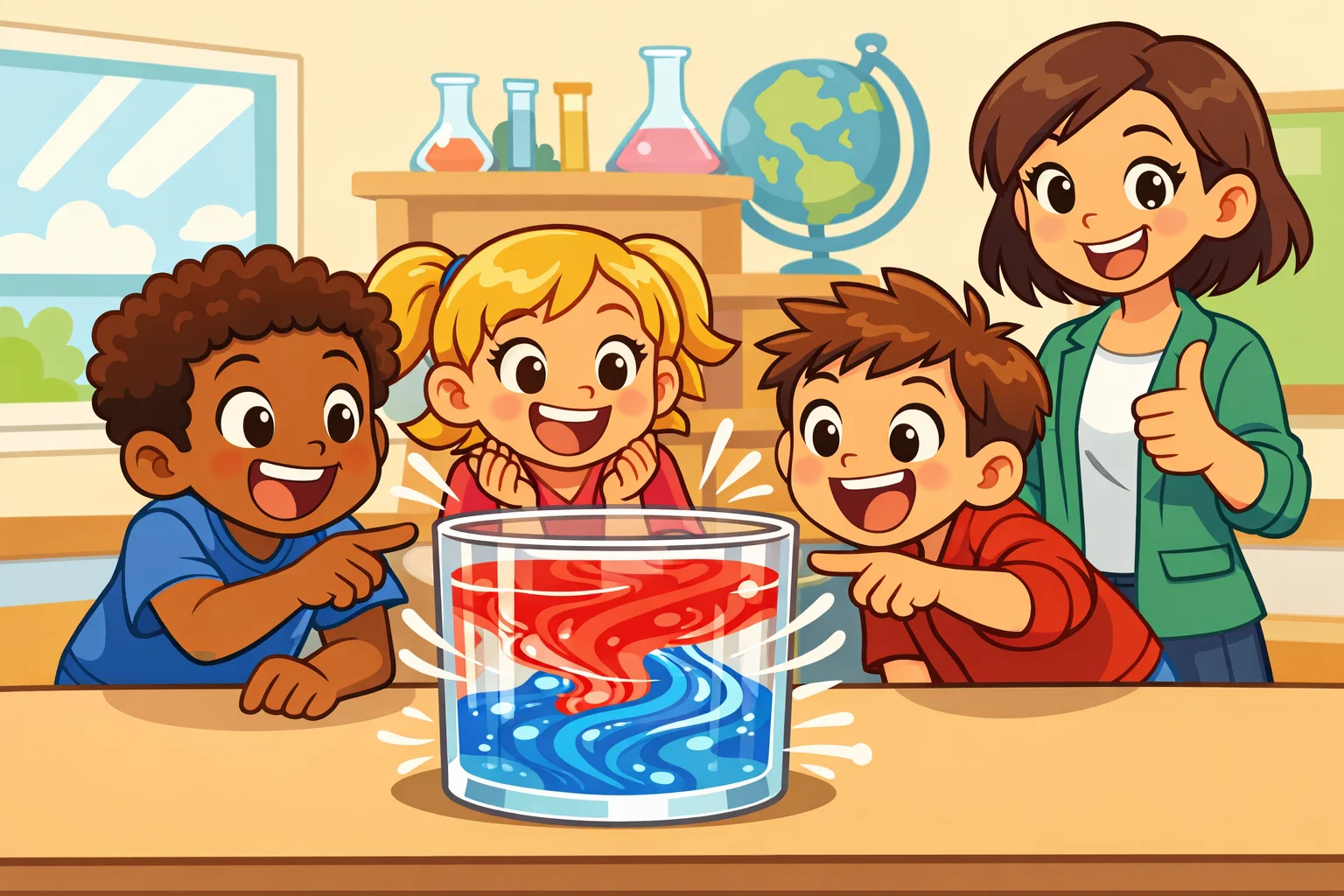
Understanding the vast movements of our planet’s oceans can feel daunting for young learners. However, you can bring the majesty of the ocean right to your kitchen table with a simple, high-impact science experiment. This activity demonstrates how thermal differences create ocean currents in a visual, hands-on way that transforms abstract concepts into tangible “aha!” moments.
Designed for children ranging from preschool through middle school, this STEM project uses common household materials like blue food coloring, red food coloring, and clear cups of water. By the end of this science activity, your little scientists will understand the foundational principles of ocean science, including density and convection currents, while having a blast watching vibrant colors dance and swirl.
Ocean Currents Experiment Overview

This ocean currents demo serves as a miniature model of the massive movements happening within our hydrosphere. By utilizing high-contrast dyes and varying thermal states, we can model key aspects of the “global conveyor belt” in a clear container. The activity focuses on the principle that fluid movement is not random; it is governed by physical laws that children can witness in real-time as colors migrate across the tank.
- Prep Time: 10 minutes (mostly for heating and cooling the liquids).
- Duration: 15–20 minutes of active observation and discussion.
- Primary Focus: Observing how cold water sinks while warm water rises to the surface.
- The “Wow” Factor: Watching the red water and blue water form distinct layers of the ocean before they eventually mix into a purple hue.
Learning Goal for Kids
The primary educational objective is for children to learn about ocean currents by observing how the marine environment moves based on its thermal state. Kids will discover that the liquid is denser when it is chilly, causing it to plunge toward the seafloor, while warmer flows are less dense and tend to float. This circulation creates a continuous “loop” known as a convection current, which is the primary mechanism for transporting heat, nutrients, and gases across Earth’s major bodies of saltwater.
Age Range and Skill Level
This ocean activity is highly adaptable to different educational stages, ensuring that the complexity of the explanation matches the child’s development.
- Preschool (Ages 3-5): At this level, the focus is on sensory observation. Parents should encourage kids to identify colors and predict where the “blue” or “red” will go.
- Elementary (Ages 6-10): Students can begin to use scientific terminology like density and surface currents. This is an ideal age to discuss how the sun warms the equator more than the poles.
- Middle School (Ages 11-14): Older students can dive into complex topics such as salinity, deep ocean currents, and how these movements affect global weather patterns and the ecosystem.
Science Concepts Covered
By participating in this hands-on activity, students explore the intersection of physics and geography. They learn about Thermodynamics, which is the study of how heat energy moves through a medium, and Fluid Dynamics, which examines the physics of flow. Crucially, the science experiment highlights the concept of density – the idea that cold water molecules move more slowly and stay closer together. Finally, it addresses Earth Science, specifically how temperature gradients affect ocean currents on a global scale.
Materials Needed for Ocean Currents Experiment
You don’t need a professional laboratory to explore marine science; the beauty of this stem project lies in its simplicity. Most of these items are already in your kitchen pantry or craft closet.
Basic Supplies
To begin, you will need a large, clear glass container – a rectangular baking dish or a small fish tank is perfect because it allows a “sideways” view of the layers of the ocean. You will also need a supply of hot water (warmed on the stove or in a microwave) and a separate container of cold water that has been chilled in the refrigerator. To make the movement visible, red and blue food coloring are essential. Finally, gather a few small cups of water to mix your dyes and a pipette or small spoon for a gentle, controlled pour.
Optional Tools for Better Visual Results
For a more advanced demo, consider using ice cubes made with blue food coloring to simulate the melting of arctic or antarctic glaciers. A thermometer can also be helpful for older children to measure exactly how colder or warmer the liquids are, allowing them to record data like real scientists. Some educators also use a flashlight; shining a beam through the side of the glass can make the food dye swirls look even more dramatic, highlighting the fine details of the water currents as they interact.
Safety Notes for Hot Water
Safety is a priority when conducting any science activity involving heat. Adult supervision is required whenever a child is working with red hot water to prevent accidental scalds. It is important to note that the liquid does not need to be boiling to show the effect; a temperature around 120°F (48°C) is usually sufficient to demonstrate that hot water is less dense. Always ensure the large container is placed on a stable, flat surface to avoid spills that could cause slips or burns.
How to Set Up Ocean Currents Experiment

Proper preparation is the key to a successful ocean science demonstration, as the visual impact depends on the temperature gradient between the fluids.
Preparing Hot Water
Fill a small vessel with very warm liquid. Add several drops of red food coloring until the fluid reaches a deep, vibrant crimson. This represents the warm water found near the equator, which is constantly being heated by direct sunlight. Ensure the dye is fully integrated so the color is uniform, making it easier to track as the water rises during the observation phase.
Preparing Cold Water
Take a cup of chilled H2O and, if possible, add an ice cube to keep the temperature as low as possible. Add blue food coloring until the liquid is a dark blue. This represents the cold water from the arctic or antarctic regions. Because water is denser when chilled, this blue water will provide a stark contrast to the red, helping kids observe what happens at the “poles” of their experiment.
Container Setup
Fill your large, clear container with room temperature water. It is vital to let this central reservoir sit for a few minutes until all water moves cease and the surface is perfectly still. This acts as our neutral “ocean” environment. If the central liquid is still swirling from being poured, it will prematurely mix the dyes, obscuring the natural convection current we want to see.
Hot and Cold Water Ocean Currents Experiment Steps
Now it’s time for hands-on exploration! Follow these steps carefully to ensure the colors stay separated long enough to see the flow patterns.
1. Adding Hot Water
Using a pipette or by pouring very slowly against the interior wall of the container, gently add a few drops of the red-colored hot water to one side of the tank. You should observe that the hot water stays near the top. Because the warm liquid is less dense, it will float and begin to creep across the surface of the water toward the opposite side, mimicking a surface current.
2. Adding Cold Water
Carefully introduce the cold blue water to the opposite side of the container, again using a slow and steady hand. Unlike the red liquid, the blue water will immediately begin to plunge toward the bottom of the tank. This provides a clear visual that cold water sinks because the fluid is denser when it loses heat. This simulates the deep ocean currents that travel along the seafloor.
3. Watching Water Movement
Sit back and watch the water currents interact over the next few minutes. You will see a beautiful circulation pattern: the red stream moves across the top toward the chillier side, while the blue water moves along the bottom toward the warmth. This is a convection current in action, showing how the major ocean basins constantly redistribute heat around the globe.
Why Hot and Cold Water Create Ocean Currents
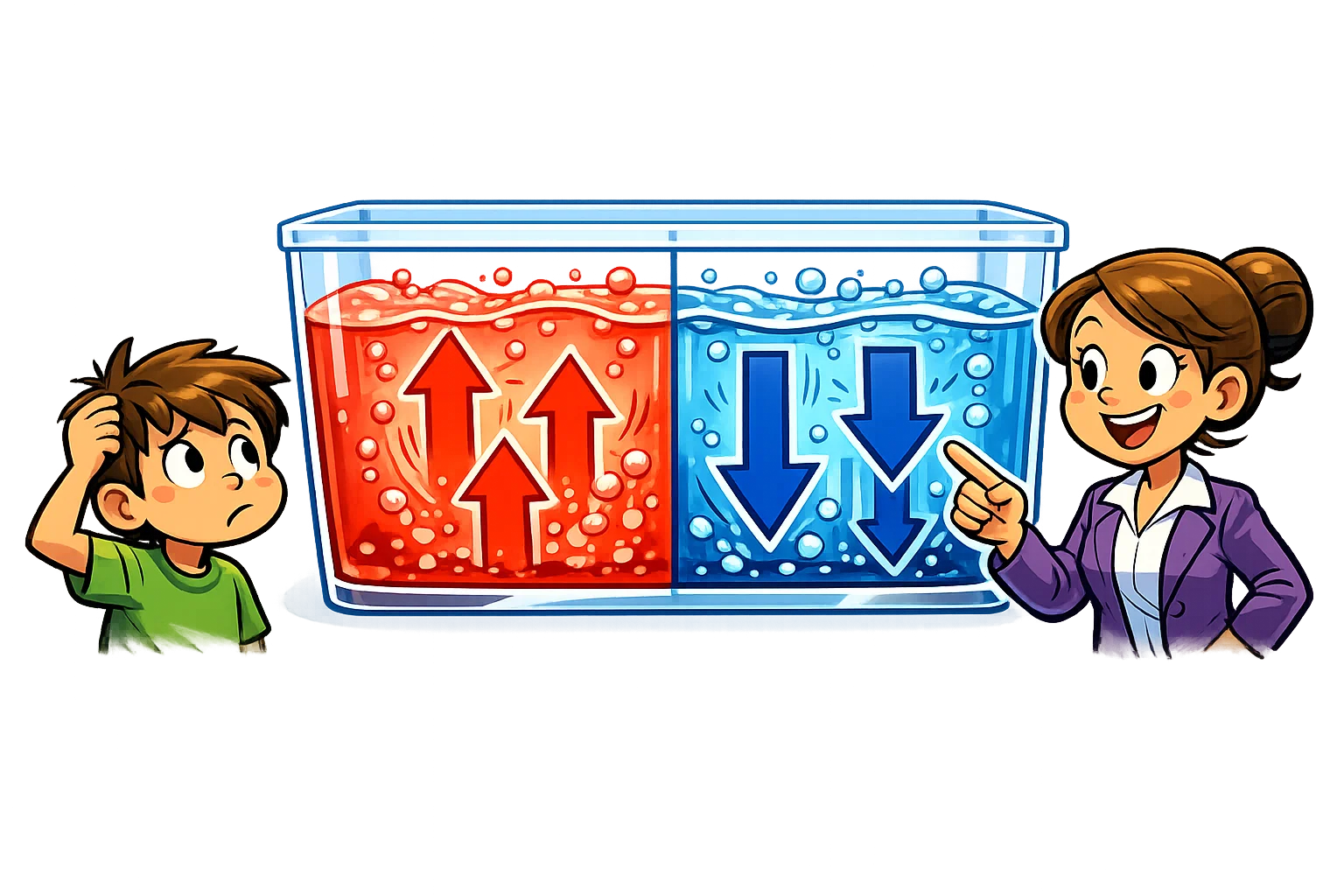
To understand the science of the sea, we must look at the behavior of the molecules within the aqueous solution.
Water Temperature and Density
Density is a measure of how much “stuff” is packed into a specific space. When the liquid is heated, its molecules gain kinetic energy, moving faster and spreading further apart. This makes the substance less dense, which is why hot water rises. Conversely, when the fluid is chilled, the molecules slow down and huddle together. This makes the cold water heavier for its volume – or denser – causing it to sink below the warmer layers.
| State of the Fluid | Molecular Density | Visual Behavior in Tank |
| Heated Water | Low | Rises and Floats |
| Chilled Water | High | Sinks and Dives |
| Ambient Medium | Medium | Passive Baseline |
Connection to Real Oceans
In the actual ocean, this process happens on a massive scale. The sun’s rays are most intense at the equator, creating vast reservoirs of warmer water. This heated mass travels toward the poles as surface currents. Once it reaches the arctic or antarctic, it loses heat to the atmosphere, becomes denser, and sinks. This “global conveyor belt” is essential for the ecosystem, as it carries oxygen to the deep sea and brings nutrients to the surface.
Everyday Examples
You can observe these same water currents without going to the beach. In a bathtub, you might notice the area near the faucet feels hot while your feet at the far end are in colder liquid. In a swimming pool on a sunny day, the top layer is warmer than the bottom because the warm water is less dense and stays at the surface. Even cooking pasta shows this; the rolling movement in the pot is caused by convection currents driven by the stove’s heat.
Ocean Currents Experiment Results to Discuss with Kids
The learning shouldn’t stop when the water mixes. Use the results of the science experiment to prompt deeper thinking.
What Kids Will Notice
Children will be fascinated by the way the blue water and red water initially refuse to blend. They will notice distinct layers of water forming, with a clear boundary between the two colors. Over time, as the temperatures equalize, they will see how the water mixes into a purple shade. This is a great opportunity to explain that in the real ocean, currents can travel thousands of miles before they finally lose their unique temperature and salinity characteristics.
Questions to Ask Children
Engage their curiosity with open-ended questions like: “Why do you think the red water didn’t sink to the bottom right away?” or “What would happen if we used salty water instead of fresh?” You can also ask them to imagine they are a fish: “Which current would you want to swim in to stay warm?” These questions help children relate the science activity to the real world and the living things within the marine environment.
Common Experiment Mistakes
Sometimes a demo doesn’t go as planned. If the colors mix instantly, it is likely because the liquid was poured too fast, creating mechanical turbulence that overrode the density differences. Another common issue is not having enough of a temperature gap; if the “hot” source is only lukewarm, it won’t float as effectively. Vibrations from a wobbly table can also disrupt the layers of the ocean, so a steady surface is a must for clear results.
Ocean Currents Extensions and Variations

Once your students have mastered the basics, you can introduce new variables to see how they affect ocean currents.
Wind Effect Variation
In the real world, the atmosphere and the ocean are constantly interacting. You can simulate the power of the wind by giving your child a straw and having them blow gently across the surface of the water. They will quickly see how the warmer water is pushed in the direction of the “wind,” demonstrating how major wind belts like the Trade Winds help drive the surface currents across the globe.
Land Mass Effect Variation
The major ocean currents don’t move in straight lines because they constantly bump into continents. To mimic this, place a large rock or a plastic container in the middle of your tank before you begin. Watch how the water moves around the obstacle. This illustrates why currents like the Gulf Stream curve along the coastlines of the hemisphere, diverted by the presence of landmasses.
Ice and Climate Variation
To discuss environmental science, place a large ice cube at one end of the container. As it melts, the colder meltwater sinks because it is denser than the surrounding warmer water than the surrounding medium. This variation is a powerful fun way to see how melting glaciers in the arctic might change the salt content and circulation of the world’s seas, potentially impacting the global climate.
Ocean Currents STEM Activities for Kids
Transform this easy ocean currents demo into a full STEM project by incorporating art, geography, and data tracking.
Ocean Currents Model Projects
Encourage children to create a 3D model of the ocean using a shoe box. They can use blue cellophane to represent the deep ocean currents and red ribbons for the surface currents. Alternatively, have them draw a map of the world and use arrows to show how water moves from the equator to the poles, labeling the arctic and antarctic zones.
Cross-Curriculum Ideas
Science doesn’t exist in a vacuum. You can connect this science activity to geography by researching the “Great Ocean Conveyor Belt.” In art class, students can create “Current Art” by dropping food dye into different liquids to see how they swirl. For a math challenge, older kids can use a stopwatch to time how fast the blue food coloring travels from one side of the container to the other, calculating the speed of their miniature current.
Classroom and Home Learning Tips
Whether you are an educator or a parent, these tips will help you manage the ocean science lesson effectively.
Classroom Setup Tips
In a classroom setting, it is best to organize students into small groups to ensure everyone can observe what happens closely. Use clear plastic bins for each group and have pre-measured cups of water ready to go. To make the colors pop, place a white sheet of paper behind the containers. This ensures the blue water and red water are highly visible even from the back of the room.
Home Learning Adaptations
If you don’t have a large tank at home, you can perform a “stacking” experiment using two identical jars. Fill one with red hot water and the other with cold blue water. Place a playing card over the hot jar, flip it over, and set it on top of the cold one. Carefully slide the card out. Because the hot water is less dense, it will stay in the top jar! If you flip them, the cold water sinks and the colors will mix instantly.
Assessment Ideas
To check for understanding, ask children to keep a “Science Journal” where they draw the experiment at three stages: the start, the middle, and the end. If they can accurately depict the red water on top and the blue water on the bottom, and explain that the difference is due to density, they have successfully mastered the lesson.
More Ocean Science Experiments for Kids
If your young scientists are hungry for more, there are many other ways to explore the wonders of the marine world.
Water Density Experiments
Density isn’t just about temperature; it’s also about salinity. You can repeat this experiment using salty water vs. fresh. Kids will find that salty water is much denser and will sink even if it is slightly warmer than the fresh liquid. This is a crucial concept for understanding how the Mediterranean Sea interacts with the Atlantic Ocean.
Marine Science Activities
To learn about biological adaptations, try the “Blubber Glove” experiment. Have kids put their hand in a bag filled with shortening (like Crisco) and then dip it into colder liquid. They will feel firsthand how fat protects marine mammals from the freezing temperatures of the arctic seas.
Seasonal Science Projects
Connect your experiments to the seasons! In the winter, you can study how salt is used to melt ice on roads, then discuss how that affects the salt content of local ponds and how those changes might affect ocean currents if they happened on a larger scale.
The ocean is a complex, beautiful system, but with a few cups of water and some food coloring, its secrets become accessible to everyone. By engaging in this hands-on ocean science activity, this activity goes beyond teaching facts and helps spark a lifelong curiosity about how Earth’s systems work together to support our ecosystem.