


Preparing a child for the world involves far more than academic achievement. While subjects like algebra or foreign languages matter, the ability to manage everyday situations – life skills – forms the real foundation of long-term success. As children move beyond toddlerhood, they begin developing independence, which requires practical tools, confidence, and everyday competence that support growth at every stage of development.
Helping a child progress from dependence to self-sufficiency is a gradual process that takes patience and consistency. From basic self-care and money awareness to critical thinking in a digital world, essential life skills shape a child’s ability to function confidently and responsibly. This guide outlines key skills that help children prepare for the challenges and opportunities of the 21st century.
Meaning and Role of Life Skills in Childhood

The term “life skills” refers to a broad set of psychosocial and interpersonal competencies that enable individuals to make informed decisions, solve problems, think critically, and manage their lives in a healthy and productive manner. In the context of childhood, a life skill is any ability that helps a child to learn how to function independently within their family and community. These are not just “extras”; they are the basic tools for survival and success.
Life skills play an important role in supporting mental well-being and helping children adapt to a changing environment. For a child, this means having the tools they need to handle a missed bus, a lost lunchbox, or a disagreement with a friend. When we teach children these abilities, we are giving them control of their lives, reducing anxiety, and fostering a sense of resourcefulness that will serve them well into adulthood.
Life Skills vs. Academic Skills
While schools focus heavily on literacy and numeracy, practical skills are often left to the home environment. Academic skills tell you what to know, but life skills tell you how to live.
- Academic skills: Focus on cognitive development, memorization, and standardized testing.
- Life skills: Focus on problem-solving, communication, and money management.
A child might be able to solve a complex equation but struggle to organise their backpack or make simple breakfast choices. Balancing these two types of education ensures that every child is not just “book smart” but “life smart.”
Benefits of early skill development
The earlier you start teaching these concepts, the more natural they become. Learning opportunities exist in every corner of a child’s day. When kids grow up in an environment where they are encouraged to perform basic tasks, they develop:
- Confidence: The “I can do it” attitude that stems from mastering a chore.
- Resilience: The ability to try again when a task (like tying a shoe) doesn’t go right the first time.
- Responsibility: Understanding that their actions have an impact on the household.
- Decision-making: Practicing how to make healthy choices regarding food or time.
Age-appropriate skill progression
It is vital to ensure that the skills for kids to learn are age-appropriate. Pushing a child too fast can lead to frustration, while waiting too long can hinder their independence.
| Age Range | Developmental Focus | Example Skill |
| Preschool (3-5) | Sensory & Basic Autonomy | Brushing teeth, putting toys away. |
| Early School (6-8) | Social & Household Contribution | Setting the table, communicating respectfully with peers. |
| Preteen (9-12) | Logic & Independence | Money management, preparing a simple meal. |
Essential Categories of Basic Life Skills for Kids
To help your child develop effectively, it helps to categorize these skills. This allows you to teach these skills systematically, ensuring no major area of development is overlooked.
Communication and Social Interaction
Good communication skills are perhaps the most important life skill a child can possess. This involves more than just speaking; it includes active listening, empathy, and the ability to communicate effectively in person and offline. In an age of digital saturation, help children prioritize face-to-face interaction. Show your children how to make eye contact, wait for their turn to speak, and resolve conflicts through words rather than physical outbursts.
Problem solving and decision making
We want our kids to learn how to think critically rather than looking to an adult for every solution. Problem-solving skills are built when we allow children to face small “crises”—like a broken toy—and ask them, “How do you think we can fix this?” This encourages resourcefulness and helps them understand cause and effect.
Self-management and responsibility
This category covers the “admin” of being a person. It includes keeping track of their belongings, staying on top of schoolwork, and understanding time. Time to teach these skills is often found in the morning rush or the evening wind-down. Using a visual schedule can help a child visualize their responsibilities.
Practical household competence
Every member of a family should contribute. A chore is not just a task; it’s a life skill that all children should master to understand the effort required to maintain a home. This includes organisational tasks like folding laundry or clearing the table, which teach the value of contribution.
Daily Life Skills Kids Should Practice at Home
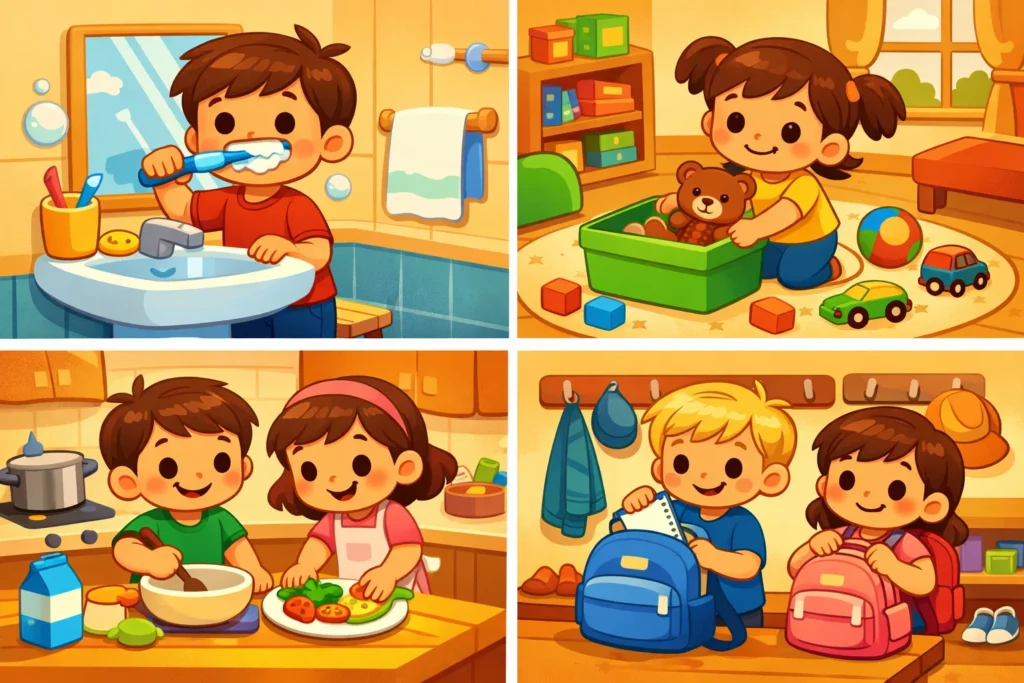
The home is the primary laboratory for life skills for kids. You don’t need a special curriculum; you just need to involve them in your daily rhythm.
Personal care and hygiene habits
Maintaining hygiene is a basic life skill that protects a child’s health and social standing. Help your child to learn the “why” behind the “what.”
- Brushing their teeth: Explain how it prevents cavities.
- Bathing: Make it a non-negotiable part of the routine.
- Dressing: Encourage them to pick out weather-appropriate clothes to help them understand logic and planning.
Simple cooking and food awareness
Food is a great way to teach science, math, and health all at once. Even young kids should learn where their food comes from. Start by letting them wash vegetables, then move to cracking eggs or spreading butter. As they get older, they can make simple snacks, which helps them feel confident and independent.
Household chores and contribution
Assigning simple chores is one of the best ways to teach responsibility. Starting simple chores at an early age can help children develop responsibility and independence over time.
- Toddlers: Pick up blocks, put dirty clothes in the hamper.
- School-age: Feed pets, water plants, empty the dishwasher.
- Preteens: Take out the trash, vacuum, help with grocery shopping.
Independence Skills for Safe Everyday Situations
As children grow, their world expands beyond the front door. They need tools to stay safe and navigate the world without constant adult supervision.
Navigation and spatial awareness
In the GPS era, the ability to find their way home is an important life skill that is being lost. When you go for a walk, ask your child to point the way back. Teach them landmarks like “the blue house” or “the big oak tree.” This builds a mental map and increases their resourcefulness.
Basic fixing and problem repair mindset
When something breaks, the instinct shouldn’t always be to throw it away. Help your child develop a “fix-it” mindset. Show them how a screwdriver works or how to use tape to mend a book. This teaches them to value their possessions and understand the mechanics of the world.
Risk awareness and common sense
Safety isn’t about avoiding all risks; it’s about managing them. Help your child develop an internal “risk meter.” Talk through scenarios: “If we are lost at the mall, who is a safe person to talk to?” This builds critical thinking skills that protect them when you aren’t there.
Emotional and Social Life Skills for Kids
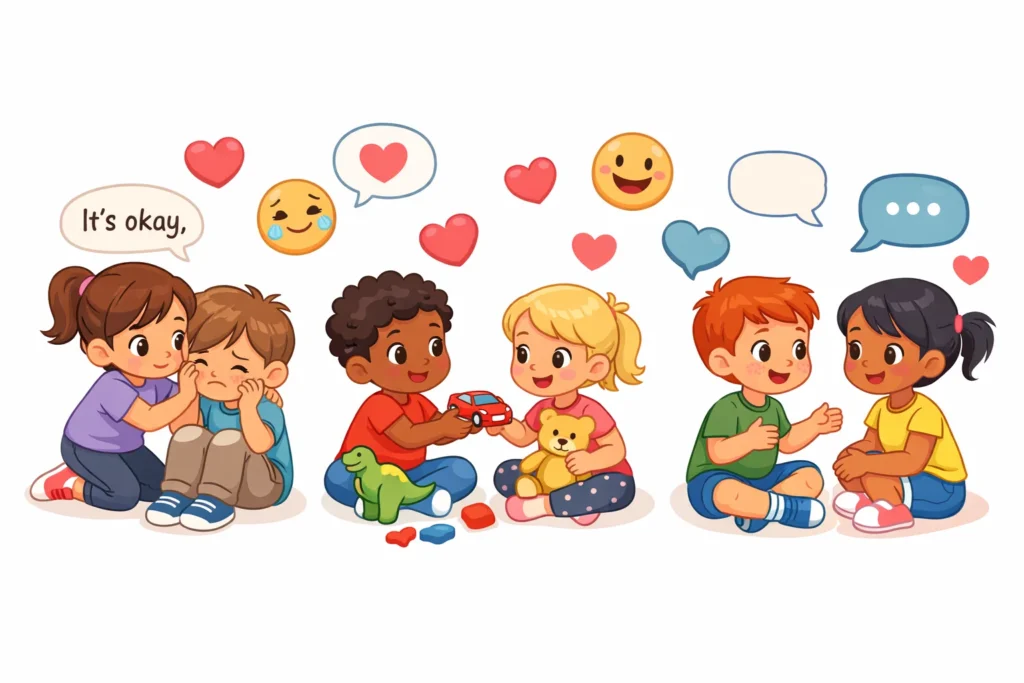
The “soft skills” are often the hardest to teach but provide the greatest lessons to build a happy life. These are the key life skills that help children become emotionally intelligent adults.
Emotional regulation and self-control
Coping mechanisms are essential for handling stress. If a child is frustrated, teach them to “take five” or use deep breathing. This skill helps them manage their impulses and will prevent many social and academic hurdles later on.
Empathy and perspective skills
A child needs to understand that other people have feelings too. Through regular family discussions, ask questions like, “How do you think your friend felt when you shared your snack?” This builds strong relationships and teamwork.
Screen-free communication habits
To keep your children grounded, designate “no-phone zones.” Real-world communication skills can weaken with excessive screen use. Encourage fun activities that require talking, like board games or playing outside, to ensure they can communicate effectively with real people.
Teaching Life Skills Through Everyday Activities
You don’t need to set aside hours of “teaching time.” Instead, look for learning opportunities in your current schedule.
Learning through routines and rhythm
Stay on top of life by using routines. A morning routine (get dressed, eat, brush teeth, pack a bag) teaches organisational skills without you having to nag. It helps kids grow into the habit of self-management.
Skill building through play and boredom
Boredom is the mother of resourcefulness. When kids are bored, they are forced to use problem-solving to entertain themselves. Fun and engaging play—like building a fort—teaches physics, cooperation, and planning.
Seasonal and holiday learning opportunities
Holidays are perfect for teaching money management and planning. If they want a specific gift, help them set savings goals. If you are traveling, let them help organise their own suitcase.
| Activity | Skill Taught |
| Grocery Shopping | Budgeting, comparing prices, healthy choices. |
| Family Camping | Navigation, fire safety, cooperation. |
| Hosting a Party | Social interaction, cleaning, hospitality. |
Life Skills by Age Range
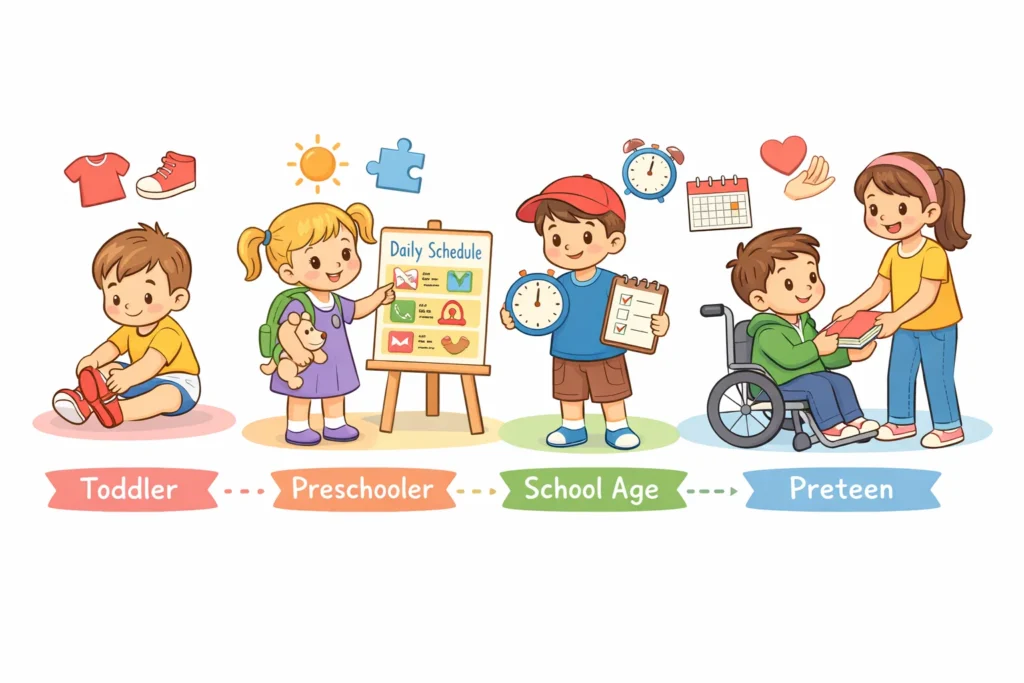
Life skills for preschool children
At this age, focus on the basics of the “self.” Help children learn to put on their shoes, wash their hands, and use their manners. These basic life skills are the first steps toward autonomy.
Life skills for school-age children
Now is the time to introduce the value of money. Use pocket money to teach them about saving and spending. Encourage them to play outside unsupervised in safe areas to build spatial awareness.
Life skills for preteens
Preteens are ready for more complex financial decisions. Explain how much things cost, from electricity to Netflix subscriptions. This is also the time for safe online practices and understanding the long-term impact of their digital footprint.
Common Challenges Parents Face When Teaching Life Skills
Balancing safety and independence
It’s natural to want to keep your children safe, but “helicopter parenting” can prevent them from becoming self-sufficient. Start with small “controlled risks,” like letting them cross a quiet street or use a toaster.
Managing screen time impact
The digital world can be a distraction from learning practical skills. Ensure they have a balance of safe internet use and “dirt-under-the-fingernails” real-world experience.
Motivation and consistency difficulties
If your child resists a chore, try to make it fun and engaging. Use a chart to track progress or do the tasks together as a family fun activity. Help them stay motivated by praising their effort rather than just the result.