

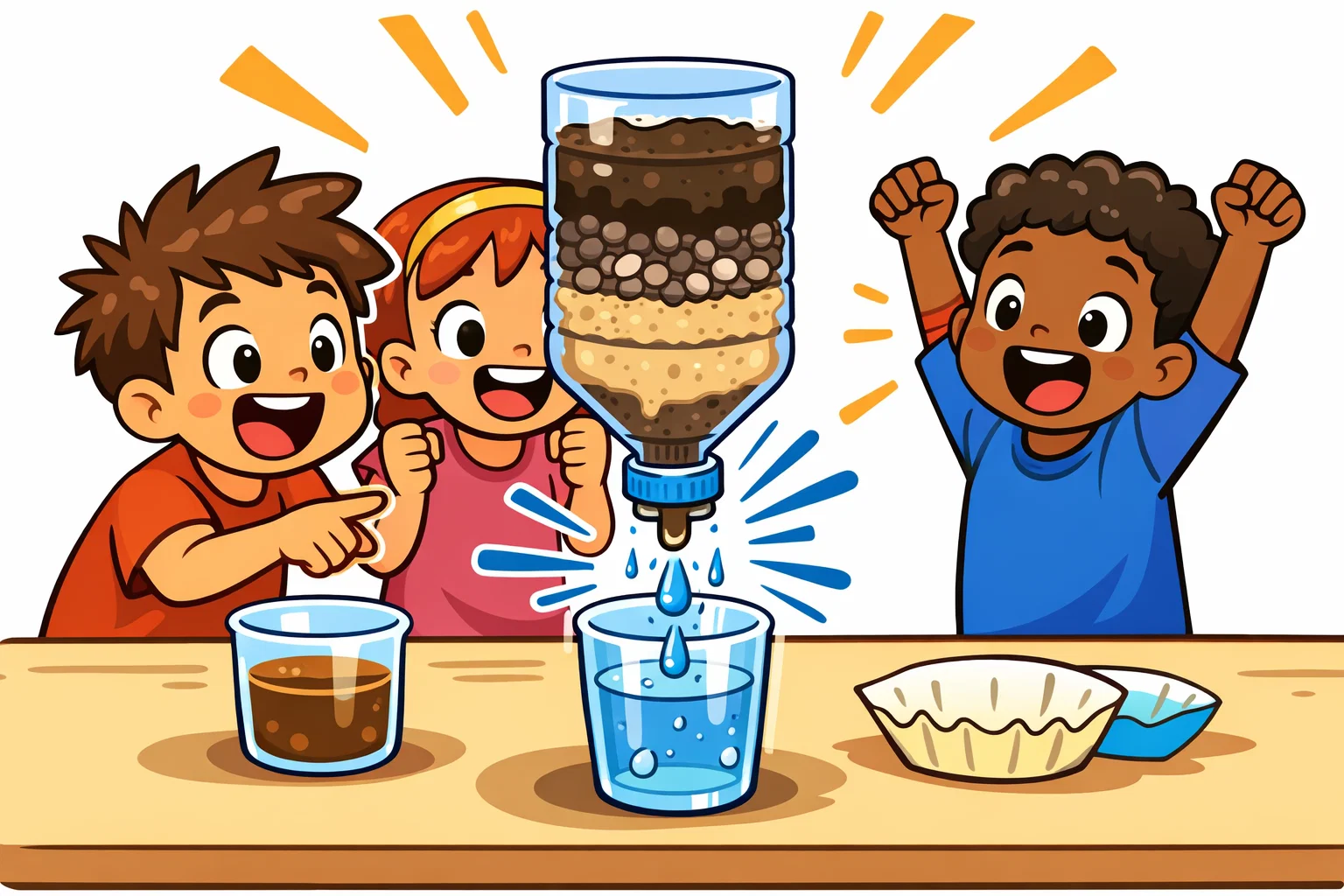
Have you ever wondered how the liquid we pull from deep underground stays so clean, or how nature manages to recycle muddy water into something that looks crystal clear? Hands-on experiments are one of the most effective ways to teach complex environmental concepts through clear, memorable “aha!” moments found in a hands-on experiment. This groundwater filtration activity is a classic science experiment that transforms a messy afternoon into a deep dive into Earth science.
By engaging in this water filter science experiment, children from preschool to middle school can visualize the hidden processes occurring beneath their feet. This activity goes beyond playing with dirt and stones and helps children explore the delicate balance of the ecosystem and the vital importance of protecting the water on our planet. This guide will walk you through how to make your own water filter while fostering critical thinking and environmental stewardship in your young scientists.
Experiment Overview
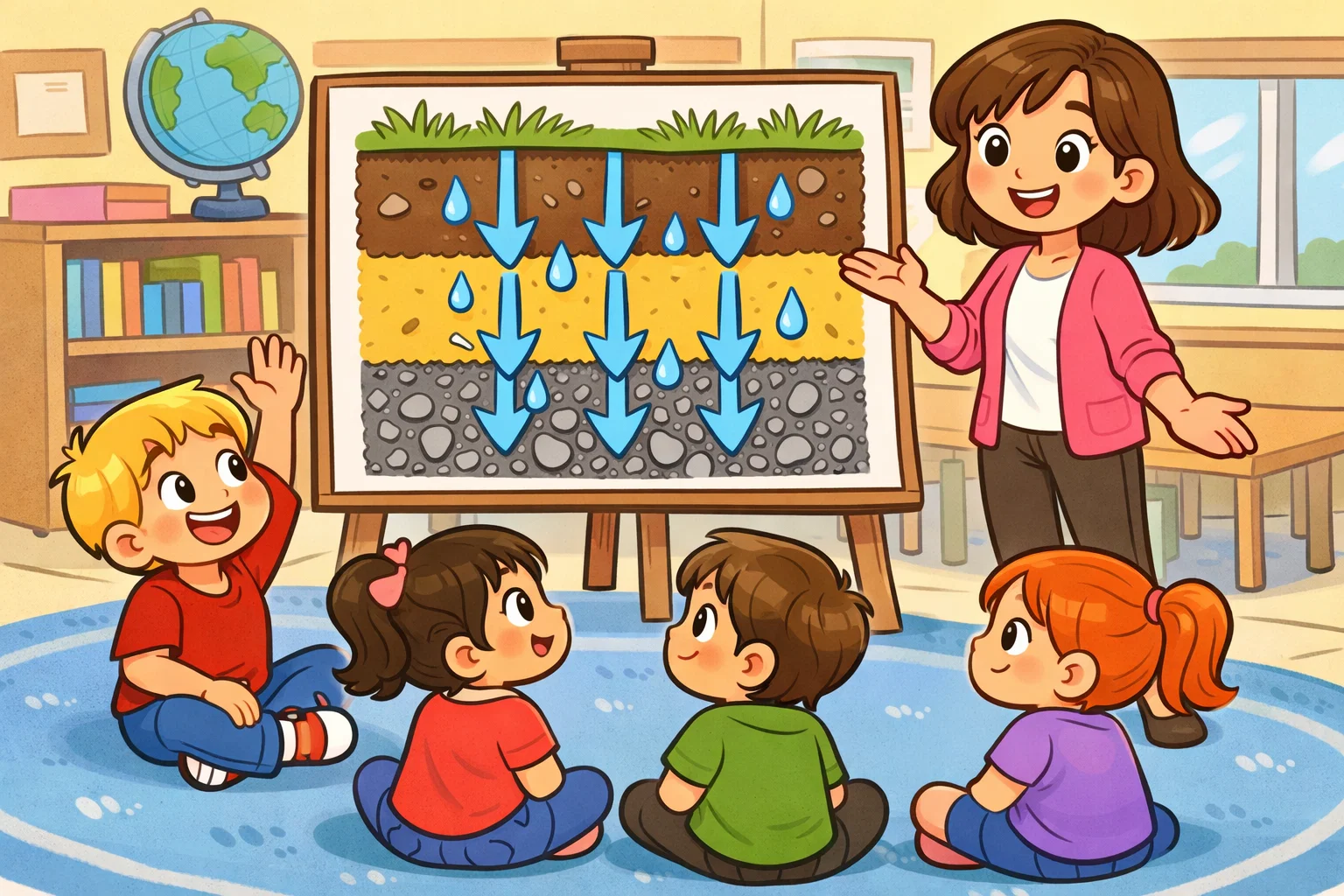
The primary goal of this water filter experiment is to simulate the natural process of percolation – where rain seeps through layers of the earth to become groundwater. Kids will observe firsthand how different materials act as a physical filter, trapping particles of debris at different stages. It is a lesson in patience and observation, as the fluid doesn’t just pass through; it interacts with every grain of material.
In this activity, we take a bottle of dirty water – filled with everything from large pebbles to fine dirt – and pour it through a multi-layered water filter system. As the liquid travels downward, the children will see that the water changes from a dark, opaque sludge to a significantly clearer substance. Natural filtration is one of the ways Earth helps improve water clarity, and this experiment models that process on a small scale.
Experiment Purpose
What children will learn
Through this water filter science experiment, children will gain a fundamental understanding of physical science and environmental engineering. Specifically, the learning objectives include:
- The Power of Layers: Understanding that each layer has a specific size-based job.
- Porosity and Permeability: Learning how fluid moves through seemingly solid materials.
- Hypothesis Testing: Predicting which material will be the best filter and observing the outcome.
- Environmental Awareness: Realizing how easily pollutant substances can enter our ecosystem.
Real-world connection to groundwater
This activity models how the Earth’s crust acts as a giant sponge and filter combined. In the real world, when it rains, moisture travels through topsoil, sand, and bedrock before reaching underground aquifers. This process is essential for providing access to clean water to millions of people who rely on well sources. By simulating this, kids understand why preventing water pollution on the surface is so important; if the top layer of our soil is contaminated with chemicals or waste, it eventually affects the drinking water we pump from the ground.
Age suitability and skill level
This experiment for kids is highly adaptable and suitable for children aged 5 to 12. We can categorize the skill levels as follows:
- Ages 5–7 (Beginner): Focuses on visual changes and pouring skills. Requires 100% adult supervision for cutting bottles.
- Ages 8–10 (Intermediate): Focuses on recording data in a STEM notebook and understanding the role of activated charcoal.
- Ages 11–12 (Advanced): Focuses on variables, such as testing how different types of sand affect the flow rate and clarity of the filtered water.
Essential Materials for Your Homemade Water Filter
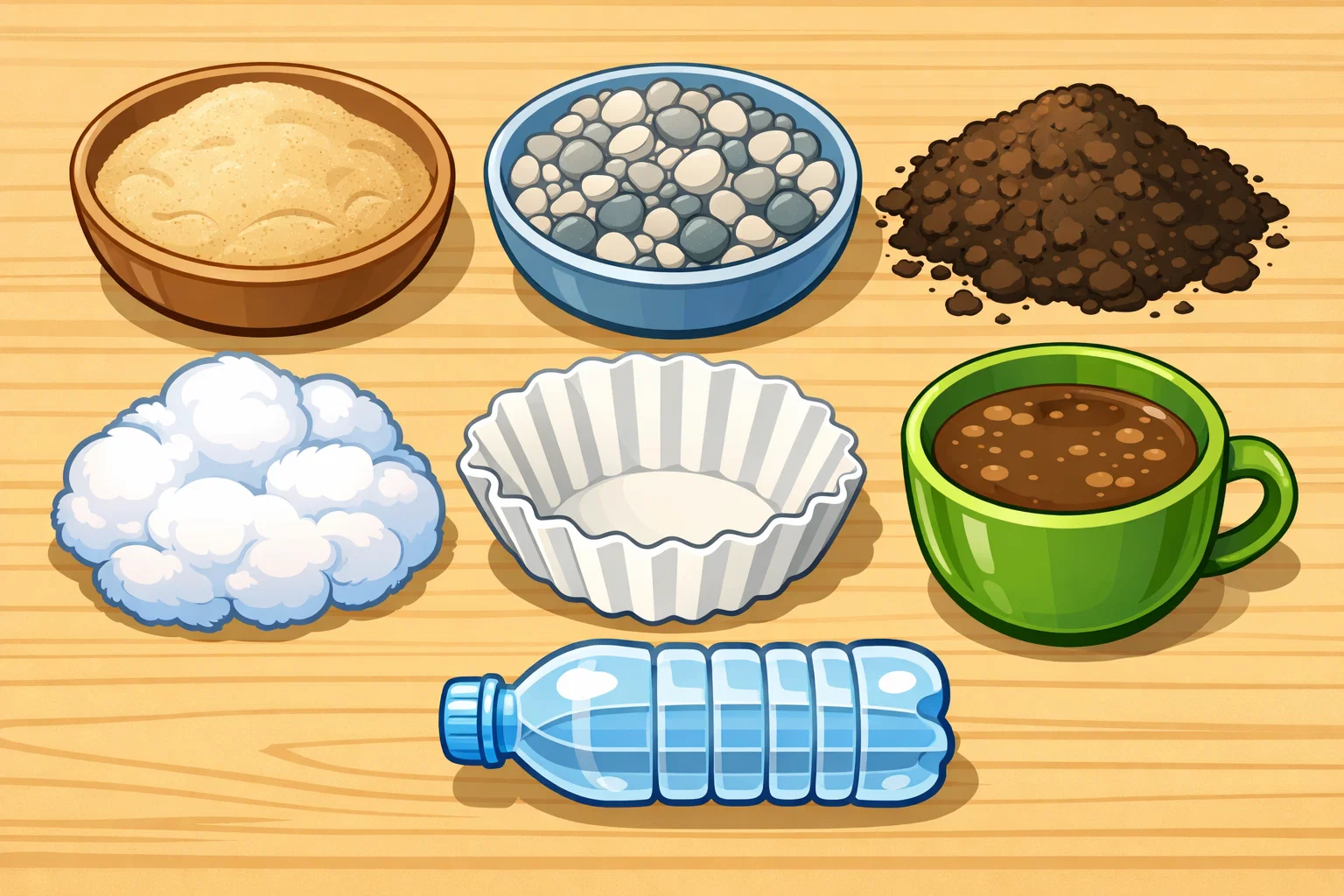
You don’t need a laboratory to explore how filtration works. Most of these items are likely in your kitchen or backyard.
Filtration materials
The secret to a successful water filtration experiment lies in the variety of the different layers. Each material has a specific “job” in the purification process:
- Gravel or Small Stones: These catch the largest debris like twigs, leaves, and large clumps of mud.
- Play Sand: The fine grains of sand trap smaller particle bits that the gravel missed.
- Activated Charcoal: Helps reduce odors and some dissolved substances.
- Cotton Balls or Coffee Filters: These act as the final “polishing” layer to catch the finest silt.
Containers and tools
To build the structure of your water filter system, you will need the following tools:
| Tool | Purpose |
| 2-Liter Plastic Bottle | The main housing for the filter layers. |
| Scissors/Utility Knife | Used by an adult to cut the bottle into two pieces. |
| Large Glass Jar | To collect and clearly view the filtered water. |
| Rubber Bands | To secure a coffee filter over the bottle neck if needed. |
Water sample preparation
To make the results truly impressive, you need to create a very messy “contaminant” sample. Follow these steps to prepare your dirty water:
- Fill a pitcher with 1 liter of tap liquid.
- Add two handfuls of garden dirt or muddy water.
- Tear up small pieces of paper to simulate litter.
- Add dried leaves or grass to represent organic debris.
- Stir vigorously until the solution is dark and opaque.
Setup and Preparation
Workspace setup
Science can be messy, and water filter experiments are no exception. I recommend the following setup to keep things cleaner:
- Surface Protection: Use a plastic tray or spread out old newspapers to catch spills.
- Organization: Line up your stones and sand in separate bowls so kids can add a layer easily.
- Cleaning Supplies: Keep a roll of paper towels and a bucket nearby for quick disposal of the wet dirt.
Filter container assembly
An adult should take the clear plastic bottle and carefully cut it in half, approximately 5-6 inches from the top.
- The top half (with the cap) becomes the upside down bottle that holds the filter materials.
- The bottom half becomes the collection base.
- You can either poke a hole in the cap or remove it and secure a coffee filter over the opening with a rubber band.
Layer planning
Before you start, discuss the order of the different layers.
- Bottom: Finest materials (Cotton/Charcoal).
- Middle: Medium materials (Play sand).
- Top: Coarsest materials (Gravel).
This planning stage ensures that the filtration works effectively and doesn’t get clogged by large particles right at the bottom.
Step-by-Step Groundwater Filtration Experiment
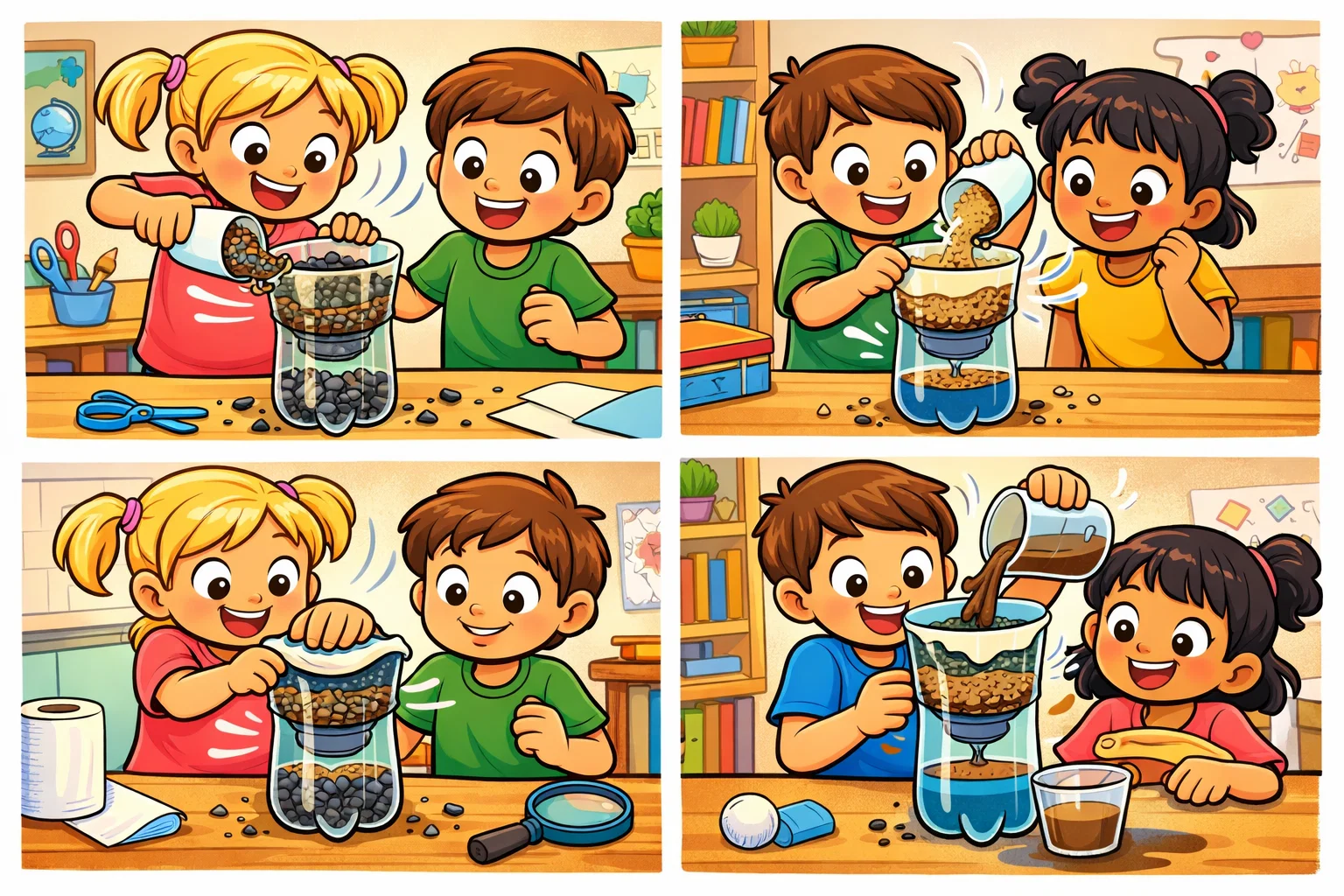
Step 1 – Building the bottom layer
Begin by stuffing two or three cotton balls into the neck of the upside down bottle. On top of the cotton, add a 2-inch layer of activated charcoal if you have it. The charcoal and cotton act as a safety net, ensuring that even the smallest particle of dirt doesn’t make it into your final collection jar.
Step 2 – Adding sand and soil layers
Next, carefully pour in a thick layer of play sand (about 3 inches). On top of the sand, you can add a layer of fine soil. The water filter using sand is the most effective part of this setup because the tiny spaces between the grains of sand are excellent at trapping the “cloudiness” that makes the muddy water look brown.
Step 3 – Placing top filter layer
Finish your filter by adding a layer of gravel or small stone. This top layer is designed to catch the “big stuff” – the leaves and twigs you added to your muddy water. By placing the largest materials at the top, you ensure that the filter doesn’t get clogged instantly.
Step 4 – Pouring contaminated water
Now comes the exciting part: pouring the water.
- Stir your pitcher of dirty water one last time.
- Slowly pour it into the top of your filter.
- Avoid pouring too fast, as this can disturb the sand layer and mix the materials.
Step 5 – Collecting filtered water
Within a few minutes, you should see the first drops of filtered water dripping into the jar. Observe the transition closely.
- The first few drops might be slightly dusty from the sand.
- Soon, the outflow should become much clearer.
- Compare the water in the jar to the original muddy sample to see the difference.
The Science Behind Water Filtration: How It Works
Particle trapping
As the dirty water moves through the layers, it undergoes mechanical filtration. The gravel traps large pieces of debris, while the smaller gaps in the sand catch the tiny particle bits. This is exactly how multi-stage filtration systems work, using various “mesh” sizes to ensure nothing unwanted stays in the solution.
Gravity and water flow
Gravity is the invisible force that makes this science experiment possible. It pulls the molecules downward, forcing them to navigate the labyrinth of stones and sand. As the fluid moves through these tight spaces, it rubs against the surface of the materials. This contact is vital because it slows the movement down, giving it more time to leave behind pollutant bits and clarifying the liquid through natural pressure and friction.
Limits of filtration
It is a crucial educational moment to explain that even though the water looks cleaner, it is not safe to drink.
- Bacteria: These are too small for a coffee filter or sand to catch.
- Chemicals: Many dissolved toxins require chemical purification rather than physical.
- Viruses: These require specialized water filtration systems found in municipal plants.
Experiment Results and Observations
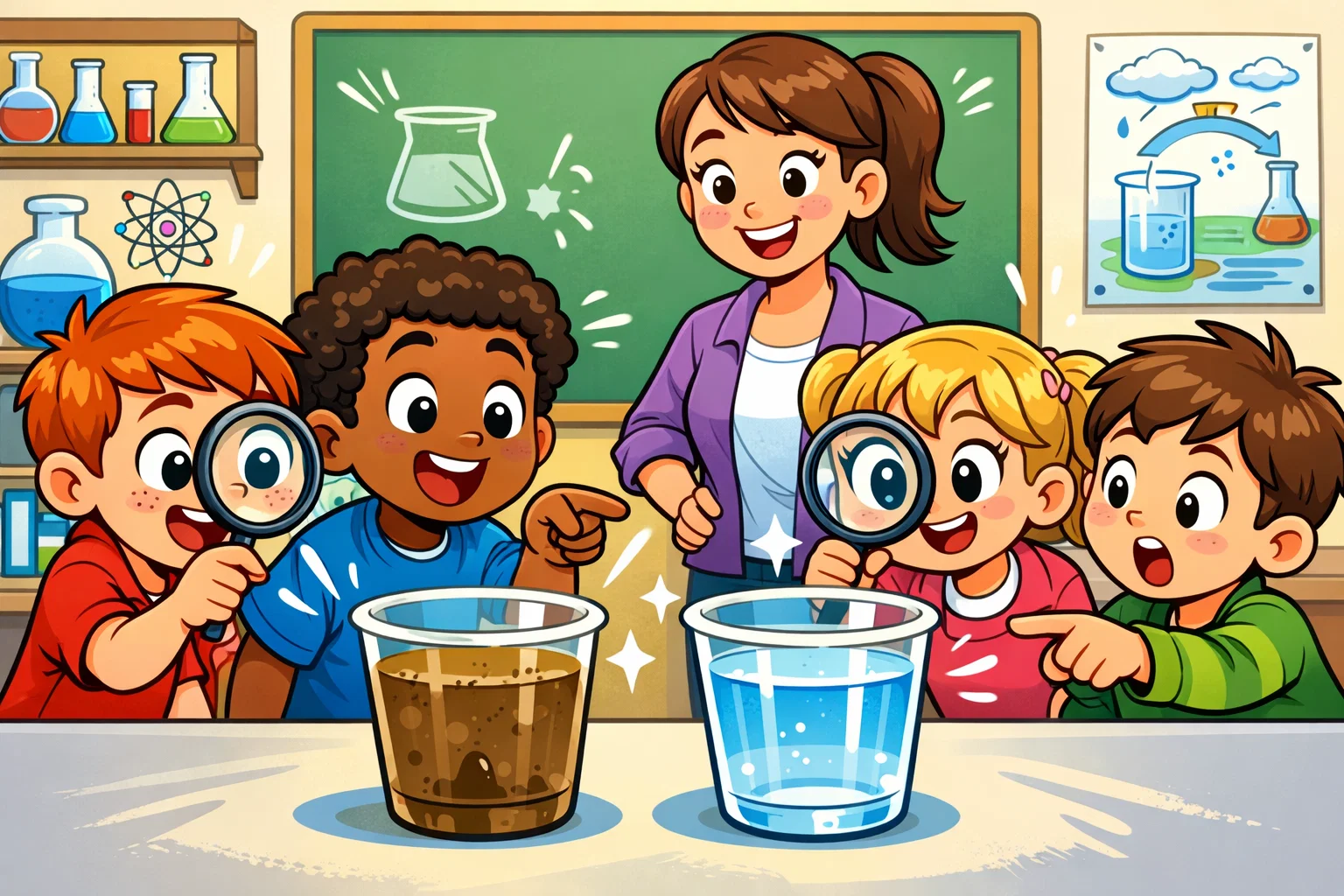
Visual comparison
To analyze your results, look for three specific things in your filtered water:
- Color: Is it clear, yellow, or still brown?
- Sediment: Are there visible bits of dirt at the bottom of the jar?
- Clarity: Can you see through the glass as easily as you can with tap liquid?
Recording results
Encourage your child to use a STEM notebook. They can create a simple chart:
- Initial Sample: Dark brown, smelled like earth, full of leaves.
- Processed Fluid: Light yellow, no smell, very few particles.
- Duration: It took 4 minutes for the liquid to go through the filter.
Common outcomes
Sometimes the sample comes out slightly yellow or gray. This may indicate that tannins from leaves or very fine clay particles are still present. If the result is still very muddy, it usually means a layer was too thin or the liquid was poured too quickly. This creates a useful learning opportunity to refine the design!
Groundwater Safety Message
Why filtered water not drinkable
We must reiterate: the fluid produced in this experiment for kids is for observation only. Even if it looks like very clear filtration results, it could still contain a hidden contaminant. Simple household materials cannot remove microscopic bacteria or harmful chemicals that might have been in the soil.
Safe disposal or reuse
Don’t just pour your results down the drain! This is a great chance to talk about how we can recycle the moisture:
- Watering Plants: The filtered water is safe for the garden.
- Cleaning: Use it to wash outdoor toys or the sidewalk.
- Composting: Pour the wet dirt and leaves back into your compost pile.
Experiment Variations and Challenges

Changing filter order
What happens if you put the sand on top and the gravel on the bottom? Usually, the fine grains will quickly clog, and the flow will stop. This variation teaches kids about “clogging” and why industrial water filtration systems always have a specific sequence to handle different sizes of debris.
Testing new materials
Challenge your kids to find other materials to add a layer. You might try:
- Crushed charcoal from a barbecue.
- Scraps of old fabric or denim.
- Dried moss or sponge pieces.
Each material will change how the filtration works.
Speed vs clarity comparison
There is often a trade-off in water filtration:
| Filter Design | Flow Speed | Clarity Level |
| Mostly Stones | Very Fast | Low (still dirty) |
| Dense Sand Layer | Slow Drip | High (very clear) |
| With Charcoal | Moderate | Best (removes odor/tint) |
Critical Thinking and Water Filter Science Discussion
Why some water cleared more
Talk about the size of the “pores” (spaces) between the materials. Why does sand catch more dirt than gravel? This introduces the concept of surface area and how it affects purification.
Groundwater pollution causes
Connect the dirty water to the real world. Ask:
- “What happens if oil leaks from a car into the dirt?”
- “Where does the liquid go after it rains on a landfill?”
This discussion helps children understand their role in protecting drinking water.
Human impact on water quality
Explain that humans have a huge responsibility to protect the water on our planet. Because the natural cycle of filtration takes time, we cannot pollute the flow faster than the Earth can purify it. It takes much longer to clean a sample than it does to make it dirty.
Learning Extensions and Activities
STEM notebook activity
Ask your child to become a “Water Engineer.” Have them create a chart comparing three different filter designs. They can rate each one on a scale of 1 to 10 for “Clarity” and “Speed.” This activity turns a simple science experiment into a data-driven project.
Engineering challenge
Give the kids a specific goal: “Create a filter that makes the muddy water clear in under two minutes using only five cotton balls and two cups of sand.” This forces them to think critically about efficiency and resource management.
Earth science connections
Link this experiment to the larger water cycle.
- Evaporation: Moisture rising to the sky.
- Infiltration: The liquid moving through the stones and sand.
- Collection: Gathering in underground aquifers.
Classroom and Home Use Tips
Group activity ideas
In a classroom, you can run this as a “Filter Derby.” Divide the kids into teams and give each team a different resource to use as their primary filter. At the end, compare the water from all the teams to see which design was the best filter.
Time planning
- Setup: 15 minutes.
- Experiment: 20 minutes.
- Discussion: 15 minutes.
- Cleanup: 10 minutes.
Safety supervision notes
- Cutting: Always have an adult cut the upside down bottle.
- Charcoal: Be careful with activated charcoal as it can be very messy.
- Hygiene: Ensure kids wash their hands after handling muddy water or dirt.
More Water and Earth Science Experiments
Water cycle experiments
If your kids enjoyed seeing how moisture moves through the ground, they will love making a “Water Cycle in a Bag.” By taping a plastic bag with a little liquid to a sunny window, they can see evaporation and condensation in action.
Soil and erosion experiments
Use a tray of dirt and some toy houses to show how flow can wash away land. You can see how plants and roots act as a natural filter and anchor for the soil, preventing muddy water from forming.
Environmental science projects
Explore “Sustainability” by researching how cities recycle wastewater. You can visit a local treatment plant or watch videos on how they remove a contaminant on a massive scale using large-scale versions of your sand filter!