

Six-year-olds experience rapid cognitive expansion as they move into early primary education. At this stage, children begin to understand cause and effect, make simple comparisons, and ask increasingly complex “why” and “how” questions. Short, surprising pieces of information capture attention effectively because the developing brain responds strongly to novelty and emotional engagement.
Fun and interesting facts for 6 year olds support memory retention and language development when presented in clear, vivid, and relatable ways. A striking comparison about space, an unusual animal ability, or a surprising detail about the human body transforms passive listening into active thinking. Carefully selected knowledge at this age strengthens curiosity, builds confidence, and encourages early analytical skills.
Introduction to Interesting Facts for Kids
What Are Fun Facts?
Fun facts are short, surprising, and easy-to-digest bits of information, often about something unusual, impressive, or unexpected. For a young child, a fun fact isn’t just a random piece of trivia; it’s like a little secret about the universe, a tiny tidbit that makes them feel connected to something much bigger than themselves.
They might learn that a cloud can weigh over a million pounds, or that the enormous blue whale’s tongue can weigh as much as an elephant! These are not just facts; they are springboards for the imagination. They take a familiar concept – a cloud, a whale – and suddenly make it amaze the mind.
Importance for Learning
Using interesting facts is a powerful tool in early education. Research in cognitive development suggests that retention is significantly improved when information is presented in an emotionally engaging way. When a fact is amazing or surprising, the brain pays more attention, and the information sticks around longer.
How They Boost Child’s Development:
- Spark Curiosity: A good fun fact, like knowing that sharks have been on Earth for more than 400 million years, even before the dinosaur, naturally leads to the next question: “How?” This is the beginning of the scientific process.
- Enhance Memory and Vocabulary: Facts introduce new concepts and vocabulary (like “predator,” “adaptation,” or “billion”) in a meaningful context, making new words easier to remember.
- Encourage Communication: A kid who knows a cool fact is eager to share it, improving their communication skills and confidence in social settings.
- Boost Self-Esteem: Being the source of fascinating knowledge (“Did you know this?”) can significantly enhance a child’s sense of competence and pride.
Fun Facts for Different Age Groups
Age-Appropriate Fun Facts for 6-Year-Olds
At six years old, children are typically in the first grade, moving into the “concrete operational” stage of thinking, according to Piaget’s theories. They can understand simple cause-and-effect and are fascinated by superlatives (the biggest, the fastest, the hottest).
Facts for this age group should be:
- Simple and Relatable: Facts should tie into familiar objects or concepts (e.g., their pet cat, the Earth, a trip to the ocean).
- Visually Striking: The facts should create a clear, exciting picture in their head, like a planet that could float on water.
- Numerically Manageable: Simple large numbers are okay (e.g., thousands or millions, but perhaps not trillions), but comparisons should be made to things they understand (e.g., “as tall as three houses”).
For example, an age-appropriate science fact for kids is that a bolt of lightning is five times hotter than the surface of the sun! This is a simple comparison that delivers a big “wow” factor.
Fun Facts for 5-Year-Olds vs. 7-Year-Olds
While developmental stages between five and seven years are closely connected, cognitive processing capacity gradually expands. Information complexity, numerical scale, and abstraction tolerance increase each year.
| Development Area | 5 Years (Kindergarten) | 6 Years (First Grade) | 7 Years (Second Grade) |
|---|---|---|---|
| Cognitive Focus | Immediate environment: pets, toys, family routines | Expanding world: animals, space, Earth | Broader systems: early history, inventions, global processes |
| Concept Complexity | One-step ideas (e.g., cats sleep many hours) | Simple comparisons and two-step explanations (e.g., clouds can weigh a million pounds) | Multi-step reasoning with brief explanations (e.g., ketchup was once sold as medicine) |
| Numerical Understanding | Basic counting and small numbers | Large but concrete values such as million, pounds, miles per hour (with relatable comparisons) | Billion, historical timelines, introductory statistics |
| Attention Span | Short bursts with strong visual support | Sustained attention with structured examples | Longer engagement with narrative and cause-effect chains |
This progression reflects increasing working memory capacity, improved logical sequencing, and stronger abstract reasoning skills. Structured adaptation of content by age supports retention and reduces cognitive overload.
Themed Fun Facts for Kids

Here are some specially curated amazing facts designed to spark curiosity in young minds.
About Animals
The animal kingdom is packed with surprises and is often the kid’s favorite topic.
- Dolphins are so smart that when they sleep, they only turn off half their brain! The other half stays awake to make sure they keep breathing and look out for danger.
- The longest snake ever found was over 30 feet long – that’s longer than two cars parked end-to-end!
- A Great White Shark can replace its own teeth. It can go through thousands of teeth in its lifetime.
- Flamingos are not born pink! They are born gray or white and turn pink from the brine shrimp and algae they eat.
- The tongue of a blue whale is so big that about 50 people could stand on it. The whale itself can weigh as much as 30 elephants!
- The tiny flea can jump 150 times its own height. If a human could do that, we’d be jumping over skyscrapers!
About Space
Space facts truly stretch a child’s imagination, moving from the familiar Earth to the vast scale of the cosmos.
- The hottest planet in our solar system is Venus, not Mercury. Its average temperature is about $870^circtext{F}$!
- Saturn’s famous rings are mostly made up of billions of pieces of ice and rock. If you had a bathtub big enough, Saturn is so light it would float!
- One day on Venus is longer than its year! It takes longer for Venus to spin around once than it takes for it to orbit the Sun.
- The first living creature in outer space was a dog named Laika, sent up on a Soviet rocket in 1957. She was a true space pioneer.
- A rocket traveling into space needs to go incredibly fast – around 17,500 miles per hour – to stay in orbit. That’s about 30 times faster than the fastest race car!
- Our Moon is bigger than the former planet Pluto. This amazing fact helps children understand scale.
About the Human Body
These are fascinating science facts for kids because they are about the kid themselves!
- You are born with about 300 bones, but by the time you’re an adult, you only have 206! Some of your smaller bones join together as you grow.
- Your heart is about the same size as your clenched fist.
- Your body produces about one liter of saliva every single day – that’s enough to fill a medium-sized soda bottle!
- The masseter muscle, which helps you chew, is the strongest muscle in your body based on its pound-for-pound size!
About Nature
Connecting children’s learning to the Earth and its processes is essential for developing a sense of geography and fostering environmental stewardship.
- A strawberry is the only fruit that has its seeds on the outside. Every little speck you see is a seed!
- Scientists estimate the Earth is about 4.54 billion years old. That’s a massive number!
- There are more trees on Earth than there are stars in the Milky Way galaxy! This gives a stunning comparison of numbers.
- A teaspoon of healthy soil holds more living bacteria than there are people on Earth. This makes the unseen world feel immense.
Benefits of Learning Fun Facts for Kids
Enhances Curiosity and Critical Thinking
Fun facts are the ultimate fuel for curious minds. When a child hears that a giraffe has a black tongue, it not only amazes them but also sparks the question: “Why?” This “why” forms the foundation of critical thinking. They begin to understand adaptation – that the black color helps the giraffe avoid getting its tongue sunburned while eating tall trees. These random facts provide a context for understanding more complex scientific concepts later on.
Makes Learning Enjoyable
Learning functions best when curiosity leads the process, not obligation. When surprising insights become part of everyday conversations, structured instruction turns into natural exploration. Even one well-placed fact can shift attention and create emotional engagement.
During an ordinary meal of French fries, a child might discover that potatoes were the first crop cultivated in space. This unexpected link between dinner and space research transforms a routine moment into meaningful discovery, strengthening memory through novelty and contextual association.
Fun Facts for Classrooms
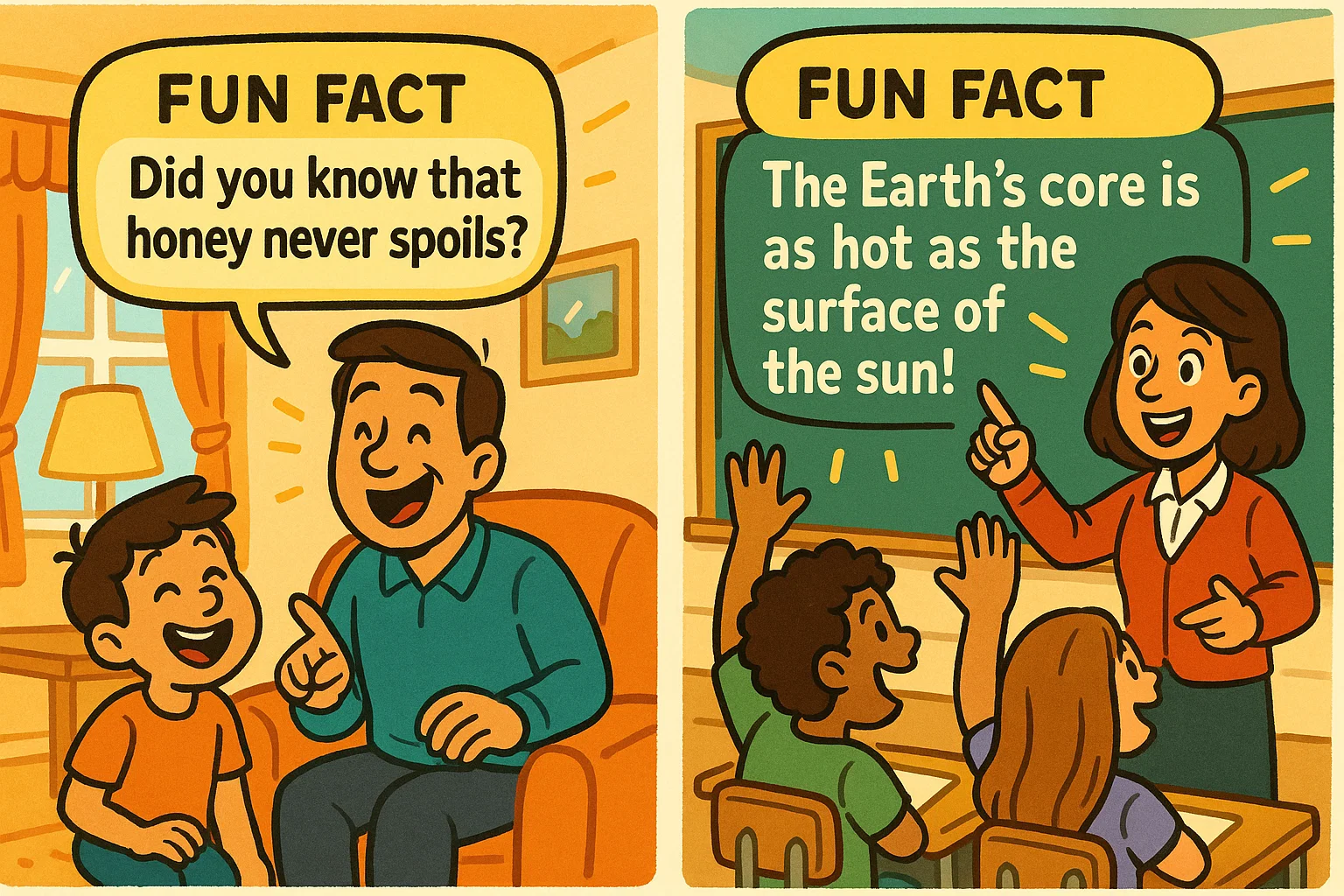
Teachers can utilize fun facts for kids as “hooks” to introduce new units or as a quick transition between subjects.
- Daily Trivia: Start the day with a “Fact of the Day” on the whiteboard.
- Subject Introductions: To introduce an ocean unit, use a fact like: “Only 5% of the ocean has been explored by scientists!” This immediately sets a tone of mystery and exploreation.
- “Did You Know?” Cards: Create a box of cards with themed facts (animal, space, history facts), and allow children to pull one out during free time. This fosters a self-directed learning culture.
Fun Facts at Home
Parents are the most significant role models for a child’s learning. Using facts at home turns family time into enriching experiences.
- Dinner Table Discussion: Instead of asking, “How was school?” try, “Tell me the most random fact you learned today!” or “Let’s share one interesting fact about the Earth.”
- Bedtime Exploration: Before reading, share a couple of calm, awe-inspiring facts, maybe about the moon or Neptune. It settles the mind and ends the day with wonder.
- Travel Trivia: Long car rides are perfect for impromptu quiz sessions using geography or invention facts. “What did the ancient Egyptians invent?” (Did you know they invented paper and the calendar?)
Trending Fun Facts for 6-Year-Olds

Cool and Surprising Fun Facts
These are some trending facts that deliver a major impact for a six-year-old:
- Dinosaur bones can be found on every continent, even Antarctica! The earliest dinosaur lived about 245 million years ago.
- If you could drive to the Moon at highway speeds, it would take you about four and a half months to get there!
- The Eiffel Tower can grow taller in the summer! Heat causes the metal to expand, making it up to six inches tallest when the temperature rises.
- Ketchup was first sold in the 1830s as a medicine! A scientist suggested it was a cure for an upset stomach.
- There are so many kinds of insects that for every one human, there are about 200 million insects.
| Fact Category | Fact Summary | Why it Amazes the Mind |
| Ocean | The deepest part of the ocean is called the Challenger Deep, and it’s deeper than Mount Everest is tallest! | Puts the scale of the underwater world into perspective. |
| History Facts | The first astronaut to go to space was Yuri Gagarin, but the first American woman was Sally Ride. | Highlights a real-life pioneer and role model for children’s dreams. |
| Animal | A cat can make about 100 different sounds, but a dog can only make about 10. | A relatable comparison of a common pet’s abilities. |
| Science Facts | The world’s smallest invention is a tiny transistor, smaller than most bacteria. | Shows how incredible human invention can be. |
Where to Find More Fun Facts
The world offers unlimited opportunities for discovery when curiosity is actively supported. A single engaging fact often becomes the starting point for deeper exploration across trusted educational sources.
- Educational Books
Libraries provide carefully edited collections such as “Amazing Facts” or introductory science trivia series. Printed materials support focused attention and structured knowledge building. - Documentaries
Age-appropriate films about animals, space, and Earth combine visual storytelling with reliable scientific information. Multimedia presentation improves retention through dual coding — image plus narration. - Museums and Zoos
These institutions operate under scientific supervision and present verified, research-based content. Exhibits translate complex concepts into interactive experiences, strengthening understanding through observation and real-world context.
Conclusion About Fun Facts For 6 Year Olds
Keep Exploring and Learning
Nurturing a child’s inner scientist is a truly rewarding experience. The small spark of a fun fact at age six can ignite a lifelong passion for knowledge, discovery, and exploration. Remember, you don’t need to be a formal expert to share the wonders of the world. By consistently sharing amazing facts about our planet, outer space, and the billions of creatures on it, you are helping your kid develop a love for learning that is authentic, deep, and enduring.
Keep asking questions, keep searching for that next jaw-dropping piece of trivium, and keep encouraging your children’s curiosity – it’s the most powerful tool they have for navigating and appreciating this incredible world. Happy fact-finding!