

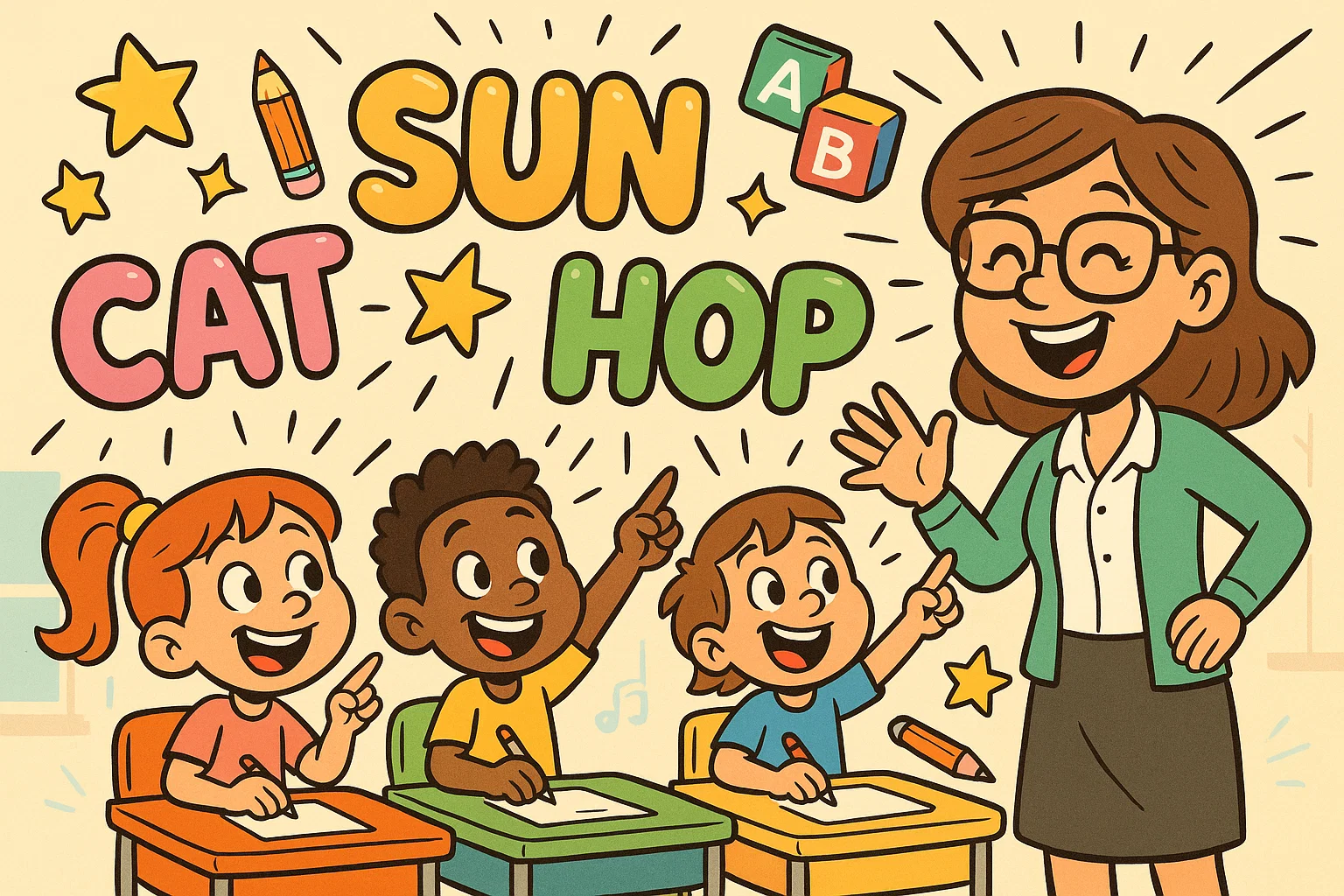
Developing the ability to spell accurately is a cornerstone of a child’s journey toward strong literacy and academic confidence. This skill forms the essential link between reading and writing, enabling young learners to articulate their thoughts clearly and effectively. Whether you are a parent creating your child’s first spelling list or a teacher looking for high-quality spelling resources, structured access to age-appropriate basic spelling concepts is crucial.
This comprehensive resource offers expert-guided, level-specific practice materials, from simple easy spelling words for beginners to beginner-friendly spelling bee words for kids. We will explore engaging methods and fun and easy activities to help kids learn spelling, allowing them not only to pass a test but also to understand how words work, build strong language skills, and develop a rich vocabulary. Let’s make learning an interactive and highly successful endeavor!
Easy Spelling Practice Sets by Age and Level

Successful spelling practice relies on providing children with vocabulary that aligns with their current developmental stage. These essential groupings begin with simple structures, which are vital for phonics instruction, and move through the grade levels, aligning with general national curriculum expectations.
Preschool Practice Set
At this stage (ages 3–4), the focus is on recognizing letters and initial sounds (phoneme awareness). They focus mainly on auditory and visual recognition rather than writing.
- A, I, O, U, It
- Big, Dog, Cat, Fun, Go
- Me, No, Up, My, Is
- Run, Jump, Play
Kindergarten Practice Set
Kindergarten introduces simple, short high-frequency words and basic phonetic constructions. Children start writing simple words by sounding them out.
- Simple Combinations: in, am, an, at, he, we, so, of
- CVC Phonetic: cap, bed, pin, hop, cub, fan, sun, pet
- Common Sight: a, the, I, see, like, and, can, you, look, come
Grade 1 Practice Set
First graders expand their vocabulary list with basic blends, digraphs, and common sight terms they frequently encounter in early readers.
| Category | Example Items |
| Short Vowel Focus | fish, desk, plug, dress, stamp |
| Blends | trip, flag, step, play, glad |
| Digraphs | shop, chin, then, when, ship |
| Sight & Exception Words | said, was, were, from, have, give |
Grade 2 Practice Set
These terms are slightly longer, often introducing vowel teams and common affixes (prefix, suffix). They are essential for kids building a strong foundation.
- Vowel Teams: meet, boat, rain, tree, cook, moon
- R-Controlled Vowels: car, her, bird, form, burn
- Affixes (-ing, -ed): walking, jumped, singing, played
- High-Frequency: always, found, really, today, know, little
Grade 3 Practice Set
Third-grade practice involves more complex patterns, including silent letters and less predictable structures.
- Silent Letters: write, knight, thumb, listen, design
- Contractions: I’m, don’t, isn’t, can’t, we’re
- Possessives: dog’s, man’s, teacher’s
- Compound Terms: baseball, outside, sunshine, classroom
Grade 4 Practice Set
At this level, the vocabulary begins to include longer, multi-syllable terms suitable for early elementary levels in some curricula and broadening the variety of words learned.
- Multi-syllable Items: important, difficult, beautiful, remember
- Homophones: too/two/to, there/their/they’re, buy/by/bye
- Commonly Used: neighbor, strange, certain, often, separate, though
Grade 5 Practice Set
Fifth graders focus on sophisticated patterns and root words that contain Latin or Greek origins. These words prepare students for more advanced competitions.
- Affixes: un- (unhappy), re- (rewrite), -tion (station), -able (lovable)
- Longer Items: necessary, knowledge, experiment, environment
- Academic Terms: atmosphere, government, continent, ancient
2-Letter Simple Terms
These are the most fundamental English words and are vital for early sight reading.
- am, an, as, at, by, go, he, hi, if, in, is, it, me, my, no, of, on, or, so, up, us, we
CVC Phonetic Examples
CVC (Consonant-Vowel-Consonant) combinations are the foundation of phonics learning, helping children understand how letters form sounds.
- Short A: cat, map, sad, fan, cap, rat
- Short E: pen, bed, wet, ten, met, leg
- Short I: pin, hit, fix, win, big, sit
- Short O: log, dot, box, mop, top, pot
- Short U: sun, cup, run, gum, tub, cut
High-Frequency Basic Terms
These are the terms that appear most frequently in printed English. Since many are exceptional words (e.g., said), they must be learned by sight.
- the, be, to, of, and, a, in, that, have, I, it, for, not, on, with, he, she, they, said, you
Easy Spelling Bee Words for Preparation
A spelling bee is an excellent motivator for children to learn a greater variety of words and improve their spelling.
Easy Spelling Bee Words
Simple, clear terms suitable for younger participants (ages 6–8) or those new to competitions. They help kids build confidence quickly.
- apple, basic, clock, dance, every, flower, giant, hello, insect, jungle, kitten, lemon, market, never, ocean
Medium Difficulty Spelling Bee Words
Appropriate for ages 9–11, these require attention to common patterns, silent letters, or vowel teams.
- believe, cushion, imagine, minute, knowledge, favorite, trouble, peculiar, honest, surprise, carriage
Challenging Spelling Bee Words
For confident and advanced young learners, these introduce less common letter patterns and longer syllable structures.
- sincerely, orchestra, souvenir, conscience, turquoise, amateur, colleague, pneumonia, schedule, foreign
Benefits of Easy Spelling Practice for Kids
Consistent practice with easy spelling words significantly impacts a child’s overall literacy development. As reading researcher Dr. Louisa Moats notes,
“Spelling and reading build and rely on the same mental representation of a word. Knowing the spelling of a word makes the representation of it sturdy and accessible for fluent reading.” (с)
Support for Early Literacy Growth
Mastering a list of basic vocabulary reinforces phonics—the understanding of how sounds (phoneme) map to letter combinations. When children know how to construct a term accurately, they recognize that pattern instantly while reading, which greatly improves reading fluency. These patterns give children a reliable foundation for learning to read and write confidently.
Boost in Writing Confidence
When a child’s brain doesn’t have to pause to recall the correct spelling of common spelling words, their thought process flows more smoothly. This familiarity encourages greater creativity and confidence in their writing skills. Knowing how to write the word without hesitation is essential for fostering a positive attitude toward written expression.
Memory and Vocabulary Development
Repeated exposure to a vocabulary list strengthens a child’s visual and auditory recall. Every time a child engages in spelling practice, they are not just memorizing; they are internalizing the structure and meaning, actively expanding their receptive and expressive vocabulary.
Easy Tips to Learn Spelling Words
Effective learning doesn’t have to be a chore. These simple, actionable, and interactive methods help kids memorize their assignments and truly master the language.
Focus On Tricky Parts In Difficult Words
Many terms, even simple ones, contain one segment that is confusing. Help kids isolate this section. For example, in the term “friend,” the common error is the “ie” combination. Ask your child to underline or circle that specific sequence, perhaps writing it in a bright color. This directs kids to focus their attention effectively.
Break Words Into Smaller Parts
Teaching a child to segment a term into its syllable units or common letter clusters makes even longer english words manageable. For instance, breaking “re-mem-ber” down makes it easier to process than tackling the eight letters all at once. Visually separating the parts, like $re/mem/ber$, is an excellent spelling practice method.
Repeat and Review Often
Reviewing words regularly (spaced repetition) helps children remember them for much longer. Encourage short (5-10 minute) sessions daily rather than long, infrequent ones. Reviewing a list of spelling words one day, three days later, and then a week later strengthens the recall pathways, making the correct spelling automatic.
Connect Terms With Pictures
Visual aids boost recall. For a noun like “ship,” draw a small boat next to it. For abstract high-frequency words like “said,” connect it to a simple visual of a person speaking. This visual association helps kids learn both the meaning and the construction.
Use Pronunciation Practice
Encourage your child to pronounce the term clearly, paying attention to the sounds (phoneme) that correspond to the letters (phonics). For silent letters like the ‘k’ in “know,” emphasize the pronounced part while subtly highlighting the silent one. This reinforces the sound-to-letter correspondence.
Write Terms On The Palm Or In The Air
Kinesthetic learning—learning through movement—is highly effective. Have your child close their eyes and trace the letters of the current list of spelling words on their palm or “write” them in the air with a finger. This adds a tactile component to their memory.
Sing Practice Terms
Rhythm and melody can transform a tedious review into a fun, catchy chant. Create a simple song or jingle to remember difficult sequences. This fun and easy approach is especially effective for memorizing the correct spelling of exceptional words.
Fun Spelling Activities for Kids
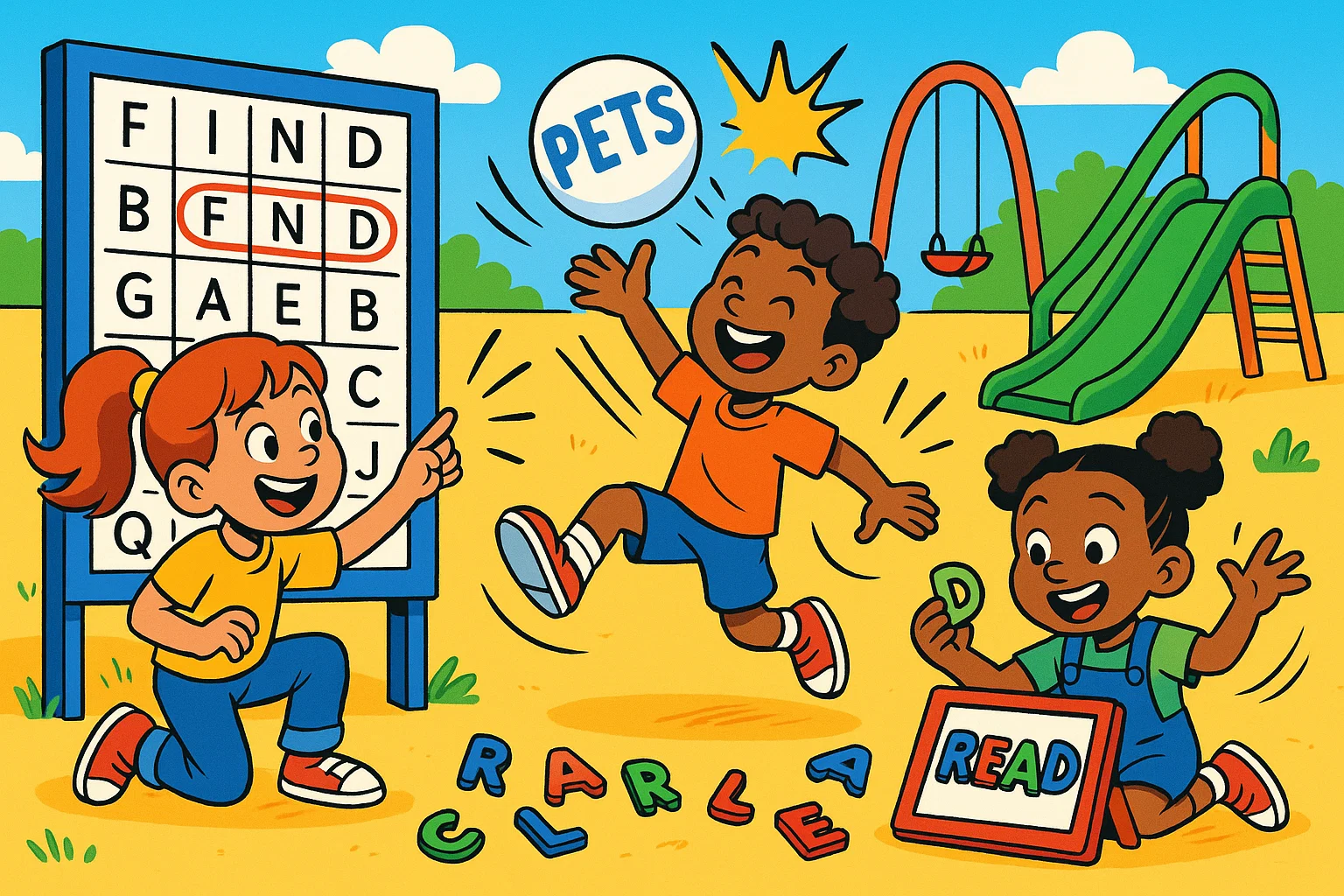
To make spelling an engaging part of the routine, integrate playful methods into spelling practice. These spelling activities use the vocabulary in a joyful, interactive setting.
Word Search Game
Create a simple word search puzzle using a few easy spelling words from their set. The act of finding the letters to form the hidden terms encourages kids to focus on the letter sequence and correct spelling. Many printable generators are available online.
Scramble-the-Vocabulary-Item Activity
Write the letters of a practice item (e.g., ‘p-a-p-l-e’) on separate small cards. The child must quickly unscramble them to find the correct spelling (“apple”). This is an excellent way to drill the correct letter order.
Commonly Misspelled Easy Terms Game
Prepare a list of common simple terms, including some that are deliberately misspelled (e.g., schoole instead of school). The child acts as the “Spelling Detective,” identifying and using the worksheet to write the word correctly.
Spelling Relay Game
An excellent classroom or group activity. Teams compete: when you call out a practice term, the first person in each team runs to the board and writes the first letter. The next person writes the second, and so on. The first team to finish the correct spelling earns a point.
Flip-Card Memory Game
Write each term from the vocabulary list on two separate index cards. Shuffle and lay them face down. The child flips two cards at a time, trying to find the matching pair. This strengthens visual memory for the item’s construction.
Word Puzzle Challenge
Use crosswords or matching puzzles where the child must match the definition or picture to the English words. For example, a picture of a cat requires the child to write the word C-A-T, linking meaning and construction.
Pass-the-Ball Practice Game
A lively, interactive group game. Children pass a ball while you call out a practice item (e.g., “dog”). The child holding the ball must say the first letter (D), pass it, and the next child says the second letter (O), continuing until the item is fully constructed.
Spelling Support at Home
Parents are crucial partners in learning to read and write. Simple, consistent routines at home can greatly help children master these essential skills.
Phonics Practice at Home
Dedicate a few minutes daily to a quick phonics review. Start with basic single-letter sounds, then move to blends (like fl, sm), and common vowel teams (like ai, oy). Ask your child to pronounce the sound, then give an example of a term that contains that sound.
Homework Support Strategies
When reviewing homework, emphasize the learning process. Instead of simply correcting errors, use the “look, cover, write, check” method, which promotes active memory recall:
- Look carefully at the correct spelling.
- Cover the item.
- Write the word from memory.
- Check their attempt against the original.
Practice Game Ideas for Home
You can use simple household items: magnetic letters on the fridge, chalk on the driveway for writing lists of basic terms, or building blocks to construct CVC examples. A favorite: “Shaving Cream Practice,” where kids write the English spelling words for kids in a thin layer of shaving cream on a tray. It’s multi-sensory and highly engaging.
Recommended Printable Resources
High-quality printable worksheet pages, list of spelling words templates, and flashcards are invaluable. Look for pdf resources organized by phonics rule or high-frequency words. These allow children to repeatedly practice spelling and writing the targeted vocabulary.
Spelling Support for Teachers
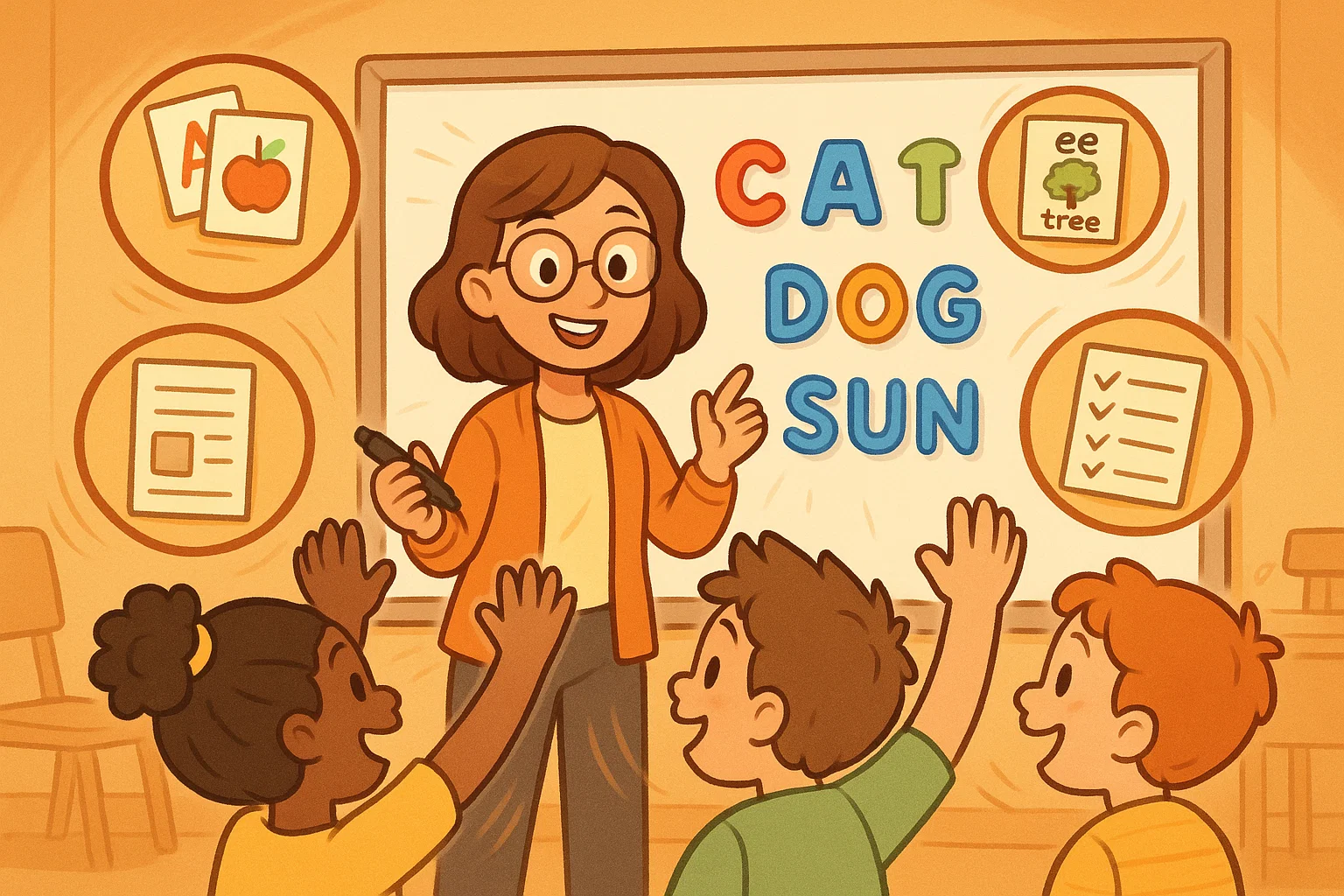
Effective integration of spelling practice into the classroom requires alignment and variety of words in instruction.
Classroom Activities for Spelling Practice
Implement a “Daily Vocabulary Item Focus” where a vocabulary item is introduced, defined, and used in a sentence. Group students by their phonics needs. Use “Practice Partners” where students test each other on basic spelling words and provide immediate, constructive feedback.
Item Lists by Curriculum Level
Ensure your weekly practice entries align standards for your grade level. For example, a Year 1 focus should include common digraphs and simple exception words. Using structured sets ensures comprehensive coverage of necessary English words.
Common Exception Words for Early Grades
Exception words are those that do not follow typical phonics rules (e.g., was, said, who). Since they cannot be sounded out, they must be learned as sight words. Allocate specific time for visual repetition and use mnemonics (memory aids) to help kids retain these tricky terms.
Phonics-Based Item Groups
Group spelling words that include the same phoneme, vowel sound, or blend. For instance, one week might focus only on terms with the short ‘a’ sound (cat, hat, map), and the next on the ‘sh’ blend (ship, shop, dash). This helps young learners recognize patterns and improves the ability to spell.
Helpful Spelling Resources and Tools
Access to the right age-appropriate tools can make spelling and vocabulary acquisition easier for everyone involved.
Kid-Friendly Practice Dictionaries
Invest in a picture dictionary or one structured by phonics rules. When a child’s brain is just learning the sound-symbol link, a simpler reference can significantly help children find the correct spelling.
Activity Books for Spelling Practice
Look for workbooks that offer a variety of words and incorporate different learning styles, such as tracing, coloring, and matching games. These worksheets often focus on basic spelling words and high-frequency words.
Digital Learning Tools and Apps
Numerous apps and online games exist that make learning fun and highly engaging. Platforms offering interactive challenges or flashcards can significantly boost motivation. Look for tools that allow you to customize a weekly list of spelling words.
Vocabulary Lists and Curriculum Packs
Purchasing structured sets of basic spelling words and curriculum packs, often available in pdf format, provides a sequential, stress-free method for parents and teachers to ensure all necessary vocabulary is covered.
How to Handle Confusing Items
Some vocabulary items are inherently confusing for young learners due to similar sounds or unexpected patterns. Addressing these directly is essential for them to spell correctly.
Homophones in Beginner Practice
Homophones are words like to, too, and two that sound the same but have different meanings and spellings. Use simple context and visual cues to distinguish them:
- To (direction: “I go to school.”)
- Too (also/excessive: “Me too!”)
- Two (the number: “Two dogs.”)
Terms With Multiple Spellings
Children may mix up similar-sounding versions or simply guess at vowel sounds (e.g., cump instead of come). Direct comparison and repeated visual exposure to the correct spelling are the best methods. Ask the child to compare their attempt to the accurate version and discuss the difference.
Days of Week Practice Tips
Days of the week are tricky due to their length and capitalization. Use a simple rhythm or chant to help children memorize them, such as saying all the days in a steady beat. Break down longer terms into their syllable components, such as “Wed-nes-day.”
Prefix and Suffix Basics for Kids
Introduce simple affixes. Show them how adding the suffix -s changes cat to cats, or how the prefix un- changes happy to unhappy. This teaches basic word structure and helps kids spell new words more confidently.
Additional Learning Guides for Kids
Enhancing learning to read and write often involves activities that connect language to other skills, making the experience whole and engaging.
Motivation Quotes for Young Learners
Positive language can inspire a child’s drive to improve their spelling. Share quotes like:
“The more that you read, the more things you will know. The more that you learn, the more places you’ll go.” – Dr. Seuss
“Mistakes are proof that you are trying.” – Anonymous
Fun Brain Teasers for Kids
Simple riddles encourage language comprehension and problem-solving, indirectly supporting literacy development.
- “What has to be broken before you can use it?” (An egg)
- “I am always hungry; I must always be fed. The finger I lick will soon turn red.” (Fire)
Cross-Skill Learning Activities
Integrate vocabulary acquisition with other subjects:
- Language and Math: Use practice items in simple problems. E.g., “If you have two apples and get one more, how many are there?”
- Language and Creativity: Have the child create an illustrated mini-dictionary using their weekly list of spelling words. They draw a picture and write the word and definition beneath it.
- Language and Reading: Have the child identify and underline their high-frequency words in a favorite storybook.